Photo of Mike Beetham

An Unexpected Teaching Assignment?

You have just had a meeting with your principal and at the end of the meeting you have been assigned a subject that you do not have a strong skill set for.

What do you do?

This has and will continue to be a very difficult challenge for teachers. I think the first thing you do is to spend time familiarizing yourself with the appropriate content that is required of you. For this article’s purpose, let’s say that you are asked to teach physical education to Grade 3 students. You are not comfortable with gym, you do not feel that you have the skills to teach gym but yet you are given this assignment and must not only teach it, you must report on it.

The good news is that in these modern day times the world is at your fingertips. There is almost an endless amount of online material to support teachers. Your critical step is to understand what the BIG ideas are for your subject. You then do not have to invent the wheel over and over. The expertise of teachers around the world can assist you in the delivery of the content. For example I have very limited artistic skills, yet I am able to provide an enriching program to my students by finding activities, projects or lessons on how to teach my students the critical content they need to know (and I am aware of).

In an ideal world, schools would have specialists in areas such as art, gym and music. But as we know that is rarely the situation in Ontario. When I was asked to teach my own music I went to my principal and had a conversation with her about how limited my music skill set was. The end result of our meeting was that she knew my students would have a fun, enjoyable time in music. They would develop a positive attitude and great appreciation for music. I realize that type of working relationship is not always the norm.

It is a critical time for you to keep a healthy balance in your life. Knowing  the expected effort that will be needed to learn your new teaching content, you will need to reduce the extras that you typically carry out on a voluntary basis in your role. This is a key opportunity for you to demonstrate to your students that you are modeling learning is a lifelong journey. You do not have to be the expert on everything, nor is it possible to be such.

Challenging the “Impossible”

“I was shocked when I saw what he had done in class. The psychologist said that’s the kind of thing he wouldn’t be able to do.”

“You’re going to try and teach your class to use sewing machines? Do you think they’ll even be able to?”

“You don’t really think beginner immersion students can memorize an entire play’s worth of lines, do you?”

At least once a year (and usually much more often than that), I have a conversation with someone – parent, colleague, administrator, student – who tells me that something I’m doing in class is “impossible” for one reason or another. Sometimes, like the first comment above, it’s an incredulous parent who is impressed (albeit confused) that their child was able to do something that shouldn’t have been possible. Other times, it’s well-meaning fellow educators who, I think, are trying to keep my lofty newbie expectations in check.

It’s okay, guys. I have this. My students can do it.

I’m not saying that I’ve never tried something that failed horribly (student-created team games in Grade 4 Phys Ed, I’m looking at you) but for the most part, my wackier ideas actually do pan out. Sometimes it takes some creative intervention from me, other times it takes a lot of patience and dedication, other times still I have to admit that we didn’t end up where I had planned but that the activity still taught what I was hoping it would – but we get there!

I credit my dedication to trying new, challenging, ambitious class projects to two people.

The first was my Grade 7 and 8 French Immersion teacher, Mme Crystle Mazurek. I have to admit that I don’t remember a lot about those two years except the really awesome art activities we did, but MAN, did we do some cool things! We made quilts, 3D art out of foam and cardboard, batik designs on fabric using melted wax, linoleum printing… I loved being in her art class (even if her dog literally ate my homework one time). It was in her class (though I can’t recall if it was while I was in Grade 7 or 8, or if it was when she was my teacher again later in high school) that we started a coin collection to help a village in India, where she had spent time in her childhood with her parents, to purchase a buffalo. From those humble origins began an ongoing collection to alleviate some of the effects of poverty in India by buying tools which can be used for trades (such as sewing machines) or by sponsoring students to attend school outside the village. I check in on the fund regularly and have a hard time believing it’s come as far as it has – from old soup cans in classrooms collecting a few coins here and there to a charity raising several thousand dollars a year.

Mme Mazurek, in hindsight, also dedicated a lot of time to helping her students succeed. Some of us were not particularly great students – I may or may not have had a few detentions in my time, despite being an active participant in class – and yet she still managed to get us excited about learning. I never did my homework, but I actually remember one of the novels we read as a class (it was about teenagers in Lebanon), details of Canadian history I know I learned in that class (the Rebellion of Upper Canada comes to mind), and how gracious and funny she was when we played an April Fool’s joke on her by switching her desk with our English teacher’s identical desk across the hall. I think a lot of my interest in becoming a teacher came from her. She probably doesn’t know that. Maybe one day she’ll google her name and find this. None of this paragraph has anything to do with challenging the impossible, she was just a really cool teacher with a bright red pixie cut, leather pants, an awesome attitude, and a wealth of personal anecdotes to keep us interested.

The second was my first Associate Teacher while I was in teacher’s college. I had the extreme privilege of working with a phenomenal teacher, Mr. Bill Morton, in an incredible Grade 3/4 Gifted class. My time in the class was too short, as all practicum placements are, but even in my five weeks there he bestowed upon me a lifetime’s worth of wisdom about education. I’m not sure the word “impossible” is in his vocabulary, unless we’re talking about retiring. His Grade 3/4 students were already engaged in learning and rehearsing A Midsummer Night’s Dream when I started in his class. As I took groups out to work through scenes and break them down, I was amazed by how well they understood the material with very little prompting from me. Nine and ten year olds! Reading Shakespeare! Not just reading it, but actually understanding it. Given what I could remember of reading Shakespeare in high school (and those were plays which I would argue were easier to follow than A Midsummer Night’s Dream, read by teenagers who were given very explicit instruction on what the words meant, who STILL didn’t seem to understand that “wherefore” doesn’t mean “where”), that shouldn’t have been possible.

The point of all of this is that you’re going to hear and read about a lot of things that your students “shouldn’t be able to do”. Students with NVLD “shouldn’t be able to” illustrate a graphic novel with consistency and detail from one page to the next. Second year French Immersion students “shouldn’t be able to” write short stories. Ten year olds “shouldn’t be able to” design and sew quilts. Students with a long history of behavioral problems “shouldn’t be able to” have a year where they fully engage in class and take responsibility for their actions.

You won’t always succeed with the wacky, outlandish ideas you have, and sometimes no matter how hard you and your students try, it won’t work. That’s part of life. But you will almost certainly have more successes than failures, and even the failures teach you something.

Be that teacher who does something “impossible”.

Fair warning, though: it gets pretty addicting to overhear your students bragging about the cool things they did in class as they walk to the bus.


Social Media and the Battle for Public Opinion

I keep hoping I will get the hang of this “parenting and blogging” thing… then suddenly it’s the last day of the month and I realize I haven’t been able to get to a computer for weeks. For a techy like me, this is crazy! I used to spend hours on the computer every day.

I bring this up because a few weeks ago, my local ran a “Twitter Training” session at our AGM. As someone who has been on the internet since before it was commercially available, whose parents ran a BBS (which was a precursor to the internet) which enabled me to chat and play games with other neighbourhood kids when I was in elementary school, I take a lot of things (like social media) for granted. I forget that if you haven’t grown up around it or aren’t terribly inclined towards using the internet, it’s easy not to know about all of the things that are out there.

Social media is really cool. Right now, as we trudge through a complicated and, frankly, disappointing bargaining session, it’s also acting as a powerful tool in communicating our message to the public. People are listening, but you have to know where they are as an audience. Right now, a lot of them are on Twitter. I won’t get into the ins and outs of Twitter on here – it’s not very complicated, but it’s much easier if someone just shows it to you as they explain. What I do want to tell you about is a really cool movement from Ontario teachers to try and enlighten the public on what we’re bargaining for, what our daily reality is, why teacher autonomy is important, and how we work for our students every day.

The first and obvious thing to know about is the official ETFO Twitter account. Worth following, for reasons which probably don’t need to be stated. Lots of worthwhile information. Lots of links to relevant news.

On Twitter, there are things called “hashtags” – words preceded by a # symbol that you put into your messages so that someone could search for a tag and find all public messages with that tag, from all users across Twitter. Over the course of the last few months, a few commonly used hashtags have come up. Click on any of the tags below and you’ll be brought to a Twitter search page showing you the most recent posts with those tags.

#mypreptime and #4MyStudents – Teachers are using these tags to talk about what they used their prep time for and how their personal time goes to support their students. They’re being used to highlight why teacher autonomy is so important and why we don’t want administrators to be able to direct what we do with our time.

#classeswithoutEQAO / #insteadofEQAO / #eqano – This tag is being used to show what’s happening in classrooms which otherwise would be writing EQAO tests right now.

#students4teachers – Students showing support for their teachers as our high school colleagues return to work but continue their job action.

#IamETFO – Daily truths from ETFO members.

@acampbell99 is a great account to follow because he has done a wonderful job of compiling some of the most poignant messages posted by Ontario teachers.

Lastly, if you are on Facebook and are a member of ETFO, you might want to consider joining the ETFO Collective Bargaining group. It’s a closed group (meaning it’s private) and only ETFO members are able to join. It’s a great place to find information and support.

These are by no means the only places to find information on social media right now, but they are a good starting point for delving into social media.

If you know of any others, leave them in the comments and I will update this post!

Photo of Tammy Axt

Top 10 things I learned from Linda Beacham

For the past seven years I was so lucky to work with an amazing colleague and special needs advocate, Linda Beacham. She passed away on Monday and she is going to be greatly missed by myself and all those who had the pleasure of working with her. She was famous for her sense of humour and creating the best top ten lists. Today in honour of my dear friend and colleague who taught me so much about working with children, here is my top ten list of things that I learned from her.

  1. Whether or not you have any singing voice at all, singing out loud is really fun!
  2. Sending an e-mail with the subject line AWESOMENESS to encourage a colleague who had an incredibly rough day working with a student with autism can lift them out of some really dark places.
  3. There are so many things to see in the hallways of your school. Just stop and walk with someone with autism who sees things from a different perspective than you.
  4. ERF, Teacher, TA and ECE are useless titles. Team should be the real title.
  5. Never be nervous about making mistakes. Laugh out loud at them!
  6. Sledge Hockey and Wheelchair Basketball are REALLY cool sports and athletes who play them are hard core!
  7. Country music is a great genre of music for boogying to.
  8. Kids just want to have fun, laugh and smile no matter what their needs are.
  9. When the facilities or resources are not available so that people with physically disabilities can play sports, start them yourself. Check out Cruisers Sports at http://www.cruisers-sports.com/Home.shtml
  10. Giving a colleague a top ten list of the amazing things about working with students with autism is a really fun way to end the year.


Photo of Samantha Perrin

Adaptation and going with the flow

Teaching is a profession that typically attracts people who are caring, nurturing, creative, and curious. Skilled at thinking on their feet, teachers are also an adaptable bunch. And good thing, too, because the changes that pop up in a teacher’s life are numerous and often unpredictable.

Here are a few examples of abrupt and significant situations you may have encountered where your adaptation skills have come into play; you think you know what you will be teaching in September, and then – a new grade level, a new classroom, perhaps even a new assignment are all handed to you; or you get your assignment and begin the school year with 24 students then, three weeks later, due to an enrolment increase or decrease, half of your students are switched up for a different set; or you prepare an outdoor fieldtrip and you have to cancel at the last minute because of inclement weather; or, your plans for a lesson get sidelined because someone in your class throws up, or trips walking around some desks and gets a nose bleed, or refuses to cooperate; or you find that no one is listening to you, or there is a lockdown practice or fire drill, or you forgot to make enough photo copies….

All of these examples come with varying degrees of stress. Regardless of how well-developed one’s adaptation skills may be, the topsy-turvy nature of our day-to-day job makes it exciting and, at the same time, sometimes very difficult. What is critical during any upheaval is to maintain professionalism as this can give you time to calmly reflect on the situation and help you decide how to proceed, thereby avoiding a hasty reaction with potential to say or do something inappropriate. In the heat of the moment, it may sound like an oversimplification, but remember to breathe. Of course, teaching is not the only profession where one has to react to change minute to minute, but it is definitely a valuable skill for teachers. Should you be looking to change schools or assignments, emphasizing traits such as adaptability and being able to work under pressure would be good points to include on a resume. Similarly, before a job interview, it may help to be prepared with an example that highlights your ability to think on your feet, switch gears and carry on.

As we head into June, a time in the school year with plenty of upheaval, it may seem difficult to summon up the energy to keep things in perspective. You’ve been adapting and thinking on your feet all year. But hold on to those amazing adaptation skills to help see you through to the end. There is always something new around the corner and it’s a good idea to be ready for whatever comes your way.

Photo of Samantha Perrin

Fine Weather for an Outdoor Library

Only recently have we been able to take advantage of some lovely warm, sunny days. Spring time has been rather elusive, bringing exceptionally cold weather and very muddy school yard conditions. So it was with great joy this week that we were able to take our class library outdoors, along with sunhats and sunglasses, to sit on the front lawn under the shade of an enormous maple tree. At the beginning of the week, we were in sparse shade, but the students noticed that by the end of the week, the leaves on the tree had filled out and there was plenty of shade for 20 of us to spread out in.

On the way out of the front doors of the school, I let the office know where we were going in case they needed to find us. Once outside and using the shade of the reading tree as our reading space, the students sat wherever they wanted and however they wanted. Some sat cross legged, alone with their books, while others lay on their backs, tummies or their sides to read. One student who tends towards anxiety, however, was really only able to take advantage of the fact that he could lie down in the grass with a book over his face. He was enjoying the relaxing more than the reading, and it was clearly what he needed to do at that moment. After his break, he came back into our discussion circle, relaxed and happy.

Our school is on a quiet street, but even with a few distractions such as vehicles going by or a person walking their dog on the sidewalk, the students were calm and very quiet. Considering I would usually describe my group of students as ‘high energy and talkative’ rather than ‘calm and quiet’, this was a pleasant transformation. I believe being outdoors had everything to do with this. Before reading a story to them , I asked the students if they found that they read less, the same or more when we brought our reading outside. They overwhelmingly claimed that it was not only more, but a LOT more reading that they were able to enjoy when we were outside. As a French Immersion teacher, I couldn’t have been happier to see and hear that my students were able to focus and read in French.

Our outdoor library, such as it is, consists of a few bins of books from our classroom library that we bring out to the front lawn. It is really not any different than when we have our reading time in the classroom – it just feels a whole lot more special because it’s outside. Now the students expect every reading block to take place under the reading tree. It is a delightful time in our day.

Photo of Tammy Axt

Taking Your Students “on Tour” to build community within the school

I grew up in a very musical household. My family is from the Maritimes where the kitchen party originated. I always had visitors stopping by and music blaring in our house. There were guitars, keyboards, banjos or the spoons being played by anyone who could cram into our home. My parents used to listen to old country while they vacuumed early on Saturday morning singing and dancing. As a teenager, I did not find this amusing, but as a music teacher I know the power of music to bring people together as a community.

The sharing of music can take many forms from evening concerts to performances in assemblies. However, this year I decided to add in a few performances that were much less formal with the goal of letting the music be the catalyst for having some fun (very much like the Maritimes).

I started a recorder consort and ukulele club this year. (A recorder consort is a variety of recorders playing together such as an alto, soprano, tenor and bass) Usually, on the first day of a new club the students’ first question is always about when they will be performing. Both of these clubs were no exception. I told the students that we were going to be going “on tour” with our instruments.

Once both clubs had learned a song or two on their new instruments off we went. During our nutrition break time, we took our instruments and found classes that were willing to sing along, tap along or groove along with our music. We went to 2 or 3 classes per break and had a great time.

All this week as I walked down the halls, students from the classes we performed in have been waving their hands and saying hi to me and the students in the club. In our big school, it is not very often that the grade five students do something with the grade two students or the grade fours with the grade ones. The older students may have brought the instruments but just like in a kitchen party everyone was a participating member of the group. Whether you bring your voice, your stomping foot or your clapping hands the music you create together is what brings you together.

ukulele

Gifts From a Stranger

While we are fortunate in my district to be well outfitted with school supplies at the beginning of the year, there are always things I wish I had on hand that aren’t provided for with limited school budgets. Usually this means I go out and spend my own money on things for the classroom, but last year I discovered something incredible.

Some of you may be familiar with the site Reddit. I won’t go into what the site is here (a quick Google search will turn up lots of info). One of the little offshoots of Reddit is something called RedditGifts, where a variety of exchanges happen between total strangers. There are gift exchanges for a huge variety of things.

One of the gift exchanges is for teachers. As a teacher, you sign up for the program in the summer. You create a profile of your class and your needs. Others sign up as gift givers – people who will be matched up with a teacher and will then go out and buy gifts for that class, for no other reason than that they wanted to. It’s an incredible program, particularly worthwhile for teachers in areas where resources are more scarce and they need all the help they can get.

This isn’t a gift “exchange”; teachers only receive, they don’t send, and people who send things don’t receive anything other than your thanks. The gifts you receive may be completely anonymous, or the person may have included their Reddit username, or they may have included their name and address (in which case perhaps a thank you note or some thank you cards would be in order!).

All you have to do, as a recipient of a gift, is post a photo of it to the RedditGifts website. This is to help the sender know that you received the items and for you to send a message of thanks.

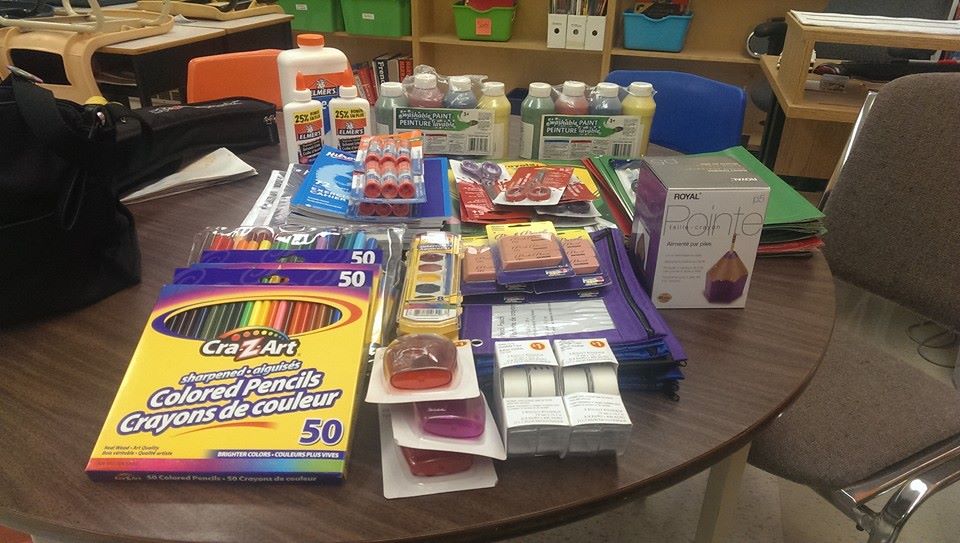
This year, I received all of this from one very kind soul out in British Columbia:

redditgifts

Duotangs, glue, tape, sharpeners, scissors, paint, notebooks, pencil crayons, markers, erasers, pencil cases, construction paper – it was an AWESOME gift and my students were really excited about everything. I had mentioned in my profile that my students often came to school without some of these things (often because they can’t afford everything on the supply list) and that the school doesn’t provide everything (for example, individual sharpeners or pencil cases).

They haven’t opened up sign-ups for the 2015-2016 school year yet, which generally happens in August, but you should definitely keep this site on your radar if this is something that would interest you.

Reddit Gifts for the Teacher

Click here for a gallery of last year’s gifts. You can see the incredible things sent to teachers all over the world. People are remarkably generous and kind!

Photo of Tammy Axt

How To Write an Original Song With Your Class For 5 Dollars (With No Music Knowledge)

This year, I tried something brand new with one of my music classes. We wrote lyrics to a song, sent them off to a song writer and performed the original song called “Gymnastics” at our spring concert! This is how we did it.

The idea came earlier this year when I was trying to come up with ideas for our spring concert. I usually ask each class in January what they would like to do for the concert and then they create something to share. This year, our concert had lots of creations, including a tableau piece about anti-bullying, a Japanese fan dance with ORFF instruments, some black light performances and the original “Gymnastics” song.

The grade 3 class that wanted to do the original song was interested in working with a song writer. (I probably could have written a song, but it was WAY more exciting sending the lyrics off). Our first step was to decide what the song was going to be about.

I handed out a blank piece of paper to groups of three and told them to brainstorm some ideas for the topic of the song. After they brainstormed, I asked them to narrow it down to three ideas that they were really interested in. As a class, we did a community circle, and shared our favourite ideas. I noticed that the topic of sports came up in every group and highlighted that for the students. I asked the students to think of a sport that could show off the talents of their class. Immediately, gymnastics came up and the song was on its way! (This class is full of twisty, fidgety, wiggly students. Gymnastics couldn’t have been more perfect.)

Their classroom teacher took over the next part of the activity by letting the students do an inquiry-based assignment about gymnastics. They watched videos about, read, and studied the sport of gymnastics. By the time they came back to me, they were a fountain of knowledge about gymnastics. Our next step was to come up with ideas that we wanted to have in the song. We then compiled all of our ideas into a list and got them ready to send off to our songwriter.

We chose our song writer from the website www.fiverr.com .

www.fiverr.com is a website where you can hire people to do a wide variety of services for five dollars. There is a large section on the website for songs. You can have rap songs written, ukulele songs, etc…. I chatted with the song writer we chose and gave these simple instructions:

  1. The lyrics can go in any order
  2. Write the song in either C major, D major, F major or G major
  3. Please don’t make the melody have large jumps between notes
  4. The range of the melody should be from about middle C to D (one octave plus a note)
  5. Make it upbeat and fun!


The song came back and it was amazing. It was a big hit at our spring concert and I am sure the kids will always remember the gymnastic song that they wrote.


Photo of Samantha Perrin

Water Day, Earth Day and Poetry

The ideology of an eight year old can be inspiring and heart warming. In the form of a poem, it is also honest.

For International Water Day (March 22), my students researched and experimented outdoors to see what they could find out about water. We turned this project into Water Week by creating a bulletin board in the main hall sharing water facts written on large paper raindrops. In preparation for Earth Day (April 22), students looked for signs of spring in and around the school yard. They found helicopter seeds, worm castings, clumps of moss growing in dirt and on bits of tree bark, early dandelion leaves, and trees and shrubs in bud. From the school yard, they also heard and learned to identify birds and their songs; Cardinal (easy to locate from his song and brilliant red plumage), Chickadee, Canada goose, Robin, and Mallard duck (we observed a couple, male and female, as they waddled around the schoolyard one rainy day across from our portable).

Sadly, Earth Day was no celebration at our school. Ironically, it was the day the city decided to cut down all the trees lining the sidewalk along the school fence as all of the trees had become victims of the Emerald Ash Borer. Seven trees were limbed, their branches tossed into the hopper for chipping, and the trunks sawed down to the ground in chunks, right beside our portable. Some of them were 45 years old. The fact that the city and the school board will be replanting 16 new trees in and around the school yard was a bit of a consolation to the students, however, they pined for a tree they named, “Hug Me” which grew outside the school yard gate a few metres from our classroom.

The students were brimming with questions and thoughts about what they had recently learned and witnessed.With April being Poetry Month, what better way to express yourself than in poetry? We had already explored many different forms of poetry, but to consolidate their thoughts without the constraints of a rhyming scheme (a thrill and challenge for some, a cause for deep anxiety for others), the students could share their ideas in a repetition poem that began, “Je veux vivre dans un monde où…” (I want to live in a world where…). This turned out to be a great form for a poem because everyone had something to say and by repeating the phrase, their poems took shape while their thoughts filled the page; I want to live in a world where trees don’t get sick and die; where you can hear bird songs instead of machines; where everyone has clean water to drink; where there are no iPads or iPhones; where people are nice to each other… Some students ended their poems with a rallying call, “Help me make this world!”

Their poems, written in colourful letters and decorated with drawings and images cut from magazines, will be proudly displayed for the school community at our Literacy Café in May. They are not all talk, either, for along with their proclamations for a better world, students have organized a school yard clean up and sprouted seeds for our school garden. Some have asked for help writing letters to the government to ask for protection of the Blue Whales in the St Lawrence Seaway and the Blanding’s Turtle in a wetland that was recently paved over and build up for a convention centre. In an effort to raise awareness, other students in the class have prepared messages for the morning announcements sharing what they have learned about water and about the Earth, and others still want to help out by having a class garage sale to raise money to protect the Great Lakes, “the last great supply of fresh drinking water on Earth” (quote from Waterlife, National Film Board of Canada, 2009). And so the inspiration continues and the stewardship begins.