The Perpetual “First Year Teacher” Feeling

This year will be my fourth school year as an LTO teacher. I have had a variety of wonderful experiences from Kindergarten up to grade six. Aside from having to move schools and build new relationships each year, the biggest downside to being an LTO teacher is seldom (or never) having the chance to revise my teaching and delivery of curriculum. When moving to new positions and grade assignments each year, or sometimes even twice within a year, an LTO teacher is always learning new things. We’re always figuring things out as we go.

Sometimes it can feel like we’re “first year” teachers every year!

I learned, just today, that I will finally get to teach the same grade twice! Tomorrow I will be starting an assignment teaching grade 1/2, the same grade that I taught last year. Finally, I’ll have a chance to reflect, revise and build upon my professional learning from last year and put it into action going forward.

So much of effective teaching is giving students feedback and then the opportunity to revise their work. I’ve always felt that was missing from my experience as a new teacher so far [am I still considered new at this point?] and the chance to do this could really make me a better teacher. I’ve taught entire units or subjects to classes that I knew I could have done better with after the fact, but have never had the chance to come back to it and make the changes I wanted to. I’ve always envied my permanent colleagues that could say, “yes, I’ll try that next year!”.

So with this opportunity, this year I am focusing on being a reflective practitioner!

I plan to recall my experiences from teaching grade 1/2 last year, reflect on my practice and change, revise and improve for this year going forward. I’m feeling relieved not to have to plan every single thing as I go, as I’ve got ideas, resources, planning and experience behind me for the first time.

Yes, every group of learners is different, and of course there will be many new things about the way I’ll teach this new class. Differentiation is a huge part of my pedagogy and approach to teaching. However, having a bit of a plan and some previous experience with the curriculum this year is something that I am looking forward to!

Good luck to all of my colleagues starting new positions this week as our schools experience reorganization! What are your goals and focuses for this upcoming year? Have you been moved to a new assignment that poses new challenges or opportunities for you?


Alternative Curriculum Programming

I am very fortunate that I am the teacher in a contained class for students with developmental disabilities. Every day is a unique experience with lots of laughter and learning. As my students would be unable to complete the expectations in the Ontario Curriculum, they all follow an Alternative Curriculum. In order to provide a successful alternative program, it requires regular input from parents,  daily assessment data and a thorough understanding of the student’s profile (which can be found in the OSR).

Recently, I was asked what my students do all day as they follow an alternative curriculum. Below are the parts of my program. For students who are going to school in an inclusion model or a contained model you could adapt part or all the pieces of a similar program to meet the needs of your student(s).

Morning Meeting- First thing in the morning, we run a meeting on our interactive whiteboard for the entire class that includes review of the date, weather, months and seasons. It also works on communication, social skills and independence as my students run the meeting with little to no staff intervention.

Hygiene- In the bathroom, we take groups of students to work on brushing their teeth, washing their face and putting on deodorant. Some of my students are close to being fully independent and others need full support and are  working on tolerating the feeling of a toothbrush.

Snack time- This is a great social time for my students. Everyone has a chance to chat while they are eating which is great for those working on communication goals. Others are working on finding their lunch bags and bringing them to their tables.

Gross Motor- We use equipment ordered for us by the Occupational Therapist and the students do a circuit through a hallway at school. It gives them time to move and build their coordination. It also teaches them how to wait their turn, do tasks in a sequence and listen to instructions.

Activity Time- This is a block of time in the day for students to work on reading, writing, mathematics or fine motor skills independently or with teacher support. In my class, a few students complete independent work, while others work with a staff member on fine motor skills, another group of students work on reading and writing and the fourth group at the interactive whiteboard playing math games. The students rotate throughout the week.

Bathroom- Some of my students require support with toileting. They are supported to become as independent as their cognitive and physical abilities will allow. We also use this time to do teaching about things like changing pads for menstrual cycles.

Art- Creating art pieces gives us lots of time to work on cutting with scissors, holding pencils or markers or being comfortable touching unusual textures.

Lunch/Recess- Similar to snack time but with a 20 minute period outside with the rest of the school. Some of my students can play with other students quite successfully and others are supported to improve in this area.

Grade 8 Buddies- Our grade 8 buddies support us with playing games, completing art, cooking, playing basketball etc… My students absolutely love them! This activity supports students goals around communication and social skills.

Cooking/baking- Once a week we cook lunch. We take this time to work on food preparation and safety, tolerating new foods, cleaning and setting and clearing a table.

Coffee Cart- We run a business selling coffee and tea to the staff once a week. My students are fantastic at selling and are quite the entrepreneurs. This activity works on communication, following instructions, listening to others and completing simple tasks.

Music- My students have music every day. They enjoy playing with the musical instruments and are working on staying focused on a task for an extended period of time.

Life Skills- After lunch everyone has a job to do. They do the job for a full week to give them time to learn the skills necessary to do the job successfully. The jobs include watering the plants, doing the dishes, wiping the tables, tidying up, vacuuming and pushing in the chairs.

Afternoon Meeting- This time is spent focusing on skills we need to practice as a class such as distinguishing between milk and cream for our coffee cart. On Fridays, we do a wrap of the week where I share pictures and we reflect on all the awesome things we did.

Integration- Some of my students join other classes for gym. But ultimately, I am always on the lookout for school wide events that my students would enjoy such as staff/student dodgeball games or the Terry Fox Walk that we join in on.

Every portion of our day is focused on developing skills and learning. My students are incredibly capable and with the right supports and practice they can achieve the goals created in collaboration between school and home!

Undercover Boss

Have you ever watched a show called Undercover Boss?

An average episode of the hour long program shows a CEO or top tier exec going incognito to better understand the work flow, flaws, and family of an organization. The show makes sure that the top dog is put alongside some pre-selected employees(often outspoken) who, fearlessly or not, walk the “newbie” through a day in the life at their job.

In most episodes, there comes a moment when a budget-line-watching-number-crunching-corner-office-seat-occupier realizes how their top down edicts are negatively impacting the organization until they see it from the perspective(s) of the workers. At this point in the show, regardless of profit and loss statements, the executive works to make things right, realizing that if things were better for the workers, the bottom line would benefit too. A win win outcome right?

I love TV. It creates narratives to suit itself. Moreover, despite a proliferation of reality TV programs, the medium remains irreal. Much like any Disney offering, TV has conditioned us to expect a happy ending that is far away from everyday experiences. If all goes accordingly, good always triumphs over evil, a hero will emerge, and on the show Undercover Boss, at least, some lucky employees will help their bosses to miraculously see the light and improve the company. This is not the current case between the government and public education in Ontario.

I would love it if our elected officials had the courage and conviction to do this for longer than the time it takes to convene a photo opp or craft a sound bite. I wonder why this is rarely, if ever, true when it comes to government and education. Other than clichés about how much the students come first and the importance of educators, hollow words do not mirror the devastating actions that senseless cuts are having on public education.

As such, we have seen neither the current Premier nor the Minister of Ed spending any meanigful amount of time with the people on the frontlines like an undercover boss. Since they are making decisions that affect everyone working in education, we all deserve to see and know that they are completely aware and informed.

I have never heard genuine words of understanding from elected officials that qualify them to make the decisions they are making which will ultimately impact our society for generations to come. In its wallet.

With so much attention placed on the bottom lines of provincial budgets, it becomes an easy target for outsiders to look across a spreadsheet and proclaim cuts can be made and no one will ever feel it without duty of care or context. This is not unique to education either.

This past year has revealed many glaring differences about how information is being (mis)used, bent, and or weaponized to suit political agendas. As such this misuse of information seems like systemic micro and macro-aggressions towards our profession, the public education system, and our students.

Which leads me to this question. How can a system of the people for the people be so myopic in its duty and dilligence? Isn’t the idea of education for all to actually provide education and therefore opportunity for all? With all of the time that governments and bureaucrats spend poring over the books, they have conveniently missed the direct cost implications of intentional systematic underfunding.

Here are some things to consider.

  1. Loss of education opportunities limits the number of skilled and quality workers contributing to the economy. That means more spending and tax dollars from higher wage earners.
  2. Economic cuts reduce opportunities for many people already living on the margins of society. That means cuts to education is a form of systemic discrimination towards many communities.
  3. Cuts to course offerings hurt the wrong people when those who can afford it can simply shift to a private school.Even my elementary students are shaking their heads about how traditional courses that lead to Post Secondary Science and Engineering courses are being limited or disappearing from local high schools. (see what is happening in my board @ YRDSB)
  4. Cuts to OSAP hurt the wrong people too. Rich kids will still go to post-secondary school, while marginalized students will have their futures moved further out of reach.
  5. Refusing to fund education to the fullest is a recipe for social disaster.  If we cannot agree on this, then we are agreeing to leave the next generation worse off than the last. When private schools are advertising that they have the courses that have been eliminated from our public schools, there is a problem.

None of the above are acceptable.

Our parents did not struggle and sacrifice for this. My mom and dad did not work full and part time for this. Neither did yours. Students and their families do not make sacrifices for this. No one would ever vote to limit the future of opportunity of its youth. Neither would a sensible and caring society allow anyone to slip through the cracks. Unless they had an agenda to undermine Canada as a civil society. The actions of our elected officials appear specious at best when it comes to education.

Our work brings value far beyond any budget lines could ever define because it brings human possibilities forward everyday. Reducing and removing opportunities also removes relationships that empower students into the future. Restricting or taking away someone’s access to education is simply an affront to all humanity. We are difference makers, miracle workers, and advocates for all of our students. We are working hard to change the narratives that have become a distraction in public education.

We are fighting to be heard and respected, let alone seen and understood, by politicians who prefer to take cover behind short sighted populist agendas that seek to serve the bosses rather than the people who work for them. It’s time for their eyes and minds to be opened.

What if every school could welcome an undercover boss(politician)? Maybe then, these decision makers would truly see the commitment, struggle, and value of our fight for students, their families, and this noble profession. My door is always open. No photographers please. It’ll disrupt the learning.

Fight on. #CutsHurtKids #ETFOStrong

Further reading

York board says bigger class sizes forced cancellation of 123 high school courses. 

What Exactly Is Happening To Ontario’s Education System? What You Need To Know

Financial facts on Canadian prisons

Optimism at 9.2 %

I was working with my students on some proportional reasoning exercises in Math. It didn’t take long before I began thinking about numbers and the relationships that exist so beautifully and naturally within them – as one does. After considering the fractions, decimals, and percentages of our tasks that day, I realized that 18 days have sped past – as of this past Friday (Sept 27th, 2019).  Here is some numerical context.

18 days 
= 2.57 earth weeks (Monday to Sunday)
= 4 school weeks (Monday to Friday)
= 1/20th of a year(non-leap)+/-
= 432 life hours
= 5400 minutes of class time
= 3480 minutes of my teaching time (preps deducted)
= 1620 minutes of recess/lunch time (school days M to F)
= 9.2% of the instructional year

Reflecting on the numbers always makes it clear for me to see that we (grade 7s+ me) have already spent a lot of time working at the speed of education. With 18 days in the books, I am feeling optimistic and here are the P.R.I.M.E reasons why.

Patience pays off, not packets of paper

So often students are hurried back to full speed once September rolls around. I have always found it better to ease learners back into the year with broad cross-curricular learning, to activate as many areas of ability from past grades. This approach may make some teachers uncomfortable because it runs counter to archaic ideas of photo-copied workbooks. However, the buy-in from students has always been positive when they are given the time, space, and appropriate tasks to challenge them.

I choose collaborative work that offers low floor and high ceilings, whether it’s Math problems that cover more than one strand at the same time, or whole class discussions/inquiries into current events. Think about tasks and activities that allow each student to show what they can do, and are differentiated enough to honour each learner’s abilities.

My students are responding well to every chance they are given to work with each other instead of another “busy worksheet” packet. I encourage teachers to possess the patience to allow students a different start to the year instead of photocopied packets, to promote engagement instead of ennui.

Relationships = good

We have worked hard to establish our relationships and expectations. In my classroom this has always meant open and ongoing dialogue. Student voice is key in this educational democracy. By always allowing a place for students to be heard, I have found that classroom management and community building become a collective responsibility and benefit.

Since the first bell in September, we have established irreducible norms about responsibility, respect, collaboration, determination, and otherliness. When students have time to grow within their community in these areas, the dynamics of our class relationships are made more positive and enduring.

Invest with interest

The past 18 days in the classroom have also been about learning what makes each student come alive or avoid at school. Having students share their highs, lows, strengths, and weaknesses has provided invaluable insight into what makes them tick in and out of the classroom.

In 11 years, I have always been surprised by the amazing and diverse interests and talents of my students. Making sure they know I am interested in getting to know them is an investment I am happy to make over and over.

Manage it all

The first 9.2% of this instructional year felt like it happened in a blender. Regardless of years of experience, this can be hard when so many daily variables (ie. schedules, personalities, tasks, etc.) are swirling around for teachers to sort out – myself included. Despite 10 years of practice, I still find that I’m overprogrammed and behind schedule. Thankfully, most of my turmoil occurs outside of the classroom from instructional planning, SERT work, and meetings.

Teachers are known for their tireless work ethics, but there has to be limits too. It’s important not to burn out at the start of the year. Setting some boundaries and giving yourself permission to leave some work for the next day is good advice to manage it all.

Encourage everyone, everytime

Take time to celebrate accomplishments on a daily basis – no matter how small. I used our recent Fire and Lockdown Drills to comment on how my students responded so well in those situations. I have also filled our corkboards with fresh work to celebrate each week. When students know they are being noticed, they will feel and have validation. This is something we can honour 100% of the year in the classroom.

Even though 9.2 % of instruction is in the books, you can see how optimism is reaching its prime already. Wishing you all an excellent next 90.8% of your school year.

Additional reading:

http://www.wismath.org/Resources/Documents/Annual%20Conference/210JMetke-Low%20Floor%20High%20Ceiling%20Handouts.pdf

Wearing Pajamas to the Swimming Pool

I go swimming on Friday nights with my friends. It is a good stress reliever and social time after a busy week at work. This past Friday at school, I spilled some coffee down my pants while supporting my students with our coffee cart business. Unfortunately, when I got home and began to get ready for swimming, I realized that I no longer had any clean pants. So, I did what any logical person would do and wore a pair of pajamas out in public to go to the pool.

“Why didn’t you have any clean pants?” many people could ask.

The answer is very simple and a problem that I have had challenges with for the last 15 years of my career.

It is the month of September.

I don’t know what happens in September, but my work life balance goes out the window. My lunches are whatever I can find in the bottom of the fridge, my partner and I wave at each other as we come in and out of the house and the hours spent at work seem never ending.

This year, I was positive that it was going to be different. This was the year that I was going to get it right! I have 9 out of 10 of the same students as last year. Surely, I thought, September would be a breeze. From the picture above with me in my pajamas, you can see that things didn’t quite turn out that way.

There is so much to do in September: reviewing busing routines, introducing new students, setting up activities, lesson planning, creating lesson plan templates, communicating with parents, filing violent incident reports, writing IEPs, introducing new staff, creating new log in information about computers, requesting computer support staff to come to your classroom, joining the Terry Fox run committee, signing in OSRs, reviewing OSRs, completing Annual Learning plans, meeting with Occupational Therapists, preparing for and attending ISRC are just a few of the tasks that takes up your time. It is like the Mt. Everest of work in September that somehow always seems to be crested right at the end of the month.

I see some of my colleagues who don’t look phased by the first month of school and seem to manage their school and home life well. I honestly don’t know how they do it. Do they have a secret time vortex machine that gives them more hours in the day than me? Do they have a maid, cook, gardener and nanny that helps them run their home?

What is their secret?

If you are one of those people who have matching outfits, excellent lunches and a clean car throughout the month of September please leave a comment below and let me in on the secret of how you do it.

As tomorrow is the last day of the month, I will have to say what I have said for the last 15 years….

There is always next year!

I Am From Poems – Building A Positive Classroom Community

I’m hoping that it’s been a great start back for everyone! The month has certainly gone by quickly. Having been out of the classroom for a year and being at a new school community, it was definitely all nerves on the first day. I always try to keep in mind that students might be feeling the same way walking into the new school year. While many of my students have been in the same school together since kindergarten, I have a few students who are new to our school this year and have been thinking of ways to make sure that they feel right at home in our classroom. 

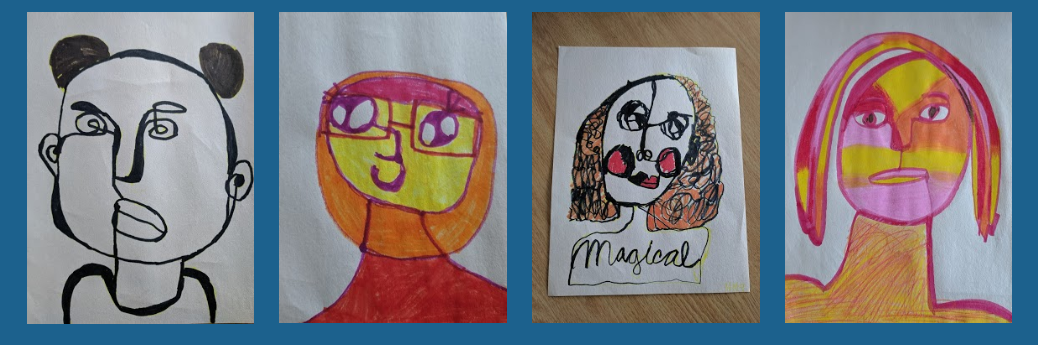
Building a positive classroom community is important starting from day one. As a part of building our classroom community, I often ask students to consider who they are as individuals and what they bring to our classroom space. One activity that I have enjoyed over the years is creating I Am From poems. In the past I’ve jumped right into creating We Are From poems where students work with a partner to find commonalities and differences and share them to the larger group. Once they have created a joint poem, we combine different parts of each poem to create one large classroom poem where everyone is reflected.  This year, instead of creating We Are From poems, we started off instead by creating our own individual poems to share with each other. 

You might be wondering what I Am From Poems are. For years, educators have used George Ella Lyon’s Where I’m From poem to inspire students to consider their own narratives. While there are different templates that can be used, I use this template to help guide my students in creating their own. 

On the second day of school, the students in my class were tasked with thinking about who they are and where they are from, learning that our experiences shape who we are as individuals, along with other factors in our lives. By the end of the week, rough copies of amazing poems were complete and students were thinking about the symbols they would use to represent their identities. Just in time for our Curriculum Night, good copies of our poems went up and we had the chance to create continuous line portraits to accompany them. 

Identity work is so important for building a safe and caring classroom community. What ideas do you have for this year? How are students showing who they are and bringing their experiences to the classroom and their learning? If you have great ideas, please share them here!

Orange Shirt Day

Orange Shirt Day is tomorrow – September 30th! While I strongly believe conversations around reconciliation between non-Indigenous and Indigenous peoples need to happen on a daily basis, Orange Shirt Day provides an opportunity for action and awareness.  In this post, I’ll be sharing a couple activities we have done this year and how we will be continuing to learn about reconciliation. 

Based on the life of Jenny Kay Dupuis’ grandmother, I Am Not a Number is a powerful book that brings to light a part of Canada’s history and its treatment of Indigenous children and families. It’s a text that I have read with students over the past few years that has helped my students understand the impacts of residential schools not only on those who attended but also the impacts over subsequent generations. 

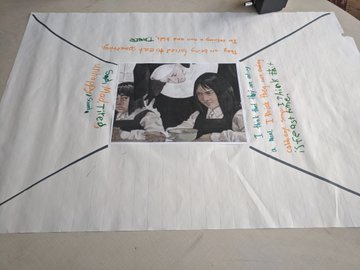
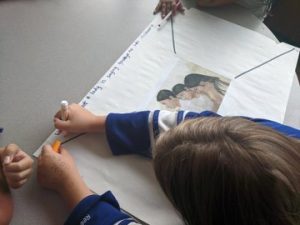
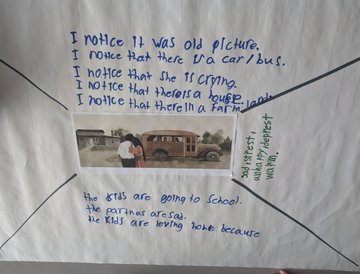
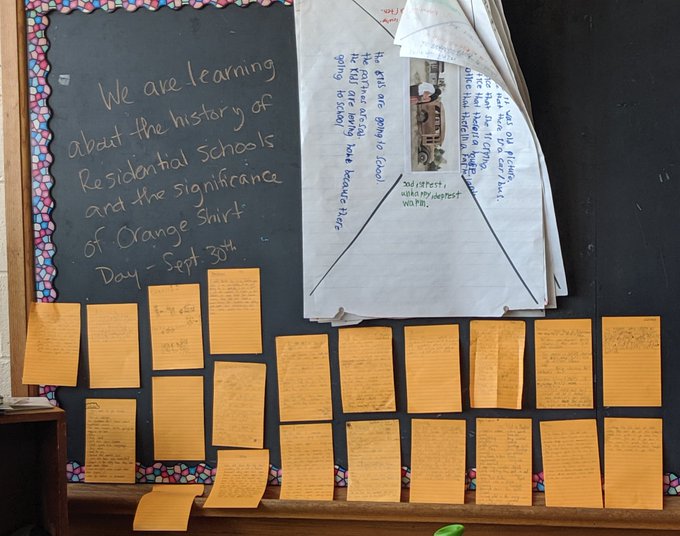
Every year, I think about how to use the text in different ways and this year our pre-reading activities were inspired by an educator in London, Graham Shular. For our activity, small groups of 3 or 4 students were given an image from the book that was glued to a piece of chart paper that was sectioned off into 4 parts. Students were asked to write down their answers to one of the following in each of the sections:

  1. What do you notice?
  2. What emotions does the image evoke?
  3. What do you think is happening?
  4. Why do you think that is happening?

 The groups were given 4 minutes to first take a look at the image and then they were given 4 minutes to discuss and jot down their ideas on the chart paper for each question. 


I was amazed at how engaged students were in the task, as was another colleague, Alison Fitzsimmons, who also did a similar activity with the students in her class. This activity was a great way for me to see what students already knew about residential schools and it was also helpful in understanding what messages students were getting in the imagery of the book.

Later, as we read, students were given large sticky notes and asked to jot down their wonders, questions and anything of impact as we read. Many were surprised at the treatment of Indigenous children and their families and that it was imposed and sanctioned by the Canadian Government. This prompted many to think about what we can currently do to ensure true reconciliation. While I want students to gain a great sense of empathy, I also want them to understand the resilience of those impacted and the rich history of Indigenous peoples over time. 

Tomorrow, we will be starting to look at our Land Acknowledgement. Said every morning during the announcements, students need to understand its significance and the people on whose land we have the privilege of learning. I am looking forward to us digging in to better understand treaties and the diverse communities of Indigenous peoples. 

Tomorrow is Orange Shirt Day. Will you be wearing orange? What activities have you done with students? What work might we continue to do to ensure true action around reconciliation? ETFO has incredible resources to get you started. Click here to find them!

Class Size and Composition Matters

Class Size and Composition Matters

As a teacher of 19 years, I’ve seen many changes to classroom composition. When I first started teaching, students with behaviour needs where either supported through Educational Assistants (EAs) or in separate contained classes. In addition, students with significant special education needs had additional supports and/or placement options for contained classroom settings. In 2015, I noticed a change in support for students with special education needs.

Much has changed in the last few years with the promotion of student integration and inclusion of special education students into mainstream classrooms. This integration policy further resulted in closures of contained classrooms thus limiting alternate options for students with significant learning and behaviour needs.

Classrooms today are not the classrooms of the past

Classrooms today are not put together like the classrooms of the past. Teachers face teaching students with significant learning delays such as having a student functioning at a grade 1 level in grade 6 classrooms. The gaps between student achievement levels and their placement in their grade level are widening. Teachers deal with a myriad of students’ special education and behaviour needs without additional support from EAs.

Lack of funding to identify and support students with special education needs

The widening gaps may be a result of the lack of funding for students to received psychological educational assessment/testing funded by the schools boards. When parents have resources such as insurance and/or money to cover the cost of this testing, they do not wait the years it takes for their child to get to the top of list. Instead, they pay for the assessment, getting their child tested in a private organization. I had my son tested privately as I was fortunate to be able to cover this cost. This put students from lower socio-economic areas at a higher risk of getting the support they need to be academically successful.

In their annual survey of Ontario principals, The People for Education noted since 2014, “the Ministry has maintained the overall level of funding for special education, but has changed how funding is distributed among boards. The goal was to make the funding more responsive to boards’ and students’ needs. These changes have resulted in some boards getting more funding, while others receive less. Comments from schools indicate that the impact of these changes is being felt on the ground.” People for Education, 2017.

We have children in crisis…wait lists are long, we do not have the services the children require to be successful at school. It is heartbreaking. Cutting an additional million from our school board will have a catastrophic effect on the children. The Ministry needs to re-evaluate this current funding model. Elementary school, Limestone DSB” (People for Education, 2017).

The People of Education further state “Based on available resources, some boards limit the number of students that principals can put forward for assessment each year.”

“Psychological assessment services are rationed essentially to the most needy one or two students a year. System level placements for our most needy students are rationed to an extent we are creating more problems during the wait time. There is a growing parent, staff and student belief that our schools are not the positive and safe places they once were. Elementary school, Hamilton-Wentworth DSB” (People for Education, 2017).

In 2017, the People for Education noted that:

Teachers must manage students with significant behaviour needs with little or no support

In addition, teachers must manage the significant behaviour of students who may or may not have EA support. Often, even when students have funded EA support, staff are pulled to deal with other students who have greater behaviour needs and who may or may not have funded support. Administrators tell EAs that this funding is “assigned to the school, not the student.” This leaves teachers spending a great deal of time managing student behaviour instead of teaching the rest of the class.

The People for Education note that

“According to a recent study by the Canadian Teachers’ Federation (CTF), more than 70% of teachers across Canada are seeing an increase in both the rate and severity of violence in schools. The study reviewed existing publications on the topic, media reports, and survey findings from five CTF member organizations, which included over 40,000 teacher respondents.” (People for Education, 2018)

“The violence educators’ face includes verbal aggression, property damage, threats, and physical assault. Non-physical (verbal/emotional) violence is most commonly experienced by educators, followed by physical violence. The survey results found that between 41% and 90% of teachers (depending on their province) report having experienced violence at some point in their careers.” (People for Education, 2018)

Further, People for Education noted that the highest rates of violence were “reported by women, teachers who work in elementary schools, special education teachers, and teachers who work in schools with lower socioeconomic status and/or large urban areas. According to the report, many teachers are unlikely to report the violence to administrators and police, either due to concerns about job insecurity, concern for student well-being, or lack of knowledge about reporting procedures/policies.” (People for Education, 2018)

Recent cuts to educational funding have further exacerbated this support gap.  Many recent studies (i.e. People for Education, University of Ottawa) have documented increases in violence in classrooms. Violence against teachers significantly impacts classroom and school cultures. When students become verbally or physically aggressive against their teachers, this creates an unsafe environment for learning. A teacher’s job is not just to teach students, their job is to also keep their students safe. When the teacher, who is the adult that keeps students safe, is dealing with aggressive student behaviour, the other students do not feel safe. Further, aggressive behaviour interrupts learning and wastes valuable classroom time.

Teachers’ working conditions = Students’ learning conditions

In one study, teacher respondents from an Ontario elementary teacher union local reported:

  • offensive behaviour with 47% of elementary teacher respondents experiencing threats of violence from students
  • 48% of elementary teacher respondents experienced physical violence from students

The survey respondents indicated that their board’s organizational culture:

  • tolerated behaviours harmful to their mental health and that they felt uncomfortable in discussing and/or reporting violence in their workplace.

In this teacher survey, it was not surprising that these teachers were experiencing signs of stress and burnout – given that the participants showed that they were dealing with significant levels of students’ offensive behaviour in a climate with poor psychological health and safety supports.

Painting a picture of poor learning conditions in classrooms

This paints a picture of teachers’ poor working conditions as they were dealing with inadequate resources and staffing to support teachers and their students. And I posit that poor working conditions for teachers result in poor learning conditions for students.

Teachers should not have to deal with workplace violence issues as part of their job. But it is becoming a commonplace occurrence in Ontario classrooms. Since 2018, during recess duty, I personally experienced being bitten, kicked, punched, and sworn at. All this behaviour came from students who were in the primary grades.

Does this imply that all adults who work with students need to receive Behaviour Management Systems (BMS) training? I personally do not feel comfortable using BMB.

Funding cuts to education, especially in supporting students with special education needs, impacts all students. And when a teacher has a student with special education needs added to their classroom, this means that no supports will follow to help these students. Students must wait for help from the one teacher in the classroom while the teacher deals with the needs of the rest of the students. With the recent cutbacks in funding, teachers’ jobs of meeting all students’ needs just got harder as there are even more students in classrooms.

Students with special education needs should have a safe, supported, and inclusive classrooms

Students with special education needs should be included in mainstream classrooms. To make this work for students and teachers, these students with special education needs must be supported with the assistance of EAs. With the support of EAs, students with special education needs can thrive in school and be with their peers.

Teachers need to teach in safe and supported inclusive classrooms. With inadequate funding, the Ontario Ministry of Education’s of inclusion policy will result in yet another poorly implemented education policy in Ontario.

Collaboratively Yours,

Dr. Deb Weston, PhD and special education classroom teacher

References

Elementary Teachers Federation of Ontario. (February 2018). Behaviour Management Systems (BMB), Elementary Teachers Federation of Ontario, Downloaded from http://etfo.ca/SupportingMembers/Employees/PDF%20Versions/Behaviour%20Management%20Training.pdf

People for Education. (2017).  People for Education Annual Report: 2017, People for Education, Downloaded from https://peopleforeducation.ca/report/annual-report-2017/

People for Education. (2018). National report finds teachers increasingly experience violence in schools,  People for Education, Downloaded from  https://peopleforeducation.ca/our-work/national-report-finds-teachers-increasingly-experience-violence-in-schools/ 


School year start up

A new school year has begun again and I am once again teaching grade eight, in my opinion, the most exciting and enriching grade I have taught so far.

The first few weeks have been incredible because of the honest conversations we had week one about how great their year can be if they make it that way. We talked about fun trips, ideas and awards that go on during their grade eight year. We talked about what the ideal classroom looks like, sounds like and smells like (ha!) so we made some ideas on how we can achieve those goals. The students have done an amazing job so far on adhering to all of the goals they set out for our own classroom.

A few things have been making this start up so incredible:

  1. There are many student leaders in the classroom who have helped to set the tone for all of the other students in the room. They model positive behaviours and shut down negative ones. There is little to no times where I have interjected to tell them what I expect because another student has already done that for me.
  2. I have already received the help during breaks and afterschool of about 9 or 10 students with teams that go on at our school. These leadership activities have made them stand out in the classroom as well as the extra responsibility has made them thoroughly enjoy each day. That feeling that they are making a difference in their school shows everyday in their mood and behaviours. I am hoping even more students will be interested in these opportunities as only ten of the 26 have stepped up so far. I have awarded these students with small circular stickers that they put on their desk organizers. At the end of the year, we will see who has volunteered the most and those students will be eligible for a token of appreciation (not sure what that will look like yet). It will also help the staff with selecting grade eight awards because they will see who has given up so much of their time for our school community.
  3.  I have offered students homework to complete every night which will help them prepare for grade nine. 19 out of the 26 students have taken this homework and completed it each night. I have three ESL students who I am working on preparing appropriate homework for them so then it will be 22 out of 26. We take up this homework each morning and new homework is given out every night before they go home. The fact that it is optional makes students actively take the initiative to better themselves and their after school time. I am so proud of these students as I mentioned it will help them get ready for grade nine and the few students who took that opportunity last year had the highest marks in the school (they won the principal’s award). It is great hearing groups of students want to hang out after school to work on homework. It is definitely a good after school option for them.
  4. I also have offered students level four or above and beyond opportunities that go with each task we have completed as a class. Seeing those 10-12 students select that option is awesome as they are actively selecting to do better and to challenge themselves each day. I remember being in school not knowing the difference between all of the levels and not knowing how my teacher came up with my mark. I make sure all of my students know how they can excel to the highest level possible.


I think all of these things working together have made it impossible for the students in my room to have a negative experience or to make the day negative for someone else. It is incredible to see such focus and leadership day to day and it makes me so proud of my class. I was away last week at a junior baseball tournament (coached by two of my students) and my supply left only this note, “Your class rocks!” This would not have been possible last year as I must have missed many of these steps in the school year start up. I am really hoping the year will continue in this positive manner.

Having faith in your students and challenging them daily is the best way to go 🙂

Violence in Ontario Schools

Violence in the classroom is emerging as a significant issue for teachers’ working conditions and students’ learning conditions.

In the United States, a national survey of 2998 teachers from 48 states noted that 80% of teachers reported at least one incidence of violence with 94% of respondents stating students as the source (McMahon, Martinez, Espelage, Rose, Reddy, Lane, & Brown, 2014). In another US study, 2324 teachers reported at least one occurrence of student generated violence against teachers. These incidences where not consistently reported even with teachers experiencing multiple occurrences. This was especially significant when there was a lack of administrative support (Martinez, McMhan, Espelage, Anderman, Reddy & Sabchez, 2016). Several authors noted an increase in students’ aggressive behaviour shifting to ever lower age brackets including those students in Kindergarten (Emmerová, 2014; Kirves & Sajaniemi, 2012).

Emerging Trends in the Media

The media has also highlighted the emerging trend of increases in students’ aggressive behaviour. In February of 2019, CBC Radio’s The Sunday Edition posted a commentary, “I felt helpless”: Teachers call for support amid escalating crisis’ of classroom violence, summarizing a teacher’s reluctance to report violence in schools over “fear of repercussions”. Sherri Brown, director of research and professional learning at the Canadian Teachers’ Federation (CTF), described the current state as an “escalating crisis” and also noted that much violence in the classroom goes under reported.

In 2018, a national organization compiled the results of a survey conducted by Elementary Teachers Federation (ETFO) showing that of its 81,000 members, 70% of elementary teachers reported experiencing or witnessing violence at their school workplace during the 2016-17 school year. In addition, the survey results noted that 80% of ETFO members noticed an increase in school based violence and 75% of ETFO members reported school based violence becoming more severe.

The People for Education’s Annual Report (2017) stated that principals reported significant increases in students’ mental health needs and behavioural issues. Principals stated that mental health issues were taking an increasing amount of their time and that schools had inadequate levels of support from social workers, psychologists, and guidance counsellors. The report went further highlighting that “in 2017, 47% of Ontario elementary schools reported having no access to child and youth workers, 15% did not have access to social workers, and 13% did not have access to psychologists.” People for Education also addressed the increased importance of social and emotional development for students which included self-awareness, self-management, social awareness, interpersonal relations, and decision making.

At this point, I’ll state my concerns about the response of Ontario school boards in advocating for students using self-regulation and mindfulness strategies in order to address the increases in behavioural needs. Self-regulation and mindfulness strategies do help some students develop their social and emotional capacity but self-regulation and mindfulness strategies do not compensate for the myriad of causes and complex intersectionality of environmental, developmental, intellectual, social, emotional, economic, and mental health needs that may be at the root of students’ behavioural outcomes. Students’ behaviour needs have complex and multi-causal roots. Using mindfulness strategies as a treatment to these significant student behavioural issues is like putting a bandage on a gushing wound.

Violence against teachers significantly impacts classroom and school cultures. When students become verbally or physically aggressive against their teachers, this creates an unsafe environment for learning. A teacher’s job is not just to teach students, their job is to also keep their students safe. When the teacher, who is the adult that keeps students safe, is dealing with aggressive student behaviour, the other students do not feel safe. Further, aggressive behaviour interrupts learning and wastes valuable classroom time.

When dealing with aggressive behaviour, teachers have many options. Often teachers ignore aggressive behaviour to disengage the offending student. The next step in disarming student behaviour includes removing the student from the classroom, contacting administrators, and contacting parents. Even with these steps, students often continue with their behaviour. Parents may or may not engage teachers in their outreach for support. Based on personal experience, when parents hold their children accountable, student behaviour often improves. But when parents do not hold their children accountable and blame the teacher for the behaviour, students often continue forward, sometimes escalating in their actions. When aggressive behaviour significantly escalates, teachers must act to protect their students and themselves from harm.

Disciplinary actions are often a result of continuous issues with students’ behaviour and are administered by school principals. Here, progressive discipline comes into play. The approach of progressive discipline is to provide a continuum of interventions, supports, and consequences that are clear and developmentally appropriate in order to reinforce positive behaviours and help students succeed in school. Interventions include verbal reminders, contact with parents, withdrawal of privileges, referral to counselling, and possible suspension and/or expulsion. Within the context of disciplinary actions, the student’s Individual Education Plan (IEP) is also considered. As part of the student’s IEP a Safety Plan and a Positive Behaviour Intervention Plan (PBIP) may also be in place.

There is a list of activities that can lead to suspension which include uttering threats of bodily harm on another person, swearing at a teacher or a person of authority, bullying/cyberbullying and any other activities identified in school boards’ policies (i.e. Safe Schools). Principals must consider a number of factors before deciding upon a suspension including students’ age, cognitive ability, social/emotional history, special education needs, and ongoing education.

The challenge with progressive discipline is that students’ circumstances may dictate no suspension and instead initiate a need for increased student support. The challenge with obtaining increased support for students with behaviour needs is that there is inadequate funding to provide this support. Without support to deal with significant aggressive behaviour, students return to their classrooms and the teachers must deal with future aggressive behaviours (see Suspension and Expulsion: What parents need to know.)

Violence tends to be underreported in schools for many reasons including a lack of adequate reporting venues, a lack of time to complete requirements for reporting, a fear of reprisals from administration, and a lack of understanding of the seriousness of  the behaviour upon which it should have been documented before it escalated  (one in which I have been complicit).

Putting Students’ Aggressive Behaviour into Real Life Context.

In the late spring of 2019, the Occupational Health Clinics for Ontario Workers Inc. (OHCOW) conducted a survey to measure the psychosocial factors of elementary teacher members in Ontario. This survey was based on the Copenhagen Psychosocial Questionnaire which was developed as part of a survey of the psychosocial work environment among Danish employees. Specifically, this survey used the COPSOQ II (Short) and COPSOQ III (Core) surveys with additional survey questions from the Mental Injury Tool (MIT) Group 2017 edition. Various versions of the COPSOQ survey have been translated into many different languages and are used to measure psychosocial factors in workplaces around the world. The survey participants were members of an ETFO teacher local.

Although the survey results are not a direct representation of the population of all members, it can be used to the gage working conditions in this ETFO teacher local. A total of 496 participants accessed the survey and 396 participants completed the survey. This accounts for an approximate response of 6% of the member population for this local. This sample of ETFO members had a variety of teaching assignments including approximately 33% Primary/Kindergarten, 15% Junior, 12% Intermediate, and 12% Physical Education/Health in participant identification. The majority of teacher participants had 16 to 20 years of experience (28%) followed by 24% of participants with 11 to 15 years, 23% over 20 years, and 19% with 6 to 10 years of experience. Over 85% of the survey participants identified as a woman which is slightly over the 81% of ETFO members who identify as a woman. The majority of participants (96%) worked full time.

In addressing issues regarding offensive behaviour, the participants indicated:

  • 47% experienced threats of violence from students
  • 48% experienced physical violence from students
  • 17% experienced bullying from students
  • 10% experienced discrimination from students
  • 86% experienced any offensive behaviour overall

Survey participants showed high levels of burnout with 69% indicating much worse than average Canadian workers as represented by feeling worn out, physically /emotionally exhausted, and tired.  Survey participants expressed significant signs of stress, irritability, problems relaxing, and feeling tense with 57% indicating much worse than average Canadian workers. Participants indicated challenges with sleeping (46% much worse), somatic symptoms to stress and anxiety (40% much worse), and  cognitive/concentration issues (46% much worse).

In measuring workplace their Psychological Health and Safety climate, participants indicated it was not so good (25%), poor (21%), or toxic (13%). Further, participants agreed (37%) or strongly agreed (28%) that their board’s organizational culture tolerated behaviours harmful to mental health. Participants disagreed (38%) or strongly disagreed (25%) that their board had enough resources and disagreed (43%) or strongly disagreed (36%) that there was adequate staffing. A total of 44% of participants never or hardly ever felt comfortable discussing workload issues with their immediate supervisor. Finally, when asked about the effectiveness of their board’s violence and harassment policies, 42% disagreed or strongly disagreed that these policies were effective.

In this survey, it is not surprising that these teachers were experiencing signs of stress and burnout – given that the participants showed that they were dealing with significant levels of students’ offensive behaviour in a climate with poor psychological health and safety supports. This paints a picture of teachers’ poor working conditions as they were dealing with inadequate resources and staffing to support teachers. And I posit that poor working conditions for teachers result in poor learning conditions for students.

Under the Workplace violence under the Occupational Health and Safety Act workplace violence is clearly outlined. Further, the Workplace violence in school boards: A guide to the law outlines specifics on how to deal with violence in schools.

Teachers should not have to deal with workplace violence issues as part of their job. But it is becoming a commonplace occurrence in Ontario classrooms. In the 2018/2019 school year, I personally experienced being bitten, being repeatedly kicked while protecting another student, had items thrown at me, being sworn at, had my personal property damaged and destroyed, and being threatened with being stabbed and killed with a knife. All of this behaviour came from students who were in the primary grades.

I write this blog because I care deeply about the impact violence in schools has on teachers teaching and students learning. I understand what it is like to experience violence from students as I have personal stories to tell.

Below I’ve noted some excellent downloadable resources provided by the Elementary Teachers Federation of Ontario which may help teachers, like me, deal with violence in their classrooms – I have the poster in my classroom.

As always, Collaboratively Yours,

Dr. Deb Weston, PhD

ETFO Action on Violence in Schools Print Resources

  • A Glossary of Workplace Violence Definitions for ETFO Members
  • Brochure – ETFO Action on Violence in Schools
  • Poster/Wallet Card –  ETFO Action on Violence in Schools

ETFO Action on Violence in Schools Video Resource

ETFO Flowchart for Reporting Workplace Violence and Serious Student Incidents

References

Emmerová, I. (2014). Aggressive Behaviour of Pupils against Teachers – Theoretical Reflection and School Practice. The New Educational Review, Vol. 35. No. 2, pp. 147–156.

Kirves, L., & Sajaniemi, N. (2012). Bullying in early educational settings. Early Child Development and Care182(3-4), 383-400.

McMahon, S. D., Martinez, A., Espelage, D., Rose, C., Reddy, L. A., Lane, K., & Brown, V. (2014). Violence directed against teachers: Results from a national survey. Psychology in the Schools, 51(7), 753-766.