Blog

Report Card Feelings

Last post, I discussed mental health activities and one was discussing report card feelings. I went further into the topic with my class and thought I would share the results of how that went.

Today was the day that report cards went home with students so I took a moment to re-read their brainstorm list of ideas about how they felt regarding report cards. I also asked today that if they felt comfortable, they could raise their hand to show how they were feeling. I thought it would be important to look around and see who was raising their hands for the positive feelings vs. the negative ones. It was not what I expected. Students who put up their hands for the negative responses were not necessarily the students who had reason for concern. We cannot always assume that the students who participate the most/ try the extensions etc. will feel positive about seeing their report cards. They may have the highest expectations for themselves of everyone and with that, their parents may share those expectations.

It will also be important to talk to my class Tuesday after they have read their reports, discussed them with family and have had time to reflect on them to see how they feel. One number/comment to summarize all their efforts in a subject can often feel defeating so I want to address those feelings next week.

I thought it would be meaningful for all educators to see the results of the question “How do report cards make you feel?” My class sorted all of the feelings into either positive feelings or negative feelings.

Positive Feelings:

  • I feel good
  • I feel okay- I like knowing my grades
  • I love them
  • It’s okay
  • I get proud of myself to see how I did
  • Exciting
  • I feel proud of myself when I get good marks
  • I like reports because it shows how good you have been doing
  • BEST THING!
  • Decent
  • I feel excited to see what to improve on
  • I feel good about it
  • I feel okay seeing my marks
  • It’s okay I guess
  • I feel good and alright

Negative Feelings:

  • I feel bad
  • I feel nervous
  • I hate them
  • I do not care about them
  • I am scared
  • I feel terrible, it’s scary
  • I am scared about when I get my report card
  • It is horrifying because I do not want my grandparents to judge me

We agreed as a class that we were happy there were more positive feelings than negative. We know that these feelings resulted from past experiences and could change based on what to come. But, as their teacher, I need to think about where to go from here. There are so many great podcasts, inservices, articles and books about how to approach report cards. The negative stigma around them will always be hard to shake because so many students struggle with feelings proud of their efforts. I hope this year to help shake those feelings and help students feel proud of what they are doing, regardless of what it all averages out to be.

Anti-Black Racism to Change Pedagogy and Practice

In the fall, I was fortunate enough to take the Additional Qualifications course Anti-Black Racism to Change Pedagogy and Practice, Part 1. In one of our reflections, we were asked to think about a six word teaching philosophy. Mine was: All bring knowledge. All can learn.

I based those words on what I believed to be recognizing all students and their ways of knowing and being. I always felt that I wanted to acknowledge who students are, their learning styles, the things they liked/disliked that helped to make up their identities. My goal was to know each student personally, especially to help them feel like a part of the classroom community.

Now through the lens of dismantling anti-Black racism, I consider the biases that I have brought to the classroom and the learning community. I acknowledged colour and racial identities; probably a much easier task as a racialized woman myself. However, I also think about how I considered representing racial identities in the classroom. Often, I considered teaching and learning around racial identities as a way to acknowledge injustices happening to equity deserving identities and the systems of oppression that surrounded them.

Teaching to dismantle anti-Black racism requires learning about Black identity and the understanding that Black identity is vast and varied. Black identity was erased so intentionally throughout history, including the loss of language, traditions, and even families. Black children deserve autonomy over their identities and that my role is in creating space that affirms their identities (even when fluidly evolving) and sustains their identities (even in the face of oppressive forces).

Thinking back to the factors that influence affirming spaces, I am reminded of the importance of acceptance and genuine care. To create a space that is Black affirming, we need to acknowledge and accept different identities with unconditional love and joy. In schools, this can sometimes be complicated for Black students as often educators are seen as the symbol of a larger system of oppression. However, educators can always offer radical and unconditional love to students by continuing to be present, honour student voices, and student experiences and by creating conditions allowing them to explore, share, and develop their own identities. Our own work, as educators, comes with building our own understanding of the systems of oppression that influence each of us and also engage in dismantling our own actions and belief systems that uphold them.

Revisiting my original teaching philosophy “All bring knowledge. All can learn.” I realize that I want to revise my words into actions as a reminder to myself to be an intentional anti-racist educator. Including verbs to create a call to action while centering students and understanding that they bring a myriad of experiences and perspectives, I revised my philosophy to: Know students. Affirm students. Sustain students.

This spring, ETFO will be offering part one of the three part series Addressing Anti-Black Racism to Change Pedagogy and Practice. For educators who are wishing to build and extend their knowledge of how to dismantle discrimination and encourage transformational change, I highly recommend this course offering. You will have opportunity to learn about intersectional Black identities, historical constructions of Black identity, and the space to reflect on how our actions as educators can create culturally sustaining educational spaces.

The Benefits and Joys of Learning a New Language as a Teacher

There is always so much new learning we are encouraged to engage with as teachers – much of it with the specific aim of enhancing our pedagogical practice. And yes, it is critical that we expand our teaching repertoire – but it is also essential for us to pursue our own interests for our own mental health and well-being. Finding time to balance both personal and professional learning can be tough!

If you have been considering learning a new language for personal reasons but have struggled to make time because of a busy teaching schedule, you might want to consider the benefits learning a new language can have on your teaching practice. As an English language teacher with a passion for learning languages (or me, it has been Spanish, Tagalog, Portuguese, and Serbian), I can wholeheartedly say that the experiences have informed my teaching practice in so many ways.

Here is a list of some of the best reasons teachers should learn a new language, for both work and fun!

You’ll Better Understand the Multilingual English Language Learners in the Classroom

If you have ever wondered what you English language learners are experiencing as they learn in the classrooms you teach, there is nothing quite like actually being a language student. You will get a sense of what it feels like to decode a text or consume media with limited vocabulary, and which resources are comprehensible at different phases of language acquisition. Learning a new language can be an exercise in empathy, and will inform the way you approach instructing newcomer multilingual students.

You may even be surprised to find learn what resources work, and which do not. For example I am always amazed at how much new vocabulary and confidence I gain just by talking and listening to people who are communicating in the language I am trying to learn. Much information goes way over my head, and other times, if the conversation is going slow enough, I can hear the different verb tenses and familiar words. The takeaway for me as a teacher is that opportunities to talk are so important for multilingual students!

It’s Great to be Taught

As teachers, we often spend so much time planning and facilitating learning that we forget how great it is to be a student. Sitting back and letting someone else teach you feels shockingly luxurious! Imagine someone else planning learning experiences and doing all the photocopying while you get to sit in class and chat with classmates. It’s pretty amazing!

Being a student can also an incredible source of insight about different pedagogical strategies. One thing that surprised me in Spanish class, for example, was how hard it was to read a novel even though I was in the “Intermediate Advanced” class. The experience really made me see how important it is to offer a range of texts to students. I also realized how fun group work actually is, and how stressful it is to write a pen and paper exam. Entering a classroom as a student and being on the receiving end of learning activities, group work, and assessments just feels different as an educator.

Make Cultural Connections while Travelling

One of the best parts about being an educator are the summer months where we can not only prepare for the new school year ahead, but rest and make time to travel and explore. This is where having another language under your belt comes in handy: being able to communicate with locals in the countries you are visiting enriches your experience while also making exploration much easier. It is wonderful to be able to order exactly what you want in a restaurant, to understand directions, and to be more aware of your surroundings.

Travel is also a great way to immerse yourself in the language you are learning and truly accelerate your acquisition. You’ll get a sense of how quickly you can learn with spontaneous social interactions and having to use your language skills in practical, real-life situations.

Reconnect with Your Cultural Heritage

Like many second generation kids in Canada, I grew up in a multilingual home but developed a very limited ability to communicate in the language my parents and elders spoke. Taking online Tagalog classes with my kids has helped me to understand my relatives better and feel much more connected to my heritage. If you have a home language you want to learn more about, you may love how identity affirming and relevant it is to make the time to study it.

Develop a New Teaching Skillset

While it may sound farfetched in the beginning, it is certainly possible to develop a whole new set of teaching skills by learning another language. I was obsessed with learning Spanish as an additional language from a young age, and while I would never describe myself as fluent, I loved being able to teach the basics of Spanish to younger learners in weekend and after school international language programs. Making some extra income not only helped to fund my language learning hobby, but gave me some new teaching experiences I would not have had otherwise.

Set Your Personal Learning Goals

Your personal growth matters, and making the time to pursue your interests is truly a radical act of self-care when you are in a career that seems to constantly demand more of your time and mental energy. Whether it is learning a new language or learning any new skill, you can enrich yourself both personally and professionally. So don’t hold back on following your interests!

Book Tastings

Remember that saying, “You can’t judge a book by it’s cover?” Well, up until a few years ago, I actually still did that in bookstores. It is overwhelming to enter a place that has so many possibilities and to have limited time to choose something that I used the easiest and most accessible strategy I had!

Just shortly after Covid restrictions were lifted and we were able to go physically to the local library, I felt like I had much more time to think and explore different types of books and genres that I might be interested in reading. Our library is such a cozy and child friendly place that my kids could go to their section and I could wander the stacks. I would use my phone to read reviews, read the first page or so, maybe think about the synopsis, the author, and really think about the books I was choosing to read. Sometimes I would even consider my state of mind – did I just come out of a heavy story? Did I need something lighter? What was I in the mood for?

As school started this year, I really wondered how much time I had spent teaching these reflective strategies to students. I know I taught strategies for choosing a ‘good fit’ book in primary (I can read the words, just right vocabulary, interesting), but I didn’t really pull apart strategies for junior and intermediate grades. I know I didn’t give them enough opportunity to think reflectively about their relationship with reading and their identities as readers.

Enter book tastings. This fun and engaging way to introduce new books to students allows them to try out some strategies for book selections and reflect on themselves as readers.

A book tasting is an activity that allows students to ‘get a taste’ of different texts. There are a few different strategies for setting up a book tasting and here I am going to outline my own thinking around the activity. Remember though, like any good meal, if you choose to try it in your classroom, add your own ‘flavour!’

Set the table first. Some educators really work to create an atmosphere, including tablecloths and place settings, but the essentials are a ‘menu’, a pencil, and a high interest selection of books that best suit the readers. You might want to find out prior to the book tasting what types of books they are interested in reading (e.g., graphic novels, non-fiction, dystopian, fantasy, etc.) or perhaps a topic they are interested in learning about (human rights, climate change, famous people, etc). It’s great to have this take place in the library where they can check the books out right away or to use books that you plan to have students engage with for activities like literature circles in the classroom. The ‘menu’ would have the list of books to be sampled and space for writing notes or rating their preferences in order, depending on your purpose for hosting the book tasting.

There are lots of ways to ‘taste’ the books. The whole activity should take about one period or less to keep the time moving quickly for the students. It should be enjoyable and honour that it can be a long time for some students to sit still and focus. Plan on students spending about five minutes exploring each book.

The actual ‘tasting’ can be done in different ways, depending on your purpose.  If you want to have students freely engage with a variety of books then set each table with a few books and students get the opportunity to sample them at their own leisure.  Explicitly explaining some strategies would be helpful, for example, look at the cover, read the synopsis, read the first few pages, think about your current mood, is this an author you enjoy, etc. If you want to try a more guided approach, have the same books at each table and lead some conversational dialogue.  Ask students what they think of the cover and what type of book they think this would be.  Take a moment to read the first few pages together. If possible, look up the author’s website for information about who is writing this text and what is their message or intention for greater depth.  

The specifics of hosting a book tasting might look different, depending on the educator’s style; however, the purpose of hosting a book tasting is most important.  A book tasting is a fun vehicle to have students reflect upon and practice their strategies when choosing a book to read.  It’s promoting conversation about reading, to think about ourselves as readers, and to build a reading community together. 


From Consumption to Creation – Media Literacy

Over the while, I’ve noticed that content creators are getting younger and younger. While many of our students are consuming media, many are also creating on a variety of platforms, often in their spare time. Keeping this in mind, I’m realizing more and more that my media lessons of creating a poster or a cereal box also need to evolve. While there is still value in these lessons, this year, I’ve been trying to see how I can support students in using technology tools that are board approved to extend these lessons. One tool that I have found great success in using this year is Adobe Express. In this post, I’m sharing what we’ve been working on and how I’m hoping to support students in creating media connected to curricular areas.

Media is all around us. Simply put, media can be described as words, images, graphics and/or sounds working together to convey a message to the reader. When teaching Media Literacy, I often start off by having students identify the purpose, meaning and audience for a text. Almost every time, I start off with print media which is probably something that I could expand on since there are so many different forms of media. We often do move into commercials. From there, we often create a list of conventions and techniques associated with media and how they are used to create meaning. Finally, students often are asked to demonstrate their learning by creating their own media work; speaking to the specific conventions and techniques they have used. 

This year, I had students design a new menu item for a fast-food restaurant. The item had to be something that would be appealing to a specific audience and would have to be in line with the identity of that specific restaurant, but elevating its existing offerings. Some students picked well-known fast food places in our school community, while others chose local less-known places where they enjoyed meals with their families. They designed their menu items and then we jumped into Adobe Express to learn about how they could create a short commercial, pitching their item. The idea of being able to create their own short commercial took the activity to a whole new level of excitement. Once I helped students to log in and showed them a couple of features, they were off to the races. With limited tech, we’re taking turns and have used it as an opportunity to get feedback from peers.

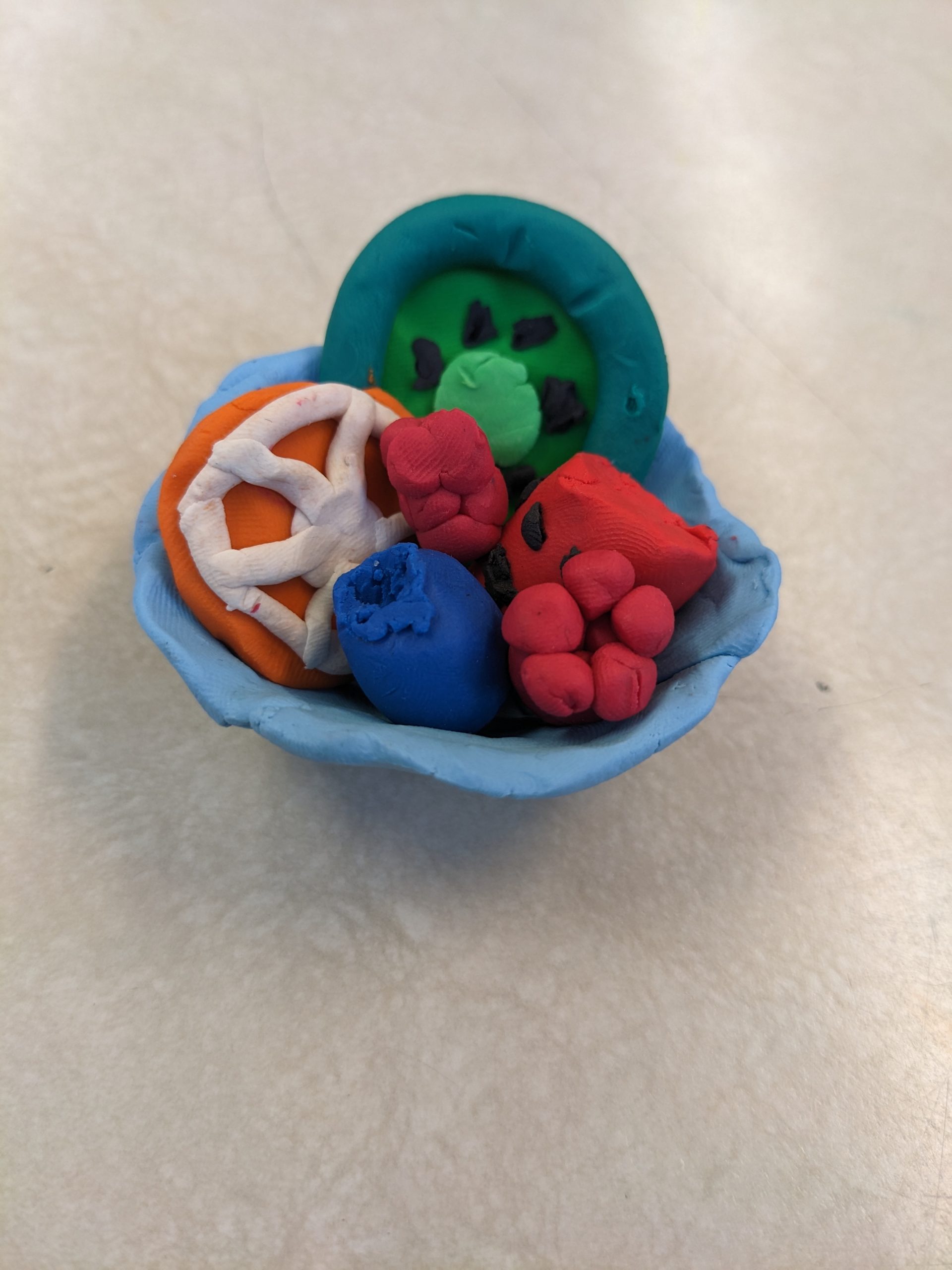
The results so far have been incredible. Students have added sound effects and some tried to create their own music to add to their commercials. All of the images they have used have been their own creations and some have even worked on creating clay images to represent their food. Many of their commercials have far exceeded my expectations and it’s been a pleasant surprise. While there has been great value in my lessons of the past with posters and cereal boxes, this has been a reminder of how extending this work and using tech can really spark some great ideas that far exceed my expectations. While students enjoy consuming media, they’re really excited to create and share with others.

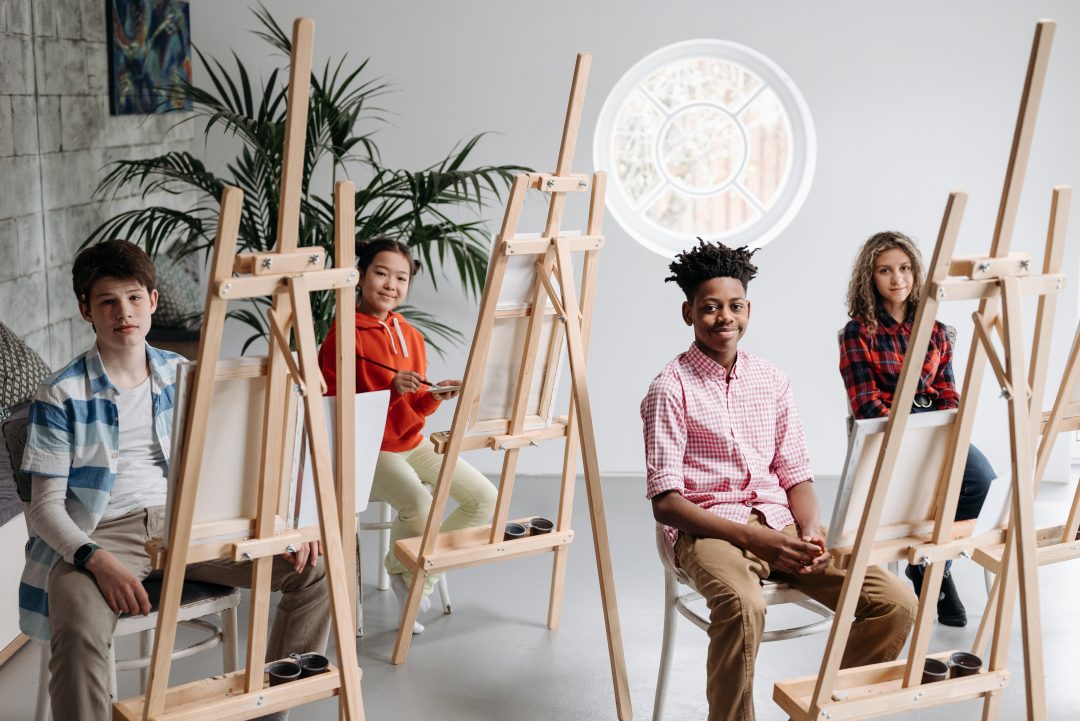
A diverse group of four students. Each is sitting in front of an easel.

Black History: Black Education Matters.

Photo By: Pavel Danilyuk

Ponder This: 
What did you learn about Black Canadian history in elementary and secondary school?
What was the narrative you were told regarding Black people in Canada? Did it begin pre-colonization?

The adoption of multiculturalism helped stabilize white supremacy by transforming its mode of articulation in a decolonizing era” (Maynard, 2017; Thobani, 2007: n.p., p. 50).

A Very Brief Canadian History

The prevailing myth in the United States is that Americans have overcome their racist past and are no longer racist, and the prevailing myth in Canada is that we are a country without a history of racism.

  • July 1784: “the first race riot in North America.” The confrontation ignited a wave of
    violence in Shelburne County that lasted approximately ten days. The majority of the
    attacks targeted the county’s free Black population.
  • Contrary to popular belief, Slavery was practiced in Canada until 1834.
  • Black families have petitioned the government and school boards for fair access and equity in education since the early 1800s.
  • Ontario was one of two provinces that legislated Black segregated schools.
  • The doors of Ontario’s last segregated school closed in 1965, while the last segregated school in Canada, located in Nova Scotia, closed in 1985.
Black Resilience over generations paved the way for the Black Lives Matter movement, which is recentering the narrative of Black Lives in Canada today. Unfortunately, systems of Anti-Black Racism are still part of the fabric of Canadian society and are still evident in our education system today. A big part of the change that needs to occur to combat Anti-Black Racism is the intentional education of students on the whole history of Canada instead of some of the highlighted parts.

One of the structural ways Black people continue to be discriminated against today is in education.

Far too often, contributions, innovations, and the ingenuity of Black people are not discussed within schools and learning environments until February, when there is a hyper-focus on Black History. During this month (February), there is a great focus on retelling the stories of oppression Black people have faced, which are presented as the only stories of triumph and fortitude attributed to Black people. In this guise, there is also a hyper-focus on American society and American issues, painting a false narrative of Canada’s racist past and present.

There needs to be a change in how we educate about the history of Black people in Canada. “It has to be changed in policies, practices, and it has to be systems change” (Hogarth, 2020). I boldly say that the change must begin in education.

“Racism is a learned behaviour that can be mitigated through the education of Ontario’s youngest learners. While there are topics in Ontario’s curriculum related to anti-racism and anti-discrimination and options for more in-depth teaching, explicit learning expectations related to Black history and issues must be built into the curriculum. A key issue that must be addressed is integrating discrimination and racism into teaching through a critical race lens. The instruction and learning must be ongoing. One-off lessons are insufficient to raise awareness and knowledge of the impacts of anti-Black racism and Black contributions to Canadian society” (Building Better Schools, 2023).

ETFO’s 365 Calendar provides ” educators and students with a visual touchstone to embed the voices of those who have been marginalized or silenced.” This resource highlights and celebrates many of the contributions and innovations of Black Canadians that have shaped Canada into the vibrant nation that it is today.  Though it is by no means an exhaustive list, it provides Elementary educators with the tools necessary to ’embed Black Canadian history in classrooms throughout the school year.”

A Call to Action

  • Deepen your understanding of the effects and impact of Anti-Black racism in education.
  • Find, read, and become familiar with your school board’s Dismantling Anti-Black Racism Strategy (if your board does not yet have one, advocate for intentional work in implementing one).
  • Conduct an audit of your unit plans, lesson plans, and teaching resources.
    • Ask yourself:
      • Do they provide windows of learning that represent the diversity of cultures, achievements, innovations, and impact of Black people in Canada and worldwide?
      • Are Black students mirrored in engaging and uplifting ways in the resources used, conversations had, and lessons learned?
  • Recognize how your own social positionality (e.g., race, class, gender, sexuality, ability) informs your perspectives, reactions, and responses as you engage with Black students and colleagues.
  • Remember that learning is ongoing. There is no one-and-done approach to systemic reformation.
  • Step out of your comfort zone and dare to engage in teaching and learning that intentionally amplifies the too often missing and omitted voices of everyday Black change-makers.
  • Join the fight in Addressing Anti-Black Racism in Education.

“ETFO supports calls by the Ontario Black History Society, Black families and others for the Ontario government to make Black studies a greater part of the public elementary curriculum” (Building Better Schools, 2023).

Black Canadian


References:

Aylward, C. (1999). Canadian critical race theory: Racism and the law. Fernwood Publishing.

Building Better Schools. (n.d.). Retrieved January 8, 2023, from https://www.buildingbetterschools.ca/addressing_anti_black_racism

CBC News. (2021). Being Black in Canada. CBC News: Special Presentation. YouTube Video. Retrieved from https://www.youtube.com/watch?app=desktop&v=Ntn0Nz8OT44&t=12s&ab_channel=CBCNews

Elementary Teacher’s Federation of Ontario. (n.d.). Retrieved February 1, 2023, from https://www.etfo.ca/classroom-resources/365-black-canadian-curriculum/365-black-canadian-curriculum-34d475930fc96a7121246be5c24e8be2

Gibson, D.O. (2018). Black Canadian. Hype B for Prosound Studios. YouTube video. Retrieved from https://www.youtube.com/watch?app=desktop&v=HSiQrXANexA&ab_channel=D.O.Gibson

Ladson‐Billings, G. (1995). But that’s just good teaching! the case for culturally relevant pedagogy. Theory Into Practice, 34(3), 159–165. https://doi.org/10.1080/00405849509543675

Lemert, C. (2021). Social Theory: The Multicultural, Global, and Classic Readings. 7th Edition. Routledge (Taylor & Francis). (Original work published 1993).
Advocacy – Using My Educator Voice

“Part of ETFO’s mission is the education, stimulation, and transformation of provincial and local organizations to be responsive to the diverse needs of the membership, and to be a positive influence for change at a societal level. “

 Source: ETFO Social Justice

I’ve been thinking more about my privilege in society and how to create space for others. I imagine my classroom, or even my school, as a microcosm of society and try to model kindness, joy, and hope to my students and colleagues. How do we make the world a better place? What does that look like in the teaching profession?

Reading the anti-oppressive framework created by ETFO helps me think critically about how I teach, the physical setup of my learning space, and the direction I’m helping my school take. It reminds me that part of being an ally is to advocate for those experiencing the negative impacts of colonialism, racism, homophobia, transphobia, classism, and ableism.

Sometimes advocacy work means starting conversations that will be uncomfortable, but educators need to ensure that we unlearn oppressive practices and ideologies. We can create space for the oppressed to have a voice. We can advocate spending school budgets on specialized resources for clubs or educational opportunities for students from marginalized groups. We can advocate for professional development to implement the calls to action of the Truth and Reconciliation Commission. We also know that the arts and libraries need our voices heard to give all students access to music, drama, art, dance, books and technology. 

The teacher-librarian AQ course taught me to advocate for the library/learning commons. For years, I have had to justify my requests for the school budget to be spent on books, magazines, and technology. The effort was worth it. Recently, a student who graduated from grade eight thanked me for allowing her to exceed the book checkout limit every week. When other students were taking 1-2 books, she was taking eight. Consistently, every week, for grades two and three, she continued this pattern. By grade four, she began reading some longer books, so the number of books she checked out was fewer, but she was still reading voraciously, and she continues to do so to this day. Her family did not use the public library, and they couldn’t afford to keep up with her appetite for books, so the school library was the place she relied on to keep her reading. With this student and others like her in mind, I will continue to advocate for schools to have libraries and for libraries to have books.

Educators, your voice is valued, don’t be afraid to use it to make things better for someone else.

Diverse Representation in the Media: An Unexpected Lesson

Isaac missed the first of four lessons in a media literacy unit. I invited him to my desk to review the first lesson. I didn’t know that Isaac was about to teach me instead.

In Media Literacy, my grade 2 class watched the video A Pep Talk from Kid President to You. We watched it a few times to observe how the words, the backgrounds, and the music impacted the meaning. In the next media literacy class, we reviewed a pep talk script I created based on the video. Students had to fill in the blanks to make their own pep talk, or they could choose to rewrite the script themselves. In the third class, we would pair off and film the pep talks using tablets. Finally, students could share the pep talks and accept feedback. 

When Isaac sat with me to watch the video, he reacted with shock as soon as Robby Novak came on the screen.  

“Hey,” said Issac, “He looks like me!”

In case you are not one of the 48 million viewers of “A Pep Talk from Kid President,” Robby Novak is an African American who was nine years old in the video. He went on to create more viral Kid President videos and wrote a book, all focusing on making the world more awesome.

When Isaac reacted so immediately and with such surprise to seeing someone he could identify with on the screen, I realized I needed to take diverse representation in the media more seriously. I must examine my privilege and bias when choosing media for any subject.

The American non-profit Common Sense media produced a report in 2021 called The Inclusion Imperative. The key findings include the following:

– High-quality children’s media can promote positive ethnic-racial attitudes and interactions.

-Among young people of colour, watching favourable depictions of their ethnic-racial group can have a positive impact on self-perceptions and views about their ethnic-racial group.

-Media created for even the youngest children should consider inclusiveness and representativeness.

I’m thankful for Kid President, and especially Isaac, for making me aware that I need to do more than I have been doing to ensure students experience more diverse representation in the media we use at school.

Resources:

Common Sense Media                     MediaSmarts


The Teacher Down the Hall

During these longer nights and shorter days, I often find time to reflect on my own journey as an educator. Coming up on 25 years very soon (gulp!), I can honestly say that I am not the same educator I was at the beginning of my career or even the same as I was five years ago.

Earlier this year I wrote a post about professional learning and realize as I reflect on my career that I also need to acknowledge the teachers down the hall. These educators have influenced and shaped my vision about students and teaching in so many ways through their mentorship, their permission to be human, and their examples as leaders. I want to dedicate this post to the teachers down the hall whose influence and teaching extended beyond students and to colleagues.

One of my favourite educators would always remind me, “You are human.” Teaching can be overwhelming and is often described as the job that never ends. I know there are times when I felt I could literally work 24 hours and still not have “finished”. However, we also need to understand that we are human. We need to give ourselves some grace for the weight of the work we do and know that we need time to recharge. Setting boundaries for work doesn’t make us bad teachers, it means we are humans who deserve the time for necessary self-care.

An intermediate colleague I worked with once asked me, “If you’re not having fun, how do you think the students feel?” In the light of all the curriculum expectations and data collection, it’s hard to remember to ensure that the class community enjoys their time together. Whether it’s engaging in community building, sharing funny stories, or a cool science experiment, having fun makes the learning environment a comfortable and safe place to be. It helps to build relationships between students and educators. One teacher I worked with always greeted his primary class with a morning joke and that was always brought up by students years later at every grade eight graduation. Those small moments where we have fun are sometimes the small moments that have a big impact.

Another mentor teacher would always tell me, “We teach children, not just curriculum.” It is so important to know each child that we share space with during the day. To recognize that they hold different identities and experiences, acknowledging that those factors influence how they feel seen at school. As teachers we all want students to feel welcome and that school is a place they belong. Getting to know and accept students’ full identities, such as cultural heritage and neurodiversity and everything in-between is necessary to create that feeling of belonging.

Working with another colleague, I learned “Be passionate about your own learning!” Teaching is a practice and one that we strive to get better at doing each year. Learning more about teaching strategies, resources, and new pedagogical research are all ways we can fuel our own professional learning. Trying new strategies helps to deepen our understanding of subject matter and to stay excited about teaching.

I reflect on those conversations and am so grateful to those teachers who gave me a shoulder to lean on and a listening ear. When I think back on the last two decades, it seems like no time has passed since my very first class. I feel like that same new teacher on the inside, though I have been shaped by different experiences and growth – much of that due to conversations and mentorship from those teachers just down the hall.

The Shape of Things

We’re having fun with shapes! In kindergarten, grade 1 and grade 2, we have been exploring, sorting, and comparing 2-D shapes using a variety of tools.  Here’s what we’ve been up to for the last couple of weeks.

In some classes, we started off on a shape scavenger hunt to see which shapes we could identify in our learning space. Students were excited to identify different shapes in the room and magazines. Many were impressed by how many items they could find that were shapes that they knew the names of. The face of our clock is a circle. The lego bins in our class have faces made out of rectangles. The books on our shelves and our SmartBoard also have rectangular faces. We identified a lot of rectangles in our space. 

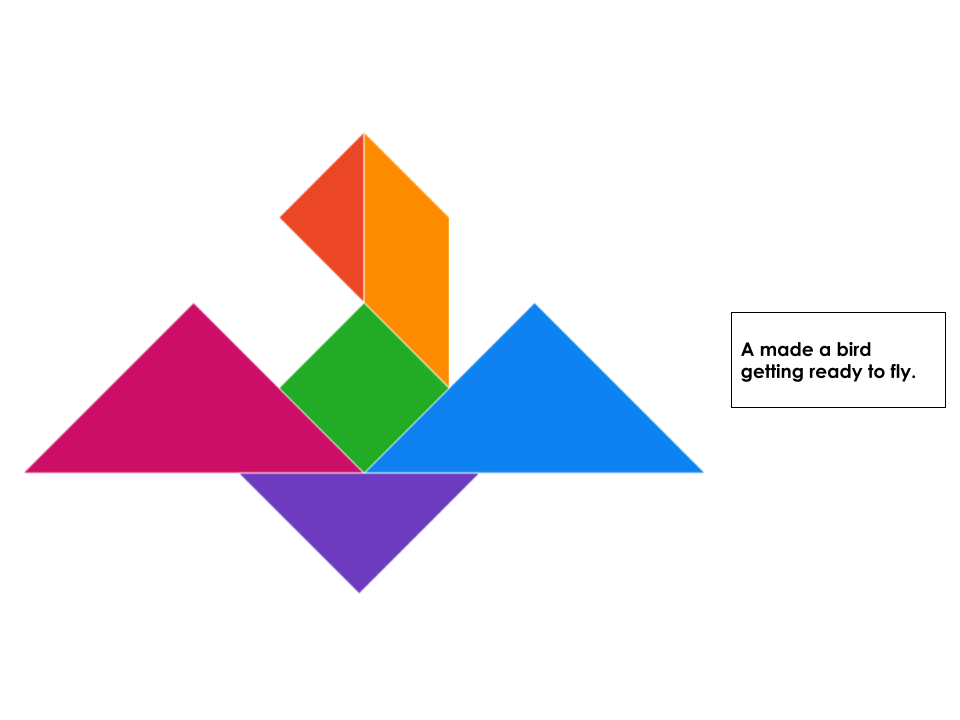
After identifying shapes that we could easily name or identify, we started talking about composite shapes. The tangram is a Chinese puzzle made from a square cut into seven pieces: two large triangles, one medium-sized triangle, two small triangles, one square, and one parallelogram. After discussing the properties of these shapes and congruence, the students were really amazed by how these 7 shapes could be put together to make a square. Many tried to flip and turn the shapes to return them to the original square and realized that it was a little tricky. After having some time to play with the tangram, students had the chance to try and see what they could create other than a square. They were then introduced to tangram puzzles and their minds were blown. After having the chance to physically manipulate the shapes, we took our skills online. Exploring Mathigon’s Tangram Builder, students had the chance to see how they could piece together the shapes to compose pictures and designs using these 2-D shapes. 

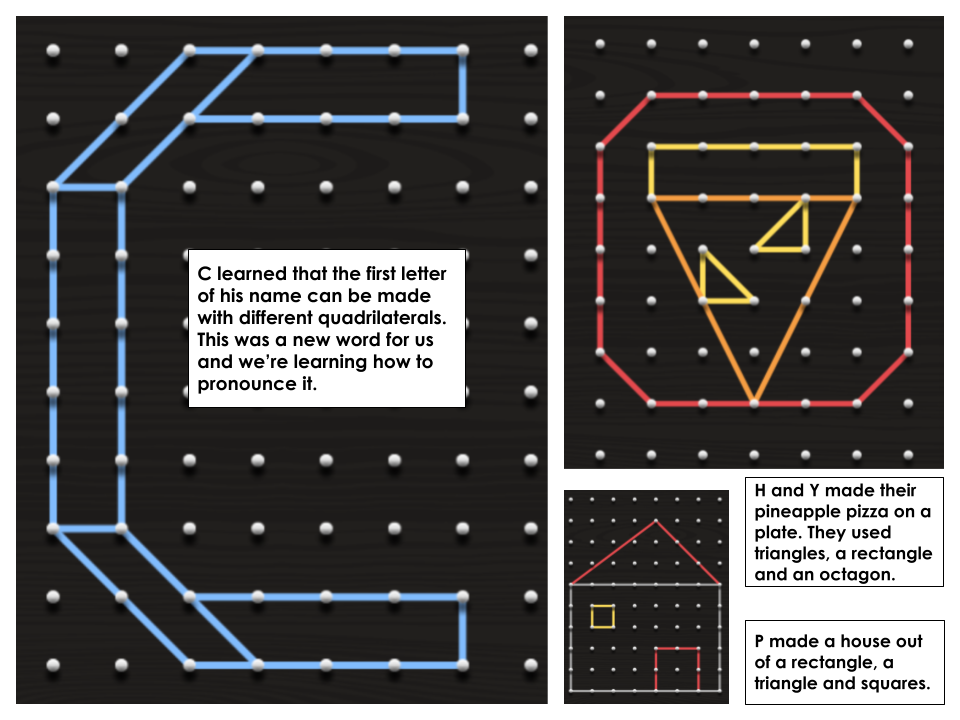
We have also been exploring what we can make using geoboards. Using the Math Learning Center’s Geoboards, students were given a few challenges and rose to the occasion. Here are just a few of the challenges we explored:

  •  Using your geoboard, make a shape that satisfies a rule (i.e., four sides; all equal sides; greater than 4 sides). What’s the name of your shape?
  • Using the geoboard make the letters in your name. What shapes did you use?
  • Create a picture using 3 different shapes. Describe your picture and the shapes you used. 
  • Make triangles of different sizes. Describe the differences between your triangles. 

We’re having a blast exploring shapes. This has also been a great reminder for me as to the importance of having manipulatives that students can move around and use as well as incorporating technology. We’ve explored with both and while some have really enjoyed using the online tools, there have been some who automatically gravitate to the physical tools in our space. Either way, we’re learning and having fun in the process.