Allies

The word ally is typically defined as a nation or state cooperating with another for a military purpose. As with most words it of course has been expanded for many uses but retains the meaning of being on your side. So the question I ask you today is, as a teacher who are your potential allies?

From the minute I enter into my school I have an amazing opportunity to make allies, get people to support the work I do with my students, school and community. Allies are everywhere but like countries you must take the time to build up relationships to develop those allies. When you do that, they will be there when you need them most. I am going to talk about several key allies that I have in working with my students and how without them there are many things I would have much greater difficulty accomplishing.

The first ally is of course the parent(s) of my students. Let’s be honest, we both really want what is best for a child even though we may not agree on how to accomplish that. From the moment I know a child is going to be in my classroom I reach out to families to try and start building that working relationship. It starts with a simple call home the week prior to school welcoming them and their child to my classroom. It continues on with my first Weekly News letter home by asking them to brag about their child as they know them best as well as asking them to prioritize two goals they would like their child to accomplish this year. This helps sends the message they are a part of the formula to create success for their child. I continually update them with sunshine calls home, weekly news updates, inviting them to attend events in the classroom and any other way I can include them or make use of their expertise and assistance in my room. Of course not every parent becomes my ally or totally agrees with every decision I make. There will be some parents who just won’t or don’t engage in your efforts. This work I put into recruiting parent allies always pays off with some very strong relationships that are there when I need them most.

The second set of allies I work hard at creating are with the school support staff such as our office manager and custodial team. These are key people who are the heart and soul of the school and can be there to support me in many situations when I need the help. One of the most unique request I made of our custodian was to have our front classroom door taken off so my class could create a drawbridge door for our Medieval Times study. Needless to say I had to have a strong relationship with that person to make and receive such a request. Our office manager (and every office manager) is the heart of the school. He/she is the first and often last person everyone sees when coming to our school. That role is so important and my class spends time on a regular basis showing how we appreciate the work she does. That time and effort has helped me many times over the years when I need a last minute request or forgot some important deadline.

The final ally I want to talk about is a community-based position. My class spends time doing service learning projects and as such we need to have people who trust that I can take a group of 8-11 years old out into the community and perform projects that enhance our community. I have worked a lot with city environmental personnel who over the years have come to value and trust our staff and the request we make. There are community agencies and people who can also become a potential ally for you.

As I began to change the lens upon which I viewed my classroom I began to see more and more how many potential allies (support) I have available to me. I do not have to do this on my own. My educational team continues to grow as I grow relationships and take advantage of the opportunities they can provide me in supporting my students and my professional growth. Allies do not just happen, you must work at creating them.


Express lane to learning

Recently, I was out shopping, and came upon something that’s not usually found for sale on the shelves at local grocers. Insight.

Funnily enough, it was probably there all along. I must have blown past a bunch of times while buzzing about my mental list of must buys. But this time, finding insight was meant to be. I’ll explain in 10 items or fewer.

https://www.flickr.com/photos/kirrilyrobert/2355105082/ CC by 2.0

Usually, upon walking into a store, I’m pre-occupied with my mental shopping list, figuring whether something is a good deal or not, and by getting out as quickly as possible. This requires the use of several life, mental Math, and critical literacy skills.

The act of shopping really requires planning and strategic thinking to figure out when a store will have the least amount of people as possible in it so that we may park, pickup a cart, procure, pay, and part. It is impossible to ignore the thought required for such seemingly innocuous trips that are made for our milk, bread, and eggs etc.

From now on, and armed with this understanding, I am going to use my trips to the store to seek out and share its valuable lessons. There’s knowledge to acquire about Math(Measurement or Number Sense), to Media Literacy(package design, use of space), and to the development of crucial future life/socialization skills in every aisle.

Consider the yogurt section for a moment; there’s something for everyone in that part of the dairy case. Where else could so many products co-exist so peacefully? In fact where else could such diversity exist(except Canada)? Here gluten free, lactose free, peanut free, Halal, Kosher, vegan, and meatatarian are available to all at the grocery store and share an inclusive space.

Then there’s the produce section.

While perusing here, I saw couples discussing, quite demonstratively, which bunch of Rapini to buy. Then I spied the apple aisle. There was a person who felt compelled to touch all of the apples in the case. I witnessed a grape thieve looking from side to side and then pop a few into her mouth. Here were real lessons on relationships, human behaviour, and decision making all before me waiting to be picked and extended into the classroom.

It’s like that in the classroom or a head of Iceberg(lettuce). Teachers work hard to make learning engaging, extendable, and relevant everyday.What most outsiders see is only the first leaf, layer or ply.*

Speaking of plies. I thought it would be fun for my students to calculate which toilet paper at the store was the better deal based on size and number of sheets per roll.

Talk about a real life problem. Initially, I went around snapping pictures of the different packages and their details to build the questions. The class discovered that there’s a lot going on that can confuse consumers. We came away wiser for the time knowing we wouldn’t get rolled over by the manufacturers next time. IMG_3962

Your turn

Have you ever considered or taken a class to the local grocer? What about a super-type store à la WalMart(wish I could still write Zeller’s here)?

Or how about a homework assignment to include children in the planning and shopping? Who knows it might become fun, or democratize the food choices in some households. It may even lead to conversational and debating skills.

There’s a line forming behind me. Happy shopping. Thank you for reading. Please share and take time to comment to keep the conversation going.

*You thought I’d say tip since iceberg was used, but no!

Student surveys

If you haven’t had your students use google forms, the survey creator on google drive, then you must! Students will have the chance to create online surveys and administer them to anyone they want.

We took our data management project to whole new heights when they created a survey for a certain grade to answer. We were looking at student satisfaction in regards to clubs and teams available at school. The answers were shocking as sometimes 75% of  students in the grade were unhappy with the clubs and teams available to them. My 28 students were divided up among all the grades at school and each group surveyed the grade they chose to survey. We will now look at the results and try to accommodate to add the new teams and clubs to our school.

I also was able to survey my students using the same program, google forms. I asked them about the way I ran the math program, language program and drama program. They were able to check mark all that they enjoyed about each program. Here are the results for the math section:

  1. 11 students enjoy projects
  2. 9 students enjoy group work
  3. 8 enjoy math around the class
  4. 6 enjoy tests
  5. 5 enjoy lessons on the board
  6. 2 enjoy quizzes
  7. 1 student wants to learn taxes

This way, when I do my next math unit, I can plan for maximum student enjoyment. It is important to know how your students want to learn so that you can have the best learning environment possible.

Surveys that matter

Today was a very interesting day for learning that took a different direction than I anticipated. We started off talking about ideas for the holiday assembly when I mentioned to my students that I would like them to survey the grade to find out their interest. It seemed unfair to force a grade of students to be involved in an assembly unless they really wanted to. Five of my students surveyed the entire grade about how they wanted to be involved. It was great to see them learning the process of how to create a survey (using google forms) and then administering it to their peers. Twenty minutes later, we created one to see if and how we should decorate the class. This survey was then administered to our class by five other students. It was great to see students talking about percentages and comparing pie graphs in a context that was not even supposed to be a math lesson. Learning can take place in all contexts and it is awesome when it is student led and the teacher just sits back and lets the magic happen. I am letting my students survey the intermediate students to select their music for the next school dance. I am also hoping to survey the school in the near future about extra curricular activities they would like to see in our school. Data management is proving to be an all encompassing area of study and is creating amazing student leadership! Try it out at your own school and see your students become teachers. They loved seeing the results from their survey matter and saw how action took place right away.

Pay It Forward

As I reflect back on my teaching career I have come to understand how appreciative I am of the amazing teachers and administrators that have impacted and helped shape my life both as a teacher and a person. Everything I am as a teacher, everything I do as a teacher, everything I have is a result of the sharing that was done with me throughout my years in the classroom.

There are times when you do not know how to show your appreciation and saying thank you seems so inadequate. As a very wise principal (and now a good friend) once said to me, the best way you can show your appreciation is to make use of the advice given to you and pay it forward.

This post is going to be about paying it forward. I am going to share with you two of my most successful teaching units and two of my most cherished books that I use year in and year out. If you read this blog, I am going to then ask you to pay it forward by sharing in a response to this blog or via other social media options two of your most tried and tested teaching strategies, units or themes as well as two of your favourite books that you use in your classroom. Together we will pay it forward.

Books:

1994h4This book has been a part of my teaching for almost fifteen years. It is the book that starts my class off from Day 1 each September. The power of this book is in the multiple messages that can be drawn from the words and texts. The two main benefits I reap from this book are that everyone can read, reading is going to be fun and it kick starts my focus on drama for the year.


imgresThis book is part of who I am and my passion for the outdoors. It is the story of a 13 year-old boy who is lost in the wilderness and has to rely on himself to survive. This is a powerful book to hook children into the outdoors as the author creates a picture that transfers my students into the setting where they re-enact the main character. We culminate this book with our ‘Hatchet Day’ at a local outdoor education centre and then do a compare and contrast with the movie version ‘A Cry In The Wild’.


Poetry is a powerful form of writing and the success I have had with reluctant writers has been very inspiring to me. The power of this genre comes in the multi-faceted approach one can take with it. Poetic language does not have to follow grammatical rules, which allows reluctant writers to focus on meaning through word selection. I often use the outdoors as the theme behind our writing as we bring our experiences into the classroom and on to the paper. We culminate with a poetry recital where they invite guests to hear their writing.


Team building is a non-stop, five day a week, always on my mind approach that I take in my room. I de-emphasize competition and focus on common goals. ‘We’ is the pronoun that runs through the heart of my classroom. We enter into our year as individuals and from minute one we focus on coming together for a common good. The diversity and differences in our room becomes our strength as we celebrate and benefit from the shared expertise and passions in our classroom. This is accomplished through character education, books, songs, games and most of all face-to-face interactions such as eating lunch together.


Thank you for taking the time to read this blog and I now ask you to pay it forward.


Self-Guided Professional Learning

As an adult learner, you know what your strengths are as well as what your next steps should be. You understand you current lifestyle, the demands of family and friends as well as the other components that are a part of your busy life. Self-guided professional learning allows you to continue to enhance your classroom pedagogical practice and curriculum knowledge at a pace and focus that is specific to your needs.

There are so many learning options available to ETFO members. It starts within your local federation where your professional learning committee is already at work planning out opportunities for members to continue to enhance their best practice. Talk to your committee, find out what is being offered, put forth suggestions that they can look at or better yet, get involved in this committee.

The next main area that provides a treasure trove of learning opportunities is our provincial organization. If you go to the provincial website (http://www.etfo.ca/Pages/default.aspx) and search under the subsection professional learning you will find a wide variety of options that are offered by our provincial team. The scope and sequence of the options available ensures there is something for everyone. The provincial office also provides equitable access from a geographical standpoint.

Whether it is AQ courses, Summer Academy, one time workshops, workshop series, provincial or local book clubs, or just gathering together as same grade colleagues and having professional dialogue on a topic, find what you need and seek to grow as a teacher each and every day. One of the most rewarding facets of teaching is when students and teachers can continue to grow side-by-side.

1

Wisdom Begins in Wonder


tumblr_mabyllzj6p1qfvq9bo1_1280


The end of the Kindergarten day. The students are safely back with their parents, the classroom is a mess and I’m probably covered in some form of art medium, tidying blocks, cleaning paint brushes, organizing toys and most importantly, reflecting – reflecting on the deep thinking, problem solving, exploration and discoveries that my students made in just one day. Sometimes this meaningful learning took place as a result of a simple question or observation made by a child that exploded into a day full of inquiry. One morning, a group of students were chasing each other’s shadows, which led to the entire class exploring the concept of light, an inquiry that captured their full attention for three days. Another day, two students noticed a sprout growing in the cracks of the pavement outside which turned into a nearly month-long exploration of life and natural life cycles. Another time, a large truck came by the school to pick up a garbage dumpster, and after witnessing this the entire class spent days researching heavy trucks and vehicles, relating them to simple machines. This eventually stemmed into a second inquiry about recycling and caring for our environment. In every case, the learning spanned into their writing, their demonstration of mathematical concepts, their dramatic play, their art creations and their building projects. What was my role in all of this? To question them, support them and observe them. This is what I love about Kindergarten. It is the perfect environment for inquiry-based learning.

Inquiry is probably one of those buzz words that you are hearing left and right – and rightfully so. To prepare students for life in the 21st century, we need to change the way we are teaching them to think. In other words, we need to teach them to think. It’s not just about teaching facts and information, but teaching our kids how to come across, process and communicate that information. The process of inquiry is not just about delivering the curriculum in a new way, but equipping our students to apply critical thinking, research and exploration skills to all areas of their life.

A colleague of mine implements Genius Hour in his grade five class. For one hour each week, his students are given time to research and explore any topic that is of interest to them. His students are working in a variety of areas – researching dogs, writing skits, creating a new sport, making presentations about the Eiffel Tower. Are they necessarily working on curriculum concepts? No. Are they learning? Yes! Are they engaged, intrinsically motivated and excited about their learning? Yes, and this is the key.

When our students are engaged in an authentic inquiry process, guiding their own learning, being autonomous in their decisions and problem solving on their own, they are engaged in much higher learning. We need our kids to take ownership of their learning. We need our kids to be excited to explore the world around them. We need them to wonder. When we accomplish this through immersing them in inquiry based learning, we are creating 21st century learners. It’s not always about what our students learn, but how they learn it.

Many classrooms that I have been in are using the inquiry model of learning in at least one or two subject areas – most often in science and social studies. Think of how valuable the learning could become if one inquiry could span into all curriculum areas, much like it does so naturally in the Kindergarten classroom. Why not give it a try? As I’ve learned from teaching Kindergarten, when students are free to direct their own learning, amazing things can happen.

As a teacher, it is such a rewarding feeling to watch students go above and beyond in their learning when they are motivated and engaged. I think it’s important for us all to remember that sometimes we need to step back, stop teaching and start asking.


.

Meet the teacher night

Tonight was open house at my school and as usual parents wanted to know how their son or daughter were performing. This is always an interesting question to answer because parents want to know about math and language and I want to tell about how they are getting along with others and how polite and helpful they are.

It’s interesting to see that what a teacher values teaching the most is not always what would come up at a meet the teacher night. I hope that in my program I can help children with their math and language as well as help them treat others with respect as well as help them make our class a friendly place.

As a young teacher, I am always hoping that parents will be on board with the new shift in education, away from tests and onto rich learning experiences. Sometimes I wonder if after my students leave me, that I have failed them if they start to take tests and have no idea what they are doing. I do see the value in showing how much they know on a piece of paper as many high schools still work with this model, but I am always wondering how that will help them in their future. I understand that test writing is an important skill, so I need to think of ways to include this in my program in the future.

I am working on making our class a very open and comfortable space for learning right now and I am hoping in my next post to share about how the alternative seating is making the student space an amazing place to work. I hope to see the benefits of the seating and I am excited to take pictures of student learning experiences and share the stories.


The H word

Homework board-928381_1280Homework (shudder). It’s like two perfectly decent four letter words have conspired to become super villainous by joining forces. For most students, it’s part of a nightly ritual.

I get it. My parents used it as a polygraph test, of sorts when I was younger, by asking the same question after school each day.
“Did you do your homework?” 

We’ve all had to go through it, but now as teachers we must wrestle with the pros and cons of having to assign it to our learners…or not.

So as the year begins and questions of “To assign homework or not to assign homework?” bandy around staff meetings and grade teams. I want to share some personal thoughts on this 2 x 4 letter word and ask you to reflect on how you use it in your learning spaces?

Homework is not always where the heart is.

I love home, and I like work. For me, home is a place of relaxation, retreat, and support among family. Work is my home away from home. I have a family of caring colleagues and a classroom filled with students in possession of boundless potential. However, when it comes to homework I feel that things have changed since I was a student. My memories of homework hearken back to 1000s of pages of banal reading from largely outdated textbooks which I like to call knowledge coffins, redundant work sheets, and largely irrelevant content which seemed disconnected from my life.

Like all the good learning soldiers in my day. I did it, knowing of no alternatives. I wonder whether we gained any advantage from the discipline in completing assigned tasks, or lost a little of our desire to learn for never asking why we were doing it and where it would matter to me?

In my class when homework is assigned, it must be relevant to a larger idea that requires consideration beyond the classroom. That might mean asking students to lead a conversation at the dinner table or on the way to hockey practice with a captive audience. I remember assigning my Grade 5 Social Studies class the task of asking their parents, “What they would change about the government?” followed by, “Why do we need the government?” the next night. The conversations that resulted allowed students to lead, share, and gather ideas as they build on in class concepts/schema and then were able to take it back home to add on a broader family perspective. When they came back to school their responses were rich, often humourous, and engaging. Mission accomplished.

Some Irreducible Minimums

I do assign something for students every night, 30 minutes, or more, of reading. Don’t judge me! This is non-negotiable. Students do not have to show me proof, but are expected to develop their own positive habits around reading, its genres, and via any media of their choice.

Additionally, I’ve created and assigned flipped lessons using TED Ed as homework. Students view the lesson content, get to look at the guiding questions, and are able to browse additional resources to establish initial understandings on a topic. When we tackle the work the next day, my students are already familiar with the concept having prepared for it the previous night. I can track their progress via the TED Ed Lesson platform and provide feedback and next steps too.

On other occasions I have encouraged students to help out with the dishes or with other chores without being asked. The results have been so positive for everyone after the initial groans. But hey, they groan when you assign homework too. Perhaps it’s time to rethink the purpose of homework? Kids can thank changes in socio-economics, urbanization, and the Space Race.

It’s only since the early 20th century where homework became de rigueur in education. Even then the fervour in its favour continues to ebb and flow. We have to remember most kids were working at home before and after school to help their families. It’s what people did. There wasn’t time especially when there were chores to do.

Nowadays, more and more students enjoy a quality of life, and abundance of free time far removed from their homework deprived agrarian predecessors. Instead, students are filling their evenings with music lessons, participation on one or more sports teams, tutoring, and or second language classes. With all of the extra-curricular activities there is little time left at the end of the day when homework is added into the mix. I’ve had students say to me they couldn’t complete work citing one or all of the above reasons.

In a his post on homework from earlier this year, Mike Beetham shared a powerful experience in his piece Homework or No Homework. I love the consideration he puts into his practice. The final lines of this post serve as guidelines,  encouragement, and validation of the educator’s ability to use professional judgement when it comes to assigning homework.

“Homework for the sake of homework is not a productive component to any student’s learning. It must have a specific purpose that is helping meet the targeted academic outcomes of the classroom.”

How about you? Where does homework fit in with your pedagogy? Do you assign it to placate parents who insist their child have something to do at night? Do you vary the work from subject to subject each night? How do students who are chronically unable to complete homework get supported? Is the work you assign traditional in the sense of reading and responding to questions in writing? Do you post work via electronic classrooms or other apps?

If you’d like to discuss more about this post or learn more about TED Ed please take time to comment and I’d be glad to share more with you.  Reach out via Twitter or below. Thank you for reading this post.

Students making a difference

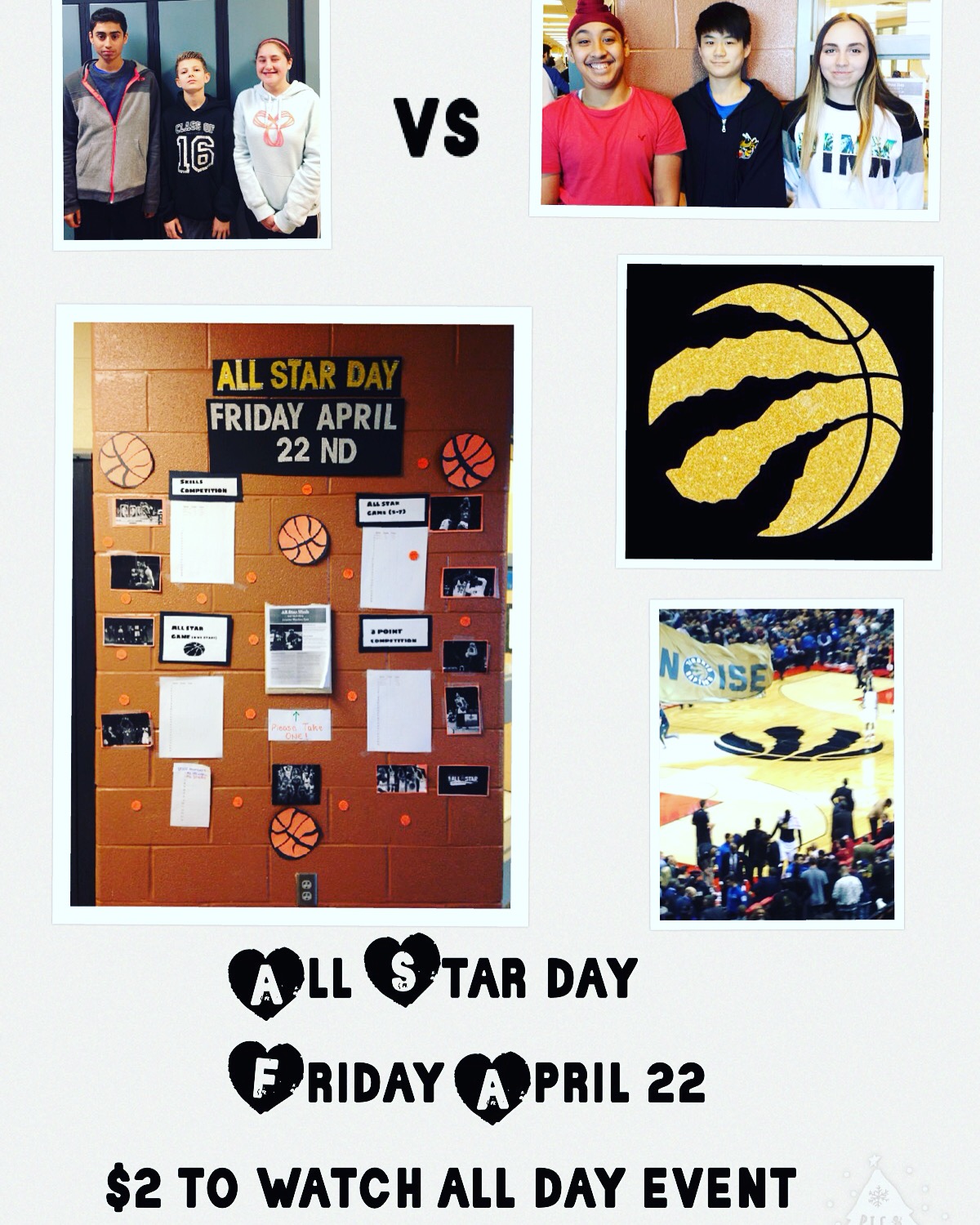
Throughout this school year, it was one of my goals to not only start a fundraiser that would benefit a charity somehow but to have students orchestrate most if not all of the procedure. At my school Ancaster Meadow, I asked a group of 30 grade eights to plan with me a day entitled “All Star Day”. Together with myself the grade eights:

  • chose two charities for all monies collected to go towards
  • selected how the day would work picking the events at All Star Day
    • 3 point competition $10 to play
    • All star skills competition $10 to play
    • All Star game where kids from grade five to seven would play and would be coached by grade eights $20 to play
    • All star game where grade eights would play the teachers $20 to play
  • help run the day and organize the crowd to watch the event

There were many other tasks involved to help make the day a success. I went to 30 different companies to ask for donations as well as other companies to sponsor t-shirts, lunch the day of and volunteers were involved from Redeemer University.

The day went off without a hitch and we raised $2000 total, $1000 going to each charity. After this day, every grade eight came to me asking to lead more events, raise money for more charities, etc. They had all these ideas that are impossible to all say yes to because it is May at the end of a school year and the ideas they have would take many months to plan for. However, students do have the potential to make the greatest difference in their school. Whenever you have an idea, put it in the hands of your students and trust that they can take it anywhere. I have never seen kids more involved or more into what they were doing in a school building then I saw on that day. I cannot wait for next school year when I can do that same event again, keep building on it and inspiring children to know that they can make a difference and have an amazing time while doing so.

If you would like to see videos from our event, you can youtube: Ancaster Meadow All Star Day. IMG_4604