Teaching the Language of Power

Most of the learning I’ve experienced as an elementary school student is a blur. There are few moments, however, that stand out as pivotal and that have helped shape my experiences as an educator today. One of such moments was grade 7. It was in grade 7 that I learned the word mediocre. Before then, I had never encountered this word and once introduced, it was truly a powerful moment for me. In learning this word I was given language to express an idea that I didn’t even know had existed. This is the power of language and this is why I fell in love with words. My fascination with the ways in which words can be intentionally nuanced to convey ideas with such lyrical intensity fascinates me; not only because of the creative ways in which ideas can be constructed, but also because it is a tool for granting access to discourses that without them one would remain silenced. I experienced the power of language but also that language was power. This experience brought me to my journey of engaging my students in the politics of language and exploring ways I could grant them access to platforms of thinking simply by equipping them with the language of power.

More than mere vocabulary boosters, words of the day or word studies, when introduced in meaningful contexts, can not only enrich student vocabularies, but can also give volume to their voices as thinkers, activists and world changers. My journey toward empowering learners with the language of power began in my first year of teaching. It was a grade two class and I was terrified. I had no idea what to do or how to go about it. It seemed like all the learning from my formal teacher education went out the door as soon as the students walked in. I realized I was in trouble when I would speak to my students only to receive blank stares. What I wrestled with was whether or not to make what I was saying more child-friendly or to simply bring the children up to speed and create many teachable moments with the words that I used. The result was the latter and we began an anchor chart entitled “Ms. Nelson’s Fancy-Schmancy Words” where when students stopped me mid-sentence to seek understanding of a specific word I used and it would be added to the list along with its definition and the sentence in which it was used. Now, 7 years later, the anchor charts have evolved into a word wall in which students are constantly identifying not only new words that I used but also introducing ones of their own and adding words they find in the literature they read or listened to on a daily basis. The love for words became contagious and the thirst for learning new ones was intrinsic.

Students were then invited to use words, or the language of power, as tools in exerting voice to an authentic audience. Students were empowered by words when they interviewed all 5 Mayoral Candidates in the 2015 Mayoral Election. Students wrote speeches and presented them as great orators in front of invited community members that included the local crossing guard, a church pastor and family and friends. Students raised awareness by writing blogs about the impact of their social identities and shared these sentiments with the school community. Their words spoke to issues of social justice and coloured the imagination with distinct imagery, was a power to be wielded in the pens and voices of elementary school students.

IMG_0600

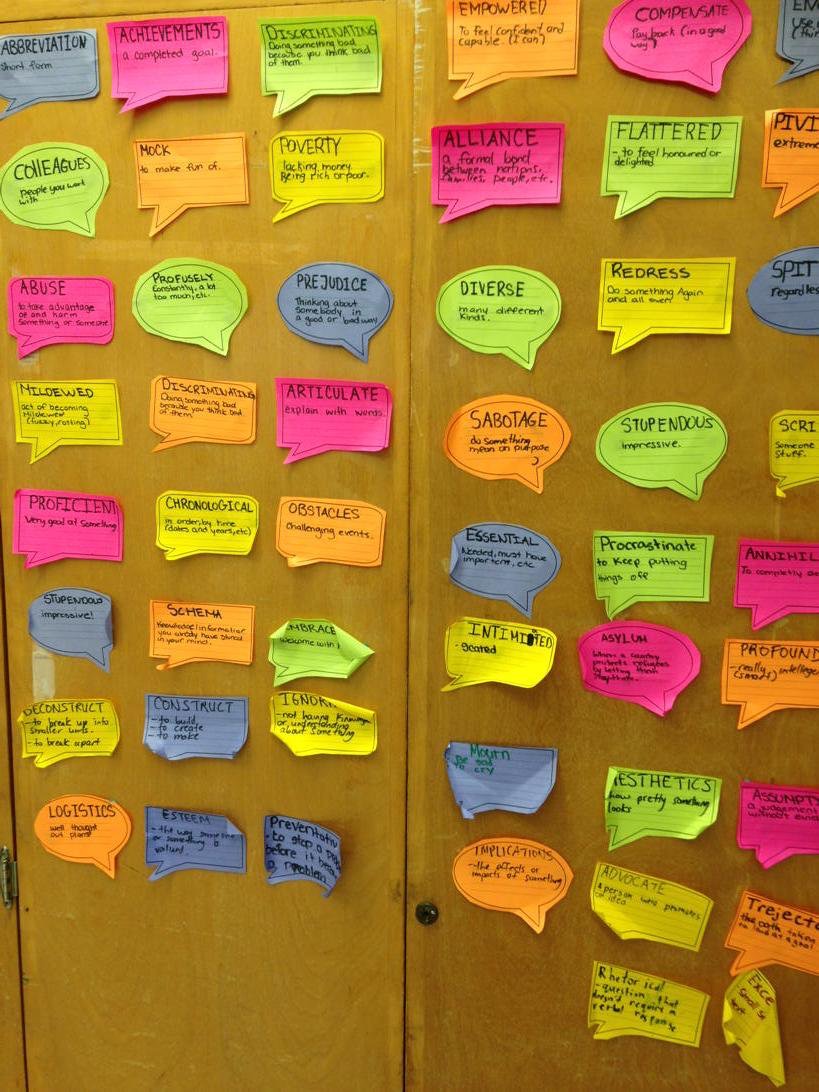
Word wall from my Grade 5/6 class: sabotage, aesthetics, logistics, schema, implications profound, trajectory, embrace, chronological, deconstruct, procrastinate, intimidated


Keep swinging for the fences

photo by jcclark74 CC0

Spring is definitely here, perhaps this is not so evident in our temperamental weather, but by the fact that baseball season is back. In honour of that I wanted to share some connections to how being a student of the game is like learning in the classroom.

I look at baseball as a sport for all ages and genders. Everyone can play. In some ways, a baseball diamond could be the ultimate classroom with so much going on at anyone time in the stands, in the dugout, and on the field.

Baseball is a game of scenarios. There are constant situations to be thought through in every game and there are statistics kept from little league to the major leagues. Just think of all the other Math skills at play in the concession stands, ticket offices, and accounting/payroll departments. Math is an important part of baseball.

Baseball is a game of Physics. How a ball rotates from the pitchers hand towards home plate determines its trajectory. The angle and bat speed at which a player makes contact with a ball determines its flight duration and distance. Major League Baseball measures everything possible on the field that happens in a game, including ball rotation, pitch velocity, swing(bat speed), and field area covered in a program called Sabremetrics. I wrote this TED Ed lesson called Future of the game: Baseball latest statistical revolution to show how it is used.

Weather plays a role here too. Forecasts determine whether games can be squeezed in or postponed. Data from on-field temperature, and prevailing winds gets noted too. Imagine the engineering required to design the perfect outdoor ball park because no two seem to ever have the same design.

Baseball can be altered and adapted to suit the level of all its players. There is Kickball(soccer baseball), marshmallow baseball(played with a tennis racket and a bag of marshmallows), and Rounders. Some might even prefer the game of Cricket as it may be more familiar to their students than baseball. All of these adaptations have similar fundamentals and transferable skills.

Baseball is a team sport. No one can play all of the positions at once. It requires collaboration. Everyone plays a role whether in the field or waiting to bat. Baseball is a thinking game. Many of the lessons of life come from playing it. I mentioned Math and Physics before, but there are other areas that come in to play here too;

  1. Emotional- Players can get caught up by a moment, or when a mistake gets made. This can lead to other mistakes if focus required to make the next play. Baseball teaches its players to keep their minds on the game. It also shows students that mistakes are going to happen. How they recover from them is an important part of the game/lesson.
  2. Mental – With all of the statistics kept in baseball it is important for players to know what to do with the information. Processing on the fly and responding just like in the classroom comes from preparation aka practice. Players and students alike prepare for games/tests receiving coaching/instruction and next steps for improvement.
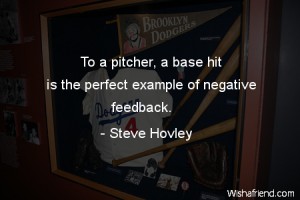
    Steve Hovley negative feedback
  3. Feedback – Whether playing baseball or learning in the classroom there is always feedback. Some is positive and some is negative. This can depend on something as simple as mindset, timing, and delivery. With students the risk of being kicked off the team is never on the table. There are no minor leagues in education. Teachers are in the room to help all of their students make contact with the ball and circle the bases with their learning. Regardless of the type of feedback teachers and coaches are there to instruct, identify talents, and encourage their students.
  4. When a player strikes out, there will be another chance to bat. When a player walks a batter or misses a throw, there will be another chance coming their way soon. The lesson is always be thinking and practising for the next opportunity whether it is in the classroom or on the field.

So as the players take to the field for the next umpteen months take some time to share this incredible game in your classroom. Take time to enjoy the Science, Math and chance to develop life strong habits of resilience and teamwork.

That Chickadee Feeling

This classroom field trip is based on a book written by Frank Glew. It is a regular part of my classroom in the winter. Each year in my attempts to keep my students winter active I use this read aloud as a focus for my students to connect to their natural world in all seasons. The precise of the book is about how a young child is bored and has nothing to do. So the parent decides to take them on a hike. The child experiences for the first time that Chickadee feeling.

Finally the day has arrived where my class and I will be heading to our local outdoor education centre where we will try and experience in real life what we witnessed in the picture book. The snow is gently falling and the forest is covered in white with only the underside of branches showing their natural colour. It is a perfect day for what we are wanting to do as there are very few natural food sources available for our winged hosts. As we hike toward their feeding area, the Chickadees know we are coming and they start to follow us, knowing that human presence means it will soon be feeding time. My students start to both hear and see the tiny birds as they stay close to cover to avoid any natural predators.

Finally we arrive at the location where we will attempt to experience that Chickadee feeling. I take a few moments to talk about the best techniques to try and get the tiny winged marvels to land and feed from their hand. One-by-one the students collect some black sunflower seeds (Chickadees are very fussy eaters) and move to a location where we will serve as a human bird feeder.

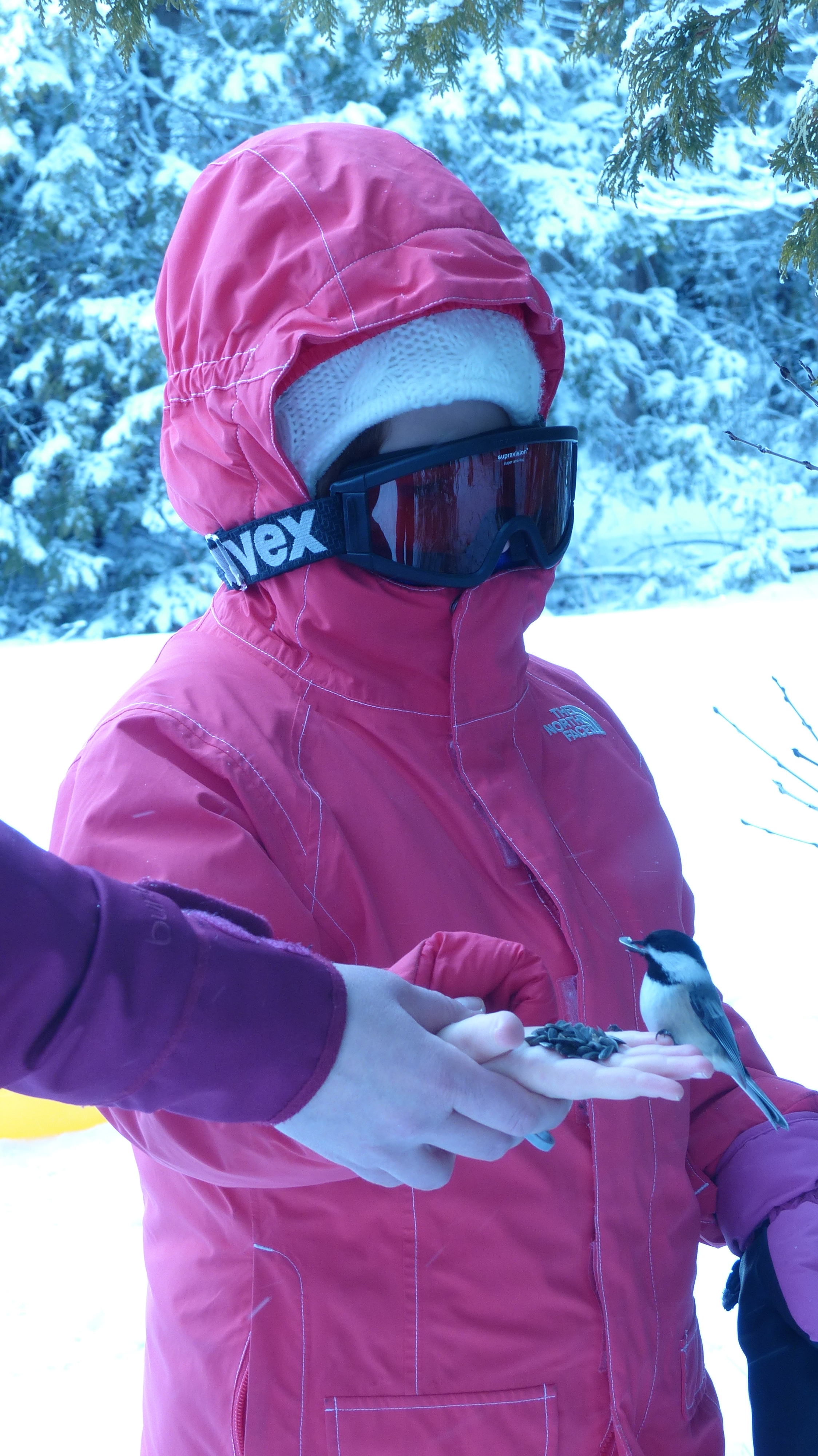
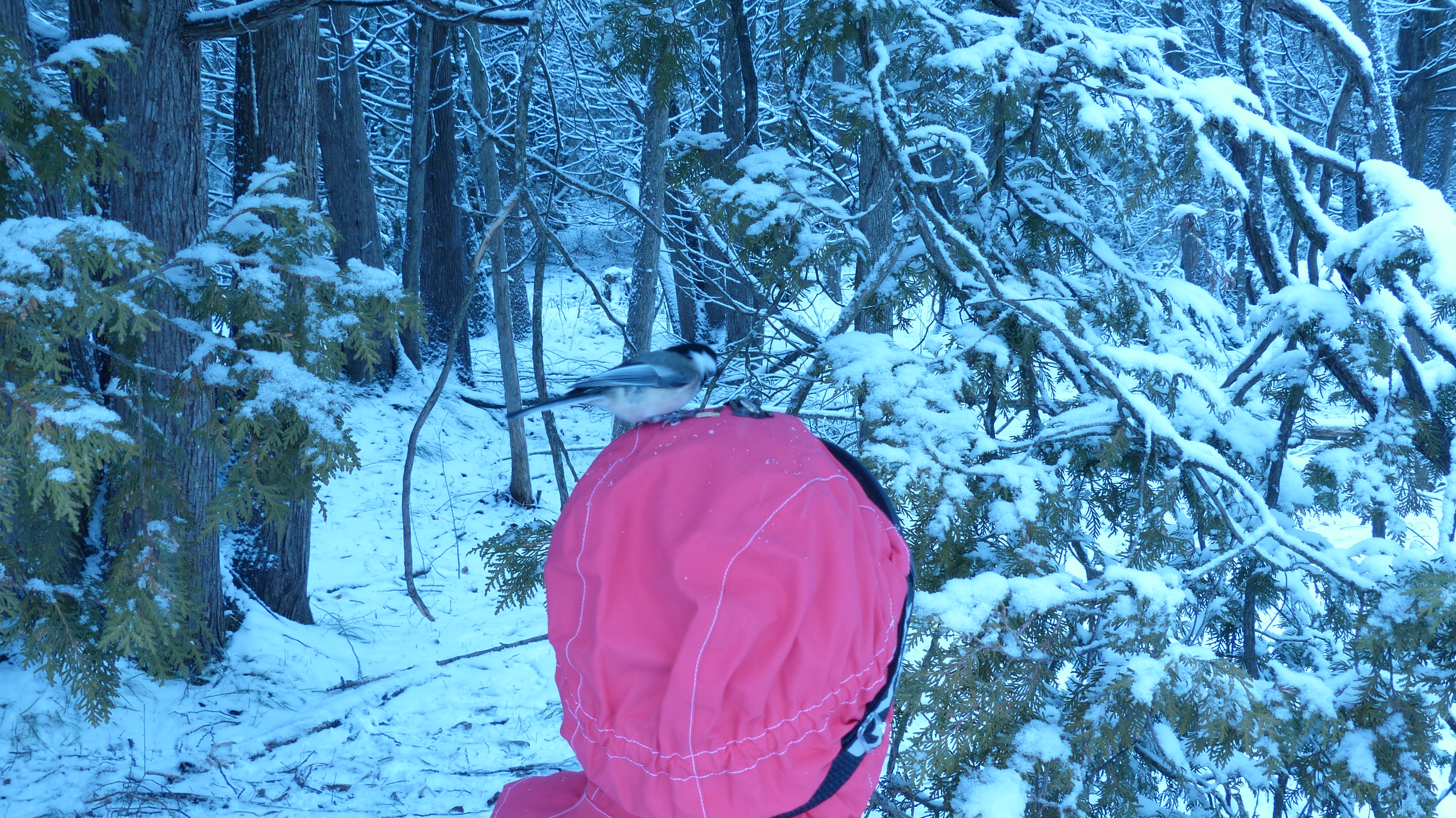
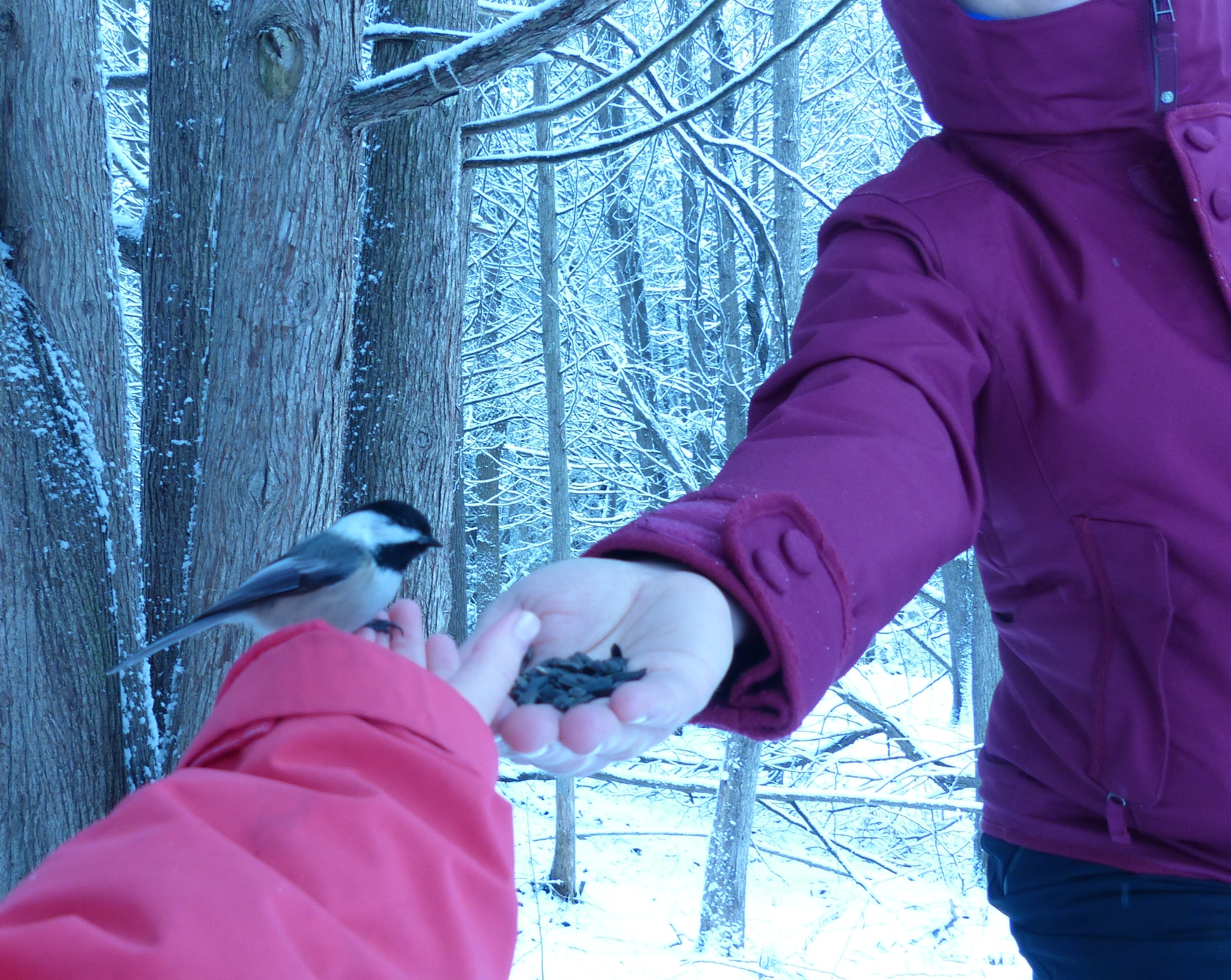
Within minutes the word has spread somehow in Chickadee language and it seems like dozens of birds arrive and carefully scout out the sudden feast that awaits them. Then, it happens! The first Chickadee lands and perches on my student’s outstretched hand, grabs a seed, looks at my student and flies quickly away. This first landing creates a chain reaction of the same scenario and they feast for the next 10 minutes. Like a proud father I carefully observe my students to ensure that each and everyone of them have that opportunity to experience the Chickadee feeling. The smiles, the chorus of oohs and ah that echo in the forest tells me that they know they have just become a part of the infamous Chickadee Feeling Club. I hope you do one day as well.P1050784 P1050792 P1050786

Tech Talk

I would like to share a new initiative my class is starting at our school Ancaster Meadow.

Our class realized the large need for technology in the classroom. We noticed that students are sometimes unfamiliar with apps that are available for completing work and for presenting learning. We are starting a new program called “Tech Talk” where as a class we travel to classrooms and instead of “Reading Buddies” we will assist the class one on one with apps of the teacher’s choice. We came up with a benchmark of five:

  1. Explain Everything
  2. Kahoot
  3. Weebly
  4. Pic Collage
  5. Prezi

These apps will be explored in detail by my class so when we visit our first class after the break, the break off sessions will be smooth and very productive. We will offer this program to grades two-five and speak to teachers before regarding sign up. Students will be able to explore the apps, prepare a small task and then share it with the whole class. The sessions will be fifty minutes long as that is how long a period is in our school. We hope that students will learn from each other and that everyone will be able to use these apps in the new future. I hope it will be a meaningful experience for my class to teach younger students skills that they already have. I cannot wait for our first trial after the break. I encourage everyone to try this  “Tech Buddies” program and share your experiences as well.

Rebound From Your Mistakes

Perfectionism seems to be a common character trait of teachers in that they expect to be perfect at everything they do. They must have perfect lessons, they have to have perfect classroom displays, they expect perfect interviews and so on and so on. If this level of achievement has not been met they often feel they have let down their students. They may feel guilt or embarrassment and tend to dwell on the negative aspect of the scenario. The reality is we are human and humans make mistakes even if they are teachers.

We are patient with our students. We expect them to make mistakes in their personal learning journey and offer formative feedback that allows them to reflect on their learning and move forward to the desired outcome. If this works with students, it will also work with teachers.

There have been many, many times over the course of my career that I made a mistake. Like when I said something I should have phrased a different way or when my reaction to a classroom situation was not handled in as professional a manner as it could have. Each time a situation occurs that I feel could have been handled a different way I complete a personal reflection that helps me move forward in my practice. All of those not so shining moments, have helped shape my learning and skill set for the present and future.

One of the Keys of Excellence in my classroom is ‘Failure Leads To The Sweet Smell of Success’. This foundational belief teaches my students that mistakes are inevitable and we can examine the error and turn it into a teachable moment so that future scenarios will result in success for all. An added bonus to this is that my students become more of a risk taker as it relates to ability to try new things. I live by this belief and it has helped me become a lifelong learner as well as a risk taker in experimenting with new pedagogical practices.


…What I have Learned

Well, true to form, the trajectory of inquiry can never be predicted. And so it was that at the end of the couple of weeks of exploring What Happens in Winter, our students ended up quite aways beyond knowing that animals hibernate and plants die off when the weather gets colder. Following a visit from a teacher from the Ottawa Inuit Children’s Centre, their understanding was now in the realm of recognizing how a wintery landscape not only makes animals adapt in different ways, but how it has also influenced the lives and culture of the Inuit.

The students touched sealskin, fox, and rabbit pelts; tried on an amauti (anorak), kamik (boots), and bone snow goggles; played a caribou skin drum; held seal knuckle bones which were used to create pictures during storytelling; and played Inuit games that involved strength and stability (hilarious wrestling games which they discovered are also easily played outside in the snowy school yard). Our KWL bulletin board filled up with sentence strips on which the students wrote about what they learned and liked about the visit; “I learned that sealskin is best for clothes and boots because it’s warm and waterproof.”; “I learned that Inuk live in houses not igloos.”; “I liked playing Inuit games.” At the art table, several chose to paint what they learned; “I learned how to play a drum – a man’s drum and a woman’s drum,” “I learned that fox don’t hibernate in the arctic – they change color,” and, “I learned how to tell a story using seal bones.”

In activities and centres we set up following the visit, we offered opportunities to draw on their learning.  In math, after discussing the best shape of rock to build an inukshuk, students were challenged to draw an inukshuk with more than 5 rectangles and then to tally the total number of rock rectangles they used. Later in the block centre, several students took the challenge further and built free-standing, life-sized inukshuk (which are usually not very tall). Another day during the week following the presentation, a group of students were tipping over chairs and using them as blinds while they were hunting seal and polar bear – it started to get very physical with running and squealing, so, for safety reasons,  the crew were redirected to the art table to make paper bag puppets of seals, polar bears, hunters and dog sleds. They were so excited to use the puppet theatre to act out their skit which we were later all invited to watch. Another provocation was posting the Inuktitut ‘alphabet’ on chart paper. Next to each symbol I wrote out the sound it represented. While some students recognized that there were several triangles in the alphabet, others attempted to find the syllables they could use to write their names.

Now when we are outside for our outdoor learning every day, I ask questions about the snow, the sky and clouds, and animals; “If we had to build a shelter, would this be good snow to use? Let’s find out.”; “What are the clouds telling us? What do you notice about the weather today? Is it different from yesterday?”; “Can you hear any animal sounds? Have you noticed any signs of animals?” (scat, tracks, birdsong, etc.)

The students are also now aware of the fact that, according to our local groundhog who got scared of his shadow, we are in for a few more weeks of winter. What does that mean for them? Now that they have learned a bit more about What Happens in Winter, and have explored how arctic animals and the Inuit have adapted and survived in a wintery land, my next challenge is to provide opportunities for them to show me what they will do with that knowledge. The big question is, what do I need to do to help my 5 year old students take the next step into stewardship and sustainability?

Classroom Resolutions

New Year’s Resolutions are a time-tested tradition in which individuals make personal commitments to improve in some aspect of their life. I have used this activity in my classroom for over two decades and find it to be a wonderful, fun tool in helping both myself and my students set goals on how to make the most of their academic year.First and foremost I model this activity for my students by reflecting on my first four months of the school year. I determine what went well and what do I need to do to further enhance the success of my students. I set personal resolutions in the following areas:

  1. Continue – what practices are going very well and should continue in the new year
  2. Improve – what practices have not went as well as expected and what do I need to do to improve that area of my teaching
  3. Experiment – what new area or tool would I like to start to experiment with in my day-to-day practice

This year my resolutions are going to be to continue with the use of technology as an alternative option for demonstrations of learning. I will improve in my area to both understand and apply the concept of sensory accommodations in the room (especially around noise). I will start to experiment with social media and how it can become an option for my classroom pedagogy.

For my students it starts with a discussion around New Year’s Resolutions and how it is a part of their life. Most often they talk about how the adults in their life make resolutions around quitting smoking, losing weight or exercising more. The conversation shifts to what the purpose of a resolution is and why people make them. I pose the following question, ‘Should only adults make New Year’s Resolutions?’. Of course their answer is always no. That leads us to talking about the types of resolutions that children might make. It always generates a very rich discussion about how we are individuals with different strengths, different needs and different lifestyles. That focus in itself is a key vehicle in which our group comes to understand and accept the uniqueness of each other.

The final product that is used by my students is a graphic organizer that will focus on four different areas of their life. The first is personal health. What do they need to do in order to be healthier (exercise more, less screen time, eat healthier)? The second focus is on happiness. What will they do in order to be happier in their life? The third area is academics. What do they need to spend more time on in order to be successful? The final component will be on friendships. How will they be a better friend or seek out more friendships? For the month of January we review these resolutions every Friday. After that we look at them every 2-3 weeks and finally in our year-end celebration we examine how successful we have been in reaching our resolutions. Over time I have had the students put them in a time capsule that is opened up much later in the year as well as having them take it home and share with family or a close friend. Whatever way they are used, it is an enjoyable way to start the new calendar year off.

The First Snow

We had our first snowfall last week! Glorious, white, sticky snow. Enough to shovel and slide a toboggan over. We have been learning vocabulary in French to describe the weather as well as identifying winter clothing, so the students were really excited to be able to put it all into practice outside while playing and later inside, during their writer’s workshop period.
In the morning, instead of the usual buckets, shovels and dumptrucks, we hauled out a collection of toboggans and shovels our school had bought a few years prior to Full Day Kindergarten. (The winter equipment must have been on a wishlist of a kinder teacher who has since moved on, but to whom we are very thankful!) Curricula, such as language and science, as well as physical and health education, were accessed in multiple ways that morning as the students pulled, piled, rolled, and slid on the snow, and then later wrote about their day.

It is not surprising, I suppose, that not all children loved the snow. I could generalize and say that it tended to be the ones who were not dressed warmly enough for the weather – there certainly were a few who forgot snow pants or splash pants – however, one or two seemed to have an opinion about snow that I thought only adults would express; “I don’t like snow because it’s cold and winter is long.” So, although this statement is true, and I understand there are some people who really do not like snow or winter, I feel hopeful that opinions such as this, coming from a 5 year old, may be changed with a more positive representation of what is a reality in Canada for five months of the year.

 
One aspect of the Overall Expectation in the science curriculum is for children to “demonstrate an understanding of the natural world and the need to care for and respect the environment.” With this in mind, and with the hope that we can foster a group of learners who love being outside in the snow just as much as we do, we have also talked about how different living things prepare for the winter; losing their leaves, dying off (annual plants in the garden), getting thicker coats, hibernating, flying south, digging deep in the mud under a lake, etc. We read books and sing songs about winter, winter clothing, and winter weather – Youtube has a vast collection to choose from – and set out activities where students can draw winter scenes with white crayons on blue construction paper, cut up paper snowflakes or make snowflakes on mirror tiles with straws, cotton balls and blue glass beads.

 
Being aware of the natural environment is also an expectation of the science curriculum, and so, sharing the Scandinavian expression, “There is no such thing as bad weather, just bad clothing,” offers the students the opportunity to explore what that might mean and why it is a common saying in a cold part of the world. To delve deeper into snow-based culture, we have invited presenters from the Ottawa Inuit Children’s Centre to present clothing and tools and teach Inuit games to our kindergarten students. We are hopeful that if the students become aware of all the children, just like them, who live in a snowy world for a much longer period of the year, they will see how it is necessary for us to become more connected to our environment so that we can adapt and live within it, rather than try to avoid it.

Fall Gardening with Kinders

Because we have made it part of our timetable to spend the first and last block of every day outdoors with our SK students, we have become pretty regular weather watchers. So when we noticed that they were calling for 20 degrees on a Thursday in November, we decided to plan for a full morning of activities outside.


The first thing we did was brainstorm what learning opportunities we could provide that were a little different from the regular. Then we let the parents know of our plans, reminding them of the importance of dressing their children appropriately for a day of exploring outdoors, a day that included a filled water table. We also included the principal in our communications and were very happy when she had no objections or concerns.


With 2 ECEs, 2 teachers, a parent volunteer and a Child and Youth Worker placement student, we were able to put together a good variety of activities 2 days ahead of time. Besides the climbing structure which is always a big draw any day, we had cooperative games on the pavement; a reading area under a tree with a basket of books on a tarp; and a water table and Lego ship building. We also provided metres and metres of mural paper attached to the school wall for painting on; dump trucks, watering cans, shovels and pails for digging and building with; and a chance to do some gardening in the raised vegetable garden beds.


I was in charge of gardening. I brought some gardening tools from home (trowels, sequiturs, forks, and cultivators) which the students could easily manipulate. We set about pulling up the dead plants in the vegetable garden, trimming the perennial herb garden plants (lots of great things to smell and taste), planting about 20 bulbs of garlic, and covering the four raised beds with leaf mulch from the school yard. We had so much fun! We dug up a small Rosemary plant to overwinter in the classroom and a small maple seedling that was out of place growing in the middle of the vegetable bed. The students decided that we should dig the seedling up, bring it into the classroom and look after it until spring, at which time we could plant it in the school yard.


The students were so enthusiastic about the plants, but even more so about the bugs they discovered in the garden. Although many of them were hoping to find worms, we found slugs, grubs, potato bugs, and spiders, all of which they handled gently for closer inspection. One student asked if we could bring one of the slugs into our classroom. Since we already had a small aquarium set up for observing worms from the vermicomposter, we discussed whether we could use it as a slug habitat. Now we have worms AND a slug in our classroom. I mentioned in last month’s blog what great class pets worms could be. Slugs are even easier!

Everybody loves worms (in our class)

We have worms. Actually, there are three senior kindergarten classrooms with worms. Our parent council very generously paid for the vermicomposters and 2 pounds of Red Wrigglers which eat fruit and vegetable scraps from student lunches and snacks. If you don’t mind worms, they are a great class pet – fascinating, easy to handle, quiet and odourless (when fed properly). Setting each vermicomposter up and settling a few hundred worms into their new home is pretty straightforward, but I recommend following the instructions provided in the kit – the worms will be much happier, sooner.

To help with the settling in process, the students used authentic writing to make posters and signs so that visitors to the classroom would be aware of the worms at work. Also, for the first five days, the lights in the classroom needed to be on all the time because if the worms think it is daytime, they will stay in the dirt, otherwise, if they think it is nighttime, they will go out crawling. Signs were made NOT to turn off the lights, tape was placed over the light switch in case it was accidentally turned off, and the custodial staff were alerted and kindly asked to change their evening routines for a few nights. Despite all the warnings and signage, sadly, one classroom wasn’t so lucky with their worms as the light was turned off one evening….The morning I went to check on the Wrigglers , I was shocked to see the floor covered in dried worms scattered in a 5 foot circumference around the vermicomposter… Luckily, there were one or two worms who stayed put and will have to carry on all the work on their own for a while. In time, we will introduce some worms from the other 2 vermicomposters to increase the colony (if that’s what you call a collection of worms), however, the lights-on routine will have to happen again to make sure another exodus is averted.

We have big plans for the worms. So far, we’ve read the Diary of a Worm, made a poster of what they like to eat, and a mural of the underground world of worms and insects, using lengths of brown wool as worms that can be easily glued into squiggly tunnels. After a Knowledge Building Circle, we collected a host of intriguing questions the students have regarding how the worms live, eat, why they are the colour they are, etc. and so we will be guiding the students through this inquiry with the help of books, collective knowledge in our group, and observation. What’s fun is that the questions about worms are leading into wondering about other creepers and crawlers in our world – spiders, centipedes, beetles. And although winter will soon be upon us and the bug world out in our school yard will be covered in snow, the Museum of Nature in Ottawa has just begun a major show on insects which will run until the spring and which many students will be thrilled to attend. Myself included.