What did you see today? 

Hello Fellow Travellers,

Progress reports have gone home and we are moving through the school year. I hope you are well and are taking care of yourselves.

I’m Here Now

I used to do other jobs before, as a Grade 7-8 science teacher, then SERT in the Grade 6 to 8 years, then K-3 teacher etc. But I am here now. I do not have a classroom of my own is one way of looking at it. Another way, is to think that all classrooms into which I am invited are my teaching-learning spaces too.

I am here now. This is one such recent memory of being in the moment, teaching and learning.

One Monday Morning Recently

As with every stage of life when things change I remind myself that I’m here now so there’s more looking ahead with hope and anticipation than looking back with nostalgia.  It was Monday morning and I was in a Grade 2 classroom at the farthest school on my list.  I’d not been in this classroom before though I’ve met the students in Grade 1.

What Did You See Today?

On my drive, as I travel up from the southern end of the region,  I see the land change and I see horses.

When I’d worked with them then, they’d asked me “where do you live?” And when I’d shown them the general area, some of them had asked, I remember “What did you see on your way up?”

Something Lost, Something Gained

I remember when my younger child learned to read I had felt as if a part of my life  changed forever. So also, as I’ve missed this part of a classroom teacher’s job since 2020. In the early days I remember I used to look through picture books and think “oh that’ll be great to read aloud” and then I’d remember that I didn’t have my own classroom anymore.  It took time to get used to the idea that it’s possible to belong nowhere yet be a part of everywhere.

The Book 

The book I’d chosen was one I have liked as a reader as well as an educator. Friends and colleagues had read and recommended it to one another over the years. That said, I encourage all readers to consult your school board’s Text Selection and Guidelines.

All Are Welcome 

We’ve Read This Book Before

The colleague who’d invited me and I had decided I’d bring a book to read, I’d introduce myself and I’d review her expectations chart… you know how the routine goes.

I did the first few things and as I took out the book the students said, “We’ve read this book before.”

So Let’s Think Differently ( I thought)

I always carry a few copies of copies of picture based prompts for exactly such a moment . I handed out the cards and began to read. I asked the students what they could see in the pictures as I read and what they could tell from their previous reading. They were eager and listened, then responded.

We read together, we noticed some things, we commented on some things, we made connections.

Then a student asked “do you have these cards for our class?” “Yes, I do”, I said and I left a spiral bound mini version with him.

Previous Connections

Although I recognize students from previous years I don’t crowd their space and place when I meet them again. But after  giving the student these cards, as I was moving away, I was stopped with a soft tap on my wrist.

“I remember you”,  the student said softly. You come from far away and you see horses on your way to our school ”

“Yes, I do”, I replied.

It appears that “All Are Welcome” wasn’t just the title of the book I’d chosen.

It was also my experience in this classroom. For such moments, I am deeply grateful.

I want to invite you to write back directly (if you know me outside this space) or through this space to share what you see that welcomes you into your teaching and learning spaces.

With You, In Solidarity

Rashmee Karnad-Jani

Leave It With Me

In educational work, pace is always a busy one. Our work is not possible in isolation and it gets done well in community with others. As educators, we have professional connections between classrooms, across schools, in other provinces even other countries from whom we learn and with whom we share. Yet, in the everyday busyness of our work day, it is the people in our buildings such as in support functions who are also key partners.

Colleagues Behind The Scenes

Educational work whether in schools, or between schools doesn’t go on smoothly by itself. There are many people in our offices who work behind the scenes both efficiently and diligently to support the work that we do.

We may be in the the public eye thanks to our social media presence and followers, or conference attendance etc. but the people behind the scenes, who keep the work flowing smoothly are the glue, the fulcrum, the heartbeat of moving things forward.

After all, with one online system talking to another, the correct information in its place and the appropriate boxes checked off are important details so that educational services can reach students.  With all the deadlines that swirl in our work, where would we be if we were on our own?  I’d drop more than a thing or two, I am sure.

Also these colleagues are the ones in our educational spaces  to whom students go to seek information and support.

Leave It With Me

Some sentences said in passing become a special gift.

So it is with my colleague whom I had met five years ago online and later in person.

I may be running from one school to another and then for day, work at various other locations before returning to the office and I stop by with a question or to think through a problem…

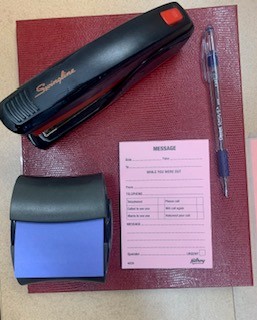
A stapler, a blue sticky note in a dispenser, a pink message pad and a ball point pen on a maroon notebook.
The Things I Borrow When I Am In A Hurry …

When she says “leave it with me”, my slumped shoulders straighten and I know that in a matter of minutes the process will have begun or a few days things will be sorted out.

How Can I Thank You? 

When I think of the many people who make my day easier, like you, I want to thank them.

I can’t carve something beautiful or bake something delicious for all the people who’ve smoothened out wrinkles in my work life.

But I can write.

So here is a huge thank you to all the wonderful colleagues who do so many things everyday: welcome students and families into our schools, connect the dots between different data bases, register participants for regional workshops, book translators for family-teacher meetings, check in about meal choices, bridge across work sites etc.

In your school and mine, there are many people who do many things and their work supports ours.

So here’s my wish, Fellow Traveller: I hope you also have someone in your work life who says “leave it with me”.

Please share this piece with them.

Please tell them I said hi.

With You, In Solidarity

Rashmee Karnad-Jani

Learning with Intention: 3 Tips to Support Developing Your Professional Practice

As I prepared for this school year, I thought about the books and other texts that I want or need to read to support further developing my professional practice. I focus on books and other print or digital written texts because reading is one of the primary ways I engage in independent professional learning. I also focus on books and other print or digital texts because reading is my preferred method when I want to build my knowledge in certain domains because I’m more readily able to retain and recall information, while also make connections between different concepts and ideas. Reading may be one of the primary ways that other educators learn while others may prefer to listen to podcasts, engage in professional conversations with colleagues, take additional qualification courses, attend professional learning sessions, watch videos, or combine some or all these methods. Whatever your primary or preferred method(s) for engaging in professional learning, the questions and tips below should still provide some insights to support your work.

To begin, I’ll share that I’m anticipating that this school year will be busy like others because I’ve just come to accept that the school year is a busy time. Therefore, I’m thinking about how I can be more intentional with what I choose to read so I best use my time and focus my energy. To help me think about how I can be more intentional with what I choose to read, I’ve been asking myself the following questions: What books or text do I want or need to read to further develop my professional practice? Why do I want or need to read them? What insights, ideas, or information do I hope to gain from what I plan to read and how can that knowledge support my work with students and colleagues? In sum, what are some gaps in my professional knowledge, how do intend to fill them, and in what ways can my professional learning translate to improved student learning?

I share these questions remaining aware that there are some texts that I know I/we will be required to read such as Ministry curriculum documents, board correspondence, Ministry and board policy documents, Ontario student records, and union memos. However, in this post I’ll share three tips that I plan to apply to my optional reading material to ensure I engage in professional learning with clear intentions that helps to further develop my professional practice. Hopefully others find these tips and insights useful and can apply them to their professional practice.

Tip 1: Identify Gaps in Your Professional Knowledge

When I think about what I want or need to learn to support my professional practice I first think about the gaps in my knowledge in one or more of the seven broad areas of what I think of as the knowledges related to teaching. I mean let’s face it to be an educator that positively impacts student learning, we need to possess a lot of different knowledges. Some of them include, curriculum knowledge, instructional knowledge, content knowledge, assessment and evaluation knowledge, pedagogical knowledge, knowledge of students’ cognitive development, and of course knowledge of the students’ cultures, identities, values, and their funds of knowledge.

Following a reflection on the gaps in my own professional knowledge I then select an area or areas that I identify are most pressing and develop my knowledge there. For example, this year I’ve committed to developing my instructional knowledge related to providing explicit instruction in the background knowledge students need to comprehend and compose texts. I’m focused on developing my instructional knowledge related to background knowledge because I understand it is an essential contributor to both reading comprehension and writing composition. I also know to effectively teach background knowledge I need to identify and understand evidence-based instructional approaches in this area.

Tip 2: Learn with Intention

Having identified one gap in my professional knowledge and understanding why I believe I need to fill that gap, the next tip is to engage in professional learning with intention. For me this means asking myself questions then finding answers to those questions. For example, when I first began reading about background knowledge some initial questions that guided my learning included, what is background knowledge? Why is it important? Meaning how does background knowledge contribute to students’ comprehension and composition of texts? How do I help students gain the background knowledge they need to comprehend and compose the texts I use to teach? Specifically, how do I know or figure out the background knowledge that students already have and further need to acquire so they can adequately engage with certain texts? What’s the difference between background knowledge and prior knowledge?

Having found some answers to the questions listed above from reading books and research articles (See my previous two posts where I share what I’ve learned about background knowledge), I’m now focused on finding more evidence-based instructional strategies to support providing explicit instruction in background knowledge. To help, I plan to read the article, Building Background Knowledge by Susan Neuman, Tanya Kaefer, and Ashley Pinkham, where the authors identify five instructional strategies to support students in developing the background knowledge they need to comprehend and/or compose texts.

Tip 3: Write for Consolidation and Retention

To consolidate my understanding of the texts I read and to further support my professional learning, I plan to either write a summary or identify one or two insights I gained from reading the texts to affirm my comprehension and support retention. Research on writing has found that when a person writes about what they read, it not only clarifies their comprehension of the text but also supports retaining the ideas. Researchers Steve Graham and Michael Herbert share these ideas in their report, Writing to Read: Evidence for How Writing Can Improve Reading. Writing for consolidation and retention is not only a strategy that I plan to use to support my professional learning but one I plan to employ with students.

Let’s grow something! 

Hello Fellow Travellers,

April has left behind a warm May and when the sun isn’t shining, it’s been cool cloudy Khandala (please look it up) weather.  There have been many things to go at work and much time to play: both aspects a reflection of the privilege one takes for granted when one gets to being in a certain place in a certain way. There’s that Standard North American Family * shelf on which one lives.

Before Work, I Play

When I first started teaching in 2004, I began at an early start school so I’ve  been in the habit of waking early. A huge help with meal prep and a quiet cup of coffee when raising young children back then. Nowadays as I’ve got more time and less mothering work to attend to, I look around and I peer.  There are many thoughts running through my mind that my botany courses do not explain anymore as this is a connection that goes beyond scientific knowledge and leaf identification skills.

“There you are!”, I whisper

“You came back after the winter”, I say.

“Oh my goodness. You’ve got many more little ones along the fence now!”, I celebrate.

Looking Down and Planning Up

Just as one indulges people in one’s life they reciprocate as well. When they were younger, my children would remark when I’d walk about in early spring on this space or elsewhere: “Mamma is peering at the ground. Something is growing there”. I do this in every area of my life. I peer and I wait patiently.

I also work to create conditions that will allow that which is growing to thrive.

Transferable Skills: The “Remember-When Mindset” (Karnad-Jani, 2025)

Recognizing potential and creating conditions for growth and thriving is a skill. We can learn it. We can practice it with critical and kind friends and colleagues who know the heart and art of teaching and learning.

I work hard to strengthen the skills in in one area of my life so that I can use the “remember when? mindset” to support myself and others in another area. I am sure there is a theory for this somewhere and a fancy name in a book, but to me, it means noticing that something is sprouting and how when I and you create conditions for roots to go down and stems to grow upwards the young seeds become plants and the seedlings become shrubs and trees.

Let’s Grow Something Together: The Sunflower Lesson

A few weeks ago, I planted sunflower seeds outside but brought them in on the mid-May long weekend due to the cooler temperatures. I noticed on Saturday that sunflower seedling had flopped. I gently poked in a wooden stick beside it and on Monday I notice that it doesn’t need it anymore!

Sunflower Seedlings On Their Own

What does that tell me? Scaffolding and support to those who need it, allows seedlings to strengthen without expending energy to prevent bending or breaking. I take this insight with me into all areas of my life and also sharing with you, my fellow travellers.

Sunflower Seedlings After Support

With You, In Solidarity

Rashmee Karnad-Jani

  • The Standard North American Family, says Smith, is an ideological code that informs the biases by which we see particular families as deficient because the ideal of SNAF is a two-parent, heterosexual family where the father’s work allows the mother to attend to the children’s schooling and educational outcomes. It is also important to notice that race is a critical intersection within SNAF (Karnad-Jani, 2021).

Teaching Reading is Equity Work!

For the past several years, my annual learning goals have centered around deepening my understanding of Structured Literacy—an approach rooted in the Science of Reading and grounded in decades of research into how children’s brains acquire and process written language.

As educators, we know that teaching reading is not just an academic goal—it is a matter of equity. Ensuring that all students receive access to high-quality, evidence-based literacy instruction means we are actively dismantling barriers to learning. We are building a culture of belonging, wellbeing, and opportunity.

Structured Literacy prioritizes clear, intentional, and research-informed instruction. Here are the core principles that define this approach:

  • Sequential
    • Skills are introduced in a logical, developmentally appropriate order, with careful scaffolding to ensure mastery before moving forward.
  • Explicit
    • Instruction is direct, intentional, and interactive. The gradual release model—“I do, We do, You do”—supports learners through modelling and guided practice.
  • Systematic & Cumulative
    • A structured scope and sequence ensures instruction builds progressively, helping students connect new learning to prior knowledge.
  • Diagnostic
    • Assessment is ongoing and timely. It drives instruction and allows educators to respond to students’ evolving needs with precision.

If you are beginning your journey understanding the Science of Reading and Structured Literacy, it is encouraged you to explore the resources listed below. The Margaret Wilson Library is a great place to check out books !

  • Supporting classroom practice: Lessons language curriculum 2023 (ETFO)
  • Shifting the Balance by Katie Egan Cunningham, Jan Burkins, Kari Yates
  • 7 Mighty Moves: Research-Backed, Classroom-Tested Strategies to Ensure K-to-3 Reading Success, by Lindsay Kemeny
  • Know Better, Do Better: Comprehension: Fueling the Reading Brain With Knowledge, Vocabulary, and Rich Language by David Liben, Meredith Liben

The Importance of Questions (Part 2)

Noticing The Questions

As I  composed this piece in the last weeks of December, I was aware that it has the potential of being more than a 2 part piece. I continue to notice questions in everyday professional spaces. Questions asked around me stand out because the language that goes from seemingly innocuous talk to formal texts that in turn guide trajectories of educational work and the outcomes for students.

If those outcomes unfold on paths of equity and social justice, I always look deeper for the driving gear: who is the person – parent, family friend, educational worker or combination of all three or more who have made it their mission to ensure that that student achieves their fullest potential. 

Also, sometimes the topics I write about invite readers to take a deep and honest look around so that we can be authentically inclusive in our professional practice towards all with whom we interact. A twinge here and there is therefore okay, it helps us sharpen out growth mindset as ETFO members.

Some Spaces Are Special

A black metal park bench beside a walking track with three red-leafed trees behind it. The grass around it glows in the sunshine
A Special Park Bench (Karnad-Jani, 2024)

Notice this beautiful bench situated along the walking track around the cricket pitch beside the school with the gorgeous sunrise where I worked for 14 years. In 2018, after considering many factors, mostly around breathing room and well being, I had decided to move to another school. But I still walk here every season as long as the paths are ice-free. So it was that one late summer in the last week of August, shall we say, I met up with a former student now an educator who wanted to talk through some career decisions.

Such walks are mutually supportive as I can give back to the communities of practice that steady me and another educator can have an unconditional space to air their ideas and possibilities. We walked a few laps and sat down to take in the view. A warm breeze was blowing and I was thinking of 6 students in my last three years at this school with whom our team used to walk this track daily for our observation skills, social skills, and conversational and communication goals with our flip and talk books etc. One student had clearly described this very bench as “A park bench is like a chair that’s outside. It is longer than the chair inside our class and you can’t pick it up.” How delighted we were at this description! It is one of the special memories of that time


What are YOU doing here?

Just then, someone I knew from years ago stopped in front of me and demanded, “What are you doing here?” and without waiting for a response, walked on.  My walking companion was as startled as I was at this interaction if one could call it that. “What was that, Ms. Karnad-Jani? They did not even wait for a response.”

My heart beat quickened from past memories of having faced this question in various spaces. 

Deep breath in. Look around. Exhale. I was glad I was in a beautiful space outside that helped me compose myself. We walked some more and that was that.

I have thought about this question often as it appears in our lives in many ways.

When one is asked “What are YOU doing here?”  we can claim space individually and collectively to support one another when this question comes up  that may challenge our very presence in some, many, any spaces.  

I am sharing Claiming Space: Self-Identifying With My Union from 2018 which is always relevant. Also please read the Letter from the Editor highlighting the writing from the issue in which this article was published.

Also, always consult and implement the guidelines outlined in ETFO’s Terms of Use when using any published materials in professional learning and elsewhere because all of us who write academically and professionally work very diligently to think about the ideas we share with you. 


"I am ETFO" button with the word "also" added in reads " I am also ETFO"
I wear my “I am ETFO ” button proudly.

With You, In Solidarity,

Rashmee Karnad-Jani

How did I do?

This is a busy time for ETFO members. It is also an important time of the year for students and their families.

The first term report cards have been written , reviewed, revised and are being prepared to be distributed. In addition, there are IEP updates to complete for Term 2. What we had planned to teach, that which was taught and assessed, now moves on the next stage of communication with our partners in education – students and their caregivers.

The Importance of Report Cards
Report cards are institutional texts that contain important information because they determine a student’s trajectory through the K-8 panel and from there, to and through high school.
These texts also greatly impact what families do with the time and material means that they have at their disposal after they receive report cards.
I remember a mother who participated in my research in April 2019, an Occasional Teacher in the GTA at that time, who had said that she bought practice books for her children from garage sales before she started working and bought them in shops after she had a job. Affordability of resources is a key factor.
Whether families have experienced challenges to access education in their lives or have had many equitable opportunities, all families and caregivers want positive educational outcomes for their children.  We may not all speak the same language, have identical accents, worldliness or insider language of education, but all  caregivers do their best with the material means that are available to them. This we know.
Sometimes, that which is seen as reluctance or reticence can be the result of huge burdens that some families carry as well as broken trust due to the experiences families have had. But that is another thought for another time.
A and E Professional Learning: What do I do?
I read the ETFO bulletin board regularly when I am in the physical work space, and I also read ETFO emails promptly.
As a centrally assigned special education consultant, I work in classrooms alongside teachers and students. On colleagues’ invitation, I support IEP writing. I also co-plan and co-teach.
Sometimes, I am invited to work with colleagues when they write report cards. They may ask me look over student work with them and we engage in rich conversations.
I believe that engaging deeply in ongoing learning strengthens my professional judgement.  Our local offers professional learning workshops on a variety of topics and one that recently caught my attention was on assessment and evaluation.  It was very valuable learning delivered by one member from our local and one member who was from another local.
By Us, For Us, With Us
Professional learning designed by members for members based on the areas that we want to focus on, is a great way to strengthen one’s practice. The PL committee at our local spends time thinking through these aspects. After the committee sends out surveys asking about our PL needs, the gathered data are used to curate meaningful PL offerings. This is much appreciated by me and many. The sessions fill up quickly.
Especially with new curricula guiding our work, thanks to this Assessment and Evaluation PL, I feel a sense of shared purpose with my colleagues.
All of us, as ETFO members can access this learning and have a common platform and language related to A and E. I am therefore sharing ETFO’s Assessment and Evaluation page.
I use it often and I add it to the list of resources I curate for colleagues when they ask for specific A and E related strategies. I invite you to review the resources here. Please use them and share them with others. Whether you are an early career member and an experienced member, we all benefit from ongoing learning.
An orange rectangle with the words "ETFO Members Sharing in Assessment. ETFO's logo is in the top left corner.
ETFO’s Assessment and Evaluation Page

The tabs at the top of the page lead us to important information such as:

  1. Assessment For Learning (AFL) Cycle
  2. Tools
  3. Tools by Division
  4. The ABOUT link consists of a webinar on the main topic of A & E followed by sections on Assessment For Learning, Assessment As Learning and Assessment of Learning.
Please check out the PL offerings from your local. Visit the ETFO bulletin board in your worksite.
Just like students, I also wonder sometimes “How did I do?” So, thank you to all who are leaving comments in response to my writing and are engaging in conversations when we meet in schools and work spaces as well.
With You, In Solidarity.
Rashmee Karnad-Jani
Shifting to an Asset-Based Lens to Support Student Identities

Shifting to an Asset-Based Lens to Support Student Identities

January is a busy time of the year for many educators: collecting various forms of data, reviewing grade books, collaborating with families and colleagues to write Term 1 report cards and goals for Term 2 IEPs (Individual Education Plans). During this time, it is important to reflect on how we communicate about learning. Language plays a pivotal role in this process, and adopting an asset-based approach is key to maintaining high expectations and supporting students’ identities.

The Ontario Ministry of Education’s Growing Success document encourages educators to adopt an asset-based approach when describing student strengths and areas for growth. This practice shifts the focus to potential, emphasizing the learning and progress.

Examples of shifting language

Instead of saying… 

  • This student is weak in identifying numbers to 20
  • This is a Level 1 math student
  • This is a Spec Ed student
  • This student cannot speak English

Shift to say … 

  • The student’s learning of identifying numbers to 20 is emerging.
  • This student is currently demonstrating a level 1 in number sense
  • This student has an IEP
  • The student is building their English proficiency 

The Impact of Language on Identity

Notice how what we say can also indirectly impact a student’s identity? 

What we say about students—to families, colleagues, and the students themselves—shapes their identity as learners. Asset-based language communicates that we believe in their potential and growth. Having brave, critical conversations with colleagues about this shift is challenging. However, this shift in practice helps ensure that all students can achieve, regardless of their starting point or identity. 

What are your thoughts on this?

You Deserve The Best of Me

My photograph of the sunrise in Markham, Ontario from 2015 Winter

Sunrise Thoughts

It is still early Fall in Ontario. Recently, my day was spent in a Grade 1 classroom at an early start school from 7:30 where I set down my bag and took a deep breath as I got out of the car.  I especially love working at early-start schools because I started my career at one in 2004 in Markham, Ontario. A new building, then in its second year that still had its new-building aroma and shiny science lab that became my classroom for some years as I taught Grade 7 and 8 science before I moved on to other assignments. I worked there for 14 years and carry this place in my heart. 

This school has a protected forest tract behind it towards the east and because I would reach early, I always stayed a while and enjoyed the view, Fall to Summer. The sunrise always showed up and the view was always beautiful. I often refer to this special space as “the school with the beautiful sunrise” and write or speak of it this way. 

Back in 2004, this school was set amidst new houses and some construction spaces. There were no other built structures there. No park yet, as that came much later.  Now, years later, there is a cricket field with a well planned walking track, cement risers with a beautiful red roof over them and batting nets for cricketers to practise. In the summer when I walk there, some evenings the stands are full with community members watching the practice and jubilant cries of “Howzzat!!!” bring a smile to my face. 

Keeping Time 

We keep time in many ways and cricket nets can also be one. Every Fall, the tall poles that hold up the nets around the cricket pitch (a cricket ball is hard, no kidding) are attended to by the City of Markham, the nets folded up and tied back neatly. Every Spring, they unfurl, bringing the promise of warm weather and the familiar thwack. A dear colleague who works in this classroom that we set up together with two other colleagues messages me and sends a picture: “The nets are going up”.  

I know that for all of us who remain deeply connected to colleagues and spaces and fond memories it is possible for heartstrings to stretch across time and space. We become fellow travellers.

Learning Together

When there is authentic mutual respect, a shared goal to support learning outcomes of all students, and we strive to work together towards student well-being, we can support one another in our everyday work in meaningful, respectful and sustainable ways.  

I am currently in the role of centrally assigned teacher in my school district. In this role I work in schools alongside colleagues to provide professional guidance to support their students by co-planning, co-teaching, co-debriefing and co-reflecting.

In this capacity, I remind myself that colleagues in the classrooms I visit deserve the best of me. So how do I ensure that?

ETFO defines Professional Judgement as highlighted below.

“Professional judgement is defined, in part, as “judgement that is informed by professional knowledge of curriculum expectations, context, evidence of learning, methods of instruction and assessment, and the criteria and standards that indicate success in student learning.”

This definition is what I hold up before me as I enter the spaces where colleagues and their students spend their school day. I ask myself daily: Is my judgement in this interaction informed by the following?

  • Professional knowledge of curriculum expectations
  • Context (school, classroom and communities)
  • Evidence of learning
  • Methods of instruction 
  • Methods of assessment
  • Criteria and standards that indicate success in student learning

I also regularly check these ETFO Guidelines for Professional Judgement to understand what my strengths are in the outlined areas and what are my professional learning needs. And I seek support so I can support you and through you, your students. That is the path.

Like you, I do not use the term Professional Judgement lightly. When I speak with my colleagues and administrators who have invited me to work alongside in schools, I want you to be able to trust that I have the professional knowledge and skills from which my recommendations come.

I understand deeply that this word is not intended to hinder professional dialogue or to protect my privilege.  When my professional judgement meets the criteria that ETFO continues to share regularly, I am confident that you  have the collaborative partnership you deserve through which you can in turn support your students.  I am sharing an article “Exercising Your Professional Judgement” featured in ETFO Voice

So when I meet you or see you again, please trust that I bring with me my Professional Judgement to the spaces where you welcome your special sunrise.

I continue to add to my knowledge and practice my skills because you, your students, your families and communities deserve the best of me. 

With you, in solidarity.

Rashmee Karnad-Jani


lost and found

I am not sure why the title of the thought stream to follow sprung forth to wrap this month, but I will roll with it just to see where it will flow.

We have had one heck of a March at the speed of learning. With 70% of the seeds of this instructional year plan already planted, it looks to be an exciting and busy 3 months of tending, nurturing, and harvesting ahead.

It’s Spring. It’s new years and reflection and remembrance for some. It’s resurrection time and Ramadan for others. It’s also the annual rebirth of nature and reflection that we have all been waiting since the first snows of winter blanketed our outdoor spaces.

lost and found

I have been thinking a lot about what is mine and what is not. I can pinpoint the most recent moment that precipitated the throughline of this piece too.

In our school caretaker’s work room there was a dolly full of about 8 large plastic bags and a number of boxes. Curious, I took a closer look and happened to see that the bags were full of clothes that had accumulated between the Winter to Spring breaks. 8 bags. This got me wondering about a couple of things beyond the obvious: How could a kid lose boots or a winter coat and not know they were missing?

Perhaps I have gotten used to this scene playing out over the past years in schools, and have become comfortable in knowing that the thrift shops in our community always benefit from receiving the goods. Hence why they were on the dolly ready to be delivered. However, a few thoughts still linger.

I started to wonder about how much we have to lose before we realize/recognize/know it’s gone? Is it too late once we do? Have you ever found something that had been lost and forgotten about? This seems to happen each time I organize my materials, especially for science, for a new unit and when I move classrooms/schools.

In those moments I am hit with multiple memories of past lessons and classes. These times have also come with my own version of a Marie Kondo intervention. Was this item useful? Did it bring my students knowledge and understanding? Does it bring me joy when I used it? Will it still be able to serve its purpose going forward?

Many times, the answers have been no, not really, and result in a new home in the recycling bin. This has been hard for me as I have horder tendencies when viewed through the educational lens. I am guilty of keeping things even when they no longer serve or survive their purpose. It has only been recently that I have worked through this challenge.

Happy to say that my own personal dolly loads have decreased as the years go on. To this day, I do not regret recycling or giving away any of my resources although I have retained some digital versions of a few on USB.

So what about losing someone?

Spring is also the time when many educators seek new schools, get surplused, or retire. I know this very well being on my 5th school in 15 years. The necessity/choice to make a move can be exhilarating, nervewracking or both. In each of my cases, it meant losing one community and then finding it again but in a new ecosystem.

Along the way, I have tried to maintain some connection with staff from each place, but it also comes with the need to accept that absence makes you irrelevant when you are not sharing the same spaces. The pandemic really amplified this fact as we used to be able to catch up at PD or larger conferences, but those opportunities/reunions have yet to return. Whenever it does happen though, reminds me of the positive experiences gained from those times together. Despite the distances, some strong friendships have remained regardless of the bricks we work within now. Even though there are few guarantees when making a move, the opportunity for growth will be there for you.

I guess my point here is that it is worth the effort to keep in touch even if it is only once a year. Yes it can be time consuming, but it can also be a breath of fresh air, like Spring, to hear from someone you used to work with when they reach out. I also know that it can be equally joyous not to hear from others. Thankfully that is not the majority of my experience, but I won’t speak for former colleagues.

Sometimes you have to get lost to get found and whether it is in reinventing your classroom approach, moving schools, or seeking out connections with past and present Spring offers us a perfect time to weigh what is important and not so important, what brings us joy and what can be appreciated when looking back.

I wish all of this for you whether you move, move on, or stay put for another year. May yours be the joy that fills those spaces.