Music Centres to support guided instruction

Just like reading and writing, music is a subject that needs built in time for guided instruction to meet students’ needs. While I have been doing guided instruction with a small group of students, the rest of my students have been working on skills that they needs to refine at Centres.

Here is what a lesson plan looks like in my class with Music Centres:

Grade: 4

Assessment for learning that informed this lesson: Students have written one piece of music on the staff 3 weeks ago. After individually performing their piece for the teacher, I have identified that playing the correct rhythm and blowing less on the lower notes are two areas of need with this class.

Grouping of Students: Students have been placed in heterogeneous grouping in order to support learning when doing independent practice.

Duration: This lesson will take between 3-4 classes to complete.


Curriculum Expectations:

Grade 4 music expectations: C1.3 create musical compositions for specific purposes and audiences (e.g., write a composition for recorder using musical notation on the five-line staff)


Minds-On Activity:

Think-Pair-Share

Ask students “When you have a new piece of music to learn, how should you learn it?

Review the following steps to learning a new song.

  1. Read and say the rhythm of the song. (Ta, ti ti)
  2. Read the notes of the song (B, G, E)
  3. Read the notes according to the rhythm
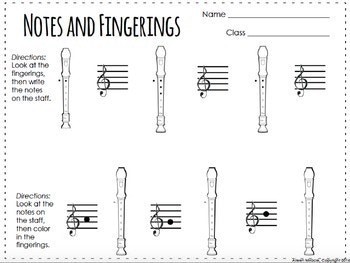
  4. Finger the song on the recorder
  5. Play the song

Apply the steps to an eight-beat piece of music


Action:

Students will participate in 6 centres that focus on the development of skills required to write compositions on the 5 line staff.

Centre 1: (with Ms. Axt) Students will have guided practice in writing and performing their own 8 beat piece of music on the recorder following the steps for learning a new song. The requirements of their created song will be in line with their next steps from their previous assignment.

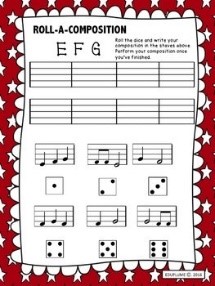
Centre 2: Roll and Compose. Students will compose their own piece of music by rolling a dice. They will record their piece on an Ipad with an introduction about how they make a good sound on the recorder.

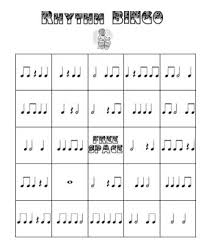
Centre 3: Rhythm BINGO. One student will be the BINGO caller as others try to find their rhythm on the BINGO card.

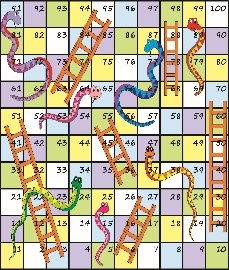
Centre 4: Students will play the game musical snakes and ladders. This will help them review the beat quantities for each rhythm symbol.

Centre 5: Creating and recording their compositions. Students use cards provided by the teacher to write their own piece of music and record each other on the iPad for the teacher to review after class. Students will add an introduction about how they read the notes on the staff.

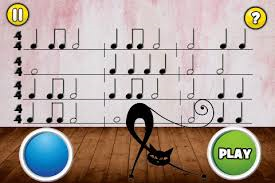
Centre 6: Rhythm Cat: Students will use the app on the iPad called rhythm cat. This app gets progressively harder as students can play more difficult rhythms. Each student will have their own tablet and headphones.

centre 2Centre 6centre 3centre 5Centre 4


Setting Students with Special Needs Up For Success in Music

For the past eight years, in my role as a planning time teacher, I have had the privilege of working with over 50 students with a variety of special needs. Our school has been fortunate to have 4 different types of contained classes and students with a variety of special needs in the mainstream classes. It has been important to me to ensure that all of my students are successful regardless of their needs. I have set them up for success by implementing some consistent practices in my program.

Students have come with a variety of needs to my classroom. In addressing those needs, I have set goals for their alternative and modified IEPs, followed PBIPs and helped to create social stories. The contributions to these documents have ensured that students’ needs are addressed and that their best interests are taken into account.  Goals have been academic, social, and life skills oriented.  For example, skills such as taking turns, coping with a noisy environment, and transitioning between spaces have been areas that my students have worked on. If you are not sure how to write IEPs or contribute to behaviour plans I recommend the following resource from the ministry of education which will be helpful for writing your first IEP. IEP Resource Guide

ERFs have been important teammates in positively impacting student learning in my class. I don’t know what I would do without their talents.  It is important to be able communicate effectively your expectations for the students they are assisting. I know that I am responsible for planning for my students with special needs but I am open to the ideas and suggestions of our ERFs, as they know the students they work with very well.  ERFs are an integral part of my classroom and are included in the structure of our day to day activities and routines.

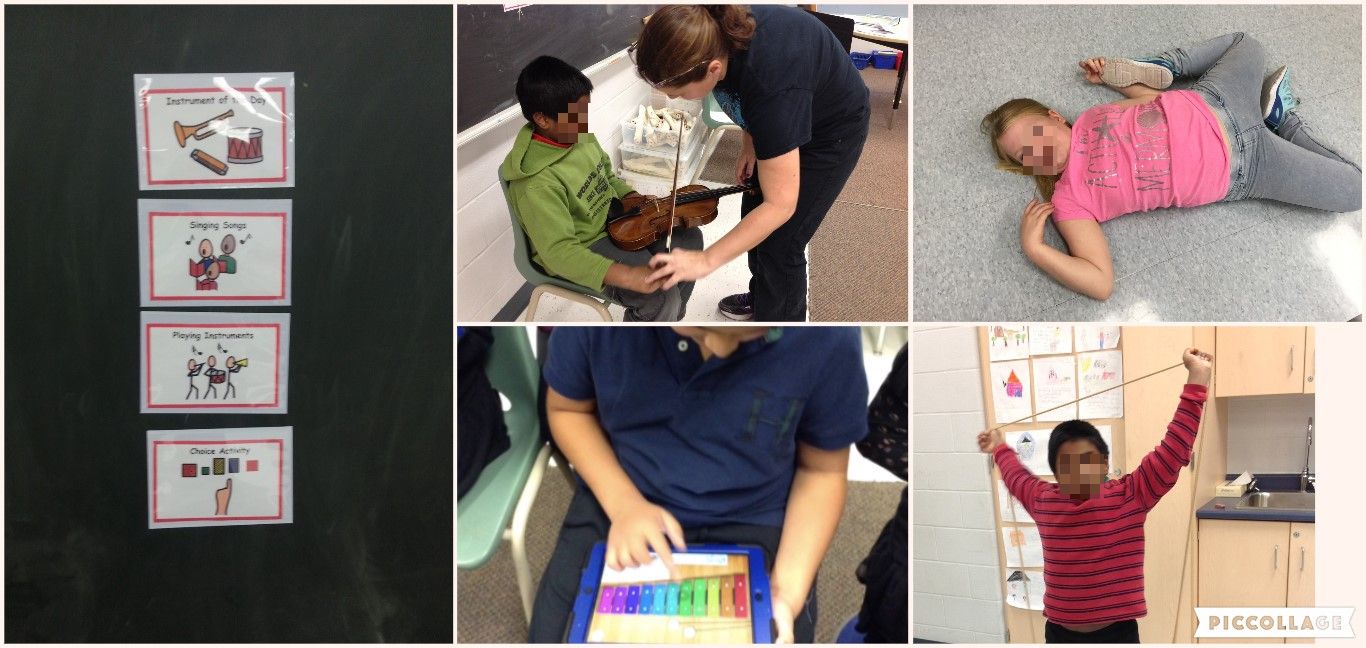
For students with special needs, a predictable environment is very important.  Knowing what will take place during their day helps them to feel safe and secure.  This feeling of security minimizes the chances of students having outbursts and other behavioural challenges.  I have used visual schedules, verbal, individualized prompts, and clear instructions and expectations to ensure that students know what to expect.

With my music and drama background, I provide an engaging and interactive environment for students.  Singing songs and movement are incorporated into many activities.  They are encouraged to show their creativity and their individuality.  Planning is done to include materials and activities that highlight students’ strengths.  Humour is an essential part of my classroom environment.

In making all of these elements a part of my practice, I know that I have set up my students with special needs, both past and present, for success.

contained collage 2_censored


contained collage_censored

Define and defying (smart) device use

photo by sik-life CC0

There’s more to Modern Learning than delivering lessons on to smartphones.
There’s more to Modern Learning than having a paperless class.
There’s more to Modern Learning because there just is…
And I’m fine with that because there is more to Modern Learning.
So much so, that we are seeing more and more educators trying to define it even if others seem to be defying it.

Walk into a K- 8 classroom and you’ll most likely see students and teachers using smartphones, tablets, MS desktops, Apples, and Chromebooks. Perhaps they’re inquiring about a recent lesson, or digging deeper into a passion project during Genius Hour? Maybe the whole class is playing Kahoot with their French teacher?

From a distance it looks amazing. I have been the teacher who has witnessed all of the above and I’ll throw in a Google Classroom, TED Ed Lessons, Padlet, and raise you a Twitter. Can you hear the government types and administrators applauding and patting themselves on the back for allowing it to happen. However the applause should be for the educators who have led the charge to implement Modern Learning into their spaces. They are willing to take risks, try new things, and make mistakes to reach their Modern Learners. Teachers are in the trenches of learning everyday and understand the what, why, and how of their classrooms.

Outside looking in

To outsiders, visions of devices and technology in every hand sum up their understandings of modern learning. A cynic may equate Modern Learning as simply a shift from text books and worksheets to students completing digital versions of the same old thing.

Keep in mind, “Modern learning” is not limited to tech use alone, but will be for this post. Technology in the hands of educators and learners has now become the conduit through which learning takes place. When modern tools and passionate instruction are paired, learning becomes more relevant and engaging to students. Imagine being able to ask a question and have time to search for the answer immediately with only a few keystrokes and clicks?

“Technology’s primary effect is to amplify human forces, so in education, technologies amplify whatever pedagogical capacity is already there.”                  Jørgen MORTENSEN

Board wide access to WiFi means more and more students are taking notes during lessons using the technology at their fingertips. At the same time, teachers are gathering evidence of learning too.  And, still others are watching a cool cat video or streaming music? It’s all possible in the modern learning classroom. However, as many educators have already discovered, the use of smartphones can be a friend and foe in the classroom and comes with a few caveats. Modern Learning

A smart device is a tool in the learning toolbox not a cure all. It is not the only one and as such should never be relied upon for a quick fix or for ushering in the ‘educational renaissance’. Consider what Jason Lodge writes,

Enhancing education is a complex, wicked problem because learning and teaching are multifaceted phenomena, involving biological, technological, psychological, social, economic and pedagogical factors.

Reading this provides little comfort to my understanding of Modern Learning. In fact it leads me deeper down the rabbit hole in pursuit of understanding it better. Despite the wonder promised by all of this technology, students are still engaging with it far more often to connect and communicate rather than curate, create, and collaborate on content.

True story time

The other day I observed a grade 6 student using a device at an inappropriate time. As I approached, she quickly hid it(an iPhone 6+). Like a phablet that size can be hidden. I asked what she was so consumed by on her device that she was defying school policy? She shared it was a fan site for Ariana Grande.

Not the worst use of WiFi by a student, but off topic to be sure. After a few more questions I asked her to explain to me what she liked about Ariana Grande. We chatted about the March For Our Lives rally and about her performance. The convo continued and I got to know more about the student rather than defaulting to a YOU SHOULD KNOW BETTER moment, followed by the standard lecture on appropriate use of technology.

Maybe this approach can be considered as Modern Learning too. If not, we can call it Modern Pedagogy that builds relationships and connections before asking students to fall into curricular compliance without context. Maybe Modern Learning has to be willing to defy convention?

By taking the time to discover her interests, some barriers were taken down. It was only afterwards that I suggested that classtime was intended for curriculum, and that I would suggest a Genius Hour activity in the near future where she could combine learning with her personal interest in Ms Grande – all the while helping other students discover, scratch, and share their own intellectual itches.

Another approach

At other schools, students are now required to lock their smartphones away for the learning day as an effort to reduce misuse and device distractions. What the link did not mention was that the school probably has students on computers or tablets as part of the instructional space. Anyone who has booked a computer cart or lab knows that students can become as easily distracted by these tools too.

So what ends up happening are these absolutes and dictums from class to class and school to school. It is obvious that some teachers are more open to embrace this more easily than others. Perhaps it is an admin or system issue, but there does not appear to be a consistent policy about device useage in schools. The dissonance in all of this for me is that we ask our students to innovate, we give them the most amazing and powerful learning/communication devices on the planet and then expect them to be able to put them aside to listen to a lesson that is being pulled from a text book or source older than they are. In other cases, students are creating multi-modal masterpieces of identity and ingenuity.

How about engaging and empowering them to use their devices for everything that is possible, trusting them to make good decisions, and having them create the criteria for use in classrooms? At the same time, educators can model appropriate use by sharing documents, links, updates, and evidence of learning via Twitter or class web sites.

The technology is not going away. The when, where, why, and how it will be used needs some defining so that students are not seen as defying school when they use their devices. Then maybe Modern Learning can be more than just more with technology.

Extra Fuel for your Modern Learning fire;

https://www.theatlantic.com/education/archive/2015/06/why-technology-alone-wont-fix-schools/394727/


“Bee”ginning Inquiry Part 1

The Provocation

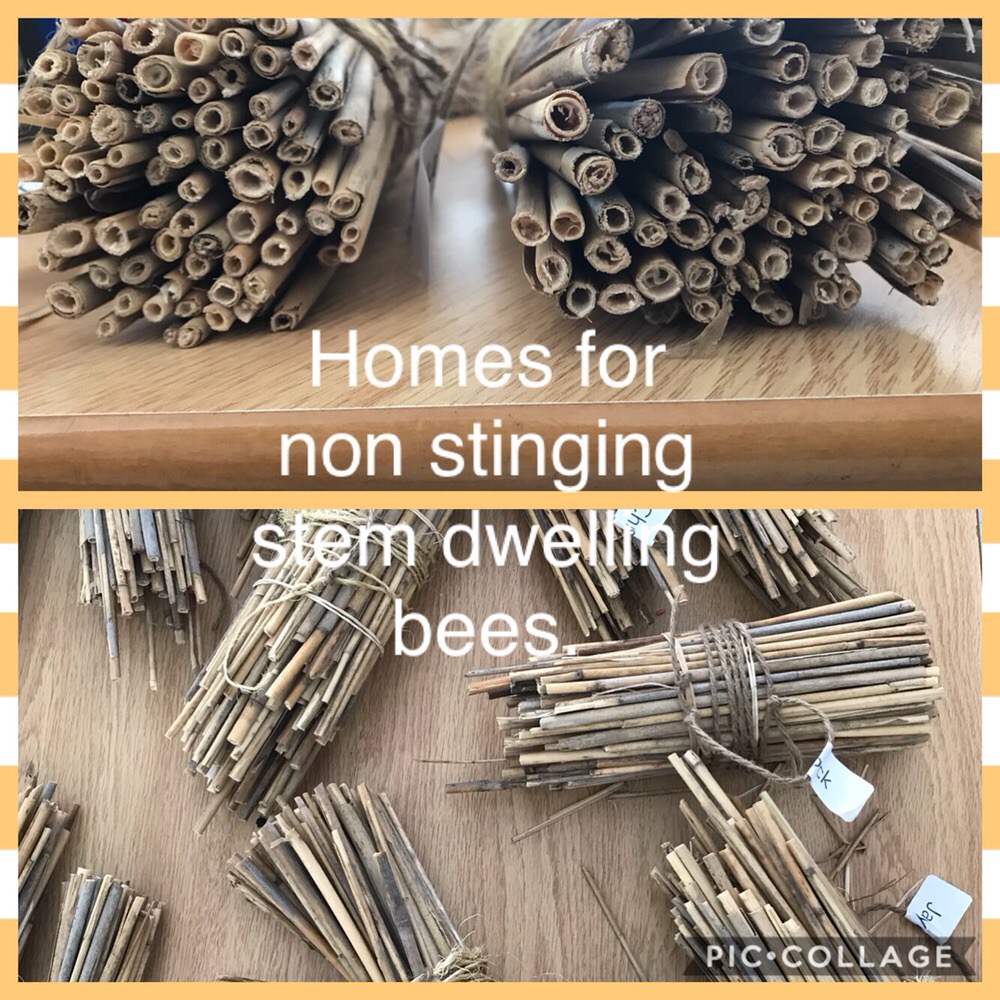
After many years of marriage my husband realizes that any trip outside the house might result in bringing home something that will inevitably end up in my classroom.  Generally a trip to Costco is pretty safe.  I might come home with a few books for the classroom library.  A few weeks ago, however, we came home with a bee house.

6F771D71-F60B-48D5-B84F-6986EC522232


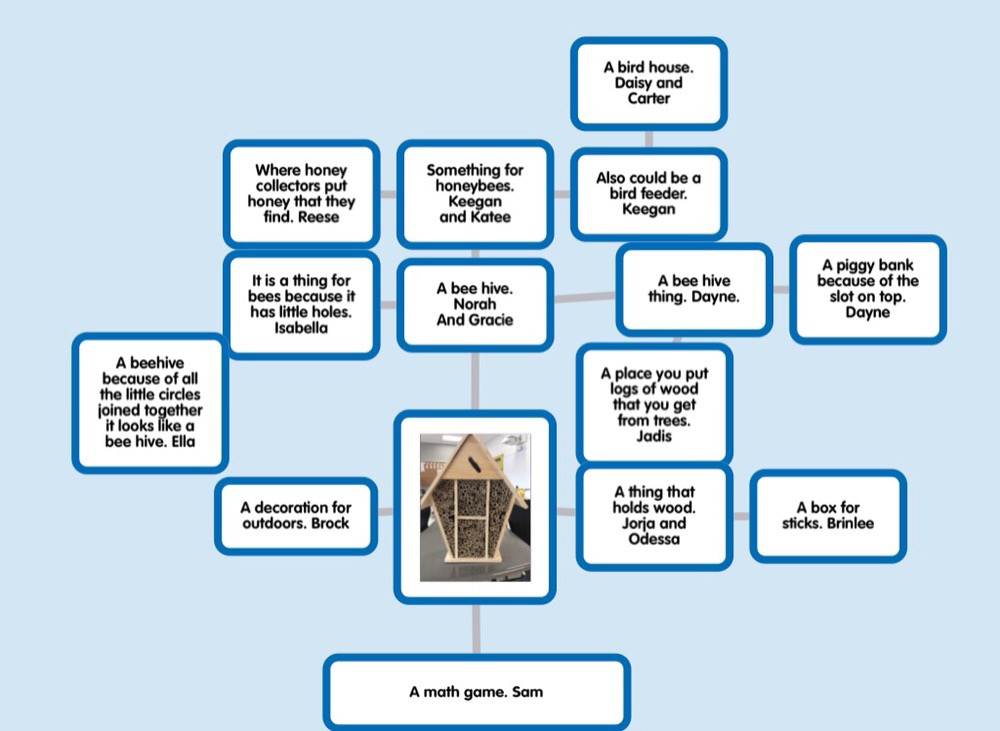
I took off the label and took it into the classroom.  I set it on the desk at the front of the classroom.  When the students came in the next day I asked them to write about what they thought it was used for and I got quite a few different answers.

F7CEADA6-CA74-4D18-BAE5-2AA0699E491B

 Made with Popplet

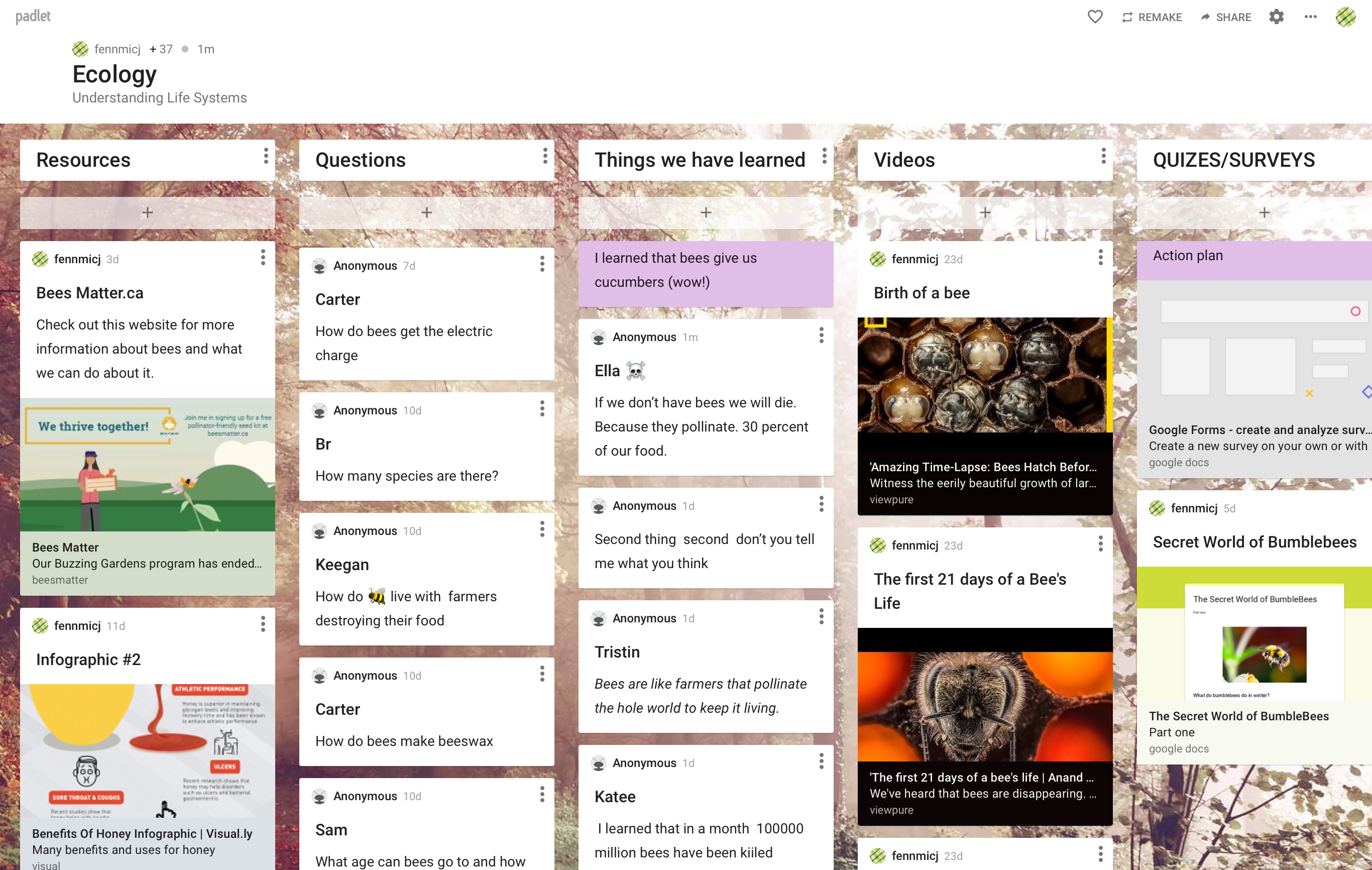
When they came to the conclusion that it was indeed a “bee house” for non-stinging, solitary bees; the students then began asking questions and the biggest, burning question was, “Why do bees need houses?”  Why indeed?  I suppose we’ll have to find that out!  I am not an entomologist.  This is new territory for me but I was interested in the whole “Save the Bees” movement myself.  Knowing that this provocation would quite like lead to a burning question for inquiry, I had already created a Padlet with all kinds of links to videos that were relevant and that I had screened and removed advertising.  You can purify videos using a website called Pureview .  Of course, this was only the beginning.

EC9C65CF-A76F-4822-8821-9A939D31CF6C

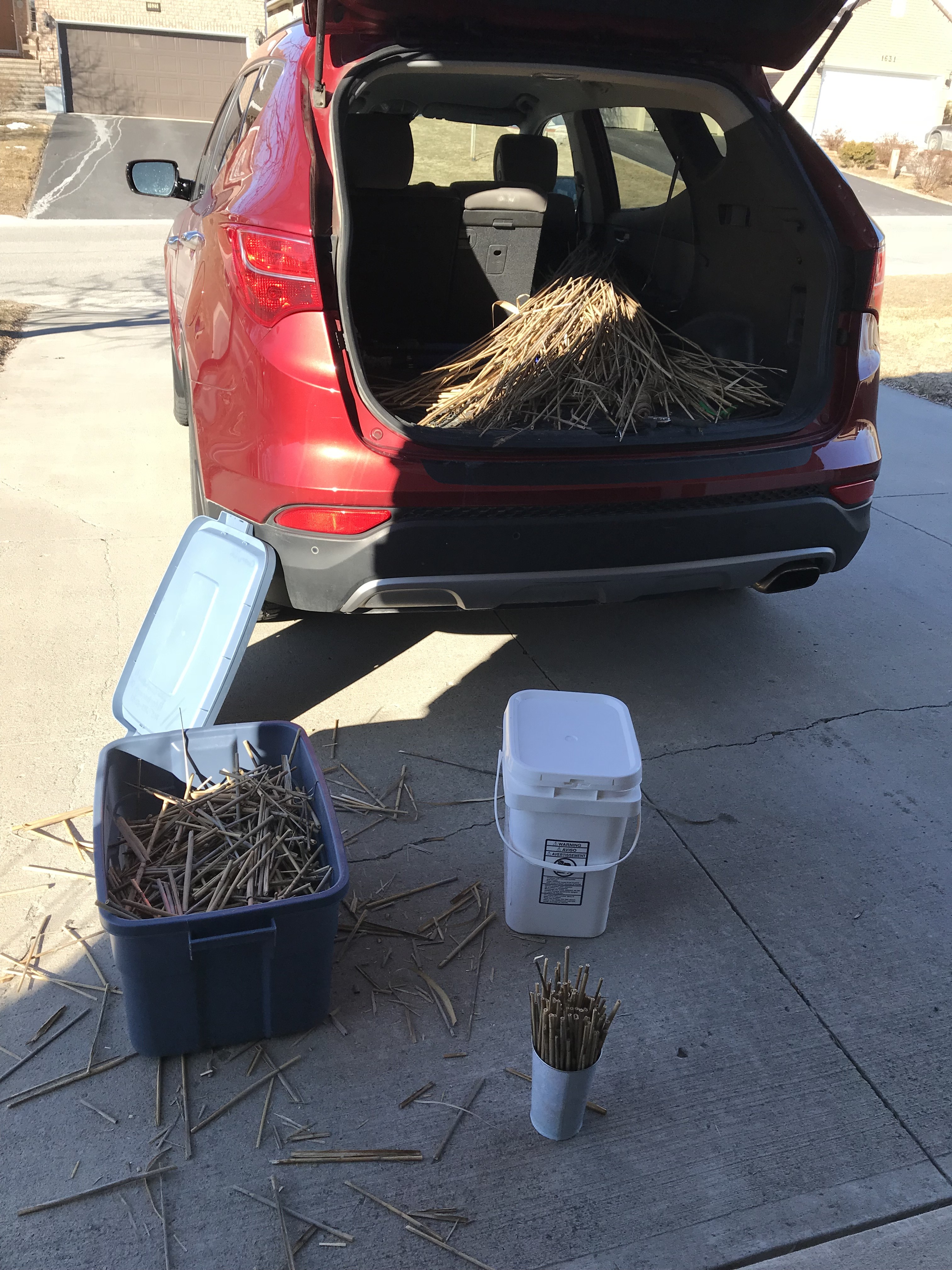
One of the websites included an article about a local researcher; Susan Chan.  We went about contacting Susan to ask a few questions but as inquiries often take a life of their own; it got much bigger!  Susan offered to come in so the students could make their own bee houses.  So my husband and I were off to the local ditches to find and cut the plants needed for the task.  My husband knows not to ask questions when I say things like; “I need to go and find and cut some grass that grows near swampy areas in ditches.”  He is a committed husband of an elementary teacher.

37C5BEE5-9FE9-4936-B258-08E7393AC5A0


After a few hours, we had enough for each student to make their own home for a non-stinging solitary bee.  Likely, a mason bee.  It didn’t take them long to make and it made them feel as though they were really doing something to help save some non-stinging native bees.

7C54069E-46C3-4DD8-B3E7-3583517058E9


The students were thrilled with their bee homes for solitary mason bees.  They took them home and hung them up in their backyards with the instructions to take photos so we could post them on Twitter and Seesaw.  However, the students didn’t think it was enough to make 20 bee homes.  They had much more planned.  Stay tuned for part two of our quest to “Save the Bees.”


Music & Identity

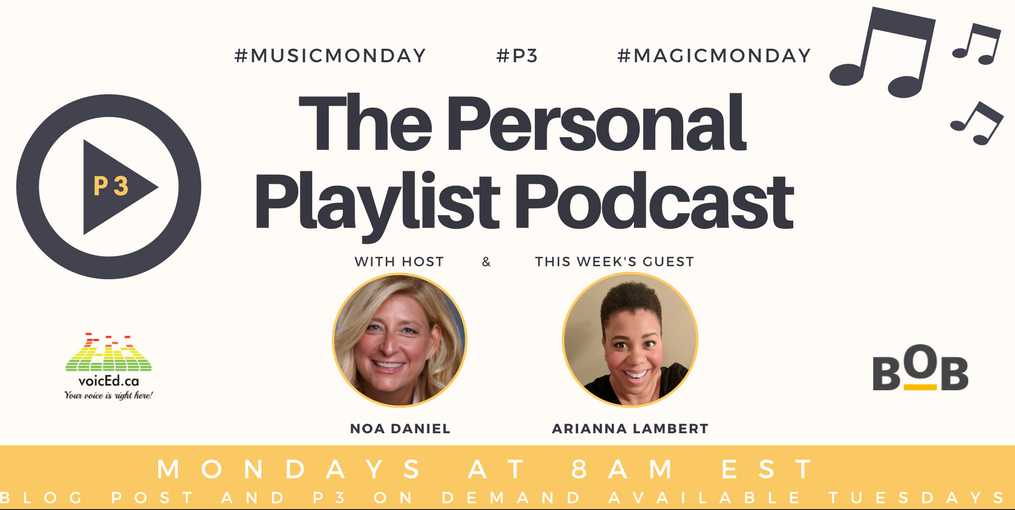
This past week, I had the opportunity to be interviewed by Noa Daniel for the Personal Playlist Podcast on VoicEd. I was asked to identify 3 songs to share: one that held a nostalgic value; one that gave a sense of identity; and one that motivates me. Even though Noa was kind enough to give me a lot of notice, it was difficult for me to find the right songs. When I did, it was amazing how they spoke to different aspect of me and had me thinking about how music is such a powerful tool for allowing us to be able to express our identities and sometimes say things that we have difficulty expressing. I started wondering how something like this might impact my students.

This year, our school was selected to participate in tdsbCREATES which is a program that connects local artists to classrooms in our board in order to shine a light on the Arts and careers in the Arts. Our Artist is a musician who has worked with schools to create the 10-minute musical. This year’s theme is Narratives of NOW – it’s about you, it’s about the world, it’s about time! Immediately, I thought about current issues in the world around us and how students have been speaking up to be able to create change. I also thought about the fact that change usually comes when we identify with a specific issue and so we have started to look at identity and how we might be able to use music to express our own identities and in our understanding of others around us. Today, students had the chance to use a Padlet to be able to add their thoughts on identity after having some time to consider for themselves by making notes in their journals. Many students said that identity is something that we can’t change and is a part of us and that our identities are what makes us unique. They determined that parts of your identity could be based on gender, sexual orientation, race, background, religion and family status. We came to the conclusion that there are many facets to our identities and that there are no two people that can have exact identities because they may also be impacted by lived experiences. It was such a deep discussion and sadly, we had to cut it short for recess.

Thinking about the work that we are about to do with our artist and my recent experience with Noa, my next step might be to get students to consider a song that speaks to their identity and to share the lyrics with us. I think we’ve gotten to the point in our class where we have a sense of respect for one another so that the sharing of songs may be valued and may help us to grow in our understanding of one another. I would be interested in seeing what songs resonate with them and the reasons why. I would also be interested in unpacking the lyrics – considering we will be writing our own for our musical – and seeing how lyrics to a song speak specifically to areas of identity.

I always feel as though I end my blog posts asking you to stay tuned but please do! Next month we will be getting deep into our tdsbCREATES project and I will be blogging about our progress.

Interested in hearing my personal playlist? Check it out this Monday, April 2nd, 2018 at 8:00am and at 7:30pm.

Screenshot 2018-03-29 at 4.27.28 PM

Digital Breakouts

Escape Rooms have been all the rage as of late. Over the past couple of years, I’ve learned about and used breakouts in my classroom to engage students and as a tool in assessment for and assessment as learning. Essentially, it’s a Google Slides presentation or a Google Site where there are links to different elements of learning and a form where students or colleagues can enter their responses.

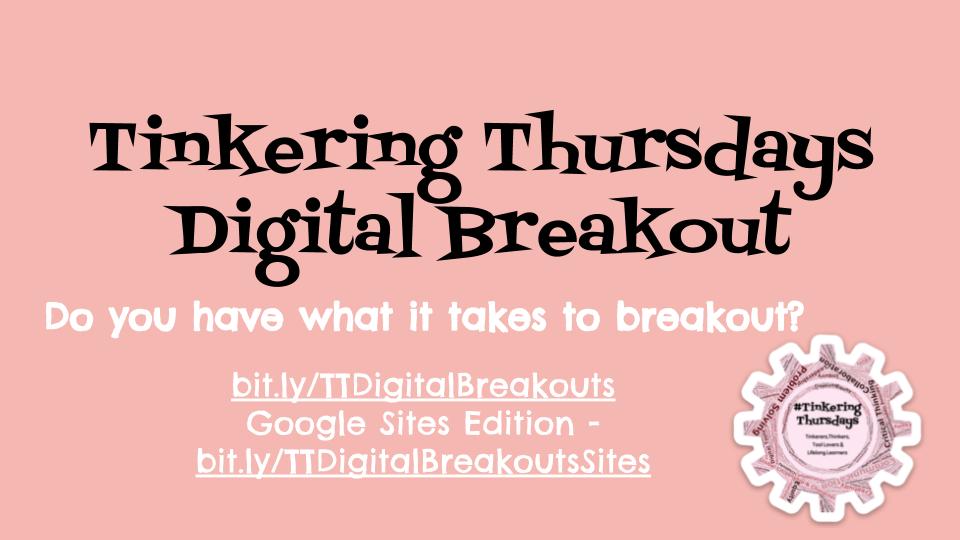
Last week, I was fortunate to work with an amazing group of teachers during #TinkeringThursdays and we spent the time breaking out and considering applications for the classroom. I have to say that students tend to be a little more resilient in trying to solve problems but in this process, it was interesting to see teachers as learners and to consider what students might experience when presented with tasks that challenge them and push them to problem solve.

Breakouts with students

As mentioned before, I enjoy using Breakouts as assessment for and assessment as learning. For me, it allows me to see whether or not my students can apply some of their learning to solve puzzles collaboratively. A couple of weeks ago, I worked on a decimal breakout with my students as a means for assessment for learning. I wanted to understand what they already knew about decimals. Now I used this breakout before with students who were a little further along in their learning and it was great to see that my current group of students took the time to view the videos in order to learn or understand a concept in a deeper way, whereas my previous students were more able to apply their learning to solve the problems. Either way, there was the support needed to help guide them as they problem solved. When we work on breakouts, I usually have students work in groups of 2 or 3 so that they have the opportunity to collaborate and possibly look at a problem from a different perspective.

Breakouts with colleagues

Over the past year, I have had the opportunity to present sessions on Digital Breakouts to colleagues and it’s been so much fun. In each session, we start with a breakout and I’ve seen this as a great way to engage in learning in a fun way. This got me thinking about how we might be able to use breakouts to engage colleagues in new learning in staff meetings or PD sessions. Rather than having information delivered, could this be a tool where we – like our students – discover and learn on our own? I’m starting to think about more applications for breakouts with colleagues so stay tuned!

Next Steps

While writing this blog, I started to think about gamification in the classroom. How might it engage some learners and what might the implications be for students who truly enjoy learning in this way? It also had me thinking that it was great that students had an experience in learning though a breakout, but what’s next? How might we use student-created games to not only facilitate their own learning but collaborative learning in our classrooms? My next step is to get my students to start creating their own and getting them to consider how they develop their questions and how they determine what information might be helpful to others solving the problems in their games. Again, I’ll keep you posted. In the meanwhile, if you’re interested in trying the breakout that we used for #TinkeringThursdays, click on the image below. The last couple of slides have important information on creating your own.

Tinkering Thursdays - Digital Breakout - Slides

Also, please feel free to share how you are using games – like breakouts – in your classroom for student learning or learning with colleagues. I would love to hear from you!

Distraction

photo by Sebastian Ganso CC0

It’s Spring. At least that’s what the calender and the weather are telling us. Dust has replaced the snow on the playground. Tell that to our playground grass fields still resisting the urge to grow too soon. Judging by the pale straw colour a field of green is still 6 weeks out. Somehow nature has equipped itself for a chilling frost or Spring blizzard that could be only a Colorado Low or Polar Vortex away.

Hopefully, March exits like a lamb and not like a lamb being chased by a lion. At this time of year, hope, like the temperature rises and with it the rain to wash away the remnants of Winter. Hope is the promise of Spring. Warm temps, more sunshine, daylight savings, chirping birds, sap running, and buds bursting on trees cannot be missed. There are great things waiting outside the doors of our classrooms. Teachers need to enjoy them. Our students need Spring and all of its promises even more.

To no one’s surprise since the Vernal Equinox, the classroom has become a livelier place each time the warm breezes blow. Students are absorbing the Vitamin D and converting it into boundless energy. It’s like an alarm goes off the moment the snow melts and the clocks move forward. March Break has come and gone and the realization that nearly 70 percent of the school year is in and out of the books. It’s as if that once the weight of snow suits and winter boots is shed, our students have been given permission to chirp, run, and burst with energy. It should not be missed.

With all of this vivacious vim and vigour I am planning ways to take advantage of outdoor learning, walkabouts, and a little more time in the fresh air. Along with this re-invigoration comes opportunity for distraction too. How we make use of our time outdoors can be a balancing act of classroom management amidst chaos. How we harness that natural energy with our students can lead to effective outdoor fun, positive mental health activities, and memorable learning opportunities.

What this looks like can depend on a number of factors: location, mobility, and volition. In my class we are taking advantage of the good weather by shifting some of our time outside. This is not limited to Physical Education either. Sure it’s fun to do, but there is also room for book talks, journal writing, guided reading/Math groups, and Science.

What I have enjoyed sharing with students on our walk and talkabouts are the changes going on all around us. It has been fun to ask them to comment on something they’ve noticed and to create a broader awareness of the habitats and spaces they occupy at school.

As we venture out, the eyes, ears, and lungs of learners are filled. It may appear that they’ve become distracted by it all, but it is not a distraction. It is more of an awakening of the senses instead and students are excited to discover it again for another year.

In my class, we are playing social games where everyone is involved. This includes our version of Manhunt; now known as Person hunt, SPUD, Chain Tag, Kickball, and Grounders. If possible I try to play in every game rather than watch because it engages students even more to see their teacher(as able) running, laughing, getting caught, and playing alongside.

You’ve read enough. Time to go outside and get distracted with your class. Happy Spring.

Please share how your class enjoys its outdoor time in the comments section below. Thank you for reading.

Twitter EDU

Over the last few years many people have become disgusted and disenchanted with the platform of Twitter.  I agree that it can be an echo chamber for those who like to hear their own voice.  However, I also know that it can be an effective Professional Learning tool.  I have created an entire Professional Learning Network on Twitter because of the people that I chose to follow and I am diligent about blocking people who are spreading unworthy tweets.  My Twitter account posts nothing personal.  It is about my own professional learning. With Twitter colleagues challenge my thinking regularly.  Questions that I have for my educational colleagues are answered immediately and without judgment.  Global connections are made easily and then I use these connections to learn with my students.

Let me give you a few examples of how I’ve used Twitter in the classroom.  One of my students brought in a rock with a fossil on it from his backyard.  We took a photo and tweeted it out to find out if anyone could tell us what it was and the approximate age.  Within an hour we heard back from a scientist at the ROM.  He had an answer for us and was happy to help.  In fact, he told us that corresponding on social media at the ROM as a scientist IS his job! One of the students brought in a mushroom from the woods near their house.  We tweeted out to our PLN because they wanted to know whether or not it was edible.  We were answered immediately and there were many links to other sites for information that sent us on a further journey into the wonderful world of fungi.  Consequently, the advice from our Twitter contact was to never eat anything you find in the woods unless you are a scientist. In music, we were learning the words to a song by the Alternate Routes band and the students asked to tweet the band. They tweeted us back thanking us for the support and encouraging us to keep singing.  We found some great classes across Canada to Skype with through Twitter and did mystery number finds with other grade 1 and 2 classes. You get out of Twitter what you are willing to put into it.

I have gotten more out of 15 minute Twitter education chats than I have out of some day long workshops.  The educators on Twitter chats are there by choice and they are passionate about education. The questions are specific and the answers are in 140 characters. The best part is, you don’t even have to comment if you don’t feel comfortable.  You can just sit back and learn.  I have also met these Tweeters in person at IT conferences and taken their workshops.  Knowing the presenters ahead of time and having a connection is like going to a concert when you already know the newest album really well; it makes the experience richer and deeper.

Here are a few EDUTweeters that I suggest you follow to get started:

@dougpete  @peterskillen   @brendasherry    @avivalova   @mraspinall  @sylviaduckworth  @Toadmummy (that’s me)

Here are a few #hashtags to follow

#EdchatON    #edtechchat     #teacheredchat   #bfc530

Twitter may not be your thing, but don’t knock it until you’ve tried it as your #PLN.  I guarantee you will find some ideas for #deeperlearning or #inquiryed.


Why It’s Time to End Publicly Funded Catholic Schools

school

What is the purpose of publicly funded schools?

According to the publication, Good Governance: A Guide for Trustees, School Boards, Directors of Education and Communities, the purpose of publicly funded Ontario schools is to “provide universally accessible education for all students, regardless of their ethnic, racial, or cultural backgrounds; social or economic status; gender; individual exceptionality; or religious preference.”

Further to this, Good Governance goes on to state that “English and French public systems are founded on the principle of equality of educational opportunity: every student deserves an opportunity to achieve to his or her fullest potential.”

How many school districts are publicly funded?

The Education Act provides for the establishment of four types of district school board systems in Ontario. Even though all schools districts do not have the “public” label, all four district school board systems are publicly funded.

According to Ontario Government in 2015-2015 (same numbers as 2013-2014) school board data:

48% Public School Boards (for 69 % of Ontario’s population)

  • 31 English Public School Boards
  • 4 French Public School Boards)

52% Catholic School Boards (for 31% of Ontario’s population)

  • 29 English Catholic School Boards
  • 8 French Catholic School Boards

According to the Statistics Canada 2011 Ontario data, Roman Catholics represented 3,948,975 out of 12,651,790 people or 31.2% of Ontario’s population (down from 34.3% Roman Catholic in 2001) with 69% of Ontario’s population identifying as non-Roman Catholic. This is evidence that students who identify as non-Roman Catholics attend publicly funded Catholic schools. According to Kelly Gallagher-Mackay, Toronto Star reporter, 8% of students attending Catholic schools are not Catholic.

Why does Ontario have so many school boards?

In 1867, the British North America Act (BNA) constituted funding for French and English schools as well as Protestant and Roman Catholic schools up to grade 10. In 1867, the majority of Upper Canada’s (now Ontario) population were Anglo-Protestant. The BNA mandated standardization and public funding for education. As Ontario’s populations grew, Protestant schools became more secular. Sometime in the mid 1970’s, as a student, I no longer had to repeat the Lord’s Prayer every morning. In 1989, required recitation of the Lord’s Prayer was held in violation of Canada’s Charter of Rights and Freedoms. Thus Protestant French and English public schools became French and English public schools with no religious affiliation. In 1984, Ontario’s Premier, William Davis, extended full funding for all secondary grades.

What’s the issue with publicly funded Catholic schools?

In 2012, Ontario’s Drummond Commission examined the reform of Ontario’s public services, which included education. The report identified areas of overlap and duplication (which could save taxpayer’s dollars) within Ontario’s four schools systems but did not ever consider the idea of ending public funding of the Catholic school system. According to the Federation of Urban Neighbourhoods (2012), the reduction in multiple boards would reduce duplication, busing, and capital funding saving the Ontario government between $1.2 and $1.6 billion annually. In the 1990s, Quebec and Newfoundland ended funding of denominational, religious-based schools. But funding of Ontario’s Roman Catholic school system has been considered a constitutional obligation and a really big political football. Note that Jewish, Muslim, and non-Catholic Christian schools are currently not publicly funded.

Why public funding of Catholic schools is unfair?

Right to refuse admission – Even though Ontario’s Catholic schools are publically funded, they have the right to refuse admission to non-Catholic students until grade 9. But with declining enrollment, non-Catholic students are being admitted. My own children attended a Catholic elementary school and had several non-Catholic, (Muslim and Hindu) students in their class. As a middle school teacher, pressure was put upon me to give grade 8 students all “Good and Excellent” learning skills on report cards as parents were told that the local Catholic high school would not take students with “Satisfactory and Needs Improvement” learning skills.

Admission of “preferred” students – According to Kelly Gallagher-Mackay (Toronto Star), research from Scott Davies at the Ontario Institute of Studies in Education showed that children attending Catholic schools are more likely to have parents with post-secondary educations. Further, EQAO data shows GTA Catholic school boards have fewer students with special education needs and significantly fewer students whose first language is not English as compared to English public schools. As a Special Education teacher, in a contained class, I have direct knowledge of Catholic students (who regularly attended Catholic church) being denied access to their local Catholic school as the school “could not accommodate the students due to their special education needs”. Based on my own anecdotal observations in three schools in which I taught multiple grades, the number of students with special education needs is increasing, every year, as a percentage of overall classroom composition.

Lack of acceptance of student diversity – Some Catholic schools ban student funding and clubs were they are “directly or indirectly” inconsistent with Catholic teachings. This means no student funding for the United Way which funds Planned Parenthood or students running Gay Straight Alliance clubs that embrace LGBTQ2S student identities. I’ve also been told that teachers who identify as LGBTQ2S are told to keep quiet about their identity.

Right to refuse employment to non-Catholic teachers – Even though Ontario’s Catholic schools are publicly funded, they have a right to refuse employment to non-Catholic teachers. This means that a large majority of non-Catholic teachers are ineligible for permanent teaching positions, advancement, or promotion. This also means that the non-Catholic students attending Catholic publicly funded schools do not have teachers who represent their religion. Further to this, sectarian Catholic education (Catholic religion classes) is not mandatory.

When my children went to the local Catholic public school, as a parent, I had to produce baptismal certificates for both children.  But as enrollment decreased, more non-Catholic students were admitted to the school. As a former Catholic, I was denied access to employment with the Catholic boards as I had to produce a letter from a priest, stating that I attended a Catholic church.

The current public funding of schools in Ontario does not honour the purpose to “provide universally accessible education for all students, regardless of their ethnic, racial, or cultural backgrounds; social or economic status; gender; individual exceptionality; or religious preference.”

Maybe we should draw school boundaries based on local neighbourhoods, instead of religion. Ontario could also consider having drawing lines in having a French and English only boards.

With Ontario’s great diversity of students from multiple backgrounds and religions, it’s time to make all of Ontario’s publically funded schools secular.

Collaboratively Yours,

Deb Weston

References

Drummond Commission Report (2012) Downloaded from https://www.fin.gov.on.ca/en/reformcommission/

Federation of Urban Neighbourhoods (2012) Downloaded from https://urbanneighbourhoods.files.wordpress.com/2010/11/ingsfromthemergerofontariopublicandseparateschoolsystems.pdf

Good Governance: A Guide for Trustees, School Boards, Directors of Education and Communities © 2014 Ontario School Trustees Downloaded from http://cge.ontarioschooltrustees.org/en/an-overview-of-ontarios-publicly-funded-education-system.html

OneSchoolSystem.org Downloaded from http://www.oneschoolsystem.org/fast-facts.html

Statistics Canada (2011) Downloaded from http://www12.statcan.gc.ca/nhs-enm/2011/dp-pd/dt-td/Rp-eng.cfm?TABID=2&LANG=E&APATH=3&DETAIL=0&DIM=0&FL=A&FREE=0&GC=0&GK=0&GRP=0&PID=105399&PRID=0&PTYPE=105277&S=0&SHOWALL=0&SUB=0&Temporal=2013&THEME=95&VID=0&VNAMEE=&VNAMEF=

Kelly Gallagher-Mackay, Toronto Star, (Tuesday, March 13, 2018) Must end publically funded schooling in Ont. Downloaded from https://www.pressreader.com/canada/toronto-star/20180313/281754154841725

 

Know Your Responsibilities Dealing with Safety in Learning Environments

school-safety-clipart-1

As teachers, it is our responsibility to keep our students safe at school. I tell my students that keeping them safe is my first job as their teacher. My second job is to teach them something. As a teacher, knowing your rights and responsibilities in the teaching profession is key to protecting yourself and your students. Below is a a short summary of highlighting areas that I thought would be relevant to new teachers. In the endeavor to be accurate, I decided to copy sections from the advisory instead of paraphrasing. Please refer to the Ontario College of Teachers’ document, Professional Advisory on Safe Learning Environments 2013 for further details.

Professional Advisory on Safe Learning Environments 2013

(The Council of the Ontario College of Teachers approved this professional advisory on April 4, 2013.)

INTRODUCTION (as per OCT): When student safety and well-being are involved, teachers’ “foresight, knowledge and professional judgment are essential … Recognizing student vulnerability and acting to mitigate it is a teacher’s professional responsibility”.

ETHICAL UNDERPINNINGS (as per OCT): The Ontario College of Teacher’s Ethical Standards for the Teaching Profession and the Standards of Practice for the Teaching Profession state that the ethical standard “principle of care holds that members express their commitment to students’ well-being and learning through positive influence, professional judgment and empathy in practice.”

LEGAL IMPLICATIONS (as per OCT): Relevant legislation, policies, standards and guidelines for legal implications include the Child and Family Services Act and the Occupational Health and Safety Act. “For example, under the Child and Family Services Act, OCT members are obligated to report any suspicions to a children’s aid society that a child is or may be in need of protection. The obligation to report directly is on the individual — teachers cannot rely on another person to report on their behalf.”

DISCIPLINARY IMPLICATIONS (as per OCT) : “The responsibility of Ontario Certified Teachers for student safety extends to their treatment of students during daily interactions. Not following the advice contained in the professional advisory could lead to issues of professional misconduct.”

ADVICE TO MEMBERS: MINIMIZE THE RISKS (as per OCT) :  See document, Professional Advisory on Safe Learning Environments 2013, for further details.

KNOW YOUR PROFESSIONAL RESPONSIBILITIES (as per OCT): “Ontario Certified Teachers have a professional responsibility through due diligence to safeguard and educate students who have been placed under their care. Jointly with school administrators and key stakeholders, teachers are responsible for creating safe and healthy instructional settings integrating hazard identification, assessing the risks and controlling the situation in all aspects of the facility. Due diligence refers to taking every precaution reasonable in the circumstances to avoid injuries.”


A FRAMEWORK FOR DEALING WITH SAFETY IN LEARNING ENVIRONMENTS (as per OCT)


RECOGNIZE, REPORT AND REFLECT (as per OCT)

Recognize: that incidents involving student safety generally occur when teachers least expect them.

Report: Following a safety-related incident, report the incident and actions you have taken to your direct supervisor and to appropriate health and safety representatives.

Reflect on the incident:

  • What happened?
  • Was my reaction appropriate? Yes/No. In what way?
  • Was my conduct in keeping with the ethical standards of my profession (care, respect, trust and integrity)?
  • Was my conduct in keeping with the standard of commitment to students and student learning?
  • Do I review safety instructions and procedures regularly and make improvements, as needed?
  • What could or would I do differently if faced with another similar situation?
  • Do I know how to recognize an unsafe situation and where can I go to better prepare or access additional training?
  • What have I learned from this experience?
  • Would others benefit from what I have learned and how can I share this information?

ACT PROFESSIONALLY (as per OCT): Know your obligations, Talk with other professionals, Regard your own professional development as a personal responsibility.  See document, Professional Advisory on Safe Learning Environments 2013, for further details.

Ontario Certified Teachers should be able to say with confidence (as per OCT):

  • My actions show that I treat students with care, respect, trust, and integrity.
  • I am aware of the legal parameters that guide my professional practice.
  • I am familiar with my school/employer’s policies and emergency procedures regarding student safety.
  • I reflect on past occurrences, monitor ongoing situations, and prepare for the unexpected.

As a teacher, I know my first priority is to keep my students safe. For students, school should be a safe place to learn without verbal, physical, psychological, emotional and/or sexual harm. While ensuring a safe learning school environment, it protects both students and teachers.

To protect yourself and your students, know your rights and responsibilities.

Collaboratively Yours,

Deb Weston

Professional Advisory on Safe Learning Environments 2013