Designated time a.k.a Genius Hour

#PinDropQuiet

It’s quiet in my classroom right now.
A little too quiet.

Did my students just have the most boring lesson ever?
I don’t hear snoring.

Did they all eat turkey for lunch?
Not today.

Are the students all out of the room during prep?
Nope. They are all here and engaged in something called Genius Hour.

Can You Hear the Pin Drop by Daniel CC BY NCSA 2.0

Here’s what led up to this moment.

Me: Have you ever wanted to study something on your terms and wasn’t in your text book?
Them: Yes. I do. Wait what? Followed by another 6 simultaneous comments in favour.
Me: Would anyone like to do that now?
Them: Yup. YES! Me! Followed by another 6 simultaneous comments and another 6 side conversations on top. All if favour of this strange, but intriguing opportunity.
Me: Okay, but here are the rules.
Them: Oh great, now here come the rules…(I only imagined this last line).

The Rules

1. Your topic must be declared and shared with the teacher before proceeding. That way some suggestions and direction may be offered if needed. Switching topics in not encouraged. See one idea/interest through, and chase after a new one next time. Ask them if this something they really want to share? Why is this interesting to you? Explain.
2.You must work quietly on your own. Don’t annoy your peers. They’re working too – so be cool.
3. You must be on task. Independent learning sounds easy, but carries a great deal of responsibility to those who are privileged with the gift of time. Use the present(see what I did there?) wisely.
4. You may use technology or texts or whatever you can gather information from to do your research. Interviews are cool too, but may require more than the time allotted. See teacher to negotiate.
5. You may use headphones to screen videos or audio content as long as it relates to your topic.
6. You may share your new learning in the format of your choice. This can include, but is not limited to; visual presentations, works of art, a performance, video, a poem/song/rant, research paper, or TED style talks.
7. You will become the in-class expert on your topic. So enjoy discovering the knowledge that is waiting for you to find it.

The certainty of uncertainty

When students are empowered and engaged, the resulting learning is immersed in intense inquiry and thought. The room is filled with nothing other than productive silence; barely broken by keystrokes and infrequent fidgeting as grade 5s are wont to do. Students’ questions are usually met with responses of redirection that affirm their instincts rather than direct answers. I want them to develop and trust their instincts as learners by stretching beyond their comfort zones. If that means answering a question with another question, then so be it. One thing’s for sure, it will be a stretch for everyone including you.

Me: Here’s your chance to discover something that you’ve always wanted to know more about. What do you think it should be? What did you discover when you were doing your research? Have you considered…?

Then there’s the momentarily unsure. Occasionally, there are students who are really stuck when given so much latitude in the classroom. It might be a good idea to have the class share some general ideas that can be used in the case of Genius Hour Learner’s Block. Keep in mind this is new for some students as they have been conditioned to learn what is being taught without ever having time to scratch their own intellectual itches. If a learner is still stuck, keep directing them back to what they are passionate about in their lives. Feel free to share what you might study if given a chance. My students always love when I share my own passion projects in learning. Here is my latest one about the Psychology of Accents.

Handing over the learning to students is a struggle for some educators. We are so used to having everything organized, on time, and in its place. If this is you? Don’t panic. Please keep in mind that it will be messy at times. Some educators will feel compelled to assess this somehow. I get it. Perhaps for the first time, you consider only assessing the presentation skills rather than the content. If this is truly to resemble self-driven inquiry in learning, students should not be afraid to take chances because a mark is hanging over their heads.

Take it as opportunity to construct the success criteria with your students. They will not let you down. Consider having students assess one another’s work for the purposes of learning. Maybe you can make it like a gallery walk where half of the class shares and the other goes from one presentation to the next. You can also model and post some guiding questions as prompts.

One more rule

8. Have fun and celebrate all of the new learning that your students have discovered.
Free Creation Apps to Show Student Thinking

I was asked to present a workshop about using technology in the Primary grades over a year ago and got into a debate with the Principal at the host school about apps.  The Principal was quite excited about the apps that he intended to purchase for his teachers to use with their students and he showed me his list.  I was surprised.  None of the apps were creation apps.  They were all “practice basic skills and keep kids quiet apps”. I showed him my list of preferred apps.  It was his turn to be surprised.

“These apps that you have chosen for the teachers are a lot like fancy worksheets for kids to practice basic skills.  Those skills are important, but doing a worksheet on an iPad might be a little more engaging, but it is still a worksheet, and an expensive one at that!  The apps that I am going to share with the staff today are all apps that students can choose from to show their thinking in a fun, engaging way that also provides opportunity for feedback and editing.” Unfortunately, he didn’t stay for the workshop.

The main difficulty that I have found with apps is finding something that you can use in schools that doesn’t cost a lot of money and isn’t just a free trial or have “in-app purchases”.  I don’t mind paying a few dollars for an app but when you get into the double digits for a school, it isn’t sustainable.  I thought I would share a few free creation apps that I have used with both the primary and junior grades.  I have also included some samples.  None of the samples are done by students, but I can assure you that each of these are quite intuitive and easy even for primary grades to use.  Each of the apps has a link to it in the App Store for further information.

Shadow Puppet EDU  The name is deceiving and the little white bunny on the app icon is too.  It basically provides a video of a slide show in which you can add voice and text.  Students can link to the already sourced for copyright pictures provided within the app or take pictures from their iPad or with the camera.  The students find this one easy to use but tricky to edit some of the text.  It uploads to Seesaw and other platforms easily.

Here is a sample of Puppet EDU:


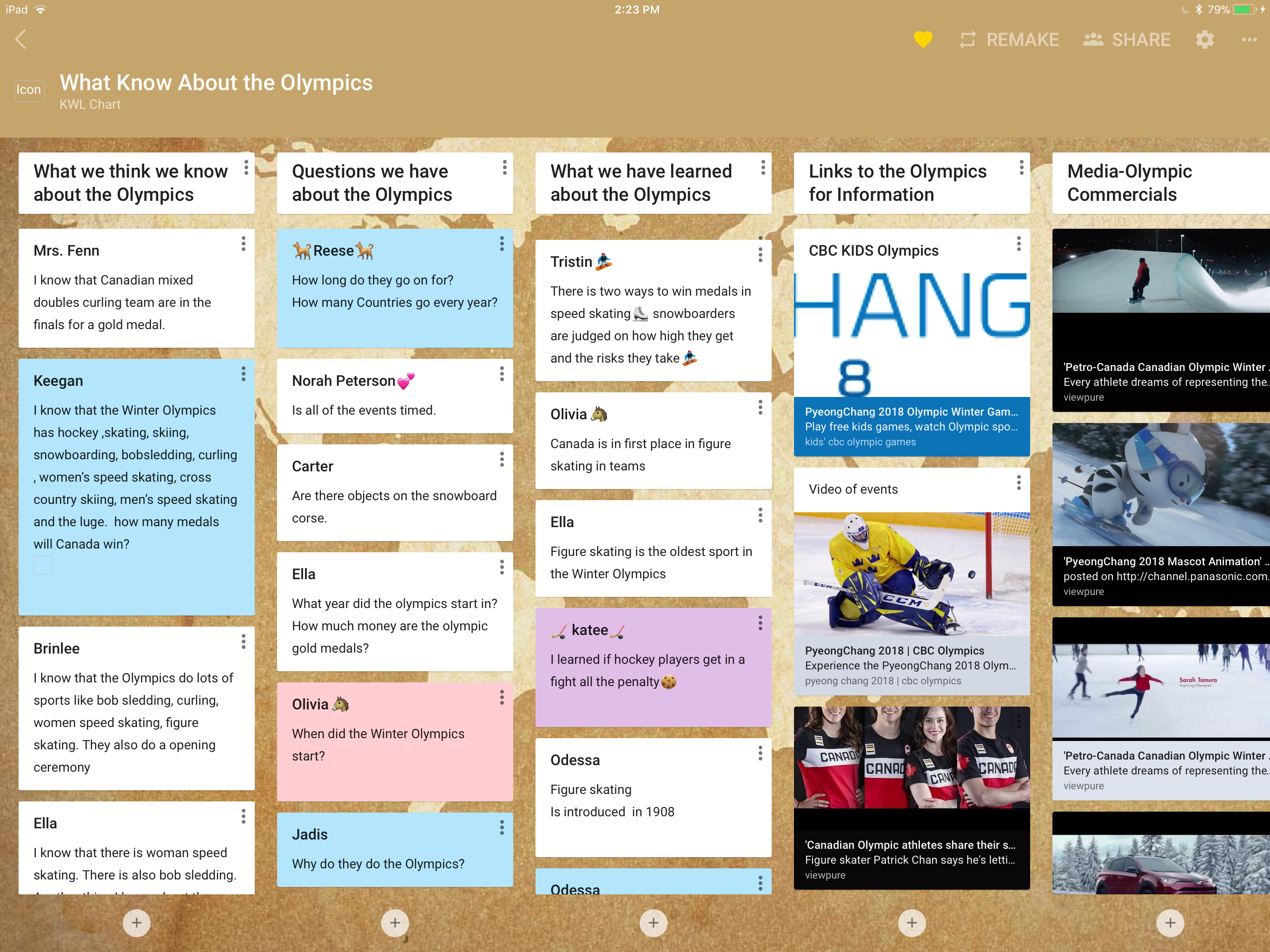
Padlet  I have used this a lot in order to begin a new unit of inquiry on something.  It provides a place to put safe links and videos that I have sourced for the students as a starting point and reference.  In addition, the students can collaborate their thinking with sticky notes. You can share it publicly with other Padlet users, but we keep ours private at this point.  We may share our Padlets with other classes at our school through the use of the QR code and password.  The sign is uses a QR code which you can print out. We are using Padlet for our unit on the Olympics.  The students will then create their own Padlet to share with classmates on an Olympic event that they will research.  Students will be invited to provide feedback to one another.  This is a screen capture of our Olympic Padlet:

2E085D6F-B02D-4F0E-828C-4DA00F168CA1

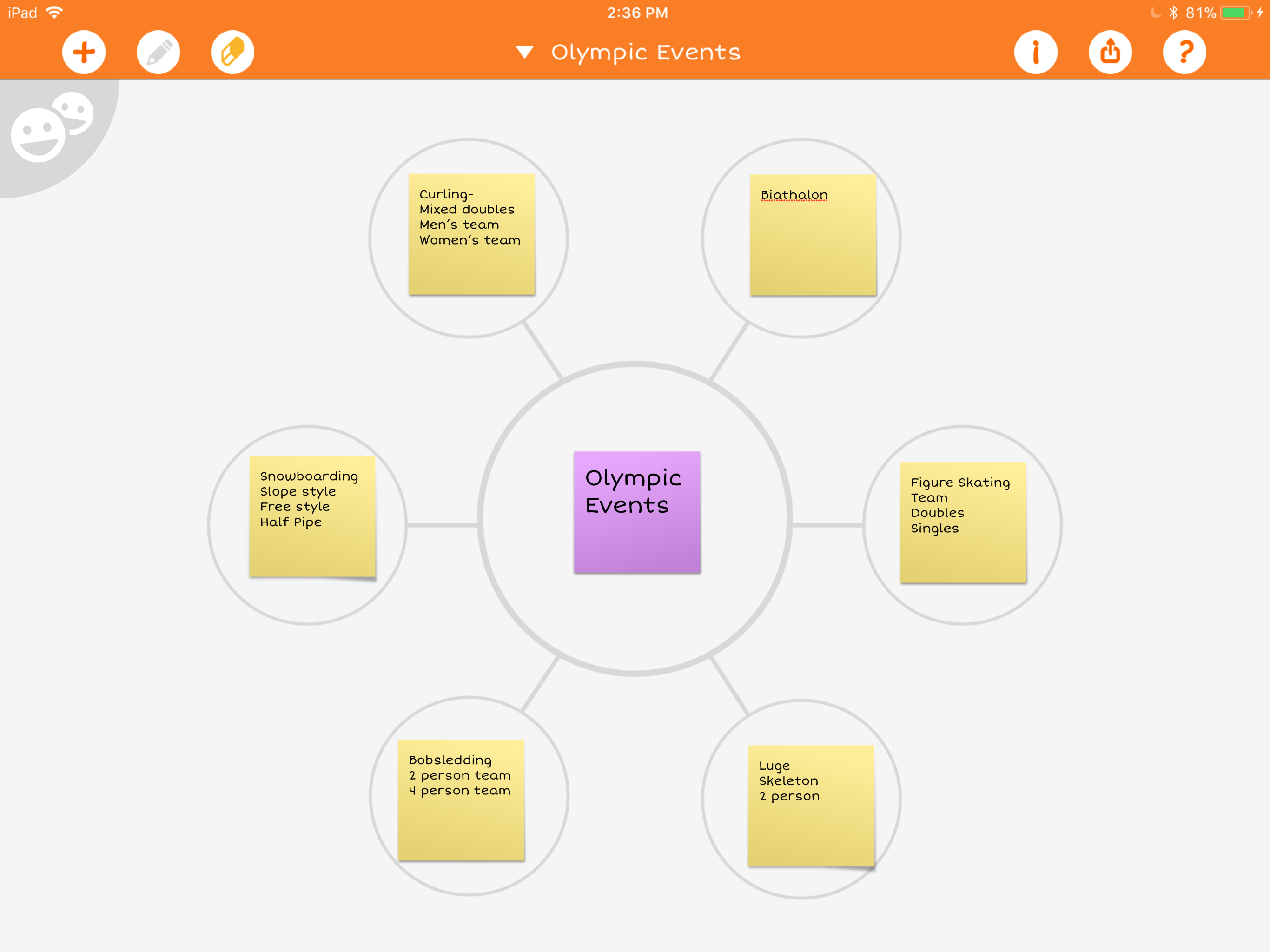
iBrainstorm  This app allows students to add sticky notes, text or hand written notes to templates like Venn Diagrams.  In addition, up to 3 other people can be invited to collaborate on the same template in real time. You can take a screen shot and save it to photos.  It also uploads to multiple platforms easily.

1DC21708-D63F-4C35-968A-3EEB52AC0F12

The Virtues of Non Fiction Reading and Writing – Part 2

Our Journey

We began by identifying the books in our book bags as fiction or nonfiction.  The students justified how they knew if a book was fiction or nonfiction.  In small groups the students compiled lists of nonfiction text features that they noticed in their stack of chosen books.  As a class we went through the Scholastic Book order and they decided which books were fiction or nonfiction and explained their choice.  The students discussed whether there was a realistic photo, the title and if there was a synopsis about the book.  We explored the “Explain Everything” app and played with it for a short period before getting into the project.  I find that a “romance period” with a new tool helps to keep them on task when they begin their work. The app was fairly new to me but the students found it to be mostly intuitive.  They were really stoked to use the feature that points to the words using a “light sabre”.  There were a few glitches with accessing text edits but eventually they got the hang of it.  We have the free trial version.  The actual app is quite expensive.

Establishing a Purpose

I explained to the students that our younger “buddies” were going to be learning about nonfiction and their teacher was looking for an engaging presentation about nonfiction text features for her students.  By setting up an authentic purpose and audience for writing, the students were engaged immediately.

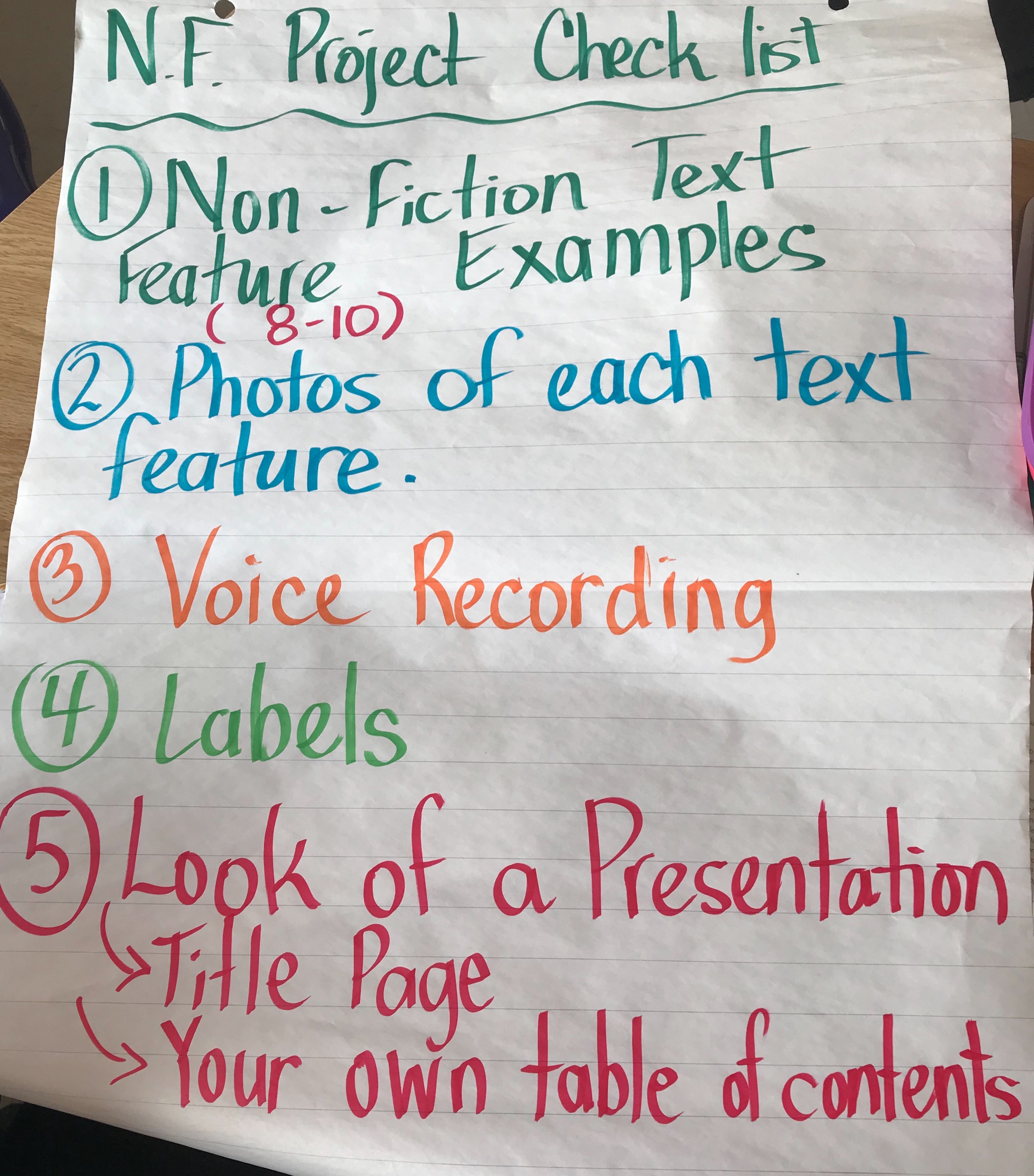
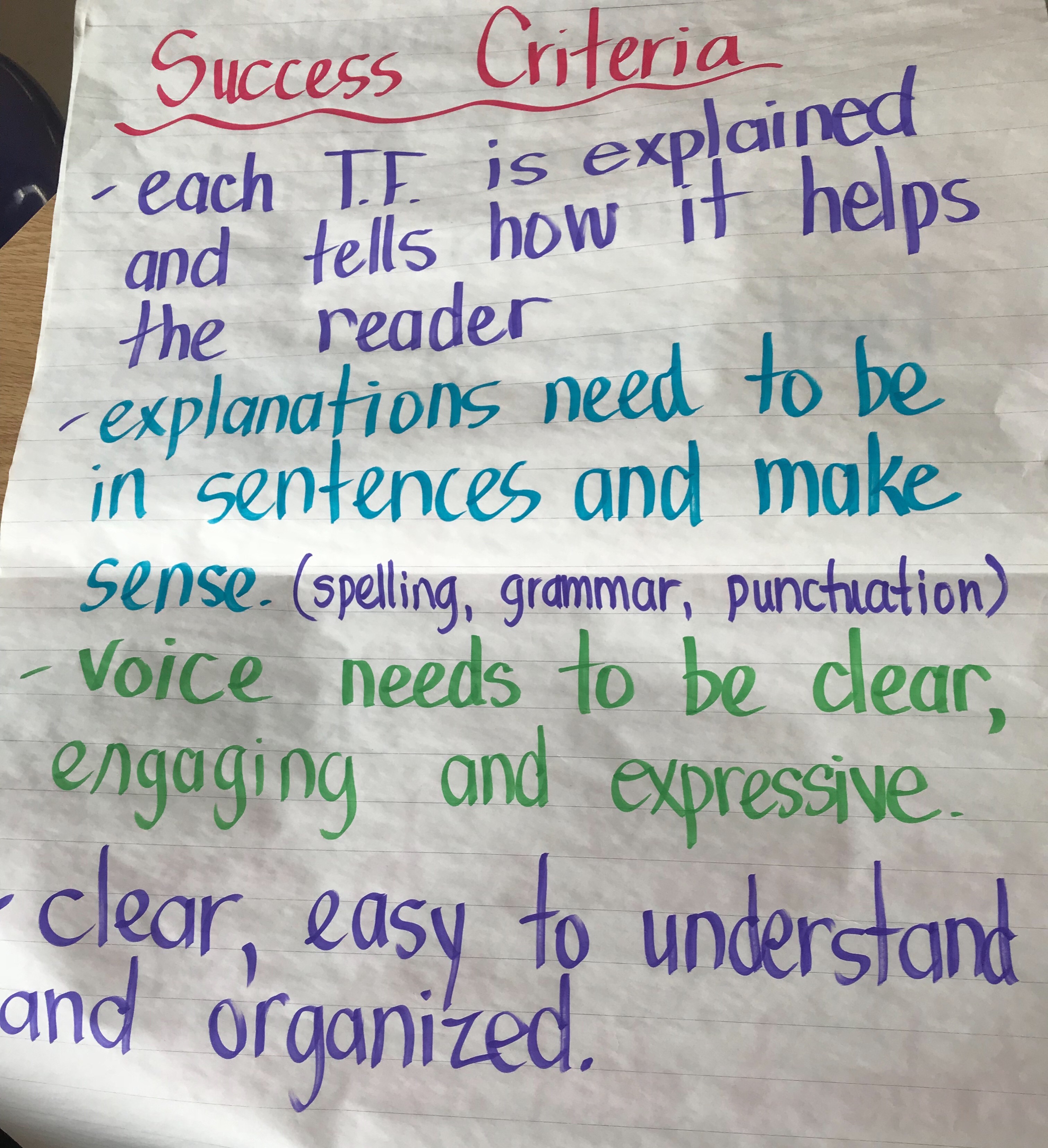
These are the learning goals, success criteria, project checklist and anchor charts that we developed over a period or two.  We added and changed some things as time went on as well.

CEE6A17D-F84C-43F7-B9A9-25090CBB9579                                       A481EA45-96C1-430C-9EEE-5D04A47F2750

The students really had to think about the information that a nonfiction text feature gave them as a reader.  The learning was much deeper by creating a teaching video than if they had just identified the features in texts.  Students referred to the success criteria and checklists throughout the project.  Before they came to me they had to have some peer feedback.  They put their first draft on Seesaw and I provided some feedback online.  The students edited and adjusted from peer and teacher feedback and then posted for parents to see on Seesaw.  Below the blog, I have included three different examples of projects from both grade four and five.

Assessment and Evaluation

The integration of technology with a presentation provides an opportunity to assess many different curriculum expectations in language:

-ability to critically analyze the purposes for nonfiction text features

-ability to create a piece of media for a specific purpose and audience

-ability to oral communicate coherently and expressively

-ability to write clearly using appropriate conventions and their ability to edit their work

-ability to use success criteria, anchor charts and feedback in the creative process

In the area of learning skills:

Independent Work

-adhere to timelines and guidelines

-use class time appropriately to complete a task

-monitor, assess and revise plans to meet goals

Responsibility

-provide appropriate feedback to peers; being considerate of the feelings of others

-have their materials ready

Initiative

-find answers to questions and materials they need on their own

-find ways to make their work better

Organization

-set up their work so that the ideas are communicated and the audience understands their thinking

-prioritize what needs to be done

Collaboration

-uses politeness and kindness when providing feedback

-shares resources, information and expertise

Self Regulation

-asks for clarification about feedback

-uses mistakes as a learning opportunity

-provides evidence that they think about their thinking

#PDThatWorks

It’s no secret…I’m a lover of professional development! I’ve always been of the mindset that learning is a continuous process that is afforded to all of us in a variety of ways and we should take advantage of as many opportunities as we can. That being said, over the past couple of years, I’ve been on a hunt for #PDThatWorks. It’s a hashtag that we used last year as part of our STEM Certificate Course hosted at RJ Lang Elementary and Middle School for K – 8 Teachers. We too were interested in finding a model for professional development that would inspire teachers to continue the work outside of the session and build capacity in their schools and over-time, the board. I think that I finally found what works for me:


  • Building a community with participants
  • Time for implementation and reflection
  • An opportunity to celebrate and look for next steps

Building A Community With Participants

Our module was 4 days long, over a 4 month period (1 day per month), and this time afforded us the opportunity to get to know the colleagues that we were working with on a deeper level. It wasn’t just one session where we learned something to take back in isolation, but over the course of even the first day or 2, we were quickly realizing that we could leverage the skills in the group in order to learn from one another. As a facilitator, it was exciting to see relationships being built based on reflecting on experiences and connections we might be able to make with the students we have the opportunity to serve. Amongst facilitators, it was great to be able to understand the skills that each of us brought to the course and how we were able to form a great team because of the diversity in our skills. Once the course was finished, we simply couldn’t stop there. As facilitators, we decided that we wanted an opportunity to continue our work together with like-minded educators who were just as excited about learning and growing professionally as we were. #TinkeringThursdays was born out of this idea.

Time For Implementation And Reflection

Ever participated in a PD session where you received many handouts and great ideas to take back to the classroom without any real follow-up, accountability or commitment to implementation? I have. Ultimately, as educators it’s our responsibility to take the learning back to the classroom to implement but often times, without accountability, things fall by the wayside. Good intentions exist but follow-through doesn’t always happen. Being a part of a workshop or course such as this, allowed for participants to take the time needed to implement, reflect and return to have discussions on successes and areas of need. I know that there should be some intrinsic motivation for implementing our learning but let’s face it, collaborating with colleagues who have also had the chance to implement ideas in their own spaces, provides a better opportunity for success. There are many times that I’ve seen ideas that worked well in one learning space and then when brought into my own have had different results. What’s the difference? The students. When we take an idea and make pivots based on the needs of our learners and share, there’s even more learning that can be gleaned.

An Opportunity To Celebrate and Look For Next Steps

On the last day of the course, participants showcased the work that they did with students based on their learning during the course. It was phenomenal. Some participants even went as far as bringing their students so that their actual voices were heard through the projects and tasks that were created. Not only were the presentations or projects diverse, but they spoke to the true learning and teachers were excited to share with one another their next steps for implementing the Engineering Design process. Again, there was the gathering of ideas and an excitement about having been able to learn with such an amazing group over a 4 month period.

Now that I know the type of #PDThatWorks for me, I’m better able to tailor my learning experiences and find sessions that truly honor my style of learning and speak to me as an educator. What type of #PDThatWorks will you find?

The Virtues of Non Fiction Reading and Writing – Part 1

Many years ago at a Reading for the Love of It Conference, I listened to author and educator Tony Stead speak about the virtues of teaching non-fiction reading and writing in the elementary grades. It was an “ah-ha” moment for me as an educator. As an adult the majority of the text that we interact with each day is non-fiction. Writing a grocery list, filling out a survey, reading an advertisement, reading a blog and corresponding in an email are all examples of interacting with non-fiction text. If I read fiction it is because I choose to do so for pleasure. Yet, much of my language curriculum in the primary grades had been fiction based. I had chosen many beautiful picture books for read alouds and focused a lot of our time on narrative story writing.  Most of what I write as an adult is purposeful communication, not for pleasure. During that time I also put together that the majority of what the boys in my class were interested in reading and writing were non-fiction topics and that likely contributed to the reluctance of many of them to read and write.

Consequently, as an educator, I spend much more of my time teaching how to read non-fiction and how to write in different non-fiction genres.  Recently with my grade 4-5 class, we have been investigating non-fiction text features.  We are learning to use non-fiction text features to help us both as readers and writers.  For example, through inquiry the students learn what a diagram is, what is used for, how it helps the reader to gain new information and how we can then use it in our own writing to communicate information effectively.  The students are working towards providing a kind of instructional guide to non-fiction text features using the app Explain Everything to present to younger students in our school.  Students search for examples of non-fiction text features, take photos and using voice, text or diagrams; explain how the text features work and how they help readers and writers communicate.  Students understand that these diagrams, graphs, maps etc., in their texts can provide quick snapshots of important information and make their research interesting, richer and often more expedient.  In their writing, they understand that many features provide “proof” of the point they are trying to make for their readers.

My love of non-fiction does not exclude studies in fiction.  However, as educators it is important that we are expose our students to purposeful, rich, relatable tasks as well as good stories.  In part two of the blog, I will be sharing student work with non-fiction.  For more information about educator and author Tony Stead I have included some links below.

Tony Stead author biography

The RAN Strategy video


Teaching Dramatic Arts-Resource Recommendations

My first Additional Qualification Specialist was in Dramatic Arts.  When I signed on at my current school board I worked as an overlay teacher between two schools and taught whatever I was assigned by the Teachers for whom I provided preparation time.  I was mostly asked to teach art, drama, dance, and music.  These curriculum areas are my passions but not all Teachers feel qualified or comfortable teaching these subjects.  Drama seems to be one of those courses that some Teachers “tack on” for a week or two just before a reporting period and with good reason, they aren’t comfortable teaching it and it can become difficult to manage behaviour during dramatic arts.

Drama lends itself well to all areas of the language curriculum.  There is a misconception that Drama and Theatre are the same thing and that scripts and plays are the end goal of the Dramatic Arts curriculum.  However, there are many ways in which to incorporate Dramatic Arts activities into the daily language curriculum and you don’t ever have to mount a full scale production.  Drama doesn’t have to be scary.

One of the best resources that I recommend to Teachers who have Dramatic Arts Anxiety is the DramaNotebook website.  It has all of the Drama games you will ever need all in one place and is especially handy for Occasional Teachers for transition times.  In addition, it has poems and scripts that you can access from 2 parts up to 30 parts.  There is a sign up for a cost, but there is also many free items including 40 drama games for teachers.

Another great Canadian source for drama lessons is Larry Swartz.  He is an Educational Consultant, author, speaker and Dramatic Arts specialist.  His book, “Dramathemes” is in it’s 3rd edition and is used in many Education Faculties in Ontario.  It not only provides “activities” but it creates units that are easily integrated into the language curriculum.

The Council of Drama and Dance Educators has a fantastic website and there are many free resources which are written by educators and can be accessed even if you are not a member of CODE.  In addition, they have a conference each year held in the fall which provides opportunities to learn along with other Educators.

I would also highly recommend the Arts resources from ETFO.  The Primary ETFO Arts and Revised ETFO Arts resources provide an integrated approach to all of the Arts.  You can find them at Shop ETFO on the website by following the link below.

http://www.etfo.ca/SupportingMembers/Resources/pages/shopetfo.aspx

Revised ETFO Arts (2014) $23

Ref. #91.129  The Revised ETFO Arts book is a practical step-by-step handbook for junior/intermediate grade teachers who want to include the Arts in their classroom program by introducing all the elements of dance, drama, music and visual arts.

Primary ETFO Arts (2013) $20

Ref. #91.169  Primary ETFO Arts is a publication that features 10 picture books that will pique children’s interest with their universal themes, issues and questions. Each section of Primary ETFO Arts includes engaging verbal and non-verbal activities to stimulate imagination, communication and critical thinking.

I hope that these resources provide you with some ideas and inspiration.  I am always looking for more.  If you have some other resources to recommend; please add a comment.


The destination

This is the companion post to The drive shared on December 30, 2017. I wrote it because trips are always more fun with a partner.

When I was in grade school, there always seemed to be one adult whose job it was to ask students, “What do want to be when you grow up?” For some reason, this was more of a cruel conundrum rather than a sparkling conversational point. I hated hearing this question in my day. I still cringe whenever it gets asked today. Secretly, I hope students respond with something creative like Unicorn rancher or underwater coffee shop owner – anything will do, as long as it changes the subject.

I see the question more like asking students to pick the trip of their lifetime without ever having a chance to take a Geography lesson, browse a web-site or read any reviews on TripAdvisor.¹ Even though our jobs are to provide and guide our students, we still must let our learners decide their own destination(s).

This is cause for concern because I fear we’re running out of road(s) for some of our learners. For many, the destinations are leading to dead-ends instead of their dreams coming true. If we consider the ruthless nature of the real world our graduates will face, there will be many detours, breakdowns, and accidents outside of the classroom courtesy of life. And yes there will be traffic, road closures, and potholes. This makes it even more crucial for us to be paving new roads with our learners.

It’s hard to drive.
It’s even more difficult to discover what drives us.
Then there’s always the destination where departure times depend.
Decidedly, education helps define destiny and dignity.

Over the past 9 years of my teaching journey, I have sped past a few common sites along the way. Like the repeating background of an old cartoon or the cookie-cutter rest stops that line the highway – each with the same caffeine, food, and fuel options. They are;

A. Our students are taught to worry so much about the destination that they risk getting lost or forgetting the reason for their journey all together. If all they are taught to see is a mark, then it is time to redraw the maps and reprogram the GPS.

B. There is no amount of training to completely equip educators for every iteration of classroom they will work within. Some or most of the learning will come on the job, and that’s okay. Redrawing the map required, again.

C. Worksheets are neither the solution for active engagement, nor parents who demand homework for their child. They are most likely mind-numbing disengagement exercises destined for the recycling bin if not managed. How can students be free to think when the answers are fed to them to regurgitate on a page? Maybe this paper could be used for the maps instead?

D. No matter how much teachers care for their student’s well-being, academic achievement, or future they will still be allowed to fall through the cracks due to decisions made outside of our school walls. This is hard to understand, but we have to accept it and support these students where possible inside of the system.

E. Students have voices that need to be equipped and amplified. If we are not listening to our learners when they whisper, it will be too late to help when they are screaming at us. Asking students for feedback, ideas, and improvements has been one of my favourite and frightening activities. It can hurt the ego from time to time, but can also break down barriers in the classroom that can lead to more effective and honest feedback as learning.

Destination TBA is A-OK

Over the course of their learning, students will change their minds 1000s of times. They will find something interesting one week and then something different the next. What worked to inspire them last year may be the thing that gets in their way the next. As educators, we have to consider the importance of our work in preparing students to reach their destinations not ours. We must always be creating new roads for them to travel not just maintaining existing ones. We must also be teaching our students to read and draw the maps to their own future.

There will also be slamming brakes, reversing at full speed, doing donuts in snowy parking lots, and tearing out engines for rebuilding. We will fill their tanks, provide directions, and clean windshields. Yet, as elementary teachers, we rarely get to see our impact on students once they’ve traveled further down life’s roads.

Hopefully, they’ll send an occasional postcard and maybe a map to let us know they’ve arrived at their destination.


1. I used to tell people corporate lawyer so they would leave me alone. It seemed to cover all of the bases even though I would have rather pursued diplomatic or NGO work overseas. And now, here I am – a teacher, writer, and question askerer.


The drive

Hands up if you’ve ever wondered what goes on in the minds of the drivers on the road around you?

Recent commutes to school and to shopping feel more like scenes out of a Mad Max movie, except with snow storms instead of sand storms. Vehicles speeding, tailgating, weaving, cutting one another off, and then there were some drivers who provided visual proof that not all birds have flown south this winter. However, none of this reflects anything close to the spirit of kindness and giving this season is supposed to celebrate.

Lately, a combination of work-life/Geo-political stress, an over-abundance of festivities/holiday cheeriness, and wintry weather have made people significantly more interesting. And by interesting, I mean disagreeable, distracted and sometimes dangerous. Being easily distracted myself, I started thinking about self-driving cars and how an autonomous vehicle would handle this time of year?¹

Then came a realization that our current cohort of elementary students could be among the first to have self-driving cars by the time they get their driver’s licences. Will this be a good thing or will a Neo-Luddite backlash prevent this particular advancement in technology from coming? What about education? Could classrooms become more autonomous too?

Why hasn’t all of this happened sooner when it could be better and safer for everyone? Are there Edu-Luddites at work trying to preserve exhausted and traditional systems? As education ploughs into this century, will it keep pace with a modern world that is changing at the speed of learning? Will broke down dogmas of teach, test, report, and repeat finally be traded-in, repaired, or left on the side of the road? Is this why NASCAR is so popular?

Getting somewhere

Speaking of NASCAR, I wondered whether everyone travelling at the same rate was a good idea. Did you know there is something called a restrictor-plate? Isn’t that what’s happening in our classrooms already? Students race through their learning based on birth years, circling the track over and over until all of their age appropriate laps are completed, and then they’re towed or driven off at the end of Grade 12.

But what if they need to stop along the way? Are there pit-stops/provisions in place to support students who do not fit the factory learning model or who prefer a different pace? I get that special and alternative education options are already available, but what if more students need them and they are not available? Think of a racer who needs tires and gas at a pit-stop, but only being able to choose one. It’s only a matter of time before frustration and failure become the outcomes.

In my next post I want to continue driving home this theme, but will shift gears to consider where we and our students are heading. Please read my companion piece The destination to continue the journey.

Thank you for reading. I hope you enjoyed it. Please share and take time to comment.


1. Did you know that Tesla’s autonomous vehicles are logging over a million miles of data per day?

Occasional Teachers; Unsung Heroes

Unfortunately, I have had many health challenges this year that have necessitated having to take a significant amount of time off of work to recuperate.  These absences have provided me time to reflect on my practice as a classroom teacher and about how important occasional teachers are in our practice.  I had the pleasure of working in our local ETFO office as a released officer for 3 years alongside the incredible Marsha Jones, Occasional Teacher President extraordinaire.  She taught me a lot about Occasional Teachers, the obstacles they face and the little things that I could do to make their days go easier.  I thought I would share a few of my insights.

Occasional Teachers that come to our school like to return because of the friendly atmosphere.  In the staff room, they are included in our “tea days”, people engage them in conversation and always ask how they can be of help.  It sounds like a simple thing, but many of the Occasional Teachers that come to our school comment on our friendly staff.  So the next time you see an Occasional Teacher in your school, smile and say hello and ask them how their day is going.

Do NOT ask an Occasional Teacher “who” they are for the day.  What an insult!  You can ask who they are in for, who they are helping out, who they are rescuing or replacing, but they are themselves each and every day they come to work.  We should appreciate the fact that we have access to qualified teachers to replace us for the day so that we can take sick days when we need them or go to conferences for professional learning.

Speaking of insults, please try not to call Occasional Teachers “substitute” or “supply” teachers.  We rely on these colleagues. “Occasional Teacher” is their job title.  Be respectful of it; we rely on them.

Remember to have a few days of “emergency” plans in advance of your absence.  It takes the edge of having to type up plans in between trips to the washroom when you have the flu.  Leave them in a place that is easy for the Occasional Teacher to find.  This makes your life easier too.

If you generally have an active classroom that engages in centres, activities etc., then TRUST your Occasional Teacher and leave plans that include those lessons.  Chances are your students know how this stuff runs and will let the Teacher know.  It may mean giving up a bit of control; deal with it.  If you leave all day seat work that you’ve photocopied or a movie that isn’t connected to anything that they are doing in the classroom, it will not be enjoyable for the students and likely your Occasional Teacher will have more behaviour issues.  Consequently, you will not get the quality of work that you normally see from your students. Don’t have huge expectations.  No matter how wonderful the Occasional Teacher may be, they are not you and the students know that.  We also need to remember to trust the judgment of an Occasional Teacher.  I’ve heard it and I’ve said it; “The ‘supply’ didn’t follow my day plan. I worked for hours on that detailed plan.”  We don’t know what kind of a day that teacher had with our students.  They may have experienced a lockdown, fire drill, class evacuation, pizza money, scholastic money, a student injury or even a skating field trip.  (My sincere thanks to Occasional Teacher Rachel Johnston on that one!)  We need to remember that they are qualified teachers and they have the right to exercise their professional judgment in order to keep the class calm and engaged.  Let them do their job and thank them for it.

I write my day plans on my computer for myself each week.  This makes writing a day plan for the Occasional Teacher much easier.  I have all of my emergency information, how to deal with specific students, who to count on and the general rules and routines in a separate document to attach to daily plans.  I always attach a class list.  Try to keep your plans as close to the regular routine as possible.  If I am going to be away for a meeting I will try to find out who will be replacing me for the day and I email them the plans in advance and ask if they have any questions.  I include my cell phone number in case they can’t find a password or an item and few of them ever use it but if they do then I know that they care about my students and the plans that I have left for them.

Finally, show your gratitude.  Some Occasional Teachers drive an hour to get to our school and in bad weather.  Some are called at the very last minute, through traffic, to an unfamiliar school using GPS.  Their mornings are often stressful before they even arrive on site.  So when an Occasional Teacher has done a great job and your classroom is still standing when you go in the next day, write a quick email and say thank you. Occasional Teaching is often a thankless job but we can’t be sick without these wonderful people.


Learning to swim

https://www.flickr.com/photos/eviltomthai/5129962638 CC By 2.0

I remember laughing when our teacher taught us that fish swim in schools. You know how kindergarten students think, right? Naturally, I wondered which classroom at my school held the aquarium? Would dolphins be there too? Then came the cruelest lesson of all; dolphins are not fish. Why was I even there?

All these years later, I understand that we were the fish in that educational ocean. We were taught to swim in a school at school zigging back and forth as if in a constantly choreographed current. Sit here, read this, write this, stand here, go there, eat, play, run, think, solve this, and repeat.

We were learning to swim in our little school to survive life. Zagging in and out of the doors and halls from class to class like small fish between coral reefs and vegetation.

We swam for all of our might and soon discovered 2 things; the current kept getting stronger, and that danger was always lurking in the water. Without learning to swim, we were at risk of being singled out, devoured, or even worse, drowning. Yup, fish can drown…kinda.

The reality that fish can drown(suffocate) makes me think that even when students seem like they are swimming along fine, they could still be at risk. How we teach our learners to swim and navigate the waters comes with equal parts skill, frustration, and grace too (thanks to the Tragically Hip). So are we teaching our students to swim for their lives, or are we over fishing them to death with rote lessons, busy work, and too many assessments?

When Giovanni Caboto, aka John Cabot, and his crew discovered the rich stocks of cod fish off of the Grand Banks he told the King of England that there would be enough fish to feed the kingdom until the end of time.

Little did he know that within a 500 hundred years, the Grand Banks would become over fished and the cod population was nearly decimated. The lessons learned over the past two hundred years in education are caught in a similar net.

Our students are over tested. The system has cast the same catch-all nets for too long. They feel too much stress, and they see the world of their future as a total mess. The oceans they’re inheriting are clogged with the debris left behind by their predecessors. Remember, these are the same people who gave us standardized testing, drill and kill Math, regurgitated learning, and grammar police state nightmares in both official languages.

Ironically now, there is also a figurative and literal garbage patch to clean up thanks to current education systems and its ancestors. What was once a thriving home full of opportunities and diversity is now a murky, polluted, and estranged place. Insert image of bleached coral here.

What I fear the most is that our students’ reasons for learning are disappearing like the cod on the Grand Banks. Without an intervention, the desire to learn that is coded into our youth faces extinction too. Can we revive this generation of learners by teaching them to swim, by cleaning their waters, and providing the safe habitat for them to thrive?