Self-Guided Professional Learning

As an adult learner, you know what your strengths are as well as what your next steps should be. You understand you current lifestyle, the demands of family and friends as well as the other components that are a part of your busy life. Self-guided professional learning allows you to continue to enhance your classroom pedagogical practice and curriculum knowledge at a pace and focus that is specific to your needs.

There are so many learning options available to ETFO members. It starts within your local federation where your professional learning committee is already at work planning out opportunities for members to continue to enhance their best practice. Talk to your committee, find out what is being offered, put forth suggestions that they can look at or better yet, get involved in this committee.

The next main area that provides a treasure trove of learning opportunities is our provincial organization. If you go to the provincial website (http://www.etfo.ca/Pages/default.aspx) and search under the subsection professional learning you will find a wide variety of options that are offered by our provincial team. The scope and sequence of the options available ensures there is something for everyone. The provincial office also provides equitable access from a geographical standpoint.

Whether it is AQ courses, Summer Academy, one time workshops, workshop series, provincial or local book clubs, or just gathering together as same grade colleagues and having professional dialogue on a topic, find what you need and seek to grow as a teacher each and every day. One of the most rewarding facets of teaching is when students and teachers can continue to grow side-by-side.

1

Meet the teacher night

Tonight was open house at my school and as usual parents wanted to know how their son or daughter were performing. This is always an interesting question to answer because parents want to know about math and language and I want to tell about how they are getting along with others and how polite and helpful they are.

It’s interesting to see that what a teacher values teaching the most is not always what would come up at a meet the teacher night. I hope that in my program I can help children with their math and language as well as help them treat others with respect as well as help them make our class a friendly place.

As a young teacher, I am always hoping that parents will be on board with the new shift in education, away from tests and onto rich learning experiences. Sometimes I wonder if after my students leave me, that I have failed them if they start to take tests and have no idea what they are doing. I do see the value in showing how much they know on a piece of paper as many high schools still work with this model, but I am always wondering how that will help them in their future. I understand that test writing is an important skill, so I need to think of ways to include this in my program in the future.

I am working on making our class a very open and comfortable space for learning right now and I am hoping in my next post to share about how the alternative seating is making the student space an amazing place to work. I hope to see the benefits of the seating and I am excited to take pictures of student learning experiences and share the stories.


Revise, Refine, Reimagine

Although sometimes I would rather have a balanced-calendar school year, where summers were shortened and more frequent breaks are embedded throughout the academic year, the two months off that a 10-month school year calendar is still a welcomed experience. The structured close of what often is an intense year of teaching and learning, affords us the opportunity to touch the reset button, as it were, and engage in some meaningful reflection about how to continue the journey forward.

For me, this is one of the most difficult times of the year where my focus is consistently being challenged. Engaging in year-end activities (i.e. report writing, school celebrations, etc. ) while at the same time anticipating the year to come (i.e. new teaching-assignments, classroom moves, etc.) pulls my attention is so many directions that I find it hard to stay present and in the moment. My mind is constantly racing ahead as I would honestly rather engage in the year-end clean-up of my classroom as the thrill of reorganizing my “stuff” seems all too inviting. (Sidenote: teacher hoard WAY too many things…sigh…)

Reflecting on the year that was, however, is the best way to prepare for the year ahead. Intentionally thinking about the things that went well and the challenges that were grappled with can prepare you for a more focused year. The following is a framework for reflection that some colleagues and I have explored as we sought to address areas where we can improve in the work we do:

Revise: What were the things that didn’t work out the way it was intended to this year? Why was that so? How might you revise the experience so that it achieves the purpose and function that you had originally envisioned?

Refine: What went well this year that, with a few additional tweaks, could go even better the next time around? How might you refine your practice in ways that allows you to work smarter and not necessarily harder? What might be some efficiencies that you could employ that will allow your efforts to be stretched far and wide?

Reimagine: What possibilities might there be for aspects of your practice that you find stuck in your comfort zone? How might you embrace the spirit of innovation to reimagine possibilities that were once never an option? With the prevalence of technology and resources that support integrative thinking, what aspects of your practice might be opened to your imagination for radical shifts?

After engaging in thoughtful reflection the year forward can look so bright. With the natural starts and stops, we are compelled to be progressive as teachers. Here’s to closing the school year with a boom and beginning the new one with a bang.

What does it mean to learn? What does it mean to teach?

What does it mean to learn? For me, learning is the trajectory between not knowing and arriving at new understanding. What, then, does it mean to teach? Teachers have long been grappling with this question and exploring the best way to define this through the study of pedagogy.  Pedagogy is the method one engages to facilitate learning. It makes the difference between those who know a lot of information (content knowledge) and those who know how to skillfully craft learning experiences that will facilitate the acquisition or construction of information. Thus, to teach means to employ pedagogy.

So beyond big words, what does good teaching look like? This is something that I consistently reflect on to see  how much I’ve grown and developed as an educator. Seven years ago, as a new teacher, my enthusiasm around teaching revolved around how much knowledge I could share with my students. This was usually demonstrated by how much I spoke. Since then, my vision of teaching and practice of pedagogy has drastically shifted in that now I believe a good day of teaching takes place when my students do much of the talking and we all engage in the learning. Effective teaching, though ultimately reflective of student learning, is the intentional construction of experiences that invite curiosity and nurture the construction of new understandings. In other words, good teaching nurtures the conditions necessary for learning to occur rather than the teacher saying a lot of “stuff”.

As a math teacher, I get excited when learning opportunities arise that provokes dissonance and ignites curiosity. The careful blend of the familiar and not yet known motivates students to embrace challenges that have a low threshold but a high ceiling. Students are engaged in a real life problem that causes them to arrive at many stumbling blocks of previous understandings and must harness perseverance in order to proceed forward in constructing understanding. In such cases, I often encourage my students to “embrace the struggle” as the the inverse reaction to dissonance is learning. This way, students become motivated learners not because of a sticker or a final grade, but simply for the joy of learning.  Bottle up this experience and you get good teaching – the intentionally crafted growth-opportunities nurtured by teachers. These experience don’t happen when teachers do all the talking, these things happen when teachers allow students to experience their own journey between what is known to that which is understood. This is what it means to learn.

More Than Right or Wrong

“Did I get it right teacher, did I get it right?”. This I am sure you have heard over and over again when it is time for students to take up their work. I can go back to my elementary school years (way too long ago to provide a date for you) and remembering sitting there anticipating getting my paper back so that I could look at the top of the page and see my grade. Red on your paper was not a good thing. Either a smile or a sad expression immediately came across my face and I would be asked to get it signed by my parents, return it to my teacher and move on to my next unit of study.

Good assessment pedagogy now has taught us that the opportunity for learning is in examining the mistakes, looking at what strategies were being used and providing timely feedback that allows a student to learn from their own work. This approach helps facilitate their growth toward those target outcomes.

I have an anchor chart in my room that is used by both my students and by myself when we are looking at the work we have completed. On that chart are three defined types of mistakes that can be made. The first is referred to as ‘Careless Mistakes’ which are characterized by minor mistakes that are made as a result of miscalculations, rushing through work or more typically a student not looking back and checking their work prior to handling it in. When I am conferencing with a student about their work and find these types of mistakes it indicates to me that the student has grasped the key concepts and need feedback/strategies on how to avoid making those types of errors.

The second type of mistake that can be made are ‘Misconceptions’. These are characterized by a student’s understanding of a concept being inaccurate and thus as the student moves forward with his/her thinking, that student is immediately going down a wrong thinking pass that will result in his/her work being wrong. This will lead me to create a mini lesson for that student or a group of students that will help adjust their thinking by clarifying the necessary content to eliminate the misconception(s).

The final type of error is due to a ‘Lack of Knowledge’. In this scenario the student does not have the necessary background knowledge or sub-skills in order to accomplish the task at hand. This immediately indicates the need for me to assess where the student knowledge base lies and backtrack to that point in order to provide him/her with the necessary next step in his/her learning. I find this often is below grade level and thus requires me to modify the content to help that individual gain the necessary knowledge to move his/her learning forward. This scenario occurred just last week in my class as we moved into a unit on fractions. In my diagnostic task it became very clear to me that my students had little or no understanding of what fractions were despite being comfortable with using the word fraction. They could take an apple and split it into two pieces, describe each piece as a half but not quantify what that meant.

By sharing this understanding with my students, it facilitates their participation and role in the learning process. They now have more ownership over their work, over their effort and over their plan on moving forward with their own learning.

Stewardship/Sustainability in SK

With our winter inquiry coming to an end, the biggest challenge in my mind was how to facilitate the opportunity for my senior kindergarten students to use what they have learned so that they can become valuable stewards of the planet.

To provoke an understanding of the need to care for and respect the environment which related to our winter inquiry and hoping the students would automatically spring into action, I wrote a note from the creatures the students have observed living in and around our schoolyard. In the note, the creatures complain that the snow is so dirty, that it is making them sick: “Chers Amis, Our homes are not healthy any more! When the snow melts, the water we need to live is making us sick. Many of our friends have already left to find a cleaner place to live. We don’t want to leave! Can you help us? Signed, your friends – Earthworm, Chickadee, Rabbit, Crow and Cardinal. I folded the note and tucked it into a space between the bark and trunk of one of our maple trees growing along the fence in the schoolyard.

During the morning Outdoor Learning period, we started off the lesson with a turn and talk activity to review some of the things we learned about What Happens in Winter. Information flowed as the students chatted with their peers. When they had finished, I gave them the challenge of looking for and finding evidence of living things in the schoolyard. I was beginning to wonder if anyone would find the note, when finally, a group of students came running back, all talking loudly at once about something they had found in a tree.

I gathered the students together and read the note aloud to them, ending it with the question, “What do you think?”  They turned and talked with their neighbours excitedly. “Rabbits can’t write!”  “Yes they can.” And about the message of the snow being unclean; “It’s true! There is sand in the snow. I can see it.”  “Snow looks clean but it’s actually really dirty.” Others mentioned the microbes and the dirt from cars as well as the dogs that dirty the ground. So I asked, “Can we drink the water if we melt this snow?” to which came the answer, “Ewww! No way!”

At this point, I was hoping the students would acknowledge that humans played a part in the messing up of things and that, consequently, it was up to all of us to stop it. However, I was quickly made to realize that, of course, how to clean up the planet is a gazillion dollar question that nobody can fully agree on, let alone a group of five year olds. At this age, they are very capable of figuring out how to help in such a situation, one animal at a time, by giving a bowl of clean water to drink, which is what they do for their pets at home. And what did I really have in mind as far as stewardship goes? Petitions? Posters? Protest marches? It became clear to me that rather than ask HOW we might help the creatures, a better question was, WHAT IF? So I started over again, asking them, “What Would Happen If There Were No Winter?”,  and I explained that, “There is something called Climate Change which is making our Earth warmer than it should be. Scientists think this is happening because of pollution caused by people using cars and airplanes to travel around, and building factories to make things.”

At first, the group was rather quiet, but then one of the students made the comment that a warmer Earth meant that the snow would melt. RIght away, more students began to add their thoughts as a conclusion began to form itself:

“If the snow melts, then the polar bears would have no home.”

“And the seals and foxes, too.”

“There would be no habitat for the animals.”

“All the animals would lose their habitat and then they won’t have anything to eat.”

“Their habitat is broken and the animals would get dead.”

Losing habitat is something the students could visualize and understand, and so I was able to ask them, “How do you think we can be habitat helpers, then?” They were so happy to articulate how they have bird feeders in their backyards, how they compost and recycle garbage, how they plant gardens with their families, and how sad they are when they see destruction of habitat such as trees being cut down, or dried up worms on the pavement. While five year olds may not independently engage in activism on a large scale, when we finished this inquiry, many of them realized that they already do have a positive impact on the environment. My own learning came when I had to acknowledge that Stewardship and Sustainability in an SK classroom are, of course, tied very closely to the five-year-old developmental stage and the way children at this age perceive the world, with themselves firmly at the centre of it all. I was reminded that everything does, after all, start with the individual.
Keep swinging for the fences

photo by jcclark74 CC0

Spring is definitely here, perhaps this is not so evident in our temperamental weather, but by the fact that baseball season is back. In honour of that I wanted to share some connections to how being a student of the game is like learning in the classroom.

I look at baseball as a sport for all ages and genders. Everyone can play. In some ways, a baseball diamond could be the ultimate classroom with so much going on at anyone time in the stands, in the dugout, and on the field.

Baseball is a game of scenarios. There are constant situations to be thought through in every game and there are statistics kept from little league to the major leagues. Just think of all the other Math skills at play in the concession stands, ticket offices, and accounting/payroll departments. Math is an important part of baseball.

Baseball is a game of Physics. How a ball rotates from the pitchers hand towards home plate determines its trajectory. The angle and bat speed at which a player makes contact with a ball determines its flight duration and distance. Major League Baseball measures everything possible on the field that happens in a game, including ball rotation, pitch velocity, swing(bat speed), and field area covered in a program called Sabremetrics. I wrote this TED Ed lesson called Future of the game: Baseball latest statistical revolution to show how it is used.

Weather plays a role here too. Forecasts determine whether games can be squeezed in or postponed. Data from on-field temperature, and prevailing winds gets noted too. Imagine the engineering required to design the perfect outdoor ball park because no two seem to ever have the same design.

Baseball can be altered and adapted to suit the level of all its players. There is Kickball(soccer baseball), marshmallow baseball(played with a tennis racket and a bag of marshmallows), and Rounders. Some might even prefer the game of Cricket as it may be more familiar to their students than baseball. All of these adaptations have similar fundamentals and transferable skills.

Baseball is a team sport. No one can play all of the positions at once. It requires collaboration. Everyone plays a role whether in the field or waiting to bat. Baseball is a thinking game. Many of the lessons of life come from playing it. I mentioned Math and Physics before, but there are other areas that come in to play here too;

  1. Emotional- Players can get caught up by a moment, or when a mistake gets made. This can lead to other mistakes if focus required to make the next play. Baseball teaches its players to keep their minds on the game. It also shows students that mistakes are going to happen. How they recover from them is an important part of the game/lesson.
  2. Mental – With all of the statistics kept in baseball it is important for players to know what to do with the information. Processing on the fly and responding just like in the classroom comes from preparation aka practice. Players and students alike prepare for games/tests receiving coaching/instruction and next steps for improvement.
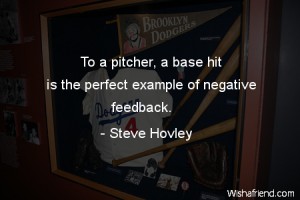
    Steve Hovley negative feedback
  3. Feedback – Whether playing baseball or learning in the classroom there is always feedback. Some is positive and some is negative. This can depend on something as simple as mindset, timing, and delivery. With students the risk of being kicked off the team is never on the table. There are no minor leagues in education. Teachers are in the room to help all of their students make contact with the ball and circle the bases with their learning. Regardless of the type of feedback teachers and coaches are there to instruct, identify talents, and encourage their students.
  4. When a player strikes out, there will be another chance to bat. When a player walks a batter or misses a throw, there will be another chance coming their way soon. The lesson is always be thinking and practising for the next opportunity whether it is in the classroom or on the field.

So as the players take to the field for the next umpteen months take some time to share this incredible game in your classroom. Take time to enjoy the Science, Math and chance to develop life strong habits of resilience and teamwork.

Cancer, pink shirts, and why I hate Jell-O

cancer

Cancer is a ruthless disease. It knows no boundaries, respects no ideologies or cultures, and disrupts the lives of everyone affected by it. Cancer has a twin in education. It’s bullying.

Recently, I was creating some TED Ed lessons about bullying(in its various forms –The Cyber Bullying Virus and Bully Dance). This got me thinking about the following question;

What makes bullying so virulent that it can evade, morph, and destroy generation after generation?

What if we looked at bullying like it was a medical epidemic? If we called it a disease, which it truly is, would it be treated more seriously? Could it then be given the same attention and urgency as HIV/Aids, Ebola, and Cancer are in the medical world?

Or have we built up our immunity to the existence of bullying in our schools that says if it is not happening to us?  Like cancer, bullying is serious. Its symptoms leave lives in havoc along its path.

Yet, for all of the attention(meetings, resources, legislation), research, assemblies, and instructional time invested into eradicating bullying across multiple lifetimes it has not disappeared. With fingers pointing in all directions it is time we all look to our youth to solve the problem of bullying because the adults have made a mess out of it.

Remember back in 2014 when school trustees, all adults, managed to create a working environment so toxic that the police needed to be called in to deal with the troubles. My students asked why the adults couldn’t get along? I couldn’t answer it with anything other than bullying.

How do we justify this behaviour to a media savvy student body when those in positions of leadership are modeling “do as I say, not as I do” by their actions?

The course of treatment for the cancer of bullying is simple. Let students lead.

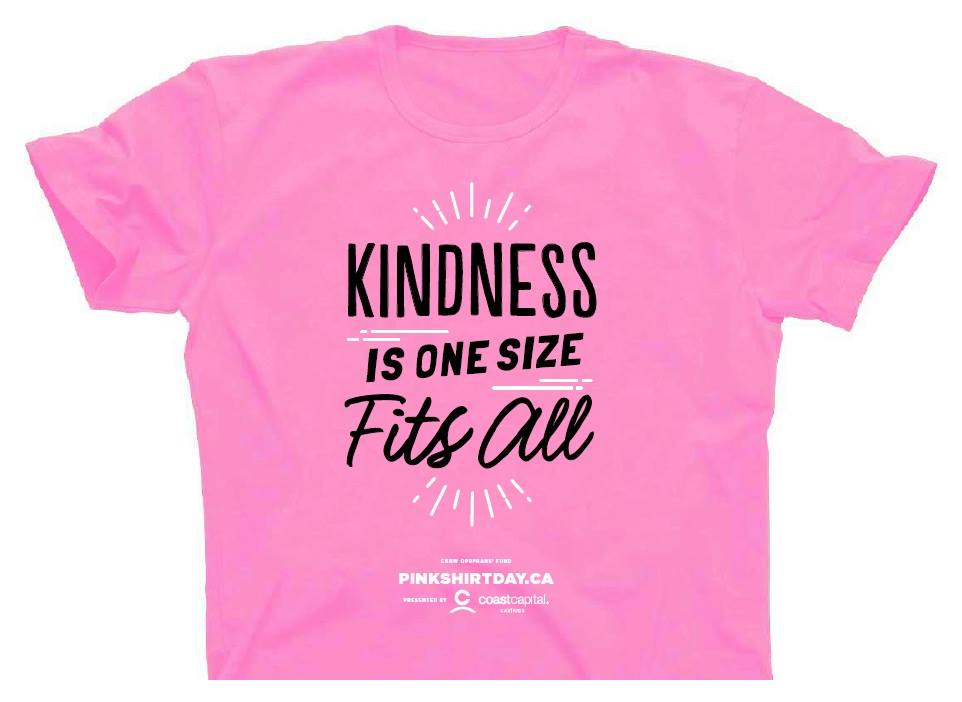
Students possess limitless energy, potential, and ideas so why not equip, empower, and get out of their way to do great things? A powerful example of a student led initiative to stop bullying is Pink T-Shirt Day. It started in 2007 at a Nova Scotia high school where a grade 12 student defended a grade 9 be being bullied because of the colour of his shirt. It has since become celebrated as a national day of awareness, with schools across the country holding stand up to bullying by wearing pink events.

PinkShirtDay

One of the reasons Pink T-Shirt Day is such a success comes from students leading the way. It has now fostered other wear pink events to fight bullying, homophobia, and transphobia. My school will be participating in its 2nd Day of Pink of 2016 on April 13th. At its core, pink shirt day is a way for everyone to stand together in order to focus on everything that unites us. I feel more student led events like this would set a positive and lasting example for people who have struggled with bullying at all levels of education from classroom to committee.

When students are allowed to lead they naturally rise to the task. Want proof? Look at the impact that Ryan’s Well, Free the Children, and Me to We have made on our world. Each amazing initiative inspired by a student.

Think about how you can encourage your students to be agents of change and social good in the fight against bullying in your school. I would love to hear if your school participates in Day of Pink activities. Tag me here or on Twitter @willgourley.

p.s.

I had Jell-O in the title because I was looking for a silly focus point in the title. There is an explanation of my true dislike for Jell-O at …why I hate Jell-O on escheweducationalist.wordpress.com.

Tech Talk

I would like to share a new initiative my class is starting at our school Ancaster Meadow.

Our class realized the large need for technology in the classroom. We noticed that students are sometimes unfamiliar with apps that are available for completing work and for presenting learning. We are starting a new program called “Tech Talk” where as a class we travel to classrooms and instead of “Reading Buddies” we will assist the class one on one with apps of the teacher’s choice. We came up with a benchmark of five:

  1. Explain Everything
  2. Kahoot
  3. Weebly
  4. Pic Collage
  5. Prezi

These apps will be explored in detail by my class so when we visit our first class after the break, the break off sessions will be smooth and very productive. We will offer this program to grades two-five and speak to teachers before regarding sign up. Students will be able to explore the apps, prepare a small task and then share it with the whole class. The sessions will be fifty minutes long as that is how long a period is in our school. We hope that students will learn from each other and that everyone will be able to use these apps in the new future. I hope it will be a meaningful experience for my class to teach younger students skills that they already have. I cannot wait for our first trial after the break. I encourage everyone to try this  “Tech Buddies” program and share your experiences as well.

Recording Process

I recently gained access to the HWDSB app catalogue on our new teacher iPads. I was able to download up to 175 apps and check out the apps I thought would be very helpful for my students. The one app I discovered that I think helps with recording student progress and behaviours in class is the app called idoceo.This app allows for you to walk around with your iPad and keep track of all student work ethics throughout the day. I have started to use the “happy face” symbols that come in four different colours to note the four levels of achievement. This is so helpful because you do not always have to have your mark book out, you now have a portable mark book with easy to use features.

You can also use the “seating plan” section app that helps you chose students at random rather than calling out random students. This keeps all students on their toes and always ready to answer.

You can always show students how they are doing on this app by calling them over to check their process marks in class. I find that I am always so focused on the end product and do not focus enough on the process of my students. With this app in hand, I feel I will be more readily available to record student efforts.

I am very fortunate to be able to have this extra iPad for my class which makes using technology that more accessible.