
Photo of Mike Beetham

Context – That Makes Sense

Please turn to page 134 in your Mathematics text and complete questions 1 -5. Students comply with smiling faces, complete the work, take up the solutions and then move on. Next day when you revisit a topic, it almost seems like they had forgotten everything that had been done the previous day. This is not a rare occurrence in classrooms of all ages. Research clearly points out how important the role of emotion is in learning. One of the most critical tools for a  teacher is the strategy of context. I always ask myself prior to developing a unit of study what would this concept or skill look like in the everyday life of my students. That helps me frame the context for the learning task.

When I am able to make connections to the everyday lives of my students and the focus of instruction in the classroom I find that the learning is more likely to be consolidated and accessed by the student in future related tasks. Here is an example of how I used context in February. I took my class to camp for 3 days. Prior to going to camp we had to look at what the total costs would be per person as well as for the group. The level of engagement was extremely high as they explored a real life task that required them to access prior mathematical knowledge. While at camp they took photographs and filmed a specific activity they took part in. When we returned to school we did a recount of our experience that was to be shared with their families. It was some of the best writing they had done all year and it allowed me to see a transfer of the skills we had been working on since September. There was no reluctance, no hesitation as the task was real for them.

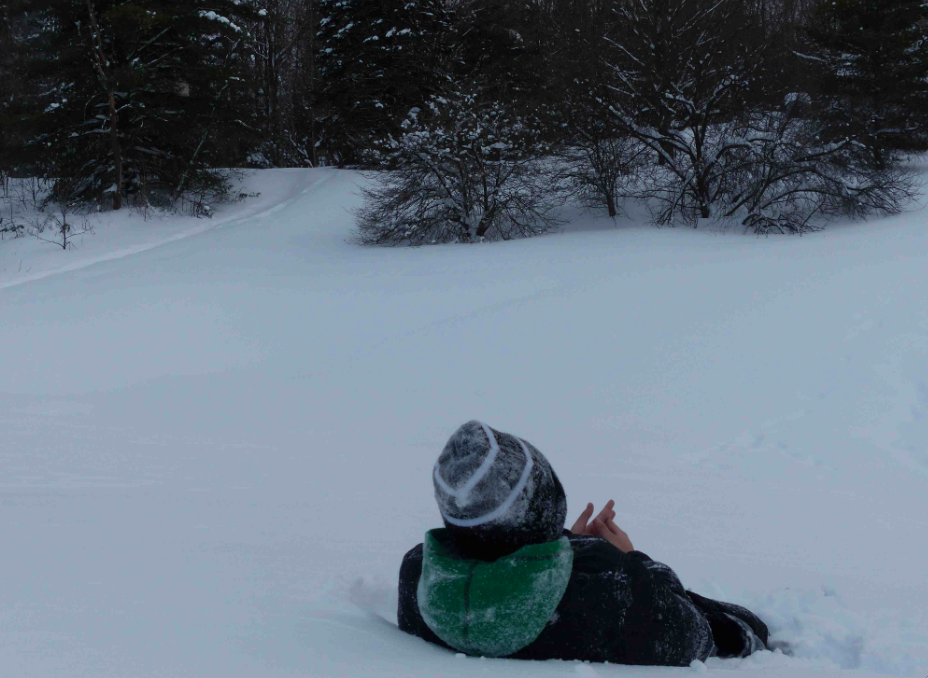
A person lying in the snow

The Power of the Outdoors

A traditional classroom is seen as a room with four fixed walls, desks, books, manipulatives, educational supplies etc… Imagine the enthusiasm running through your students as they scoop, lift and observe the life in that small stream or the piece of art coming to life as they sit and sketch the wonderful scenery that surrounds them from nature’s canvass in the fall.  Nature and the natural wonders of the world opens up options to both the students and the teacher as they ask questions and experience the process of discovering how the world around them works.

Outdoor education is more than just visiting a local conservation area or board run program. Outdoor education is making use of the local parks, school yard playgrounds, school gardens or any natural area that is connected to the lives of your students. Developing an awareness of their environment and just how precious their day-to-day lifestyle habits are must be experienced and not just observed or researched. Over the many years of my career I have learned just how powerful the outdoors can be as witnessed in the level of engagement and the quality of the work produced by my students. You belong outdoors!

Photo of Mike Beetham

What’s For Lunch?

One of the best team building activities and diagnostic tools that I use is eating lunch with my students during the first month of school. During this precious time, I am able to discover so much about the uniqueness of each and every one of my students as people and students. Bonus content comes in the form of what I learn about the  social climate of the classroom (and school).  Over the course of a week I make sure that I move around the room and sit in a variety of groupings to ensure that I have 1:1 contact with every student.

Of course the reciprocal scenario also unfolds as I am able to reveal myself as a real person right before their eyes. I soon am not just their teacher! It is that critical beginning where I am able to send them the message they are important, they are special and that together we will accomplish great things and overcome challenging struggles.

For any teacher new to a school you must always balance this with the need to connect and become a part of the professional team at your site. The critical concept is that this is a planned event with a specific target outcome and can’t just be left to happen haphazardly.

Photo of Mike Beetham

When Does A Classroom Agreement, Become A Classroom Agreement?

I have been using the concept of the group collectively coming up with the behaviour and work standards they would like to live with for their time together as a team for over a decade. But on one fateful day in the winter of 2013 I was able to be a part of an experience that was a profound learning opportunity for me. Students have always enjoyed and valued being asked about the type of classroom they want to create. They have generated ideas, held dialogue on their and other’s ideas, compromised and come to an agreement in which they sign and live by. At that point the class moves forward and the journey begins.

This year we went through the same process I had for many years and came up with a wonderful classroom agreement that everyone was proud of. As always, about a month into the year I purposely broke the classroom agreement and needed to be held accountable for my actions just like everyone else who signed the agreement. That usually means that I have to go through  the problem solving model we use, take ownership for my choices and deal with the appropriate consequences for my actions. Needless to say, there is never a shortage of students who are willing to give up their free time to monitor their teacher as he sits in a detention. Thus the lesson passed on is that this agreement is truly for everyone in the room and not just for students. What made this year different was how my students reacted to it. They were completely silent and unsure of what to say or do when I put myself in the solution zone. A follow-up debrief revealed that teachers have always said that they were part of the agreement, but usually just said sorry when they did something wrong and moved on. They had never been held accountable as the students are. This experience provided me with me a lot to think about!

Photo of Erin G

Current Francophone Musical Artists – 10 “Must Know” Musicians

     When disscussing current Francophone musicians with Grade 8s, I’ve found it challenging to hone in on those that would appeal to 14 year olds who are somewhat reluctant to buy into anything outside of the mainstream top 40 charts. When it comes to music, their musical tastes seem to be quite ingrained. Seldom is there much flexibility between the rock and rap genres let alone new linguistic frontiers. Given the sheer volume of what’s out there, it can be difficult to identify what’s good, what’s appropriate and what’s appealing. Consulting the current charts was not very useful since there was not a great deal of difference between what was also popular here. I was therefore pleasantly surprised to find an easy answer to my query when I happened upon the website girlsguidetoparis.com (see link below) and found an entry entitled “10 French Singers You Should Know” that covered a range of genres and was accompanied by an informative blurb about each individual/group (direct links were also provided).

    According to the “girls”, the list included the following:  Coeur de Pirate, Shy’m, Benjamin Biolay, Camille, Christophe Mae,  ZAZ, Ben l’Oncle Soul, BB Brunes, -M-, et Sexion d’Assaut. I’ve checked out a few of them and so far, I think they would potentially be okay. I plan on screening a couple segments of some of the videos and have the students write reviews of the songs (a task we’ve been doing already in accordance with their selections). Other ideas might be to design some web-based reading activities around biographical info, upcoming concerts, reviews, etc. As indicated by the title, the webiste itself would be appealing to girls in particular and woud offer some interesting off-shoot activities (think “voyage virtuel”)…

http://girlsguidetoparis.com/archives/10-french-singers-you-should-know/

Photo of Mike Beetham

A Great Classroom Is Created When…

I had to share this with someone, so I felt this blog was the best way. At a recent class meeting we all sat down and started to talk about what makes a classroom great. This topic generated a myriad of ideas, discussion and debate. I am sharing with you the final product that came from this amazing group of students.

– when everyone works as a team

– you celebrate when people do something right

– every student is a success

– tell the teacher how you care for them and they will tell you the same way

– teachers teach us how to share, cooperate and work as a team

– we have fitness in the morning

– we do different kinds of things like planting

– you don’t give too many chances

– you take the time to get to know each other

– don’t be too easy, don’t be too hard

– we set goals

– when students can be taught and entertained at the same time

– teachers discipline

– you take risks with each other

– students and teacher communicate to each other

– we give lots of smiles

– students are allowed to teach teachers

– students are allowed to learn from their mistakes

Needless to say, my students have once again taught me how valuable an asset to our classroom they are. Their collective voice has demonstrated the power of our class motto ‘Together Everyone Achieves More Success’. I hope you can read my happiness and pride!

Financial Literacy

Money “Cents!” Introducing Financial Literacy in the Elementary Classroom

Financial literacy is defined as, “Having the knowledge and skills needed to make responsible economic and financial decisions with competence and confidence.”  In A Sound Investment, 2010, a document released by the Ministry of Education, this is the definition according to leading experts called upon to look into the need to integrate financial literacy in the elementary and secondary curriculum.

Four years ago I began to wake up to the fact that I didn’t fully understand my own personal financial reality and the consequences my decisions had on both a short-term and long-term level.  I realized that I needed to understand the impact my financial decisions made on both my personal life and that of the global economy in order to participate as a responsible citizen in today’s every-changing and complex society.

I took the first step by immersing myself in resources to support my own financial literacy and those that would help me integrate the concepts and skills into my own classroom.  To my amazement (and delight), students thoroughly enjoyed each and every opportunity to learn about topics that focused on money management, healthy living skills, decision-making and personal awareness, consumer awareness, and responsible citizenship.  In addition, families showed their appreciation in having their children begin preparing for their financial future at such a young age.

I know that if I had been introduced to financial literacy in the elementary grades and explored it in-depth in secondary school, many of the financial decisions I made throughout my adult life would have been different.  We always want what is best for our children and often times that means doing for them what we wish was done for us.  Integrating financial literacy just makes “cents!”


The following are a few resources to get teachers started with learning about and integrating financial literacy in their own classroom.

A Sound Investment, Ministry of Education, 2010

www.edu.gov.on.ca/eng/financial_literacy_eng.pdf

EduGAINS: Financial Literacy Resources- Ministry of Education

http://www.edugains.ca/newsite/financialLiteracy/index.html

Investor Education Fund: Inspire Financial Learning 

www.getsmarteraboutmoney.ca


“I Know Here”

At one of our first staff meetings this year, we had a discussion about building community in our school. What is our community? How do we see ourselves? Many of the teachers had a difficult time describing our school community. We are in a building with additions that have been attached on various levels, resulting in doors and stairs that physically separate the classrooms into small groupings of three or four to a floor. The community outside of the school is also diverse. There are few apartment buildings as well as a neighbourhood of homes, a park, and a plaza of stores.

To discover our community through student inquiry, all the classes read the book I Know Here by Laurel Croza.


We then asked the students to take a similar approach and define their community with words and representations. The results were outstanding. Every age from Kindergarten to grade 8 was able to identify what made the community unique and they presented their own perspective. To extend that sense of our community defined by student voice, we set up a literacy night at the school to showcase the student work. It included descriptive writing, drawings, 3D representations, photos and videos.

The experience was rewarding for the teachers, students, and parents of our school community. The work was meaningful and the children were engaged. It was a topic that was accessible to all and promoted equity throughout our school. The children were also able to share new insight and point of view with us, the educators.

Photo of Carmen Oliveira

Tackling Challenging Topics: The Dolphin Dilemma

Recently, our Grade 4 class began exploring habitats and communities in our Science unit.  The children were very excited to share what they thought we would be learning about and which habitats and animals they were looking forward to researching.  One student was eager to tell the class that she saw dolphins at a marine park during the summer and would like to learn more about them because they were beautiful.  Now, I have to preface my story by saying that every student I’ve ever had in my classroom knows how much I love dolphins.  In fact, anyone visiting my classroom immediately notices the countless dolphin figurines lovingly given by many of my former students.  However, what students may not know is how strongly I believe that these mammals do not belong in marine parks but rather, should be left to swim in the wild.

During our classroom discussion one of the boys surprised me by asking the student who had visited the marine park why she liked to see dolphins in pools when they were supposed to be in the ocean.  Many students looked at him confused and admitted to having seen dolphins in marine parks and they also thought they were “cool.”  He seemed outnumbered by the blank and puzzled stares coming from his classmates and looked at me for support.  I have to admit that my natural reaction would be to defend him, prove why he’s right and try to educate students by raising awareness about the issue.  Of course, after so many years of tackling challenging issues related to social justice, the environment and students’ personal lives I know that the best way to engage in meaningful conversation is to keep an open mind, look at all perspectives, raise relevant questions that will provoke critical thinking and provide factual (hopefully biased-free) material that can be used to analyze the issue at hand.

This always takes me back to Chimamanda Adichie’s TED Talk  “The Danger of a Single Story.”  http://www.youtube.com/watch?v=D9Ihs241zeg
In the past I’ve broken down this video with my students for us to realize how biased we all are to some degree and how those biases can greatly affect how we see and interact with the world.  When we have the tools we need to deal with challenging topics, we end up not only learning more, but growing from our experience, even if we continue to disagree.  It’s a powerful lesson to learn in life: before deciding where we stand on an issue,  step back and look at it from all sides before venturing toward a conclusion.

I do have to confess that despite all my attempts to stay neutral I did wear my Dolphin Project – Swim Wild t-shirt to school that same week.  Needless to say the students have decided (without my coaxing) that they’d like to learn more about a dolphin’s natural habitat and study the impact that keeping them in marine parks has on them.  This inquiry will definitely present some challenges for me but I hope to guide my students to their own well thought-out conclusion.  I’ll post our findings in the near future 🙂


Photo of Erin G

Getting Kids to (Really) Speak French

This year, my goal is to get my students speaking a lot more French and sound better doing so. If it were me, I would like to have something more to show after learning French for four or five years. I suppose this is what is really behind the focus of the (soon to be released?) new curriculum.

As for me, I’m going to vary my approach this year. In the past, a lot of the French speaking came from short daily activities, questions/answers and summative oral presentations that focused on integrated targeted vocabulary and grammar structures. The summative activities were always creative and students responded well to them, however, they were perhaps not the most practical (cooking show, blind date, etc). Based on feedback to some written response questions and from parents, it is surprising to me to find out that students seem to really want to learn French. I know, shocking isn’t it? My challenge this year is how to balance out the practical but still make it interesting and most importantly fun.

For September with my grade eight classes, I have begun with the basics. I mean the real basics like greetings, variations of how are you and trading contact information. I’ve been using the resource and provided them with current lingo/slang in order to make their interactions more authentic. A typical lesson includes some explanation/questioning by me followed by 5 to 10 min of guided conversation with “freestyle elaborating”. We have already tried a short skit with a partner whereby they had to incorporate “Comment vas-tu?” and trade contact information but they were free to come up with their own context. The end product was okay but I found that they were more carried away by adding in all this extra detail to support the scenario which distracted and in some cases derailed them entirely. In the end, I decided that I would follow up with a one-on-one “examen oral” based on the same content. I think that an actual conversation will give me a better idea of how they are really able to communicate. Will keep you posted as to their progress. In the meantime, please let everyone know about anything that has been working for you.