Stewardship/Sustainability in SK

With our winter inquiry coming to an end, the biggest challenge in my mind was how to facilitate the opportunity for my senior kindergarten students to use what they have learned so that they can become valuable stewards of the planet.

To provoke an understanding of the need to care for and respect the environment which related to our winter inquiry and hoping the students would automatically spring into action, I wrote a note from the creatures the students have observed living in and around our schoolyard. In the note, the creatures complain that the snow is so dirty, that it is making them sick: “Chers Amis, Our homes are not healthy any more! When the snow melts, the water we need to live is making us sick. Many of our friends have already left to find a cleaner place to live. We don’t want to leave! Can you help us? Signed, your friends – Earthworm, Chickadee, Rabbit, Crow and Cardinal. I folded the note and tucked it into a space between the bark and trunk of one of our maple trees growing along the fence in the schoolyard.

During the morning Outdoor Learning period, we started off the lesson with a turn and talk activity to review some of the things we learned about What Happens in Winter. Information flowed as the students chatted with their peers. When they had finished, I gave them the challenge of looking for and finding evidence of living things in the schoolyard. I was beginning to wonder if anyone would find the note, when finally, a group of students came running back, all talking loudly at once about something they had found in a tree.

I gathered the students together and read the note aloud to them, ending it with the question, “What do you think?”  They turned and talked with their neighbours excitedly. “Rabbits can’t write!”  “Yes they can.” And about the message of the snow being unclean; “It’s true! There is sand in the snow. I can see it.”  “Snow looks clean but it’s actually really dirty.” Others mentioned the microbes and the dirt from cars as well as the dogs that dirty the ground. So I asked, “Can we drink the water if we melt this snow?” to which came the answer, “Ewww! No way!”

At this point, I was hoping the students would acknowledge that humans played a part in the messing up of things and that, consequently, it was up to all of us to stop it. However, I was quickly made to realize that, of course, how to clean up the planet is a gazillion dollar question that nobody can fully agree on, let alone a group of five year olds. At this age, they are very capable of figuring out how to help in such a situation, one animal at a time, by giving a bowl of clean water to drink, which is what they do for their pets at home. And what did I really have in mind as far as stewardship goes? Petitions? Posters? Protest marches? It became clear to me that rather than ask HOW we might help the creatures, a better question was, WHAT IF? So I started over again, asking them, “What Would Happen If There Were No Winter?”,  and I explained that, “There is something called Climate Change which is making our Earth warmer than it should be. Scientists think this is happening because of pollution caused by people using cars and airplanes to travel around, and building factories to make things.”

At first, the group was rather quiet, but then one of the students made the comment that a warmer Earth meant that the snow would melt. RIght away, more students began to add their thoughts as a conclusion began to form itself:

“If the snow melts, then the polar bears would have no home.”

“And the seals and foxes, too.”

“There would be no habitat for the animals.”

“All the animals would lose their habitat and then they won’t have anything to eat.”

“Their habitat is broken and the animals would get dead.”

Losing habitat is something the students could visualize and understand, and so I was able to ask them, “How do you think we can be habitat helpers, then?” They were so happy to articulate how they have bird feeders in their backyards, how they compost and recycle garbage, how they plant gardens with their families, and how sad they are when they see destruction of habitat such as trees being cut down, or dried up worms on the pavement. While five year olds may not independently engage in activism on a large scale, when we finished this inquiry, many of them realized that they already do have a positive impact on the environment. My own learning came when I had to acknowledge that Stewardship and Sustainability in an SK classroom are, of course, tied very closely to the five-year-old developmental stage and the way children at this age perceive the world, with themselves firmly at the centre of it all. I was reminded that everything does, after all, start with the individual.
Teaching the Language of Power

Most of the learning I’ve experienced as an elementary school student is a blur. There are few moments, however, that stand out as pivotal and that have helped shape my experiences as an educator today. One of such moments was grade 7. It was in grade 7 that I learned the word mediocre. Before then, I had never encountered this word and once introduced, it was truly a powerful moment for me. In learning this word I was given language to express an idea that I didn’t even know had existed. This is the power of language and this is why I fell in love with words. My fascination with the ways in which words can be intentionally nuanced to convey ideas with such lyrical intensity fascinates me; not only because of the creative ways in which ideas can be constructed, but also because it is a tool for granting access to discourses that without them one would remain silenced. I experienced the power of language but also that language was power. This experience brought me to my journey of engaging my students in the politics of language and exploring ways I could grant them access to platforms of thinking simply by equipping them with the language of power.

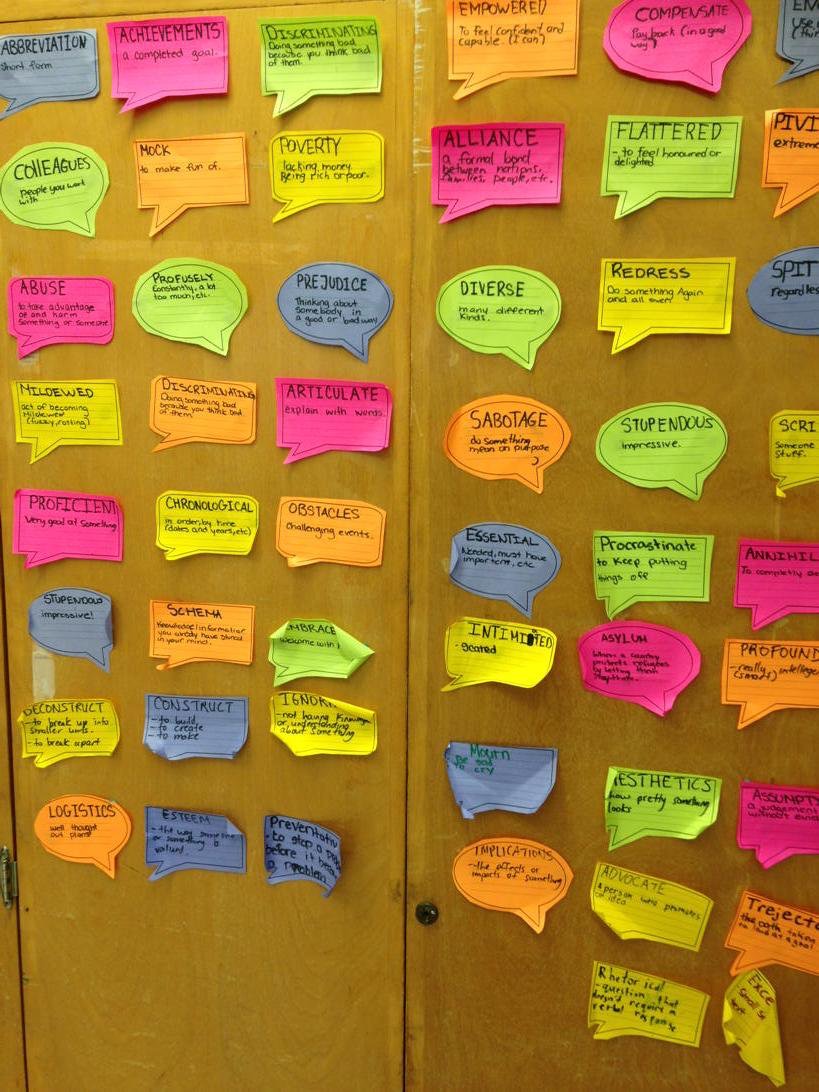
More than mere vocabulary boosters, words of the day or word studies, when introduced in meaningful contexts, can not only enrich student vocabularies, but can also give volume to their voices as thinkers, activists and world changers. My journey toward empowering learners with the language of power began in my first year of teaching. It was a grade two class and I was terrified. I had no idea what to do or how to go about it. It seemed like all the learning from my formal teacher education went out the door as soon as the students walked in. I realized I was in trouble when I would speak to my students only to receive blank stares. What I wrestled with was whether or not to make what I was saying more child-friendly or to simply bring the children up to speed and create many teachable moments with the words that I used. The result was the latter and we began an anchor chart entitled “Ms. Nelson’s Fancy-Schmancy Words” where when students stopped me mid-sentence to seek understanding of a specific word I used and it would be added to the list along with its definition and the sentence in which it was used. Now, 7 years later, the anchor charts have evolved into a word wall in which students are constantly identifying not only new words that I used but also introducing ones of their own and adding words they find in the literature they read or listened to on a daily basis. The love for words became contagious and the thirst for learning new ones was intrinsic.

Students were then invited to use words, or the language of power, as tools in exerting voice to an authentic audience. Students were empowered by words when they interviewed all 5 Mayoral Candidates in the 2015 Mayoral Election. Students wrote speeches and presented them as great orators in front of invited community members that included the local crossing guard, a church pastor and family and friends. Students raised awareness by writing blogs about the impact of their social identities and shared these sentiments with the school community. Their words spoke to issues of social justice and coloured the imagination with distinct imagery, was a power to be wielded in the pens and voices of elementary school students.

IMG_0600

Word wall from my Grade 5/6 class: sabotage, aesthetics, logistics, schema, implications profound, trajectory, embrace, chronological, deconstruct, procrastinate, intimidated


Is Math Neutral?

The notion of neutrality speaks to the experience of being impartial or unbiased. It speaks to the absence of asserting value, power or privilege over another or the act of being impartial, unprejudiced and nonpartisan in nature. There are many areas of teaching and learning where the existence of prevailing politics is named and sometimes challenged: Whose stories do we include in the social studies/history curricula? What literature is considered to be the cannon? What art forms are considered cultured? But when educators think about the tapestry of math education, this notion of it being neutral tends to be widely agreed upon because of the perceived objectivity and absolutism that characterizes the ideas that are explored. But I wonder…is math really neutral?

“Math is about numbers. Surely it is neutral.”
This year, in supporting English Language Learners in math, I have learned many new Mandarin and Cantonese words from my students. More specifically, I’ve learned the inherent ways that Chinese characters are written to nurture a conceptual understanding of quantity. For example, the number eleven is written 十一 which means “ten-one” or can be understood as “ten plus one”. Similarly, the number twenty is written 二十 which could be understood as “two tens” or “two times ten”. Finally, the number thirty-three is written 三十三 Which could be understood as “three ten and three” or “three times ten plus three”. The fact that the word for the number eleven, when represented in English, has no relationship to the the concept of quantity speaks to the way numbers are represented are not neutral. This discrepancy in language representation speaks to the biased nature numbers are conceptualized through language. Thus proving an inherent bias in the ways in which numbers are conceptualized and number sense is acquired. Similarly, the bias toward English representation of numbers can limit the conceptual understanding of languages that represent numbers in a more conceptually friendly way.

“Math is about problem solving. Every has the capacity to solve problems.”
Consider the following problem: Brandon travels to the city using the subway. Each car seats 30 travelers. How many people might be on the subway if there are 10 cars? What background knowledge might students need to have in order to understand the context yet a alone respond the the problem mathematically? While the problems we pose to our learners may involve numbers that can be calculated and manipulated in flexible ways, the context, when coming from particular experiences, can deny access to the learning that needs to be achieved. In other words, if the context from which we invite students to explore math concepts can be carefully crafted in order for our learners to be able to relate to the ideas, they can also be unintentionally crafted in ways that could limit students access. In this way, contexts are never neutral because they come from a particular place of knowing or experiences that not all students have access to.

So there you have it. I’ve explored two very simple ways bias is experienced in math discourse. The presence of even one form of bias discredits the neutrality of math. If math, a lens for viewing the worlds through numbers, shapes and patterns, can be ladened with bias and politics, what else about the schooling experience share this similar trait?

Field Trip to the Toronto Symphony

Last month, all of my grade four classes went on a field trip to Roy Thompson Hall to see the Toronto Symphony Orchestra play their annual concert for students. I love going on this field trip. For most of my students, this is the first time that they have ever seen an orchestra live and for many of them it is a rare occasion that they visit downtown Toronto. They ooohhhed and aaahhhhed as we passed by the CN tower and marveled over the fancy seats at Roy Thompson Hall.

Before, during and after the field trip there were many details to organize to ensure a safe, fun learning experience for everyone involved.

Before the Trip

Logistical Planning (A couple of months before the trip)

  1. My first stop before planning the field trip was to ask my administrator for permission to go. I was asked to fill out some forms with information about costing, busing requirements and date of attendance. After my administrator gave the green light to plan, I made contact with the coordinator for student field trips and decided on a date.
  2. (Note: In my very first year of teaching I inadvertently booked my school on a field trip. I was calling two different locations and trying to enquire about dates for both. I had not booked or signed any contracts with either place but one of the locations turned around and sent me a bill for around $500 dollars for not showing up to the field trip day that we had spoken about on the phone months before. Through lengthy discussions with the location the situation was resolved. So learn from my errors and be VERY explicit when discussing dates with potential locations.)
  3. After the date was selected and my administration approved the forms I added the date to the master calendar of my school so that nothing else got booked on that day.
  4. Once I booked the trip, I approached my office staff for a cheque to pay the deposit.
  5. I followed my school’s protocol for ordering the buses and kept the confirmation in a safe place.
  6. The next step was to prepare a parent letter for field trip. (Here is the letter….Toronto Symphony letter 2016)

Logistics (The final couple of weeks leading up to the trip)

  1. I put a plan in place for students who did not be attend the field trip. For my school, this was all the grade 3 and 5 students in split classes. The teacher of the grade 4/5 class stayed back and taught all the grade 3 and 5 students during the day.
  2. Also, I ensured that there was a plan in place for students with special needs. I was the extra support person for the class that required assistance. I stayed with a group of high need students the whole trip.
  3. I spent a lot of time preparing students for the assignment that they were required to complete post field trip.
  4. In class we reviewed expectations on a field trip. I was very explicit. We all did role plays of good audience behaviour at the symphony. What would audience behaviour look like at a symphony versus a rock concert. It was a lot of fun.
  5. With so many details to remember, I sent an e-mail to my administration and all the teachers attending the field trip one week before the trip to review all of the information required for a successful day. Hopefully this list will help remind you of a few items for the day.

Hello everyone,

 Here are some final pieces of information/reminders about our trip on Thursday and a schedule of the day.

  1. Our office staff has provided me with a master list of all emergency contacts for every student in grade four.
  2. Just a reminder that all grade four students will be having pizza day this Wednesday not Thursday.
  3. Remind your students to eat a big breakfast on Thursday. Lunch will be slightly later than normal on Thursday so remind them to fuel up before we leave. I have told your students not to bring their backpacks or lunch bags with them on the trip as their will be no space for them. However, I have told them a small purse or a small string bag would be fine.
  4. Remind students that there are no devices on this trip and students do not need to bring money.
  5. Remind students that there will be time to visit the bathroom before the concert and after the concert at Roy Thompson Hall. Please encourage them to use the bathrooms at those times so that they are making every effort to watch the one hour show.
  6. Please ensure that all students with medical needs bring their epi pens and puffers on the field trip.
  7. My cell phone number is ———-.
  8. This year the organization of the TSO student concerts have changed slightly.  “Ushers will meet you at the main doors of Roy Thomson Hall to guide you and your class to your assigned seats.  Please note: there are no hard tickets for this concert; ushers will be working from a seating plan. I have the busing and seating information package and will be bringing an extra copy for both buses on Thursday.
  9. I have attached the schedule for all students not attending the trip.
  10. Finally, remind your students to look awesome on Thursday as we are having a fancy dress up contest!”


During the Field Trip

Before we left I handed in the attendance of students on the trip, the bus number and an emergency number to the office staff. I then helped students find their seats on the bus and at Roy Thompson Hall. I was very careful about who my students were sitting beside and worked hard to ensure that the students were making good choices all day long.

After the Trip

Follow up activities

Besides having an amazing, awesome fun day with the students, all five of my grade four classes had an assignment to complete in the last hour of school when we returned from the trip. Leading up to the trip, I spent a lot of time prepping the students for what they were going to hear and see at the symphony. We spent a lot of time analyzing pieces of classical music and using word banks that they would be using for this assignment. In addition to analyzing music, I also showed the students the actual assignment and wrote examples of a level 4, 3, 2 and 1 answer. Every student also received a paper with a word bank that I have from Musicplay’s Listening Resources and a list of the songs played by the orchestra.

Here are the Anchor charts for grade 4 assignment and Grade 4 symphony assignment for your use. Hope you and your students have an amazing, wonderful, excellent, awesome time on your next field trip!!!


Embracing a New Teaching Assignment

The spring brings many new things to us in the teaching profession. It is an end to hallways that smell like winter boots and the request of help from the students in our class who have lost their mittens for the tenth time this year. Spring also brings the new teaching assignment. As is practice for many schools, teachers wait for their principal to meet with them at this time of year to assign the new package for the upcoming school year.

Four years ago when I was teaching a grade 2/3 split my principal came to me with what seemed like a crazy idea for me to team teach music with the other music teacher in the school. I understood why she asked, I had done some extracurricular work co-leading some students in drumming so it seemed like a good fit. Although I was very cheery when I responded to my principal and told her that this assignment “sounded great” when I got home I freaked out. I had no formal music training and I was going to be team teaching with someone who was a professional oboe player before she became a teacher. I didn’t know how to read music. I knew how to find a good groove on the drums but that was it. I literally went ahhhhhhhhh every time I thought about this assignment for the next few days.

After I calmed myself, I met with my new co-teaching partner. She was very keen and nice to me in that initial meeting but I am positive she knew I had very little formal training in music. I grew up in a maritime house where kitchen parties and dancing around the house was the norm. I heard Patsy Cline at 6:00 AM every Saturday morning throughout my entire childhood as my parents sang and cleaned the house. I love music but I had never taken any kind of formal music lesson. However, I wanted to do well at this assignment so after some reflection, I signed up for piano lessons. Yes, it felt funny to be sitting in the waiting room with a bunch of children but the teacher that I had was great and in no time at all I was reading music and playing the piano.

I continued with piano lessons and then theory lessons and every single music workshop that I could get me hands on until I had improved my knowledge base significantly. What initially drove me to go to these lessons was that I felt my students really deserved a teacher who was knowledgeable and committed to doing the best that they could to facilitate learning. What I didn’t expect was how much I ended up loving the piano and the music it creates and will probably continue to study it for a very long time. I also discovered that I love spending a good chuck of every summer ‘geeking out’ studying music theory.

So as you get your assignment this spring, and it may feel unexpected and like a strange fit. You never know, it might be the best thing that ever happened. I have no intention of leaving the arts department at my school anytime soon. Who would have thought it four years ago that when my principal gave me this crazy assignment that it possibly would be a long term career path.

However, if this spring you get the worst teaching assignment you could have ever imagined, then there is always hope for next spring when the new assignment will come again.


Keep swinging for the fences

photo by jcclark74 CC0

Spring is definitely here, perhaps this is not so evident in our temperamental weather, but by the fact that baseball season is back. In honour of that I wanted to share some connections to how being a student of the game is like learning in the classroom.

I look at baseball as a sport for all ages and genders. Everyone can play. In some ways, a baseball diamond could be the ultimate classroom with so much going on at anyone time in the stands, in the dugout, and on the field.

Baseball is a game of scenarios. There are constant situations to be thought through in every game and there are statistics kept from little league to the major leagues. Just think of all the other Math skills at play in the concession stands, ticket offices, and accounting/payroll departments. Math is an important part of baseball.

Baseball is a game of Physics. How a ball rotates from the pitchers hand towards home plate determines its trajectory. The angle and bat speed at which a player makes contact with a ball determines its flight duration and distance. Major League Baseball measures everything possible on the field that happens in a game, including ball rotation, pitch velocity, swing(bat speed), and field area covered in a program called Sabremetrics. I wrote this TED Ed lesson called Future of the game: Baseball latest statistical revolution to show how it is used.

Weather plays a role here too. Forecasts determine whether games can be squeezed in or postponed. Data from on-field temperature, and prevailing winds gets noted too. Imagine the engineering required to design the perfect outdoor ball park because no two seem to ever have the same design.

Baseball can be altered and adapted to suit the level of all its players. There is Kickball(soccer baseball), marshmallow baseball(played with a tennis racket and a bag of marshmallows), and Rounders. Some might even prefer the game of Cricket as it may be more familiar to their students than baseball. All of these adaptations have similar fundamentals and transferable skills.

Baseball is a team sport. No one can play all of the positions at once. It requires collaboration. Everyone plays a role whether in the field or waiting to bat. Baseball is a thinking game. Many of the lessons of life come from playing it. I mentioned Math and Physics before, but there are other areas that come in to play here too;

  1. Emotional- Players can get caught up by a moment, or when a mistake gets made. This can lead to other mistakes if focus required to make the next play. Baseball teaches its players to keep their minds on the game. It also shows students that mistakes are going to happen. How they recover from them is an important part of the game/lesson.
  2. Mental – With all of the statistics kept in baseball it is important for players to know what to do with the information. Processing on the fly and responding just like in the classroom comes from preparation aka practice. Players and students alike prepare for games/tests receiving coaching/instruction and next steps for improvement.
    Steve Hovley negative feedback
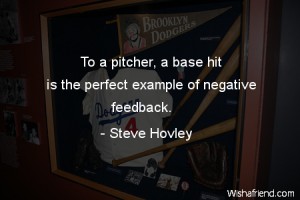
  3. Feedback – Whether playing baseball or learning in the classroom there is always feedback. Some is positive and some is negative. This can depend on something as simple as mindset, timing, and delivery. With students the risk of being kicked off the team is never on the table. There are no minor leagues in education. Teachers are in the room to help all of their students make contact with the ball and circle the bases with their learning. Regardless of the type of feedback teachers and coaches are there to instruct, identify talents, and encourage their students.
  4. When a player strikes out, there will be another chance to bat. When a player walks a batter or misses a throw, there will be another chance coming their way soon. The lesson is always be thinking and practising for the next opportunity whether it is in the classroom or on the field.

So as the players take to the field for the next umpteen months take some time to share this incredible game in your classroom. Take time to enjoy the Science, Math and chance to develop life strong habits of resilience and teamwork.

Cancer, pink shirts, and why I hate Jell-O

cancer

Cancer is a ruthless disease. It knows no boundaries, respects no ideologies or cultures, and disrupts the lives of everyone affected by it. Cancer has a twin in education. It’s bullying.

Recently, I was creating some TED Ed lessons about bullying(in its various forms –The Cyber Bullying Virus and Bully Dance). This got me thinking about the following question;

What makes bullying so virulent that it can evade, morph, and destroy generation after generation?

What if we looked at bullying like it was a medical epidemic? If we called it a disease, which it truly is, would it be treated more seriously? Could it then be given the same attention and urgency as HIV/Aids, Ebola, and Cancer are in the medical world?

Or have we built up our immunity to the existence of bullying in our schools that says if it is not happening to us?  Like cancer, bullying is serious. Its symptoms leave lives in havoc along its path.

Yet, for all of the attention(meetings, resources, legislation), research, assemblies, and instructional time invested into eradicating bullying across multiple lifetimes it has not disappeared. With fingers pointing in all directions it is time we all look to our youth to solve the problem of bullying because the adults have made a mess out of it.

Remember back in 2014 when school trustees, all adults, managed to create a working environment so toxic that the police needed to be called in to deal with the troubles. My students asked why the adults couldn’t get along? I couldn’t answer it with anything other than bullying.

How do we justify this behaviour to a media savvy student body when those in positions of leadership are modeling “do as I say, not as I do” by their actions?

The course of treatment for the cancer of bullying is simple. Let students lead.

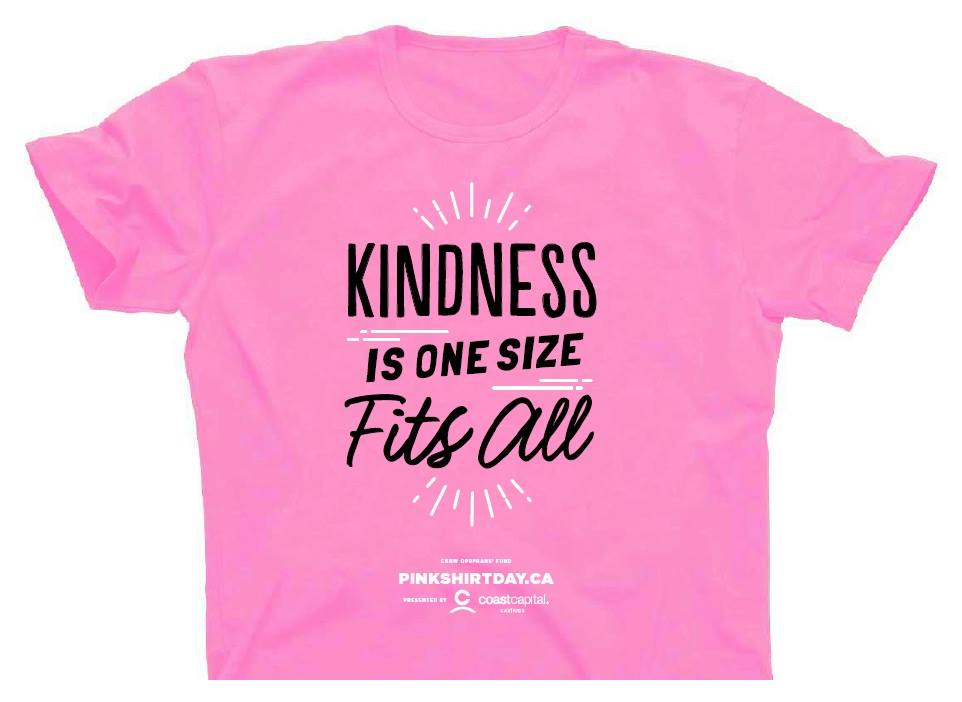
Students possess limitless energy, potential, and ideas so why not equip, empower, and get out of their way to do great things? A powerful example of a student led initiative to stop bullying is Pink T-Shirt Day. It started in 2007 at a Nova Scotia high school where a grade 12 student defended a grade 9 be being bullied because of the colour of his shirt. It has since become celebrated as a national day of awareness, with schools across the country holding stand up to bullying by wearing pink events.

PinkShirtDay

One of the reasons Pink T-Shirt Day is such a success comes from students leading the way. It has now fostered other wear pink events to fight bullying, homophobia, and transphobia. My school will be participating in its 2nd Day of Pink of 2016 on April 13th. At its core, pink shirt day is a way for everyone to stand together in order to focus on everything that unites us. I feel more student led events like this would set a positive and lasting example for people who have struggled with bullying at all levels of education from classroom to committee.

When students are allowed to lead they naturally rise to the task. Want proof? Look at the impact that Ryan’s Well, Free the Children, and Me to We have made on our world. Each amazing initiative inspired by a student.

Think about how you can encourage your students to be agents of change and social good in the fight against bullying in your school. I would love to hear if your school participates in Day of Pink activities. Tag me here or on Twitter @willgourley.

p.s.

I had Jell-O in the title because I was looking for a silly focus point in the title. There is an explanation of my true dislike for Jell-O at …why I hate Jell-O on escheweducationalist.wordpress.com.

Learning to share habitat

The week before March Break we scheduled a workshop with the Scientist in the School program. Our presentation was for a kindergarten workshop on habitat called, “There’s No Place Like Home.” It was a great way to engage the students so close to a holiday, and a wonderful lead up to Earth Hour which our school participated in during the last afternoon before the break.

During the workshop, the students rotated through centres facilitated by parent volunteers and the program presenter. In the well-organized and engaging centres, they learned about animals in salt versus freshwater habitat; they learned about animals that dig tunnels and animals that live in, on and under trees; they also learned how beavers create habitat when they dam a waterway. All in all, it was a great afternoon of hands-on learning which the students thoroughly enjoyed.

When we got back to the classroom, I created the opportunity for the students to paint a mural of animal habitat as a follow up to the workshop. On a blackboard placed at eye level for the students, I painted the slope of a hill which lead to a body of water. To encourage the placement of a beaver dam, I painted two water levels, to simulate before and after a dam. Then I invited students to come and paint animals in their habitat.

They painted birds in trees on the hill, worms and ‘bunnies’ in tunnels under the hill, and fish, ducks, and turtles in the water. Someone painted the beaver dam and added a moose on the shallow water side having a drink. Throughout the day, students would ask if they could add an animal and its habitat, and so the mural was quite full and detailed by the time we left for outdoor play at the end of the day.

The following day, I sat with some students at the art table. I had with me a pile of card stock cut in half lengthwise (about 4.5” x 11”). On one of the cards, I drew a long broken line down the middle of the length of the card, put some masking tape on the back, and handed it to one of the students, asking them if they could find a spot to put a section of road in the habitat mural. I asked them what happens when a road is built but there is water or a valley along the way. That’s when they realized they had to build a bridge with the cardstock over the water and the beaver dam. As the road and bridge were being built, I asked if anyone wanted to draw, colour and cut out cars and trucks to put on the road. Then I asked if houses and buildings could be drawn up the same way. Soon the mural was full of roads with cars, buildings, a bridge, a car factory, stop signs and traffic lights.

When it was done, I gathered the students to have a seat in front of the mural. I asked them what had happened to our habitat mural. Here is some of what they said:

“Cars came.”

“The habitat got covered up.”

“Their habitat is under the road and it’s not really good.”

“The road’s right above the bunny tunnel and they can’t get out.”
“If animals try to get up on the road, they could get killed.”

“Maybe some workers that cut down the trees might not know that a robin was in there.”

When I asked, “What should we do?”, the students suggested taking all the roads and buildings out of the habitat, until one little girl asked, “But what about us? We need a place to live, too!” There was a collective murmur of, “Oh yeah…” and several heads nodding in agreement as they realised that there might be a bit of a problem with their initial idea. Rather than getting into a discussion of the enormous conundrum involving population growth, urban development, and habitat destruction, and hoping instead that the lesson would build knowledge and end on a positive note, I reframed my question by asking them if they and their families had ways of living that could help and protect habitat. Many mentioned that they have bird feeders, that they walk to school instead of driving in a car, and that they have a garden and a compost bin. As they continued to list off the many small ways they are engaged in looking after the environment, there was a sense of , “Oh ya! I am a helper not a destroyer,”  which seemed to make everyone feel better.  Later on, when we turned off all the lights, the computer, and the overhead fans for Earth Hour, the students had a new appreciation for participating in yet another way to help out the planet.

That Chickadee Feeling

This classroom field trip is based on a book written by Frank Glew. It is a regular part of my classroom in the winter. Each year in my attempts to keep my students winter active I use this read aloud as a focus for my students to connect to their natural world in all seasons. The precise of the book is about how a young child is bored and has nothing to do. So the parent decides to take them on a hike. The child experiences for the first time that Chickadee feeling.

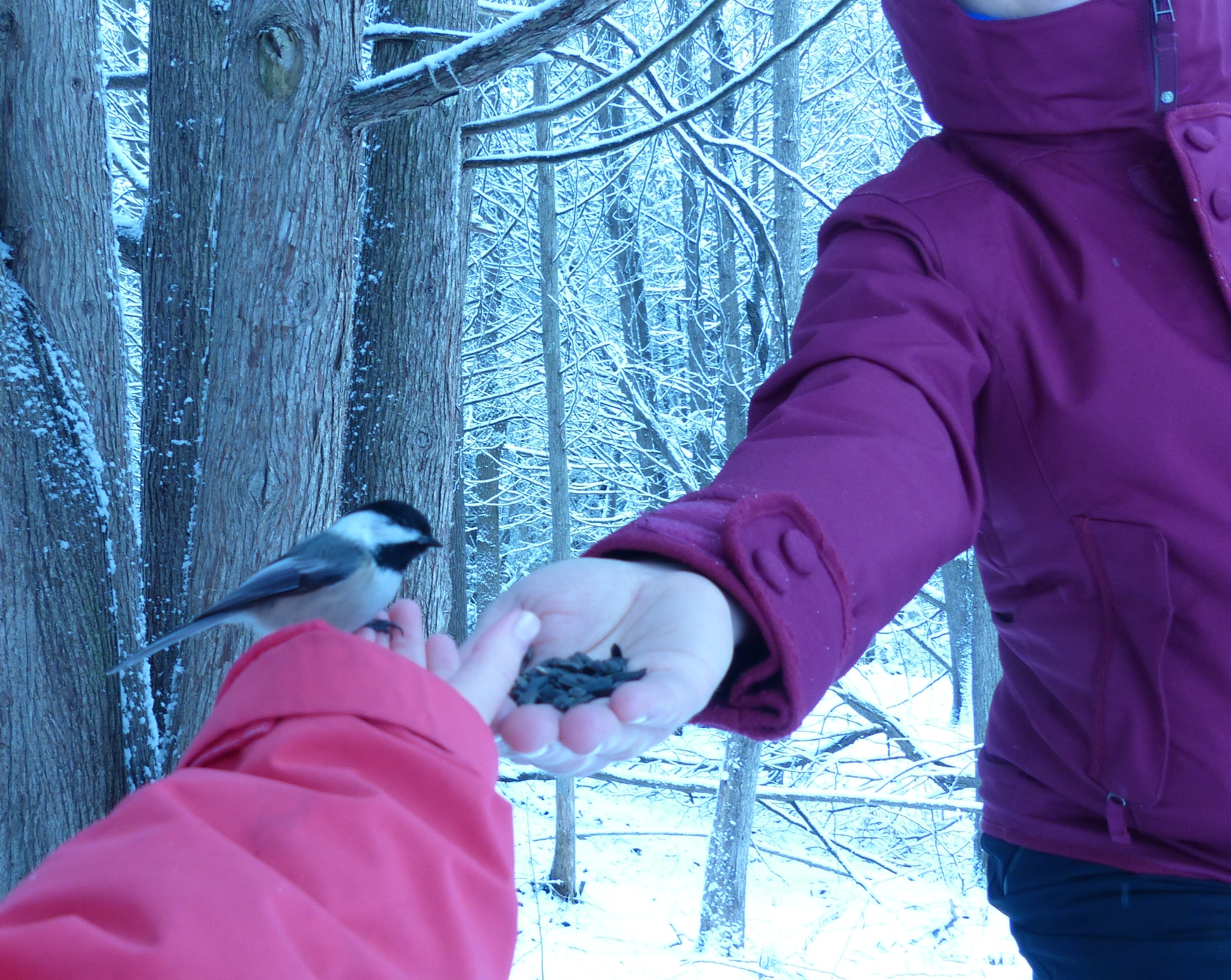
Finally the day has arrived where my class and I will be heading to our local outdoor education centre where we will try and experience in real life what we witnessed in the picture book. The snow is gently falling and the forest is covered in white with only the underside of branches showing their natural colour. It is a perfect day for what we are wanting to do as there are very few natural food sources available for our winged hosts. As we hike toward their feeding area, the Chickadees know we are coming and they start to follow us, knowing that human presence means it will soon be feeding time. My students start to both hear and see the tiny birds as they stay close to cover to avoid any natural predators.

Finally we arrive at the location where we will attempt to experience that Chickadee feeling. I take a few moments to talk about the best techniques to try and get the tiny winged marvels to land and feed from their hand. One-by-one the students collect some black sunflower seeds (Chickadees are very fussy eaters) and move to a location where we will serve as a human bird feeder.

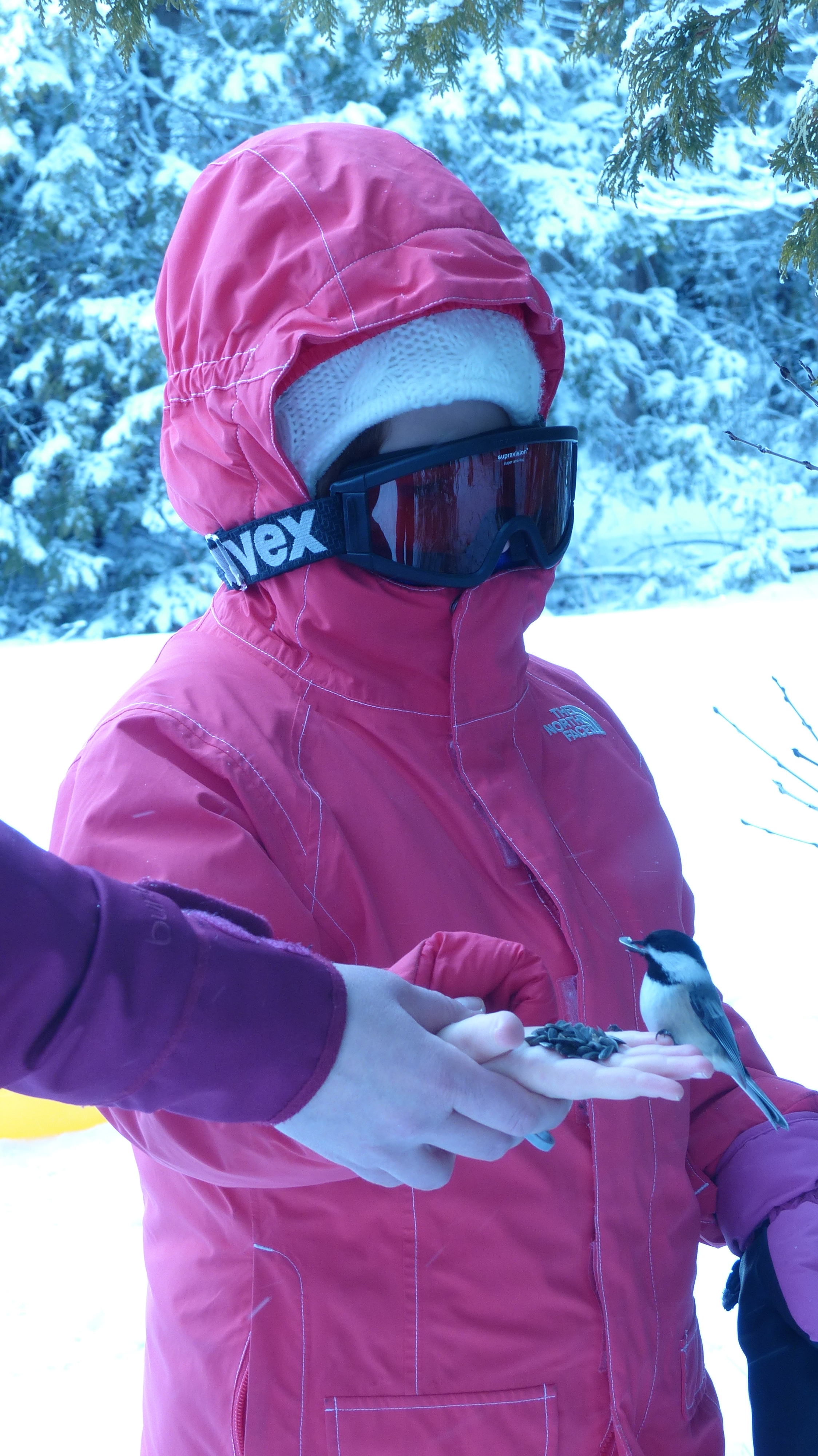
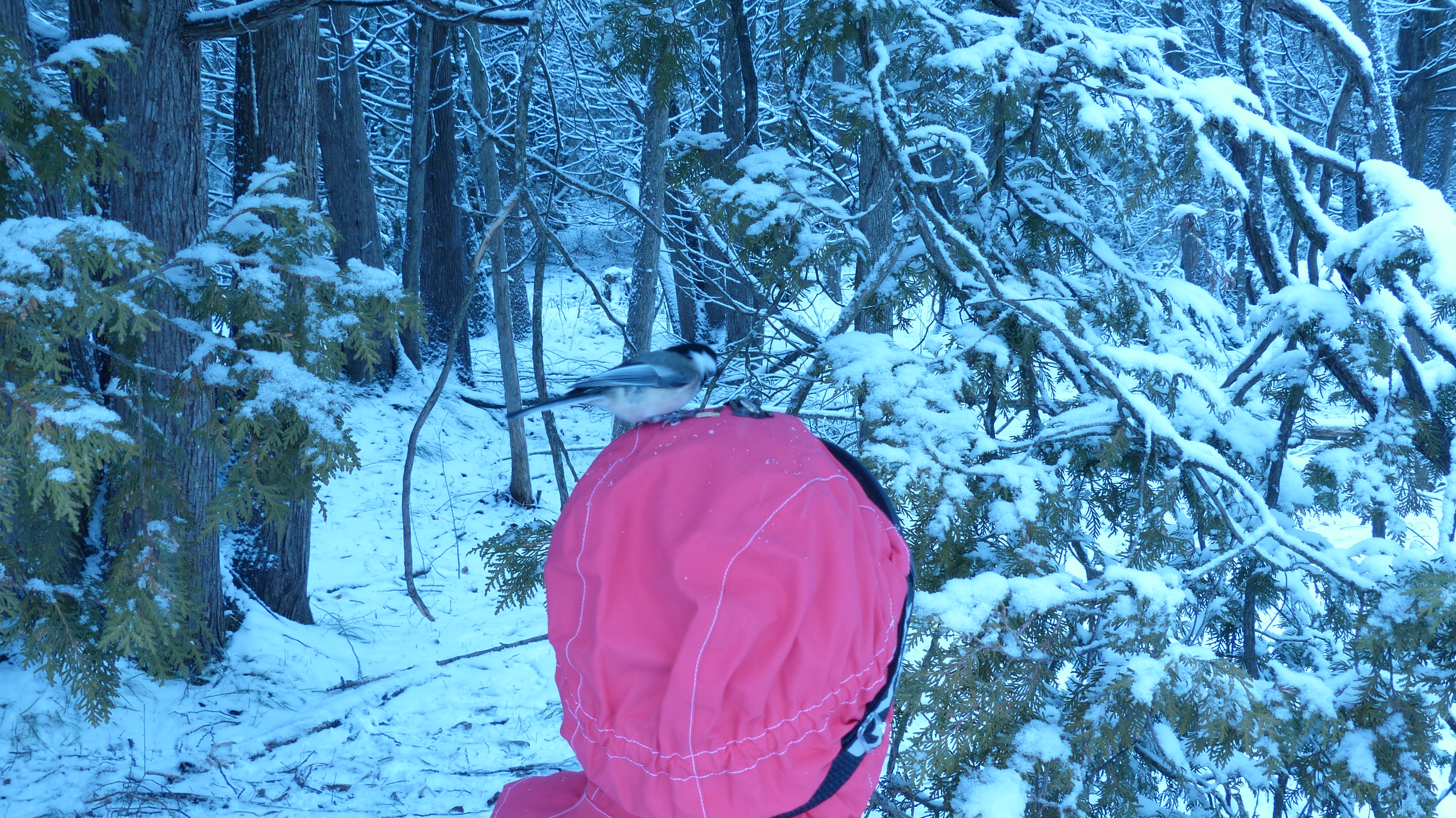
Within minutes the word has spread somehow in Chickadee language and it seems like dozens of birds arrive and carefully scout out the sudden feast that awaits them. Then, it happens! The first Chickadee lands and perches on my student’s outstretched hand, grabs a seed, looks at my student and flies quickly away. This first landing creates a chain reaction of the same scenario and they feast for the next 10 minutes. Like a proud father I carefully observe my students to ensure that each and everyone of them have that opportunity to experience the Chickadee feeling. The smiles, the chorus of oohs and ah that echo in the forest tells me that they know they have just become a part of the infamous Chickadee Feeling Club. I hope you do one day as well.P1050784 P1050792 P1050786

Tech Talk

I would like to share a new initiative my class is starting at our school Ancaster Meadow.

Our class realized the large need for technology in the classroom. We noticed that students are sometimes unfamiliar with apps that are available for completing work and for presenting learning. We are starting a new program called “Tech Talk” where as a class we travel to classrooms and instead of “Reading Buddies” we will assist the class one on one with apps of the teacher’s choice. We came up with a benchmark of five:

  1. Explain Everything
  2. Kahoot
  3. Weebly
  4. Pic Collage
  5. Prezi

These apps will be explored in detail by my class so when we visit our first class after the break, the break off sessions will be smooth and very productive. We will offer this program to grades two-five and speak to teachers before regarding sign up. Students will be able to explore the apps, prepare a small task and then share it with the whole class. The sessions will be fifty minutes long as that is how long a period is in our school. We hope that students will learn from each other and that everyone will be able to use these apps in the new future. I hope it will be a meaningful experience for my class to teach younger students skills that they already have. I cannot wait for our first trial after the break. I encourage everyone to try this  “Tech Buddies” program and share your experiences as well.