
The Ten Principles [Anti-Racism Education: Theory & Practice].

An expression used colloquially in the English language says “______ wrote the book on that subject,” can be applied to George Dei’s research on Anti-Racism Education. Though written in 1996, it outlines so many fundamental principles of antiracism education that educators must grapple with in order to do this work well.

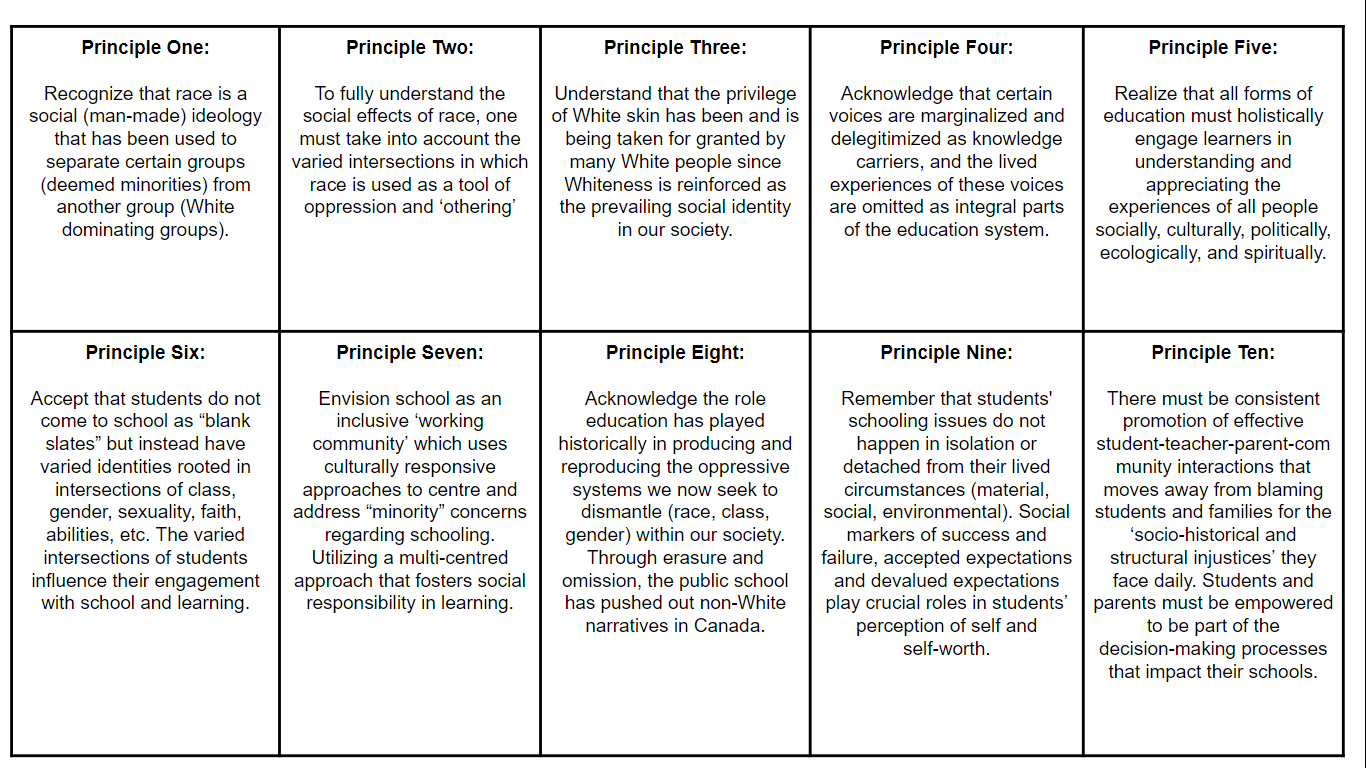
Race has been and is being used as an identifier, a marker that sets one apart from another, which is reinforced by the perceived dominant group through deliberate erasure and omission of narratives regarding who occupies particular spaces.  Action-oriented strategies and explicit identification and naming of race and social issues that strike at the heart of the power imbalance and inequities found in our education systems are what Dei explores in this resource, this call-to-action. The ten basic principles of Anti-racism Education are summarized in the chart below. “Anti-racism education may be defined as an action-oriented strategy for instructional, systemic change to address racism and the interlocking systems of social oppression… Anti-racism education seeks to build what has been termed “communities of differences.” This task can only be undertaken successfully if educators first learn how to deal with difference and the inherent conflictual interests and power imbalances in our societies.” (Dei, 1996).

As educators committed to teaching and learning centered on anti-racism and anti-oppression, it is pertinent to examine and reflect on these basic principles.

Ask yourself:

  • What areas in my teaching & learning styles foster anti-racist teaching?
  • What areas in my teaching & learning styles require change?
  • How can I integrate these ten principles in my learning environment (classroom) to foster equitable learning?

Taking the time to intentionally examine ourselves as educators, to think about our styles and reflect on our practice is essential to consistently cultivating meaningful learning for our students, particularly racialized students who are often not reflected at the forefront.

Examine, Reflect, Refine. This is one of the ways we continue to work towards ‘Building Better Schools.’

References:
Dei. G. J. S. (1996). Anti-racism education: Theory and practice. Basic Principles of Anti-Racism Education. Fernwood Publishing. Halifax & Winnipeg, Canada.

kids these days – educator version

I googled “kids these days” to see what would pop up on my browser and was neither surprised nor happy. In fact there was a complete absence of anything necessary to help me create a catchy opening. By necessary, I mean humorous. 

Of the 4.1 billion possibilities: a bunch of clichéd book titles, a podcast, and some music videos were all that filled the first page. Despite my optimism, all I got was not a lot. So much for this roundabout approach yielding anything interesting as a way to set this piece up. I gave it a shot, and based solely on such underwhelming search results, it is on to plan B.

Plan B: In other, more accurate, words, “the kids are alright”.

For the past month, I have been working with a teacher candidate (TC) from a Toronto area university. Happily, I might add. He now joins a mighty group of amazing educators (14+) who have patiently pursued and plied their practice in my classroom. For the record, the expression shared in the title of this post has yet to enter my thoughts when I consider the preparation, professionalism, and passion being shared each day through our interactions, in the classroom with students, and among the rest of our school community. And when you thought that things couldn’t get any better, our school has been fortunate enough to welcome an additional 3 other teacher candidates into our classes.  

Life is good and it is happening at the speed of education everyday at my school, and it is aided, in part, by the presence of 4 teacher’s in training. We are fortunate to be sure, but it could and needs to happen more often. Which was why it came as a surprise prior to welcoming my TC, to learn it has been a struggle to find host teachers. 

Granted, the last 2 or 3 years must have been very difficult for new teachers to find placements in host schools due to reasons well beyond anyone’s control. At first it was understandable as we were all forced back and forth between our school and home bases to teach on line for the first two years of COVID19, and then came the soul murdering hy&r!d learning model that still triggers my gag reflex each time I think about it. Despite the pile up of so many uncontrollable obstacles, pivots, and uncertainties I still happily welcomed 3 teacher and 4 CYW candidates into our school community. Difficult yes, yet still possible and worth it every time. 

I get that the idea of hosting a student teacher right now might be something educators have put to the side for a while, but now that we are back to school, for now, there is still a lot of upside to a TC in the new non-normal we are teaching in. With another practicum cycle only 5-6 weeks away, I wanted to share this post to encourage you all to consider being a host teacher/mentor at your school. Yes there is additional work to do, and it is worth it. 

So here is my pitch: we need more teachers to host teacher candidates. 

Here goes: firstly, without adding too much sentimentality, we all owe our host teachers some props for helping us as we were getting started. This friendly yet simple reminder never hurts once in a while. I know that my experiences as a TC all those years ago continue to anchor my practice in some way. Whether it was based in inquiry, equity, or photocopied busy work, the potential impact of those first 100 days in the classroom are what equipped me to become a host teacher. For the record, I left the photocopying busy work behind almost immediately.

Imagine if you could go back to when you were a student teacher. What advice would you have wanted to hear? What noise would you have tuned out? This is what pushes our profession forward. My goal remains to help each student teacher turn ripples of potential into limitless waves of possibility long beyond their practicums.

Even those who have not considered because they are newer to the profession I encourage you to do it. Imagine the opportunity to reflect on the growth you have made since you were in their shoes? Imagine the wisdom you have gained since you walked into the classroom as an OT, an LTO, and now as a teacher with a contract? It’s time to give back and get even more in return. 

Are there benefits?

Yes. No classroom is ever hindered by having a well prepared and supportive additional educator in the room. Need more? Sprinkle in daily doses of fresh thinking around curriculum, assessment, and educational philosophy as part of the deal. The daily conversations with my TC have been reflective and thought provoking. It is a two way superhighway of ideas and next steps. Still on the fence? Student teachers are extremely enthusiastic about planning units and lessons, and make good collaborators whether it is in planning or co-moderated assessment. 

Are there drawbacks? 

I have asked folx from different schools what their take on the idea of hosting TCs, and the answers have lined up pretty consistently in favour of them. I have also heard, “Oh, they are a lot of work and I don’t want to take that on that responsibility and paperwork.” This is a valid answer at times, and yes there is a bit of paperwork (mostly digital now), but is often used far too often without realizing the benefits, ideas, and support that a TC brings as well. Any additional work is far outweighed by their contributions in support of students. 

“I had a student teacher once, and they tried to take over my class.” There is always a possibility that a very excited and ambitious educator will come bouncing through your door for their practicum, but it is also a chance for you to impart that wisdom you’ve worked so hard on accumulating. If it is not going to be a good fit, be honest about it right away. I did have occasion to decline working with a candidate after the first day it became very clear they were neither prepared nor able to work respectfully with the students in my classroom. 

“I am not used to giving over control of my classroom.” I get it. We are used to ‘be the one and only’ in our classrooms however fresh views and voices bring a level of excitement along with them and it is good to learn how to let go knowing that you are not abdicating your role, but making room to equip the next generation. 

By sheer amount of space on the page devoted to the pros and cons of having a student teacher, it might appear that there are more downsides, but that is only a visual ruse. By far, working with teacher candidates over the past decade has provided a great deal of personal growth along with it. I hope you can make room for them in yours. 


My Experience with Project Overseas

If you are a life-long learner who believes in equity, inclusion and public education then volunteering your time and skill-sets with the Canadian Teachers’ Federation (CTF) Project Overseas (PO) might just be the right experience for you. I myself have volunteered for PO for three years (2017, 2018 and 2019) and I can honestly say that it was one of the best experiences in my professional career. Overseas projects have not run in 2020, 2021 or 2022 due to the pandemic. You might be asking yourself, what is Project Overseas and how can I get involved? I will share a few things with you to get you started and also connect you with some websites for additional information.


What is the Canadian Teachers’ Federation (CTF)?

CTF is a national alliance of provincial and territorial member organizations across Canada (including ETFO). Its head office is located in Ottawa. The goal for CTF is to demonstrate a commitment to advancing education and building teacher solidarity worldwide. 

Here are some ways that CTF supports teachers:

  • Increased influence with government
  • Support for better working conditions
  • Research and professional development
  • Educational resources and services
  • International volunteering opportunities (i.e. Project Overseas)

For more information on CTF, please visit www.ctf-fce.ca 


What is Project Overseas?

PO is a collaborative learning opportunity for participating provincial and territorial teacher organizations with other progressive countries throughout Africa and the Caribbean. As a selected member from your union, you and your team of Canadian teachers/members will travel to the host country (usually for the month of July) and work in partnership directly with other facilitators from the host country to co-plan and co-deliver professional development strategies to their lead teachers and administrators in a series of workshops and presentations. In most situations, the experience will be similar to a train-the-trainer model. This is a shared approach to teaching and  learning, as you will learn as much from the host nation as they will learn from you. The goal for PO is to improve teaching and learning around the world, to ensure equitable access to higher education for young girls, and to promote equitable, high quality, publicly funded public education for all. 


What was my experience like with Project Overseas? 

My experiences in Sierra Leone and Uganda have been one of the best learning experiences in my professional career. I met amazing educators who were doing amazing things with very little resources, with no, or next to no access to technology and with limited opportunities for professional development. Educators were using tree bark to create soccer balls for physical education. They were using pebbles, bottle caps and seeds from fruits to support students’ learning in numeracy. They were using flattened out empty cardboard boxes as anchor charts to teach concepts in literacy, science and social studies. These amazing educators were so enthusiastic about learning new ideas and sharing their own teaching strategies with us. One of my learning highlights was understanding and appreciating their use of music in teaching new concepts and as a tool for reviewing big ideas. In fact, singing, clapping and movement were used in all aspects and subject areas throughout the learning process. Music was used to welcome people into a space, to bring the group together, to teach a new concept and to review what was taught. Music was used as an holistic and inclusive way of learning. You would certainly be moved, in more ways than one, by your shared experiences and new learning opportunities with PO. You would be certain to learn new ideas that you could bring back to your school community and incorporate into the classroom. 


With PO, we also had opportunities for cultural exchange. There was usually a cultural event where we shared aspects of our Canadian culture. This might have included a taste of certain food like maple syrup, a Canadian geography game or two, a game of hockey or lacrosse and of course the singing/playing of the national anthem. The host country in return would present a special event which usually included the wearing of traditional outfits, dancing, food and games/plays. In some cases, we were able to visit a cultural museum, a zoo or a school/classroom that might still be in session. 


Regardless of which host country you attend, you will make an impact on their access to quality education and you’re certain to return with a new outlook on what it means to be an effective educator, an advocate for change. 


Tips on Applying for Project Overseas

  • Get involved with your local/territorial and/or provincial union (volunteer to be a member of a committee, attend local meetings, participate in/lead a workshop or conference, volunteer to be a union steward, or  volunteer as an alternate or delegate at ETFO’s AGM)
  • Check ETFO’s website for information and updates about Project Overseas.
  • Begin working on your resume (including references), as you will need to demonstrate your work experiences and leadership skills 
  • If you also speak French or another language, it would be helpful
  • Consider volunteering with a non-profit organization locally and/or internationally, to gain international and intercultural experiences
  • Reflect on your willingness/readiness to be away from home (your family) for a long period of time, with limited access to technology on a daily basis, sharing accommodations with others, working in partnership with others from diverse backgrounds and cultures, and experiencing food choices that may be new to you
  • Check out CTF/FCE Project Overseas website to see a list of the various partner organizations in which they participate and begin to do your own research on the culture, costumes and educational challenges of those countries


For more information on how to apply for PO, visit CTF/FCE Project Overseas


The Butterfly Conservatory

A few years ago, I visited a butterfly conservatory. It wasn’t my first ever visit, but it was my first visit through the lens of an educator as I was a teacher candidate at the time. I left the conservatory in absolute awe. Of course, the butterflies were beautiful, but I couldn’t stop thinking about the facility that housed the butterflies and the dedicated and knowledgable staff members that kept the butterflies safe and content.

I like to think of butterfly conservatories as an analogy for classrooms.

The focus in the conservatory is on the butterflies and giving them exactly what they need to thrive. Not all the butterflies got the same treatment, but an equitable environment was maintained by giving each species of butterfly what was required to meet its needs. Much like equity in our classrooms, students do not all need the same resources or supports to be successful, but they are all given equal opportunity to succeed by receiving individualized supports.

The butterflies can co-exist peacefully in the same space. Despite the creatures being of different species, different colours, or from different parts of the word, they live harmoniously. I like to think that within the core of all humans is a desire to co-exist peacefully with other humans. For some learners, this may take practice, repetition and patience, but the human need for connection and feelings of safety and belonging are innate and essential.

Lastly, this butterfly facility does not run itself and it is not run by just anyone. There is so much “behind the scenes” work that happens at places such as this, to ensure the butterflies and their visitors have an unforgettable experience. There were many tests being done to ensure air quality, temperature and humidity were remaining at optimal levels to accommodate for each different butterfly species present. The butterfly staff were not only knowledgable and had received training on how to care for the butterflies, but they were also passionate and proud to share the butterflies with the incoming visitors. Similarly, school staff are the backbone of the education system and put in invaluable time and effort “behind the scenes” to create optimal learning conditions and plentiful opportunities for students.

My analogy sticks with me and comes to mind often. Maybe this is something you’ve thought of before, maybe you have a more applicable analogy for classrooms, or maybe you’re now creating your own analogy for the first time.

Either way, one thing is true…

An ecosystem like the butterfly conservatory is delicate. It’s fragile. It can be damaged. What are the butterflies to do if their environment becomes destroyed or the homeostasis is disrupted?

Unlike the butterflies, we don’t fly away. ETFO members and education workers stand together in solidarity.

Though we may not be “living” in optimal conditions like the butterflies, we continue to advocate for public education, safe learning environments for staff and students, and equitable learning opportunities for all.

Why Union Matters

As a new teacher, back in the day, the idea of being a part of a union was fairly new to me. I had very little idea of what unions do and how they support the professional and mental well-being of people like me. I recall hearing varying opinions about ETFO, as a union body, as well as learning about some of the ways colleagues interacted with their local and/or provincial union. However, I wanted to find out for myself what my union was all about, what they could do for me and what I could do for them.

A personal story: My very first interaction with my union came at a very pivotal point in my career. My first job in 1999  was as a LTO teacher in Toronto. It was shortly after the amalgamation of the six cities into one mega city, and many of the administrative roles and responsibilities at the various board offices were still going through reorganization. After working for a month, I realized that I wasn’t getting paid and my bills were piling up. Though I submitted all the necessary paperwork and documentation to the board on time as directed, apparently I was nowhere to be found in their payroll system. Every time I called payroll to find out what was going on, I was redirected to someone else based on my last name. At one point, I was told that I was calling the wrong board office and was given another number to call. Apparently that person was out of the office and no one else was able to respond to my issue at that time, so I was given another number to contact, and so on and so on. This continued for another two months and I had no idea what else to do to solve the problem. One day, I shared this issue with a colleague, who happened to be our school’s union steward. She gave me instructions on how to contact my union with all the necessary information and documentation of my issues with getting paid. I contacted the union and, to my surprise, the very next day I got an emergency cheque from the board. Two weeks later my regular pay was deposited into my bank account and I have had no issues with payment ever since. That was my introduction, and the start of a great partnership, with my union and the connection has grown stronger over the years. 

As I got more involved in the union in my role as union steward, volunteering on various local and provincial committees, attending ETFO’s annual general meetings as a delegate and representing ETFO at the Canadian Teachers’ Federation (CTF) Project Overseas program, I began to learn a lot about why union matters. I learned that ETFO not only fights for better wages and working conditions of its members, ETFO fights to improve equitable access to publicly funded public education. ETFO also advocates to ensure that members’ working conditions are safe and free from harassment and oppression. I also like the fact that members have access to professional development and quality teaching resources and support to ensure high quality student learning and achievement. I believe in a strong partnership between the union and the school boards across Ontario. A strong partnership would help to ensure that members feel safe at work and students receive high quality education in an equitable and inclusive environment. I know that not everyone might have had the same experience with their union as I did, but what remains true is that, together, our union makes us strong. 

For more information about your union, visit: ETFO

the eyes tell our stories

Trigger warning: This post may be triggering to some folx as it discusses the emotional and physical toll happening on our students and our profession. I hope you read on.

A student asked to speak with me the other day. They said things weren’t going so well. They didn’t have to say a word. Their eyes told the story of someone who had been going through a lot lately. They shared and I listened while resisting every urge to cry along with them. How has it come to this I thought? How have so many of life’s weights been placed on a student who deserves to enjoy these years without worry, fear, or doubt?

While they spoke, it became known that these feelings of sadness and dread have been building up for a couple of years already. It struck me a bit odd as this student comes across as one of the most well liked, bright, and optimistic persons. If they were struggling, then how many more have not found the courage to come forward? My mind raced around how best to support them in the moment, but then moved to thoughts of what needs to happen on the macro level of our classrooms.

Despite some training, my mental health first aid kit is still only partially stocked, and unless additional social workers can be added to our school, I fear things will only be getting worse.  If it is happening in one school, then it is probably happening in many others. Notwithstanding the already existing immense work loads placed on centralized caregivers in school boards, it does not appear that supply will meet demand any time soon.

I guess that my best move for this particular person will be to check in with them a little more frequently, contact family to construct a cohesive support plan, and to recommend seeking some help from a social worker if at all possible. I am also going to build in some wins for them throughout the week. These could be a few more affirmations or intentional opportunities to have fun in their day.  Maybe this approach could help in supporting staff as well? Read on.

They didn’t have to say a word. The eyes told a story of someone who has been crying a lot lately. What happened before coming to school? How were they going to make it through another day when the sound of fast paced walks toward their door meant another part of the day, intended to plan and organize, was going to be co-opted again. How can this continue to happen when things are supposed to be safer, better, and back to normaler? Cue the tears. Cue the sadness. Cue the confusion. It’s hard to hide the stress or frustration. With all of that to manage, anger is never far behind. So when someone asks what is causing the tears specifically, the answer is nothing and everything at the same time.

Nothing because there is nothing we can do about what is happening other than mask up, make sure the kleenex box is full, and brave out the current chaos of each day. Everything because the number of issues provide more than enough straws to collapse every camel’s back. Mixed messages, inaction, anti-vaxxers, non-maskers, insane rates of infection, lost preps, fatigue, and having to complete the same system work with less time due to time that has been ‘liberated’ from one’s daily schedule.

Image
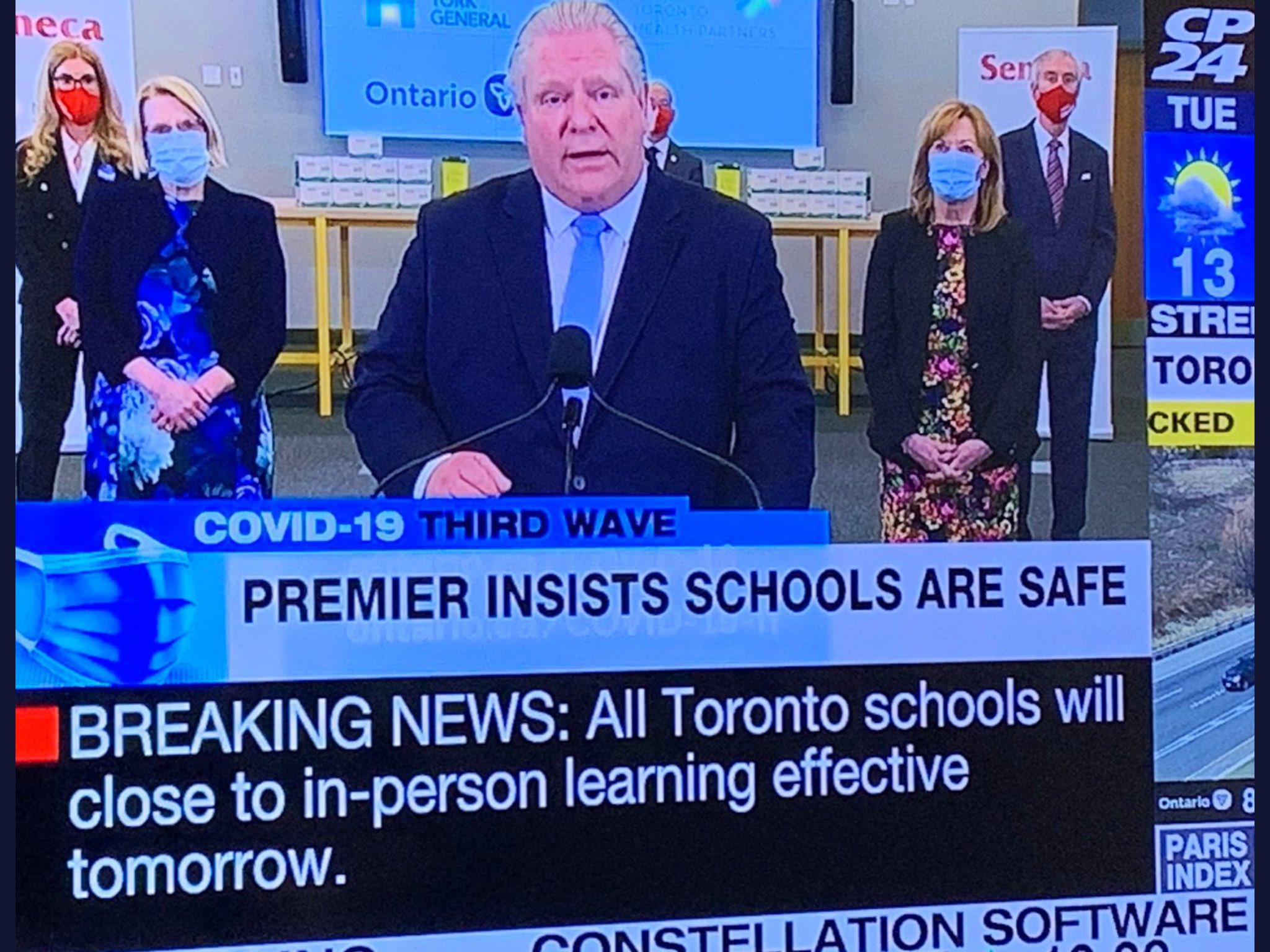
via https://twitter.com/MikeJToronto/status/1520175065333219329?s=20&t=NLlivpQQu-yLApHE3_iEUA

I looked into the mirror. My eyes were dull, glassy, and dry. Thankful that another week has passed where I did not have to be out of the classroom. Thankful that I did not have to isolate. Relieved that time outside of school meant a chance to disconnect and recharge.

Although there is no single thing to attribute this current state. It could be because of the daily dread built up from what is happening in schools right now. It has gone far beyond any occasional days when OT jobs went unfilled to a sadly predicatable and unprecedented time in our profession. When was the last time you ever heard of 9 unfilled OTs at one school? Last week comes to mind.

If it hasn’t been mentioned before, the folx caring for this province’s most precious resources are having a tough time and are being pushed to the brink of exhaustion and anxiety. It seems that once again, pontificating politicians have put their heads in the sand when it comes to equipping educators to meet the realities of the day with the resources they need.

Let’s start by having more teachers available to cover the amounts of educators having to take time to quarantine due to illness/exposure to COVID19 or to care for an infected family member in the same home. As we enter the final months of the school year I am not feeling super confident that things will change and that has me worried about my own energy and emotional levels.

Despite every educator’s individual efforts, ‘things ain’t goin’ so good’. No amounts of extra time or out of pocket expenses are going to fix what is happening. We need personal supports for students and staff more than ever not affirmative memos and lipservice from elected/board leaders. Help.

…and in this corner

….weighing in at the size of that giant elephant in each of your classrooms.

Yup, with a sense of timing so impeccably ironic, that it is only achievable by elected officials, we are once again face to face with maskless learners and colleagues.

Oh the freedom!

This all despite numbers related COVID19 cases, hospitalizations, and deaths) increasing across the province. Despite a strategic throttling of information from the current government and an ineptly duplicitous media incapable of calling out the “horse hockey” being shovelled at an unwitting public who is either happily oblivious learning how to live with COVID19 or now scrambling to avoid a negative patient outcome for someone in their life who is immuno-compromised.

Another struggle took centre stage the moment the masks were allowed to come off in Ontario. We are once again facing government sanctioned chaos when it comes to public health policy and education in our province and there are signs of  trouble in nearly every public school. #Onted via Twitter reveals numerous schools with growing numbers of COVID19 cases and exposures among their youngest learners. That means more absences (students and staff), more missed learning opportunities, and more uncertainty in schools/homes.

To no one’s surprise who has actually taught in a school over the past 2 years, students, teachers, and support staff  once again find themselves at greater risk of being exposed to COVID19 now that masking has become optional in public schools.*

Thankfully, at the school where I teach, the number of students and staff still choosing to mask up each day remains around 90%. Odd though how that figure corresponds to another public health statistic at 90%. Hint, it rhymes with vaccination rate. Hmm? Yet, that is not the case inside of many other schools and has the potential to be problematic on a number of fronts. I’ve seen this movie before and as I recall, it ain’t a comedy.

The removal of required masking, limited cohorting, mandatory hand sanitizing protocols, and social distancing have not provided me with the peace of mind that the return of such “freedoms” pretends to promise. So what is can a health conscious public educator do while they are now placed on the frontlines of learning to live with germ warfare?

Psst. Running away and hiding are not options.

The safest moves are to continue limiting our own exposure to potential infections by keeping our distance, masking at all times, sanitizing, and limiting our social interactions. Overcoming a global pandemic entering its 6th wave is going to take a little more time. We have gone through so much and have learned an equal amount about ourselves and others.

I can sense that students are still concerned about this too. I have noticed them still sanitizing their hands and trying to maintain their distances with students who have chosen to go maskless in class. Thankfully, I have not observed any social shunning as of yet which makes me hopeful that this will be the case in the general public when ideologies collide as legislated social expectations are gone. It is in this spirit of care and respect that I encourage you all to stay safe and strong as you continue to serve and shine in your classrooms.

* I was going to make a snappy comment about how private schools did not have  to remove their mask mandates while all public schools were ordered to do so, but I could not think of a good way to phrase it without the use of profanity.

Protect Full-Day Kindergarten

The data does not lie.

As Ontario’s Full-Day Kindergarten Program heads into its 11th successful year, several studies have shown the positive and long-lasting effect Ontario’s Kindergarten Program has had on students, families and communities. 

In a longitudinal study by Janette Patricia Pelletier & James E. Corter comparing full-day and half-day Kindergarten programs, it was discovered that students who attended the full-day Kindergarten programs scored higher in the areas of reading, writing, number sense and self-regulation.  

The Kindergarten Program document itself sources countless resources and empirical studies revealing the importance of play and inquiry based learning programs for young children. The Council of Ministers of Education, Canada (CMEC) are quoted in The Kindergarten Program (2016) as stating “the benefits of play are recognized by the scientific community. There is now evidence that neural pathways in children’s brains are influenced by and advanced in their development through the exploration, thinking skills, problem solving, and language expression that occur during play” (p. 19). 


What is the real price to pay?

Dr. Gordon Cleveland’s executive summary of The Kindergarten Program from January 2021 reads: “Our conclusion is that high-quality Kindergarten is very good for children. Well-trained teachers and small effective class sizes are important in producing this quality. The effects of high-quality Kindergarten experiences are long-lasting, and socio-emotional support is a key part of providing positive Kindergarten experiences”.

In February 2021, I wrote a post highlighting the reasons why the pedagogical approach that is central to the Kindergarten Program should be celebrated as it establishes a strong foundation for learning in the early years. My trust in the Kindergarten Program has not changed. As we continue to live in a global pandemic, this program becomes increasingly vital for Ontario students and families. 

Removing or changing the current model of Ontario’s Kindergarten Program will disrupt the very core of students’ learning. Changes to the current Kindergarten model will leave students behind in regard to early intervention, mental health and well-being and create cracks in the foundation of academic success. 


Why is this program so special?

If you have never had a chance to read The Kindergarten Program document, I highly recommend you do. Rather than threatening cuts to this program, Ontario should be looking into how to weave the philosophies of teaching and learning highlighted by The Kindergarten Program into all other curriculum documents for students attending public schools. Ontario’s Kindergarten program is exemplary and visionary in the way that it supports the creation of a learning environment that allows all children to feel comfortable, is built around attainable expectations and provides all children with the kind of support they need in order to develop.

ETFO continues to fight for the current model of The Kindergarten Program in Ontario. 

Why must we continue to defend what has proven to be indispensable? 

Who Am I?

If I have learned anything from the last year and a half is that the only thing that matters is NOW. Now is the time to laugh louder, now is the time to reach a bit higher and now is the time to hold on to loved ones just a little bit longer. For me that means taking control of my life, overcoming painful obstacles and pursuing goals that I no longer wish to ignore. I have always been shy to speak my truth and to believe that my voice matters. I feel that this platform will help me to develop a meaningful voice that can inspire other educators to make a difference in the lives of the students they teach, unapologetically. 


As a new blogger, I want to share some of my lived experiences and to connect with you in a meaningful way. First, I must tell you that writing has never been an easy task for me to do. It took me two hours of writing, and revising my writing, just to get this far in the blog, really. Why am I doing this then, you might ask? It’s because of what I wrote in my first paragraph above. Writing has always been a huge block for me, and I have chosen to embrace writing/blogging as a form of self-empowerment, liberation and inspiration. Now is the time!


I have been a teacher with the Toronto District School Board (TDSB) since 1999. I have taught grade 3, a split grade 4/5 class, grade 7 and grade 8 in three different elementary schools in diverse communities around the city. I have spent most of my teaching years in the intermediate grades teaching core subjects as well as a grade 7/8 special education Homeschool Program (HSP) and a grade 7/8 Intensive Support Program (ISP) which I thoroughly enjoyed. For the past five years, I have been working in a central role (except for 2020/2021 when I was redeployed as a grade 8 virtual school teacher) as a guidance counsellor, supporting the social and emotional development of grade 7 and 8 students, as well as supporting their transition into high school. 


This year, the role has been reformed to better support the academic needs of intermediate students, especially those whose academic successes have been negatively impacted by the pandemic. This role might look differently in different spaces, as the needs vary greatly in different communities. I am looking forward to supporting teachers, working with students and building capacity with the entire school community so that all students can succeed. 


I have volunteered my time and leadership to the Elementary Teachers’ Federation of Ontario (ETFO) and my local union, Elementary Teachers of Toronto (ETT) on numerous committees, workshops and projects. Volunteering with my local and provincial union has afforded me the opportunity to network, to find my passion and to advocate for the rights of teachers and students. One of the most rewarding experiences for me was volunteering my time and leadership with the Canadian Teachers’ Federation (CTF), as a sponsored ETFO member, to participate in their Project Overseas summer in-service program. I have been a team member and team leader in a summer co-training in-service program in Sierra Leone and Uganda. Let me just say it was an experience of a lifetime that I will never forget. There is so much I could say about that right now, but I will leave the details for another blog. There are so many ways to get involved in your union, if interested just ask your local union rep and they will be more than happy to provide you with support and leadership.


My teaching and leadership style is through an equity and anti-oppressive lens. I am passionate about advocating for equitable treatment and access for our most marginalized, black, indigenous, special education and LGBTQ2+ students, just to name a few. I am committed to building capacity for all teachers, so that they can be equipped with the necessary knowledge, tools and resources required to teach and support the needs of all students in diverse communities. In particular, I support teachers in embedding students’ lived experiences in bringing the curriculum to life in the classroom. I support using differentiated instructions (DI), culturally relevant and responsive pedagogy (CRRP) and universal design for learning (UDL) to improve and optimize teaching and learning for all students, especially the most underserved students in our school system. I am also a strong believer that it takes a community to raise a child, and we cannot fully support students without the engagement and input from families/parents and community partners. I will share more in future posts. When we work together in a safe, nurturing and inclusive learning environment that puts students first, the possibilities for their success are endless. 


To our new teachers, I encourage you to take the necessary time to find your voice, and when you find it, use it to advocate for yourself and for the rights of our most vulnerable students. As a vulnerable student myself growing up in the system, I know what it means to have even ONE teacher that believes in you and accepts who you are without judgement. It was two teachers in particular who saved me from going down a very dark path in life. They may not know it, but they gave me hope and showed me that my life matters. Today, my hope is to pay that gift forward to you and to all with whom I come in contact. 


I hope this helps you understand a bit more about me and what I bring to the platform. Please feel free to share your thoughts and questions with me. As a new blogger and writer, I welcome your feedback and suggestions. Looking forward to learning together. Blessed!


Getting involved in your ETFO

Since this space is dedicated to encouraging new teachers it seems like a great time to share some of the important benefits that you can gain from getting involved early on in your careers in education. 

So here is a little list and some handy links for you to click on to get you started;

  1. Your voice matters and as such you should feel represented and included. Joining a committee and following your ETFO local news is a great way to connect and find opportunities to learn how things work as well as find ways to support and serve in your region. A quick glimpse through some of the provincial locals shows committees for social justice, political action, and new teachers. Make sure you also attend your annual general meetings too. Your votes matter too.  
  2. Find a mentor. This does not have to be someone in your building. Technology and social media have created excellent mentorship channels for new members. ETFO Provincial has a link and as mentioned above, local chapters have New Teacher Committees. New teachers might also want to check out The Mentoree website
  3. Don’t go it alone. Although many of us graduate from teacher’s college feeling we have to have it all together, the truth is that no one comes out fully prepared. Once you graduate, and enter the classroom as a teacher or occasional teacher, the real learning begins. ETFO offers the Survive and Thrive conference to new teachers within their first 5 years of their careers. Some school boards also offer summer sessions for teachers who are switching grades or taking on new roles. YRDSB has hosted its Great Beginning Conference for years and it allows attendees to meet others and gain valuable and practical resources from experienced fellow educators. 
  4. Remember you don’t have to reinvent the wheel. When you are new to teaching or even looking to update your own lessons, ETFO has curated an excellent set of resources for its members. Start with Teaching and Learning and click on a sub-topic and scroll down. ETFO members has many phenomenal resources for educators by educators. Check out:
    ETFO Action on Anti-Black Racism 
    Building a Just Society 2SLGBTQ+  
    Adressing Anti-Asian Racism resource booklet
    There are way more to share, but I will let you enjoy discovering them at your own pace. 
  5. Take ETFO AQ and other courses. They are incredibly relevant and well taught by fellow member educators. They are also affordably priced and designed to fit your schedule. 
  6. Get on social media and find other like minded folx in education. #onted is a great place to start.
  7. Subscribe to the Heart and Art of Teaching and Learning blog. 

Most importantly, don’t forget that we are a family of committed, creative, and caring professionals who share a common goal to maintain the best public education system in the world. If you would like to connect please drop a line in the comments section. Welcome to ETFO.