Snow Day = No School Day

ETFO’s position on in-person learning remains unchanged. The union firmly believes that the daily, in-person model of instruction and support best meets the educational, developmental and social needs of students, provides the best experience for support, and is the most equitable learning model for all students. ETFO’s expectation is that elementary virtual learning in any capacity, including through hybrid models of instruction, will end once the pandemic ends.

As an elementary special education teacher, I teach in a hybrid class of some students learning synchronously online and some learning in-class. It’s a juggle of competing agendas as teaching online and in-class are very different due to different ecologies of learning. Ecology is defined as “the study of the relationships between living organisms, including humans, and their physical environment; it seeks to understand the vital connections between plants and animals and the world around them.”

In-class ecology of learning

In-class learning happens in a physical environment of personal connections. In-class students learn by watching and listening to teachers while they also complete their work. Teachers can address specific students’ needs by reading body language and answering students’ questions.

Classroom learning is personal in nature.

In-class ecology is based on interactions between participants that occur face-to-face with the opportunity to directly deal with students based on need. Needs are determined by teachers being able to assess students’ needs by their knowledge of student learning profiles and emotions identified via body language. Classrooms also provide students with opportunities to interact with other students and move while learning.

Classroom learning is fostered by relationships and the interconnections between students, parents, and teachers.

Online ecology of learning

Online learning happens in a virtual environment of auditory connections. When students learning online, they learn mostly by listening through a screen via an online platform. Teachers explain concepts through images and speaking with little or no eye contact with students. As students often have their cameras off (i.e., their choice to protect their privacy at home), teachers cannot assess students’ level of engagement nor can they assess students’ understanding of lessons. Further, since students learn via camera, they miss the opportunity to engage in learning by manipulating objects such as with math manipulatives or creating experiments in science.

Online learning is void of the personal nature found in classroom learning.

Through a camera, teachers cannot develop the fulsome relationships key to the evaluation of students’ understanding and need for support. In addition, teachers are highly limited in the understanding of students’ learning profiles or emotional needs.

The assessment of work is also a challenge as teachers cannot directly witness products or collect observations in assessing success criteria. Conducting assessments via conversations is challenging as other students are literally in the same space as the student being assessed.

Online learning falls short in the building of relationships and interconnections between students, parents, and teachers. As the act of learning is fueled by personal interactions and relationships, without them learning is constrained. Online learning, especially for students with special education needs, is not an effective venue to learn. Further, online learning disproportionally impacts students who come from lower social economic backgrounds where the additional resources of time and money may not be available to support learning from home.

Online and In-Class Learning have different ecologies

Overall, it’s taken me many months to delineate what works synchronously online and in-class via the hybrid model. As learning about how to teach is based on experience, I’ve had some lessons that were not to be repeated and through this process I know what works with my current class of students.

In-class and online teaching “Flip-o-Rama”

Tuesday, February 16th, 2021 was the day my in-class students were to return to school. My online students would remain online but follow along in class via a camera (which was finally provided to me by my board of education after a year of teaching online learning.) But Mother Nature decided not to have us return to school via a big dump of snow – a snow day was announced via Twitter.

My lesson plans for this day were based on teaching in-class at school. We were to get our classroom organized, go over new Covid protocols, discuss plans for our science projects, and learn about anti-racism. I did not plan for another day of teaching online.

I was informed via Twitter by this message “On Feb. 16, 2021, all buses are cancelled & school buildings are closed to students due to inclement weather conditions. Learning will continue at home through remote, synchronous instruction, where possible.”

I understand the need for students to continue their learning and I have been working over 6 days a week to make this happen. I have been stepping up to “learning through remote synchronous instruction, where possible” by making it possible every day since September 2020. As a teacher, during the Covid-19 pandemic, I have worked hard to meet every additional expectation presented to me by my board of education. I have made “where possible”, possible.

Just Pivot In-class to Online

The challenge I face is that I cannot “just flip a switch” (i.e. or pivot) to go from planning for in-class learning to synchronous, online learning. It is not an easy, “flip of a switch”, transition. The reality is that I need to plan more for online learning by making sure students have the materials they need to participate in lessons.

My greatest concern is that, in the future, once the pandemic passes, Snow Days (i.e., inclement weather days) will automatically become online learning days. This will result in teachers having to flip from in class learning to online learning within hours of inclement weather announcements. Parents will have to arrange their day to accommodate their child’s online school by monitoring their work and supporting learning activities where possible. It’s a big ask for teachers and parents.

Setting a precedent for online learning during inclement weather days is a slippery slope.

I can see boards and ministries of education using inclement weather online learning to move more students’ learning, online.

Collaboratively Yours,

Deborah Weston, PhD

Equity or Anti-Racism

Equity vs Anti-racism

As part of my advocacy for students, I’m on a school-based committee to address systemic equity issues within my school board. These board wide equity issues deal specifically with documented Black racism.

Within our committees’ discussions, a debate launched into what our committee should be called. Some members wanted the title, Equity Committee. Others preferred, Anti-Black Racism Committee. A third group of voices discussed a blend of both, Anti-Black Racism Equity Committee.

Equity

Equity is defined as “justice according to natural law or right specifically freedom from bias or favoritism” or “the quality of being fair or impartial; fairness; impartiality: something that is fair and just.” The idea of equity does not address the systemic issues that people face. Making all things equal does not compensate for the underlying challenges faced by groups such as oppression and socio-economic factors. Equity does not always invoke the action needed to overcome deeply rooted systemic cultural issues.

Anti-racism

Anti-racism “is a form of action against racism and the systemic racism and the oppression of marginalized groups. Being antiracist is based on the conscious efforts and actions to provide equitable opportunities for all people on an individual and systemic level.”

In order for anti-racism action to be effective, all people involved must take a conscious approach to face their own privilege by acting against acts of racial discrimination and changing personal biases.

Does equity work, really work?

Over my various careers as a Geologist, Marketing Manager, and now Teacher, I seen many equity committees come and go. Well meaning participants discussed the importance of promoting equity in organizations but in the end, they failed to meet their goals as the initiatives merely scratched the surface. These committees also did not address organizational cultures that support systemic barriers and prevent the implementing of real change.

Equity for Women’s Rights

As a Geologist, over 30 years ago, I faced many systemic walls and gatekeepers that discouraged me from moving forward in my career because I was a woman. I lost track of how many times I was told that I should “just get married and have babies.” My colleagues were mostly White privileged men with wives who did the unpaid work of managing family and home. These men had the privilege of devoting all their time to their work. They rarely faced barriers.

Equal Pay for Work of Equal Value

As a Marketing Manager for a Canadian corporation, I was part of an “equity” committee. Here we discussed ways to give more equity to women. During an “Equal Pay for Equal Work” program, my corporation rated my job title to a job title in their warehouse; it probably had more to do with what I was getting paid instead of my level of responsibility. I did not get a raise in pay.

More Workplace Equity for Women

The equity committee discussed surface level approaches to support more equity for women in the workplace. But the managers and directors of the company were all men with White privilege. I felt I was treated equally to men most of the time, until I had children. Having children unearthed the many inequities faced by all working mothers. Besides finding good daycare, I had challenges staying home with my children when they were sick. Their father refused to take time off as it was a “career limiting move.”

I started talking with women parenting while working and suggested creating a support lunch group called “MAW – Mothers At Work.” This was quickly shut down by my supervisor as the gatekeepers were not comfortable with the existence of this group. I knew then that starting a daycare at the corporation was not going to happen!

The most significant memory I have of this time was when a meeting went over time and I told my supervisor that I had to leave to go home and feed my child. I could not get home late; I was breastfeeding at the time and had an hour’s commute to Burlington. My boss told me that if I left the meeting, it would be a “career limiting move.”

The corporations’ gatekeepers pushed for the equity committee, not to promote equity, but to give the impression of promoting equity as they were comfortable in the systemic culture that kept them firmly in place.

Systemic Organizational Barriers Against Anti-racism

I cite the above personal experiences as examples of how untargeted equity work is ineffective in making real change for those who need it. Real change means unearthing barriers to equity. This means that gatekeepers can either change their ways, or be replaced. In order to effect change, this means that people, who identify as racialized, must see people like themselves in leadership roles. Having a token person who identifies as racialized does not cut it.

Parents without their Voice Being Hears

As a teacher, I attended a school board meeting where a group of parents were advocating for special education support for their children. These parents had already asked teachers, principals, superintendents, and school board trustees for support for their children and this was their next step.  Listening to their stories, I wondered why these parents had to go to such lengths to get this support. In order to support these students, resources would need to be found. It became clear to me that the school board did not want to pay for the psychoeducational assessments needed to unearth these students’ specific special education needs. The board probably noted that if these parents got this support, then it would open the flood gates of more board paid psychoeducational assessments. Providing more opportunities for board paid students assessments would be very costly. These students were Black and lived in low social-economic households.

Lack of Resources to Support Students

In my role as a teacher, I’ve witnessed Black students not getting the support they needed to be academically and socially successful. Many reasons exist. Students may be on long waiting lists for psychoeducational assessments that are paid by school boards; note that resourced parents don’t wait for these assessments and pay for them privately. A lack of funding for extra supports, such as social work, could also be an issue in getting students’ support. Additional issues could be that students’ significant socio-economic issues distract from getting to the root of academic challenges. In the end, these students still move from grade to grade without the supports they need, falling further behind.

Targeting historic, systemic legacy of racism

Here, the heart of Black racism starts with the Transatlantic Slave Trade. As early as the year 1503, the Black Slave Trade devastated African countries, making many Europeans and North Americans very rich. To what is now Canada and the United States, the Slave Trade shipped millions of people, forced into bondage into a lifetime of work in fields, households, and mills. It is estimated up to 12 million Africans were captured and forced into the slave trade as human property. Unfortunately, more that a million people never set foot on North American soil as they died on the journey.

In Upper Canada, now Ontario, a former slave, Peter Martin, brought the mistreatment of Black slaves to the attention of Lieutenant Governor John Graves Simcoe.  Simcoe pushed for the legislation of 1793 Act Against Slavery. The Upper Canada elected executive council members, “who were merchants or farmers who depended on slave labour, saw no need for emancipation”. The Assembly did pass an Act Against Slavery that legislated the gradual abolition of slavery. This meant “no slaves could be imported; slaves already in the province would remain enslaved until death, no new slaves could be brought into Upper Canada, and children born to female slaves would be slaves but must be freed at age 25”. It took until another forty years, in 1833, for Britain to abolish the slavery of Black people.

Enslaving Black Africans and African Americans would not end until after the American Civil War on December 18th, 1862 (only 158 years ago). This resulted in many freed slaves becoming poorly paid sharecroppers and workers. White supremacy movements and Black Codes were launched, a year after, in 1877.

In the 1960s, the Civil Rights movement achieved political and social gains. This would still be not enough as the Black Lives Matter movement would rise in 2013.

A legacy 360 years of social and economic systemic oppression

The 360 years of slavery would leave a legacy of social and economic systemic oppression for all people who identify as Black.

As Dunia Nur, the president of the African Canadian Civic Engagement Council (ACCEC), states

Will Anti-racism work to overcome systemic bias?

For me, the push for equity for all is not enough. There are documented issues of racism against Black students within school boards in Ontario. It is time to dig deeper into challenging the systemic racist structures within school systems in order to give our students, who identify as Black, a chance to overcome their own barriers to social and academic success. As educators, we must take this difficult task of challenging our own biases towards those who identify as Black. Teachers work to promote the best opportunities for all students’ futures. We have more work to do.

I write this blog as a White woman with economic and educational privilege. I live my life carrying my White Backpack of privilege, never worrying about being carded or being asked to see a receipt when I leave a store. When my students, who identify as Black, complain about police bothering their families, I acknowledge that this happens and we talk about the roots of racism. When my students note that books have “all White kids” in illustrations, we talk about why this is the case and how it should change.

I will work towards Anti Black racism on an Anti-Racism committee as I unpack my White backpack …  as it is a life long task.

Collaboratively Yours,

Deb Weston, PhD
Teacher Advocacy Matters in the Right to Read

Ontario Human Rights Commission on the Right to Read

In the past school year (2019-2020), the Ontario Human Rights Commission (OHRC) on the Right to Read has launched a public inquiry on the human rights issues affecting students with learning disabilities. This public inquiry was facilitated due to concerns from parents and recent Education Quality and Accountability Office (EQAO) test scores showing over 25% of Grade 3 students and 53% of Grade 3 students with special education needs did not meet provincial standards.

Students Struggling with Reading

The OHRC cites that students who cannot read struggle with many aspects of school and are more vulnerable to psychosocial stressbehavioural issuesbullying and much lower levels of educational achievement  (Schumacher et al, 2007.) The result of these challenges means that these students face life-long consequences including, homelessness, and involvement with the criminal justice system (Bruck, 1998; Macdonald, 2012; Maughan, 1995).

All students with reading disabilities, such as dyslexia, have a right to learn how to read. The OHRC is concerned that these students are not getting the supports they need to become literate. This is particularly challenging when students are not receiving early intervention and supports that are known to be effective in increasing reading ability.

The OHRC Right to Read inquiry team assessed evidence based approaches to meet students’ right to read. As part of an effective systematic approach to teach all students to read, they cited five benchmarks including: universal design for learning (UDL), mandatory early student screening, reading intervention programs, effective accommodations, and psycho-educational assessments.

OHRC Advocacy for the Right to Read

For the 2020-2021 school year, the OHRC Right to Read inquiry team wrote to the Ministry of Education and school boards, calling on the establishment of programs that systematically address the needs of students with learning disabilities. The communication cited concerns around students’ inconsistent access to technology, professional services, screening and assessment, and specialized reading instruction and programing. In addition, the OHRC Right to Read inquiry team had concerns about the role of Identification, Placement, and Review Committees (IPRCs), the implementation of Individual Education Plans (IEPs), and the duty to accommodate students’ education needs.

The OHRC Right to Read inquiry team is currently analyzing the information received and is drafting a final report. The report will address concerns with how Ontario’s public education system meets the needs of students with reading disabilities. These concerns relate to curriculum and teaching, early screening, reading interventions, accommodations and psycho-educational assessments.

A final OHRC Right to Read inquiry report, which will include detailed findings and recommendations for government and education stakeholders, is now planned for release in Spring of 2021.

Teacher and Guardian Advocacy on the Right to Read

As teachers, we see the direct impact challenges with reading has on students’ learning. The lack of literacy at grade level prevents students from taking full advantage of what is being taught in the classroom. Every day of not being able to read results in another day where students fall further behind.

Waiting for Psychoeducational Assessments

Psycho-educational assessments are key to determining students’ strengths and needs in their educational profile. With this profile, students can receive the special education funding and support they need to achieve their potential as learners.

As teachers, we also know of students who have been placed on long waiting lists for psycho-educational assessments. Even with the increase in special education funding, boards of education and principals report inadequate resource funding to meet students’ needs (People for Education, Feb 2020.)

Parents and guardians must wait, for sometimes years, for their child’s name to make it to the top of the list in order to receive a board funded assessment. Parents and guardians who have resources can seek costly psycho-educational assessments from private providers. Parents and guardians who do not have resources must wait as their child falls further and further behind. Sometimes students never receive a psycho-educational assessment. This reality means that students who live in lower socioeconomic households may never get their special education needs assessed or met, thus making them more susceptible to leave school early.

It is important to note that boards of education are trying their best to support all students’ needs. Boards of Education already spend 80% more on special education than they receive from provincial educational Ontario funding (Ontario’s Auditor General, 2017.)

Teacher Advocacy Matters

When students struggle with their learning, teachers’ advocacy matters. In the Ontario College of Teachers’ (OCT) Ethical Standards for Care includes “compassion, acceptance, interest and insight for developing students’ potential. Members express their commitment to students’ wellbeing and learning through positive influence, professional judgment and empathy in practice” (OCT, 2020). This means that within teachers’ practices, they must promote students’ potential. I cannot think of anything more important than promoting literacy to promote students’ potential.

As a dyslexia learner and a teacher of dyslexic learners, I understand the struggle and emotional impact of living with dyslexia. People do not grow out of learning disabilities, they just learn how to live with them.

The bottom line is that reading is a human right and without the ability to read, students face an ambiguous future.

Teachers work to empower literacy for all students, as all our students deserve the Right to Read.

Collaboratively Yours,

Deb Weston, PhD

Resources for Teachers and Guardians

What are LDs?

Living with LDs

Assistive Technology and LDs

Executive Function and LDs

Reading and LDs

Writing and LDs

Math and LDs

https://www.ldathome.ca/what-are-lds/math-and-lds/

Math Waterfall Chart: Understanding Learning Disabilities- How processing Affects Mathematics Learnings

Building Math Skills at Home

Attention Deficit Hyperactivity Disorder (ADHD and LDs)

Mental Health and LDs

References

Bruck, M. (1998). Outcomes of adults with childhood histories of dyslexia. Reading and spelling: Development and disorders179, 200.

Macdonald, S. J. (2012). Biographical pathways into criminality: understanding the relationship between dyslexia and educational disengagement. Disability & Society27(3), 427-440.

Maughan, B. (1995). Annotation: Long‐term outcomes of developmental reading problems. Journal of Child Psychology and Psychiatry36(3), 357-371.

Schumacher, J., Hoffmann, P., Schmäl, C., Schulte-Körne, G., & Nöthen, M. M. (2007). Genetics of dyslexia: the evolving landscape. Journal of medical genetics44(5), 289-297.

#ETFOProud

Full Disclosure: I am a proud and active ETFO member who feels grateful every day for the privileges I have as an elementary educator.

In the last 17 years, I have met educators and activists from all over this province who are passionate, committed, smart, innovative, creative, and brave.  I am inspired by the collective strength of our membership, and ETFO’s ongoing commitment to equity and social justice.

Professional Development

As a classroom teacher, I have participated in many programs offered by ETFO’s Equity and Women’s Services, as well as ETFO workshops, conferences, and Summer Academy courses.  This professional learning has supported me to deepen my teaching practice, build relationships, develop leadership skills, and find my voice.  ETFO facilitators and instructors are strong, and they always bring an inclusive, anti-racist/anti-oppression framework to their practice.

I strongly recommend visiting the ETFO website regularly to find out about professional development opportunities that are available, and to work with your local union to bring ETFO workshops to your area.  Search: “Supporting Members & Local Leaders: Equity Workshops”

Mobilizing for Justice

Last year, I participated in a powerful ETFO program called “Mobilizing for Justice”.  At the time that I applied, I had no idea that our school year would be impacted by job action and COVID-19.  This program supports women members to learn what it means to be an ally in social movements, and to develop an action plan in their local communities.  I used the opportunity to create a BBSAT: Building Better Schools Action Team to increase engagement and political action.

As we prepare to return to work, I am using our BBSAT to mobilize and organize families to support what we need for a #SafeSeptember.  You can find resources to create your own BBSAT at: BuildingBetterSchools.ca.

Recently, I joined OEWU: Ontario Education Workers United.  They are actively working with Ontario Parent Action Network and other community groups to fight for the schools our students deserve.  OEWU have organized many resources to empower members to mobilize for justice in our schools.  Check out these resources: linktr.ee/oewu

Union Steward

Another way to get involved in ETFO is to become a Union Steward.  In my first year of teaching, I shared the Union Steward role with a mentor teacher.  Working in collaboration with 1-2 other staff members helps to build relationships across divisions and supports effective communication, especially in a big school.  Last year, during our contract negotiations, I really appreciated the support of my co-Stewards.

Union Stewards participate in training throughout the year, which is an excellent way to learn about your local and provincial union, and to appreciate the importance of solidarity and action.  This training has prepared me to advocate and collaborate with staff, families, and community members.  I have also made a lot of friends and allies!

Annual Meeting

If you really want to appreciate the power of the union, you should attend an Annual Meeting, which is held every year in August.  This is an opportunity to meet educators from all over Ontario, hear reports from ETFO officers and committees, ask questions, participate in elections, vote on resolutions, and receive a line-by-line financial report of how our membership dues are spent.  It is exhausting and exhilarating!  ETFO members work hard, and they know how to celebrate and honour achievement.  The annual dinner is always a highlight!

Every other year, the whole delegation participates in United Social Justice Actions.  This year, ETFO will take action on anti-Black racism and will re-affirm its commitment to develop policies, professional learning and curriculum resources to hold members accountable and push for systemic change in schools.

You will find excellent resources created by ETFO members at: www.etfo.ca.  Search: “Building a Just Society: Anti-Black Racism”.

Re-Think, Re-Connect, Re-Imagine

This year, I am honoured to be joining the writing team at ETFO’s Heart and Art Blog.  I look forward to learning with you during this transformative year as we explore pedagogies of hope and healing.

The 2020-2021 school year will be challenging for all of us, but it can also be an opportunity to transform the way we teach, learn, and assess.  It will require us to collaborate, to think critically and creatively about pedagogy and possibilities.  As my wise ETT colleague Ayesatta Conteh says, “May we rise as we re-imagine.”

Saying, “I am not racist” is not enough pt 1

“One either endorses the idea of a racial hierarchy as a racist or racial equality as an antiracist,” Kendi writes, adding that it isn’t possible to be simply “not racist.”
from New Yorker Magazine article Aug 18, 2019

It’s not enough to say, “I am not racist,” and I feel that it is time for us all to join in the battle against anti-black racism and racists. Recent events and tragedies in the news are too numerous to mention (Arbury, Taylor, and Floyd). They have left my mind spinning, and I want to do something supportive and meaningful with the privilege I have as a blogger for ETFO.

I am a white, middle-aged, cisgendered male who has watched from the sidelines, trying to mind my manners and my business for far too long. I have become uncomfortable with the skin I am privileged to be born in without becoming part of the solution to overthrow the overt and ignorant racist actions of my predecessors, contempories, and self. I want to use my next two posts to encourage all educators to join me on a journey that leads to our collective allyship in the fight against racism.

Educators find themselves on the frontlines of many socially volatile spaces. It is impossible not to be in the middle of things that impact our world because we are responsible for teaching critical thinking skills as part of our work with students. More importantly, our students are directly affected whether it is by witnessing daily violence and oppression in media or because of way they are made to feel by existing systems because of the colour of their skin. They need to see their teachers standing up for them. We have fought for good working conditions. Now it’s time for another fight against anti-black racism.

This means asking questions, listening for understanding, and allowing for ideas to be shared that lead to growth and change – especially during times of great unrest in the news. This also means being uncomfortable when answers to questions cannot be found at the back of a textbook or anywhere else for that matter.

To be sure, teachers are dealing with torrents of important issues right now and we must prioritize one above the others if we haven’t done so already – that is racism. First, we need to know where we each stand before any of us can commit to overcoming the central issue of  the day, week, month, year, and history of humanity around racism? So where do you stand as an educator? Are you trying to keep your head down, your nose to the grind stone, and avoiding making any waves on the calm waters of your practice? Admittedly, there can be a lot of peace and safety by being a witness to someone else’s battle.

But that safety is not a privilege that everyone has, there is something bigger at stake than our comfort in all of this. It is the entire fabric of our existence as educators to be the ones who foster change and encourage potential in our students. We are also really good at taking a stand along side of the oppressed in order to make something good out of bad situations. It’s time we weave a new and stronger layer.

In some places we witness systems, employers, and staff working together and taking stands against racism in solidarity. I know school boards have been embroiled in significant issues to do with anti-black racism in the past years. Some have been making slow progress to correct their past mistakes and lead forward. Breaking down Structural/systemic racism is crucial, but it must happen at the same time as we identify the signs of individual racism. Check out the 9 slides on this post from @theconsciouskid:

https://www.instagram.com/p/CAtmbeXJwOW/?utm_source=ig_web_copy_link

In know that there are countless educators already learning and working together educate themselves and others in order to move from allies to activists through social and academic spaces.

Consider the wisdom in this quote from Ijeoma Oluo

“The beauty of anti-racism is that you don’t have to pretend to be free of racism to be anti-racist. Anti-racism is the commitment to fight racism wherever you find it, including in yourself. And it’s the only way forward.”

There is so much being done already to equip hearts and minds for this battle. Yet, it seems that ideological differences continue to be amplified in the media, and allowed to build up until the pressure below the surface of a once capped/dormant social volcano rises up. A volcano has erupted somewhere else. Now, those lying dormant in our own backyards are experiencing significant seismic activity. So are you going to be standing at the bottom when the lava flows? Probably not, because like me, our privilege has us miles away watching out of harm’s way.

I understand that not everyone is capable of standing in the streets to demand justice and change, but of each of us can use the privilege of our voices to show support, demand change, and to state unwaiveringly, “I am anti-racist!” Once you’ve said it, it’s time for action.

This is a much bigger commitment than saying, “I am not racist,” because it is not enough to say that you are not something. The time for neutrality is over. Saying, “I am anti-racist!” means you are standing up against anti-black racism, and are willing to take action. It means that you are going to help others get out of danger when the volcano explodes.

Your turn. “I am anti-racist!”

If you said those words, most likely, you are already taking the steps to move from acknowledgement that racism is an issue that plagues our world. It means you are working as an anti-racist ally. As teachers, we are used to taking on challenges in the face of adversity.  Now how can the tragedy of recent events north and south of the border be used to support our students in and out of the classroom so that something positive can come from recent tragic events? It’s our turn to ask how we can help?

In Saying, “I am not racist” is not enough part 2 I will continue this thought stream and will share what I plan to do in my own life to grow into allyship and activism. For now, let’s say it together, “We are anti-racist”.


Class Size Matters: Then and Now

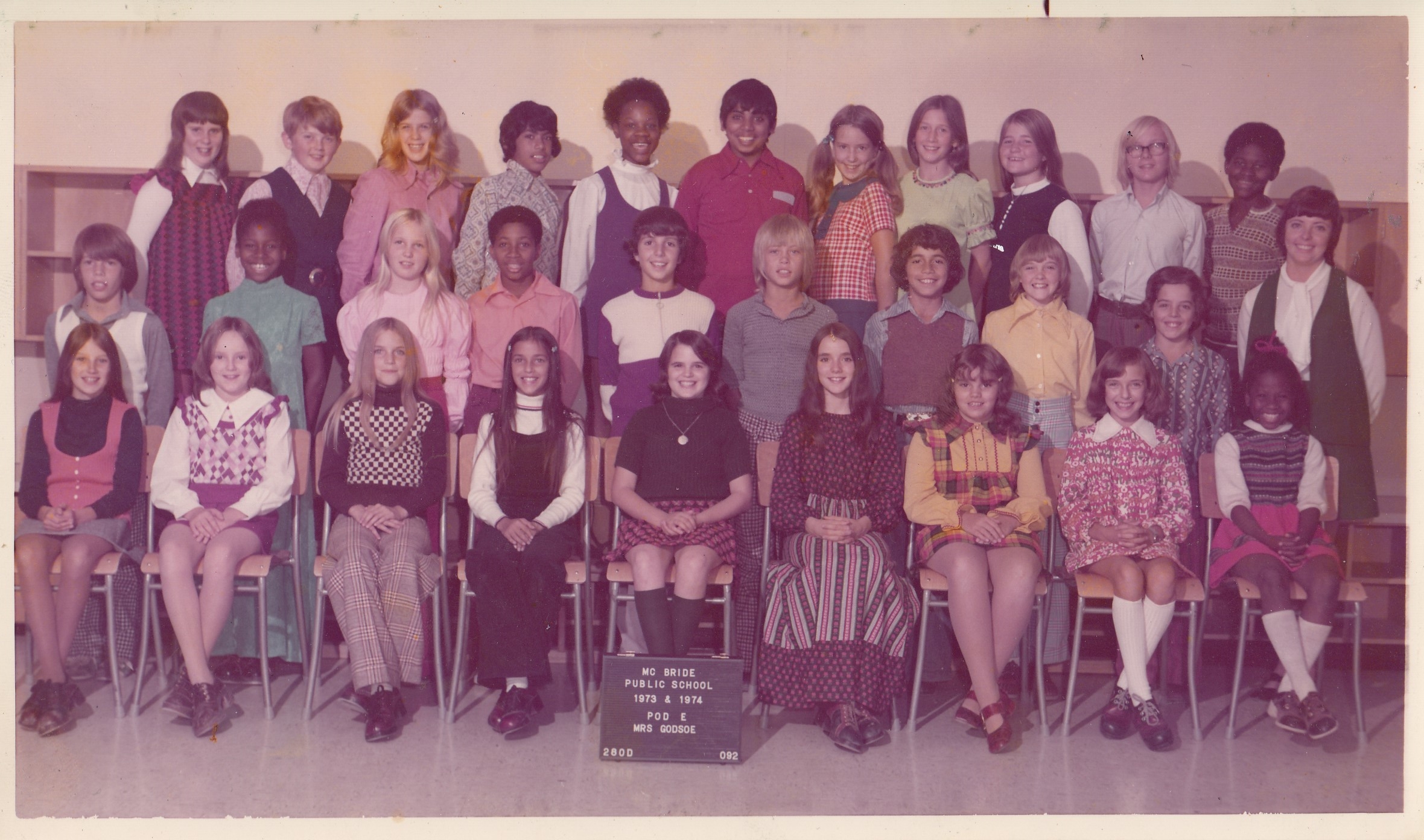
As I look back on my 1973/1974 grade 5 classroom of 29 students, there are significant differences in how we were taught.

Teacher Qualifications:

Our teacher did not have a university degree and only one year of teachers’ training. (I looked her up).

Today’s teachers must complete a 4 year university degree and two years of teachers’ training before they can become professional teachers.

Seating:

I recently returned to my former grade 5 classroom and knew exactly were I sat as we were in rows in alphabetical order. There was little or no collaboration with classmates and we were expected to sit quietly and work with little or no support from our teacher. In the 1970s, I did a lot of rote learning and paperwork – it was pretty boring. I sat and worked in the same spot for my entire grade 5 year.

Today, classrooms are dynamic with flexible seating and continual student collaboration. Now learning is more active through student inquiry and the use of technology. Collaboration within groups is a key learning skill on report cards.

Class Composition:

In 1973, we did not have any students with significant special education needs as those students were placed in contained classrooms. This was before the inclusion model was implemented. Any students who struggled were likely held back by failing a grade. (I was almost held back due to my undiagnosed learning disability). We also had students who were younger as they had “skipped” a grade.

Today, there is a wide range of student abilities in classrooms. I’ve taught classes with gifted students and students with significant learning deficits. This meant that I had to modify my teaching instruction to several grade levels higher or lower to meet these students’ needs. I once had a student functioning at a grade one level in a grade 7 classroom and was fortunate to have an educational assistant and special education teacher to support this student.

Educational Assistants:

In the 1970s, classrooms with students with significant special education needs had educational assistants/teaching assistants. I can only remember ever seeing teaching assistants in the special needs’ classrooms.  I recently spoke to a retired teacher who informed me that when the inclusion model was implemented into Ontario schools, the government promised teachers significant  support with an Educational Assistant in every classroom. That was not implemented as promised.

With today’s classroom composition, teachers need significant additional supports. A full time Educational Assistant (EA) would give teachers time to work with all students. In addition, when I’ve worked with Educational Assistants, my students have been much better behaved as there are two adults watching them work. Even when students are allocated funding for Educational Assistant support, schools often place EAs with other students who have no funding – as the EA is “assigned to the school, not the student”. This means the student with EA funding never gets their allocated support and the teacher must support this student instead. Teaching in classrooms with a few students with special education needs and little EA support is doable but currently many classrooms have up to a third or more of students with special education needs. This is unmanageable and disheartening when teachers cannot provide enough support to help all students. In this case, students who are capable but need a small amount of support never get the help they need.

Discipline:

When I went to school, students were expected to behave themselves in class. I personally was terrified to get into trouble at school as I would have received significant consequences. I remember a few students receiving “the belt” by the principal. In order the get this consequence, the principal had to document and justify the consequence.

Today, discipline varies by administrator, school, and school board. Students who misbehave can go to a behaviour teaching assistants’ room (if this is available) or to the office. The challenge is that students with behaviour needs really require intervention supports to improve their overall behaviour and academic outcome at school. I personally know of a situation where a student, who struggled academically and with behaviour needs, got the mental health and behaviour support programs they needed and is now thriving academically and with behaviour under control. (This support happened as the teacher did a work refusal due to extreme student behaviour concerns which precipitated extra support for this student).

So why can’t we implement programs like this for all students who need behaviour supports? Funding – recent government cutbacks have meant that these safeguards of mental health and behaviour supports have disappeared leaving only the most challenging students getting this critical intervention.

The Bottom Line:

Class size matters more today than it ever has as classroom compositions are highly differentiated with students with many needs. Further, with fluid and dynamic instruction, students do not sit in orderly rows not leaving their seats. As a teacher, I prefer teaching this way as it is more organic and helps students develop critical collaborative skills they will one day use in the world of work.

The bottom line is that teachers need more support in their classroom with not more, but less students. Schools need more Educational Assistants and Special Education Teachers to support students with significant academic and behaviour needs. Boards of education need more programs and qualified adults to address mental health and behaviour needs with students. Without these supports and interventions, students’ behaviour and mental health needs will only be compounded and student outcomes will flounder.

With this blog, I advocate for all students with special education and behaviour needs to get the support they require to be successful in their education … because without these student outcomes will be grim.

Collaboratively Yours,

Deb Weston, PhD
Seniority Matters

Seniority in teaching matters because there is much documented research showing that teachers must practice up to eight years before they develop efficacy in their practice. In the British VITAE study of 300 teachers in 100 schools, authors Day, Sammons, Stobart, Kingston, and Gu (2007) showed that teachers’ levels of confidence and self-efficacy continue to grow until around the 7 to 8 year mark. After 8 years, teachers reached a significant turning point in their professional development (Day et al., 2007).

The 7th year of teaching is significant as it marks about 10,000 hours of teaching practice. Malcolm Gladwell’s book, Outliers, states that in order to master any skill it takes “to a large extent, a matter of practicing … for a total of around 10,000 hours” (Gladwell, 2008). This make sense because teaching is a complex and challenging profession and as a result it takes over 7 years to develop high levels of professional efficacy. Further to this, as teachers’ professional knowledge grows, so does their professional judgement.

In the early years of teaching, there is a great deal of trial and error in developing practices that work with students. I content that this process, while occurring less often, is an ongoing part of teachers’ practices as teachers must meet the needs of many students. This results in developing a myriad of strategies implemented in tandem with many students’ needs.

I personally know that if I need collegial advice, I approach the most senior teachers in my school, as they have the depth of experience and knowledge to guide me. Further, teachers with extensive experience know that the work of teaching is complex, and it is naïve to believe that simple solutions will address complex challenges with students’ learning.

To imply that older teachers should not be teaching because of declining efficacy is to imply that other professionals such as older doctors, lawyers, and politicians should do the same.

I dedicate this blog to courageous teachers who strive to work with their colleagues and do the best for their students day after day.

I believe that when working collaboratively, teachers are better together.

Collaboratively Yours,

Deb Weston, PhD

References

Day, C., Sammons, P., Stobart, G., Kingston, A., & Gu, Q. (2007). Teachers matter: Connecting lives, work and effectiveness. Maidenhead, UK: Open University

Gladwell, M. (2008). Outliers: The story of success. Hachette UK.


Celebrating us

We did it.

We brought another amazing decade of learning to a succesful close with passion, creativity, and purpose. For ETFO it has been 21 impactful years in the service of public education, students, and educators.

It’s my 11th year as an ETFO member, and I am looking back at the past decade with some mixed feelings. Perhaps it is a function of the time of year when all of the best and worst lists are being shared in the media? Regardless, I am thankful to be an educator who works with wonderful students and amazing staff at a great school.

On the other hand, I am also intrepid about what is continuing to widening gap between student needs and the resources with which to support them. What will the future look like if government cuts and policies changes go unchallenged? This got me thinking about how instrumental the work of ETFO is to supporting us and I found myself browsing through pages of resources, messages, and initiatives via etfo.ca

Whether you are newer to the profession or a veteran educator, I thought it would be a good idea to look back at the positive impacts made by our union that have helped us get us here, and as we prepare to for 2020.

Let’s take a moment to break down some of the numbers from 21 years of ETFO:

  1. Membership ~ Let’s use 75 000 as the mean number of teachers from past to present.
  2. Days of Instruction ~ 21 years x 190 days = 3990 days
  3. Minutes (days x 300 minutes of instructional time x membership) ~ 8.9775 x 10 ^10 minutes

For the sake of my own brain, I am going to say a lot of learning has occured as a direct result of tens of thousands of past and present caring ETFO educators. Millions of moments curated that have culminated and contributed to millions of positive impacts in and out of classrooms. Millions of moments where struggles turned into opportunities and hard work paid off. Millions of students who have gone on to do amazing things. Millions of lessons learned with millions more still to come.

Without becoming too nostalgic, I think it’s a great time to take stock of all the amazing things that have happened that have ensured the voices of elementary educators will be heard. 21 years on the shoulders of giants who have stood tall in the face of adversity to prepare a way for future teachers to succeed. To all of those who have taught before and alongside me, I am grateful.

Grateful for:

21 years of lessons learned in and out of the classroom.
21 years of remaining on the cutting edge of technology and ongoing teacher training
21 years of inclusivity and equity
21 years of looking out for the safety, mental health, and wellbeing of our membership
21 years of dispelling myths with facts
21 years of commitment to something bigger than themselves
21 years of standing up for students, their families, and to make public education better/stronger 
21 years of fighting against the malicious mandates of socially and fiscally tyrannical governments
21 years of solidarity

Such success is something to celebrate. Especially, with a strike mandate of 98% in favour this past Fall. Our collective voices and our profoundly positive professional impact will not be dismissed or ignored.

While certain media factions seek to villify our profession, we know that we possess the power to light the way for public education well into the coming decades. When elected officials undermine our collective good in the short term, we remain focused on the future by standing together now. Side by side, ours are the shoulders to stand on.

As I shared earlier in this post, the numbers show that the possibilities grow everyday an ETFO educators enters a classroom. Bring on 2020!

Cheering you on everyday and looking forward to celebrating an even better future in education. Thank you for reading.

In loco contractus

It has taken a lot of restraint to ignore the volumes of micro-aggressive, passive aggressive, aggressive, and macro-aggressive comments flying around the Twitterverse about education since our most recent contract with the government expired this past August.

And then there is the elected official du jour with the education portfolio.

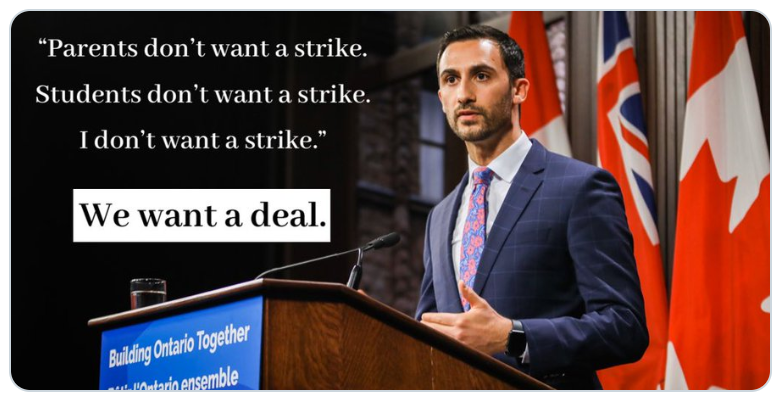
I have tried not to focus on the orchards of low hanging fruit being grown by our current Education Minister at the behest of his leader and his agenda. Elected or not, it is imperative of this incumbent and every other MPP to serve the public better. This means, any disinegenous attempts to villify our profession through weak one-liners and scripted media apperances as a scare tactic have to end. Saying you want a deal and then not bargaining will never be deemed as negotiating.

Despite not having a contract, all educators continue their tireless work on behalf of students to educate, encourage, and move forward even though our government managed to cut teachers and course offerings, and then wrote themselves a nearly 5 month absence note with a retro-active pay raise for good measure. This is not a sustainable situation. It is however, a recipe for a toxic and uncertain future.

What the province’s students need now is a government that sees, supports, and serves them and not the interests of corporate bullies or privateers bent on profiting from manufactured crises in public education. Instead they are blasted with a daily dose of misinformation without consideration of the present or the future. Our youth deserve a future and the truth.

This is what they are getting.

In between not negotiating, there have been absolutely zero authentic moments when this elected official sat at the table, conducted meaningful dialogue with teachers, or made an unscripted appearance at a public school without a camera crew. Maybe he should read my Undercover Boss post.

Instead it’s a steady stream of steamy slurry being served to the public via social media and scripted segments. #somethingsmells

Ontario education minister deletes tweet after social media backlash

“Lecce’s office told Global News on Thursday that the location of the photos was chosen due to timing and convenience, saying the decision was not made in an effort to avoid going to one of the province’s public schools but instead so as not to create a disruption.”

https://news.ontario.ca/edu/en/2019/11/minister-of-education-statement-on-first-day-of-work-to-rule.html

“My negotiating team stands ready for meaningful, good-faith bargaining 24/7, to reach the deals Ontario students and families deserve. There is a path to a deal, and it requires all parties to be reasonable and fair and put the needs of our children first.”

https://news.ontario.ca/edu/en/2019/11/statement-from-education-minister-on-osstf-strike.html

“Strikes hurt kids. Our Government has been clear, we want deals that keep students in class. For teacher unions to leave the table, to turn their back on our children, and to escalate to the point of compromising their education, is deeply troubling for parents and our Government.”

Cue Dr Carol Campbell from OISE and a litany of very committed educators who, to no surprise, have provided the corrections and descriptive feedback. Follow the thread all the way through. I especially like the part where the OntGov will never leave the table and be available 24/7. The OSSTF is also working hard at fact checking the M.O.Ed’s claims. #onceateacheralwaysateacher

There is nothing helpful about using the hashtag #strikeshurtkids that could ever be considered conscionable compared to the budget cuts being inflicted in our province. For so many people concerned about the public purse, a vision prescription update may be forthcoming to help them see the red ink that will stain the ledgers of future generations of Ontarians. When the people are denied adequate and equitable access to the world class education system that already exists in Ontario, the costs will make the current deficit look like an OLG winfall. The shortsightedness of this will end up costing us all. #antithetical #malfeasance or #unethical #incompetance

Think of overburdened social service systems, the disenfranchisement of students who have had their course options stolen, or of the marginalized/at-risk youth who deserve more interactions with opportunities and adults who are equipped to support them. Think about the danger to the economy of an underprepared/underserved workforce. This is why we need to keep up the struggle and fight against the visionless economic tyranny of the day. #cutshurtkids

Cuts Hurt Us All

Not to be overlooked, our collective rights as a union are being threatened by a pack of budget wolves that is blind to all but the bottom line. Few if any, have ever dared to step foot into the very institutions they wish to “save” and witness the magic and miracles being performed by teachers and support staff everyday without a press conference or a contract. Now that’s putting students first. #ETFOStrong

What’s up with the increase of students with IEPs in Ontario classrooms?

From People for Education, 2019, p. 15

An Individual Education Plan …

  • is a working document that is developed and maintained for a student who is deemed exceptional by an Identification, Placement, and Review Committee (IPRC)
  • must be developed with input from the parent(s)/guardian(s) and from the student if he or she is 16 years of age or older
  • is developed within 30 days of the placement of an exceptional student in a particular program
  • must provide a copy to parent(s)/guardian(s)
  • must provide a copy to student 16 years or older
  • identifies the student’s specific learning expectations
  • outlines how the school will address these expectations through appropriate accommodations, program modifications and/or alternative programs as well as specific instructional and assessment strategies
  • includes accommodations (i.e. ways to support the student’s learning) and modifications to learning expectations (i.e. often changes to grade level expectations)
  • has students deemed with an exceptionality based on a psychoeducational report
  • contains IPRC recommendations when developing or reviewing the student’s IEP

Psychoeducational reports/assessments

  • completed by trained educational psychologists
  • based on testing and observations
  • identifies student’s profiles including their strengths and needs
  • suggests accommodations and/or modifications to support learning
  • includes supports such as special equipment, technology resources, and educational assistance
  • “Psychologists are a vital component of special education support in Ontario. These professionals assess students’ special education needs, design interventions for students, and provide direct support to both students and the staff supporting them (Ontario Psychological Association, 2013).” (People for Education, 2019, p. 15)
  • “Northern school boards report the highest percentage of schools (58%) without access to a psychologist – this may be due to the difficulty of traveling to more isolated schools in Ontario’s rural North. According to a 2017 report, the cost associated with travel and housing for specialized staff have contributed to a lack of support for students with special education needs in Northern and isolated First Nations communities (Ontario First Nation Special Education Working Group, 2017).”  (People for Education, 2019, p. 15)

Role of Identification, Placement, and Review Committee (IPRC)

  • consideration must be given to any recommendations made by the IPRC concerning special education programs and services that may be particularly appropriate for meeting the student’s needs
  • includes possible funding to support these recommendations made by the IPRC concerning special education programs and services that may be particularly appropriate for meeting the student’s needs

What if the student has not had a psychoeducational assessment?

  • an IEP can be developed for students who have not had a psychoeducational assessment and/or have not been identified with an exceptionality under the Special Education Act
  • students may also have an IEP developed when they require accommodations, program modifications and/or alternative programs
  • students with special needs, not formally identified with an exceptionality, may receive appropriate special education programs and/or services that will allow them to be able to achieve the grade-level learning expectations
  • IEPs can include accommodations and modifications documented in the students’ IEP
  • some students require alternative expectations, not specifically related to curriculum, that may outline specific learning needs and strategies

Why is the IPRC process so important?

  • IPRCs deem students with an exceptionality based on psychological educational assessments
  • IPRCs recommend supports and funding to support students’ learning needs
  • approximately 50% of students receiving special education support go through the formal IPRC process based on psychoeducational assessment (Ontario Ministry of Education, 2018b)
  • students with IPRC identification have a legal right to special education support (Education Act, 1990)

Has there been an increase in students with IEPs in classrooms?

The Ontario Human Rights Commission 2018 policy stated that schools must accommodate students’ disability needs “whether or not a student with a disability falls within the Ministry’s definition of ‘exceptional pupil,’ and whether or not the student has gone through a formal IPRC process, or has an IEP” (Ontario Human Rights Commission, 2018, p. 13).

“Data from the Ontario Ministry of Education show that, while the proportion of students going through the IPRC process has remained relatively stable since 2006-2007, the proportion of students with IEPs has been steadily increasing” (People for Education, 2019).

In other words, students who are not identified via the IPRC process are increasingly receiving special education support through an IEP. With no exceptionality in place, specific supports are not always forthcoming. These supports could include educational assistants, support personnel, and specialized equipment.

Lack of funding for psychoeducational assessments

 People for Education (2019) reported:

  • “60% of elementary and 53% of secondary schools report that there are restrictions on the number of students who can be assessed each year”
  • “92% of elementary schools and 94% of secondary schools report that students waiting for an assessment are receiving some special education support”

With little or no funding for psychoeducational assessments:

  • students are put on waiting lists for assessments, sometimes for many years
  • students with the greatest needs are moved to the top of the lists leaving other students waiting longer for assessments
  • parents with resources pay out-of-pocket for each private assessments costing up to $4000
  • 94% of elementary and 81% of secondary schools reported having students on waiting lists for psychoeducational assessments (People for Education, 2019)
  • on average there can be up to 6 elementary students and 4 secondary students on waiting lists for professional assessments in their schools (People for Education, 2019)

Gaps in support – Lack of equity in special education funding 

Students with psychological assessment

Students with no psychological assessment
  • psychological assessment to develop IEP
  • no psychological assessment to develop IEP
  • psychological assessment to have student deemed with an exceptionality via IPRC
  • no guarantee of funding or support via IPRC
  • funding in the form of additional special education support for teacher and/or educational assistant time
  • no funding for special education support for teacher and/or educational assistant time
  • funding can include special equipment and technology supports
  • no funding for special equipment and technology supports

The People for Education have noted an increasing gap between students with IEPs as compared to students with IPRCs (see chart below). This means there are an increasing amount of students with special education needs in classrooms with little or no support as compared to students with special education supports.

Year

Students with IEPs

Students with IPRCs

2017 – 2018

16.7%

8.5%

2016 – 2017

16.5%

8.7%

2015 – 2016

16.2%

8.8%

2014 – 2015

15.9%

8.9%

2013 – 2014

15.4%

9.1%

2012 – 2013

15.2%

9.2%

2011 – 2012 14.5%

9.3%

2010 – 2011

14.5%

9.3%

It is not Ontario teachers’ imaginations that there are more students with IEPs in their classrooms. With less support for students with IEPs, teachers struggle to meet the needs of these learners and the needs of the rest of the students in their classroom.

“Large class sizes impact the teacher to student ratio. Students with special education needs require greater support and more teacher one-on-one time. Large class sizes make this challenging. Having more special education teachers would help to reduce this challenge by decreasing the teacher to student ratio. Elementary school, Peel DSB” (People for Education, 2019).

Questions about supporting students with special education needs:

  1.  Why are there so many students with IEPs in classrooms without additional adult support?
  2. What data is being used to develop IEPs without psychoeducational assessments?
  3. Given the Ontario Human Rights Code, why is the public education system condoning the lack of assess to psychoeducational assessments for students who have less assess to funding?
  4. Why are teachers solely having to support so many students with IEPs?
  5. Are Ontario public schools NOT meeting the needs of their most vulnerable students with special education needs?

As an advocate for students with special education needs, I write this blog out of concern for all students with special education needs who are not getting the support they need to learn.

Special Education Teacher,

Collaboratively Yours,

Deb Weston, PhD
References

Education Act, Revised Statutes of Ontario. (1990, c. E.2). Retrieved from the Government of Ontario.

Ontario First Nation Special Education Working Group. (2017). Ontario First Nations Special
Education Review Report. Toronto, ON: Author.

Ontario Human Rights Commission. (2018). Policy: Accessible Education for Students with
Disabilities. Toronto, ON: Author.

Ontario Ministry of Education. (2018a). Education Facts, 2017-2018 (Preliminary). Toronto, ON:
Government of Ontario.

Ontario Ministry of Education. (2018b). 2018-19 Education Funding: A Guide to the Special
Education Grant. Toronto, ON: Queen’s Printer for Ontario.

Ontario Ministry of Education. (2019). Part E: The Individual Education Plan (IEP), Downloaded from http://www.edu.gov.on.ca/eng/document/policy/os/2017/spec_ed_6.html

Ontario Psychological Association. (2013). Professional Practice Guidelines for School Psychologists in Ontario. Toronto, ON: Author.

People for Education. (2019). Annual report on Ontario’s publically funded schools 2019. People for Education. Downloaded from https://peopleforeducation.ca/wp-content/uploads/2019/06/PFE-2019-Annual-Report.pdf.