Why our public education system is awesome!

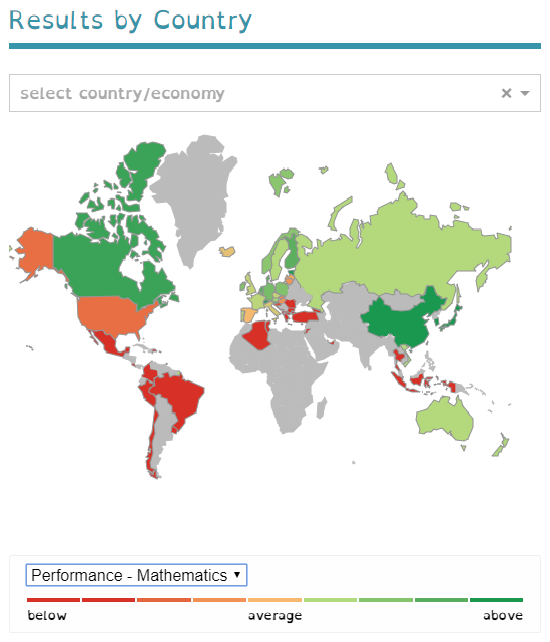
PISA 2015 results by country MathPISA 2015 results by country Science

Recently, during a discussion in an AQ course @ed_rego, we started talking about math scores and the effectiveness of Ontario’s public education system. Ed Rego mentioned Ontario and Canada’s success on the international front. Not only do Canadian students rank high on the international front, its public education system also makes a difference in students’ lives. Let’s look at some reveling data first.

1. Canada ranks high in international testing.

In my studies on education, I discovered how well Canada does on international test scores, especially in relation to the United States. The Organization for Economic Co-operation or OECD conducts yearly tests to rank countries based on performance in science, reading, mathematics (Program for International Student Assessment or PISA) and trends in international mathematics and science study (TIMSS) in both French and English. Students are randomly selected by age (15 year olds for PISA) or by grade level (Grades 4 and 8 for TIMSS).

In 2015, Canadian 15 year olds ranked 4th in science , reading, and mathematics among the PISA results tied with Finland. Singapore, Japan, and Estonia were the only countries to surpass us (Chinese countries include Taipei, Macao, Hong Kong, and B-S-J-G China) . The United Kingdom came in 10th place and the United States came in 20th place. The trends show Canada varies only slightly between testing years. Also note, in Canada, all 15 year old students, of all abilities, participate in our education system and thus would be possible participants in the PISA testing. Also note that Canada does not have weekend “Cram School” as part of our educational landscape. Cram School focuses on rote learning and not critical thinking. In addition, some countries stream students with learning challenges away from formal education. A breakdown of PISA 2015 results for specific provinces can be accessed below.

In 2015, Canadian students ranked 8th in grade 8 mathematics surpassed by Singapore, Korea, China Taipei, Hong Kong, Japan, Russia, and Kazakhstan. England ranked 10th and the United States ranked 11th. Norway students ranked 14th in mathematics. Finland scores were not listed. In science, Canadian students ranked 13th in grade 8 surpassed by Singapore, Japan, China Taipei, Korea, Slovenia, Hong Kong, Russia, England, Kazakhstan, Ireland, United States, and Hungary. Norway students ranked 18th in science. A breakdown of TIMSS 2015 results for specific provinces can be accessed below.

These PISA and TIMSS scores show strong results for both Canada and Ontario, particularly in light of the latest decrease in mathematics EQAO scores in 2017. From these results, I can conclude that Canada’s public education system does a very good job educating our students, even on an international level.

Note: I did not analyse the breakdown of grade 4 test scores as the introduction of specific Canadian curriculum differs in mathematics from other countries.

Canada’s 15-year-old students among best global performers in science, math

Breakdown of Canada’s PISA scores for 2015.

2015 mathematics TIMSS results 

2015 science TIMSS results

TIMSS 2015 Ontario result breakdown

2. Canada teaches students how to critically think and engage in rational discourse.

As Heather Mallick of the Toronto Star stated, our public education system teaches “to value thought over feeling, reason over passion” (Mallick, Toronto Star, November 12, 2016). Canadian teaches do not accept writing with statements without supporting details that come from credible sources. Teachers teach the difference between real news and false news.

3. Canadian public education socializes students.

All students, from all backgrounds (i.e. age, gender, cultural background, socio-economic status, or ability) participate in Canada’s public education system. Students are not segregated based on background, culture, or socio-economic status. Students all learn together. Teachers teach values of inclusion for all and education for all. Students learn to get along with others from many different backgrounds and many different places in the world. And this level of national inclusion, is one thing that makes me proud to be a Canadian citizen and a Canadian teacher.

Ontario’s Equity and Inclusive Education Strategy

4. Canada’s public education is equitable and democratic.

Canada’s public education system (almost) compensates for disadvantages that impact student learning. Canada’s public education system gives students from all background (due to age, gender, cultural background, socio-economic status, or ability), an opportunity to succeed in school. Newly-arrived immigrant students rapidly integrate enough to perform the same as their Canadian classmates. Dr. John Jerrim (UCL Institute of Education in London) stated that Canada’s high league table ranking reflects the narrow socio-economic gap in school results. The outcome is that Canada’s score show a very high average, with relatively little difference between advantaged and disadvantaged students. The OECD states that Canada supports social equity as “Schools should provide a good education for all students, regardless of their parents’ education or career. PISA assesses to what extent differences in education outcomes are associated with the social status of parents as well as the performance gap between advantaged and disadvantaged students. It also identifies the share of students who perform well, despite coming from disadvantaged backgrounds, known as resilient students.” (OECD, 2015)

How Canada became an education superpower

I end this blog with the words of John Dewey …

It is no accident that all democracies have put a high estimate upon education; that schooling has been their first care and enduring charge. Only through education can equality of opportunity be anything more than a phrase. Accidental inequalities of birth, wealth, and learning are always tending to restrict the opportunities of some as compared with those of others. Only free and continued education can counteract those forces which are always at work to restore, in however changed a form, feudal oligarchy. Democracy has to be born anew every generation, and education is its midwife. (Dewey, 1916, The Need of an Industrial Education in an Industrial Democracy)

Let’s celebrate Canada’s public education system success as a democratic and well educated nation – for I believe this is why we are one of the best places to live in the world.

Collaboratively Yours,

Deb Weston

This blog was inspired by an article written by Heather Mallick, Toronto Star, November 12, 2016.

Always a Mentee, Always a Mentor

MentoringImageTransparent


This year, I‘m in a new school, in a new role. This September, every school day, I’m trying to figure out where my class is suppose to be and what and how I need to teach my students with special education needs. I am gradually learning the names of my colleagues but it seems like I can only get either their first name or the last name – I cannot put the person’s whole name together. My role in this special education classroom involves using a very prescribed program to support struggling readers and I’m still figuring it out.

And our school went through re-org (reorganization). This meant redoing class lists and changing rooms. The first week of school, my room 204 was organized and I had my bulletin boards decorated. After spending two and half weeks setting it up, I had to change rooms. Really? I moved all my stuff to room 102, redoing the bulletin boards and redoing the schedule so my students and I know where and when we are suppose to be.

You’d think this would not be a challenge for me as I am in my 18th year of teaching. But every time I take on a new role, I start all over again. Why do I do this? Because every time I take on a new role, I learn, a lot.

This year, my colleague and mentor, DHS, has been wonderful in supporting me through my transition into the school and into my program. Her contemplative stance has helped me work out various decisions and challenges. She also helped me set up my newly located classroom.

Over the past 18 years, I have been a mentee and mentor. I am a big believer in “Paying it Forward”.

My first teaching mentor was AT. She was my first practicum teacher and I was very fortunate to work with her as a grade level teaching partner. AT welcomed me into teaching with an open heart and a guiding hand. She showed me how to teach and I still use what she taught me today. I’ve had other mentors who were not teachers. My Vice Principal, AMW, walked me through a new program that I started in our school. The best part of AMW was that she was straightforward with me and challenged me in areas where I needed to grow. AMW was and is a great listener and guide.

At about my 7th year of developing my teaching practice, I became a mentor to other teachers. As a mentor to another teacher, I quickly realized that this mentoring process was not about me and my success but about my mentee and their success. I’ve mentored many teachers formally and informally.

My first “official” NTIP (New Teacher Induction Program) mentee was BT. He was a grade 8 Math and Science teacher, like me. After a couple of weeks of teaching grade 8, he was going to quit teaching. He told me (his words) “I did not give up going into the tech sector to deal with this stuff” – he actually used another  word.  I still remember him pulling up a chair directly in front of my desk and putting his head in his hands. I listened to him talk about the challenges of teaching grade 8 – which can be many and very disconcerting to a grade 8 teacher. BT was ready to jump off the teaching wall in this first month of teaching. I talked him off the wall. We spent time planning and working together – he got through the year without having to take a leave of absence or worse, quitting teaching. I knew he was going to be a great teacher because he was upset and cared about his work. Today, BT is a great teacher. When I saw him recently, I was so proud for his success.

I’ve also informally mentored Long-term Occasional teachers. HK was teaching grade 8  Math and Science. My Vice Principal asked me to help her as she needed collegial support.  Unfortunately, at that time, occasional teachers did not have access to NTIP support. HK was dealing with similar challenges I had faced (and BT had faced) as a grade 8 teacher. HK was a highly skilled and dedicated new teacher that was driven to make a difference in her students’ lives. We spoke often and met every week at a well known coffee location. There were tears and many stories. It was a tough cohort year of grade 8s in our school. She made it through and has gone on to be a very strong and dedicated teacher. I am very proud of how well she has done in her career.

I’ve mentored other teachers too. One teacher came from South Africa and was looking for Canadian experience. She spent time in my grade 7 classes, learning how we teach in Ontario. I directed her towards many resources she used for courses she needed to upgrade her credentials. To my delight, she ended up getting a full time teaching position a year later.

More recently, I mentored a newly graduated teacher, who helped out in my contained special education class. SM was keen, very well qualified (i.e. she had French) and working two jobs. She was a natural when working with my academically challenged students. She ended up volunteering in a French class at our school and then landed a full time teaching position.

After many positive and fulfilling experiences, I continue my career as a mentee and as a mentor. It’s part of our teaching practice and it’s part of our career path. We are teachers for our students and our colleagues.

And even as an 18 year plus teacher, I thank my colleagues for all the mentorship, collaboration, and support they continue to give me, every day.

I believe that when working collaboratively, teachers are better together.

Collaboratively Yours,

Deb Weston

Partnering for Success Getting the most from Ontario’s New Teacher Induction Program: A Resource Handbook for Mentors

Ontario Teacher Federation: Survive & Thrive

Getting Past “The 5 Year Wall”

wall peek

As a new elementary teacher, I believed I would really know what I was doing after 5 years of practice. After 5 years in my previous careers, I could handle just about anything. I had 8 years experience as a student in elementary school. And, yes, I had watched my elementary teachers teach. I thought, “How hard can it be?” I figured after 5 years of teaching, working long hours after and on weekends, I’d be able to relax a bit.

But back then, I was very naive.

There was a lot about teaching I did not know or even consider. I did not count on having to switch grade levels every year for the first 5 years of my practice. I thought I’d have readily available teacher resources. I did not know that teachers spent a great deal of their own money to stock their classrooms with supplies and books. Nor did I realize I would be expected to implement waves of educational initiatives within a year of introduction. Further, I had not considered having students functioning at grade levels below the grade I was teaching or dealing with special education needs with little or no support. In addition, I did not know how to deal with students who had behaviour issues – in my first week of teaching grade 8, a student threw a chair at me. I also was hoping to get support and mentorship from my teacher colleagues, which at the time was not always forthcoming. My teacher education had not prepared me for all of this.

So I pushed forward by working hard and doing the best for my students. I took courses that I thought would fill in some gaps, which helped a bit. I solicited curriculum support from my colleagues and spent a great deal of time talking to my peers about my classroom challenges. My colleagues were very helpful and I absorbed as much wisdom as I could from my tenured peers.

Then it happened. I hit “The 5 Year Wall”. After 5 years of teaching, I thought I’d know more and feel more effective in my practice. I thought my lesson plans should be going the way I planned them. I thought that my classroom management would be awesome by this time. Instead, I was left with feelings of frustration and dissatisfaction in myself as a teacher. I thought, maybe if I worked harder, I would feel more effective; I was so disappointed in myself.

But because I was very committed and dedicated to becoming a great teacher, I moved forward facing many challenges. I continued to seek support and mentorship from my colleagues. My collaborative collegial support proved to have the biggest impact on my practice. My colleagues saved me from my professional dissolution.

Then something else happened. Around my 7th and 8th year of teaching, I started to feel my levels of self-efficacy and self-confidence rising. I started to finally feel like I knew what I was doing … most of the time. At 7+ years of teaching, I still faced challenges with switching grades. I realized that educational initiatives did not always stick. Lack of continued resource support or the introduction of a “new” initiative, often meant the end to last year’s latest innovation. Having students with multiple functioning levels and needs was a classroom norm. My teacher skin grew thicker when dealing with student and parent issues. I realized that lesson plans were made to be adapted to address the students’ needs, not the teachers. After 8 years of practice, I really started to enjoy teaching.

While researching, I discovered that my experience of building professional confidence and self-efficacy was supported in the literature. In the British VITAE study of 300 teachers in 100 schools, authors Day, Sammons, Stobart, Kingston, and Gu (2007) showed that teachers’ levels of confidence and self-efficacy continue to grow until around the 7 year mark. After 8 years, teachers reached a significant turning point in their professional development (Day et al., 2007).

I thought about what made this 7 year mark so significant. Then a friend mentioned that in the book Outliers, Malcolm Gladwell stated that in order to master any skill  it takes “to a large extent, a matter of practicing … for a total of around 10,000 hours” (Gladwell, 2008).  I did the calculations and the 7 year mark correlated with about 10,000 hours of teaching practice. This made sense because teaching is a complex and challenging profession and as a result it takes over 7 years to develop high levels of professional efficacy. Further to this, as teachers’ professional knowledge grows, so does their professional judgement.

Well into my 8th year of teaching I noticed several new teachers experiencing high levels of professional frustration. Some of these teachers were so distressed they regretted becoming teachers. Some were thinking of leaving the profession. Remembering my own frustration, I reached out to my novice colleagues. I told them about The 5 Year Wall. In my following years of teaching, I have talked many novice teachers off the ledge of The 5 Year Wall. Sometimes there were tears. Sometimes there were daily pep talks. Sometimes there were weekly meetings at a well known coffee shop. After my years of collegial mentorship and support, my colleagues have become excellent teachers.

So if a new teacher talks to you about their professional frustration, tell them about The 5 Year Wall. Tell them to hang in for the next few years so they can reach their professional turning point in year 8. Support them with your mentorship and listen to their concerns. Because in isolation, there are no colleagues to inspire novice teachers with ideas or to suggest resources/strategies or to support them when it’s really needed. And even as an 18 year plus teacher, I thank my colleagues for all the mentorship, collaboration, and support they continue to give me, every day.

I believe that when working collaboratively, teachers are better together.

Collaboratively Yours,

Deb Weston


References

Day, C., Sammons, P., Stobart, G., Kingston, A., & Gu, Q. (2007). Teachers matter: Connecting lives, work and effectiveness. Maidenhead, UK: Open University

Gladwell, M. (2008). Outliers: The story of success. Hachette UK.

The (W)rap

The following is proof why I will never quit my day job for a career in entertainment.
Sung to the tune of Rapper’s Delight with apologies to the Sugar Hill Gang.

Rap

It’s June again and the heat is on,
School is buzzin’, students’ll soon be gone.

What’s that you say? No not yet.
You forgot to give one last test.

Too late my friends that’s all the learnin’
It’s time for the grades they’ve been earnin’.

10 months of fun fly by so fast.
Too bad, so sad these times don’t last.

But, that’s ok, not to fear,
We’ll all be back for another new year.

So say see you later, not goodbye
There’s no need to dry your eyes.

Take time to celebrate your endeavors,
Kick back, and relax. Take time to recover.

Boxes

Before you shut the door for the final time this June, take time to look back on all of the amazing things you were part of in your classroom this year? Maybe it was a break through in Math or Language. Perhaps it was a victory in classroom management? Don’t forget the “a-ha!” moments where it seemed like all of the light bulbs over your students’ heads went on at once. Make sure to pack your boxes of memories tightly. Holding on to each one, because it is the sum of these experiences that continue to inspire, shape, and fuel your practice.

Look at the lives you made better for students where you invested time to coach teams, organize a concert, or lead a club. Cherish the moments of learning outside of the curriculum. The minutes you have shared will add up to a life time of difference in the lives of learners. Think about the mentorship you provided a new teacher, or the warm welcome you gave to an OT.  Take time to remember all of the good you’ve brought to education this year.

Congratulations to everyone for another amazing year of education at the speed of life. It is an honour to share the journey of education with you all.  May your time away be truly be relaxing and restorative.

THANK YOU!

It has been a long, arduous journey from September to the end of June and we are just weeks away from closing the chapter on another academic year. I am going to relive the last ten months of a fictional elementary school teacher.

A group of twenty plus disconnected, diverse individuals arrived in your classroom with a variety of needs beyond their academic status. Through careful planning, creative thinking, endless commitment and tremendous flexibility you were able to to:

  • make each child feel welcomed and loved
  • create a learning community
  • develop the confidence and self-esteem of your students
  • help them move forward in all academic areas
  • taught them the power of being a team
  • provided off campus, intramural, choir, club and athletic opportunities for them
  • offered them a high five to celebrate and emotional support when needed
  • in some cases provided food to meet their basic needs
  • laughed and cried with them
  • believed in them enough to provide tough love
  • wrote reports, called parents, attended meetings
  • organized assemblies and spirit days
  • created Individual Educational Programs
  • purchased necessary materials for your class and students
  • spent endless hours beyond your school day
  • gave up personal and family time for your students
  • helped develop future global citizens
  • attended a variety of professional learning opportunities to help in your journey toward best practice
  • you have sacrificed personal health for your class and school
  • please continue this list with anything I have missed

THANK YOU! THANK YOU! THANK YOU! On behalf of students and parents everywhere, you continue to be a part of one of the most rewarding and important roles there is. You are a teacher!

I would also like to take this time to thank ETFO for the opportunity they have given me to be a part of the Heart & Art blog for the last 5 years. In that time I have had the wonderful opportunity to learn from many talented people. I have had comments shared with me that reminded me how proud I am to be a part of this profession. Finally, I have become a better teacher as my blogging has helped me reflect on the day-to-day work in my classroom. I am making this my last blog and challenge the many talented and inspiring teachers in ETFO to join in and share the expertise that lies within you and your teaching. THANK YOU!

Partnerships

This past week allowed me an amazing opportunity to work with a very committed and compassionate group of Early Childhood Educators. They are part of ETFO and as such are able to partake in a variety of services that are offered including workshops. The topic of this session was on poverty (Why Poverty? is the official name for the provincial workshop). So on a Monday evening in the month of June, twenty ECE staff showed up after a full day of work to talk and discuss the topic of poverty.

At first I was quite nervous, as I had never facilitated a workshop for anyone but teachers. Over the two hours that we worked together the titles faded away and we just became a group of like-minded people who were seeking ways to help level the playing field for the children in our care.

Then it happened, that aha moment where the idea of partners and partnerships became very real for me. So on my drive home from Hamilton I began to ask myself where else could I find partnerships? Who could also partner with me to enhance the educational experience of my students? The answer was astonishingly simple. I need to look no further then the staff room in my school. I just needed to look with a different lens in order to see the amazing wealth of talent that exists within each school (Child and Youth Workers, Educational Assistants, Early Childhood Educators, volunteers).

Yes, right before my eyes existed a wealth of ideas, passions, skill sets and people who chose a career that focussed on helping young people be successful. The task is to work on bringing them all together, to create an environment that values each person, their profession and not their title. This approach is alive and well in our Kindergarten programs. How do we transfer that to our entire school? How do we bring support staff and teachers together in workshops to learn side-by-side?

I highly encourage the readers to please share their ideas or current practices on how to best create, maintain and foster growth in these types of partnerships. In closing, I would like to thank the Early Childhood Educators from Hamilton who helped me experience the power of a partnership.

Speaking of immovable objects

Here’s an open ended question for your classroom or next staff meeting.

Q: What happens when an unstoppable force meets an immovable object?

I love asking questions like this. They tend to force people to engage a different set of neurons to come up with the answer(s). Usually, the room gets quiet at first, but then what follows can be quite rich and edifying.

Did images of the universe collapsing upon itself come to mind? Were Neutrinos, light energy, and dark matter dancing destructively in your mind? Nice, but this is not a Science blog. I predict nothing happens. This seems to be the most simple answer I can conjure. Especially, when neither entity can be stopped or moved. Let the exchange of ideas begin. This is what I strive to achieve in my classroom.

Lately, something has interrupted our flow. Again.

Fill in the blank.

It’s the most __________________ time of the year.

a) Wonderful (b) Hectic (c) Incredible (d) Stressful (e) All of the above

Here’s a snapshot from last week in my own incredibly hectic and quasi-stressed out classroom.
Tuesday: Students come to school under a cloud of distraction and worry over the provincial government’s mandatory standardized test EQAO. So I prescribed a Math test to get their minds off of the days ahead.

Wednesday to Friday: EQAO testing delivered over 3 days in 6 x 100 minute periods. Followed by a decision to provide 100 minutes of movement time each of those afternoons. After sitting at their desks writing assessments, which are as long as some high school tests, my grade 6 students earned the right to move around. So to the gym and outdoors we fled. Unless Participaction and Ophea are lying to us, an active body leads to a healthy mind and the two are inextricably connected because they add up to happy learners.

EQAO17

Movers and groovers

If we are truly differentiating education to support all learners in Ontario, then why is the standardized assessment basically a read and respond test? How are the needs of all learners honoured here? When will kinesthetic, musical, visual/spatial, and inter-personal learners get their rightful moments to shine? And then there are the students who suffer from anxiety regardless of their incredible skills.

Anxiety is one thing parents and schools do not need to teach students.

Q: Why do so many students come to school worried about this test?
A: They’ve learnt it at home, and then they’re learning it in school.

This revelation comes from an informal poll taken over 8 years of teaching students in grade 6, many, who feel their families put pressure on them over EQAO, and also that the school intentionally or inadvertently perpetuates in the classroom in Grades 3 and 6 does the same.

Despite repeated assurances that EQAO is a meaningless test, with regards to their report cards and chances of getting into university, students and their families are still laying a lot of emotional eggs into this basket. For whose benefit, then, do tests like these really serve? In my neighbourhood it appears to be increasingly financial as homes in “high achieving” schools like Markham and Unionville are in constant demand on the real estate market.  No pressure. 

Think of the money

Are parents sub-consciously stressing children over EQAO scores to influence their property values? Say it isn’t so. Each year on meet the parent night in September, the test is front and centre on the agenda of many in attendance. With some time and clear information, many of their concerns are acknowledged and addressed. However, 8 months into another year, there are still remnants of confusion in the general public. Recent correlations between house prices and test scores are adding fuel to this fire?

So how can you help students overcome test anxiety? Last year I shared some of my strategies. Below you’ll find some others to choose from and build on;

a) Give them lots of tests and worksheets to build up students’ test-taking immune systems? This is a classic technique from the Drill and Kill Society of Educators. This would not be my personal strategy to share, but it is still widely in use. It is easily rationalized with, “Life is a test” and “Everything is a test.” To which I reply, “Life’s tests are, at least, meaningful.”
b) Develop strategies for answering questions? This involves a plan. I always suggest reading the questions over 2 or 3 times while highlighting the key points, skipping questions to revisit afterwards helps students to get past feeling stuck, double checking calculations helps make sure all steps were followed along the way, and re-reading answers afterwards for evidence of understanding. These techniques help students to a point, but are not test taking cure-alls.
c) You could also build higher order-thinking skills that apply understanding, knowledge, application, and evaluation into every response?
d) Don’t forget to look after your body. Drink water, have a snack, close your eyes, take a few deep breaths, and repeat motivational axiom of your choice. You got this.

Our corner

What did we do to prepare? Nothing. No sheet of paper was harmed in preparation for EQAO in my class. I posted some links to the EQAO homepage via our class web site at the beginning of the year after a parent requested them. Other than that, it’s been a beautiful year of asking engaging questions, interleaving concepts*, and opportunities to develop/use critical thinking in every aspect of the learning lives.

Let me know what strategies you use in the classroom to combat standardized test fatigue. Please share in the comments section and keep the conversation going. Thank you.

* More on Interleaving via http://www.greatmathsteachingideas.com/2015/02/01/building-interleaving-and-spaced-practice-into-our-pedagogy/

Building Better Schools Forum

What does a healthy classroom look like? What does it sound like? What does it feel like when you enter through the classroom door? I recently had the opportunity to be a part of our local ETFO’s Building Better Schools Forum in Kitchener. It is an initiative by our provincial office to engage parents, guardians and community members in helping shape the direction of elementary schools in our province (http://www.buildingbetterschools.ca/the_plan ).

I was part of a three-member panel that was made up of a social worker professor from the University of Waterloo, a school council chair and mother of students in the WRDSB and myself, a teacher in the board. We had a variety of questions that were asked of us that allowed the audience (including our local released officers, director of education, superintendents, board trustees and general community) to hear from this cross section of people about their concerns, their wishes and the areas that they felt satisfied with in the public education system.

The number one item that came across from the panel was the concern about mental health and how it permeates every area of our education system from students to teachers to parents. What was once overlooked, swept under the carpet or just ignored now is coming to light as a result of the courage of many people who are helping reshape our thinking.

The end result of needs not being met when it comes to mental health in the classroom is usually maladaptive behaviour that can range from withdrawal to violence to attempting suicide. What was clear in the conversation is that there is not enough supports available in our communities and schools to support the increasing demand.

As teachers, we are at the frontline to this growing epidemic and need to understand that our wellness will dictate the wellness of our classroom. Don’t tolerate violence, don’t just look at the behaviour component and don’t stop lobbying for change by our government. We must give ourselves permission to take care of ourselves, we must build balance into our lives throughout the school year and not just on holidays and finally we must have our voices heard in helping get the changes needed in our education system.


Jack of All Trades, Master of None

I am for sure aging myself here, but for those of you who may not be familiar with this figure of speech it is used to describe a person who is good at many skills but a master of none. That is the best way to describe who I am as a teacher and how I have evolved over my career of  learning to be a better teacher.

Far too often we think that in order to use a strategy or tool in our classroom we have to be an expert at it. We don’t! As a teacher I have to be familiar with the content, the methodology and/or the necessary steps but I do not have to be a master of it. I am going to talk specifically to my personal Achilles tendon of teaching, the ARTS. I am in no way a musician, yet I can share my passion for music, lyrics and the powerful messages found in music. I can learn and teach to the curriculum expectations of my grade. I can partake in professional development opportunities to expand my skill set and knowledge. Even after all that, I will still not be an expert as compared to a music specialist.

My greatest accomplishment in the arts has been my work on understanding drama as a teaching tool, learning dramatic content and implementing it into my program. I have never been on stage (other than as an elementary student at Christmas time). I have never been a part of any formal dramatic theme, other than helping clean up after a school event and yet drama is one of the most successful components of my program these days. Each year my team and I take a group of highly volatile behaviour students and put on a formal dramatic presentation that we travel with to various schools within my board to share. We are currently in mid production of this year’s play.

Like in almost anything I was not comfortable with as a teacher, the students’ skill set, passion and innate ability to learn took over and I was just left to facilitate their growth. The second message is that when you share your expertise with your colleagues (collaborative planning) the saying that no one person knows more than all of us holds true. I am writing this for all teachers to understand that is it okay to take risks, it is okay to make mistakes in your classroom and learn from those mistakes and it is certainly okay to be a jack of all trades and master of none.

TED Ed

TED Ed in the Classroom

I’d like to share, what is probably, my favourite on-line and in-class instructional tool – TED Ed. And since 2013, it has been front and centre in my classroom. TED Ed you wonder – it’s like TED Talks right? Kind of yes and not exactly. Although I use both at my school, there are some differences.*TEDEdClubLogo1920WhiteBG (1)


It all started in 1984

Last year, I shared TED Ed with alot of educators. So to break the ice, I begin by asking them to guess what TED stands for? Most people respond with Technology, Education or Engineering, and Design. Those happened to be my guesses too, but the ‘E’ in TED, stands for Entertainment. Since those first talks in 1984, tens of thousands of speakers(students included) have stood on the dot and shared their ideas worth spreading which are both entertaining and educational.

The Ed or education component is a relatively recent addition, but it is quickly becoming a phenomenon that is uniting educators around the world.

TED Ed Clubs

Out of the incredible talks and desire to connect educators around the world with one another, the TED Ed Club and TED Ed Lesson platforms were developed. Now teachers have an opportunity to curate, create and share lessons with a global cohort of educators and learners. What’s incredible is that students can access and contribute to the lessons too.

So far this school year, I have shared lessons with high school students in Poland, connected with TED Ed Club leaders and students in Zambia, and worked welcoming new club leaders from Syria, India, and here in Canada. From these experiences we support one another, while encouraging students and educators to discover their passions, find their voices, and develop important presentation literacy skills.

Through TED Ed Clubs in my school, students cultivate ideas, learn to organize and express them and then present their talks at number of opportunities throughout the school year. Some talks are even shared, with permission, on the TED Ed YouTube Channel.

TED Ed Lessons

Whether it is for mind’s on activities introducing new subjects, or I have created and shared over 50 lessons using their free lesson editor. It starts with an idea, and then another one, and suddenly there are ideas spilling all over the desks, into the hallways, and out the doors of the school. Simple right? Did I mention it was free?

With a certain lens. I’ve discovered the magic occurs whenever I am able to find out what interests students as I plan my instruction. Armed with that knowledge, I can then create or bookmark lessons to spark curiosity, broaden understandings, and encourage digging deeper.

In fact, one of my favourite parts of creating a TED Ed lesson is filling the Dig Deeper section with resources and additional lessons, images, and points of view. I even post music videos as a soundtrack for some. The feedback has been overwhelmingly positive from students and parents. I hope you take the time to explore TED Ed and are able to use it in your classroom. If you create a lesson, please share it with me.

If you’d like to learn more about TED Ed, please message me in the comment section and I would be happy to share. In the meantime, click on some of the links. One of them is the current Prezi I share with educators for PD.

Thank you for reading.

* When I was starting out in French Immersion, the subtitles in TED Talks allowed me incredible access to fascinating digital content, while honouring the need to maintain a focus on French language learning. Now, I am trying to gather like minded educators to contribute lessons to be shared for French Language education. Please leave a message in the comment section if you are interested in joining me.