Students making a difference

Throughout this school year, it was one of my goals to not only start a fundraiser that would benefit a charity somehow but to have students orchestrate most if not all of the procedure. At my school Ancaster Meadow, I asked a group of 30 grade eights to plan with me a day entitled “All Star Day”. Together with myself the grade eights:

  • chose two charities for all monies collected to go towards
  • selected how the day would work picking the events at All Star Day
    • 3 point competition $10 to play
    • All star skills competition $10 to play
    • All Star game where kids from grade five to seven would play and would be coached by grade eights $20 to play
    • All star game where grade eights would play the teachers $20 to play
  • help run the day and organize the crowd to watch the event

There were many other tasks involved to help make the day a success. I went to 30 different companies to ask for donations as well as other companies to sponsor t-shirts, lunch the day of and volunteers were involved from Redeemer University.

The day went off without a hitch and we raised $2000 total, $1000 going to each charity. After this day, every grade eight came to me asking to lead more events, raise money for more charities, etc. They had all these ideas that are impossible to all say yes to because it is May at the end of a school year and the ideas they have would take many months to plan for. However, students do have the potential to make the greatest difference in their school. Whenever you have an idea, put it in the hands of your students and trust that they can take it anywhere. I have never seen kids more involved or more into what they were doing in a school building then I saw on that day. I cannot wait for next school year when I can do that same event again, keep building on it and inspiring children to know that they can make a difference and have an amazing time while doing so.

If you would like to see videos from our event, you can youtube: Ancaster Meadow All Star Day. IMG_4604

Teaching the Language of Power

Most of the learning I’ve experienced as an elementary school student is a blur. There are few moments, however, that stand out as pivotal and that have helped shape my experiences as an educator today. One of such moments was grade 7. It was in grade 7 that I learned the word mediocre. Before then, I had never encountered this word and once introduced, it was truly a powerful moment for me. In learning this word I was given language to express an idea that I didn’t even know had existed. This is the power of language and this is why I fell in love with words. My fascination with the ways in which words can be intentionally nuanced to convey ideas with such lyrical intensity fascinates me; not only because of the creative ways in which ideas can be constructed, but also because it is a tool for granting access to discourses that without them one would remain silenced. I experienced the power of language but also that language was power. This experience brought me to my journey of engaging my students in the politics of language and exploring ways I could grant them access to platforms of thinking simply by equipping them with the language of power.

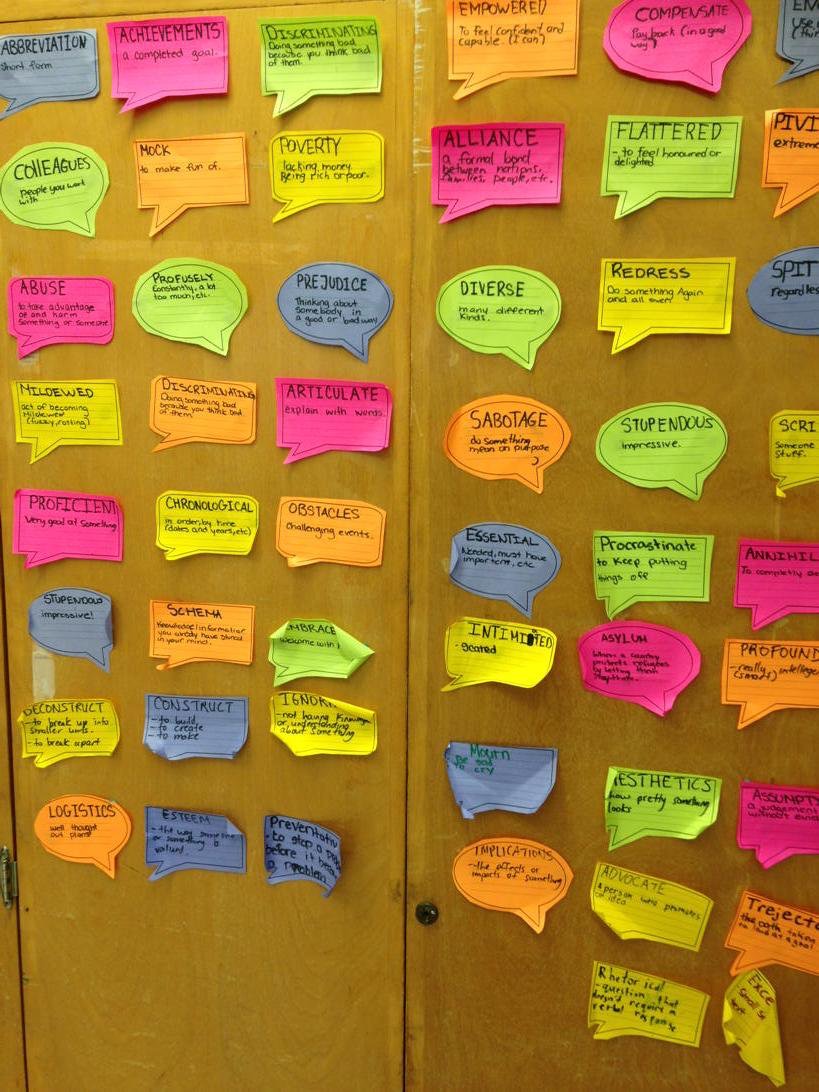
More than mere vocabulary boosters, words of the day or word studies, when introduced in meaningful contexts, can not only enrich student vocabularies, but can also give volume to their voices as thinkers, activists and world changers. My journey toward empowering learners with the language of power began in my first year of teaching. It was a grade two class and I was terrified. I had no idea what to do or how to go about it. It seemed like all the learning from my formal teacher education went out the door as soon as the students walked in. I realized I was in trouble when I would speak to my students only to receive blank stares. What I wrestled with was whether or not to make what I was saying more child-friendly or to simply bring the children up to speed and create many teachable moments with the words that I used. The result was the latter and we began an anchor chart entitled “Ms. Nelson’s Fancy-Schmancy Words” where when students stopped me mid-sentence to seek understanding of a specific word I used and it would be added to the list along with its definition and the sentence in which it was used. Now, 7 years later, the anchor charts have evolved into a word wall in which students are constantly identifying not only new words that I used but also introducing ones of their own and adding words they find in the literature they read or listened to on a daily basis. The love for words became contagious and the thirst for learning new ones was intrinsic.

Students were then invited to use words, or the language of power, as tools in exerting voice to an authentic audience. Students were empowered by words when they interviewed all 5 Mayoral Candidates in the 2015 Mayoral Election. Students wrote speeches and presented them as great orators in front of invited community members that included the local crossing guard, a church pastor and family and friends. Students raised awareness by writing blogs about the impact of their social identities and shared these sentiments with the school community. Their words spoke to issues of social justice and coloured the imagination with distinct imagery, was a power to be wielded in the pens and voices of elementary school students.

IMG_0600

Word wall from my Grade 5/6 class: sabotage, aesthetics, logistics, schema, implications profound, trajectory, embrace, chronological, deconstruct, procrastinate, intimidated


Is Math Neutral?

The notion of neutrality speaks to the experience of being impartial or unbiased. It speaks to the absence of asserting value, power or privilege over another or the act of being impartial, unprejudiced and nonpartisan in nature. There are many areas of teaching and learning where the existence of prevailing politics is named and sometimes challenged: Whose stories do we include in the social studies/history curricula? What literature is considered to be the cannon? What art forms are considered cultured? But when educators think about the tapestry of math education, this notion of it being neutral tends to be widely agreed upon because of the perceived objectivity and absolutism that characterizes the ideas that are explored. But I wonder…is math really neutral?

“Math is about numbers. Surely it is neutral.”
This year, in supporting English Language Learners in math, I have learned many new Mandarin and Cantonese words from my students. More specifically, I’ve learned the inherent ways that Chinese characters are written to nurture a conceptual understanding of quantity. For example, the number eleven is written 十一 which means “ten-one” or can be understood as “ten plus one”. Similarly, the number twenty is written 二十 which could be understood as “two tens” or “two times ten”. Finally, the number thirty-three is written 三十三 Which could be understood as “three ten and three” or “three times ten plus three”. The fact that the word for the number eleven, when represented in English, has no relationship to the the concept of quantity speaks to the way numbers are represented are not neutral. This discrepancy in language representation speaks to the biased nature numbers are conceptualized through language. Thus proving an inherent bias in the ways in which numbers are conceptualized and number sense is acquired. Similarly, the bias toward English representation of numbers can limit the conceptual understanding of languages that represent numbers in a more conceptually friendly way.

“Math is about problem solving. Every has the capacity to solve problems.”
Consider the following problem: Brandon travels to the city using the subway. Each car seats 30 travelers. How many people might be on the subway if there are 10 cars? What background knowledge might students need to have in order to understand the context yet a alone respond the the problem mathematically? While the problems we pose to our learners may involve numbers that can be calculated and manipulated in flexible ways, the context, when coming from particular experiences, can deny access to the learning that needs to be achieved. In other words, if the context from which we invite students to explore math concepts can be carefully crafted in order for our learners to be able to relate to the ideas, they can also be unintentionally crafted in ways that could limit students access. In this way, contexts are never neutral because they come from a particular place of knowing or experiences that not all students have access to.

So there you have it. I’ve explored two very simple ways bias is experienced in math discourse. The presence of even one form of bias discredits the neutrality of math. If math, a lens for viewing the worlds through numbers, shapes and patterns, can be ladened with bias and politics, what else about the schooling experience share this similar trait?

Tech Talk

I would like to share a new initiative my class is starting at our school Ancaster Meadow.

Our class realized the large need for technology in the classroom. We noticed that students are sometimes unfamiliar with apps that are available for completing work and for presenting learning. We are starting a new program called “Tech Talk” where as a class we travel to classrooms and instead of “Reading Buddies” we will assist the class one on one with apps of the teacher’s choice. We came up with a benchmark of five:

  1. Explain Everything
  2. Kahoot
  3. Weebly
  4. Pic Collage
  5. Prezi

These apps will be explored in detail by my class so when we visit our first class after the break, the break off sessions will be smooth and very productive. We will offer this program to grades two-five and speak to teachers before regarding sign up. Students will be able to explore the apps, prepare a small task and then share it with the whole class. The sessions will be fifty minutes long as that is how long a period is in our school. We hope that students will learn from each other and that everyone will be able to use these apps in the new future. I hope it will be a meaningful experience for my class to teach younger students skills that they already have. I cannot wait for our first trial after the break. I encourage everyone to try this  “Tech Buddies” program and share your experiences as well.

The Heart of Teaching – Teaching with Your Heart

I have always known that I wanted to be a teacher. I’m not exactly sure when to pinpoint the start of my journey, but from as young as five years old, I knew that teaching was my calling. Throughout my educational career I had some amazing teachers who provided me with invigorating learning experiences that were creative, challenging and fun. I also encountered “the other guys”. Needless to say, I’m sure my experiences aren’t unique to those who have encountered a public education in Ontario over the past thirty years. Although I can bashfully say that I don’t remember most of what I learned from my ten years of elementary school, even as an enthusiastic and engaged learner, the two resounding life lessons that I continue to embrace are: to never settle for mediocrity and to always go beyond the call of duty. Thanks to my grade 7 and 8 teachers, I continue to strive to apply these key learnings in my life.

As I reflect on my key learnings, I wonder what key learnings I might share with my students. The experience of school in the 21st century is so much different than being a student in the 80s and 90s. The over emphasis on consumerism, the pervasiveness of social inequities and the advancements of technology which birthed the unvaulted access to information definitely add layers to make the schooling experience even more dynamic than when I was a child. How did my teachers prepare me for my future? How might I prepare students for theirs? These are essential questions I continue to grapple with and is the essence of what the heart of teaching is for me.

I believe that at the heart of teaching is the desire to help students be the best version of themselves so that they can be contributing members of society. This may seem like a long-term goal but really, at its core is my desire to prepare students to be their best self now, in order to continue to be their best self in the future. Teaching the curriculum definitely addresses many of the content that students need to know in order to achieve success in their future academic and social experiences. But what might be absent from the curriculum that proves to be essential life lessons that students might benefit from having guidance over? Throughout the past 7 years I have come to realize that more than the curriculum, there are essential life lessons students need to be exposed to. Supporting students as people first and learners second is how we can help them navigate some of the challenges they face in their day to day experiences of schooling. It is not just about the curriculum. We need to reach both the student’s heart and their mind.

Everyday I am constantly wondering about how my students are navigating the world while I address curriculum expectations. These are the reflective questions that arise from my interactions with them:

  • How might we support my students in seeing themselves as capable?
  • How might we support my students to be motivated from within themselves and not based on grades or the need for validation?
  • How might we encourage my students to take risks and try new things when realistically when we evaluate their understanding of curriculum and the consequences of risk taking may not garnish the reward they desired?
  • How might we teach the value of perseverance and that dedication to a task may cause improvement and denounce the rhetoric that practice make perfect.
  • How might we support my students in navigating the social hierarchies in school knowing that creating a respectful learning environment does not guarantee the kind of friend relationships that students are looking for from their peers?
  • How might we support my students in navigating a competitive world while yet embracing the benchmark of their own personal best?
  • How might we support my students in navigating the reality that particular aspects of their social identities (race, accents, culture, etc.) will grant them access into some opportunities but also bar them from others simply because of the ways societal systems are structured and not necessarily based on personal attacks?
  • How might we nurture confidence in our students?
  • How might we make students accountable for their choices?
  • How might we support students in embracing self-love in a society that values constant validation from others?
  • How might we support to identify their emotions beyond happy, mad and sad and how to effectively navigate them?

Like many of the questions that I pose, I don’t always have the answers. As I continue to reflect deeply, I can only hope that my pedagogical choices can address some of these concerns. As I teach to the minds of my students, what I hope for is to reach their hearts. Teaching from my heart, I pull back the curtains of curriculum and instruction and see the person and not just the learner. This unveils the weight of the task set before me.

Occasional Teachers As Partners

In my classroom an Occasional Teacher is referred to as a Guest Teacher for many reasons. The most important being that the person who arrives that day is first and foremost a teacher. That individual is a qualified teacher who is there to help students continue on their daily academic journey. They are not there to keep students busy nor are they there to just supervise for the day.

It is very important that in my plans I both value and allow that incoming expertise to be shared with my students. Of course I have developed plans that will be a continuation of what is going on in my classroom but have left instructions that are open ended and allow the guest teacher to be able to adjust them based on the needs of the students they are working with as well as the expertise and experience they bring into our classroom. In that way, my students are able to enjoy and share the uniqueness of each teacher they work with.

My experience has taught me that one of the worst things I can do is to set up the guest teacher for failure or classroom management problems by assigning work that is not relevant or connected to the day-to-day academics that are occurring in that room. My students need to know that each and every task they are working on is important to their overall growth and academic success.

I truly enjoy the day after a Guest Teacher has been in my room and the students remember their name, tell me something personal they learned about that individual and are eager to share the work they completed. That type of response provides very valuable feedback about how well my students are transferring the classroom agreement to all individuals they come into contact with.

 I want to tell Occasional Teachers how important your role is and how much I appreciate the time and effort you put into my students. Thank you for everything you do as partners to contract teachers.

Mental health in the hallowed halls.

Here’s a snippet from casual conversations playing out in school hallways everywhere.
Pick the lines you’ve heard or have used before.

https://www.flickr.com/photos/wfiupublicradio/5601192190 https://creativecommons.org/licenses/by-nc/2.0/
Photo Credit:
WFIU Public Radio

“How are you? How’s it going? What’s up? How’s it?”

“Good. Great. All good here. Meh. No worries. Busy. So busy. Cool. Not too bad. OK. Could be worse.”

What would you do if someone answered honestly saying; “Not good. I’m being bullied by a group of students. I don’t like my body. My parents are divorcing. No one likes me. I feel alone and sad all of the time”? Would you pull out the motivational clichés and tell the person to toughen up? Would you walk away saying, “hope you’re OK?” and “things will be better with time” or would you inquire further? Would you feel comfortable finding out the truth? Do you have enough emotional energy in the tank to make a difference?

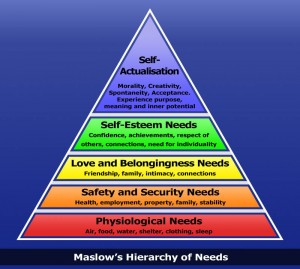
Regardless of years of experience, many new teachers feel uncomfortable, even under-equipped when facing mental health issues in the classroom After all, we’ve been taught pedagogy, not psychology, in teacher’s college. That’s not completely true. We did learn about Maszlow’s Hierarchy of Needs, but that was so long ago, it was only a small series of lessons/readings, and  besides we have lessons to deliver.

In this post I want to share a side of education that Maslowdoes not get enough attention. I’m talking about mental health in schools.
Understanding and supporting students with mental health issues is as important in our classrooms as the curriculum we are instructing.

What keeps educators awake at night are the the same daily problems being encountered in classrooms around the world. I am a witness to how mental health issues are scarring education. There is a recurring generational amnesia in the hallways of educational institutions and it’s time we do more about it.

That may not seem like a light and lively subject for conversation, but discussion in all of these areas is crucial as it pertains to making our classrooms safe and inclusive learning spaces. How are you dealing with issues like this in your classroom? Here are a few ideas that have helped in my learning space.

In my classroom we have worked hard to develop a safe space for all learners. This means that we all try to support each other when times get tough. We try to use the idea of Ohana (family) where no one is alone or forgotten. We have instituted Mindfulness Moments as brain breaks. Students need time to consolidate their learning, and to be still/quiet for a few minutes. This little break in the action calms the mind, reduces anxiety and teaches students a valuable de-stressing skill.

In my classroom, there is always a little something to eat. It is amazing how a granola bar, a juice box, and some crackers can help a student who has not had enough to eat to start the day. During tests, quizzes or quests, as we call them, we have “test crackers”.  They’re tasty, crunchy, and important to helping students relax during assessment tasks. I have found that when a student has something to eat, albeit very small, they are more relaxed and perform better.*

In a follow up post I share some thoughts about mental health issues as they relate directly to educators. You’d be surprised how similar they are to those our students face. Or maybe not?

I need a granola bar.

* Maybe I’ve found a thesis to test for my M Ed?

My O.B.I.T (open biographical info time)

I ‘ve always wondered about the biography portion of blog sites. Do people read them?
If they do read that section, does it connect or disconnect them more to the writer?
Do the writers keep them updated? After all, it’s a two way street.

What happens when the blogger writes something disagreeable? Do readers continue subscribing to see what comes out next or is as Eminem says, “you only get one shot”?IMG_2116

What if the text is too vanilla? Oh? People like vanilla, but why read at all if it was the only flavour? And now it’s my turn to churn.

How many take time to reply in lieu of muttering to themselves or the closest ear?

So in the interest of transparency, glasnost, and nothing to hide here’s a bit about me.

My name is Will, I have been bullied and been a bully. I have failed in every possible way as a student and according to North American standards of success. I have also succeeded in a world that is overcrowded with enmity, ennui, and expectations to maintain the status quo.

Teaching is my 6th career. Restaurants, real estate, radio, writing and retail were its predecessors. Even though each job was different, they all contributed to a bigger understanding of life and in shaping my world view. Human interaction, failure, and resilience (stubbornness) have contributed also.

I did not start this chapter of life until my 40s. In a way it’s like Plutarch (a convenient hero), who in his 40s went to school, and then became the teacher of the emperor of Rome. Although, I have yet to teach an emperor, many noble minds have graced my classroom in my first 6 years. Along the way I found a series of opportunities and passions revealing themselves and opening my life up great things in and out of the classroom.

I am passionate about infusing social issues into every element of my classroom. My goal in the classroom is not to cram the crown onto the heads of my students, but to hold it above for them to rise to it. I love sharing TED Ed with teachers and students every chance I get. Through these posts I will be able to provide glimpses into the spaces where I teach and in between. Look for pieces about mental health, social justice, genius hour, success and failure as they relate to the teaching profession, our practice and those we are privileged to teach.

Will

ps My next post about Re-Org is almost ready to share.

Photo of Samantha Perrin

“Reconciliation through Education”

It would have been hard to miss the news coverage of the closing days of the Truth and Reconciliation Commission last week. With the tabling of the Report, any doubt, misinformation or ignorance has been addressed regarding the cruel treatment that Aboriginal children were forced to endure for over 100 years of Canada’s 148 years as a nation. What was also made abundantly clear is that this history was not taught in Canadian schools in the past, and at present is still not expected to be taught by all teachers all across the country. Last week, many Canadians heard for the first time in detail the horrors that over 150,000 children experienced while attending residential schools across Canada between 1840 and 1996. Throughout the 360 pages of the Truth and Reconciliation Commission’s Report, the accounts of 7,000 Survivors document the hunger, sickness, physical and sexual abuse, torture, humiliation and fear perpetrated by their educators and guardians in these schools. And if there was ever any doubt about the severity of the effects of the residential school system on Aboriginal children and families, this legacy in Canadian history was so calculated and so thorough in its aims that it is now considered a “cultural genocide”.
None the less, a week has passed, and the media has turned to other timely events. Where does that leave us? The talk of reconciliation is becoming distant, along with the concern of the general public. As teachers at this critical time we have the opportunity, responsibility even, to not let reconciliation become just another passing news item. Taking to heart what Manitoba Justice Murray Sinclair said in his closing remarks, there must be “reconciliation through education”. As Chair of the Truth and Reconciliation inquiry into the terrible legacy of Canada’s Indian Residential School System, Justice Sinclair urged educators to close the gap in our understanding about this shared history and walk with the Survivors and their families towards reconciliation. There is no better time than the present. Regardless of the fact that curricula across the country will take time to change, there are many ways that teachers can start the learning right now: beginning in the primary grades, by reading and discussing books like; Shi Shi Etko, Shin Chi’s Canoe, When I was Eight, Not my Girl, Arctic Stories, to name a few, or, following the lead of the First Nations Child and Family Caring Society’s initiative, by planting a Heart Garden at your school to commemorate the children lost and those who survived.
Now that it is over, it is not enough to simply have acknowledged the testimony of the Survivors and the work of the Truth and Reconciliation Commission, and we cannot honour the lives of the generations of Aboriginal children and families who were affected by the residential school system if we wait for other teachers to teach this history. It is our responsibility as educators to open the dialogue now and to learn and grow in this new chapter of reconciliation between settler and Indigenous peoples. Indeed, Ontario Premier Kathleen Wynne has admitted that “for reconciliation to succeed, we must also renew our commitment to educating Ontarians on the role that treaties and the residential school legacy play in Canada’s past, present and future.” So, although many teachers in the past may have faced scrutiny or a lack of support from colleagues and administration as they endeavoured to teach the truth about the Aboriginal residential school system in Canada, we can now consider Premier Wynne’s statement and Justice Sinclair’s words of ‘reconciliation through education’ as a rallying call to all educators to do what is right not just once, but every year we teach.

Photo of Mike Beetham

You Did It

To quote my favourite author Dr. Seuss, “Unless someone like you cares a whole awful lot, nothing is going to get better. It’s not.” As the year is rapidly coming to a close it is so easy to reflect on what you did not get accomplished, how you wish you had more time, if only …. The reality is that for the last ten months you have given everything that you have to a group of students, their families and your school community. You have sacrificed your personal health at times, your family time and your passions in order to provide each and every individual under your care the best opportunity to learn and evolve as best they can.

It is now time to allow yourself to take a deep breath, look in the closest mirror and smile as you celebrate the relentless commitment you have put forth in your role. It is not easy for teachers to do this as we are by nature perfectionists that do not seek out the limelight. As the summer break quickly approaches it is important that you take the time that you need to bring that balance back into your life (family, friends, passions) so that in a very short two months from now, you are prepared to do it all again!