Blog

Hiring Uncertainty

I’ve been employed as an Occasional Teacher for just over three years now. I spent some time doing daily supply work and I’ve been very fortunate to have worked in full-time Long Term Occasional positions for nearly the whole time since. My last few LTO positions have been full-time, full-year, so I haven’t really been feeling like an Occasional Teacher, until the end of the year comes and I’m loading up my car, once again. I’m very happy doing what I do. Whether I’m with my class permanently or as an LTO teacher, it doesn’t change my day-to-day life and it certainly doesn’t change how much I care about my work.

But that doesn’t mean I’m not waiting patiently, and excitedly, for a permanent position.

If you’re like me, you’ve been paying close attention to the movement in your board, checking job postings daily, closely monitoring your place on that seniority list, and trying to determine your chances at having enough seniority in an applicant pool to finally get that permanent interview call. By my speculation, I was quite hopeful that this coming school year would finally be my year to gain permanent status.

Recent changes to our education funding have caused up quite a stir about hiring and the potential loss of teaching jobs. I can’t imagine how newly hired permanent teachers or those in positions at risk must be feeling. After all, they were right where I am not long ago.

My fellow Occasional Teachers are worried, too. Could my hoped-for permanent position be delayed by a year, two, or three as a result of the inevitable surplus? Many boards are hoping to absorb job losses through retirements, but it’s easy to see that next year’s hiring just won’t be what it has been over the past few years. It won’t be what I think many of us were expecting, meaning many people in the same boat as I am are probably feeling pretty discouraged right now.

What I want to say is hang in there. Remember that every day you spend in a classroom, whether you’re there for one day as an Occasional Teacher, or a year as an LTO, you are making a difference. You are teaching, inspiring and doing what you are meant to be doing. The road to permanent employment may have just become seemingly longer and harder to navigate, but it certainly doesn’t change the fact that one day, you won’t have to load up your car at the end of the year. One day, you’ll get to stay permanently in your happy place. Don’t give up on that.

It hurts my heart and my head to see colleagues and friends considering alternate employment, purely out of the necessity to provide for their families. I’m talking about people who have poured their heart and soul into becoming a teacher – people who belong in the classroom. Beginning teachers are some of the most driven, excited and passionate people I know. We’ve got so much to offer to our kids.

It certainly is an interesting time in education right now. To all my colleagues out there who are concerned about their jobs or their ability to find work over the next while – I see you. Hang in there and don’t let our circumstance overcome your drive and passion. Good teachers belong in classrooms, and you’ll get there eventually!
Attending ISRC (In-School Review Committee)

Most of us will attend an ISRC (In-School Review Committee) at some point during our career. Usually, it is for students that we have concerns about in a variety of areas including behaviour, academic success, emotional well being etc… In my experience, the ISRC will include an administrator, a Special Education teacher and a variety of other professionals from outside your school. The goal of the ISRC is to review and monitor students’ needs.

Like many other things in teaching, no one really sits you down and explains how to get the best out of your trip to the ISRC. I wish someone had told me how to prepare and what to ask for so that my students could get the best services possible.  After one year in a special education role, I have learned many things that I didn’t know before and I can share with you how I now prepare for an ISRC.

Before I go, I answer the following questions:

What is the problem? Is the student struggling academically, is attendance an issue, have they gone through some kind of trauma, is there severe behaviour, are they going through difficult financial times etc. Before you go before the panel have the issue that you are trying to address very clear in your mind. Basically, what is in the way of this student being an academically successful contributing member of the classroom? If it is multiple things, pick one to start.

Have I done my homework? Get out the OSR for this student to see if this student has ever had any kind of supports before. Referrals, signed consent forms and reports of service should all be in the OSR for you to review. A good team at the ISRC table will ask about previous supports for the student.

Do I have evidence to support my student’s need? Evidence will help you answer any questions that the panel may have for you. Evidence may include attendance records, assignments, report cards or behaviour tracking sheets. Basically, anything to demonstrate your student’s need.

Have I called the parents to communicate my concerns? Before you step foot in ISRC you should communicate your concerns with parents and explain that you will be going to discuss their child at an In School meeting.

What services does the student need? Before I started my current job, I literally had no idea what supports were even available to ask for. This is the mistake that I made many times early in my career. I went to ISRC not to ask for services but to highlight a student I was worried about. No one told me that going to talk about a student I was worried about was sometimes not a useful exercise.  I wish I could go back in time and request social work for my student who was always absent and Speech for my student who was struggling with his articulation.

Nobody told me that you could ask for:

  1. Speech and Language Therapy. Can address concerns about articulation, assistive technology, programming and communication needs.
  2. Occupational Therapy. Can address concerns about fine motor, gross motor, sensory needs and daily life tasks such as toileting, putting on clothing, holding a pencil and tying shoes.
  3. Physical Therapy. Can address concerns about physical mobility and safety around the school and in the classroom.
  4. Social Work. Can address concerns about family trauma, attendance and mental health. They can also provide support in making connections with community support.
  5. Phycologist. Can perform Physcoeducational assessments and support on the writing of a safety plan
  6. Behaviour Team. Can observe, plan and consult on behaviour at school and at home and help with behaviour that is interfering with academic success.

Obviously, there is usually a long, long wait list for many of the services and the services are often given to students that are most in need first. However, if you never ask, the student will never receive the help you are looking for.

One final thought

If the student is struggling academically, you can go to ISRC to get input on teaching strategies from the panel. However, please keep in mind that out of all of the people in the room you are the only one that has taught the student. It can be very frustrating listening to a group of people suggest strategies that you know will not work because of your experience with the student. It makes more sense to invite a colleague or a teacher in the school with special education experience to come in to your class and to co-teach a lesson and discuss strategies. After you have tried a few strategies and have some data to demonstrate the effectiveness of those strategies a trip to ISRC could be the next step and the experts in the room will be able to provide more effective feedback.


Thanks for all that you do every day to support your amazing students at your school!


Be Strong in the Face of Poor Government

FDK (too soon)

EQAO (to help real estate $)

Class sizes (to build resilience)

Drill and Kill Math (We’re Open for Worksheets)

Funding formulas (creative govt accounting to underfund boards)

Antiquated HPE curriculum (since no one needs to learn about consent)

Don’t let them fool you.

Despite what the government says to the contrary: public consultation involves asking many more people than a few plum political campaign contributors. The world is not flat, and Ontario has one of the best education systems in the world.

Be strong. We serve over 2 000 000 future voters, taxpayers, and consumers who will be impacted by the short sighted and overt actions of the current government to undermine our profession. Why would anyone want to risk losing 2 000 000 votes to curry favour with businesses who prefer to pad their bottom lines rather than pay their share of taxes. It’s time we start to boycott the companies that lobby our governments for an even slimmer share of their tax obligations while holding jobs over everyone’s heads. It’s time to unite.

Be strong. The work you do has meaning. Yours may be the only kind words and smiles that a child receives each day. That snack you pay for and provide means more to that child than you could ever know. The time you invested in coaching students(teams, academics, life) long before and after the day is done continues to impact their lives long beyond the years in school. You are equipping students to do great things in their own lives and the lives of others.

Be strong. The time you spend learning, creating, and collaborating with colleagues matters. None of us is a strong or as smart as all of us when we work and stand together. Stand together, support each other when times are tough and the government tries to undermine our confidence and that of the public in us with misinformation.

Be strong. You matter. Education matters. Our students matter. We matter. And because we do, it’s time to work, even more closely together, to support one another for the collective good, not the corporate coffer.

Be strong. screenshot-www.etfo.ca-2019.03.31-21-50-18screenshot-www.etfo.ca-2019.03.31-21-50-37

Before you get hurt…again.

https://pixabay.com/photos/concrete-space-empty-3161863/

Student: (momentarily non-responsive to verbal interaction) slap, push, slap, hair grab, lunge, slap, yell, cry, run, crouch, cry, calm, apolgize

Staff: (1 CYW, 2 SERT) block, block, reassure, block, supportive stance, reassure, block, redirect, clear space, block, reassure, follow, remain calm, reassure, accept

The slaps(verbal/physical) are like slabs of concrete that a student piles up when they are in distress(feeling helpless, unheard, confused, frustrated, angry, trapped, hurt, and _________).

Our students are using these slabs to construct walls which will insulate and protect them from what they feel are are real threats to their wellbeing, happiness, and safety. All the while, staff are working tirelessly to keep them from walling off completely to the point of hurting themselves or others because the ability for flight has left, and the fight is on…again.

It has been happening a lot more frequently in our classrooms and it knows no age limit as educators are experiencing violence from JK to 12. Has it happened to you? How about to someone in your school?

A 2016/17 survey of elementary teachers showed that 70% of them had experienced or witnessed violence in their schools. That distills down to an average of 7 in 10 educators are on the frontlines of a serious problem. No one wants to work where threats and acts of violence are now daily bi-products of their job? Yet, that’s what many teachers are facing as they enter the classroom each day. Even with NVCI, CPI, SERT, CYW, EA, IBT, BHS, and Social Work support in the building or available from regional teams, incidents are increasing in number and intensity.

Students are taking out their frustration, anger, and anxiety in physical ways directed towards school staff. More than ever, it is being documented and reported more across all age panels. So what’s happening inside our schools where once seemingly uncommon incidents are now daily occurences? All of this cannot simply be dismissed as statistical anomalies.

A reminder

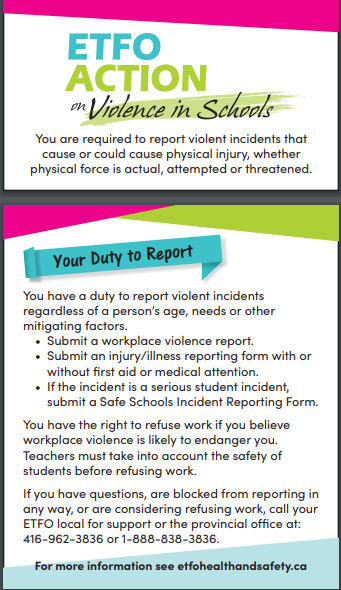
Before you get hurt, or hurt again. Each time a student slaps, bites, kicks, target throws, pushes, strikes with an object etc. a report must be made. If you are injured, seek medical help first. Make sure you tell someone (union rep, admin, a colleague). See the graphic below to make sure you are protected as you have the right to refuse work when you believe workplace violence is likely to endanger you. If you are hurt, it is not the time to play through pain or put on a hero cape. It is your health and well being that must be protected. No one should go to work expecting to be hurt on the job. If you need help, call your union rep or a colleague. Let your voice be heard.

http://etfohealthandsafety.ca/

Our schools cannot be left under-supported with an expectation to educate our students in the face of increasing violence and increasingly complex behavioural needs? Our schools need supports in place to ensure safety for all and that includes you.

I will leave you with this final question.

How have spaces of nurture, growth, hope, and community also become places of anxiety, stress, harm, and PTSD for both teachers and students? How are you managing in your school? Please keep the conversation going.


 In case you need some more food for thought

Our notifications, news outlets, and social media feeds are filled with stories, images, and video sharing what’s happening. As I draft this post. CBC News shared a disturbing news story that surfaced online involving a teacher being assaulted by several students in Toronto.

Read more about how ETFO has been lobbying our government to address the issues of violence in our schools.

https://www.thestar.com/yourtoronto/education/2017/01/17/teachers-union-raises-alarm-over-rising-violence-in-schools.html


Update: Inquiry project

An exciting update for my classes upcoming inquiry project, our board has funded the project for us! Students in my class will start to work with the supplied budget to help them start their treat company! This funding will make it possible for the students to make this project the best it can be.

This week they will start planning for the supplies to make the smoothies and their advertising/media project will be made possible due to the funding that will allowed them to order stickers or other items to be introduced with their treats. We are excited to begin researching paper straws and look at why it will be better to purchase the paper straws vs. the plastic ones. We will also continue to look at the best combination of ingredients in order for our smoothies to taste as good as possible!

We will have to look for suppliers for all the products now that we have the funds to buy them. This project is so exciting and I look forward to updating you all on the steps we take.

A group of ten of my students (out of 22) have indicated they would like to be in charge of delegating tasks and headlining the operation. I am so excited for my students to take this project under their wing. It will be great for them to understand that in the future they can all run their own businesses with hard work and sound thinking.

On another exciting note, two of my students applied for a grant for a mental health day at our school with fun activities for students in grade JK-8 to participate in. This will be another fun venture for my students to plan! It is awesome to see so many opportunities available to kids in our board… hopefully the funding will always be there 🙂

It’s About Relationships!

Over my 10-year career as an educator, there have been a number of times of uncertainty in education. These are the times that drive us to reflect on why we became educators: to have an impact. There have been some great posts within this platform with fantastic tips on how to thrive during these times. For this piece, I’m thinking about relationships.

We all know that at the forefront of education is the power that comes from building meaningful relationships, both with our students and colleagues. It’s was fuels the work that we do and empowers us to see the impact that we can have, are having and will have. It’s through relationships that we keep the lines of communication open when parents and students who don’t always know what the impacts may be a school community.

When I think about relationships I think about creating spaces that are:


  • Open to dialogue
  • Safe to try, fail and try again
  • Real


Open to Dialogue

Ever been in a quiet classroom or one where the main voice was that of the teacher? How did it feel? On the other hand, have you ever been in a classroom that was loud and slightly chaotic with meaningful dialogue happening amongst students? How did that feel? I’m sure that both spaces feel very different.

I believe that “the rules” we have in the classroom, set the tone for the way in which our students converse with each other. When students feel free to be able to bring their experiences, thoughts and ideas into the classroom, there’s a sense of freedom that comes from being who you are with people who care. Now, don’t get me wrong, I’ve been in buildings where administrators wondered about the noise happening in my classroom but when they can come in, spoke to students and saw that it was purposeful, some of the questioning dissipated. Many would also drop in for our times when we were connecting on things that were meaningful to students and had an impact both in within the classroom and the world around us.

I believe that classrooms should be spaces for students and educators to have open dialogue about what is being learned within the classroom which should also include real connections to what is happening in the world. These are sometimes courageous conversations that need to be met with students having the opportunity to share their concerns and having a non-judgemental adult being there to help guide with facts and information.  We want students to be asking rich and meaningful questions of each other and understanding that communication is a skill that they can work to develop with each other. That means that they don’t necessarily have to agree with the thoughts and ideas of another but they understand that they have to respect that diversity of thought exists.

Safe Spaces to Try, Fail and Try Again

Growing up, I always felt that at school, I had to be perfect and show what I knew. Failure wasn’t embraced and there was a culture around making sure that what was shared was the right answer for that was most important. The stress that this puts on students when they should be in a space where learning and the progression of skills and knowledge is embraced is unbelievable. As such, I tried to create spaces where students could present themselves as is and we could work towards helping them to improve where needed.

Now I can’t say that this is an easy task but imagine if students felt safe failing and viewed it as an opportunity to get back up and grow. A place where talking about what they believed to be correct and working to identify misconceptions and helping students to consider what other options might be correct. Or better yet, having their peers work towards helping to change misconceptions. What if we offered students the freedom to fail and then the opportunity to try again after providing feedback and clarification for them? This takes work, time and effort but how might the climate in our classrooms change and how might they help to deepen connections made with each other? What outcome could this provide for students in the long term?

Real

People naturally gravitate to those who are real and genuine. Colleagues are genuinely navigating uncomfortable spaces at the moment and it’s important to be able to have at least one critical friend with whom we can share our concerns but who will also empower us to continue with the goal that we know is most important, our students and their success. Have you found a critical friend? One with whom you can be real and know will help to encourage you on those tough days?  

While we are uncertain of what the outcome of the changes in education may be, we do know that through relationships, we can stay true to what we believe to be the most valuable part of our role: having an impact in education.

It’s Spring! Let’s Talk About the Environment!

  It’s spring! As a classroom teacher, who taught grade 4 for a number of years, it was always my favourite time to teach our unit on habitats and communities. As nature comes back to life after a long winter of hibernation, I’ve always found it to be the best time to be outdoors, observing changes that are happening and having the opportunity to wonder. For this post, I’m writing about the great opportunity that we have as educators to teach about the environment and climate change.

With Earth Hour upon us and Earth Day coming up, there’s so much already being said about our environment and the classroom is a great way to have students consider their role in being great stewards of the earth. In my quest to find resources to share – and there are numerous – I happened upon some great resources on the ETFO website.  I’ve taken some time to dig into 3 that I liked and would absolutely use in my classroom.

World Water Day 2019

Screenshot 2019-03-31 at 5.18.14 PMMarch 22nd, 2019 was World Water Day. The theme for this year was Leaving no one behind which speaks directly to the UN’s Sustainable Goal #6 – Water for all by 2030. The goal was for everyone to be thinking about tackling the water crisis and considering reasons why so many people – mainly marginalized groups – are being left behind.  There I found a link to a great fact sheet that I think would be a great tool to get the conversation going in many classrooms. Used as an informative texts, groups of students could engage in finding out some of the reasons why equitable access to water is something that we all need to be fighting for. With calls to action at the end of the fact sheet, I could see students engaging in activities to bring awareness and even thinking about potential solutions to problems in their local, national and global communities. With print resources and short videos, there are so many different ways in which we can help students understand the disparity that exists and create our own calls to action as we think about our impact.

Green 2 Go Project

Screenshot 2019-03-31 at 5.18.46 PMThis project reminds me of a great investigation that the students in Barbara Robson’s Class. A truly inspiring educator who worked with her students around issues of environmental concern, particularly in the area of recycling.

This project, The collaborative Green 2 Go Project, aims to assist Vancouver in its goal of reducing landfill-bound solid waste by working with city restaurants and the public in dialogue and support in reducing take-out container waste. With engaging infographics created to share powerful research, I can see great connections that can be made in both Math, Science and Language. While the information speaks to what’s happening in Vancouver, it might be nice for students to be able to use some of these ideas to see what’s happening right here in different communities in Ontario. The information on this site has changed some of my views on dining in locations where containers with black plastics are used, I wonder how this information, in the hands of our students, might bring about even more change.

Earth Hour Kit

Screenshot 2019-03-31 at 5.18.24 PMEarth Hour is an international event usually held on the last Saturday of March between 8:30-9:30pm. During this hour, citizens around the world turn off their lights in support of addressing climate change. Schools typically participate on the Friday prior to the official Earth Hour by turning off all non-essential electricity for one hour during the school day. Yesterday was Earth Hour and it’s always so much fun seeing great tweets about how people are working to do their part for the environment. It’s also fantastic to see big cities all around the world, turning off the lights on prominent buildings, showing that their citizens aren’t alone in the fight but that government also has a role to play.  
This Earth Hour Kit has great ideas for activities both in the classroom and school-wide. I like that there are a variety of grades represented in the lessons and it appears as though some have been written by or adapted from the work of educators. I also really like some of the ideas laid out in the letter to parents.

These are just 3 great resources available as you consider working with students around themes of environmental importance. What will you try?

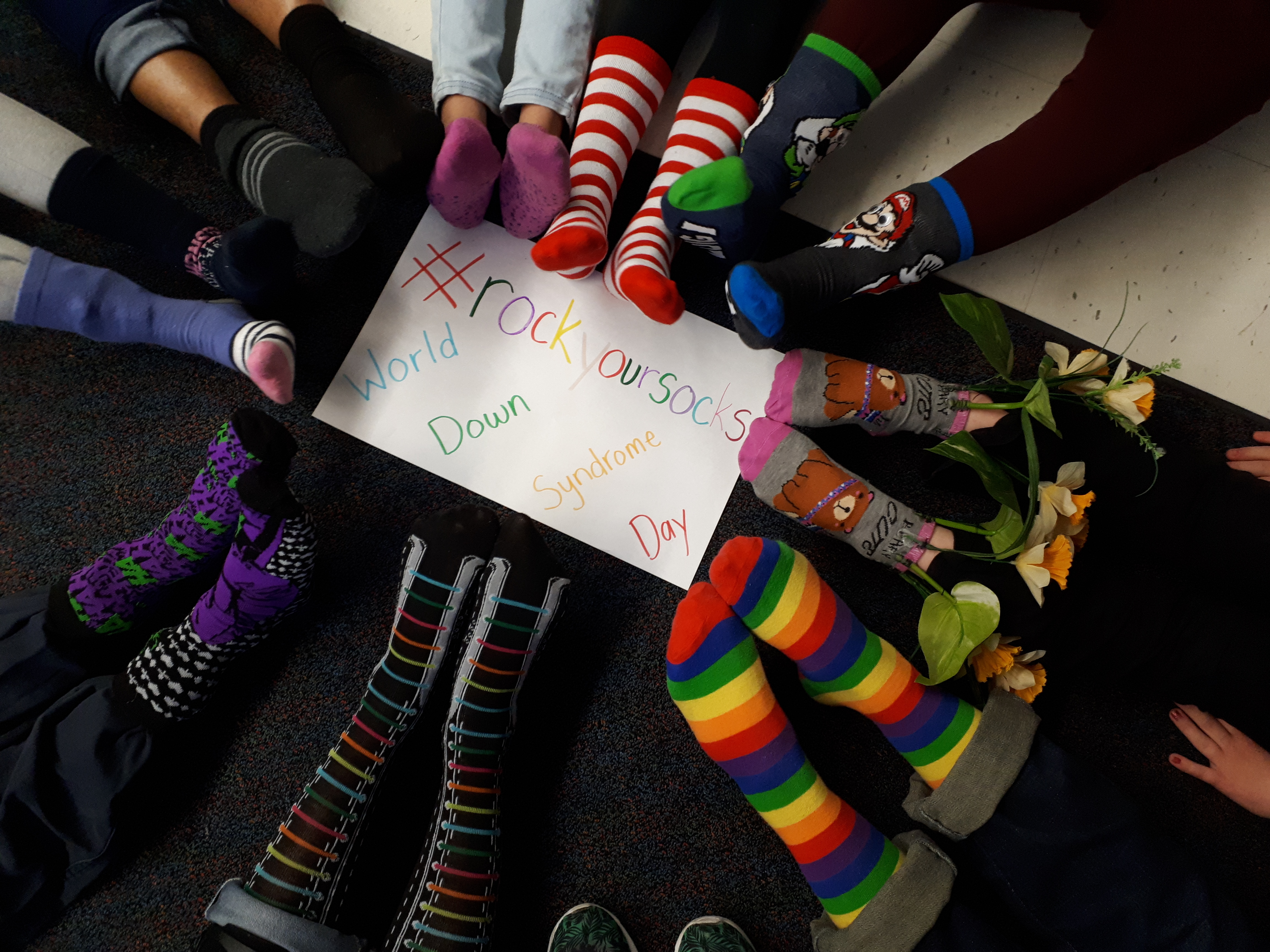
A poster for "Rock Your Socks" World Down Syndrome Day.

World Down Syndrome Day

On March 21st, our class celebrated World Down Syndrome Day.  World Down Syndrome Day is designed to recognize and celebrate the contributions of people with Down Syndrome. It is also a day to highlight the rights, inclusion and well being of those with Down Syndrome.

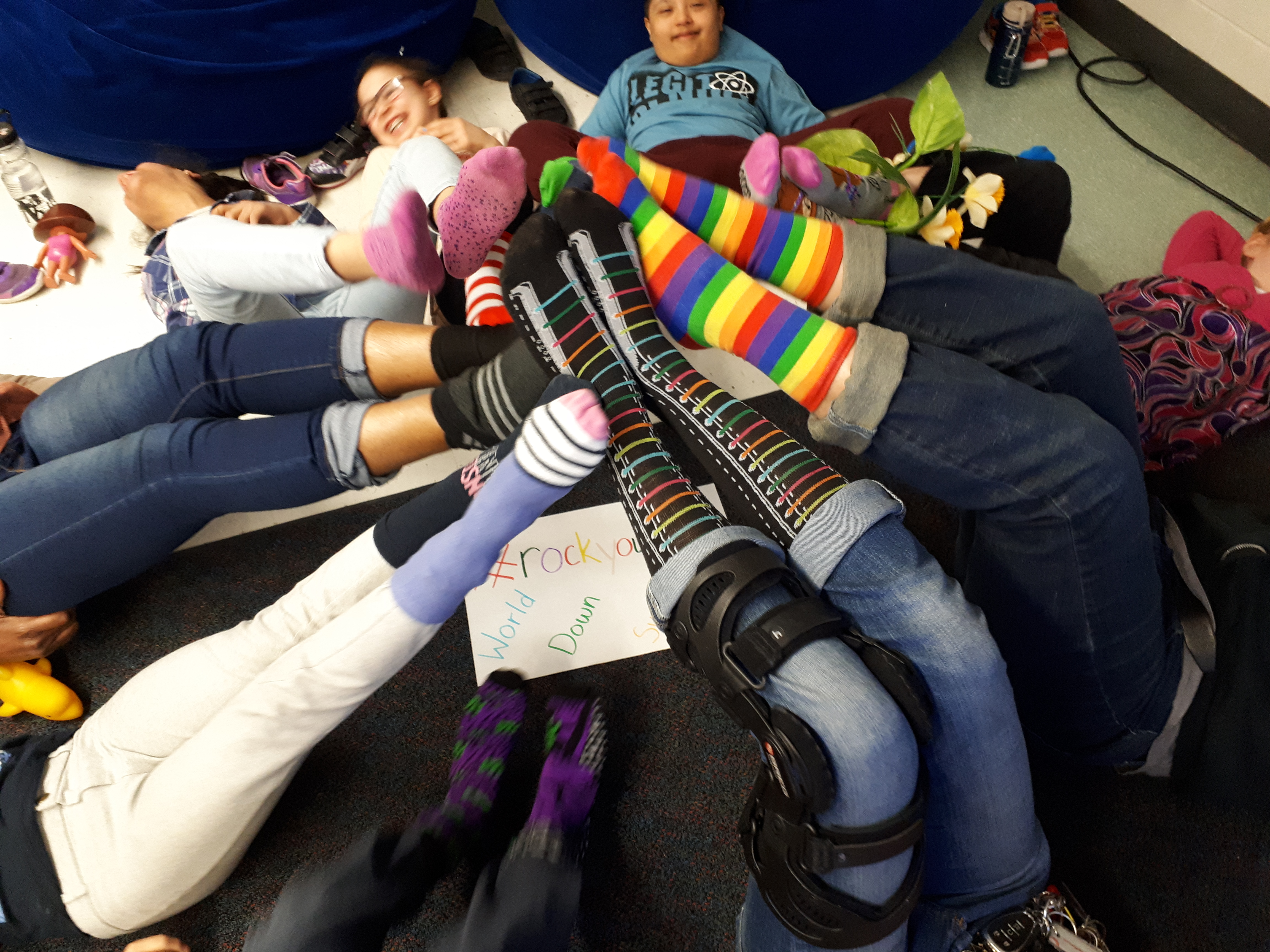
It is common for many schools and places around the world to demonstrate their acknowledgement of the day by wearing unusual or mismatched socks. This simple act encourages all of us to celebrate uniqueness and diversity.

For us, preparing to wear our special socks was a great way to start the conversation about this fantastic day.We sang the song “Lots of Socks” every morning throughout the month of March and spoke daily about Down Syndrome.

On the 21st of March, we had a celebration in the morning where we all shared what was special about each of us. We spoke about Down Syndrome and all the amazing people in the world with Down Syndrome. And of course, we showed off our socks!

socks2

In addition to our class celebration, I thought I would share some of the things that I have learned this year.

I am very fortunate that I teach 5 students with Down Syndrome. It has been my first-time teaching students with Down Syndrome so I had a lot of misconceptions going into the role and I have learned a lot!

The first thing I learned fairly early in the year was the correct way to speak about someone with Down Syndrome.  In the past, I had the misconception that a person with Down Syndrome may be referred to as someone with Down’s. That plural form is incorrect. John Langdon Down was the person who classified the Syndrome but he did not have it and therefore, it is not possessive. The only proper way to speak about someone is to put the person first (as you would with any exceptionality) and follow it with either Down Syndrome or D.S.

Eg. Student with Down Syndrome or Student with D.S.

I also had the misconception that people with Down Syndrome are always happy. I can confirm for all of you with out a doubt that my students demonstrate a variety of emotions regularly. My 3 students who have just hit puberty, go through about 25 emotions an hour as many of you have experienced with your students who are adolescences. Whew!

However, my students do smile a lot and that sometimes prompts many of the adults at my school to speak about how “sweet” or “cute” my students are. Sometimes I have to gently remind the staff that my students are not young children and that they need to be spoken about the same way you would speak about other 11 and 12-year-old students. They need high expectations for behaviour and communication.

Finally, as I started reading articles about people in the Down Syndrome Community, I was surprised how many times they were referred to as being afflicted with Down Syndrome. Just this week I read an article that spoke about people being victims of Down Syndrome. I assure you that my students are not victims. They are some of the coolest, most interesting, charismatic, smart, caring students I have ever taught.

Happy World Down Syndrome Day!!


Teaching in Uncertain Times

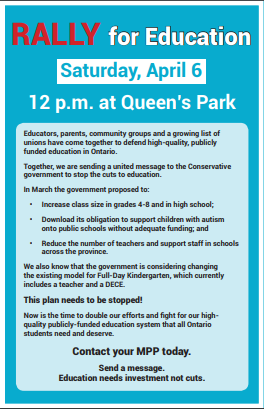
When I graduated teacher’s college it was the beginning of the “Harris years”.  Teachers were being declared redundant all over Ontario. I spent three years teaching outside of the province.  Since then I have been through many rounds of collective bargaining-both as a teacher and a local ETFO leader.  I have seen how Ontario’s Provincial governments have continually eroded our collective bargaining rights, stripped our benefits and made working and learning conditions steadily worse for teachers and students.  As you well know, they’re at it again. I’ve been asked, what can new teachers do to make a stand for education while still keeping a focus on our classroom in these uncertain times?

1. Take care of yourself  Anxiety abounds in times of uncertainty and scarcity.  Focus on the present moment as much as possible.  Make sure you have the facts you need but try to stay out of the swirling vortex of unproductive conversation and speculation.  Take time when you need time, do something for yourself that isn’t school related, eat healthy, exercise, if it is something you do-meditate, and get some sleep.  Take one day at a time.

2. Don’t believe everything you hear in the staff room  Well meaning and passionate teachers will discuss the political situation.  Some of the things that you hear will be true and some will not.  The correct information will come from ETFO Provincial office, local ETFO  leadership and your school Steward.

3. Social Media  Social media is a great a source of information but also one of anxiety.  Remember to follow reputable sources such as ETFO and other Ontario Education Unions and get the information you need from reliable sources.  As always, be cognizant of who could be reading your social media posts and pass on correct information.

4. Attend Union meetings and ask questions  Collective bargaining and political legislation can be daunting.  Sometimes it is assumed that everyone in the room knows exactly what is being discussed.  Ask questions when you need clarification.  You might find there are others in need of such clarification too.

5.  Follow the advice of your Union Your Provincial ETFO has a plan of action that is communicated to all local ETFO leadership and ETFO members.  As a new teacher you may feel powerless, but there is strength in members taking action together.  Read your emails from your stewards and participate in political actions when asked.

6.  Support one another These are uncertain times for all teachers and education workers.  It is important to be aware of your own mental health and that of your colleagues.  Check in with your mentor and friends on staff when possible.  A note or a treat in a mailbox, an email or a visit at recess might make the difference in someone’s day.  Remember, other education workers in your school, whether they belong to a union or not, feel the same pressures.

7.  Your students  When the learning begins, your students will always need your full attention.  They will sense the anxiety that you are feeling.  Try to leave the uncertainty and politics at your classroom door as much as possible.  Concentrate on the students that you have in front of you for the next three months.  The students are at the heart of what we do as educators and we will get through this together.


Support each other

This is a much needed time for everyone.  The sunlight is increasing. The snow is melting. The temperatures are increasing.  What a time to celebrate?

During this much needed break our government has decided to make announcements of change.  This is quite the political tactic.  Distraction from what they want us to know. Politicians have become good at using others to create distractions so we don’t see what they are trying to distract us from.

Many events world wide surround us with violence and hate.  These political announcements contribute to the negative feelings of change when times are uncertain.  This makes for troubling times for many.

As educated, caring people stand together and support each other.  Acknowledge the trying times and stand up to the hate. As I walk through my daily life, I make a point to be extra kind. I smile. I pay it forward. I do what I can without using all my resources.  The ripple effect then begins to grow.

During this time of change and political play, stand strong while supporting each other in all areas of this world. We can make a difference.  There is a great history of strife to be where we are today.  We have many strides to make towards a healthy supportive world. These times of political play cause negative energies.  We can stand together to defend all of our rights. Support each other in every way that you are capable. Take time for self care and ask others for help when needed to stay the course.

“We are not equal until everyone is equal.”

Picture1