smashing pumpkin spiced thinking – school edition

I can almost hear it now, the sound of the last pumpkin spiced anything be sold and the leftovers being shipped back to the warehouses for next year. I am positive that the chemicals that make up these products have a half life and will ensure it’s best before date does not expire for another decade or more.

Who buys this stuff? To my knowledge, I do not think anyone in my circle of friends has ever been excited about pumpin spiced goodies and drinks. Cue the relief. Not that there is anything wrong with it. We all go through a curious phase or two in our lives, but once the trance wears off it’s usually back to the status quo.

Have you ever been persuaded to try something that you instantly regretted afterwards? At first, you think you like it because how could all that hype be wrong? Once that fades and the taste kicks in you’re left to be alone with your decision(s). I mean where would we all be without the gift of knowledge regret provides us?

I’ll give you an example: Hammer pants  One of many the blessings of being a certain age is that any evidence of my bad decision making has not been digitally preserved. Case in point with this late 80s fashion craze. I am sure that it seemed like a good idea at the time.

Speaking of good ideas at the time

Starting out as an educator, all of those years ago, I came with my own set of bags packed full of the way that I was going to lead my class. Inside that luggage were many positive, and unfortunately, negative experiences and I was determined to repeat what worked and bury what didn’t. What could possibly go wrong?

What I quickly realized in those first years was there were already several well traveled paths to follow along that started to be seen as ruts rather than pathways to success. I found myself trying to shape my students around the resources in the building rather than the other way around. Things went well, teach, practice, test, and repeat, but it came with a cost. Those lessons never felt like they were relevant to my students. They lacked depth and scope for a number of reasons, some of which are on me as a new teacher, and others because they fell within the “We’ve always done it this way” space.

When my second year rolled around it was easy to follow along the well worn path once more, but instead of proceeding safely along with so many others, I made a decision to wander off to see what else was out there. Don’t get me wrong, I could still see the trail to provide some cardinal directions, but my detours began to provide us all much richer and diverse perspectives. It only took a year to realize that there were many paths to create and pursue that could edify both students and their teachers.

I began to seek out others who wandered off in their spaces and ended up connecting with an insightful and supportive global professional learning network or PLN. All these years later, I am thankful for the connections and kindness that helped me navigate off of what was the norm and around some other ruts that needed avoiding.

Where do I find these amazing folx?

For me, it started out at school board level events and edtech training sessions. It didn’t take long before I joined Twitter when it became a truly global cohort. Yes, Twitter can still be used for good and not evil despite its new owner and legions of misinformed malicious account holders exercising their free speech without facts or accountability. End rant.

I joined weekly discussions via #edchat and then #etmooc and then #CnEdChat to start and started following some of the more experienced and supportive educators on the platform. As time went on, I started a blog called What and Why are Everything to hash out some of my thoughts. Our weekly Q and A discussions on Twitter became sources of great perspective and growth which continue to inhabit my practice to this day. It was almost like I was given permission to be the teacher I wanted to be rather than another educator flattening the well worn path.

What started happening was the democratization of my classroom through student directed learning, Genius Hours, and the use of videos to enhance the scope of my instruction. What better way could there be to bring an expert into the class room with the click of a button rather than read through a text book that had been written years beforehand.

This shift in thinking helped me realize the static and fluid natures of knowledge that we have to balance each day for our students and ourselves. It also moved me past some of my negative experiences as a student. I appreciate how some of the things I went through empowered me not to repeat them just like I would never buy a pair of Hammer pants or pumpkin spiced anything again.

Lions, Tigers and Kinders, Oh My!

Let’s face it. We all have preferences when teaching a specific grade or division. For me, it’s the Juniors. I find that students in grades four to six have a degree of independence regarding task completion, while still being excited about school and learning. What sometimes feels out of my league are the students who are in kindergarten. Sure, I’ve walked past and seen the magic that is a kindergarten classroom and have even entered a time or two to engage in the fun but there’s always been the opportunity to retreat into the comfort of the Junior classroom. But not this year! I’m teaching STEM to 2 kindergarten classes and I’m learning so much. As learners, kinders are: capable, creative, and excited.

Capable

I’ve heard it said that you don’t know what you don’t know. I started the year off with all my classes learning about design thinking. With differing projects for K-2 and 3-5, it was an opportunity to see what students know and what they are still learning. For my K-2 students, we started off with magical envelopes that were dropped off and in them, we found different animals. Now we all know that an envelope is not a home for an animal so we quickly got to building habitats for our animals, learning along the way what each of them needs to survive.  When it came to the build, I quickly realized that some students already knew how to hold scissors and cut, while others needed support. But let me tell you, they quickly got on the scissor-learning train because there was a task to complete and they were eager to do the job. What I’m learning about kindergarten students is that when given a challenge and support with learning, they are capable. While building their habitats, I saw students that were giving each other ideas and supporting friends who needed a hand with glueing or cutting. At the end of our build, they were so proud to share their creations with each other. This was an excellent reminder for me that although they are little, they are capable of so much.

Creative

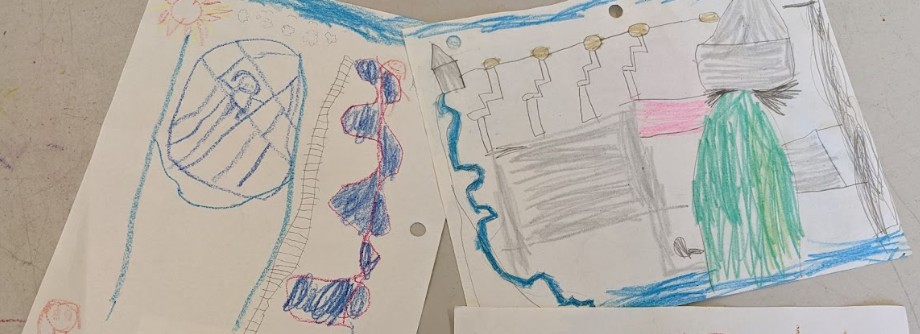
Kinders are creative. They design something and the stories they can tell based on a picture alone are wildly imaginative. We started our year reading some of the books from the If I Built Series. When asked to let their imaginations flow, students designed playscapes that would rival any playscape on the planet. Equipped with swings and slides that were inclusive of a variety of needs, they thought of their friends and family members and what they might like. While many used the ideas from the books, there were a number that made their own designs that were unique and out of this world. I enjoy so much that students at this age have not yet attached being “good at” art or drawing to their level of creativity. Everyone got a sheet of paper and everyone excitedly started drawing their creations with their crayons.  

Excited

These little people are excited about school and learning. Every challenge laid before them from building their habitats to coding our robots has been met with great excitement. They are eager to jump in and give things a try. I love the fact that they don’t yet feel as though they have to be perfect at something to be excited about doing it. I know that this happens much later in the lives of students and I often wonder how the process happens. At what point does the excitement of learning become scary and daunting or dare I say exhausting for students? It’s so refreshing to work with our youngest learners because of the excitement they bring even to tasks that I may perceive as simple. 

The start of the year has been filled with much reflection and learning for me. I’m looking forward to the other lessons I will learn from the kinders and to the experience becoming even more familiar.

Being Gentle With Myself

As mentioned in a previous post, it’s a new year and I’m at a new school. I often forget that so much goes into learning about a new place, space or community. I’m trying not to be too hard on myself for not knowing the space and I’m asking questions. In this post, I’m sharing some of my experiences this past month. 

Learning Names

Names are powerful and important. They are a part of who we are and a key identifier in schools. I have to admit that learning names doesn’t come easy to me. As a prep teacher, teaching all students in our school, there are times that I feel overwhelmed with making sure that I also know how to correctly pronounce student names. It’s the end of September and I’m almost there but there are a few that I am still learning. This month there has been a lot of asking for reminders and using my time during yard duty to familiarize myself with names. While I wish that from day 1 I remembered them all, I think it has allowed my students to see that I too am learning and they have been patient in the process.

Setting Intentions & Reflecting

I started a journal at the beginning of this school year as a tool for reflection.  Every morning, I take 5 minutes to think about the day and in the evening, I take some time to reflect. In the morning, I list 3 things that I am grateful for; 2 things that will make the day great; and one affirmation for the day. I find that in doing this, I’m able to set an intention that helps guide the day. At the end of the day, I reflect on  3 things that made the day great, 2 actions that I could have done differently, and one thing that I did for myself. For me, it’s an opportunity to think back on the day and determine whether or not I feel the day was a success. The good news is that if I haven’t been successful, I know that I can try again the next day. 

In the beginning, I noticed that the 2 things that I was writing that would make the day great were things that I expected others – students, colleagues, etc. – to do rather than focusing on what was in my control. For example, rather than hoping students would pay attention during a lesson, I could instead write that I hope that the lesson planned would be of interest to students and offer multiple entry points. When I started focusing on what was in my control, I realized that I wasn’t as attached to the actions of others. 

Another thing that I noticed was that there were many days that I wasn’t actively deciding to do something for myself. I was fishing for things to write, which was a reminder of how much we often choose to do for others, especially as teachers. I’m going to keep journaling and reflecting this year.  

“Learning the Ropes”

I can’t tell you the number of times that I have walked into a new school and realized just how different the routines are. From entry to dismissal, every school has their way of doing things. I’ve learned not to make assumptions and to be explicit in asking questions so as to understand the practices of that particular school community. It may seem silly but while “learning the ropes”, I think nothing is off the table in terms of asking questions. Having been on the other end – someone very familiar with the practices of a school – I also realize the importance of sharing information with others who are new and trying to pass knowledge on. 

I hope you’ve had a great start to the school year. If not, I hope you know that it’s ok to be gentle with yourself. I know that I have been and will continue to be. We’ve only just begun. There’s still time yet for things to turn around.

My Experience with Project Overseas

If you are a life-long learner who believes in equity, inclusion and public education then volunteering your time and skill-sets with the Canadian Teachers’ Federation (CTF) Project Overseas (PO) might just be the right experience for you. I myself have volunteered for PO for three years (2017, 2018 and 2019) and I can honestly say that it was one of the best experiences in my professional career. Overseas projects have not run in 2020, 2021 or 2022 due to the pandemic. You might be asking yourself, what is Project Overseas and how can I get involved? I will share a few things with you to get you started and also connect you with some websites for additional information.


What is the Canadian Teachers’ Federation (CTF)?

CTF is a national alliance of provincial and territorial member organizations across Canada (including ETFO). Its head office is located in Ottawa. The goal for CTF is to demonstrate a commitment to advancing education and building teacher solidarity worldwide. 

Here are some ways that CTF supports teachers:

  • Increased influence with government
  • Support for better working conditions
  • Research and professional development
  • Educational resources and services
  • International volunteering opportunities (i.e. Project Overseas)

For more information on CTF, please visit www.ctf-fce.ca 


What is Project Overseas?

PO is a collaborative learning opportunity for participating provincial and territorial teacher organizations with other progressive countries throughout Africa and the Caribbean. As a selected member from your union, you and your team of Canadian teachers/members will travel to the host country (usually for the month of July) and work in partnership directly with other facilitators from the host country to co-plan and co-deliver professional development strategies to their lead teachers and administrators in a series of workshops and presentations. In most situations, the experience will be similar to a train-the-trainer model. This is a shared approach to teaching and  learning, as you will learn as much from the host nation as they will learn from you. The goal for PO is to improve teaching and learning around the world, to ensure equitable access to higher education for young girls, and to promote equitable, high quality, publicly funded public education for all. 


What was my experience like with Project Overseas? 

My experiences in Sierra Leone and Uganda have been one of the best learning experiences in my professional career. I met amazing educators who were doing amazing things with very little resources, with no, or next to no access to technology and with limited opportunities for professional development. Educators were using tree bark to create soccer balls for physical education. They were using pebbles, bottle caps and seeds from fruits to support students’ learning in numeracy. They were using flattened out empty cardboard boxes as anchor charts to teach concepts in literacy, science and social studies. These amazing educators were so enthusiastic about learning new ideas and sharing their own teaching strategies with us. One of my learning highlights was understanding and appreciating their use of music in teaching new concepts and as a tool for reviewing big ideas. In fact, singing, clapping and movement were used in all aspects and subject areas throughout the learning process. Music was used to welcome people into a space, to bring the group together, to teach a new concept and to review what was taught. Music was used as an holistic and inclusive way of learning. You would certainly be moved, in more ways than one, by your shared experiences and new learning opportunities with PO. You would be certain to learn new ideas that you could bring back to your school community and incorporate into the classroom. 


With PO, we also had opportunities for cultural exchange. There was usually a cultural event where we shared aspects of our Canadian culture. This might have included a taste of certain food like maple syrup, a Canadian geography game or two, a game of hockey or lacrosse and of course the singing/playing of the national anthem. The host country in return would present a special event which usually included the wearing of traditional outfits, dancing, food and games/plays. In some cases, we were able to visit a cultural museum, a zoo or a school/classroom that might still be in session. 


Regardless of which host country you attend, you will make an impact on their access to quality education and you’re certain to return with a new outlook on what it means to be an effective educator, an advocate for change. 


Tips on Applying for Project Overseas

  • Get involved with your local/territorial and/or provincial union (volunteer to be a member of a committee, attend local meetings, participate in/lead a workshop or conference, volunteer to be a union steward, or  volunteer as an alternate or delegate at ETFO’s AGM)
  • Check ETFO’s website for information and updates about Project Overseas.
  • Begin working on your resume (including references), as you will need to demonstrate your work experiences and leadership skills 
  • If you also speak French or another language, it would be helpful
  • Consider volunteering with a non-profit organization locally and/or internationally, to gain international and intercultural experiences
  • Reflect on your willingness/readiness to be away from home (your family) for a long period of time, with limited access to technology on a daily basis, sharing accommodations with others, working in partnership with others from diverse backgrounds and cultures, and experiencing food choices that may be new to you
  • Check out CTF/FCE Project Overseas website to see a list of the various partner organizations in which they participate and begin to do your own research on the culture, costumes and educational challenges of those countries


For more information on how to apply for PO, visit CTF/FCE Project Overseas


Reflecting on Identity Boxes

In my schedule this year, I had a number of periods where I was able to partner with teachers around the meaningful use of technology. During one of these Assistive Technology periods, one teacher brought up the idea of supporting students on creating Identity Boxes, loosely based on the idea of Joseph Cornell’s Box. The idea was to work with students intentionally on understanding the many facets of our identities and how they intersect, and from there, to create a digital version – similar to James Cornell’s – where students could share their learning about themselves, with one another and their families. 

This past month, I had the opportunity to work with students to start the process of bringing their boxes to life and it’s been a great experience to work with them on using technology as a form of communication. From learning to link Slides and the meaning of symbolism to inserting images and formatting text, it’s been an interesting journey with students as they take their content and try to make it visually appealing for their audience. For me, this experience has reinforced three things: understanding identity is important; use of tech should be taught; and children love sharing about who they are when they know you will listen. In this post, I share about these three things.

Understanding Identity Is Important

Everyone is navigating and figuring out who they are in an ever changing world. Children are no different. At a very young age, they are identifying and learning about the different “parts” that make up who they are. While some are obvious, there are also parts that may be hidden or are yet to be uncovered. I think it’s important to discuss aspects of identity with children from an early age. Through open conversations, experiencing supportive relationships and seeing other people with similar identities being valued, children are able to develop a positive sense of self. 

In years past, I’ve worked on different activities to help students understand the various facets to identity. Depending on the age and the group of students, this work can look very different. The way we might discuss identity with a kindergarten student would differ greatly from a grade 7 or 8 student. Not only that, it would also depend on the work that has been previously done within the classroom to build a community where these important conversations can be had, without causing further harm, particularly to students who are already marginalized.

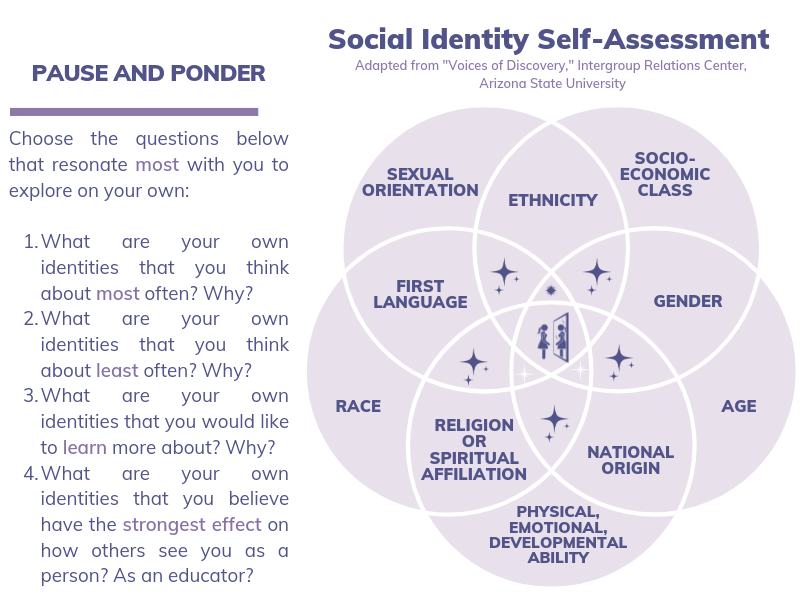
It’s important for teachers themselves to understand identity and how their own identities impact the way in which they teach and interact with students. As such, I always suggest that teachers take the time to do some of their own learning first. judy mckeown has provided teachers with an excellent resource – Pause and Ponder Social Identity Self-Assessment – that teachers may wish to use for themselves. The questions are rich and call for much reflection on how we navigate the world inside and out of our profession. I don’t think that there is one specific way to teach or do identity work with children – there are a variety of approaches that could be effective – but at minimum, I think it’s important for us to start by understanding what it is and how it influences how we navigate the world. 

Use of Tech Should Be Taught

Children are incredible with tech! I remember when my nephew was 2 and the joy he had on his face when he was able to use his iPad to pull up “Baby Shark” on YouTube. I didn’t think it could happen with him not being able to spell the words baby and shark as of yet, but if you can sing or say, “Baby Shark”, an iPad can find it with ease. 

Armed with this knowledge, I think that many believe that if we just give children a device, they’ll figure it out. Most times they do, but I’ve noticed that in order for tech to be used meaningfully, there needs to be some support with the learning. I mentioned in a previous post that I had the opportunity to partner with another teacher this year around supporting students in developing their proficiency with Google Slides. It was a really great experience because students were able to learn some of the basics that supported their use of tech and allowed them to communicate more effectively. These are skills that not only help for a particular assignment but that can be transferred across multiple subject areas and are skills that can be used beyond the classroom. 

Over the years, I’ve seen many strange and interesting things. Centering a title or the line spaces on text are important skills that students need to be able to understand how to do easily.  I’ve seen some who are excited to hit the space bar until the cursor lands somewhere in the middle of the screen. I’ve also seen students hitting the enter button to be able to double space their text, only to realize that if they change the font, the spacing is all off. These might seem like little things, but they’re also easy to teach kids in mini lessons. 

For the project on Identity Boxes, I helped students: link slides; share their slides in preview mode; and in the creation of collages of their images. Simple things that I don’t think we should take for granted that students will somehow be able to know how to do. Going forward, I really want to be intentional about creating mini lessons for students that support them in being more proficient in effectively using the G Suite for Education Tools. 

Children Love Sharing About Who They Are When They Know You Will Listen

Sitting with some of these students, it was apparent that they were eager to share parts of themselves with me. As I sat, I heard stories of their countries of origin – what they missed and what they brought with them – and also heard students share about the languages they speak and love. Although these are students that I also teach French for one period a day, having them share their Identity Boxes was almost like getting to know them on an even deeper level and it was an opportunity to see them in a different light. I felt honoured that they would share parts of themselves with me, so freely and with such joy. This experience has me thinking about the need to further offer students the opportunity to bring their whole selves to school every day and not just on days where they present parts of who they are. 

Reflection has been an important part of my growth over the years. This post allowed me the opportunity to reflect on one assignment, however, I will be taking more time for reflection and really thinking about what I will carry into next year and what I might just leave behind.

tracked and filed

My reports are completed. One hundred and ninety (190+/-) days of teaching, tasking, note taking, tracking, and now OSR filing are completed. If you are like me, then this time of year seems bittersweet.

Bitter because the act of writing report cards can be onerous. I am the first to admit that I love teaching, but hate putting a mark on things. To me, each time that happens creates a rift in the educational continuum. Regardless of rubrics, success criteria, and descriptive feedback, like on my most recent set of reports, the eyes of the reader will only be trained to the letter or percentage grade earned.

The time accumulating data, sorting through work, providing feedback is such a big part of our jobs. Yet, all this work, collaboration
and relationship building with students is distilled to a single letter or percentage grade.

When it came to the hybrid and emergency online learning many students struggled to complete work efficiently and effectively which would have been completed otherwise without issue in the classroom. Funny how computer tabs giveth and taketh away from one’s attention and abilities to learn as well as in person. In many ways, the past 2 and half years have shown us the value of being in our classrooms regardless of what consultants might have sold the powers that be in the current government.

Students received copious amounts of formative feedback that the summative result was an earned and culmination of their hard work and growth. Imagine if we could do that at every grade level. Perhaps that is the luxury I have had as a grade 4/5 teacher these past two years. Since there are no provincial assessments to ruin students lives in these years, they can really focus on the sheer joy of learning, making mistakes, unlearning, and trying again. I know this year has been a year of confidence building as much as it has been curriculum delivery, but it is important that our assessments match our students needs as their purpose is to improve student learning.

I am afraid we are still being forcibly blinded by a system incapable of seeing the brilliance of its youth each and every time we file another set of report cards. “We’ve always done it this way.” cannot be the next cliché in any of our minds if we truly want to support our students.

Reflecting on assessment at this time of year needs to be the call to action for each of us for this coming September. How can you create a space to track and file the learning that occurs in your classroom? What will be the first thing you change? How will you create the safe place for a do over or a retest or a late submission? How will you assess the strengths of your students’ abilities and needs?

Happy summer.

track and field

Track and Field Day

Is it possible to have 4 words to usher in the beginning of the end of the school any better than these? Perhaps class party early dismissal come close, but I have to admit track and field day takes first place. Although it’s been a while, we start each year off running with cross country in September and October. Somehow, they have set the pace to a year of engaging students in spaces outside of the classroom.  

Aaah there’s nothing like being outdoors in the fresh air watching students roam, run, roll, and occasionally hop from event to event. Whether it’s a 100 m dash across uncut grass, jumping events (minus high jump) or 4 laps around the building as an impromtu 800 m track it is definitely a day for students to outshine the noon day sun. Now this is my idea of distance learning. 

This year the events were held over the course of a week in order to accommodate for some wet Spring weather, but student spirits were undampened when rescheduling occured. They knew those freezees waiting at the rest station were only going to be more freezier from the wait. When the sun came out to stay, the competitions were underway. And they went off with relatively few hitches or injuries. Especially, that run around the school on an occasionally uneven concrete sidewalk. Even with a less than perfect track and field the students did really well. So why state the obvious in a union blog post?

Well I wondered that too at first when the idea baked into my head while watching our students compete. It also occurred while I watched students run events, while staff supervised, and when students had free time in between. It was like hundreds of different versions of the same moment happening simultaneously yet differently for all of us. WHOA! (Bill and Ted version)

So as I watched the days run their courses, I witnessed a lot of parallel events that might have gone otherwise overlooked if solely looking at the times, distances, and names on the events lists. Here are a few things that made it to the invisible podium that day. I’ll let you decide whether they are positive or negative. 

  1. Students are really helpful when they are empowered to lead and trusted to do so. This was so obvious as I watched volunteers from older grades lead their stations, show up on time, and encourage(wrangle, herd, shepherd) the competitors through their events. 
  2. Students really thrived with the extra time outdoors. These days were pure social with a healthy amount of friendly competition. I really appreciated how students from different grades lined the event areas to cheer on their peers. For the most part this was really wholesome other than the one or two knuckleheads who thought it was okay to mock their friends throwing abilities. #teachablemoment
  3. Students gave their best efforts considering that practice for these events (standing long jump, running long jump, ball throw, shotput etc.) is usually limited to Phys Ed classes that occur only twice per week. Seeing students struggling with these skills shows how much we have missed over the past two years of pandemic learning when we were online. 
  4. There will always be some students who choose to quit before a race is over.

I mentioned earlier that you will have to decide how to see this one

For me this has always been a toughy. Having been taught from the start to give it 110% and every other cliché in the book, I was left wondering why someone would quit in the middle of a short race when they were not injured? Have some of our students cracked some code here? Maybe it was easier for them to control the moment by ending it on their terms? All of this led to an interesting discussion with my 4/5 students. 

Since I was with them for most of that day, I saw a lot of determination and effort. I made sure I told them as such and how I was a bit relieved to see most of them push through even when first place, second place, and third place were not the prizes at the finish line while an unusually larger of their peers did not. I asked them what made them finish anyways? I also asked them what made them stop at certain times? Then I asked myself what needs to happen for everyone to finish their metaphorical events regardless of the outcomes? I guess that question has to be asked of all of us? Just like the events on track and field day, how we prepare ourselves for each day really matters. 

What keeps you going when the finish line seems further away than ever? What keeps you roaming, running, rolling or hopping until the end of the race? 

Whether it is fitness, meditation, hobbies, acts of kindness, family, friends, faith, pets, any or all of the above these pursuits/passions have helped many of us finish another school year strong despite the wretched election results, a year of hybrid learning hell (personal opinion), and countless uncovered COVID 19 absences due to systemic ineptitude. Without them, I am sure that I would not be in a good place this month.

I encourage you all to take heart, you’re almost there. The tape is stretched across the line of this decathlon of months spent planning, communicating, learning, unlearning, supporting, and teaching. You will cross that line and the rest to follow will feel so good. 

fitness

Fitness is a funny word. I get quite a chuckle each time I see this meme. Knowing where to get a laugh comes in handy in this job. The trick is knowing when and where to fit it in?

Yeah, I'm into fitness. Fitness whole pizza in my mouth. – Wag Pet Boutique
https://www.wagpets.com/yeah-im-into-fitness-fitness-whole-pizza-in-my-mouth

Fit in itself covers a broad swath in its meaning as it ranges from adequacy/competence much like whether a premier is fit to govern or if a garment is the proper size. In legal spaces, the courts decide whether someone is fit to stand trial or have custody rights. When someone is upset they are said to be having a fit. When they are inconsistent, things are happening in fits and starts. When someone doesn’t play by the rules and norms they are often told to fit in or labeled that they couldn’t fit in.

Fit can also have a positive light around it such as, “They were a perfect fit for each other” or “all the pieces fit together so well”. When we are starting somewhere new, we always hope to fit in.  When we need an appointment, we are always hoping to be fit into the schedule.

Not to be overlooked, fit can also describe someone’s physical or mental state, as well. So as the days of our 9th month in school wind down I wanted to check in and share some thoughts on fitness in order for all of us to finish strong in June. To no one’s surprise in my world, humour plays a huge part in how I maintain my mental health. Sharing it with my class has become part of our support of one another since the start of the year.

With so much happening in our world right now to crush the spirits of our students and fellow educators, humour, art, acts of kindness, and movement are my goto strategies to combat relentless tragic news stories, a pandemic, and the return of standardized testing. So how does that look in the classroom?

Before I share that, let me reiterate that there is no need, ever, for a head in the sand approach with my students when it comes to tough topics. On the contrary, active discussions about the goings on in our world, nearby and far away are crucial. I believe there is room for conversations for students of all ages. I believe there is room for them to share what they wonder, have heard, and think. I am wary when classrooms are not allowed to be open spaces of inquiry when it comes to the big questions on students’ minds especially when our students possess a world of information, real and fake, at their fingertips. It is important to let go of the control and comfort though. For some that discomfort does not come easy, but hey it’s not about you.

When we fit this work into our days, we tell our students that they are safe to ask when uncertainty abounds. In case you’re wondering. I am into fitting this into my days.  Okay now back to what can only be expressed as a fitting conclusion to a year at the speed education.

  1. Lessons getting shorter. Connecting and applying concepts still continuing.
  2. Time to explore concepts outside of the boundaries and boarders of the curriculum being added.
  3. Collaborations on projects between grades(4 and 5) guaranteed.
  4. Time for exploring new learning with another self-directed inquiry project(Genius Hour)
  5. Student led social activities and DPA. They always know the latest and greatest vids.
  6. Organization of one more PAK (purposeful act of kindness)
  7. More time listening to one another.
  8. More time for the arts beyond our weekly schedule.
  9. Joke(s) of the day.
  10. Time to celebrate that each of our mistakes is evidence that we were trying.

Lastly, there is going to be an end of school in-class celebration to honour each student for their hard work. persistence, growth, and contribution to our class family. As exhausting as the lead up to June is each year, the satisfaction and joy from a job well done lasts far longer than any memories to the contrary.

Each day of this year has been physically and mentally taxing. I have eaten my feelings on occasion. I have been called grumpy from time to time. Mea culpa. I have also found time for a lot more personal fitness in order to combat those tougher days we all go through as educators. Whatever you do to keep fit, I hope it sustains you and gives you joy through the upcoming month and well into a restful summer.

If you see fit, please share what you are fitting into your classroom in June. Thanks for reading.

sounds

I love walking around and peeking into classrooms – especially at my own school. As a SERT, it does not seem as weird when I show up unannounced in the middle of a lesson or work time since I am always in and out over the course of a day. In the spirit of transparency, my curiosity has found me marveling in rooms at other schools too. There is so much to see each time the opportunity presents itself. Long before ever becoming an educator, I was wont to wander off the tour when given the chance – still do.  Now that I am, it would be great if we all had more time to visit each other’s amazing learning environments. 

Each of my visits offer informative insights into these incredibly and creatively constructed spaces. I’ve even made some friends along the way as a happy coincidence when my curiosity leads to conversations after compliments. I think every educator wants to check out what is going on in other classrooms, but we are given little opportunity to do so while siloed in our own schools. Wouldn’t it be fun to swap places with a teacher of the same grade for a week to experience what they do and vice versa?

Admittedly, that wonder and awe comes with a hint of professional jealousy as well. I think of the time, effort, thought, and sweat it takes to make learning come alive within them. It is a gift to work among so many talented and caring educators. Each trip to another educator’s classroom is guaranteed to give me a boost of energy and inspiration. Now imagine what would happen if we all had the time outside of our own walls?  

This has occured to some small extent during family of schools events or one-off PD sessions that happen occasionally. I always love it when another educator visits my classroom. It is validation. It definitely keeps me on my toes and, like watching a movie with your own children, you notice things that you might not sans visitor(s). 

I know that when folx come by my room, they do so with an open invitation to my classroom. Over the years I have welcomed delegations from Brazil, Denmark, and Sri Lanka. Not to mention system admin types from time to time. I always wonder what they must feel like to be back in the classroom? What do they remember from “their days” pacing the rows and teaching. What did it look like? What did it sound like? 

For me, their is this constant soundtrack playing in the classroom. Each day it constructs itself out of the rythym and melody of which we all play our part.

Now, I bet you thought it was something like a cross between Brazilian Thrash Metal, Opera, and Worldbeat and it kind of is however the beautiful noise that gets made is more of a melodic cacophony to accompany the magic that happens wherever and whenever students are being taught. If you listen close enough, you here the soundtrack that accompanies a live rocket launch or cornerstone being laid. It could come in the form of a question or a response and the a “Wait! No, I meant…” followed by an answer and mini-exhale. It could sound like 26 pistons each firing perfectly to accomplish a task or like the timed pops of fireworks at 10 pm on a summer holiday (all safety precautions observed, of course). These are the sounds that reverberate off of pastel painted cinderblock walls. 

Sure I could put on some Lo-Fi Hip Hop or share my Productivity Workflow playlist from Spotify, but they could never compare to the intersection of lives and learning going on each day. 

Like our students, the sounds we hear in class have their own rhythms. Believe it or not, there is such a thing as productive noise. It can be unnerving to new teachers who enter the classroom still holding on to their own experiences as learners, but now nearly a decade past those carefree days from K to 8. At risk is losing the energy in a room when order is the only expectation. Teachers each need to work out and manage their “acceptable noise” levels with students. We must also be willing to renegotiate these terms from time to time. Setting routines and irreducible minimum expectations starts in September, but must be consistent from then to June. 

This might require a few changes to be achieved. With the sun burning brightly and birds chirping, the energy/noise levels in classrooms seem to be set to 11 out of 10. As such, a little more outside and movement time built into the day has helped. I am also adding in more time to productively self-direct or collaborate. My recent art classes saw us touring the school and then partnering up to co-create something. Through all of this, the room was filled with creative conversation with only a few moments of chaos.

I wonder whether someone else would hear it that way if they visited? I guess there is only one way to find out. 


Students as Teachers: a Culture of Inquiry and Learning

“I am just going to check in on everyone and see how they’re doing” – one of my Kindergarten students said as she led her peers through a step-by-step challenge where they created a DIY ‘marble run’ out of paper tubes and tape. 

My DECE partner and I were blown away by her kindness, patience and commitment to the success of her classmates during this process. 

We have been trying to keep an open invite for all students in our class to have the opportunity to be the “teacher” or the expert on a topic of their choice. Through online learning, fewer natural moments of teaching happen from student to student like they would in a physical classroom. Hands on collaboration between students virtually can be tricky, as they lack the opportunity to share space and materials. We decided it would be more equitable to schedule these student-led activities ahead of time, in order to allow all students time to prepare the proper materials. As I move to in person learning in the fall, it is my goal to continue this practice as a means of supporting students belonging and contributing in respect to the Kindergarten program. It is my hope to further explore the benefits of fostering students confidence as teachers in the classroom as I continue to learn from my competent and capable young learners. Here are my initial thoughts:

The classroom community

  • Inviting students as teachers creates a culture of learning, respect and curiosity
  • Students teaching their peers builds community and invites students to be vulnerable and make mistakes

Through the lens of a child

  • When our students stepped into the role of educators, it provided my DECE partner and I a unique opportunity: to see the world through their eyes. Through their ideas, descriptions and step-by-step processes we were able to develop a deep understanding of the way they view the world, the way they solve problems and the way they persevere through challenges. 
  • Many children enrolled in Kindergarten programs are immersed in their first experiences of formal schooling. For some of my students, my DECE partner and I are their very first examples of educators. The way that children go about giving instructions, gaining the attention of others and providing words of encouragement can be reflective of what they see. It can be very powerful to listen to a student recite an encouraging phrase verbatim, such as “You are a problem solver!”.

Benefits for students

  • Teaching their peers provides students with the space to take risks while gaining confidence in their own ideas and abilities 
  • For the students involved in this practice as the learner, it allows them to explore new ideas or approach learned concepts from a different perspective than my own or that of my DECE partner. 

Inviting students to perform a new role as a teacher is inclusionary, culturally responsive, relevant and meaningful – which is the basis of everything I hope to cultivate in Kindergarten.