When All of This Is Over….Remember The Number of Students Who Couldn’t Access Technology

I know I am supposed to be embracing technology and getting pumped for all the new applications and tools that I am learning how to use. I have been completely in awe of how fast Ontario teachers adapted to this new reality and created engaging learning opportunities on many different platforms for their students. However, I am facing a problem that many of the students in Ontario are currently challenged with. We are both having difficulty accessing reliable technology and the internet.

Last year, I bought a laptop and have had nothing but problems over the past couple of weeks. It has crashed multiple times, has had problems with the speaker and generally just caused me a lot of frustration. I have had to apologize to colleagues and students when our Google Meet has crashed mid sentence because of my laptop. However, I also have a tablet and a phone as emergency backup for continuing my student’s learning and connecting online with my colleagues. Many of the students in my class, school and around the province do not have the same access to technology in their home.

The thing that will stick with me from this time that we are learning from home is the number of students that required technology to complete school work. In my board alone, over 14, 500 students required technology and 2000 required internet to engage in any form of learning at home. That is an absolutely staggering number. In my classroom and my school, 20% of all students requested technology to be delivered because they didn’t have enough technology in their home to support their learning needs.

I think back now about how many messages I have sent through Google Classrooms, or assignments that have been more easily completed with internet and a computer that I have assigned. I realize how disadvantaged some of my students were every time they left the classroom and were starting behind their fellow classmates. I also think of schools where that same number was under 5% or over 50% and how monetary situations are impacting the student’s ability to access the same tools and resources required to be successful at school.

There is no doubt that students need to be confident in using technology in their daily life for many different purposes. Technology will most likely play a fundamental role in acquiring or maintaining employment as students become adults. Technology is also the primary way that many students communicate with each other. I see many of my fantastic colleagues teaching amazing lessons with the limited resources available to them to build the skills the students require. However, there is a major gap that exists between students that can go home and practice the skills regularly and those that rely on limited and sometimes broken school technology.

I am fortunate that I teach at a middle school. Working with the students there keeps me current and up to date on trends and innovations in technology. But over the last month, I have been thinking about those amazing grade eight students in my knitting club and those who assist my students with such kindness. Did they fall in the 20% at my school? If so, will they have any chance at being successful in e-learning courses in high school?


Online learning for students with DD

When much of the discussion about on-line learning happened in the media this year during the high school contract negotiations, I often thought My students should never have to participate in any course online. My students all have developmental disabilities and are working towards goals on an alternative IEP. Most have some form of communication impairment and are not able to read well enough to follow instructions online. Online learning seemed like something that would never work for my students! Little did I know when 2020 hit, we would have no choice but to figure out online learning the best we could. It has been very tricky, with some successes and some challenges. Here is what has worked:

  1. Sending a PDF file instead of logging on a pre-existing platform. My students are unable to sign onto a device or navigate difficult platforms.  My team sends home a PDF file every Monday with activities, songs and pictures for that week. The PDF has pictures that link to the activity for the student. It is simple, straight forward and allows families to work at their own pace. Since it is a PDF, families have had no trouble opening the file on phones, tablets, iPads, Chromebook or laptops.

2) Having regular parent contact. I contacted all my parents by phone the first week we started the online learning and I end every e-mail, assignment and weekly newsletter with how they can contact me. Spending a lot of time answering parent e-mails and reaching out via phone has alleviated a lot of stress and anxiety.

3) Sending students mail. Who out there doesn’t love to get mail? For my families that have decided not to access the online component of the learning, a letter in the mail continues to tell them that we are thinking of them and offers them another reminder how they can reach out. Did you know that Canada post will deliver pre-stamped envelops to your house? It took about a week to receive our envelops and we were so happy that no one had to leave their house to buy them!

4) Video conferencing with the class and with individual students. My local has worked closely with the board to make some specific platforms available for meeting with students online. When I am meeting with a student and their family, I take another staff member with me on all calls. Usually, it is one of the TAs from my class that my student knows very well. For my students who are incredibly socially motivated and have difficulty reading or communicating, seeing each other has been very important for their emotional well being. I keep it short and control the conversation. Only about half of my families wanted to do this option but the students that have participated, have loved it!!


5) Sharing pictures from class. At the end of every weekly file is a section called connecting. I have included pictures from school and also some parents have submitted some pictures from things that they are doing at home! Many parents have told me that the pictures have been very helpful for their child and they have enjoyed looking at them.


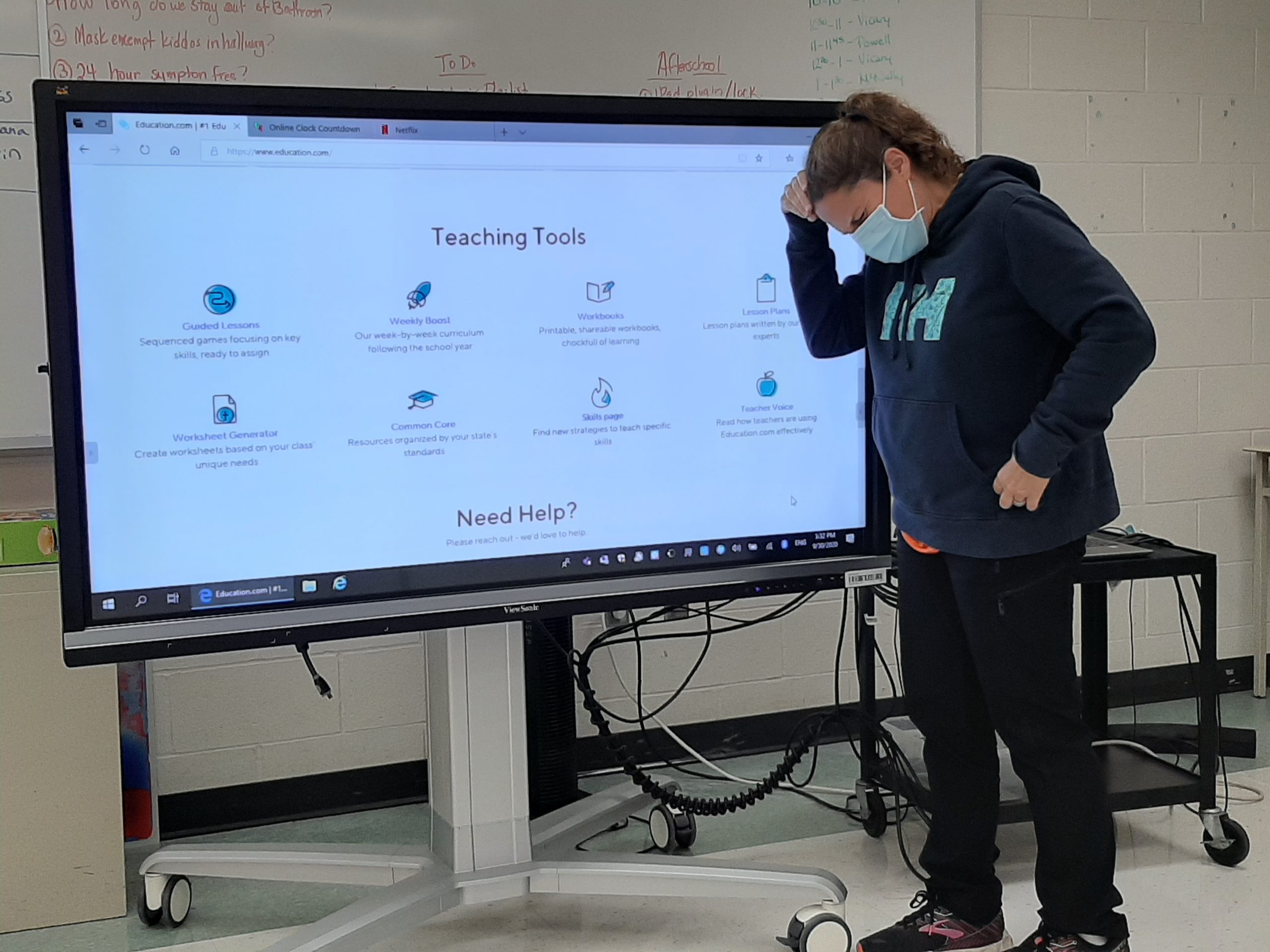
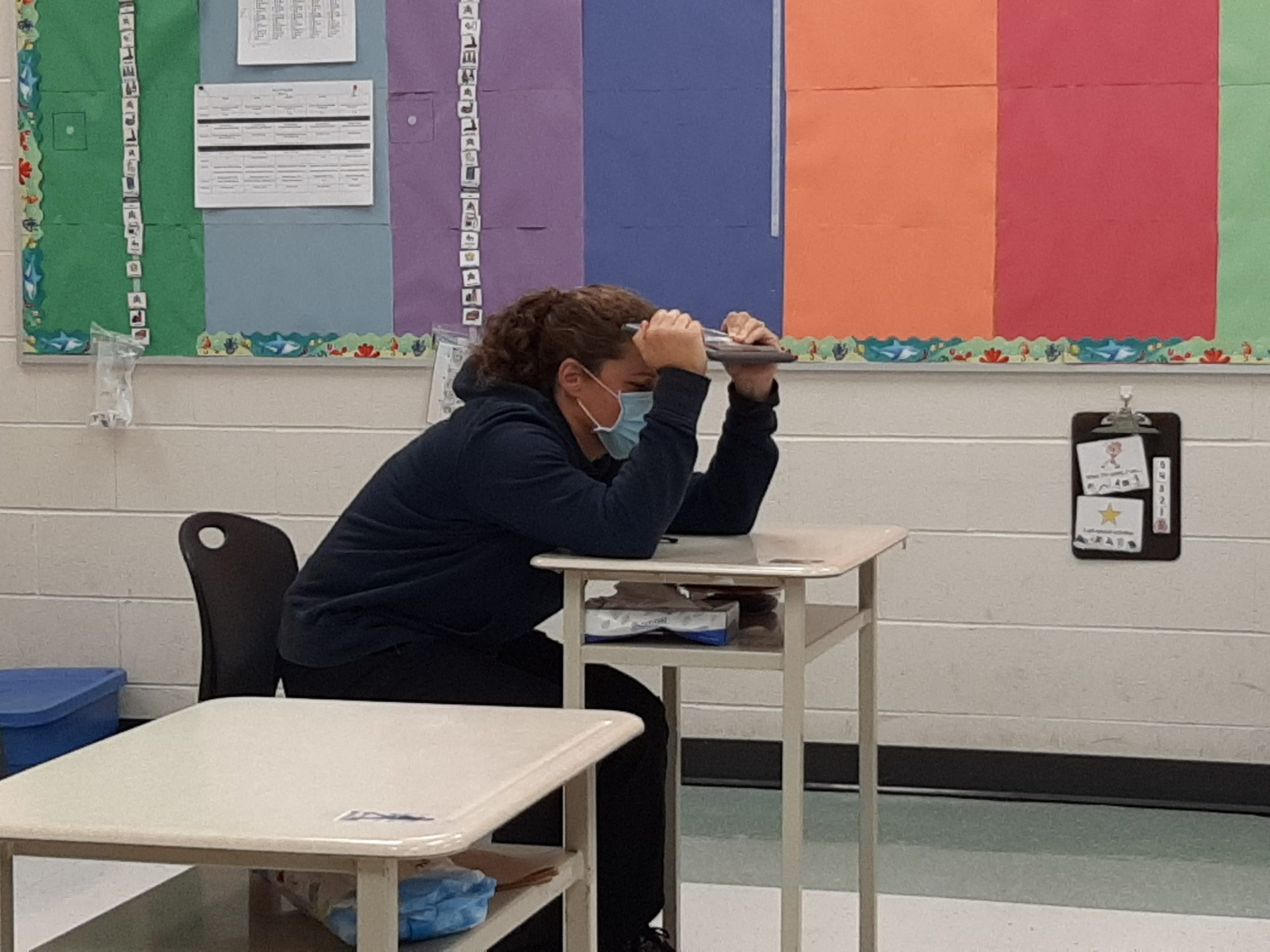
So you’re teaching from home. How’s your back?

Ouch! Each time that the government extends public school closures because of COVID 19, it hurts more and more. Although, concerns for the safety of our families at home and school are top of mind, it really hurts to be away from students, staff, and the frenetic spaces we normally occupy. It hurts wondering if they are okay or if they are struggling to cope with the turmoil and uncertainty wreaking havoc on our lives.

Well at least we are teaching and reconnecting with our learners again, but as I gaze at my screens, I feel the tension across my shoulders. As my eyes dart about, my ability to focus on digital content for extended periods of time becomes difficult. I feel my body rebelling against its natural urges to move about, write something on the board, and make eye contact. This pain hits the mind and body and I’m not sure which is worse. Ouch!

I am finding that my increased time in front of screens rather than my students is taking a toll on my body and mind that is different than face to face instruction. For one thing, I am sitting more, corresponding via email more, joining virtual meetings more, and aiming my eyes towards my screens more. If you are like me, you might have a work space at home that gets used on evenings and weekends. I use an old kitchen table and chair*. This space, which is normally only used for an extra hour or three each day, has now become my classroom and office for as many as 6 to 8 hours per day. Between the planning, prepping, office hours, and meetings the hours add up. By the end of the day, I feel it.

I never realized that my workspace would be the reason why I have been waking up with an aching neck and back after the daily grind of extended screen time – my spartan set-up has me sore, stiff, and in need of a stretch. I have already flattened 2 couch cushions beyond their intended shape. Decorating aside, this got me thinking about how other students and educators must be dealing with their non-traditional work/learning spaces in a time of physical distancing and social isolation.

I have seen pictures of students at kitchen tables that are just below shoulder height. I have heard of families, all working from home, having to negotiate work spaces between bedrooms, living rooms, and kitchens. All flat surfaces have been claimed by computers and books. TV trays are now doubling as desks, while bedrooms have become bastions for team meetings even though I have yet to be on a conference call when a child or pet doesn’t magically appear to add a little levity.

At my house it is 3 generations on 3 floors and even with all of that space, there are still moments that require the utmost patience and grace. I can only imagine what it must be like for families in apartments or condos with limited space where a comfy couch has become a conference space instead of a family refuge? I am also learning that not everyone has a place to escape to when things get crunchy.

The increased time spent in a non-traditional work space trying to do make traditional work happen despite non-traditional circumstances is new to all of us. So, it comes as no surprise that my new classroom hub was not capable of supporting me physically over longer periods of time. Knowing that continuing without making some adjustments was going to end up poorly, I made some adjustments. Here’s a quick list of things I added to help:

  1. Take movement breaks (stretch, exercise, elevate your heart rate).
  2. Hydrate (coffee/tea does not count, water works best).
  3. Take your eyes of screens. Think of the 20/20/20 rule.
  4. Adjust workspace heights. Consider adding a box to your laptop to make a standing desk.
  5. Take a break when you are tired. Call it strategic surrender.

Hopefully, these 5 things can help you to lessen or avoid the physical fatigue that we are experiencing. With so much more happening, I wanted to share some ways on how we can make emergency distance learning less stressful on our bodies. As we face at least 4 more weeks of emergency distance instruction ahead, it will be important for all of us to pay attention to our work at home ergonomics to be at our physical, mental, and intellectual bests.

If you have a story to share about you have adapted your home into a workspace, please share. Stay safe. Stay strong. Stay healthy.

Additional reading:

https://www.fastcompany.com/90480052/how-to-perfect-your-home-work-set-up-so-your-back-stops-hurting-so-much

Some solid information that is easy to digest about ergonomics for students(slide23)

*The table has been in my family for over 40 years and has math work(my sons and my own) pencilled into the soft pine as a inter-generational reminder of many lessons learnt and shared over the years.

Distance Learning: Week One

Hello all!

I hope everyone had a great first week of e-learning whether you are a teacher doing this first your first time, a parent helping their child navigate sign ins and questions or if you are a student that is doing their best to learn in a new way. I know that it felt strange for me to have an inbox full of google classroom questions rather than a line up of students by my desk. My students got their google classroom accounts up and running last Sunday so they would be ready for Monday. I assigned them four assignments on Monday, April 6th:

  1. Math: Two hours on the program IXL working on their math skills that we were doing in class
  2. Literacy: 30 pages in their novel that they took home during the break with a series of questions to see what they have read about so far
  3. Geography: A video explaining the push and pull factors of various countries and a few questions to go with this video
  4. Science: Three videos of past student experiments from a variety of science strands asking students to describe what is happening in each video in scientific terms.

My 25 students had one week to complete these tasks and could work at any time of day that worked for them. I told them that I would be available to help with any questions they may have during regular school hours. I received many questions through google classroom and offered next steps when students handed in their work. 6 out of my 25 students asked for more work halfway through the way.

In order to gage students learning interests for the week that is coming up, I created a survey to see what they thought of the first week of online learning. These were the questions I asked them:

  1. How are you feeling today?
    1. Thumbs up
    2. Thumbs sideways
    3. Thumbs down
  2. What way do you prefer to learn a new lesson?
    1. Video chat as a class
    2. Pre-recorded lesson that I send
    3. Reading an article and answering questions
    4. Doesn’t matter, you enjoy all ways equally
  3. What subject have you been enjoying most while learning online?
    1. Math
    2. Science
    3. Literacy
    4. Geography
    5. All equally
  4. How are you feeling about the one week to work on things?
    1. Too long
    2. Too short
    3. Just right
    4. There shouldn’t be a due date
  5. What are some other ways you would like to learn online?

As a result of this survey, I found out that my students were mostly feeling thumbs up, which was good to hear! This is a new way of learning for them and I was very happy to find out that no one was feeling thumbs down. My students also commented that they do not mind what way they learn although most students said they enjoy all ways of learning. In second place was reading an article. They also commented on enjoying all subjects equal with literacy coming in second. For question four, I was very interested in this answer as I had heard some teachers teaching grade eight were not giving due dates, instead having work available. However, my students have been working all year with deadlines so I was not shocked to see that almost 100% of my students said that the one week to complete work was just right. As for other suggestions about learning online, my students are interested in doing a google hangout video/zoom chat. These have been popular with online learning and I am excited for us to try one this week coming up. I will start by asking some questions about what they have been up to and then I will ask them some questions about the novels they are reading.

I am very proud of how smoothly my students adjusted to the online learning environment. I was worried that many students would ignore the work as I am not in the room with them helping them stay on task etc. but they did very well. I also thought they would be discouraged by this type of learning environment but I am once again impressed by the amount of students that handed in their work ahead of time/on time.

For next week’s assignments, I have made similar type assignments but I have scheduled a group chat in order to support the opinions of the students that wanted that added to our online learning platform.

Although this is not the way I prefer to teach, I am happy to still reach students during this time in a way that seems to be working for them. I am enjoying being “back in the classroom” even if it is online and am enjoying having some purpose back in my day.

All the best to everyone during these challenging times. I hope you all are having a thumbs up day!


(My workspace with Milo)

Turning to Twitter when tested in #onted

Without dipping too far into my bag of clichés this month, I wanted to focus on the incredible work coming from educators in respose to the “new normal” brought by the COVID 19 pandemic. The same educators who were standing up for the future of our students last month have been working hard to support them through the most extraordinary global event of this century.

The only way to describe what I’ve gained via the #onted Twitter hashtag, as we cope with #COVID19 and our work as educators, would be through words like perspective, wisdom, and supportive ideas. They would go alongside countless daily reminders that mental health matters, concern for students’ wellbeing, equity in education(access, tech, food insecurity, options), and concern for each other’s safety. In this post, if you’re not already tweeting, I want to encourage you all to join an amazing cohort of Ontario educators on Twitter so that you can benefit too.

Why? I am glad you asked(no I am not a sales rep for Twitter).

Imagine having a 24 hour cohort of teachers to form professional learning networks(PLNs), share resources, be encouraged by and learn from? That’s what connecting with the #onted PLN can do for all of us by connecting you with your fellow educators. While our numbers continue to grow, it is okay to start off slowly, sign up for an account, check out who is out there already, retweet some posts you like, share something new you’ve created like a blog post, lesson, piece of art or something you found interesting in the news. Make sure you include at least the #onted hashtag. Once you take flight, don’t be afraid to join in on some conversations. Following the #onted #ETFO #ETFOStrong and #OSSTF hashtags will keep you connected and up to date on all things happening in Ontario and with teacher unions.

So now that you’ve decided to sign up for a Twitter account there are a few things to consider.

  1. Do I create a personal or professional account?
    Try to have one of each if you can.  You can always have a personal account and then create a class account(check with your school board and admin for parameters). I have @willgourley and @MrGs_Class. I have also created a few school accounts for admin to share information from our board with families on the platform.
  2. Should I use my name or the number they give me?
    It never hurts to be brief or creative here. It is dangerous to be @Taylor167895 as it will be hard to find or remember a name with so many users.
  3. Do I need a picture?
    Yes. It can be of your pet. Try to personalize your page using the Settings. If you blog, include a link to your blog site too.
  4. How do I avoid all of the negativity coming from trolls and thoughtless people?
    Hit mute, block, and report. If you stick to the #onted #ETFOStrong #education family you will seldom come across most of the Tweets coming from alt-right types and fake news spreaders.
  5. Who do I follow?
    I would suggest following your preferred news outlets, then find your colleagues who are already on Twitter, and then any or all of the following people who are regularly contributing to the well being of their students and education in this province. Many on this list, are people who I have had the privilege to meet in person and can constantly count on for information and inspiration.
  6. Do I have to follow someone back?
    Not necessarily. Make sure to check over who is following you first. Sometimes it might not be an appropriate site. It is easier to block them to avoid the hassle.

In no particular order are some of the hundreds of active and engaging Tweeps you will find in Ontario;

Albert Fong – Science teacher in Peel DSB and educational action taker

Andrew Campbell – friend of Albert Fong, Gr 5/6 teacher, frequent guest on CBC, writer, TEDx speaker

Matthew Morris –  passionate blogger, introduced me to #hiphoped via Twitter, TEDx speaker

Debbie Donsky – a leaders leader, principal, artist, blogger, TEDx speaker

Jenn Giffen – tech queen, librarian, podcaster, and sketchnote guru

Noa Daniel – mentor, podcaster, TEDx speaker, and blogger

Chris Cluff – poet laureate, podcaster, long boarder, and creative genius

Rolland Chidiac – blogger, podcaster, maker spacer, good deed doer

Doug Peterson – blogger, Voice Ed Radio stalwart, glue that connects the #onted family

Kimiko Shibata – ESL specialist, active and creative ETFO member, nerd

DroptheDottCraig Zimmer‘s alter ego, TED Ed Innovative Educator, TEDx organizer, History teacher

Dr Deb Weston – member of our Heart and Art writing family, SpEd and AQ teacher

Dr Carol Campbell – no relation to Andrew Campell, OISE prof, and global education sage

Geoff Ruggero – maker space innovator in the YRDSB

Jeewan Chanicka – focused on equity and justice, TED Ed Innovative Educator,

Lisa Mastrobuono  – ETFO, Tweets about bargaining, education & labour issues

Zack Teitel – seeker and speaker of truth, always trying to make school less crappy and more meaningful

Sunil Singh – author, lover of all things Math, disruptor, TEDx speaker,

Andrew Bieronski – TEDx KitchenerEd organizer, consultant for education companies/tech startups,

Fred Galang – builder of creative literacy, teaches how to mix art & design with technology

For the sake of not overloading you as you join the #onted PLN via Twitter, I tried to include a wide variety of educators and voices for you to connect with to start. I could have included another 50, but that will have to be at another time.

Along the way you will find many others. My goal at the onset of this post was to introduce you to many of the people that I can count on for advice and support when times get tough. Congratulations in advance on joining the family. Feel free to tag me in a tweet sometime. @willgourley #onted #ETFOStrong

Ontario teachers

Well, it is official. We are off until May 4th.

My poor puppy will definitely be sick of me being home by then. (Although she is enjoying the extra belly rubs and she does like to help me with my work!)

After Minister Lecce spoke today and shared the new date for school closures and what parents can expect from phase two, there were definitely many questions that we all have. What is this going to look like? How are we going to reach our students if they have exceptional needs? How am I going to be writing report cards through all of this? What if my students are in crisis? The list of questions goes on and on and on and on… The mounting questions can send a tsunami sized stress wave over all of us.

But before you get overwhelmed and riddled with anxiety, remember that you have many of the skills that will lead you to do the best by your students.

We are all:

  1. Incredibly resourceful- We can figure out how to teach multiple subjects using very little materials to a large group of students.
  2. Flexible- We can adapt to changes in schedules, students added to our classroom and technology not being installed on a designated date. We regularly go with the flow and make it work.
  3. Problem solvers- We solves hundreds if not thousands of problems a day. Most of us can solve an issue between friends while helping another student with a math question in one breath.
  4. Good listeners- We regularly listen to parents and work with them to find the path that is best for their child.
  5. Strong learners- We all are excellent learners. We can learn anything, any day of the week.
  6. Able to inspire Students- Every day we inspire students to overcome adversity and succeed. This will be no different.

I know it seems like an incredibly overwhelming task at the moment to try and think about delivering an engaging and productive program in this context but we have all the skills we need to look after the well being of our students.

Good luck next week and be safe.

May the 4th be with your students

Anyone else feeling a bit gutted after hearing the news that we will not be back in our classrooms until May the 4th? (writer raises hand) While listening to the Minister of Education deliver this news today I ran a range of emotions. Firstly, I am thankful that the government was proactive when it came to our collective health by insisting on physical distancing and staying at home.* As a result, the lives of 2 000 000 students, 200 000 educators, support staff, and their families will benefit greatly from being apart. For me this seems like light years away.

Heeding the Chief Medical Officer of Health’s suggestion to close our schools beyond March Break was a prudent move, but it all happened so suddenly that we were all left with a great deal of uncertainty heading into the time off. With such short notice, it was hard to orchestrate a full scale instructional response to the news. Like so many of the #onted family, there was some concern because information was not forthcoming. I remember saying to my students(Gr 7) that it was more important for us all to follow the advice of doctors to do our part to limit the spread of COVID 19 than it was to worry about homework.**

Our last day in the classroom before the break was supposed to be a celebration of hard work to start Term 2, but instead it was a sombre send off with more questions than there were answers at the time. I only find consolation in this now knowing that the timing of this year’s March Break probably saved countless members in our schools from illness.

Not having our students in classes eliminated millions of potential interactions that would have undoubtedly accelerated the spread of the COVID 19. I am very relieved not to be in a workplace that’s traditionally susceptible to transmission of known/unknown and unchecked viruses. We have all been in a classroom with a student/teacher who should have stayed home that day. I am not lying when I say it feels like germ warfare in school sometimes. It is a relief, to be doing my part in social isolation especially as I have a 96 year old and a severe asthmatic at home.

In fact, although really missing my students/collegues, I am thankful that we have all been given the chance to stay at home in order to slow the spread of COVID 19, to look after our own health, and to tend to the wellbeing of our families. This is hard on all of us in so many ways because it is all so new. As I shared with a number of people, “Normal” is sick and its replacement “New Normal” is here bringing with it some good and bad to each of our days. The problem is that it keeps changing faster than we’d like.

Today’s announcement lifted my spirits because it meant that if we all do our part, then we have a date for a return to Normal. It also means this time can be curated to engage our students further in this year’s learning. Not knowing what was going to happen had me struggling to remember what day of the week it was since my routines were put in limbo with each postponement. No more days when, suddenly at 7 am, I wake up thinking I was late for work only to realize my body was dealing with the “New Normal” while still on “Normal” time.

Even though we will only be meeting via Google Classroom, our class will be back in session. After contacting families and students this week, it is clear they are excited to be back, even if it will only be digitally until May 4th. Fingers crossed it won’t need to be longer. In the meantime we will get on with the connecting, communicating, and learning for now.

Whether we return to the classroom on May the 4th or not, I couldn’t help but repeat the wish I shared in the title. May the 4th be with your students, and while we stay at home may every one of us be healthy and safe.

*Although arguably, essential and non-essential jobs may be a future debate topic.
** I did promise them some work via our Google Classroom once March Break was officially over.

Whoa. Just Whoa.

Whoa. Just whoa.

I can’t believe that two weeks ago I was told that school was going to be closed due to a global pandemic. I say the words out loud to myself and it doesn’t even seem real. I have gone through every emotion in the past two weeks from crying to laughing hysterically to the desire to sleep for a month. Like most, I miss my friends and family, am incredibly nervous that my partner is still working and am generally more on edge.

These past two weeks have also probably been the hardest in my teaching career and it is only the beginning.

So how do we manage through this?

I made my first couple of phone calls to my students and their families this morning. That really helped. It connected me to my wonderful students and brought me back to the best profession in the world. It also reminded me that we are going to have to work really closely with our families and be in tune to what they need. This is such a stressful and uncertain time for everyone. Some of my students have rolled along and adapted quickly, others are desperately missing their peers and are quite anxious. All I can promise is that I am going to try my hardest to meet all their needs the best that I can.

Like many other groups of students in our education system, my students have very unique learning needs. All the students in my class are on Alternative IEPs and many of the activities in our classroom use specialized equipment, technology and materials that the average family wouldn’t have in their home. All of this means that I am going to have to be a very creative, think outside the box teacher to connect with my students in the way that works best for them!

I am very fortunate to work with an amazing team of Educational Assistants and colleagues at school. I have spent many hours brainstorming with my special education colleagues about different tools and ideas for our students to use at home. The EAs and I have been testing different technology options that we could use collaboratively with our students. This will ensure that no matter what is asked of us next week that we are ready to roll.

And even with all the best laid plans, nothing is going to match my students coming off the bus with big smiles ready to start a new day at school with all of their classmates and teachers. So all we can do is carry on and hope the curve flattens right out so we can go back to being with each other.

Building professional capacity through teacher collaboration and online learning

ETFO’s position on in-person learning remains unchanged. The union firmly believes that the daily, in-person model of instruction and support best meets the educational, developmental and social needs of students, provides the best experience for support, and is the most equitable learning model for all students. ETFO’s expectation is that elementary virtual learning in any capacity, including through hybrid models of instruction, will end once the pandemic ends.

Internationally, professional educational bodies and teacher federations in the United States, Britain, and Canada, for example, advocate for learning communities and the teacher collaboration that supports it (American Federation of Teachers, 2011; Elementary Teachers Federation of Ontario, 2011; General Teaching Council for England, 2003; National Board for Professional Teaching Standards, 2004; Ontario College of Teachers, 2006).

In Ontario, the Ontario College of Teachers’ Professional Learning Framework specifies that “Learning communities enhance professional learning. The professional learning framework encourages collaboration. It supports ongoing commitment to the improvement and currency of teaching practice as an individual and collective responsibility” (Ontario College of Teachers, 2015, p. 23).

Further, the Elementary Teachers Federation of Ontario defines learning communities as “A group of education professionals who share common visions, values, and goals, and work collaboratively using inquiry, experimentation, and innovation to improve teaching and student learning” (2015, n.p.). The federation supports teachers’ involvement in learning communities when teachers’ participation is voluntary, is based on collegiality, respects members professionalism and autonomy, is supported with funding, and contributes to teachers’ professional growth (Weston, 2015).

The push for promoting teacher collaboration has gone from teachers simply meeting as a group to the hierarchical restructuring of schools in which learning community organization has become embedded in the educational landscape (Gajda & Koliba, 2008). It is important  to note that when collaboration is forced on teachers through administrative bodies, it can morph into managed or “contrived collegiality” (Hargreaves & Fullan, 2012, p. 119). An example of this would be when administrators control teacher interactions through managerial meeting agendas, lists of working groups, and data teams (Hargreaves & Fullan, 2012). Ideally, through a nonjudgmental collegial lens, collaboration should be focused on the developing, planning, and assessing of teaching practices to meet students’ needs (Lortie, 1975/2002).

Available research suggests that teacher identity norms impact teacher collaboration (Hargreaves, 2010). However, no large-scale quantitative data have been collected to investigate the relationships among teacher identity norms and teacher collaboration. In other words, there is no research that captures how teachers’ identities are implicated in the move towards a professional collaborative culture. “The research is clear on the importance of teacher collaboration in building collaborative communities (Achinstein, 2002; Gajda & Koliba, 2008; Hargreaves, 1991). What is not known is the connection between the way teachers work, the way they collaborate, their identities as teachers, and their identities as colleagues” (Weston, 2015).

In 2015, my research brought some light to what promotes and what suppresses teacher collaboration. Using quantitative research methods, my research found that the data indicated two clusters of teacher identity norms. The norm cluster of innovation, interdependence, and cooperation showed positive correlations with collaboration and the norm cluster of conservatism, individualism, and competition showed negative correlations with collaboration. The data showed that teachers highly valued collaboration as part of their teaching practice but did not always experience it in their school setting. “The analysis suggested that if schools reinforce norms of innovation, interdependence, and cooperation, collaboration will be nurtured. Further, the data showed that if norms of conservatism, individualism, and competition are continued in school cultures, then collaboration will not be sustained. As a broad educational reform agenda, teacher collaboration is used (a) to support school cultures, (b) to change teaching practices, and (c) to implement policy-based initiatives (Weston, 2015).

On a personal note, it is through my collaboration with my colleagues that I grow most in my teaching practice. Currently, I have the opportunity to work with two colleagues who also teach my classroom program. This means that they have a similar base of knowledge in teaching the Empower program in our Contained Communications classrooms. As this teaching role can be very challenging, I often rely on my colleagues experience to deal with academic, social, and emotional challenges I face with students’ success. It is also important to note that we also share students so we can compare our similar challenges with a particular student. Some days I just need my colleagues to listen to me, while on other days I need advice and suggestions for changes in practice. I provide the same opportunity for my colleagues to talk to me about their challenges or just listen. Some days we commiserate together (tissue is sometimes required).

As my research suggests, our interdependence in supporting each other builds our collaboration. Further, with regular cooperative support, we become more effective as teachers and less stressed as we can reduce our apprehension about the challenges we face with our students. In providing supplementary suggestions and resources allow each of us to become more innovative in developing new strategies that work to increase our students capacity to read and write.

Within our group’s culture, it is because of this opportunity to collaborate with my colleagues that I have developed further in my effectiveness in teaching students with significant learning disabilities. In our collaboration, we build our students’ ability to become literate lifelong learners.

How does building online collaboration differ?

As of December 2020, it’s been almost a year since I’ve started teaching synchronously online (and face to face). I’ve been reflecting on how student and teacher collaboration differs. As I reflect on my experiences with online learning, I realized the core foundations of collaboration are not much different … it’s just  the forum that’s changed. Of course, participants must deal with technical issues and and learn about synchronous Online Etiquette (i.e. when to “raise” your virtual hand, who get to speak next etc.) In an online setting, participants are still people building relationships with each other. As each online group is a unique as its participants, their online culture will also be formed based on its member’s needs and interests. As an on line teacher and instructor, I realize that it is even more important to reach out to colleagues for support as the process of collaborating via a screen can be very isolating.

I don’t have all the answers yet and I continue to learn more each day. I welcome any tips or feedback as I will learn from this too.

As always,

Collaboratively Yours,

Deb Weston, PhD

References

Achinstein, B. (2002) Conflict amid community: The micropolitics of teacher collaboration, Teachers College Record, 104(3), 421-455.

American Federation of Teachers. (2011). Teacher development and evaluation. Retrieved from http://www.aft.org/issues/teaching/evaluation.cfm

Elementary Teachers Federation of Ontario. (ETFO). (2015). Professional Learning Communities, Retrieved from http://www.etfo.ca/SupportingMembers/Employees/PRSMattersBulletin/Pages/Professional%20Learning%20Communities.aspx

General Teaching Council for England. (2003). The teachers’ professional learning framework. Retrieved from http://www.gtce.org.uk/documents/publicationpdfs/tplf_commit_ptplf0603.pdf

Hargreaves, A. (1991). Contrived collegiality: The micropolitics of teacher collaboration, In J. Blase (Ed.), The politics of life in schools: Power, conflict, and cooperation. (pp. 80-94). London, UK: Sage.

Hargreaves, A. (2010). Presentism, individualism and conservatism: The legacy of Dan Lortie’s schoolteacher. Curriculum Inquiry, 40(1), 143-154.

Lortie, D. C. (2002). School teacher: A sociological study (2nd ed.). Chicago, IL: University of Chicago Press. (Original work published 1975).

National Board for Professional Teaching Standards. (2004). What teachers should know and be able to do: The five core propositions. Retrieved from http://www.nbpts.org/UserFiles/File/what_teachers.pdf

Ontario College of Teachers. (2006). Standards of practice. Toronto: ON: Author.

Ontario College of Teachers. (2015). Professional learning framework for the teaching profession, Standards of practice. Toronto: ON: Author. Retrieved from https://www.oct.ca/public/professional-standards/standards-of-practice

Weston, D. (2015). Investigating the Relationships Between Teacher Identity Norms and Collaboration. Retrieved from https://dr.library.brocku.ca/bitstream/handle/10464/6191/Brock_Weston_%20Deborah_2015.pdf?sequence=2&isAllowed=y

STEAM to Foster Innovation and Collaboration

In my heart of hearts I am a teacher of the arts.  I began integrating technology into my classroom practice a number of years ago but always from a creation perspective.  There is still a misconception that innovation is synonymous with technology.  However, some of the deepest innovative learning comes from low technology.  Keep it simple.  On the whole students enjoyed being challenged and getting the opportunity to practice problem solving in a safe and creative way.

In order to practice the true design process I have been testing a number of STEAM challenges with students in a variety of grades.  When I do this, I ask them feedback on the process that we experience and how I might change it for other grade levels.  Students always amaze me with the amount of innovation that they demonstrate when given the opportunity and their feedback has been helpful to streamline the challenges.

I recently worked with a grade 6 class for a STEAM challenge and brought bags of materials for each pair of students.  In the bags were: two tiny plastic cups, 10 jumbo paper clips, 10 small paper clips, 4 large elastics, 4 paper straws, 2 marbles and access to string and masking tape.  I showed the students the materials and gave them about 10 minutes to create a design.  The caveat was that whatever they created had to have some kind of function or movement.  They could cut or change the materials as needed and did not have to use all of the materials.   We discussed the different part of the The-Design-Process and made success criteria for the challenge.  The success criteria focused on communication, collaboration, critical thinking and problem solving.  It wasn’t about who build the “coolest” thing.  There was room to be creative, there was room to fail and there was room to improve upon the design and try again.

Their creations were amazing! Here are a couple of innovative designs that two of the groups created.  To my ultimate delight-the engagement was the same for all genders in our classroom.

STEAM movie

STEAM movie 2