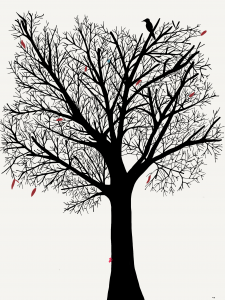
 For me as a kid, there was no better feeling than opening up a new box of 64 Crayola crayons. The big box with the flip top lid and the sharpener on the side. I can remember agonizing over which colour to pick first and being so thrilled by the perfection of the colour palette in neat rows in that box. I loved to draw and colour. I could do it for hours never lifting my attention from the page. In adulthood, I abandoned doing art for pleasure. It seemed silly for me to sit around and draw or paint for no real reason. I felt I should be doing something productive. A few years ago I began to create art again and realized how much I had missed it and how much joy it brought to my life. I create digital art now, which isn’t quite the same rush as opening a box of crayons but it is easier to share with others-like the picture above. I have recently learned about the health and wellness benefits of creating. Creating is rejuvenating, it is rest and it is soul food.
Dan Tricarico, in his book “Sanctuaries: Self-Care Secrets for Stressed-Out Teachers”, he talks about how people get lost in an activity that you love so much that the rest of the world seems to fade away. He calls it a state of “flow”. I find myself getting into that state of flow when I draw, create music, write, cook or do jigsaw puzzles. It isn’t that passive state of binge watching something on Netflix. However, sometimes life’s answer is just that. The state of flow is active and when I emerge from that state of flow, I feel rested and invigorated. In Jessie Scholl’s article, “Go With the Flow: How States of Blissful Concentration Can Boost Your Overall Health and Well-Being” she states that, “Flow triggers the opposite of a fight-or-flight response. Breathing becomes more relaxed, muscles loosen, and heart rate slows. The specific biochemistry associated with flow varies depending on the activity, but the overall benefits to health and well-being are the same. ” In fact, a 2018 Forbes article, “Here’s How Creativity Actually Improves Your Health” written by Ashley Stahl, claims that creativity increases happiness, reduces dementia, improves mental health, boosts your immune system and makes you smarter. Well, who doesn’t want all of those things?
You don’t have to be a professional musician, writer, artist or athlete to practice flow. You can do it with any activity with some level of skill that requires you to pay attention. It is really a type of active meditation. Flow can be found with exercise, writing, dancing, baking, gardening, robotics or whatever activity brings you joy.
Don’t have the “time” for a creative pursuit? It definitely requires some intentional effort to ensure that you take some time each day to pursue what you enjoy doing. It doesn’t have to be for hours but make it a specific small goal. In building anything into a routine or ritual, micro habits are key. These are tiny steps towards implementation that grow into longer lasting habits. When I started creating art again, I just started with doing 5 minutes a day. I just drew something. I wasn’t worried about perfection or even completion. I started getting lost in the flow and those minutes eventually became hours over time. I continued to build my time until I created the habit to attempt to do something creative at least twice a week. Beware of your inner perfectionism critic if you have one, like I do. Give yourself some self compassion if you get out of the habit. No one is keeping score and it is meant to be for you and your health and wellness. When I get lost in stress and the life’s duties I often think, I should probably create something and get into that flow state-it has been a while. Ultimately, I never regret taking that time away from the rush and hustle.
If your activity is just one more thing on your to-do list, it isn’t going to bring you joy and happiness. In order for something to really feed your soul, it has to be something you value, something authentically you and something that you want to do because it brings you a sense of flow, peace, focus and energy. Hopefully you will find something that gives you that “new box of crayons feeling,” whatever that means for you.