Welcome to ETFO

It is February already! Since September, it has felt as if the school year is taking huge strides that go from one Friday to the next.

In the midst of this hectic pace, I am delighted to share the Welcome to ETFO booklet for members in their first 5 years

it is very easy to follow even in your busy work day or after work with a cuppa.

Layout of the Booklet 

I especially connected with the layout of the booklet because right on the first page is the link events.etfo.org  Here, you can access information about programs and conferences that support members’ understanding of ETFO, to support your involvement and leadership growth.

Then, some key programs and upcoming dates are listed.

A yellow square with three white rectangles each listing a programme for ETFO members
Upcoming Programs in the Welcome to ETFO booklet. 

The next page has some key messages that guide the work of our union. I am sharing below a small section of each of the following.

  • ETFO Equity Statement: It is the goal of the ETFO to work with others to create schools, communities, and a society free from all forms of individual and systemic discrimination.
  • ETFO Human Rights Statement: Harassment and discrimination on the basis of a prohibited ground are violations of the Ontario Human Rights Code and are illegal. The Elementary Teachers’ Federation of Ontario will not tolerate any form of harassment or discrimination, as defined by the Ontario Human Rights Code, at provincial or local Federation sponsored activities.
  • ETFO’s Equity Initiatives: ETFO is a union committed to social justice, equity, and inclusion.
  • Definition of an Anti-Oppressive Framework: An anti-oppressive framework is the method and process in which we understand how systems of oppression such as colonialism, racism, sexism, homophobia, transphobia, classism, and ableism can result in individual discriminatory actions and structural/ systemic inequalities for certain groups in society.
  • ETFO Land Acknowledgment
An orange rectangle with ETFO's Land Acknowledgement
ETFO’s Land Acknowledgement

Letter from Your President highlights that ETFO is the largest union representing teachers with 84,000 members. In the inspiring and warm message this reminder stands out: “Your current central collective agreement expires on August 31, 2026. Preparation for the next round of bargaining is well underway. ETFO has established class size as a significant bargaining issue. Look for our Smaller Classes, Big Difference campaign advertising in your community and help spread the word to ensure the public is informed and engaged in our fight for students.”

The table of contents lists the different sections that are hyperlinked for easy access.

I highly recommend staring here because “How your union works for you” is a very important section that you need to remember and also share with colleagues even if they are not in the first 5 years of educational work within ETFO.

The booklet reminds you that,  “You will need your ETFO ID number to register. If you do not know your number, please contact Member Records at memberrecords@etfo.org or 416-962-3836/1-888-838-3836 extension 3806.”

Did You Know?

As per the provincial guidelines of ETFO, “the costs for member release time, travel, meals, and accommodation are covered for these conferences.” Do check out the programs and conferences that support your goals and sign up!

I am sure you will find lots of connections with the material shared in the Welcome to ETFO booklet.

Please ask at least two people if they have read it and please share widely.

Although this booklet is addressing members in your first years, there may be many who have worked longer and have not had the opportunity to access all the resources and information. It is never too late.

With You, In Solidarity.

Rashmee Karnad-Jani
What did you see today? 

Hello Fellow Travellers,

Progress reports have gone home and we are moving through the school year. I hope you are well and are taking care of yourselves.

I’m Here Now

I used to do other jobs before, as a Grade 7-8 science teacher, then SERT in the Grade 6 to 8 years, then K-3 teacher etc. But I am here now. I do not have a classroom of my own is one way of looking at it. Another way, is to think that all classrooms into which I am invited are my teaching-learning spaces too.

I am here now. This is one such recent memory of being in the moment, teaching and learning.

One Monday Morning Recently

As with every stage of life when things change I remind myself that I’m here now so there’s more looking ahead with hope and anticipation than looking back with nostalgia.  It was Monday morning and I was in a Grade 2 classroom at the farthest school on my list.  I’d not been in this classroom before though I’ve met the students in Grade 1.

What Did You See Today?

On my drive, as I travel up from the southern end of the region,  I see the land change and I see horses.

When I’d worked with them then, they’d asked me “where do you live?” And when I’d shown them the general area, some of them had asked, I remember “What did you see on your way up?”

Something Lost, Something Gained

I remember when my younger child learned to read I had felt as if a part of my life  changed forever. So also, as I’ve missed this part of a classroom teacher’s job since 2020. In the early days I remember I used to look through picture books and think “oh that’ll be great to read aloud” and then I’d remember that I didn’t have my own classroom anymore.  It took time to get used to the idea that it’s possible to belong nowhere yet be a part of everywhere.

The Book 

The book I’d chosen was one I have liked as a reader as well as an educator. Friends and colleagues had read and recommended it to one another over the years. That said, I encourage all readers to consult your school board’s Text Selection and Guidelines.

All Are Welcome 

We’ve Read This Book Before

The colleague who’d invited me and I had decided I’d bring a book to read, I’d introduce myself and I’d review her expectations chart… you know how the routine goes.

I did the first few things and as I took out the book the students said, “We’ve read this book before.”

So Let’s Think Differently ( I thought)

I always carry a few copies of copies of picture based prompts for exactly such a moment . I handed out the cards and began to read. I asked the students what they could see in the pictures as I read and what they could tell from their previous reading. They were eager and listened, then responded.

We read together, we noticed some things, we commented on some things, we made connections.

Then a student asked “do you have these cards for our class?” “Yes, I do”, I said and I left a spiral bound mini version with him.

Previous Connections

Although I recognize students from previous years I don’t crowd their space and place when I meet them again. But after  giving the student these cards, as I was moving away, I was stopped with a soft tap on my wrist.

“I remember you”,  the student said softly. You come from far away and you see horses on your way to our school ”

“Yes, I do”, I replied.

It appears that “All Are Welcome” wasn’t just the title of the book I’d chosen.

It was also my experience in this classroom. For such moments, I am deeply grateful.

I want to invite you to write back directly (if you know me outside this space) or through this space to share what you see that welcomes you into your teaching and learning spaces.

With You, In Solidarity

Rashmee Karnad-Jani

How was your weekend?

Hello Fellow Travellers,

November is here with all the busy-ness that this month brings. Progress reports done, family-school partnerships are getting stronger and the conversations among colleagues on how to support our learners are ongoing. In times like these, the weekend beckons.

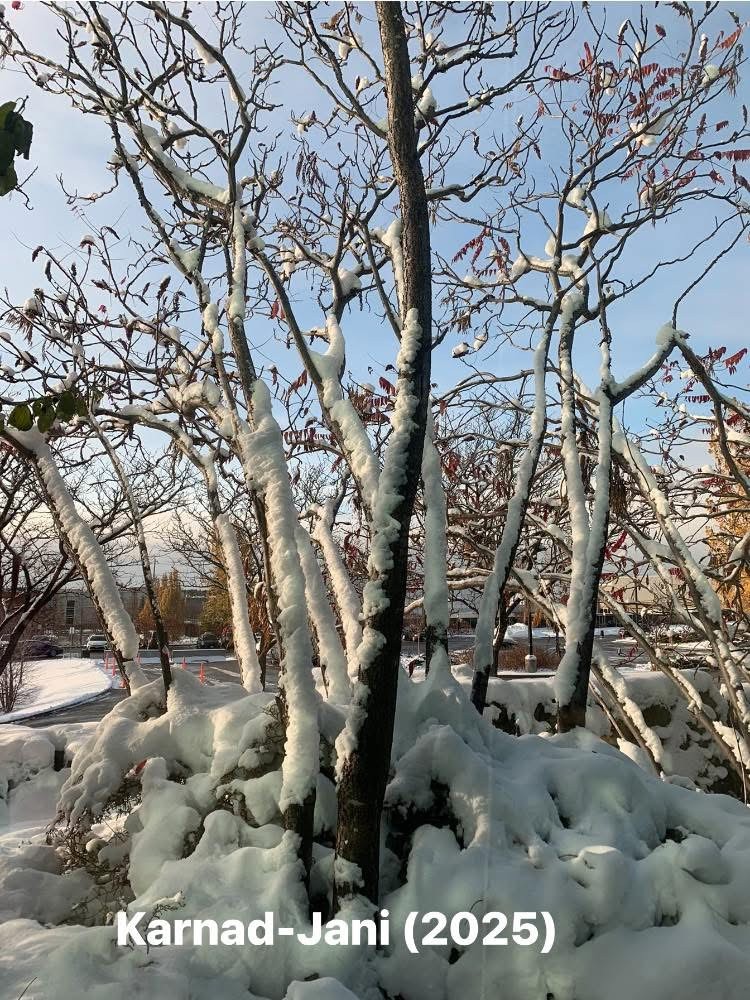
A close-up from a window showing snow covered tree trunks. The sunshine in the background is making the snow glimmer.
Sunshine and Snow Covered Trees

Busyness of a Different Kind

I don’t know the circumstances of others’ lives, and can just speak for mine, at least those that I choose to share.

On weekdays, especially when we have turned the clocks back, going to and returning from work usually happens when the sky is dark. It is also not unusual to come in to a half cup of coffee left on the ledge of the powder room sink, or the plant shelf in the front hallway or even the salt tote on the front stoop.

Weekend Treats

To re-charge and clear my mind, get ready for the week ahead, I have some weekend routines that I shall share below

  • I always make myself a special breakfast either poha, upma, idlis, dosas or a fancy omelette on the weekend
  • I then eat this delicacy in a leisurely manner with my coffee
  • The second cup of coffee is usually with a wander outside, dressed for the weather that allows me to peer at what my botanical friends are doing at this time of the year.
  • One day is for professional and academic writing and catching up on correspondence with family and friends, in the GTA, and around the world.
  • I sometimes pick up holds at the library as it is more relaxed than rushing over after a work day.
  • One day is to prepare my home and me for the week ahead – meal prep etc.
  • Yard work plays a huge part of my weekend at this time of the year because I diligently gather leaves to make leaf mold for the spring time planting.

Looking Inward, Looking Out

Everywhere around me, in order to allow me to enjoy my weekend treats, the world is at work, so to speak. The library is open, the grocery stores are stocked and serving customers, other services are up and running.  if I were to go to the hospital for myself or to support a friend, that ecosystem would also be filled with people working away.

So how would it be if I were to ask students tomorrow: “What did you do on the weekend?” if their parent or caregiver were working in the spaces that make my weekend possible?

This is the mirror I am holding up to my privilege today.

I have a weekend.

Not everyone else has the same reality.

I just wanted to leave that here with my steaming cup of coffee.

With You, In Solidarity

Rashmee Karnad-Jani


June-tember: The Busiest Time of the Year

I have come across the term “May-cember” and  “June-tember” a few times, and I think it captures it well. Spring is a BUSY time of year for ALL educators as we begin to wrap up the school year!

Our tasks includes …

  • Assessments
  • Reporting
  • Interviews
  • Field Trips
  • Class Placements
  • End of Year Planning
  • Physical Clean up
  • Transition Meetings ….

and the list keeps growing

Here are some tips and tricks I have learned over the years (keep in mind I am still learning)

  • Prioritize yourself
  • Focus on what matters: Connection, and Care
  • Say no (guilt-free): Protect your peace
  • Celebrate the small wins: A completed checklist, A kind note from a student… these are all worth acknowledging
  • Lean into joy: Among the stress, May and June brings magic: growth, resilience, and the chance to reflect on how far your students and you’ve come!

What are your tips to thrive at the busy times of the year?

seasons

seasons May 2024

This May seemed more like dismay, and there is not a thing we can do about it. It’s in the books.

As the sun sets on our 9th month of teaching for this school year, I am finding it hard not to mumble a bit more due to fatigue. It’s not just mumbling either. To be transparent here, I am speaking a bit more slowly, writing a bit more slowly, teaching a bit more slowly, assessing a bit more slowly, and on top of it all, I seem to be walking a bit more slowly too. Now before you dial 911 on my behalf, I am otherwise in passable physical condition. I have cut down on the caffeine, tried to be more active, and have increased my sleep times. Despite that little health flex, everything is just happening a little more slowly. 

My friend commented that I might be suffering from A.G.E.. Bwahahahahaha!

If this was my first year in the classroom, I might have needed to take a day to visit the doctor, but I know that the way I feel as June draws nigh, is largely a function of time; time of year, and time in environment. Definitively and definitely. 

So how could these two factors be the cause of my compounded confusion? It’s simple. So far, there have been 170+/- instructional days to plan, deliver, assess, and repeat subject over subject. Even with a fairly balanced amount of holidays, PA days, breaks, personal illness, family illness, and weekends this work takes its toll on body and mind. These past few weeks have come with a certain heaviness and have me feeling like it is a good time to hibernate rather than frolic in the fields. I find myself really craving quiet solace instead of seasonal solstice. 

Regardless of the current sources of my discombobulation, it seems like I can’t be the only one feeling this right now. Come to think of it, I have been noticing that there is a different set of seasons in this job. Here’s what it feels like as I type this post;

Sept to late October = Spring
late October to March = Winter
March to May = Spring, then Winter again
June = Spring, then Summer

This may not line up meteorologically or anywhere else except in my perception of education, but my physio-emotional barometer has read like this pretty consistently year over year. 

Maybe a better way to make sense of my seasons can come from acknowledging that we all have them and go through them in our own way. Truth be shared, my quasi-psyentific explanation above is quite falsifiable. Could this all be more a function of my current situation with another round of reports due soon? Is the internal weather that I am experiencing only a mental anomaly? Why am I struggling instead of dancing down the hallways with only one month of school left? I think there are three big reasons. 

First, the past 9 months have taken a toll on me mentally and physically. Running teams, mentoring sessions, and clubs in addition to the planning, instruction, and assessment comes with its costs. Time is finite and so are energy levels. The need to fill our tanks is undeniable. I also would not have it any other way. 

Secondly, there is a lot going on in June. Reports, EQAO, room moves for some, grads, school moves for others, and of course an extra demanding challenge of keeping the learning happening as the temperatures continue to rise. I have resorted to a resort styled wardrobe to beat the heat. Classy and cool. 

Thirdly, I am going to miss my students. Like every year, this group has really grown on me and we have come so far together.

As I try to snap myself out of this odd out of season stupor and into true June mode I am going to double up on my down time, continue to teach a little more slowly, linger longer in conversations with my learners, and take a little more time to take each of the coming moments all in knowing that another season is already on its way.

Avoiding Burnout: A Vital Pursuit for Educators

Burnout is a pervasive problem affecting educators worldwide, leading to decreased job satisfaction, compromised well-being, and diminished classroom effectiveness. Addressing this issue is paramount to maintaining a high-quality education system. The demands of teaching can be overwhelming, leading to physical, emotional, and psychological exhaustion. To maintain a high standard of education and foster a healthy learning environment, educators need to prioritize their well-being and avoid burnout.

The first step in avoiding burnout is recognizing its signs and symptoms. Burnout is characterized by emotional exhaustion, depersonalization, and reduced personal accomplishment. Educators may feel emotionally drained, detached from their students, and experiencing a diminished sense of personal competence. Identifying these signs early on can help educators take proactive steps to prevent burnout. Understanding the root causes of burnout is essential for developing effective prevention strategies.

Photo by Nataliya Vaitkevich


One of the primary causes of burnout is an imbalance between work and personal life. Educators often dedicate long hours to lesson planning, grading, and extracurricular activities, leaving little time for themselves and their families. Educators must be intentional about self-care and establish clear boundaries between work and personal life to address this issue. Setting aside time for relaxation, hobbies, and spending quality time with loved ones can help alleviate the stress associated with teaching.

Educators should not hesitate to seek professional support when experiencing burnout symptoms. This may involve consulting with a counsellor or therapist specializing in educator well-being, and sharing challenges and concerns with a trusted mentor and/or professional can provide educators with valuable insights, coping strategies, and emotional support to navigate the demands of their profession effectively.

Mindfulness and stress reduction techniques can be valuable tools for preventing burnout. Practices such as meditation, deep breathing exercises, movement activities, nature explorations or yoga can help educators manage stress and stay grounded in the present moment. Integrating these techniques into daily routines can improve emotional resilience and well-being.

Creating/immersing in a supportive community within the school environment can also contribute to educator well-being. Participating in professional development opportunities, such as workshops, conferences, and ETFO local union events (socials) and peer support groups, can provide a network of like-minded individuals who understand the profession’s challenges.

Burnout is a significant concern in education, as it affects educators’ lives and the quality of education provided to students. Prioritizing your well-being and implementing strategies that enable work-life balance, will ensure that you have a fulfilling and sustainable career as an educator while providing the best possible learning experience for your students. Ultimately, the prevention of burnout is not only essential for us as individual educators but also for the betterment of the entire education system.

ETFO members who feel that they are experiencing mental health challenges should discuss their concerns with their family doctor. Mental health support may be available to ETFO members through Employee Assistance Programs (EAP), accessed via their district school board.
Additional support may be found through Starling Minds, which offers a variety of digital programs free of charge for ETFO members. Read this PDF about Starling Minds and learn how to register.

My Union and Me

Five ETFO members share their perspectives about the union and their engagement within it in an interview. Here is what they had to say.


Question 1: What would you say to new teachers about ETFO?

ETFO is the union for elementary teachers that advocates and protects our teachers’ rights. Get to know your union. Get involved early! You are your union and so many opportunities are available for new teachers. Grab a friend and show up to something local or provincial. Make sure ETFO has your contact information and stay connected to your Local. ETFO sends out lots of valuable information, but your Local should be your first call for clarification and support. Know your union and get involved.

Question 2: What benefits or advantages do you feel you have gained from being a member of ETFO? The collective strength of the union. Access to information and resources to help inform my practice as an educator.

Deep learning, meaningful connections with educators all across Ontario. Collective Bargaining is so important, especially when faced with systems that don’t show value for teachers and education. The government can talk about how they promote education, but their actions and budgets do not reflect this. Support and knowing my rights are protected as an educator is a crucial benefit of being a member of ETFO. ETFO fights for my rights as an educator and for the rights of my students in the classroom.

Question 3:  How do you perceive the role of your union in advocating for your rights and interests as a worker?
I feel that we receive support from our union as required. The union represents you and your interests as an educator. Overall, I feel the union advocates for the rights of teachers, however, the issues are so complex and a proactive attempt to initiate change in the education system is underway. I believe the union is doing what it can with what it can when it comes to advocating for the rights and interests of its 83000 workers. I believe the union’s role is upholding the collective agreement and advocating for better working conditions for their workers. It is the most important of its jobs.
Question 4: What ETFO activities/programs do you most look forward to yearly?
ETFO workshops are very educational and supportive of teachers’ needs even when we don’t know what our needs are. The Annual Meeting in Toronto and the Professional Learning offered create space to meet meaningfully with fellow teachers across the province. I also look forward to the events and workshops provided by my Local. Learning from/with racialized and marginalized educators wherever the opportunity presents itself in ETFO’s programming challenges my thinking and enables me to refine my teaching practice each year.
Question 5: If you could describe ETFO in one word, what word would you choose and why?
Supportive. Layered. Evolving. Responsive. ETFO is there to help educators through each ebb and flow.
Get to know your union today, and be a part of “safeguarding public education in Ontario and ensuring all students have access to high-quality public education, as we address inequities in all parts of society, ETFO takes action” (ETFO Action, 2023).


smashing pumpkin spiced thinking – school edition

I can almost hear it now, the sound of the last pumpkin spiced anything be sold and the leftovers being shipped back to the warehouses for next year. I am positive that the chemicals that make up these products have a half life and will ensure it’s best before date does not expire for another decade or more.

Who buys this stuff? To my knowledge, I do not think anyone in my circle of friends has ever been excited about pumpin spiced goodies and drinks. Cue the relief. Not that there is anything wrong with it. We all go through a curious phase or two in our lives, but once the trance wears off it’s usually back to the status quo.

Have you ever been persuaded to try something that you instantly regretted afterwards? At first, you think you like it because how could all that hype be wrong? Once that fades and the taste kicks in you’re left to be alone with your decision(s). I mean where would we all be without the gift of knowledge regret provides us?

I’ll give you an example: Hammer pants  One of many the blessings of being a certain age is that any evidence of my bad decision making has not been digitally preserved. Case in point with this late 80s fashion craze. I am sure that it seemed like a good idea at the time.

Speaking of good ideas at the time

Starting out as an educator, all of those years ago, I came with my own set of bags packed full of the way that I was going to lead my class. Inside that luggage were many positive, and unfortunately, negative experiences and I was determined to repeat what worked and bury what didn’t. What could possibly go wrong?

What I quickly realized in those first years was there were already several well traveled paths to follow along that started to be seen as ruts rather than pathways to success. I found myself trying to shape my students around the resources in the building rather than the other way around. Things went well, teach, practice, test, and repeat, but it came with a cost. Those lessons never felt like they were relevant to my students. They lacked depth and scope for a number of reasons, some of which are on me as a new teacher, and others because they fell within the “We’ve always done it this way” space.

When my second year rolled around it was easy to follow along the well worn path once more, but instead of proceeding safely along with so many others, I made a decision to wander off to see what else was out there. Don’t get me wrong, I could still see the trail to provide some cardinal directions, but my detours began to provide us all much richer and diverse perspectives. It only took a year to realize that there were many paths to create and pursue that could edify both students and their teachers.

I began to seek out others who wandered off in their spaces and ended up connecting with an insightful and supportive global professional learning network or PLN. All these years later, I am thankful for the connections and kindness that helped me navigate off of what was the norm and around some other ruts that needed avoiding.

Where do I find these amazing folx?

For me, it started out at school board level events and edtech training sessions. It didn’t take long before I joined Twitter when it became a truly global cohort. Yes, Twitter can still be used for good and not evil despite its new owner and legions of misinformed malicious account holders exercising their free speech without facts or accountability. End rant.

I joined weekly discussions via #edchat and then #etmooc and then #CnEdChat to start and started following some of the more experienced and supportive educators on the platform. As time went on, I started a blog called What and Why are Everything to hash out some of my thoughts. Our weekly Q and A discussions on Twitter became sources of great perspective and growth which continue to inhabit my practice to this day. It was almost like I was given permission to be the teacher I wanted to be rather than another educator flattening the well worn path.

What started happening was the democratization of my classroom through student directed learning, Genius Hours, and the use of videos to enhance the scope of my instruction. What better way could there be to bring an expert into the class room with the click of a button rather than read through a text book that had been written years beforehand.

This shift in thinking helped me realize the static and fluid natures of knowledge that we have to balance each day for our students and ourselves. It also moved me past some of my negative experiences as a student. I appreciate how some of the things I went through empowered me not to repeat them just like I would never buy a pair of Hammer pants or pumpkin spiced anything again.

the eyes tell our stories

Trigger warning: This post may be triggering to some folx as it discusses the emotional and physical toll happening on our students and our profession. I hope you read on.

A student asked to speak with me the other day. They said things weren’t going so well. They didn’t have to say a word. Their eyes told the story of someone who had been going through a lot lately. They shared and I listened while resisting every urge to cry along with them. How has it come to this I thought? How have so many of life’s weights been placed on a student who deserves to enjoy these years without worry, fear, or doubt?

While they spoke, it became known that these feelings of sadness and dread have been building up for a couple of years already. It struck me a bit odd as this student comes across as one of the most well liked, bright, and optimistic persons. If they were struggling, then how many more have not found the courage to come forward? My mind raced around how best to support them in the moment, but then moved to thoughts of what needs to happen on the macro level of our classrooms.

Despite some training, my mental health first aid kit is still only partially stocked, and unless additional social workers can be added to our school, I fear things will only be getting worse.  If it is happening in one school, then it is probably happening in many others. Notwithstanding the already existing immense work loads placed on centralized caregivers in school boards, it does not appear that supply will meet demand any time soon.

I guess that my best move for this particular person will be to check in with them a little more frequently, contact family to construct a cohesive support plan, and to recommend seeking some help from a social worker if at all possible. I am also going to build in some wins for them throughout the week. These could be a few more affirmations or intentional opportunities to have fun in their day.  Maybe this approach could help in supporting staff as well? Read on.

They didn’t have to say a word. The eyes told a story of someone who has been crying a lot lately. What happened before coming to school? How were they going to make it through another day when the sound of fast paced walks toward their door meant another part of the day, intended to plan and organize, was going to be co-opted again. How can this continue to happen when things are supposed to be safer, better, and back to normaler? Cue the tears. Cue the sadness. Cue the confusion. It’s hard to hide the stress or frustration. With all of that to manage, anger is never far behind. So when someone asks what is causing the tears specifically, the answer is nothing and everything at the same time.

Nothing because there is nothing we can do about what is happening other than mask up, make sure the kleenex box is full, and brave out the current chaos of each day. Everything because the number of issues provide more than enough straws to collapse every camel’s back. Mixed messages, inaction, anti-vaxxers, non-maskers, insane rates of infection, lost preps, fatigue, and having to complete the same system work with less time due to time that has been ‘liberated’ from one’s daily schedule.

Image
via https://twitter.com/MikeJToronto/status/1520175065333219329?s=20&t=NLlivpQQu-yLApHE3_iEUA

I looked into the mirror. My eyes were dull, glassy, and dry. Thankful that another week has passed where I did not have to be out of the classroom. Thankful that I did not have to isolate. Relieved that time outside of school meant a chance to disconnect and recharge.

Although there is no single thing to attribute this current state. It could be because of the daily dread built up from what is happening in schools right now. It has gone far beyond any occasional days when OT jobs went unfilled to a sadly predicatable and unprecedented time in our profession. When was the last time you ever heard of 9 unfilled OTs at one school? Last week comes to mind.

If it hasn’t been mentioned before, the folx caring for this province’s most precious resources are having a tough time and are being pushed to the brink of exhaustion and anxiety. It seems that once again, pontificating politicians have put their heads in the sand when it comes to equipping educators to meet the realities of the day with the resources they need.

Let’s start by having more teachers available to cover the amounts of educators having to take time to quarantine due to illness/exposure to COVID19 or to care for an infected family member in the same home. As we enter the final months of the school year I am not feeling super confident that things will change and that has me worried about my own energy and emotional levels.

Despite every educator’s individual efforts, ‘things ain’t goin’ so good’. No amounts of extra time or out of pocket expenses are going to fix what is happening. We need personal supports for students and staff more than ever not affirmative memos and lipservice from elected/board leaders. Help.

…and in this corner

….weighing in at the size of that giant elephant in each of your classrooms.

Yup, with a sense of timing so impeccably ironic, that it is only achievable by elected officials, we are once again face to face with maskless learners and colleagues.

Oh the freedom!

This all despite numbers related COVID19 cases, hospitalizations, and deaths) increasing across the province. Despite a strategic throttling of information from the current government and an ineptly duplicitous media incapable of calling out the “horse hockey” being shovelled at an unwitting public who is either happily oblivious learning how to live with COVID19 or now scrambling to avoid a negative patient outcome for someone in their life who is immuno-compromised.

Another struggle took centre stage the moment the masks were allowed to come off in Ontario. We are once again facing government sanctioned chaos when it comes to public health policy and education in our province and there are signs of  trouble in nearly every public school. #Onted via Twitter reveals numerous schools with growing numbers of COVID19 cases and exposures among their youngest learners. That means more absences (students and staff), more missed learning opportunities, and more uncertainty in schools/homes.

To no one’s surprise who has actually taught in a school over the past 2 years, students, teachers, and support staff  once again find themselves at greater risk of being exposed to COVID19 now that masking has become optional in public schools.*

Thankfully, at the school where I teach, the number of students and staff still choosing to mask up each day remains around 90%. Odd though how that figure corresponds to another public health statistic at 90%. Hint, it rhymes with vaccination rate. Hmm? Yet, that is not the case inside of many other schools and has the potential to be problematic on a number of fronts. I’ve seen this movie before and as I recall, it ain’t a comedy.

The removal of required masking, limited cohorting, mandatory hand sanitizing protocols, and social distancing have not provided me with the peace of mind that the return of such “freedoms” pretends to promise. So what is can a health conscious public educator do while they are now placed on the frontlines of learning to live with germ warfare?

Psst. Running away and hiding are not options.

The safest moves are to continue limiting our own exposure to potential infections by keeping our distance, masking at all times, sanitizing, and limiting our social interactions. Overcoming a global pandemic entering its 6th wave is going to take a little more time. We have gone through so much and have learned an equal amount about ourselves and others.

I can sense that students are still concerned about this too. I have noticed them still sanitizing their hands and trying to maintain their distances with students who have chosen to go maskless in class. Thankfully, I have not observed any social shunning as of yet which makes me hopeful that this will be the case in the general public when ideologies collide as legislated social expectations are gone. It is in this spirit of care and respect that I encourage you all to stay safe and strong as you continue to serve and shine in your classrooms.

* I was going to make a snappy comment about how private schools did not have  to remove their mask mandates while all public schools were ordered to do so, but I could not think of a good way to phrase it without the use of profanity.