
Teacher Advocacy Matters in the Right to Read

Ontario Human Rights Commission on the Right to Read

In the past school year (2019-2020), the Ontario Human Rights Commission (OHRC) on the Right to Read has launched a public inquiry on the human rights issues affecting students with learning disabilities. This public inquiry was facilitated due to concerns from parents and recent Education Quality and Accountability Office (EQAO) test scores showing over 25% of Grade 3 students and 53% of Grade 3 students with special education needs did not meet provincial standards.

Students Struggling with Reading

The OHRC cites that students who cannot read struggle with many aspects of school and are more vulnerable to psychosocial stressbehavioural issuesbullying and much lower levels of educational achievement  (Schumacher et al, 2007.) The result of these challenges means that these students face life-long consequences including, homelessness, and involvement with the criminal justice system (Bruck, 1998; Macdonald, 2012; Maughan, 1995).

All students with reading disabilities, such as dyslexia, have a right to learn how to read. The OHRC is concerned that these students are not getting the supports they need to become literate. This is particularly challenging when students are not receiving early intervention and supports that are known to be effective in increasing reading ability.

The OHRC Right to Read inquiry team assessed evidence based approaches to meet students’ right to read. As part of an effective systematic approach to teach all students to read, they cited five benchmarks including: universal design for learning (UDL), mandatory early student screening, reading intervention programs, effective accommodations, and psycho-educational assessments.

OHRC Advocacy for the Right to Read

For the 2020-2021 school year, the OHRC Right to Read inquiry team wrote to the Ministry of Education and school boards, calling on the establishment of programs that systematically address the needs of students with learning disabilities. The communication cited concerns around students’ inconsistent access to technology, professional services, screening and assessment, and specialized reading instruction and programing. In addition, the OHRC Right to Read inquiry team had concerns about the role of Identification, Placement, and Review Committees (IPRCs), the implementation of Individual Education Plans (IEPs), and the duty to accommodate students’ education needs.

The OHRC Right to Read inquiry team is currently analyzing the information received and is drafting a final report. The report will address concerns with how Ontario’s public education system meets the needs of students with reading disabilities. These concerns relate to curriculum and teaching, early screening, reading interventions, accommodations and psycho-educational assessments.

A final OHRC Right to Read inquiry report, which will include detailed findings and recommendations for government and education stakeholders, is now planned for release in Spring of 2021.

Teacher and Guardian Advocacy on the Right to Read

As teachers, we see the direct impact challenges with reading has on students’ learning. The lack of literacy at grade level prevents students from taking full advantage of what is being taught in the classroom. Every day of not being able to read results in another day where students fall further behind.

Waiting for Psychoeducational Assessments

Psycho-educational assessments are key to determining students’ strengths and needs in their educational profile. With this profile, students can receive the special education funding and support they need to achieve their potential as learners.

As teachers, we also know of students who have been placed on long waiting lists for psycho-educational assessments. Even with the increase in special education funding, boards of education and principals report inadequate resource funding to meet students’ needs (People for Education, Feb 2020.)

Parents and guardians must wait, for sometimes years, for their child’s name to make it to the top of the list in order to receive a board funded assessment. Parents and guardians who have resources can seek costly psycho-educational assessments from private providers. Parents and guardians who do not have resources must wait as their child falls further and further behind. Sometimes students never receive a psycho-educational assessment. This reality means that students who live in lower socioeconomic households may never get their special education needs assessed or met, thus making them more susceptible to leave school early.

It is important to note that boards of education are trying their best to support all students’ needs. Boards of Education already spend 80% more on special education than they receive from provincial educational Ontario funding (Ontario’s Auditor General, 2017.)

Teacher Advocacy Matters

When students struggle with their learning, teachers’ advocacy matters. In the Ontario College of Teachers’ (OCT) Ethical Standards for Care includes “compassion, acceptance, interest and insight for developing students’ potential. Members express their commitment to students’ wellbeing and learning through positive influence, professional judgment and empathy in practice” (OCT, 2020). This means that within teachers’ practices, they must promote students’ potential. I cannot think of anything more important than promoting literacy to promote students’ potential.

As a dyslexia learner and a teacher of dyslexic learners, I understand the struggle and emotional impact of living with dyslexia. People do not grow out of learning disabilities, they just learn how to live with them.

The bottom line is that reading is a human right and without the ability to read, students face an ambiguous future.

Teachers work to empower literacy for all students, as all our students deserve the Right to Read.

Collaboratively Yours,

Deb Weston, PhD

Resources for Teachers and Guardians

What are LDs?

Living with LDs

Assistive Technology and LDs

Executive Function and LDs

Reading and LDs

Writing and LDs

Math and LDs

https://www.ldathome.ca/what-are-lds/math-and-lds/

Math Waterfall Chart: Understanding Learning Disabilities- How processing Affects Mathematics Learnings

Building Math Skills at Home

Attention Deficit Hyperactivity Disorder (ADHD and LDs)

Mental Health and LDs

References

Bruck, M. (1998). Outcomes of adults with childhood histories of dyslexia. Reading and spelling: Development and disorders179, 200.

Macdonald, S. J. (2012). Biographical pathways into criminality: understanding the relationship between dyslexia and educational disengagement. Disability & Society27(3), 427-440.

Maughan, B. (1995). Annotation: Long‐term outcomes of developmental reading problems. Journal of Child Psychology and Psychiatry36(3), 357-371.

Schumacher, J., Hoffmann, P., Schmäl, C., Schulte-Körne, G., & Nöthen, M. M. (2007). Genetics of dyslexia: the evolving landscape. Journal of medical genetics44(5), 289-297.

“Ontario considering extended school closures as winter break approaches”

Gulp. 

My heart sank down to my stomach as I read headlines such as this one flood the news and every single social media platform that I am a member of. 

I am, by nature, a worrier in general. So this year and all that has come with it has brought immense amounts of stress into my personal and professional life. When schools were locked down in March, I was so positive there would be a quick fix to the problem. Like many people, I figured a two week shut down would obviously solve the issue and we would be back with our students in no time. I often reflect back on how misguided I was in those moments. I wish I would have clung to “normal” life just a little bit harder and appreciated it just a little bit more. 

As an Occasional Teacher, my unique situation of travelling from school to school and class to class leaves me extremely vulnerable in the times of COVID-19. I wear my PPE, I wash my hands, I socially distance, but the fear of contracting and/or spreading the virus hovers over my head each day like a dark cloud. Some days it feels like I am trapped in a small room, where the walls are inching closer and closer to me. Therefore the thought of a closure feels safe to me, it feels comfortable, it feels familiar.

On the contrary, it feels like another closure is equivalent to taking ten massive steps back. Educators have made enormous  progress and countless sacrifices in order to welcome students back into school, and are simultaneously supporting students academic, social and emotional development amidst the current restrictions. Being with students is what sets educators souls on fire. It is the students that inspire me every day to keep going, keep persisting, and keep learning. 

So much unknown. So much fear. What will happen to me? Will I continue to have consistent work? Will students be okay, academically? Socially? Emotionally?…

“Minister Lecce says extended winter break will not be necessary”

New news begins to flood my social media. No extended time away from school, for now anyways. As we move forward, through the cold and flu season while battling a second wave, the fragility of the system we have worked so hard to build back up seems more apparent now than ever. It feels like at any moment, things could come to an unknowing halt. Day by day, month by month we remain unsure, on edge, confused and exhausted in anticipation of what the future will hold. 

My grandmother was an elementary school teacher for many years. She now has dementia and does not entirely understand what is happening in the world or comprehend the devastating impacts of the pandemic. Her and I often chat about teaching, as her short term memory is fading but memories of her work as an educator come easily to her mind. I explained to her my panic, my stress and my feelings of hope and despair all at once. She turned to me and said something I will never forget.

“Teachers will never know what their days at school will look like. We could plan forever and the outcome will still be different than expected. But, teachers are good at change, that’s what we do”. 


No matter what comes our way,

We’ve.  Got.  This.

From zero to one hundred, real quick!

As my online teaching journey continues, I find myself always thinking about the importance of reaching all students.

Last week, I noticed I only had about 13 out of 31 students participating daily. I wouldn’t see the other students writing in the chat, posting in the discussion section or raising their hand to speak on the mic. I started to worry if they were even in front of the screen during our calls. I started to think about solutions to this problem. I contacted every family in the class to touch base about their child’s online participation. Not even one hour later, I noticed a huge change in my entire class. I know this motivation came from a parent this time, but in the future I believe it could turn into self motivation. I received 25 out of 31 responses in math, 18 readers for our online novel, nine more short story submissions and six students speaking on the microphone for the very first time. To top it all off, this was happening on a Friday afternoon!I wondered if Friday was just going to be a one off and students would go back to their bystander ways in the future, but participation during these past two days have been better than ever. Not only that, my original 13 that participate so much (since the first day) are always encouraging everyone that is just starting to participate. The environment could not get any better!

We started off this week talking about goal setting and the importance of student participation in the classroom. Every Monday, students would set a goal that they hope to achieve by Friday. On Friday, I will ask students to type in the chat or use the microphone to share if they met that goal. If they did not, their classmates will help them brainstorm ideas for them to reach it the next time.

I know teaching new concepts is something that I can do during math, language, etc. but I love when the students get to hear from each other on that microphone or in the chat. In math, I find students teaching each other concepts before I am even quick enough to reply. In language, students are congratulating each other about their reading abilities before I even think to do so. My favourite moment of last week was in drama when a student gave away his turn because he wanted someone else to have a turn who had not participated yet. I constantly feel like crying tears of joy because of the supportive environment my class has created.

I look forward to continuing this online journey as I know I have a group of hardworking, goal oriented, passionate and kind students.  I am so fortunate to be on this learning journey and I am learning that the online environment really is turning out to be an incredible place for student growth. I cannot wait to share another great success story!


Self-preservation, in the time of Covid-19

Caring for myself is not self-indulgence, it is self-preservation and that is an act of political warfare." Audre Lord

ETFO’s position on in-person learning remains unchanged. The union firmly believes that the daily, in-person model of instruction and support best meets the educational, developmental and social needs of students, provides the best experience for support, and is the most equitable learning model for all students. ETFO’s expectation is that elementary virtual learning in any capacity, including through hybrid models of instruction, will end once the pandemic ends.

In the time of Covid-19, feeling like I am working all the time has become a regular part of my existing.

Spring 2020

In the first lockdown, I was working 7 days a week, planning, instructing, and assessing. My learning curve was steep as I was developing skills in teaching through an online classroom via video sessions and learning how to organize my classroom instruction and assessment through technology. As I look back, these skills, now attained, seem so straight forward. The end of the school year in June 2020, was a welcome time for me as I could finally relax and have time away from screens.

Fall 2020

The September 2020 hit. Almost every day, policies and procedures changed. At one point I gave up reading board emails as the absorption of information taxed my executive function and in the end was futile as information changed. Instead, I asked the office staff for the “latest” updates thus sidestepping the need to read pages of email text.

As I had anticipated a future lock down, I set up my contained special education classroom practices to be virtual in nature. This meant that I could easily flip to teaching solely online if needed. Weeks into September, I was informed that I would also be teaching students synchronously online while teaching my students in class. Naïve, I thought flipping back and forth would be something I could handle. But it wasn’t.

Hybrid teaching and learning with inadequate technology

With students both online and face to face, my classroom calendar became the classroom hub. I set video links for the online students to join our class. There were a few significant barriers I had to overcome. Technology (i.e. equipment) needed was not provided, nor was the tech support to align my synchronous instruction needs. At one point, I was using a Chromebook as a microphone and camera in order to facilitate my online students seeing and hearing me and the rest of the class. There were many failed configurations that often resulted in echoing feedback. It was a very frustrating time for my students and me.

Welcome Mike

Finally, I decided to purchase a microphone for my school computer. The in class microphone, now called “Mike”, was a stress saviour. Now, our class could interact with students at home with ease. I left the video link open all day so students at home could reach out to me for help while we worked in class. They even asked to go to the bathroom!

In late October, my board provided our class with additional teacher support to work with students at home. The online students did not receive direct Physical Education, Health, Art, and Music (i.e. PHAM) instruction and were left with no teacher instruction as I was on my planning time.

Extra support is not always helpful

I welcomed this additional support for my students, at first. But the configuration and constraints set out by my board had the teacher providing online support to my students before our school’s first bell (i.e. students were set to receive instruction outside of school hours.) There was also a suggestion that I change my schedule, yet again, to accommodate this additional teacher support. It was late October. After changing my schedule over 6 times, I had finally found a schedule that supported all planning and curriculum requirements. I refused to change it again. After several weeks, the online support teacher was working with my students in a time period that met everyone’s needs … without a change to my schedule.

Stress increased risks to health

During the spring 2020 lockdown, I noticed new symptoms with my stomach. I attributed these symptoms to my existing diagnosis of gastritis and being more sedentary than usual. Between July and August, my symptoms faded away.

Once September hit, my symptoms made themselves known, getting a little worse each day. I experience regular pain in my abdomen and was exhausted all the time. I avoided possible triggers such as alcohol and fried foods but the symptoms became increasingly more disruptive, causing me pain that prevented a restful sleep.

On the phone, I talked to my doctor about my symptoms and we agreed to increase my stomach medication. This did not resolve the pain. Finally, I went to the hospital. The emergency doctor asked me why I had not contacted my family doctor about the pain. I told her I had but my doctor was not able to palpitate my abdomen … over the phone. Blood tests and a CT scan revealed an issue with pancreatitis and irritable bowel syndrome.

As I eat well and take care of my health, I wondered why I was experiencing this painful and fatigue inducing diagnosis. I then realized the obvious cause … stress.

Establishing boundaries to preserve physical and emotional health

Since my trip to the hospital almost 2 months ago, I still have symptoms. But I am feeling better and have more energy. My diet is very limited and I cannot eat very much at a time. I’ve lost over 20 lbs … don’t worry I am not a skinny person.

As a result of my health issues, I have purposely limited the time I spend on school work. Last weekend was the first weekend since teaching during Covid, that I took an entire weekend off. I have also taken up my cross-stitching hobby and listening to books. Herbal tea with a touch of honey is also very soothing. I find that when I do choose to work on my teaching practice, I am much more focused and effective as I am making fewer errors in my online classroom planning.

The time I’ve spent, being purposefully relaxed, has helped me manage my work as a teacher. In putting my own needs first, I am able to support my students more effectively.

It is my hope that teachers who read this blog will take more time for themselves so they can be there for their families and their students. If teachers do not care for their own needs, they could face burnout or challenges with physical and/or emotional health.

As Audre Lord states

“Caring for myself is not self-indulgence. It is self-preservation and is an act of political warfare.“

Take care of yourself before you care for others,

Deb Weston, PhD

Honouring those who experienced war

George Ebert

Today, Wednesday, November 11, 2020, I spoke with my students about why Remembrance Day is a special day to honour those who lived through war.

I recognized that my words had little meaning as they were just words. We watched videos about people who had been in war; but these images had little context and meaning to my students who were sitting in a classroom in 2020.

I grasped that, in order to put Remembrance Day into context, my students needed to hear real stories about real people.

Fortunately, there are many stories I can draw from, in my own family history. Here are a few …

George Wilbert Henry Ebert (1920 -1943), navigator in the British Canadian Airforce from Cache Bay, Ontario (now North Bay).

Wilbert Ebert shot down in WWII


Will was my half uncle. He survived the death of his siblings and mother from Tuberculosis (TB). My grandfather, George Wesley Ebert, met my grandmother, Permilla Ann Coulthard (nurse) in the Muskoka Tuberculosis Sanitorium. George may have contracted TB from his work as a mining electrician or as it spread through the Cache Bay community. Will and George were the only family members remaining.

Will, a school teacher, was eager to explore the world and to learn how to fly. He became a pilot/navigator after only weeks of training and was sent to fight WWII. He was 22 years, 3 months, and 2 days old when his plane was shot down over Iceland. Will would never see his family again and would never have a family of his own. I never knew Will but I have read his letters to my grandmother and grandfather. He always sent his best wishes to my mother, who would have been around 5 years old at the time.

George Wesley Ebert (1897-1957), sniper in the British Canadian Army from Cache Bay, Ontario.

George was a sniper in WWI. My mother told me he loved the wilderness. George’s mother was aboriginal. He was a skilled hunter and fisherman. He was also a perfect person to take to the Canadian National Exhibition as he always won the very large prizes in the shooting galleries. While fighting in the trenches, he was gassed several times which caused significant damage to his lungs. His health never was the same after war and upon contracting TB, it only worsened. George was a troubled person who relied on alcohol to sooth his trauma. This would lead to his end in an early death.

George Ebert with fur

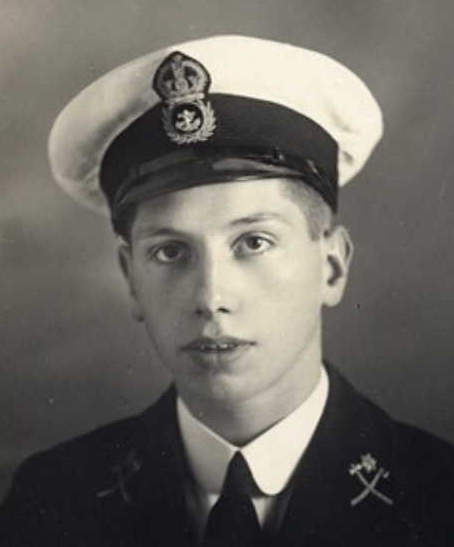
Lewis Henry Weston (1910-2008), British Navy, Lieutenant Commander born in Plymouth, Devon, England, last stationed in Northern Ireland. Lewis pictured below aged 12, 45, and 96.

Lewis Henry Weston 1910052 (2)

Lewis joined the navy at the age of 12. This was not unusual as most children from working class families did not go to school past grade 6, instead working as an apprentice or in service. My grandfather had many tales to tell about his 30+ years in the navy. Lewis was a navy engineer meaning he built bridges and roads with his hands. He was also a navel diver, wearing very large metal helmets and heavy metal shoes while men pumped air into his helmet to keep him alive. Lewis stayed alive by his commitment to duty, as well as his wits and his faith in God. At the age of 45 years old, he retired from the British Navy and collected an indexed pension until the age of 98.

While Lewis was away at war, my grandmother, Iris Doreen Turpin Lawrence Weston, was in London, England during the German bombing raids. At the time, my uncle was at boarding school in the countryside. Iris and my father, David John Weston, sought safety every night in the London Underground (i.e. subway). My father shared stories of the terror he and my grandmother experienced as bombs fell every night, destroying the City of London. Even though my father never went to war, I believe that David never got over the terror he experienced. Iris never talked about the war.

In sharing these stories with my students, their understanding of the impact and loss due to war was grounded in real stories about real people, my people.

I encourage teachers to share their own family’s stories. War needs context as this will bring a deeper meaning to the courage displayed and loss experienced. This will help our students understand and remember the terrible cost and loss of war.

Collaboratively Yours,

Deb Weston

“Just” an Occasional Teacher

Hello everyone!

I am thrilled to announce that I will be joining the Heart and Art blogging team this school year. I look forward to time spent being passionately curious with all of you.

As educators, it feels we are under the spotlight this year to openly reflect in conversations with curious strangers on how the school year is going amidst the pandemic. Everyone is wondering how educators are creating activities and lessons for students that involve social distancing, mask wearing and constant hand sanitizing. When asked personally about how this crazy year is affecting me, I often find myself replying with “I am just an Occasional Teacher”. 

I love my job and feel valued in the school system, especially this year with the demanding need for Occasional Teachers across Ontario school boards. I feel important, worthy and necessary. Why do I sell myself short each time by adding the word “just” in front of my job title? 

The word “just” has so much power and holds the potential to remove importance from meaningful concepts. As I reflect upon my own use of the word “just”, I begin to think about how this small but significant word can affect my students. Psychologist Carol Dweck talked about students’ growth mindset and the power of the word “yet”. In terms of growing and learning, students can use the word “yet” to talk about what they cannot do, but will learn to do after practicing, taking chances and making mistakes (for example: “I do not know how to multiply… yet”).

Does the word “just” have the opposite effect? Instead of granting power and adding room for growth like the word “yet” does, “just” seems to diminish the power of whatever follows.

Let’s harness the power of “yet”! Here are some phrases that should not follow the word “just”:

  • Students are “just” playing.

Play is how students explore, investigate, discover and create what they don’t know yet. No matter age or ability, each student deserves play opportunities in an environment that respects and celebrates the benefits play can have on academic progress, social and emotional growth and overall student well-being. 

  • “Just” Art, Phys. Ed, Social Science or any subject that isn’t Math or Literacy.

Each subject and learning area contributes to holistic development while providing opportunities for learning and success in areas which students have yet to grow. Students deserve to know that each subject is important and personal accomplishments can be celebrated in sports, the arts, etc. With the pressures to push for success in reading, writing and math, we must not let talent and passion in other areas go unnoticed, unacknowledged or undervalued.

  • You are “just” an Occasional Teacher/Rotary Teacher/whatever your role is in a school.

To all my fellow educators out there, no matter what you are doing, no matter where you are, you will ALWAYS be more than “just” a (insert job title here) to your students, their families and the school community.

You are passionate.

You are important.

You are valued.

For what you know now and for what you do not know yet

Compassion Fatigue and Teacher Burnout

It is no secret to educators that teaching is an occupation of high stress.  A Johns Hopkins University study ranked teaching as the 4th most stressful job of all occupations.  Educators know that the job is stressful, but sometimes it helps to put a name to something in order to help us cope.  Sometimes, it is enough to know that others are going through what we are going through in order to come to terms with our own feelings. Recently during a webinar workshop from “Right to Play,” the facilitators referred to what some educators are experiencing right now as “compassion fatigue.”  I had heard of this phenomenon relating to emergency response occupations, but I had never really thought about it in terms of education.  What we may consider “stress” in the teaching profession may be explained in better detail by examining compassion fatigue.

According to Joanna Krop, author of  “Caring without Tiring: Dealing with Compassion Fatigue Burnout in Teaching,” compassion fatigue “is a form of burnout characterized by extreme mental, emotional and spiritual exhaustion, and it’s an occupational hazard in the caring professions.”

Teacher burnout is not something new.  Recently, however, there have been a number of articles written on the topic of teacher burnout.  A few days ago, the CBC released and article with the results of a survey completed by 2,000 teachers about the pressures in education. One third of the respondents are thinking about retiring or seeking a new career.  One third.  Some educators cite that the pressure and stress is coming from trying to maintain the best educational experiences possible for students while also trying to adhere to pandemic rules and guidelines.  Teachers hold themselves to a high level of integrity and service in their work, in addition to wanting to help their students and their families.  Then add a global pandemic on top of the regular burnout reasons.  As if that wasn’t enough, there are so few teachers available for daily occasional work that teachers feel more guilty than ever when they need to take time for their health.  For many educators, teaching isn’t the only thing that is leading to that compassion fatigue as many teachers have the added pressures of taking care of children and/or aging parents. The most challenging aspect of burnout is that what seems to be the biggest factor in burnout is dedication to the job.  The more dedicated the teacher, the more apt they are to experience burnout. Teachers are burning out because they care.  Hardly seems fair.

The question becomes then, how do we counteract compassion fatigue and burnout? From what I’ve researched, it is all of the things that we know are good for our mental health:

  • figure out what you can control and what you can’t and focus on what you can control
  • temper your expectations of yourself and your work (remember that we are in the middle of a global pandemic and the circumstances are different)
  • small steps towards getting outside, eating betting, exercising and doing creative things
  • surround yourself with supportive people and trusted colleagues
  • be aware of toxic positivity or the rabbit hole of complaining about things
  • show your true self to your students, be authentic so that your students have permission to be authentic too
  • quiet time for yourself and for being mindful

All of that sounds wonderful.  All of it sounds like common sense.  However, it isn’t as easy to put into practice as all of the research makes it sound.  This can appear of just another long list of things to do added to an already long list of things to do. Sometimes burnout can get to a point where you feel immobilized or you may even be at the point that just getting through the next breath is all that you can plan.  As someone who generally plans the menu of meals for our family a week in advance so that we can do our groceries, I know the chaos I feel with uncertainty.  Right now my plan is to try to be patient and gentle with myself.  Everything is going a hundred miles an hour and I keep thinking that I have to keep up or somehow I’ll miss the bus.  However, I also know that if I get to the point of exhaustion, I become less self aware and I’ll end up getting run over by the bus and won’t be good to anyone.

It feels like an impossible task to willingly accept less of myself than I normally expect.  I feel like I will let others down.  However, if I don’t temper the expectations that I have of myself and my work I’m going to have tire tracks on my back and that won’t be good for anyone.