December…in the Classroom

December is an exciting and often hectic month in classrooms.  Holiday celebrations, snow days and events leading up to the break will provide some added complications to teaching.  Although these are things to consider every day, this time of year can be highly emotional and stressful for students and teachers. Here are some things to consider at this time of year:

1.  Be Flexible There will be many interruptions in the upcoming weeks and some of those events you might find out about over the announcements along with your students.  Go with the flow.  Whatever you had planned will keep until the next day.

2.  Be Culturally Aware and Respectful  There are many celebrations that go on in the month of December and they do not all occur during the two week break.  Be aware and respectful of the cultural diversity in your classroom around this time.

3.  Be Aware and Sensitive to the Needs of your Students  For many students breaks away from the routine and safety of school bring anxiety.  There will be homes in which the holidays provide unrest and economic stress.

4.  Prepare your Students When possible, remember to prepare those students who have difficulty with change in routine for upcoming events (that you know about).  Prepare them well in advance, keep using the visual schedules and calendars right up until the last day before the break.

5.  Keep them Working As much as possible, maintain daily routine and working on deep learning right up until the break.  Some students will sense the loss of routine and take that as a sign that the regular rules only loosely apply.

6. Avoid Busy Work  If you continue to plan deep learning and rich activities, students will stay focused and on task.  If you “write-off” December as a month that nothing meaningful gets done then that will be exactly what happens.  Report cards come quickly after the break so you will want to make sure that what you are working on in the classroom comes from curriculum expectations.

7.  Movie Time It is tempting to try to keep students calm by watching movies in the upcoming weeks.  Remember that whatever the students watch needs to be appropriately approved and should tie to the curriculum in a meaningful way.

8. Breathe December always seems as though it is rushing by at high speed.  Take time to connect with your colleagues in the staff room at break time, go for a walk or just have a quiet moment to sit in your classroom.  It will rejuvenate you for the rest of the day.

9. Extras It is easy to get caught up in the events in December.  You may want to try to avoid taking on extra responsibilities as a new teacher.  It is o.k. just to focus on your classroom.

Above all…

10.  Take Care of  Yourself  Sleep, exercise and nutritional balance are the ingredients for staying healthy through the winter months that are filled with colds and flu.  When you are sick, take the time to recover and be kind and forgiving to yourself.  You aren’t doing yourself, your colleagues or your students any favours by dragging yourself into work when you are ill.

You are almost at the first major milestone in the year.  The mid-point in the year comes during the first two weeks of February.  You can do this!


Both feet

https://pixabay.com/en/summer-swim-pond-landscape-austria-2209393/

Have you ever jumped into a body of water and been able to stop part way? If you have, can you show me how because to this point of my existence it has been impossible when I try? So far.

Defying all of the laws of Physics may not part of our human skillsets, yet. Perhaps with the aid of some bungee cords and a team of riggers, it is possible, but since most times when we take a leap(intellectual or otherwise), we do so without a team to save us.

Oddly enough, the leaps are often contrary to conventional wisdom and traditional thinking/practice. Society loves its non-conformists. As long as there are not non-comforming in their schools. Is it therefore heresy, innovation, boredom with the status quo, egotism, creativity in action, insight or indictment to break the status quo, take chances, or challenge authority/colleagues? Where does it fit in with your practice and pedagogy?

With or without a safety crew, I have always jumped into something with both feet. Knowing there is no way to stop once I’m in the air. Yes, I’ve climbed out and jumped somewhere else when the landing hurt. No, I did not land on anyone either.

Sometimes, I bounced out, unable to fit in with a particular ideology or methodology. What never changes as I try and stretch, and a leap and fall, and land/crash, is the need to keep looking for new places from which to jump with all the excitement and uncertainty that leaping, change and learning provide. A sort of educational thrill seeking if you will.

This is how I see my teaching style and I’m inviting other educators to step out onto the dock and take some leaps of their own. So often, the risk taker in all of us has been hushed by comfort, complacency, or fear. Trying new things is hard. What if no one likes it? What if I fail? How are your students supposed to take chances when you are clothed in bubble wrap yourself.

Our classrooms have to be shaped into an ultra-soft space for students to take their intellectual and emotional leaps with both feet without worrying about the landing or bouncing off the walls from time to time. It doesn’t mean they don’t feel a thud once in a while. It means that they will have a place to discover the limitless potential of their learning not the limit.

How do you see yours? When was the last time you felt free and safe enough to jump in with both feet not knowing how deep the waters?

How did  it feel?
Dangerous? Perhaps.
Exhillarating? Always.
Always successful? Not yet.
Staying put? Never!

We owe it to our students to show how much there is to gain from trying new things, taking leaps into new spaces, and from thinking about how, when, and where we are going to land.

Over the next month, I challenge you to try something new in your classroom and share it with us.
Tag me on Twitter @willgourley and try to encourage others to do the same. Thank you for reading and happy landings.

 Extra Reading for keeners

16 Reasons Why You Should get out of Your Comfort Zone

Why Taking Risks Pays off for Students and Teachers

Drawing The Line

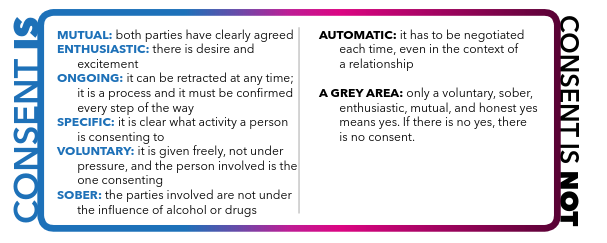
Each year, in Canada, approxScreenshot 2018-09-30 at 9.18.11 PMimately 460,000 women are sexually assaulted, although only a fraction of them report the assault to the police (1). In a day and age where this statistic holds true, it’s hard to imagine that our government is wanting to go back to a time where consent and gender identity aren’t being discussed in classrooms as a part of the Health Curriculum. Simply ignoring the very real issues that our students face in 2018 doesn’t make them go away, nor does it help to develop a society that is action-based and ready to implement change.

Earlier this year I was really excited to hear about ETFO’s and White Ribbon’s resource – Drawing The Line. Now I might be slightly biased as my brother is a contributing author but I was thrilled to see a resource that not only provided data-driven information for educators but also included a comprehensive guide for age-appropriate lessons for students in grades 1 to 8. I love that the guide addresses bystanders and offers students ways in which to respond to to sexual violence. Not only do the lessons connect to the Health and Physical Education Curriculum but expectations also in Language and the Arts are included in many of the lessons. This guide is truly a proactive approach to teaching students about healthy relationships and is one that every educator should read and implement in their classrooms. I know that in the past, ETFO was offering sessions on this resource and I hope that they continue.

Screenshot 2018-09-30 at 9.18.44 PM

With hotlines or tiplines being made available, it’s sad to say that we are in such a time where educators are somewhat in fear of teaching what we know to be essential for our students’ safety and healthy development. We need to be having these conversations because unless we do, nothing will change and perpetrators will feel empowered to continue. As you may already know, at the beginning of September, ETFO filed a legal injunction to pause the rollback of the 2015 Health curriculum. The union believes the government’s directive creates unsafe and unhealthy learning and working environments. In the meantime, how are you working to unpack these issues with students? They’re in the news and on the same social media platforms that students are interacting with. How will the work we do today impact the statistics in the future? In the next year, 5 or 10? If you haven’t already, please check out this resource as well as the other resources that ETFO has to offer.

1. Holly, Johnson, “Limits of a Criminal Justice Response” (University of Ottawa, 2012), https://books.openedition.org/uop/592?lang=en

Building upon balance

I’m back. You’re back. They’re back. We’re back!!!!!
And it could not have come at a better time. Or could it?

While our transition from summer to school traditionally begins after Labour Day, there are more and more students starting back to class in August than ever before. This is known in edu-circles as a balanced or modified year. It offers quite a few upsides that benefit our learners and with some time for adjustment, for our profession. So I ask…

Imagine if we all started in August with a balanced school year that allowed the learning to be spread out over a longer period of time, but with a few week long breaks built in? What are the pros and cons of such a shift in a historically established calendar? Is it possible to change a 100+ year old practice?

Helping out on the farm

A balanced school year makes sense on a number of levels. Especially, when we consider that the original reason for a September start stemmed from the need for students to be available to work on the family farm. In some areas of the province, farming is still a factor, but it is very evident, that the majority of the nearly 2 million students from K to 12 live close to or in cities. Most are not feeding a herd, driving a combine, or mending fences in July and August.

However, a greater majority of students are left to swelter in concrete jungles trying to stay cool. There are few if any universally accessible programs that do not require a computer bot like skill in order to register on-line for limited spaces. So no swimming lessons, city camps, or classes for all. In fact, the City of Toronto announced that it will try to add 70 000 new program spaces just to accomodate current demand.

Which means, for the foreseeable future, most students will still be given a summer sentence stuck indoors. It is no secret, our cities lack adequate child care, recreation, youth programming, and social spaces. What if all school boards were able to offer a balanced school year and provide working families with an option that would ultimately save them money in conjunction with municipalities? A kind of multi-tiered approach to community and education.

Who will pay?

With government money used for creating and subsidizing child care spaces, an investment in a balanced school year would relieve, not remove, the pressure by allowing younger school aged children to be in the classroom rather than a daycare centre. This in itself could save families 3 to 4 weeks of childcare costs that could then be spread out over time through the year rather than in one expensive 9 week chunk. Granted, that there are extra weeks off throughout the year, but they are distributed over the school calendar.

The biggest obstacle to all of this is from a purely structural point of view and comes from having to retrofit hundreds, if not thousands of elementary schools with adequate climate controls, aka air conditioning. Recent returns to the classroom remind us all that our elementary schools are woefully equipped to deal with irratic temperature fluctuations and extreme heat. 2 fans per classroom do nothing to cut through the sweltering heat on the first or second floors of any ill-equipped building – even with the lights off.

The bigger question that comes to mind is why our province still chooses to provide air conditioning to students in high school, but not from JK to 8? This type of systemic disparity does not seem fair. Are elementary school students and staff expected to feel they are being treated fairly by the government’s funding model? I can see fingers pointing in all directions here, but not a one is doing a thing to acknowledge or remedy the problem. Students suffering from heat exhaustion do not make good learners. Perhaps it’s time for our grade 5 Social Studies classes to mount a letter writing campaign to ask our government to do its job and serve its future taxpayers. We’d better hurry before that curriculum gets changed. http://www.edu.gov.on.ca/eng/curriculum/elementary/social-studies-history-geography-2018.pdf

I feel we are about to see bigger problems in our province if facilities equity cannot be guaranteed in all schools. Think of it like this; the province buys or leases 1000s of vehicles each year. After a few years they are traded in or replaced with newer models and the fleet stays rolling. If Ontario maintained its government auto fleet like its schools, some would have hand crank windows, some might have air-conditioning, some would have low mileage, while others would be up on blocks. Most would need to go to the body shop for repairs and others would have to be towed to the scrapyard. Nobody would want to drive in an unreliable vehicle. So why are our schools being left to deteriorate through underfunding and repair backlogs?

How is it fair to expect standardized results when there are no standard facilities? Is it a class thing? A neighbourhood thing?

As teachers, we take pride in our workspace. We have witnessed all that can be done each year despite the structural shortfalls and disparities from school to school and board to board. We also know that the current funding model for our schools cannot be a band-aid solution. The recent cuts by the new provincial government are leaving school boards with open wounds.

It’s not all bad (well the above part is, but below is all sunshine)

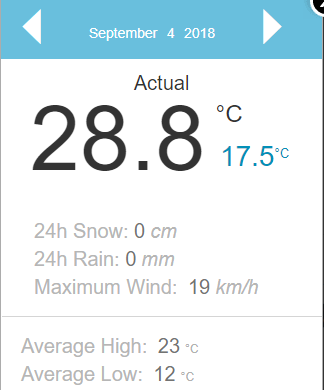
This year’s return to school was ushered in with all of the elation, excitement, and chaos of its predecessors. How could it not be so? At my school over 600 hope-filled students converged on the playground for a surreal moment of truth. Who was going to be their teacher? In which classroom? Main building sauna or luxurious portable? I loved the chaos that was the first day. It was perfect weather for a July day in September. Perhaps in the future you will be reading this message in August. In the meantime, welcome back.

https://www.theweathernetwork.com/ca/monthly/ontario/richmond-hill

In my next post I’ll discuss the aspects of greater knowledge retention that come from a more balanced school year. What do you think of the idea of the school year spread out over a longer period of time? Please share and comment to continue the conversation. Thank you for reading.

Further reading

Interesting blog post explaining how education is funded in Ontario.

Music & Identity

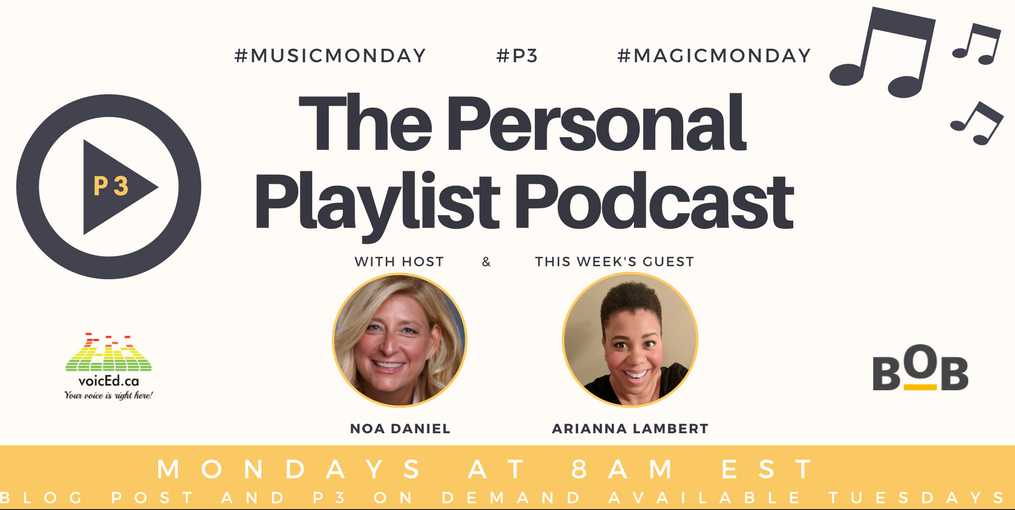
This past week, I had the opportunity to be interviewed by Noa Daniel for the Personal Playlist Podcast on VoicEd. I was asked to identify 3 songs to share: one that held a nostalgic value; one that gave a sense of identity; and one that motivates me. Even though Noa was kind enough to give me a lot of notice, it was difficult for me to find the right songs. When I did, it was amazing how they spoke to different aspect of me and had me thinking about how music is such a powerful tool for allowing us to be able to express our identities and sometimes say things that we have difficulty expressing. I started wondering how something like this might impact my students.

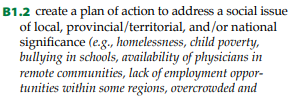
This year, our school was selected to participate in tdsbCREATES which is a program that connects local artists to classrooms in our board in order to shine a light on the Arts and careers in the Arts. Our Artist is a musician who has worked with schools to create the 10-minute musical. This year’s theme is Narratives of NOW – it’s about you, it’s about the world, it’s about time! Immediately, I thought about current issues in the world around us and how students have been speaking up to be able to create change. I also thought about the fact that change usually comes when we identify with a specific issue and so we have started to look at identity and how we might be able to use music to express our own identities and in our understanding of others around us. Today, students had the chance to use a Padlet to be able to add their thoughts on identity after having some time to consider for themselves by making notes in their journals. Many students said that identity is something that we can’t change and is a part of us and that our identities are what makes us unique. They determined that parts of your identity could be based on gender, sexual orientation, race, background, religion and family status. We came to the conclusion that there are many facets to our identities and that there are no two people that can have exact identities because they may also be impacted by lived experiences. It was such a deep discussion and sadly, we had to cut it short for recess.

Thinking about the work that we are about to do with our artist and my recent experience with Noa, my next step might be to get students to consider a song that speaks to their identity and to share the lyrics with us. I think we’ve gotten to the point in our class where we have a sense of respect for one another so that the sharing of songs may be valued and may help us to grow in our understanding of one another. I would be interested in seeing what songs resonate with them and the reasons why. I would also be interested in unpacking the lyrics – considering we will be writing our own for our musical – and seeing how lyrics to a song speak specifically to areas of identity.

I always feel as though I end my blog posts asking you to stay tuned but please do! Next month we will be getting deep into our tdsbCREATES project and I will be blogging about our progress.

Interested in hearing my personal playlist? Check it out this Monday, April 2nd, 2018 at 8:00am and at 7:30pm.

Screenshot 2018-03-29 at 4.27.28 PM

Why It’s Time to End Publicly Funded Catholic Schools

school

What is the purpose of publicly funded schools?

According to the publication, Good Governance: A Guide for Trustees, School Boards, Directors of Education and Communities, the purpose of publicly funded Ontario schools is to “provide universally accessible education for all students, regardless of their ethnic, racial, or cultural backgrounds; social or economic status; gender; individual exceptionality; or religious preference.”

Further to this, Good Governance goes on to state that “English and French public systems are founded on the principle of equality of educational opportunity: every student deserves an opportunity to achieve to his or her fullest potential.”

How many school districts are publicly funded?

The Education Act provides for the establishment of four types of district school board systems in Ontario. Even though all schools districts do not have the “public” label, all four district school board systems are publicly funded.

According to Ontario Government in 2015-2015 (same numbers as 2013-2014) school board data:

48% Public School Boards (for 69 % of Ontario’s population)

  • 31 English Public School Boards
  • 4 French Public School Boards)

52% Catholic School Boards (for 31% of Ontario’s population)

  • 29 English Catholic School Boards
  • 8 French Catholic School Boards

According to the Statistics Canada 2011 Ontario data, Roman Catholics represented 3,948,975 out of 12,651,790 people or 31.2% of Ontario’s population (down from 34.3% Roman Catholic in 2001) with 69% of Ontario’s population identifying as non-Roman Catholic. This is evidence that students who identify as non-Roman Catholics attend publicly funded Catholic schools. According to Kelly Gallagher-Mackay, Toronto Star reporter, 8% of students attending Catholic schools are not Catholic.

Why does Ontario have so many school boards?

In 1867, the British North America Act (BNA) constituted funding for French and English schools as well as Protestant and Roman Catholic schools up to grade 10. In 1867, the majority of Upper Canada’s (now Ontario) population were Anglo-Protestant. The BNA mandated standardization and public funding for education. As Ontario’s populations grew, Protestant schools became more secular. Sometime in the mid 1970’s, as a student, I no longer had to repeat the Lord’s Prayer every morning. In 1989, required recitation of the Lord’s Prayer was held in violation of Canada’s Charter of Rights and Freedoms. Thus Protestant French and English public schools became French and English public schools with no religious affiliation. In 1984, Ontario’s Premier, William Davis, extended full funding for all secondary grades.

What’s the issue with publicly funded Catholic schools?

In 2012, Ontario’s Drummond Commission examined the reform of Ontario’s public services, which included education. The report identified areas of overlap and duplication (which could save taxpayer’s dollars) within Ontario’s four schools systems but did not ever consider the idea of ending public funding of the Catholic school system. According to the Federation of Urban Neighbourhoods (2012), the reduction in multiple boards would reduce duplication, busing, and capital funding saving the Ontario government between $1.2 and $1.6 billion annually. In the 1990s, Quebec and Newfoundland ended funding of denominational, religious-based schools. But funding of Ontario’s Roman Catholic school system has been considered a constitutional obligation and a really big political football. Note that Jewish, Muslim, and non-Catholic Christian schools are currently not publicly funded.

Why public funding of Catholic schools is unfair?

Right to refuse admission – Even though Ontario’s Catholic schools are publically funded, they have the right to refuse admission to non-Catholic students until grade 9. But with declining enrollment, non-Catholic students are being admitted. My own children attended a Catholic elementary school and had several non-Catholic, (Muslim and Hindu) students in their class. As a middle school teacher, pressure was put upon me to give grade 8 students all “Good and Excellent” learning skills on report cards as parents were told that the local Catholic high school would not take students with “Satisfactory and Needs Improvement” learning skills.

Admission of “preferred” students – According to Kelly Gallagher-Mackay (Toronto Star), research from Scott Davies at the Ontario Institute of Studies in Education showed that children attending Catholic schools are more likely to have parents with post-secondary educations. Further, EQAO data shows GTA Catholic school boards have fewer students with special education needs and significantly fewer students whose first language is not English as compared to English public schools. As a Special Education teacher, in a contained class, I have direct knowledge of Catholic students (who regularly attended Catholic church) being denied access to their local Catholic school as the school “could not accommodate the students due to their special education needs”. Based on my own anecdotal observations in three schools in which I taught multiple grades, the number of students with special education needs is increasing, every year, as a percentage of overall classroom composition.

Lack of acceptance of student diversity – Some Catholic schools ban student funding and clubs were they are “directly or indirectly” inconsistent with Catholic teachings. This means no student funding for the United Way which funds Planned Parenthood or students running Gay Straight Alliance clubs that embrace LGBTQ2S student identities. I’ve also been told that teachers who identify as LGBTQ2S are told to keep quiet about their identity.

Right to refuse employment to non-Catholic teachers – Even though Ontario’s Catholic schools are publicly funded, they have a right to refuse employment to non-Catholic teachers. This means that a large majority of non-Catholic teachers are ineligible for permanent teaching positions, advancement, or promotion. This also means that the non-Catholic students attending Catholic publicly funded schools do not have teachers who represent their religion. Further to this, sectarian Catholic education (Catholic religion classes) is not mandatory.

When my children went to the local Catholic public school, as a parent, I had to produce baptismal certificates for both children.  But as enrollment decreased, more non-Catholic students were admitted to the school. As a former Catholic, I was denied access to employment with the Catholic boards as I had to produce a letter from a priest, stating that I attended a Catholic church.

The current public funding of schools in Ontario does not honour the purpose to “provide universally accessible education for all students, regardless of their ethnic, racial, or cultural backgrounds; social or economic status; gender; individual exceptionality; or religious preference.”

Maybe we should draw school boundaries based on local neighbourhoods, instead of religion. Ontario could also consider having drawing lines in having a French and English only boards.

With Ontario’s great diversity of students from multiple backgrounds and religions, it’s time to make all of Ontario’s publically funded schools secular.

Collaboratively Yours,

Deb Weston

References

Drummond Commission Report (2012) Downloaded from https://www.fin.gov.on.ca/en/reformcommission/

Federation of Urban Neighbourhoods (2012) Downloaded from https://urbanneighbourhoods.files.wordpress.com/2010/11/ingsfromthemergerofontariopublicandseparateschoolsystems.pdf

Good Governance: A Guide for Trustees, School Boards, Directors of Education and Communities © 2014 Ontario School Trustees Downloaded from http://cge.ontarioschooltrustees.org/en/an-overview-of-ontarios-publicly-funded-education-system.html

OneSchoolSystem.org Downloaded from http://www.oneschoolsystem.org/fast-facts.html

Statistics Canada (2011) Downloaded from http://www12.statcan.gc.ca/nhs-enm/2011/dp-pd/dt-td/Rp-eng.cfm?TABID=2&LANG=E&APATH=3&DETAIL=0&DIM=0&FL=A&FREE=0&GC=0&GK=0&GRP=0&PID=105399&PRID=0&PTYPE=105277&S=0&SHOWALL=0&SUB=0&Temporal=2013&THEME=95&VID=0&VNAMEE=&VNAMEF=

Kelly Gallagher-Mackay, Toronto Star, (Tuesday, March 13, 2018) Must end publically funded schooling in Ont. Downloaded from https://www.pressreader.com/canada/toronto-star/20180313/281754154841725


 

Moving Beyond “Cultural Months”

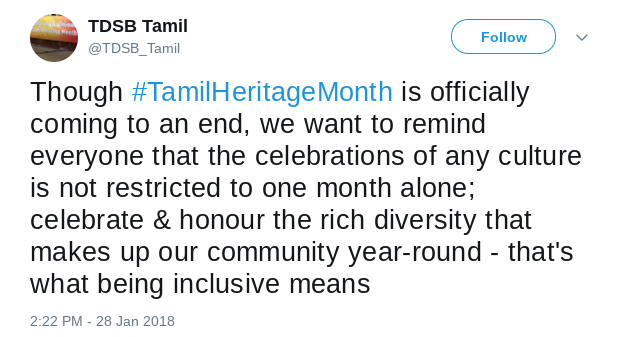
I don’t mean to be flippant but I’m sometimes leary when we have a month to celebrate a particular racialized group. What happens to their history or their identities during the rest of the year? I recently saw this post on Twitter and it got me thinking – how do we ensure that we go beyond these months and into a deeper desire for ourselves as educators and our students to value the diversity that exists in our classrooms?

Screenshot 2018-01-28 at 5.15.07 PM

Checking Our Bias

In our board, we have had many conversations around bias and equity. How are we moving from conversations and into action? In what ways are we really ensuring more equitable outcomes for our students and colleagues who are racialized? We all have bias and privilege to one degree or another. When we acknowledge our bias and privilege and are conscious of it in the spaces in which we exist, we are better equipped to extend equity and honour the experiences of others. In doing so consistently, we become those who seek out and foster ways in which to level playing field for others. What is your bias? What are your thoughts about the students that you serve? How does your bias impact the way in which you serve your students?

Courageous Classroom Conversations

Over the past few years of teaching, I’ve realized to a greater degree, the value in having conversations about the world around us with students. Earlier on in the year, we had conversations around Colin Kaepernick and other NFL players taking a knee. I had a colleague who was shocked that I was talking about it in the classroom. We have to remember that our students are living in and experiencing the same world that we are. They are keenly observing and are not oblivious to what is going on. Shouldn’t they have a space to engage in conversations about what is happening, not from a stance of judgement but of fact finding and meaningful sharing about its impact on them and the communities in which we live? By shying away from these conversations, we do a disservice to our students because that is what is real and authentic in our world and they need the opportunity to understand, discuss and determine ways in which they are able to navigate these situations in the hopes of bringing about a different tomorrow. This too is a part of education

Meeting The Needs Of Our Students Based On Their Realities

Shaughnessy is the 5th school that I have had the privilege of teaching at here in Toronto. Each school has had a different community and it’s been exciting to get to know and understand who my students and their families are. When we take the time to find out what is of value to our students and our community and teach from there, we truly start to meet the needs of our students. High expectations with lessons that are authentic and are based on the interest of our students increases engagement and allows for our students to make connections to the curriculum that are meaningful and relevant. This is what gives them greater opportunity to flourish based on who they are. We all want greater student success, why not find out what is meaningful to our students and work from there to ensure that they are represented in our lessons, tasks and classrooms?

Special months are great for celebrations of cultures but as this Tweet reminds us, let’s consider ways in which to go beyond a particular monthly celebration and make sure that our diverse identities are celebrated throughout the year.

Occasional Teachers; Unsung Heroes

Unfortunately, I have had many health challenges this year that have necessitated having to take a significant amount of time off of work to recuperate.  These absences have provided me time to reflect on my practice as a classroom teacher and about how important occasional teachers are in our practice.  I had the pleasure of working in our local ETFO office as a released officer for 3 years alongside the incredible Marsha Jones, Occasional Teacher President extraordinaire.  She taught me a lot about Occasional Teachers, the obstacles they face and the little things that I could do to make their days go easier.  I thought I would share a few of my insights.

Occasional Teachers that come to our school like to return because of the friendly atmosphere.  In the staff room, they are included in our “tea days”, people engage them in conversation and always ask how they can be of help.  It sounds like a simple thing, but many of the Occasional Teachers that come to our school comment on our friendly staff.  So the next time you see an Occasional Teacher in your school, smile and say hello and ask them how their day is going.

Do NOT ask an Occasional Teacher “who” they are for the day.  What an insult!  You can ask who they are in for, who they are helping out, who they are rescuing or replacing, but they are themselves each and every day they come to work.  We should appreciate the fact that we have access to qualified teachers to replace us for the day so that we can take sick days when we need them or go to conferences for professional learning.

Speaking of insults, please try not to call Occasional Teachers “substitute” or “supply” teachers.  We rely on these colleagues. “Occasional Teacher” is their job title.  Be respectful of it; we rely on them.

Remember to have a few days of “emergency” plans in advance of your absence.  It takes the edge of having to type up plans in between trips to the washroom when you have the flu.  Leave them in a place that is easy for the Occasional Teacher to find.  This makes your life easier too.

If you generally have an active classroom that engages in centres, activities etc., then TRUST your Occasional Teacher and leave plans that include those lessons.  Chances are your students know how this stuff runs and will let the Teacher know.  It may mean giving up a bit of control; deal with it.  If you leave all day seat work that you’ve photocopied or a movie that isn’t connected to anything that they are doing in the classroom, it will not be enjoyable for the students and likely your Occasional Teacher will have more behaviour issues.  Consequently, you will not get the quality of work that you normally see from your students. Don’t have huge expectations.  No matter how wonderful the Occasional Teacher may be, they are not you and the students know that.  We also need to remember to trust the judgment of an Occasional Teacher.  I’ve heard it and I’ve said it; “The ‘supply’ didn’t follow my day plan. I worked for hours on that detailed plan.”  We don’t know what kind of a day that teacher had with our students.  They may have experienced a lockdown, fire drill, class evacuation, pizza money, scholastic money, a student injury or even a skating field trip.  (My sincere thanks to Occasional Teacher Rachel Johnston on that one!)  We need to remember that they are qualified teachers and they have the right to exercise their professional judgment in order to keep the class calm and engaged.  Let them do their job and thank them for it.

I write my day plans on my computer for myself each week.  This makes writing a day plan for the Occasional Teacher much easier.  I have all of my emergency information, how to deal with specific students, who to count on and the general rules and routines in a separate document to attach to daily plans.  I always attach a class list.  Try to keep your plans as close to the regular routine as possible.  If I am going to be away for a meeting I will try to find out who will be replacing me for the day and I email them the plans in advance and ask if they have any questions.  I include my cell phone number in case they can’t find a password or an item and few of them ever use it but if they do then I know that they care about my students and the plans that I have left for them.

Finally, show your gratitude.  Some Occasional Teachers drive an hour to get to our school and in bad weather.  Some are called at the very last minute, through traffic, to an unfamiliar school using GPS.  Their mornings are often stressful before they even arrive on site.  So when an Occasional Teacher has done a great job and your classroom is still standing when you go in the next day, write a quick email and say thank you. Occasional Teaching is often a thankless job but we can’t be sick without these wonderful people.


Kindness and Gratitude

My hope in asking for a junior division assignment was that the students would be more independent however, I also knew that in exchange, I would be likely dealing with the issues of the tumultuous “tween” years.  My expectations for this group were particularly high because I had taught nearly half of them for two years in grades 1 and 2 and I felt as though I knew them pretty well.  Unfortunately, we have been having social issues in our classroom and the students are having difficulty treating each other with kindness.  I wasn’t prepared to have to “teach” kindness and gratitude at this age.  After 20 years in the primary grades, I suppose I assumed they would already know how to be kind.  Let me be clear.  They are not horrible kids and having raised two kids through the “tweenage” years I know the behaviour is driven by hormones etc.,  Kindness becomes more complicated in the junior grades as the social constructs change and being popular and fitting in becomes that much more important.  What I’m trying to get across to the students is that kindness is actually more powerful than being mean but they aren’t yet all buying into it…yet.  I’m not giving up.

We started by reading the book “Wonder” by R.J. Palacio together as a class.   After every few pages there was so much to unpack in discussion with the students about empathy, “precepts” for living and loyalty in friendship.  In discussions, the students were easily able to empathize the injustices suffered by Auggie and were angered by the actions of the antagonist, Julian. We also went to see the movie in order to compare the stories and they thoroughly enjoyed the experience and were thoughtful in their assessment of the themes and the major differences.  In reality, however, they were having a hard time putting all of this knowledge into practice with one another.

I needed to dig a little deeper and do some research and I happened upon a great website connected to the book; #choosekind is a campaign attached to Palacio’s book and it started us on a journey of kindness.  We’ve also been using lesson plans from the Random Acts of Kindness website and have begun daily gratitude journals.  We started restorative circles using our talking stick using Restorative Circle prompts. We have created our rules and agreement for our circle.  It has been a slow start because we are starting with topics that are allowing students to relate to one another and are not value or character based sensitive topics yet as we work to build trust in the circle.  Our first couple of prompts were, “What are 3 things that you cannot live without?” and “Who is your hero?” Not everyone is able to come up with something right away and sometimes we have to circle back, but it is a beginning.

We also wanted to do something as a class that was more global and would make an impact on people whom we didn’t even know.  In Peterborough, we have a store called Under One Sun.  They are part of a larger organization that supplies crafts from artisans in Haiti, “Restoring Dignity Through Artistry”.   We decided to participate in a Christmas ornament fundraiser which helps to create jobs and sustain families in Haiti. Some of the money goes to the artisans for healthcare, childcare, education and materials and some of the money comes back to the school.  Our class of 22 students alone sold more than $1000.00 worth of ornaments.  This fundraiser makes a difference in our community and for families living in Haiti and broadens our student’s awareness of global issues of poverty.  In addition, we are going to learn how to make paper bead jewelry ourselves as gifts for our own families.

As we move into the holiday season, December is a great month to think about giving, gratitude and kindness.  We are going to be working with the Senior Centre down the street, hanging our art work, singing songs to entertain and presenting a dramatic re-telling of “A Promise is a Promise” written by Robert Munsch.  We have created a kindness calendar which includes random acts of kindness for each day that do not cost money.  Hopefully, day by day, discussion by discussion the students will come to realize the power of kindness.

The Workshop Presenter’s Palette

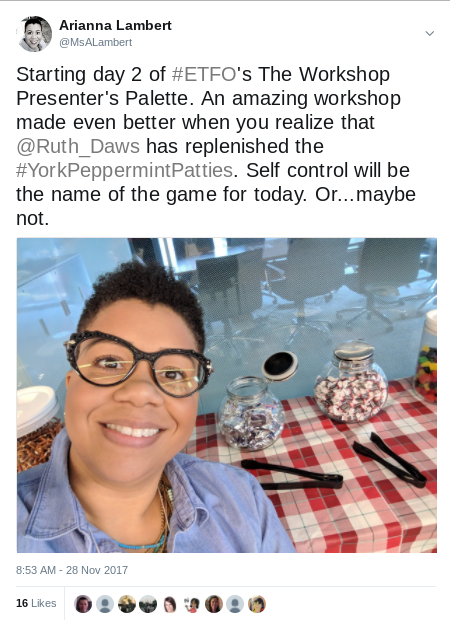
  Screenshot 2017-11-29 at 8.53.40 PMIn my last post, I blogged about attending and presenting at workshops. And well…perhaps I should have waited a few weeks before sharing about that topic. Hindsight is always 20-20 and I’m grateful for the opportunity to share with you on this topic once again.

That being said, I must admit that I am coming off of a high that I haven’t had the pleasure of experiencing enough of as of late. This past Monday and Tuesday, I had the privilege of participating in ETFO’s The Workshop Presenter’s Palette.  I walked in not knowing quite what to expect but prepared to work on something and in all honesty, quickly realized that I was really working on myself. I’ve said it before, I love sharing the work that I get to do with amazing students and this session was really for me to be able to improve on something that I already enjoy doing.

Screenshot 2017-11-30 at 7.10.16 PMMuch thanks to the “Terrific ETFO Trio” – Ruth Dawson, Joanne Myers, and Jane Bennett. Not only was it inspiring to watch these 3 women share strategies – with intentionality – but I also felt as though they gave to us on every level. From remembering our names to making sure there were yummy treats, they hosted us so well and reminded me of the importance of making my audience feel as though they matter every time that I present. I walked away wishing that I had more time to sit down and learn from them. Thank you!
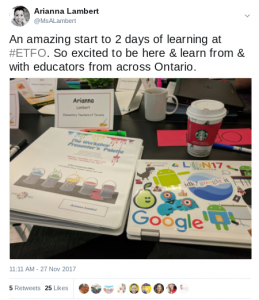
Now you’re probably wondering what was so magical. Well, here are a few tips that I picked up over the 2 days. Now I can’t go giving away all of their amazing secrets, you’ll have to stay tuned and try to get in on the fun next year.

The Environment Makes A Huge DifferenceScreenshot 2017-11-30 at 7.09.35 PM

We were in a large room with great acoustics so it was clear to hear the presenters. Everything was already set up for us and it was inviting because it made me feel as though they were welcoming me not just a group of people. If you know who your audience is and have time to prepare for them in advance, do it! Make it obvious that you have thought of them in planning your session.

Not sure who will be joining your session? Not to worry. Play some music.  I learned that the number of beats matters. Aim for 120 beats per minute. It’s uplifting and raises the energy in the room. Consider playing a game to get started. We started with a Meet Three activity where we were asked to meet 3 new people and were given prompts for each new person we met. Each prompt was timed and eased participants from a place that was familiar to them – what they plan on doing over the holiday – to the deeper purpose of the workshop – what made a workshop memorable.

When I say that there was intentionality behind every part of the workshop, there really was. Down to the variety of tools to get the attention of participants such as clappers and other noise makers. I felt heard, never screamed over but gently brought back to the larger conversation. Small things that made a huge difference in the learning space.

Help A Friend!

Ever been in a session where people were offering feedback on something you were creating? Have you ever gotten the feeling of being overwhelmed by capturing all of the amazing feedback? Well, I think I was just given the solution. We were asked to get into Mentor Groups where we shared our workshop ideas and were given the opportunity to get feedback and answers to some of the questions we may still have about our work. Rather than frantically trying to write down the wealth of information shared, the person to the right of the presenter took notes while the presenter was able to actually engage in active listening. Sound simple? It really is and believe it or not, I never thought of it. I think this is a strategy that I will take back to the classroom and use with students in peer feedback sessions.

Equity

Language matters and the idea of intention vs. impact was made so clear to me. No matter my intentions, the impact of my words is what participants and those around me actually feel. Adam Peer was our presenter for this portion of the day and he addressed the importance of being conscious of the images that are shown in our sessions. Do they show the diversity that exists in terms of abilities, skin colour, religion, age, family, and genders? Still saying girls and boys or ladies and gentlemen? Consider using children, everyone or using the person’s name instead.

I feel as though I’ve just touched the surface of all that was incredible about this 2-day session but at the same time given away a few tips that you may chose to take back to your classrooms or even workshops. I’m refreshed and excited to implement my learning into my sessions and classroom. Remember to stay tuned to ETFO’s Upcoming Events to sign up for amazing PD that is sure to change your life.