Technology Like in the Real World

This past February, I was honoured to be asked to present at ETFO’s Technology Conference for French as a Second Language(FSL). It was a great day of hands-on learning with educators across the province sharing ways in which to engage FSL students in learning the language, using technology, whether in the classroom or online. My presentation was geared towards providing teachers with ideas to support students in moving from consumers of tech to creators. During this session, I shared a variety of ideas that were shared with me over the years and that I found engaging for students. In this post, I’ll share 3 Google Tools that you might be able to incorporate in your FSL Classrooms. 

Jamboard

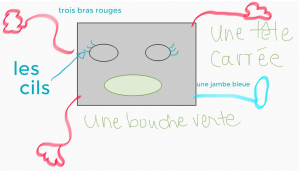
The Google Jamboard app is a digital whiteboard that offers a rich collaborative experience for students. I’ve used Jamboard for check-ins, brainstorming, listening and drawing activities, and more. One example of a listening and drawing activity comes from Chrystal Hoe who is an educator in the United States. Given their own frame in the Jam, students listen to instructions on how to draw their own monster and use the tools in Jamboard to draw. Through labeling the parts of the body, students are also able to demonstrate understanding of new and familiar vocabulary as well as spelling. When finished, each student has the opportunity to view the work of their peers, revealing that even though the instructions may have been the same, drawings may vary.  

Slides

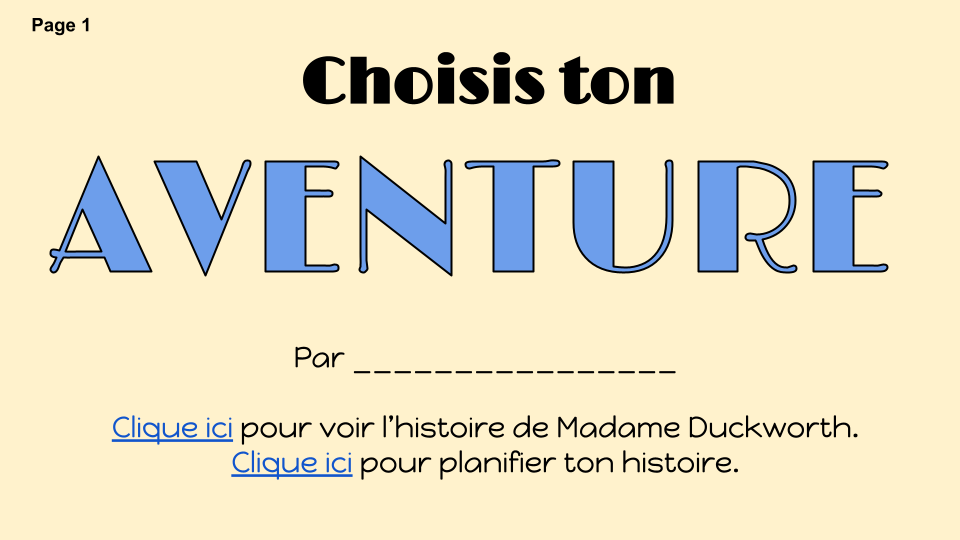
Google Slides is an online presentation app that lets you create and format presentations and work with others in real-time. With creative templates from Slidesmania and Slides Carnival, the possibilities are endless when creating exciting presentations. During my session, I shared the template for Sylvia Duckworth’s Choose Your Own Adventure Stories. Not only does Sylvia offer an example of a story, but she also gives a template to help writers organize the choices readers can make and how to include them on the correct slide in the Google Slides Template. Sylvia’s layout of the planner is clear and easy to follow. In my morning session, one participant completed their outline and was excited to share their story with the rest of us and the potential to share the activity with her students. 

Drawings

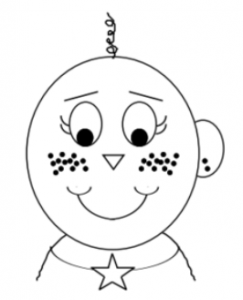
Google Drawings is the ultimate blank canvas. I’ve used it with students to create images, posters, infographics, timelines, and bioglyphs.  Simply put, bioglyphs are a symbolic representation of something in your life. Your collection of bioglyphs tells your life’s story without words. During our session, participants had the opportunity to use Google Drawings to complete their own bioglyph using instructions

Technology is an incredible tool that can be used to increase engagement while learning. These tools can be used in a variety of ways and I hope that this post helped spark some ideas of how you might be able to help students create, using tech.

“How can I help?”

The adage of “If you want something done right, do it yourself,” was ingrained in me at an early age.  Until recently, I have always thought that being confident, capable and successful meant never asking for help.  I used to think that asking for help meant that you were weak.  I now think that asking for help is incredibly brave.  My 17 year old son recently told me about a group chat with his workmates.  Someone at work had sent an urgent message to the group asking how to do something while closing up the restaurant.  Many of the coworkers poked fun at the lack of knowledge of the person seeking help.  My son (brace yourself for this proud Mama Bear moment) texted that it was really brave of his co-worker to ask for help and provided the information that the coworker needed to close up for the night. I think that his act demonstrated wisdom an empathy far beyond his years.

Have you ever felt a little territorial or protective about your ideas or lessons in your classroom?  I imagine everyone likes to be valued for their unique talents and abilities.  In general, I don’t think anyone likes to be seen to be struggling and consequently, some teachers might choose to work in isolation. Perhaps it is fear. I’ve spoken to many colleagues who have identified as suffering from imposter syndrome. Perhaps those of us who have experienced imposter syndrome think that if anyone else got eyes on what we do every day that we would be judged and found to be lacking in some way.  Often teachers will tell me that they don’t have time to share with their colleagues-there just isn’t enough time in the day to collaborate. With the busy pace of education, I know that I have absolutely felt that way. My experience has been that when I take the time to collaborate with others I in fact, have more time and consequently better programming.  It is a concerted effort and takes a trusting relationship to co-plan and co-teach but when it works, it is amazing.

In my role as an instructional leadership consultant I am responsible for two portfolios; Innovation and Technology and the New Teacher Induction Program.  At the beginning of the COVID pandemic as teachers were teaching virtually for the first time, some had never used things like Google apps, FlipGrid and Kahoot. I was doing my best to support teachers with tools for teaching online.  Thankfully, I knew some other teachers that I could reach out to and ask for help.  These teachers, close to the beginning of their careers, were using these tools in the classroom and were able to help design and present webinars to other more seasoned colleagues.  As teachers, we often think that we need to have all of the answers for our students and with one another.  I’ve heard it referred to as the “Sage on the Stage Syndrome.” We seem to feel that we need to stay ahead of everything, which is impossible.  Education is changing more rapidly than ever.  I learned so much from my colleagues over the months that we worked together as a team and even though it was stressful at times, it was also incredibly fun.  I look back now on the powerful outreach our work had and the gratitude that was expressed by our colleagues and I am so glad that I got over myself and asked for help.

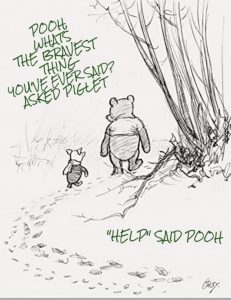
In the t.v. drama “New Amsterdam” whenever the new director of the hospital is introduced to someone, the first question that he asks is, “How can I help?”  It happens in the first episode about twenty times. This was a BIG a-ha moment for me.  What a powerful question!  How often have we wanted our students to ask for help?  How often have they refused when we have asked “Can I help you?”or “Do you need help?”  Unfortunately, asking for help is still seen as a weakness by many people.  However the question “How can I help?” turns it around so that the responsibility and focus is on the person offering assistance.  It is more difficult for someone to just say “No.” to this question.  It can help to create psychological safety in order to focus on what can be done to help rather than someone sitting in discomfort or shame because they won’t ask for help.  Sometimes just asking can make all the difference to someone when they are feeling overwhelmed, even if they decline the offer.  The four small words, “How can I help?” can make a powerful impact.  Sometimes, asking for help is the bravest thing you can do.

Attitude of Gratitude

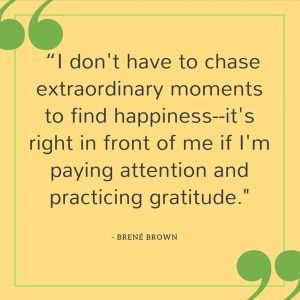
I don't have to chase extraordinary moments to find happiness -- it's right in front of me if I'm paying attention and practicing gratitude.

Many years ago I remember watching a gratitude themed Oprah episode.  There was a gratitude journal that the guest had developed and was relaying all of the benefits of writing down things that you were grateful for each day.  The power of suggestion (I’m a sucker for an impulse buy for self-improvement) lead me to the nearest Chapters to purchase one of those journals that weekend.  I certainly didn’t fill that journal. I think I lost interest in a couple of months because it felt as though I was writing the same thing over and over again.  I realize now that gratitude, like mindfulness and meditation, is a “practice.”

Gratitude practice is most effective when life is rough.  It sounds counterintuitive.  It is much easier to be grateful when things are going well right?  Easy to “count your blessings” when you are sitting on a beach in a resort in the Dominican Republic.  I personally feel the power of the gratitude practice when life isn’t going according to plan.  Though, I want to be clear here, there is a fine line between true gratitude practice and “looking on the bright side” or “finding the silver lining.”  That bright-side-silver-lining thinking can border on toxic positivity which isn’t helpful.

Gratitude practice means different things to different people.  For me, it is connected to daily journaling.  Each night since the fall I have been writing about my day in terms of gratitude before going to bed. Some nights I might write for 5 minutes.  Some nights I write for a half hour.  It might read something like, “I’m grateful that we got outside for a walk, that my son felt good about his essay after all of the struggles and tears, that we were able to eat a healthy meal, for Hello Fresh being delivered to my door and for the opportunity to reach out and connect to some new teachers through professional learning today.”  I try to reflect on the events of my day in terms of gratitude.  I could write in my journal that the technology in my professional learning session that day was glitchy, we got off to a rocky start trying to get everyone into the WebEx room, and there were links that didn’t work even though I had tested them twice. Instead, I choose to be grateful for the connection and discussion that I had with the teachers that day.  It isn’t that I ignore that bad things happen or think about how things can be improved, but ruminating on the bad things that happened during the day right before going to bed isn’t going to ensure much of a restful sleep.

In some of the professional learning opportunities that I have recently hosted with new teachers we have discussed the struggles of the current climate in the classroom.  It is important to have a safe place for teachers to voice those concerns and have someone listen with compassion and empathy and ask curious questions.  I will often say that there are many things that I can’t help them with, but that I am there to “embrace the suck” with them.   At the conclusion of those discussions my final question is always, “What is a recent personal or professional success that you’ve experienced that you would like to share with the group?”  This ends the discussion on a note of gratitude. It is SO easy to get caught up in venting and complaining about the situation in education right now. Teaching it is NOT an easy job on any given day but the difficulties have grown exponentially with the pressures that COVID has added.  So when we can take a moment to remember why we continue to go to work each day, why we got into the job in the first place and what our recent wins have been, I think it brings a feeling of hope.

Sometimes I practice gratitude in a less formal way that is more like mindfulness.  Recently while walking on a treed trail on a bright, sunny, winter day with my best friend, I stopped mid sentence and just looked around at the beauty.  I said to my friend, “I just had to take a minute to take this in.  We are so fortunate to be able to walk here.”  It only took a moment.  I don’t do that all of the time, we’d never get anywhere on our walks! However, remembering to do it every so often helps me to deal with stress and the bad things when they do happen.  If in the moment of a stressful situation I can take a moment to breathe and practice gratitude it sometimes keeps the emotions from escalating.  When conversing with someone who is frustrated and perhaps complaining or lashing out I try to remember that this person is doing the best they can at that moment and that each opportunity to interact with someone who is suffering is a chance to learn and I try to be grateful for that.  Author Andrea Owen in her book, “How to Stop Feeling Like Sh*t” would call it an AFOG-another flipping opportunity for growth.  When I remember to think about gratitude in a not so great moment, I might do it raised shoulders and through gritted teeth, but I keep trying.  It is, after all a practice.

“If the opposite of scarcity is enough, then practicing gratitude is how we acknowledge that there’s enough and that we’re enough.” -Brene Brown

Rejuvenation Through Creation

For me as a kid, there was no better feeling than opening up a new box of 64 Crayola crayons.  The big box with the flip top lid and the sharpener on the side.  I can remember agonizing over which colour to pick first and being so thrilled by the perfection of the colour palette in neat rows in that box.  I loved to draw and colour. I could do it for hours never lifting my attention from the page.  In adulthood, I abandoned doing art for pleasure.  It seemed silly for me to sit around and draw or paint for no real reason.  I felt I should be doing something productive.  A few years ago I began to create art again and realized how much I had missed it and how much joy it brought to my life. I create digital art now, which isn’t quite the same rush as opening a box of crayons but it is easier to share with others-like the picture above.  I have recently learned about the health and wellness benefits of creating. Creating is rejuvenating, it is rest and it is soul food.

Dan Tricarico, in his book “Sanctuaries: Self-Care Secrets for Stressed-Out Teachers”, he talks about how people get lost in an activity that you love so much that the rest of the world seems to fade away.  He calls it a state of “flow”.  I find myself getting into that state of flow when I draw, create music, write, cook or do jigsaw puzzles.  It isn’t that passive state of binge watching something on Netflix.  However, sometimes life’s answer is just that.  The state of flow is active and when I emerge from that state of flow, I feel rested and invigorated.  In Jessie Scholl’s article, “Go With the Flow: How States of Blissful Concentration Can Boost Your Overall Health and Well-Being” she states that, “Flow triggers the opposite of a fight-or-flight response.  Breathing becomes more relaxed, muscles loosen, and heart rate slows.  The specific biochemistry associated with flow varies depending on the activity, but the overall benefits to health and well-being are the same. ”  In fact, a 2018 Forbes article, “Here’s How Creativity Actually Improves Your Health” written by Ashley Stahl, claims that creativity increases happiness, reduces dementia, improves mental health, boosts your immune system and makes you smarter. Well, who doesn’t want all of those things?

You don’t have to be a professional musician, writer, artist or athlete to practice flow.  You can do it with any activity with some level of skill that requires you to pay attention.  It is really a type of active meditation.  Flow can be found with exercise, writing, dancing, baking, gardening, robotics or whatever activity brings you joy.

Don’t have the “time” for a creative pursuit?  It definitely requires some intentional effort to ensure that you take some time each day to pursue what you enjoy doing. It doesn’t have to be for hours but make it a specific small goal. In building anything into a routine or ritual, micro habits are key.  These are tiny steps towards implementation that grow into longer lasting habits. When I started creating art again, I just started with doing 5 minutes a day.  I just drew something.  I wasn’t worried about perfection or even completion.  I started getting lost in the flow and those minutes eventually became hours over time.  I continued to build my time until I created the habit to attempt to do something creative at least twice a week.  Beware of your inner perfectionism critic if you have one, like I do.  Give yourself some self compassion if you get out of the habit.  No one is keeping score and it is meant to be for you and your health and wellness.  When I get lost in stress and the life’s duties I often think, I should probably create something and get into that flow state-it has been a while.  Ultimately, I never regret taking that time away from the rush and hustle.

If your activity is just one more thing on your to-do list, it isn’t going to bring you joy and happiness.  In order for something to really feed your soul, it has to be something you value, something authentically you and something that you want to do because it brings you a sense of flow, peace, focus and energy.  Hopefully you will find something that gives you that “new box of crayons feeling,” whatever that means for you.

The Journey

Everyone is on their own journey. Everyone has their own story. Each educator has goals, both personal and professional. Places they wish to go and things they want to do along the way. 

Personally, I am an occasional teacher who is on a journey to becoming a contract teacher. Or, that is the plan at least.

Although not all occasional teachers have the goal of obtaining a permanent contract, many are living the same truth that I am. 

When I graduated from the Faculty of Education in 2018, I thought I was fully aware that my journey from occasional teacher to permanent teacher would never be ‘quick’ or ‘easy’. 

However, I was not fully prepared for the times I would feel I wasn’t good enough, inadequate, or the days my heart broke as short LTO positions came to an end. I knew there would be interviews I would not receive, jobs I would get declined, and times I would have to wait for something new. It is one thing to be cognizant of this journey but another to be present through it. 

Each experience is molding and shaping my practice and allows me to grow both personally and professionally. I have been forced to self-reflect, even in ways that feel uncomfortable or unfamiliar. I am grateful for this journey, the people it has brought me and the opportunities I consistently have for learning.


I must continue to grow and evolve on this journey. There is no way to go but forward.

Let’s make it okay to talk about the raw emotions happening for all of us along the way. I wish someone would have assured me that it’s okay to feel sadness, it’s okay to feel disappointment, discouragement and heartbreak. 


I see you OT’s, keep going.

You are valuable, you are worthy, you are irreplaceable. 

However, you are human… and feeling is part of the journey.

Occasional Teaching Online (part 2 of 3): My Challenges

I will never forget my first supply day for virtual learning. Even though I am early into my teaching career, I believe this experience has changed the way I will reflect on my teaching practice for years to come – dare I say forever?

As I logged onto my first Google Meet with no idea who was greeting me on the other side, so many things raced through my mind and my heart felt like it was going to beat out of my chest. Nerves. Excitement. Fear. 

In my last post I reflected on my realization of the power of connection and children’s drive for relationships. As I continue to venture on with positivity and optimism, I cannot ignore the raw emotions I have felt, the challenges I have faced and the questions I have unanswered. 


“I don’t know”. 


In my personal and professional life this year, “I don’t know” has been part of my daily conversations with colleagues, friends and family. Last year, saying this out loud would have felt like admitting defeat, accepting failure even. As the uncertainty and the unknown continues, we are being forced to live in a world of “I don’t know”. The challenge is constantly turning the “don’t know” into “let’s try” with a smile on our faces. Of course we want to support our students, their families, and our communities. Of course we want to embrace change, challenge, and even failure. But, the reality is, we are navigating this new path in which there are no correct answers, there is no manual, and there are no instructions.  

Openly admitting what I don’t know feels uncomfortable and scary. But discomfort is required for growth and change. I share my challenges with you as a means of connection. Maybe you don’t know either – and that is okay. Additionally, admitting the unknown provides opportunities to gain insight from those who may know, those who have ideas and those who can say “I have been there, and I know how hard it can be”. 

As an OT I have felt it challenging at times to engage with students who are not turning on their microphone or camera, for whatever reason. I want to get to know them but am also mindful how vulnerable they may feel turning on their video to chat with a complete stranger. How are you supporting student engagement and providing a safe space for all? 

How are you supporting students with special needs, learning challenges and students who are working with limited resources? I once taught in a class where one of the students did not have paper or pencils. 

How are you supporting students through technical difficulties or navigating new online platforms? I have been doing a lot of screen sharing. I often share my own screen and/or ask students to share their screen if they are comfortable. I am finding this method to be extremely time consuming. Although sometimes necessary, it can also be very distracting. When students share their screen, it puts the issue they are having on display for the whole group to see. This can be helpful if someone knows how to solve the problem, or harmful under certain circumstances and can intensify feelings of helplessness for some students. 


*Holds breath* 

No correct answers.

No manual. 

No instructions. 

*Exhales*


There is beauty in this.

It may be hidden or the view may be obstructed right now. But it is there. Together with our students and our colleagues, we are the creators, we are the inventors, we are the pioneers.

Honouring those who experienced war

George Ebert

Today, Wednesday, November 11, 2020, I spoke with my students about why Remembrance Day is a special day to honour those who lived through war.

I recognized that my words had little meaning as they were just words. We watched videos about people who had been in war; but these images had little context and meaning to my students who were sitting in a classroom in 2020.

I grasped that, in order to put Remembrance Day into context, my students needed to hear real stories about real people.

Fortunately, there are many stories I can draw from, in my own family history. Here are a few …

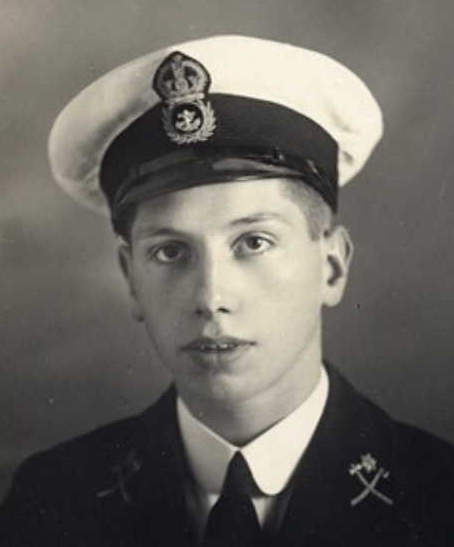
George Wilbert Henry Ebert (1920 -1943), navigator in the British Canadian Airforce from Cache Bay, Ontario (now North Bay).

Wilbert Ebert shot down in WWII


Will was my half uncle. He survived the death of his siblings and mother from Tuberculosis (TB). My grandfather, George Wesley Ebert, met my grandmother, Permilla Ann Coulthard (nurse) in the Muskoka Tuberculosis Sanitorium. George may have contracted TB from his work as a mining electrician or as it spread through the Cache Bay community. Will and George were the only family members remaining.

Will, a school teacher, was eager to explore the world and to learn how to fly. He became a pilot/navigator after only weeks of training and was sent to fight WWII. He was 22 years, 3 months, and 2 days old when his plane was shot down over Iceland. Will would never see his family again and would never have a family of his own. I never knew Will but I have read his letters to my grandmother and grandfather. He always sent his best wishes to my mother, who would have been around 5 years old at the time.

George Wesley Ebert (1897-1957), sniper in the British Canadian Army from Cache Bay, Ontario.

George was a sniper in WWI. My mother told me he loved the wilderness. George’s mother was aboriginal. He was a skilled hunter and fisherman. He was also a perfect person to take to the Canadian National Exhibition as he always won the very large prizes in the shooting galleries. While fighting in the trenches, he was gassed several times which caused significant damage to his lungs. His health never was the same after war and upon contracting TB, it only worsened. George was a troubled person who relied on alcohol to sooth his trauma. This would lead to his end in an early death.

George Ebert with fur

Lewis Henry Weston (1910-2008), British Navy, Lieutenant Commander born in Plymouth, Devon, England, last stationed in Northern Ireland. Lewis pictured below aged 12, 45, and 96.

Lewis Henry Weston 1910052 (2)

Lewis joined the navy at the age of 12. This was not unusual as most children from working class families did not go to school past grade 6, instead working as an apprentice or in service. My grandfather had many tales to tell about his 30+ years in the navy. Lewis was a navy engineer meaning he built bridges and roads with his hands. He was also a navel diver, wearing very large metal helmets and heavy metal shoes while men pumped air into his helmet to keep him alive. Lewis stayed alive by his commitment to duty, as well as his wits and his faith in God. At the age of 45 years old, he retired from the British Navy and collected an indexed pension until the age of 98.

While Lewis was away at war, my grandmother, Iris Doreen Turpin Lawrence Weston, was in London, England during the German bombing raids. At the time, my uncle was at boarding school in the countryside. Iris and my father, David John Weston, sought safety every night in the London Underground (i.e. subway). My father shared stories of the terror he and my grandmother experienced as bombs fell every night, destroying the City of London. Even though my father never went to war, I believe that David never got over the terror he experienced. Iris never talked about the war.

In sharing these stories with my students, their understanding of the impact and loss due to war was grounded in real stories about real people, my people.

I encourage teachers to share their own family’s stories. War needs context as this will bring a deeper meaning to the courage displayed and loss experienced. This will help our students understand and remember the terrible cost and loss of war.

Collaboratively Yours,

Deb Weston

Compassion Fatigue and Teacher Burnout

It is no secret to educators that teaching is an occupation of high stress.  A Johns Hopkins University study ranked teaching as the 4th most stressful job of all occupations.  Educators know that the job is stressful, but sometimes it helps to put a name to something in order to help us cope.  Sometimes, it is enough to know that others are going through what we are going through in order to come to terms with our own feelings. Recently during a webinar workshop from “Right to Play,” the facilitators referred to what some educators are experiencing right now as “compassion fatigue.”  I had heard of this phenomenon relating to emergency response occupations, but I had never really thought about it in terms of education.  What we may consider “stress” in the teaching profession may be explained in better detail by examining compassion fatigue.

According to Joanna Krop, author of  “Caring without Tiring: Dealing with Compassion Fatigue Burnout in Teaching,” compassion fatigue “is a form of burnout characterized by extreme mental, emotional and spiritual exhaustion, and it’s an occupational hazard in the caring professions.”

Teacher burnout is not something new.  Recently, however, there have been a number of articles written on the topic of teacher burnout.  A few days ago, the CBC released and article with the results of a survey completed by 2,000 teachers about the pressures in education. One third of the respondents are thinking about retiring or seeking a new career.  One third.  Some educators cite that the pressure and stress is coming from trying to maintain the best educational experiences possible for students while also trying to adhere to pandemic rules and guidelines.  Teachers hold themselves to a high level of integrity and service in their work, in addition to wanting to help their students and their families.  Then add a global pandemic on top of the regular burnout reasons.  As if that wasn’t enough, there are so few teachers available for daily occasional work that teachers feel more guilty than ever when they need to take time for their health.  For many educators, teaching isn’t the only thing that is leading to that compassion fatigue as many teachers have the added pressures of taking care of children and/or aging parents. The most challenging aspect of burnout is that what seems to be the biggest factor in burnout is dedication to the job.  The more dedicated the teacher, the more apt they are to experience burnout. Teachers are burning out because they care.  Hardly seems fair.

The question becomes then, how do we counteract compassion fatigue and burnout? From what I’ve researched, it is all of the things that we know are good for our mental health:

  • figure out what you can control and what you can’t and focus on what you can control
  • temper your expectations of yourself and your work (remember that we are in the middle of a global pandemic and the circumstances are different)
  • small steps towards getting outside, eating betting, exercising and doing creative things
  • surround yourself with supportive people and trusted colleagues
  • be aware of toxic positivity or the rabbit hole of complaining about things
  • show your true self to your students, be authentic so that your students have permission to be authentic too
  • quiet time for yourself and for being mindful

All of that sounds wonderful.  All of it sounds like common sense.  However, it isn’t as easy to put into practice as all of the research makes it sound.  This can appear of just another long list of things to do added to an already long list of things to do. Sometimes burnout can get to a point where you feel immobilized or you may even be at the point that just getting through the next breath is all that you can plan.  As someone who generally plans the menu of meals for our family a week in advance so that we can do our groceries, I know the chaos I feel with uncertainty.  Right now my plan is to try to be patient and gentle with myself.  Everything is going a hundred miles an hour and I keep thinking that I have to keep up or somehow I’ll miss the bus.  However, I also know that if I get to the point of exhaustion, I become less self aware and I’ll end up getting run over by the bus and won’t be good to anyone.

It feels like an impossible task to willingly accept less of myself than I normally expect.  I feel like I will let others down.  However, if I don’t temper the expectations that I have of myself and my work I’m going to have tire tracks on my back and that won’t be good for anyone.

Toxic Positivity in a Brave New World

I am a huge science fiction fan and was excited to start the new TV series “Brave New World”.  I read the book for my “The Science in Science Fiction Literature” course (I know, cool course right?) in University and I was looking forward to the TV series. In the futuristic “Brave New World”, society has developed mood altering drugs that everyone is required to take to maintain their “levels” so that they can have calm, happy dispositions all of the time.  The result is that the characters don’t really have to “feel” anything deeply.  If there is discomfort or grief they can take a “soma” from their Pez dispenser-type tool and go on with life in peace and harmony.  The struggle for the characters is that once they discover the power of feeling true human emotion they want to experience it, thus going against the social norm.

The “Brave New World” narrative parallels the dangers of toxic positivity.  Psychologygroup.com defines toxic positivity as: “the excessive and ineffective overgeneralization of a happy, optimistic state across all situations. The process of toxic positivity results in the denial, minimization, and invalidation of the authentic human emotional experience.”  Think of it like too much of a good thing can be bad for you.  Phrases like, “It could be worse,” or “Focus on the positive,” “Don’t worry, be happy,” may seem innocuous, but in fact reject, repress or deny negative emotions. The message is that it is not OK to feel anything except positive and happy.

So what does this have to do with education?  First of all, teachers excel at wearing stress and being busy as a badge of honour.  I’m guilty of doing it. I’ve heard myself say that I worked all weekend preparing for the upcoming week. We have established this as a norm in educational culture.  Human beings work best when they give themselves time to rejuvenate.  Teacher burn out is a real thing. I honestly think if I walked into a staff room and announced, “I totally relaxed all weekend and just read my novel.” I would face sneers and hear “Must be nice,” muttered around me. Not because teachers are bad people, but because as a culture we don’t value taking care of ourselves as much as we value productivity. Being positive about being overworked and stressed out is toxic positivity, and it is rampant in education.

The problem isn’t with genuinely upbeat and effusive people. Those people are rare.  Treasure them. The problem lies in people denying, repressing, minimizing or invalidating negative emotions.  Keeping calm and carrying on can be counterproductive and harmful to mental health.  While there are well intentioned people providing “just do it” kind of strategies and messages about being positive; those intentions may end up making people feel bad about feeling bad, adding guilt and shame to the mix of emotions.

So, what can we do?  We can try to shift the narrative to value and validate the real emotions that people are feeling.  We can try to give ourselves permission to say, “You know what, I’m not ok right now. I’m grieving the way in which I used to work and live.  I’m hoping that it will soon change.” It is OK to be sad and yet still feel positive about the future.  You can feel both things.

When someone shares their sadness, anger, grief or frustration with you, try to sincerely validate those emotions.  True empathy is saying, “I’m here to embrace the suck with you,” not minimizing the emotions of others.  You can be curious and ask questions, “That must be frustrating, tell me more about that, I’m here to listen.”  Then, do that.  Just listen.

I try to give myself grace and forgiveness.  I have not learned to knit, bake bread or trained to run a marathon during the pandemic. Some days, just putting two feet on the carpet beside my bed is a big win.  I have to remind myself daily that is OK not to be the “Quarantine Queen.” It is OK not to be productive beyond my wildest imagination during a global pandemic. I try to avoid offering platitudes about positivity. I try to validate the feelings of the people around me. I will try to give up “soma” in my Brave New Covid-19 World, throw out the fake positivity, and feel all of the range of emotions – good, bad and ugly.


Engaging with Indigenous Knowledge as a Non-Indigenous Educator

Over my teaching career I have been fortunate to teach in schools with high populations of Indigenous students and to learn from the knowledge keepers and elders in the communities that our schools served.  Admittedly, I haven’t always said or done the right things but I have learned from those mistakes.  As a non-Indigenous educator, I know that I will continuously be on a professional and personal learning journey.  I acknowledge that it is my responsibility to do this learning.  There are resources that I have used along the way and I hope that by drawing attention to the following resources, I can assist others in their learning journey.

In order to avoid cultural appropriation, to honour and respect Indigenous culture and history as a non-Indigenous teacher, it is important to have the appropriate resources. We can’t avoid teaching about residential schools because we don’t feel comfortable.  It is a part of the Ontario Curriculum.  It isn’t just about “history” either.  Current events draw attention to the pervasive issues faced by Indigenous peoples.  These are teachable moments that are authentic and relevant to students.  Students will be asking questions and forming opinions. As educators we have a responsibility to assist students to find accurate and culturally respectful information.

If you are looking for a place to begin in your learning journey, visit ETFO’s First Nations, Métis and Inuit Education website.  It is filled with cultural protocols, resources and Ministry Documents.  It is a treasure trove of information on treaties, land acknowledgements and avoiding cultural appropriation.  Throughout the literature are hyperlinks for explanations of concepts and lexicon.  Through ShopETFO you can purchase the FNMI Engaging Learners Through Play  resource created for elementary educators which provides play based activities that engage all students.

A quick resource can be found on code.on.ca (The Council of Ontario Drama and Dance Educators). This resource provides a quick chart of protocols on what to do, what to avoid, why to avoid and what to try in order to bring learning about Indigenous culture and history into your classroom.  This document also provides links to videos about Indigenous Arts Protocols, and a quick reference guide for what to think about before engaging with Indigenous Knowledge.

The website helpingourmotherearth.com is filled with tools and resources for educators including videos of Indigenous Knowledge Keepers telling their stories.  There are free educational resource kits with lesson plans for primary, junior and intermediate students.  In addition, you could sign up for professional learning or a workshop on the site.

Like me, you might make mistakes.  However, my Indigenous educator friends have coached me that the worst mistake that non-Indigenous educators can make is to do nothing.  I hope that highlighting these resources will help you along your professional learning journey.