Comments for Alternative IEPs

As we begin the final reporting process of the year, I thought it might be useful to share some of my comments that were written on my alternative IEPs at the end of term one. I borrowed a few of my colleagues reports in the fall to get me started and I used their model to help design clear language that addressed my students’ goals on their IEPs.

That is what we often need, isn’t it? Just an example to get us started. However, for many of us who have been given roles that are unique within our school context, it can be difficult to get examples from amazingly talented individuals with lots of experience.

I am not that amazingly talented person with lots of experience. Not yet anyway. But the comments below might just give you an idea for the perfect way to describe your students in your classroom.

Communication Comments:

_______ is adjusting well to his new classroom at __________. Throughout the day, __ initiates interaction with both staff and students by moving closer to them and making sounds with his voice.  _______ is indicating his needs by motioning his hand in the direction of an object he wants. _____ does that frequently at snack time by motioning to his water bottle or during tech time when ___ would like to watch an iPad. _______will also communicate his frustration and dislike of an activity by crying or hitting others. _______  sometimes responds to his own name by making eye-contact especially when you are talking to him in a small group setting or singing him some of his favourite songs. _______________ will follow one step directions such as sit down, stand up and go to locker.

_______ communicates her needs and wants throughout the day at school to her teachers. _______ has good clarity when speaking and has made progress on her ability to speak slowly so that others can understand what she is trying to say. ________ often uses partial sentences and words to communicate with others and she will be encouraged in term two to add more detail to her sentences when speaking with others.

Life Skills Comments:

________ continues to require assistance to perform self care. He allows staff to brush his teeth and wash his face after lunch. ________ joins the class when we are pouring and stirring our ingredients in our cooking program.

______ continues to brush her teeth every day after lunch. She is really enjoying our cooking program and has helped prepare soup, sandwiches, stir ingredients and cutting vegetables. Now that her menstrual cycle has begun within the last few weeks, a focus will be placed in term two on helping _______ develop a routine where she can independently manage this new part of her life.

_____ actively participates in our cooking program in class. He loves making sandwiches, tacos, pouring ingredients and helping to stir ingredients. In January, he tried the food that we prepared for the first time. _______ continues to brush his teeth and wash his face after lunch with minimal prompting.

Functional Mathematics Comments:

______ is able to sort loonies, toonies and quarters with 100% accuracy but is unable to identify all the coins consistently. ______ can do single digit addition and subtraction using manipulatives  and is able to tell time to the half hour. _______ can recognize numbers and use them in real life contexts within the classroom such as finding the date for a classmates birthday.

Personal and Social Development Comments:

______ has made gains in his positive interaction with his classmates this term. He enjoys eating his snack with his tablemates and will ask them for assistance if he needs help. He also enjoys telling his classmates when they are being kind to him and each other throughout the day. _______ happily enjoys the class and enjoys being part of our whole class activities. The dance routines he can do with four of his classmates are amazing! ________ needs encouragement to choose a friend to do a pair activity and he will continue to be supported with that skill in term two.

_______ is engaging with his peers and staff regularly throughout the day by moving closer to them and making sounds. He smiles when he sees familiar friends and staff. His frequency of hitting others has become much less since the beginning of the year and he seems generally more content with his classmates and new school. ______ will hit others if he is irritated or trying to get there attention since he is unable to speak with his classmates. He can locate the area of his locker in the morning, at snack time and at lunch time.

Fine Motor Comments:

______ continues to enjoy fine motor activities in the class. He enjoys completing puzzles, playing with lego and using Theraputty. He independently zips up his jacket and puts on his snowpants, hats and gloves. ______ has become more comfortable with writing tasks this term and enjoyed writing some of the cards for our Christmas gifts. He has made progress on his ability to open his food wrappers at snack time. Now that ______ has started wearing jeans to school, he will be working on using his fine motor skills to unfasten and fasten his top button in term two.

______ continues to carry his communication bag and lunch bag into the classroom throughout the day. ________ prefers gross motor activities over fine motor activites and will often show his displeasure to doing his fine motor work by sticking his finger in his nose. We have been providing ________ with motivators and rewards such as his favourite shows Toopy and Binoo and positive praise which sometimes motivates him to do his fine motor work.

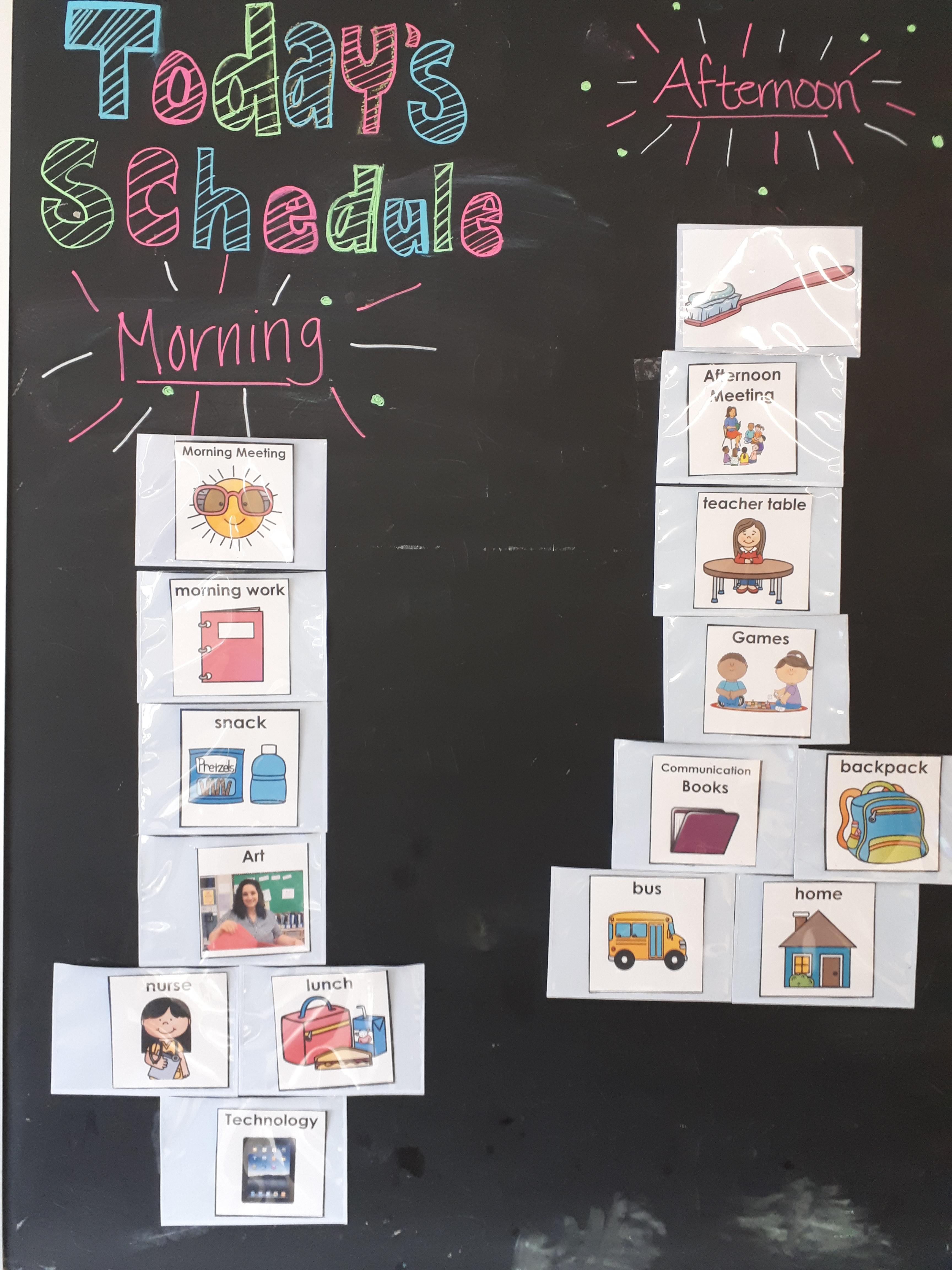
A blackboard with the schedule taped on it.

A Typical Day in a Class of Students with Developmental Disabilities

When I started my new role of supporting students with Developmental Disabilities this year, my biggest question really was about the structure of the day. Since it was my first time doing this role, I asked many other teachers who have been doing this role for a long time for advice. They shared with me how their day was structured and ideas for potential programming. I took many of their suggestions and paired them with ideas that met the needs of my students. Without the kindness of so many of my Peel colleagues, I would have been LOST! For those of you out there that will be taking on this new challenge in September, below is a typical day in our classroom to hopefully give you some ideas to get you started.

It is important to note that my schedule has changed at least 30 times since September as we worked towards the perfect fit for our students. All of our students and staff were new to our class this year and there were many things that impacted our schedule that I didn’t anticipate such as medical needs, busing schedules, integration opportunities, behavioural needs and student goals. The schedule is something that I am constantly reflecting on and am constantly tweaking as I observe my students and team in action.

A typical day in my class:


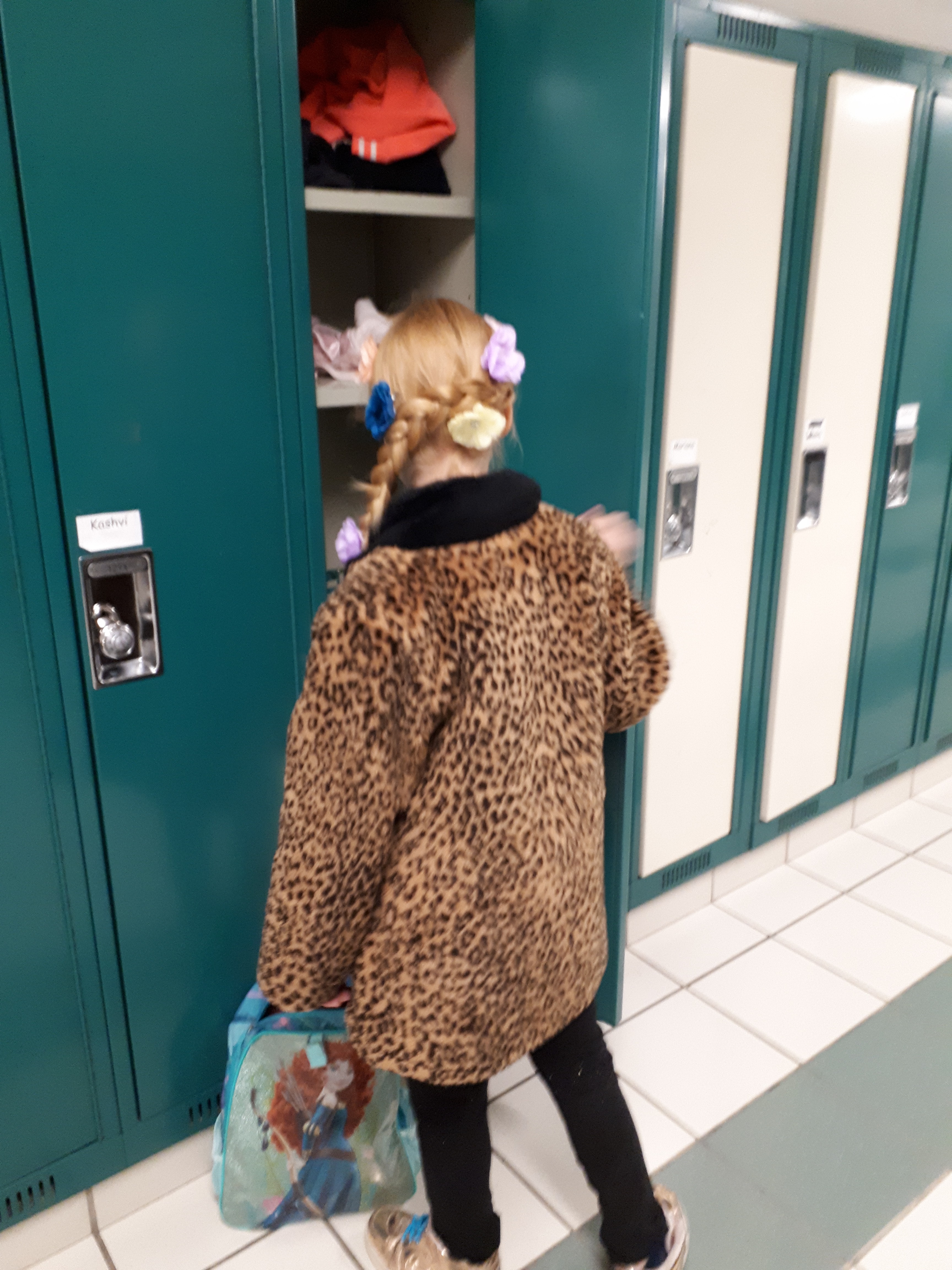
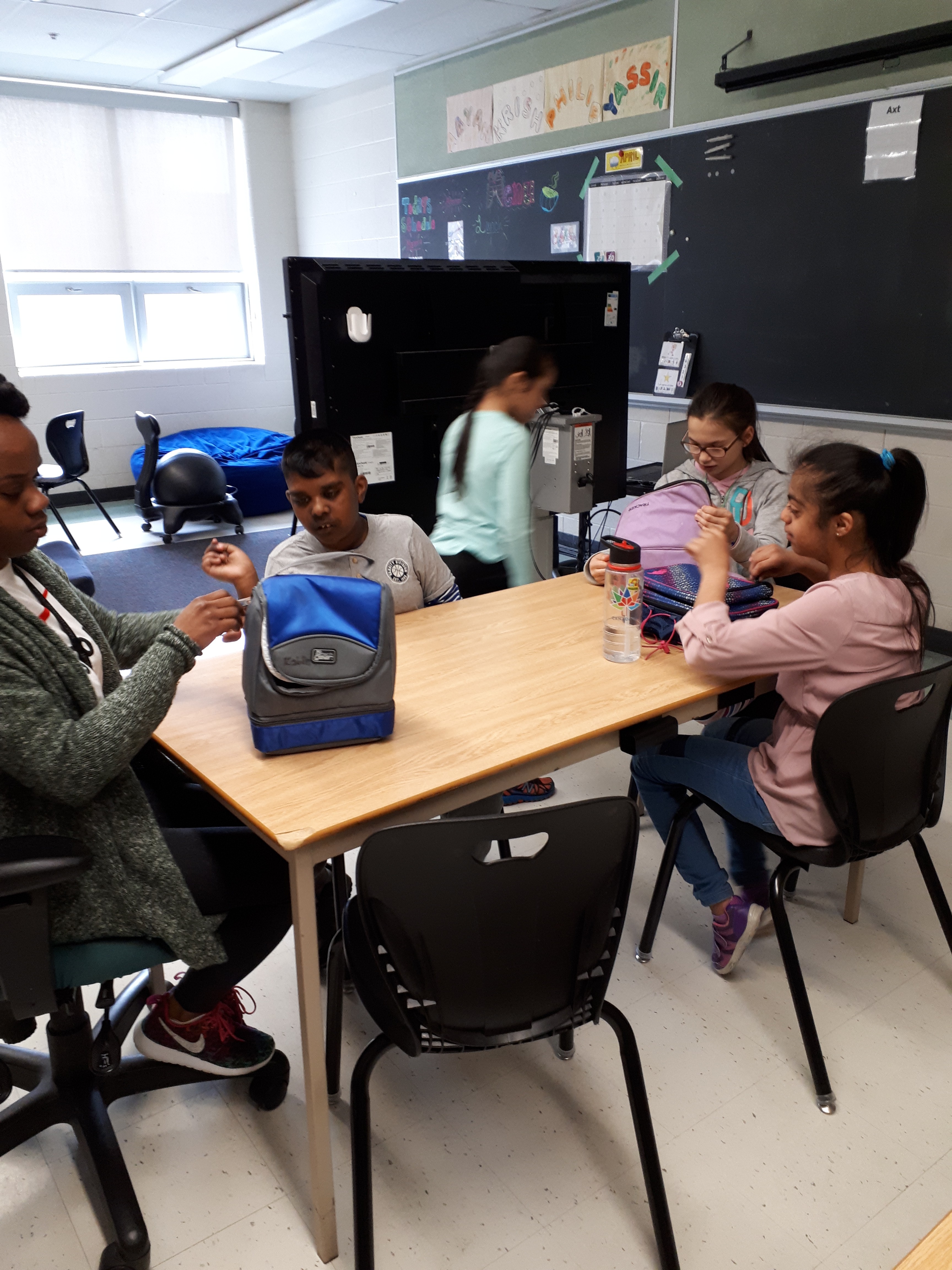
We enter the building and put our stuff in our lockers.

locker

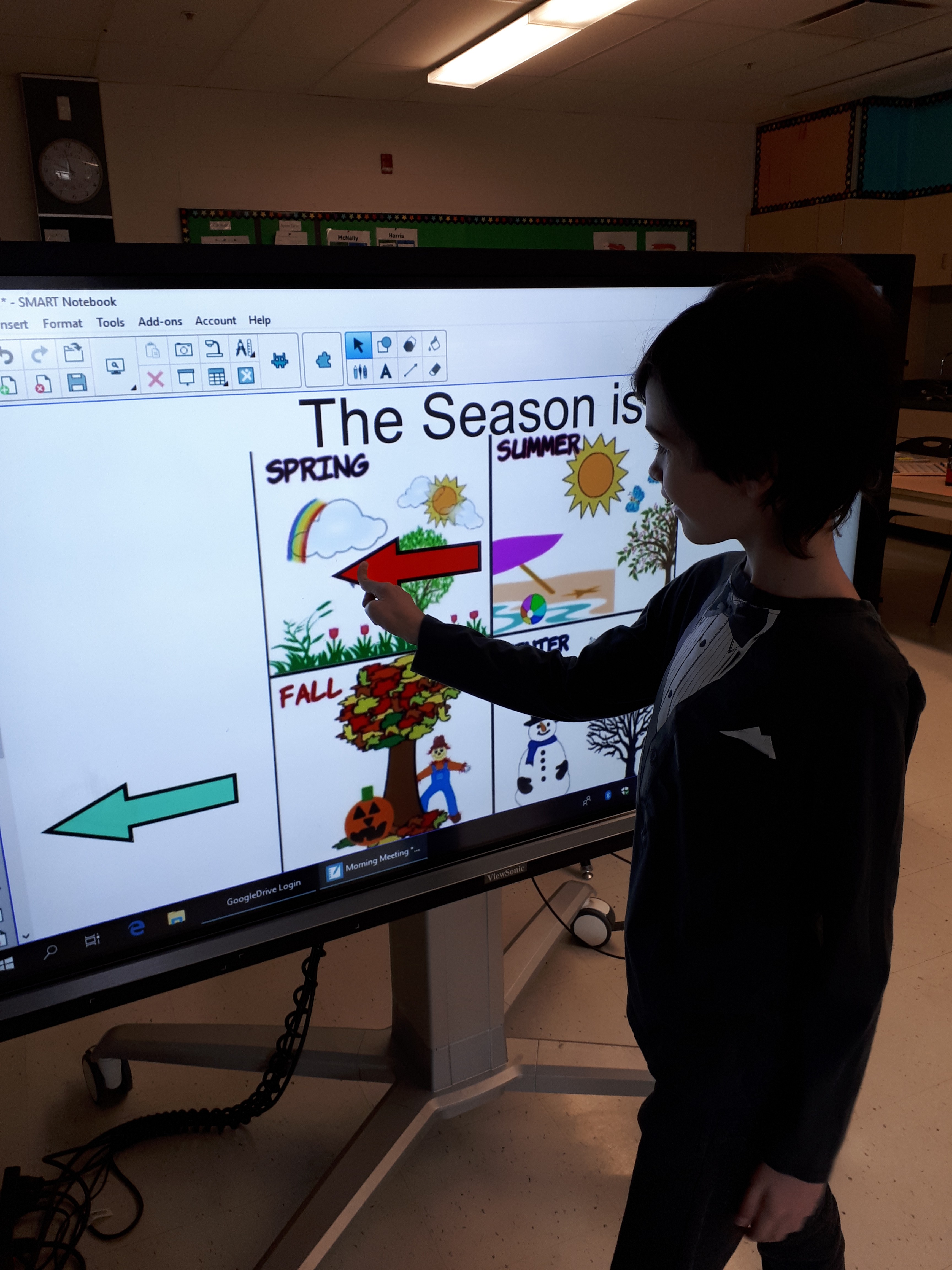
We have our morning meeting.

Morning meeting

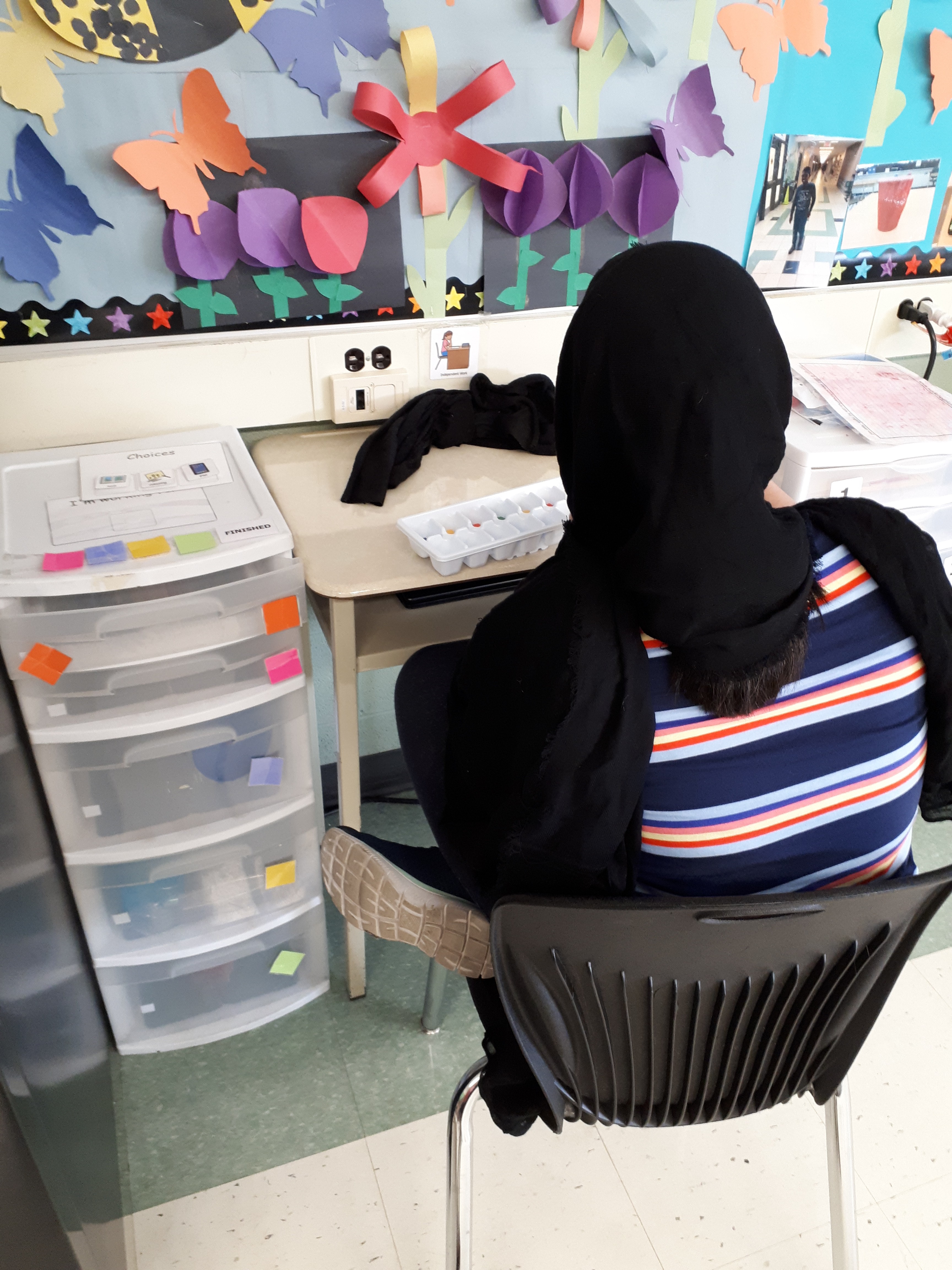
We do our morning work.

Morning Work

Snack time

snack

Gym or art

gym


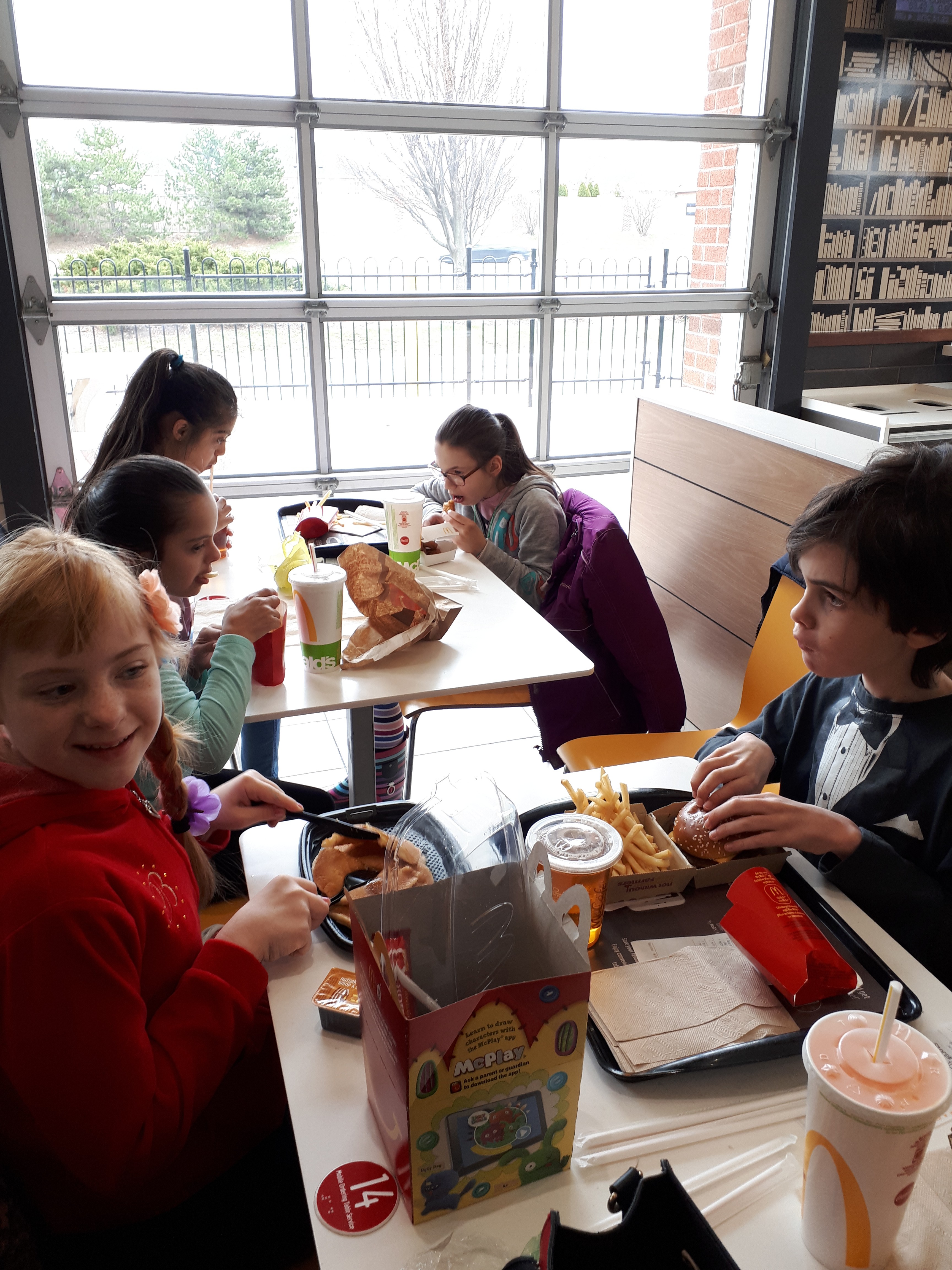
Lunch/Life skills (Today was public transit training and eating in a restaurant)


McDonalds

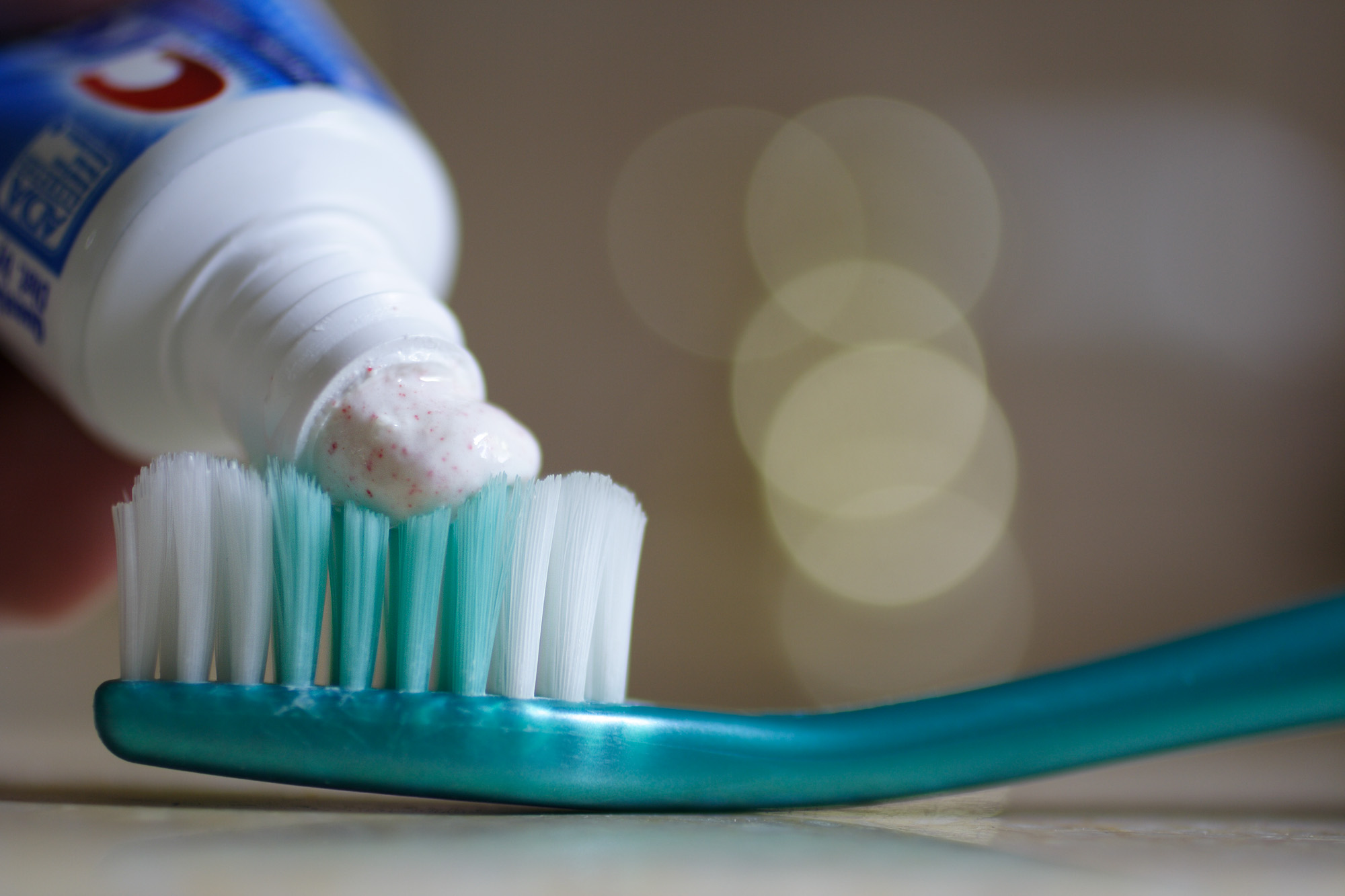
Hygiene Routine (brushing teeth, brushing hair, washing face and putting on deodorant)

Toothpasteonbrush

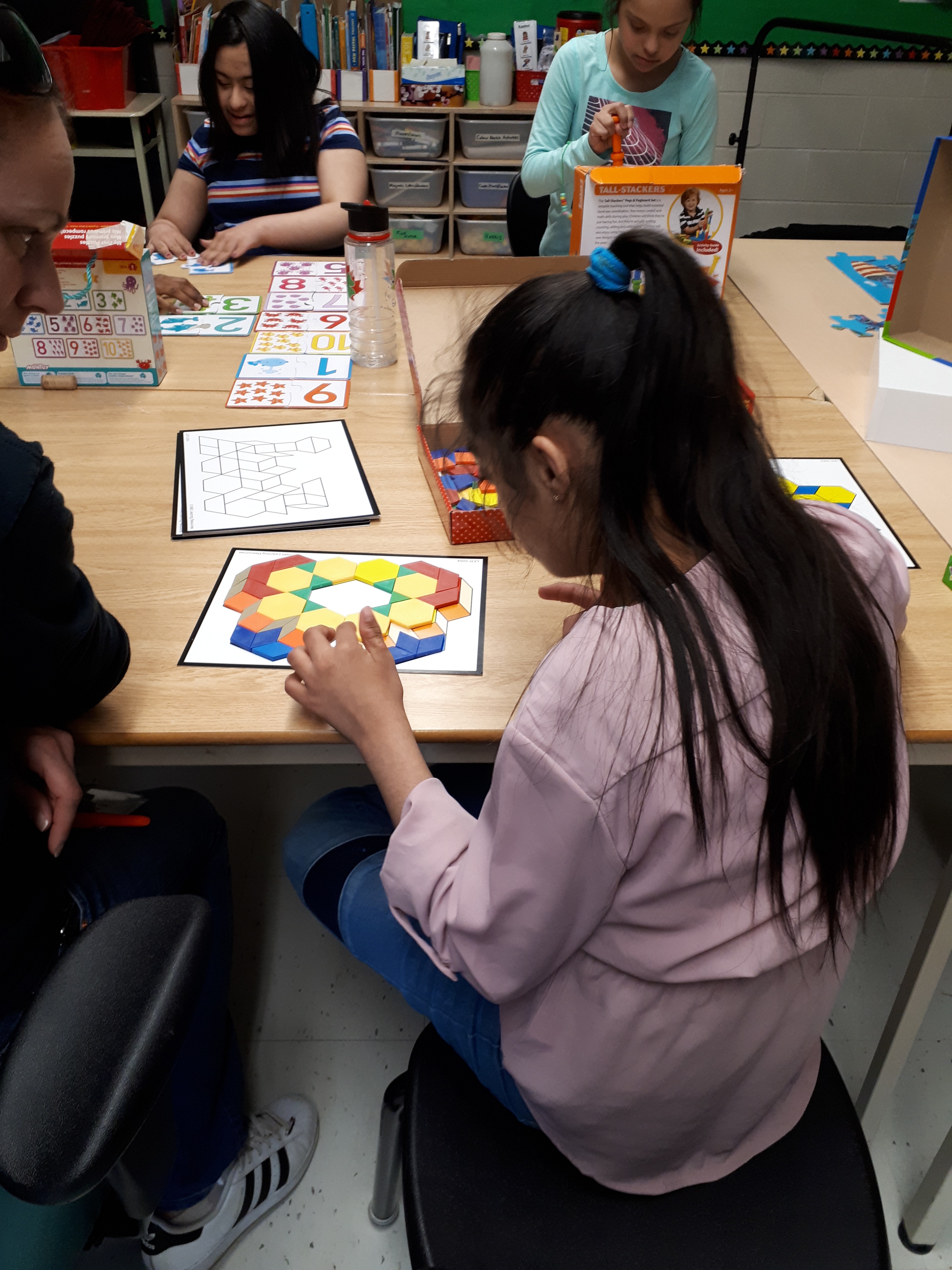
Afternoon work time/social skills


Games and work

Pack up and get ready to go home

Getting the User at the Center of User-Centered Design!

For years I’ve worked with students around designing solutions for real problems in the world around us. I’ve asked students to consider the problem from a variety of perspectives and as of late, I wonder if there’s more that can be done about solving these complex problems.

In my role at Future Design School, I’ve had the privilege of facilitating workshops for students. In working with students over the past few weeks, I’m learning more and more about the importance of having the opportunity to understand the problem from the user’s perspective as well. Now I know that this seems like something that I should have known or thought of more in depth before, but it’s something that I honestly hadn’t. When students are creating, it’s important for them to understand that what they create has an impact on those for whom they are creating. In order for students to really empathize with users, they have to first be able to understand the needs of their users. They have to really take the time to stop and hear their stories through the development of open questions. How might we help students to do this?

Being Conscious of Assumptions

In the past, I’ve asked students to be thinking about a variety of users as they solved problems. As such, they worked to create general and perhaps broad-sweeping solutions but what if they were empowered to create for a specific user? With a specific user’s needs and motivations in mind, might this impact the effectiveness of their potential solutions? When we think about user-centered design, that’s what it’s really about. The user. Without taking the time to consider a potential user, I’ve asked students to make big assumptions that we never had the opportunity to test. When we make these assumptions, especially without being explicit about the fact that we are making assumptions, we hinder the ability to create the most effective solution. This makes me think about students again creating for the teacher, rather than meeting the needs of the user, which is definitely the purpose of user-centered design. So how do we go about helping students to understand the needs of their users and move past assumption making and perhaps into assumption testing? I think it’s about interviews!

Interviews

When students are able to interact with real users and ask big questions about the problem they are hoping to solve, the have a real opportunity to have an impact. That being said, there’s a fine art to the interview. When thinking about learning more from our users, it’s important to not lead them with the types of questions that we may ask. By having open questions that really get the user talking about their experiences, you’re better able to understand the problem from their perspective. Often times, through listening, you’re also able to better understand how they feel about a situation based on what they aren’t saying. A great way to get users talking about their experiences is using the TED framework for questioning: Tell me…Explain…Describe. By starting off questions in this way, we empower the user to actually talk about the problem without leading them.

Helping students to craft interview questions that are open is a great start. Once they’ve crafted the question, it’s great to have them interview potential users in teams. One person can ask the questions while someone else can write. If there is a third person in the group, they might also make notes to capture their understanding of what the user is saying. Don’t have access to potential users? Sometimes you can use videos to help.

Watching Videos

Last year, I was working with grade 5 students on solutions to natural disasters. Because it was related to a real problem that was happening in the world, students were able to read articles that contained interviews as well as watch videos to be able to better understand their users. I used this video to help students understand the problem but it wasn’t until after, that I noticed how rich it could have been in helping students understand the problem from the perspectives of different users. Perhaps curating different videos or guiding students in finding their own might be a way to help them build empathy for a specific user. Again, this might be another time to discuss assumptions that might be made as we don’t have the chance to ask clarifying questions of the users.

I’m always looking for ways in which to make student learning meaningful and relevant. I’ve also always believed that design is a great tool for doing just that. Now my focus is shifting to empowering students to build deep empathy and truly making sure that their designs are user-centered.

Wellness in the Classroom

Over the past few weeks, I’ve had a number of people reach out to ask about an activity that I did last year with junior students in our Wellness Club. I’ve been answering questions and sharing ideas and I thought perhaps this might be of benefit to more people so for this post, I’m sharing some of the work that I did with my colleague, Cynthia Wan at Shaughnessy Public School.

Over the last number of years, I’ve personally realized the benefits of incorporating elements of wellness into my daily routine. When working with students, I always saw great value in helping them to develop their own “wellness toolkit”. Through activities and conversations, students were given the opportunity to understand and express how different situations or experiences made them feel. In being more self-aware, students were then able to determine strategies that worked best for them when they were experiencing times of stress. We all think it would be ideal to not have any stresses but in reality, stress will always be around and we sometimes need those challenges to help us grow. The difficulty becomes when we can’t manage the amount of stress that experience. While much of the activities and ideas below are things that I’ve incorporated in my classroom with all students, last year, Cynthia and I thought about trying to take it a little further with a small group of students who were willing to dig in with us and really spend some time thinking about their own wellbeing and worked to create their own physical tool kits filled with strategies and tools. Below, I’m outlining some of the tools that I’ve used in the hopes that it might help if you’re thinking of starting your own wellness club or thinking of trying some of these activities in your class with students.

Meditation Apps

Stop, Breathe & Think is an app that I’ve used with students centred around meditation. In the past, there was only one version but in the past couple of years, they also have an app specifically geared towards children. Students particularly enjoyed meditations connected to their breathing as well as the Body Scan. It offered them a chance to just pause and reset if needed. We also took the mindful walking meditation outdoors with speakers and students considered ways in which they might utilize mindful walking as they travelled from one pace to the next. There is a link to some of the resources that they have but I haven’t used any of them with students.

Sitting Still Like a Frog is another meditation tool that has a book with activities. Visualization was another tool that I used with students and the A Safe Place meditation was one that students quite enjoyed.

Resources

Zones of Regulation was also a resource that I used in my classroom. I found it super helpful for getting students to identify what they are feeling and consider their own triggers and strategies for what they might do to move back to the green zone. The language is great in not valuing one zone over the other but thinking about how we can get back to being optimal if and when we identify that what we are feeling is impacting what we are doing and our interactions with others.

The Mindup Curriculum is also a great resource that I have used in the past with my whole class. I like that it starts off with talking about the science behind what we might be feeling and our responses to stressful situations.

I found this great book list with some mindfulness books that I’ve used to talk about mindful eating and some of the other activities that I have done with students. Your Fantastic Elastic Brain is also a great resource.

Just Breathe is a great video for opening up the conversation about naming what we are feeling as being a powerful part of being able to determine steps to change the feeling if things are not where we would like them to be.

Wellness Toolkits

 Screenshot 2019-04-29 at 4.49.31 PMWhen building out toolkits, students used ideas from our discussions and activities from our sessions together to help build their own physical kits. We started off with ziploc bags and students decorated them with duct tape. This really was an idea from one of the students who had used it in the past to create her own pencil cases and she thought it would be a great – and inexpensive – way to personalize our own toolkits. Once the toolkits were designed, it was time to think about the items that they wanted to include.  

Some of the items included:

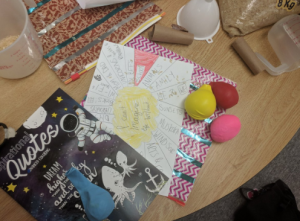
Mindfulness colouring – We picked up a few from Dollarama. Some students also worked to create their own doodle books when given a blank scrapbook.

Inspirational quote books – We also found a few at Dollarama but some students were given their own scrapbooks as well to gather their own book of quotes that served to uplift them when needed an extra bit of encouragement.

Mindfulness Jars – A quick and easy visual for helping students to be able to understand that sometimes we have a lot swirling around in our minds and that by taking some time to be mindful of this fact, we can work towards calming some of those thoughts. Some students even like using them as a way to regain focus as they watch the sparkles settle. We used this recipe but there are so many more. I like the explanation on this one but didn’t like the idea of using glue.

Stress Balls & Slime – One student lead 2 sessions for our Wellness Club around using stress balls or slime as something tactile that sometimes help to manage stress. We did have conversations around making sure that it was something that was needed vs. something that we just enjoyed playing with in the classroom.

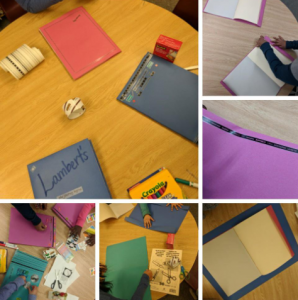
Screenshot 2019-04-29 at 4.49.45 PMWellness Journal – Students had their own journals – simple notebooks that they decorate the front of after we covered them with construction paper. We used these as a check-ins for themselves or prompts that they could use to write about how they were feeling.

Some of the prompts included:

  • Today I feel… because…
  • I’m grateful for…because…
  • One thing that I can do today to make it fantastic is…
  • Draw yourself as a superhero. What powers do you have? What powers might you like to work on further developing?
  • 3 ways in which I can help make someone’s day great are…
  • Write down three I am statements that define who you are. Take a few minutes to think about each one. Which quality feels the best? Why?
  • When you’re feeling confident, what emotions do you experience?
  • Who can you compliment today? Why? Find the time to make sure that the person hears what you have to say today.
  • Write three things that make you happy. How can you spend more time on these things each day?
  • The best day ever would be…
  • One thing that I learned about myself this week is…

Other Mindfulness Activities

Nature walks – Quiet walks in a small group in the neighbourhood to just take some time to notice. Some students captured items along the ground that they wanted to include in their journals. Some focused on sounds that they heard when they took the time to stop and truly just be in the moment.

Music – Sometimes having the opportunity to select the type of music or having ambient noise was helpful for some students as they worked and also to change their mood.

Yoga/Mindful movements – Cynthia was great in leading us in Yoga or mindful movements. A few years back, a colleague had the Yoga 4 Classrooms resource which we sometimes used to get us moving and stretching when we needed it. I also had students lead the Circle of Joy, which is also a mindful movement activity that is easy to learn and just helps to refocus.

These are just some of the tools I found useful when helping students to create their own toolkits of wellness strategies. As I mentioned before, stress is all around us. I think that helping our students determine which strategies work best to help them manage the stresses is an important part of helping them to be successful.

Less Screen Time, More Play


24 hour movement guidelines


An April 2019, the World Health Organization (WHO) study highlighted the need for children to be more physically active and get more sleep. It particularly stressed the need for children under 5 to spend less time “sitting watching screens, or restrained in prams and seats, get better quality sleep and have more time for active play if they are to grow up healthy” WHO Director-General, Dr. Tedros Adhanom Ghebreyesus stated that “early childhood is a period of rapid development and a time when family lifestyle patterns can be adapted to boost health gains” (World Health Organization, ‎2019)‎.

The WHO developed new guidelines on physical activity, sedentary behaviour and sleep for children under 5 years of age. The guidelines were developed based on the effects on young children of inadequate sleep and time spent sitting watching screens or restrained in chairs and/or strollers (World Health Organization, ‎2019)‎.

“Improving physical activity, reducing sedentary time and ensuring quality sleep in young children will improve their physical, mental health and wellbeing, and help prevent childhood obesity and associated diseases later in life,” stated Dr. Fiona Bull, WHO program manager for surveillance and population-based prevention of non-communicable diseases (World Health Organization, ‎2019)‎.

The WHO stressed the need to set healthy physical activity and sleep habits early in life as this helps shape healthy habits for the rest of peoples’ lives (World Health Organization, ‎2019)‎.

“What we really need to do is bring back play for children,” says Dr. Juana Willumsen, WHO focal point for childhood obesity and physical activity. “This is about making the shift from sedentary time to playtime, while protecting sleep” (World Health Organization, ‎2019)‎.

Recently, The American Academy of Pediatrics (Yogman, Garner, Hutchinson, Hirsh-Pasek, Golinkoff, & Committee on Psychosocial Aspects of Child and Family Health, 2018). released a policy statement characterizing exercise through play as critical to the developmental and neurological development of children. In addition, play encourages learning and “joyful discovery” (Yogman et. al., 2018). Play enhances social and emotional skills important to children’s development and mental wellness (Klass, 2019; Yogman et. al., 2018). Further, ” the importance of interacting with children, responding to their cues and questions, the value of the old-fashioned kind of face time, with parents and with peers, and the importance of helping kids find a variety of experiences that are not all about screens and screen time in a world that is increasingly virtual for both parents and children” (Klauss, 2019; Yogman et. al., 2018).

The WHO stated that prolonged restrained or sedentary screen time  should be replaced with more active play and quality sedentary time spent in interactive non-screen-based activities with a caregiver, such as reading, storytelling, singing, and puzzles (World Health Organization, ‎2019)‎. The WHO stressed that this interactive time is very important for child development. The WHO further linked inadequate physical activity, too much sedentary behaviour, and inadequate sleep time to having an impact on the “physical and mental health and wellbeing” of children (World Health Organization, ‎2019)‎.

Recommendations at a glance (World Health Organization, ‎2019)‎:

Infants less than 1 year should (World Health Organization, ‎2019):

  • Be physically active several times a day in a variety of ways, particularly through interactive floor-based play; more is better. For those not yet mobile, this includes at least 30 minutes in prone position (tummy time) spread throughout the day while awake.
  • Not be restrained for more than 1 hour at a time(e.g. prams/strollers, high chairs, or strapped on a caregiver’s back). Screen time is not recommended. When sedentary, engaging in reading and storytelling with a caregiver is encouraged.
  • Have 14–17 hours (0–3 months of age) or 12–16 hours (4–11 months of age) of good quality sleep, including naps.

Children 1-2 years of age should (World Health Organization, ‎2019):

  • Spend at least 180 minutes in a variety of types of physical activities at any intensity, including moderate-to-vigorous-intensity physical activity, spread throughout the day; more is better.
  • Not be restrained for more than 1 hour at a time(e.g., prams/strollers, high chairs, or strapped on a caregiver’s back) or sit for extended periods of time. For 1-year-olds, sedentary screen time (such as watching TV or videos, playing computer games) is not recommended. For those aged 2 years, sedentary screen time should be no more than 1 hour; less is better. When sedentary, engaging in reading and storytelling with a caregiver is encouraged.
  • Have 11-14 hours of good quality sleep, including naps, with regular sleep and wake-up times.

Children 3-4 years of age should (World Health Organization, ‎2019):

  • Spend at least 180 minutes in a variety of types of physical activities at any intensity, of which at least 60 minutes is moderate to vigorous intensity physical activity, spread throughout the day; more is better.
  • Not be restrained for more than 1 hour at a time(e.g., prams/strollers) or sit for extended periods of time. Sedentary screen time should be no more than 1 hour; less is better. When sedentary, engaging in reading and storytelling with a caregiver is encouraged.
  • Have 10–13 hour of good quality sleep, which may include a nap, with regular sleep and wake-up times.

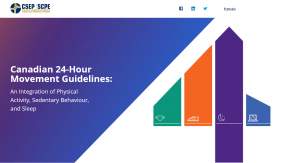
A healthy 24 hours for children ages 5 to 18 years old (Canadian 24-Hour Movement Guidelines for Children and Youth  for ages 5-17 years) :

SWEAT: Moderate to Vigorous Physical Activity

  • An accumulation of at least 60 minutes per day of moderate to vigorous physical activity involving a variety of aerobic activities.
  • Vigorous physical activities, and muscle and bone strengthening activities should each be incorporated at least 3 days per week.

STEP: Light Physical Activity

  • Several hours of a variety of structured and unstructured light physical activities.

SLEEP: Uninterrupted sleep with consistent bed and wake up times

  • Ages 5-13 years old = 9 to 11 hours of sleep per night.
  • Ages 14-17 years old = 8 to 10 hours per night.

SIT: Sedentary Behaviour

  • No more than 2 hours per day of recreational screen time; Limited sitting for extended periods.
  • Preserving sufficient sleep, trading indoor time for outdoor time, and replacing sedentary behaviours and light physical activity with additional moderate to vigorous physical activity can provide greater health benefits.
  • Children 6 years and older should have established and consistent limits on the time spent using media, with parents ensuring that digital media doesn’t take the place of sleep, physical activity or real-life personal interactions.

One thing I gleaned out of this research is that adults should also follow this good advice for being more active. This includes (Canadian 24-Hour Movement Guidelines for Adults 18 to 64 years):

  • To achieve health benefits, adults aged 18-64 should accumulate at least 150 minutes of moderate to vigorous-intensity aerobic physical activity per week, in bouts of 10 minutes 
or more.
  • It is also beneficial to add muscle and bone strengthening activities using major muscle groups, at least 2 days per week.
  • More physical activity provides greater health benefits.

The bottom line is get moving, sleep enough at the same time every day, and get off your screens … the kids are watching you.

Collaboratively Yours,

Deb Weston, PhD

References

Klauss, P. (April 2019). Prescription for growth: Let your children play, New York Times, published in the Globe and Mail April 2019. Downloaded from https://www.nytimes.com/2018/08/20/well/family/let-kids-play.html

World Health Organization. (‎2019)‎. Grade Tables for Guidelines on physical activity, sedentary behaviour and sleep for children under 5 years of age, World Health Organization. Downloaded from https://apps.who.int/iris/bitstream/handle/10665/311663/WHO-NMH-PND-19.2-eng.pdf?sequence=1&isAllowed=y

World Health Organization. (‎2019)‎. Guidelines on physical activity, sedentary behaviour and sleep for children under 5 years of age: web annex : evidence profiles. World Health Organization. Downloaded from http://www.who.int/iris/handle/10665/311663. License: CC BY-NC-SA 3.0 IGO

Yogman, M., Garner, A., Hutchinson, J., Hirsh-Pasek, K., Golinkoff, R. M., & Committee on Psychosocial Aspects of Child and Family Health. (2018). The power of play: A pediatric role in enhancing development in young children. Pediatrics142(3), e20182058. Downloaded from https://pediatrics.aappublications.org/content/142/3/e20182058?utm_source=STAT%20Newsletters&utm_campaign=053c00c518-MR_COPY_01&utm_medium=email&utm_term=0_8cab1d7961-053c00c518-150867485

The Courage to Teach

The Courage to Teach

teaching from the heart

In this very challenging time of education cutbacks, teachers are on the edge. They wonder how long they will keep their jobs and what will classrooms be like in the next school year.

Losing your job as a teacher is not just about losing a job, it is about losing the work that you do to challenge your spirit to make a difference – it is about losing your heart. When teachers teach, they teach through resources no other person possesses, their identity as a teacher and as a learner and as an adult who cares about students. As a teacher of over 19 years, I know that students can tell the difference between teachers who care and teachers who do not care – and this impacts how students learn.

Parker Palmer (2007, p. 11) puts it simply “Good teaching cannot be reduced to technique; good teaching comes from the identity and integrity of the teacher.”

When teachers teach, they are connected to the students, dialed into who the students are and what interests them. Good teachers are always looking for the teachable moment to grab students’ interest and get them excited about learning.  “Good teachers possess a capacity for connectiveness. They are able to weave a complex web of connections among themselves, their subjects, and their students so that students can learn to weave a world for themselves” (Palmer, 2007, p. 11). Methods vary depending on the grade level, subject, and opportunity – lectures, Socratic dialogues of questions and answers, experiments, collaborative problem solving, or one on one discussions. It’s all good teaching when connections are made through “the place where intellect and emotion and spirit and will converge in the human self” (Palmer, 2007, p. 11), the heart of a person, a student.

As a teacher I do my best to keep my heart of teaching  strong and pliable. I have learned to roll with the challenges of teaching through dealing with challenging students, challenging parents, and sometimes challenging administrators. It is not an easy job to keep heart.

Why do teachers lose heart?

In the daily “work out” of teaching, we are highly vulnerable as we are the centre of attention in the classroom. This is a highly personal job. Students are watching us for who we are and what we represent. Our public and private lives are on the line in classrooms. We must be ourselves but we also must have a suit of self-protection against high levels of criticism that are meant to break us. Teachers will ultimately make mistakes in their teaching, in their assessment, and sometimes in their judgement but I find that students are usually very forgiving, especially if the teacher owns the mistake.

Another reason why teachers lose heart is that teaching can be very challenging. What makes teaching really hard is in seeing the potential of students and identifying the great barriers students face in fulfilling their best self. The challenge is to face with the barriers that limit students’ potential. Human potential gets sidetracked by disability, culture, identity, family, school culture, community, and economics. In having high expectations for all students, teachers make a grand difference in the students’ future. Teaching students how to get around these barriers is key to their social, emotional, and academic growth. When using intuition and identity, teachers discover ways to reach students’ hearts.

To become a really good teacher, it took me over 8 years of practice. That’s about 10,000 hours – Malcolm Gladwell’s 10,000 hour benchmark for achieving success (Gladwell, 2008).  In the VITAE (Variations in Teachers’ Work, Lives, and their Effects on Pupils) study, with 300 teachers in 100 schools, that examined influences in teachers’ identities, Day, Sammons, Stobart, Kingston, and Gu (2007) found that teachers reach their highest level of efficacy between year 7 and 8 in teaching.

In the first couple of years of teaching I went from being totally overwhelmed in the joy of teaching to totally overwhelmed with the disappointment of teaching. Some days I was afraid. I was afraid of not being competent enough, not working hard enough, not meeting students’ needs enough, not connecting with students enough, and sometimes not being quick enough when a student threw a chair in my direction (this happened the second week of my first contract).

Even after 19 years of teaching, I still have fears, but I am not these fears. Instead, I teach with courage and resilience and discovery. I teach from curiosity, honesty, hope, empathy, and conviction. I teach from who I am. I teach with heart.

I implore teachers to have the courage to teach in these challenging times. To never surrender to a person who is trying to trivialize your work as something easy and simple and something that can be done by technology … because computers don’t have heart.

Be brave. Teach from your heart.

Collaboratively Yours,

Deb Weston, PhD

References

Day, C., Sammons, P., Stobart, G., Kingston, A., & Gu, Q. (2007). Teachers matter: Connecting lives, work and effectiveness. Maidenhead, UK: Open University.

Gladwell, M. (2008). Outliers: The story of success. Hachette UK.

Palmer, P. J. (2017). The courage to teach: Exploring the inner landscape of a teacher’s life. John Wiley & Sons.


A meme of a teacher wishing for a single point rubric.

Effective Assessment and Feedback: The Single Point Rubric

RUBRIC MEME

I’ve never really been focused on grades in my classroom. Some educators and parents might find it shocking to read a teacher put that in print.  However, what I mean is that I seldom talk to my students about levels and letter grades.  I focus discussion around feedback, improvement, exemplars and success criteria.  When rubrics were all the rage I used them rather unsuccessfully. I found that traditional 4 level rubrics were about evaluating after the fact rather than providing feedback that can be acted upon during the learning. Rubrics are sometimes handed to the students as a “big reveal” when the project has been evaluated without any chance for acting on feedback.  I don’t believe that success criteria should be a secret to be kept from students.  It isn’t fair that students are thinking, “Well, if you’d only told me that was an expectation I’d have been happy to include it.  I can’t read the teacher’s mind!”  Clear is kind.  Be clear about the learning goals and success criteria for an assignment and give the students a rich task that they will have to dig into and get feedback to act upon during the learning.

Apart from the evaluative vs. the assessment function of a traditional rubric there are two other things that I dislike about the traditional 4 level rubric.  The first thing is that traditional rubrics inform students about what the bare minimum is that they have to do to complete something.  Some students will look at level 2 and do only just what it takes to fulfill that level.  Secondly, level 4 is meant to go above and beyond the expectations.  In a traditional rubric, students seeking level 4 don’t need to think outside the box at all.  All of the criteria for a level 4 is clearly stated-no thinking necessary.

The answer to this assessment question?  For me it was the Single Point Rubric.  Using the single point rubric changed the learning for my students and shifted my assessment practices. It focuses on what the student is doing well, what the student can do to improve in the work and exactly what the learning goal and the success criteria is for the learning.  However, it also allows for the above and beyond to be driven by the student.  It lets the student pleasantly surprise the teacher with creative thinking.  It is a clear and kind way to deliver feedback to students to encourage them to be successful in their learning.

I have included an example for a grade four  Single Point Rubric Literary Response.  Feel free to copy and change it to suit your needs.

If you would like to learn more about Single Point Rubrics:

Cult of Pedagogy

Edutopia-6 Reasons to Try the Single Point Rubric


Prom Project Hamilton

On Saturday, April 13th at Delta High school in Hamilton, the Prom Project held an amazing event. This event is supported by the same foundation who gave my students our grant for our inquiry project, the Hamilton Foundation for Student Success.

The Prom Project allows students to pick out outfits free of charge to wear to their upcoming school events such as grad or prom. There were thousands of dresses, suits, shoes, accessories, hair stylists, make up artists and even on site seamstresses to help kids who needed their pants hemmed or their dresses taken in. I was able to volunteer at this amazing event along with many other teachers, principals and other adults from around Hamilton. The event was record breaking with almost 500 students walking away with new outfits. These outfits help increase their confidence knowing that they will have an outfit to wear to these events.

Among those 500 students who received outfits were 12 students from my own school. With the help of the prom project volunteers, the boys and girls found outfits that were their size, got these outfits altered and even left with their hair and makeup done. They received a swag bag full of helpful treats for their lives such as soap and other beauty products. It was awesome to see all the community partners there who donated their time, products and style capabilities to make the event the success it was.

You can still volunteer for the May 4th event by visiting http://www.promprojecthamilton.ca/. Follow the hashtags #PPH2019 and #promprojecthamilton for more info about the event. Pictured below is myself along with six students from my school who went home with Copley suits, Michael Kors suits and much more! An amazing event that really benefited so many children in our city!

Image-12

Social Advocate through Children’s Story

While many are marching to show the Ford Government our thoughts about the budget cuts, I am reflecting on how we can safely ride out this storm. As a Social Advocate for equal rights and positive outcomes for our children and this world, I am with my sisters and brothers at Queens Park today in spirit and via social media. I find myself planning ways to help the education team and students get through this next tumultuous time while supporting each other and focusing on self care. #ETFOstrong

This week I was privileged to be part of an audience engaged by the “beautiful” and talented writer, Helaine Becker. http://www.helainebecker.com/abouttheauthor.html

She presented to our school community to Grades 4-8 and then to Grades K-4.  I always enjoy an inspiring hero and artist who can inform and bring all those social justice issues that I am passionate about to the forefront with the power of words and books.

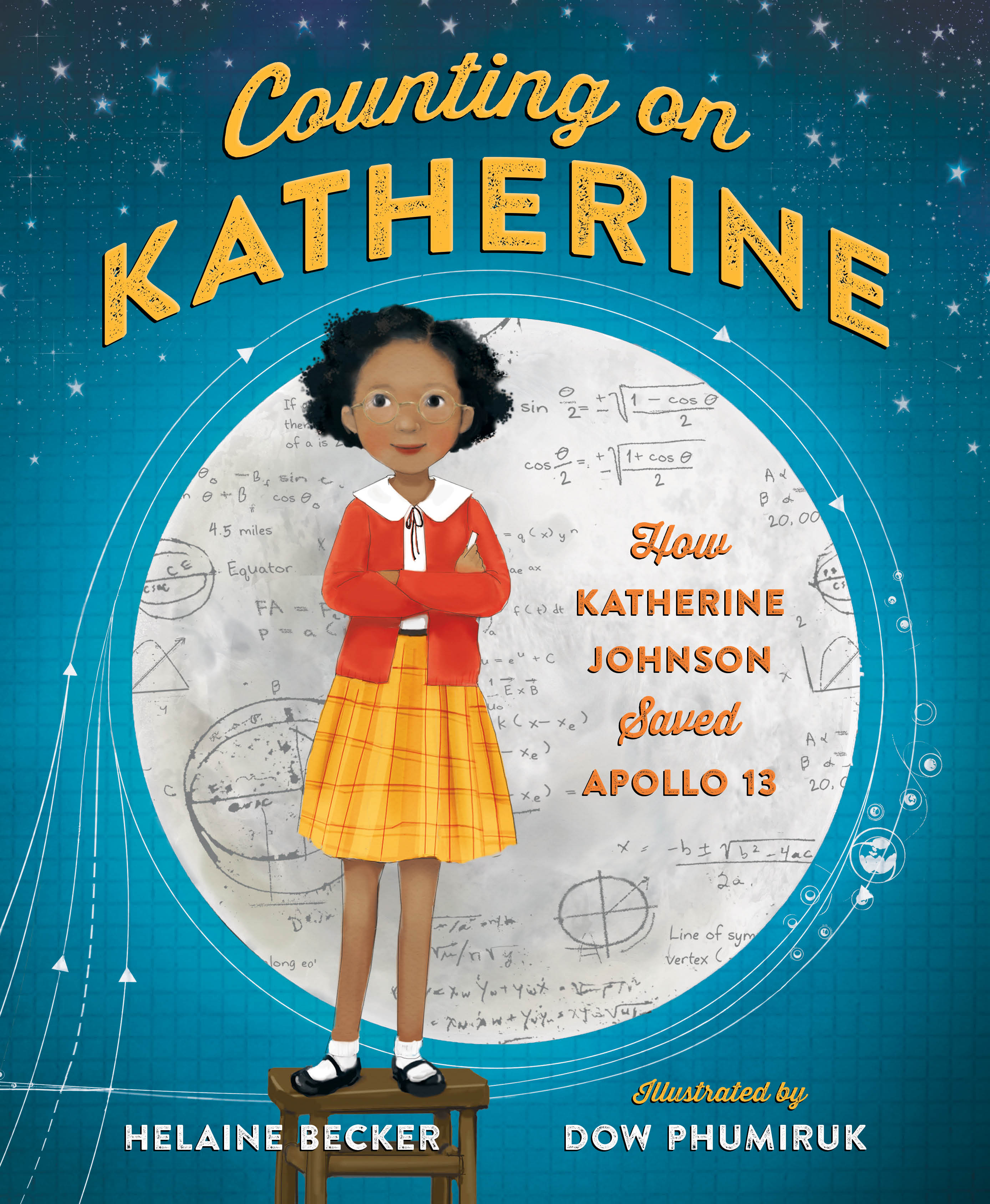
I am a woman science and mathematics teacher. This book excites me. It encompasses so many issues that I am passionate about.  “Counting on Katherine” tells the story of Katherine Johnson and the societal blocks she faced through her life.  She faced racism and sexism at every turn yet never stopped believing in herself. This story brings the truth to us about how she improved the world. She is one of the many previously unknown hero’s of my time.

countingonkatherinerevised_cover

During the very “beautiful” and talented Helaine’s presentation, I found myself and the school population, captivated with her presentation. She spoke of so many subjects which excite me. These topics open opportunities and possibilities for the many I educate. Helaine spoke of how she wrote about feminism, racism and suppression. She included topics of mathematics, science, space, and the “power of the pen”. She introduced the dream of writing to many during her amazing and dynamic presentation of her children’s books.

Thank you, Helaine for introducing me to another hero. I will now share Katherine Johnson’s story with many for years to come.

Smaller Class Sizes Matter for Kids

class size matters

As I started researching smaller class sizes, my Google search made it evident that smaller class sizes are significantly better … for students in private schools. Private schools use small class sizes to sell their product. They also get to pick who will be in their classes and who will be in their schools.

With campuses in New York, Oxford, and Torbay, the EF Academy of international boarding schools cites the key features of optimum class sizes of 17 students as “each student gets noticed”, students have “higher grades” and “perform better”, “learning is enhanced”, “teachers can teach”, “classes become a community”, “small groups mean fewer voices” so students have “more chances to speak”, teachers can focus on learning and spend less time dealing with distracted students, teachers can give more “individualized feedback”, teachers can work “on-on-one”, and “ideas are shared”.

Based on my own 19 years of teaching grades 2 through to grade 8, I know that even with large class sizes up to 30 students, I’ve been able to provide individualized feedback and present all students opportunities to speak, share ideas, and to participate in the classroom. I did not have students with significant learning or behaviour issues. I was also supported by a special education teacher on a daily basis. My classroom ran smoothly most of the time but a lot depended on who was in my classroom.

Class Size Really Matters to Students with Special Education Needs

One big impact in teaching larger class sizes is for the work teachers need to do to differentiate instruction and assessment to meet students’ needs. This is especially relevant in supporting students with special education needs. Students with special education needs may not be learning at their age appropriate grade level, may have Individual Education Plans, and may have very specific emotional needs.

Over the last 19 years, I’ve taught students functioning at three grade levels below their peers. In this case, teachers must adapt or modify students’ work as these instructional needs are prescribed in students’ Individual Education Plans. When teaching students with specific individual learning needs, teachers cannot simply plan, instruct, and assess with the “one-size-fits-all” approach. Teaching students with varying learning needs requires a great deal of work, thus teachers need a nimble knowledge of instruction and pedagogy. In addition, some students may be functioning at their grade level in a subject like math but need accommodations and modifications for subjects dealing with subjects like language. This adds to the complexity of teaching.

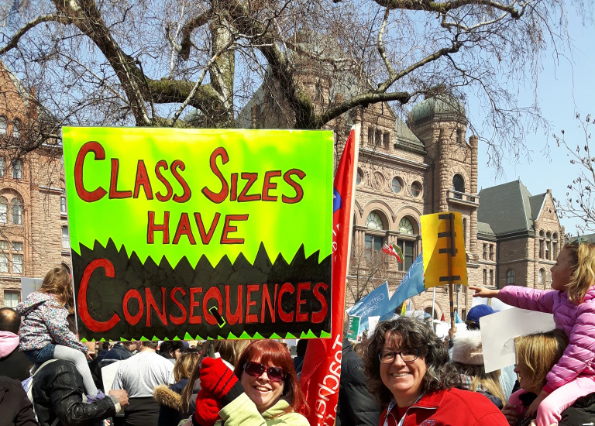
Class sizes have concequences

Class Composition Matters

Another aspect of class size is class composition. This means that one class of 23 grade 6 students is not the same as another class of 23 grade 6 students. I’ve taught some classes where most students were functioning at grade level, however several students had significant issues that impacted their academic achievement and/or behaviour. Recently, from anecdotal evidence, I’ve noted a significant increase in classroom compositions of students with additional learning and behavioural needs. I’ve spoken to colleagues with class compositions where almost half of the students had special education and/or behavioural needs – these teachers dealt with these classes with little or no additional support.

In my own 11 years of middle school, I’ve taught mainstream middle school classrooms of students with multiple needs. These issues included autism, attention deficit disorders, anxiety disorders, oppositional defiant disorders, depression, eating disorders, and self-harming disorders (i.e. cutting). In addition, many students had learning disabilities that co-occured in complexity which made it tough to support the students in their learning. I’ve taught  students with a myriad of learning disabilities which included dyslexia (i.e. reading challenges), dysgraphia (i.e. writing challenges), and dyscalculia (i.e. math challenges), dyspraxia (i.e. motor skill challenges), aphasia/dysphasia (i.e. language impairment), auditory processing disorder (i.e. difficulty processing sound), and memory issues. Further, teachers must deal with students who have social and emotional issues due to learning challenges, familiar issues, and/or socioeconomic issues. When considering the intersectionality of students’ needs, it can be overwhelming for a teacher to take on even one more student.

Smaller Class Sizes Cost Money

Smaller class sizes results in teachers having more time to spend with students. Smaller class sizes also means that with fewer students, there are less chances of disruptions interfering with learning. Smaller class sizes allows teachers to direct their energy to the business of learning and not the task of managing behaviour.

According to the National Center for Education Statistics (2018) the pupils per teacher ratio “declined from 22.3 in 1970 to 17.9 in 1985 … the ratio declined from 17.3 in 1995 to 15.3 in 2008.” After the 2008 recession, the public school pupil/teacher ratio increased, reaching 16.1. In 2014, private schools (who select students) had class sizes of 12.2 pupils (National Center for Education Statistics, 2018). In 2011-2012, average class size was “21.2 pupils for public elementary schools and 26.8 pupils for public secondary schools” (National Center for Education Statistics, 2018). Note that these class sizes are significantly smaller than Ontario’s current numbers, and still Ontario leads in solid data showing student success.

In 2003, Allan Krueger of Princeton University and Eric Hanuskek of Stanford University’s Hoover Institution debated the merits of class size (edited by Mishel & Rothstein, 2002). Krueger’s stance maintained that smaller class sizes improved students’ performance and future earning prospects. Hanuskek argued that reduced class size was only one aspect of student success and that improving teacher quality made a significant impact on students’ performance. As in most aspects of education, the educational landscape is complex and does not respond to single-issue solutions.

Lazear (1999) highlighted the link between smaller class sizes as this “reduces a student’s propensity to disrupt subsequent classes because the student learns to behave better with closer supervision, or enables teachers to better tailor instruction to individual students” (Krueger, 2003, p. 23). Lazear (1999) indicated that the “optimal class size is larger for groups of students who are well behaved, because these students are less likely to disrupt the class” (Krueger, 2003, p. 23). Lazear further stressed that “if schools behave optimally, they would reduce class size to the point at which the benefit of further reductions are just equal to their cost. That is, on the margin, the benefits of reducing class size should equal the cost” (Krueger, 2003, p. 23-24). In other words, when students’ behaviour is optimal, larger class sizes can be as effective as smaller class sizes.

The big challenge with most research on class size is that it does not provide definitive numbers specifying benchmarks on the class size (i.e. number of students) to which they are referring (Filges, Sonne-Schmidt, & Nielsen, 2018).

By referring to the numbers published by the National Center for Education Studies (2018), 21.2 students per class in public elementary schools and 26.2 students per class in secondary schools can be used as a current reference. With recent changes to the Ontario public school system, having more than 25 students in grade 1 to 8 classrooms is 18% over the average for public schools in the United States. Further, having 28 students in secondary classes is 7 % over the average for public schools in the United States. Note that these are averages and do not take into account variables in class sizes for types of class and subject taught.

Living in the Real World of the Classroom
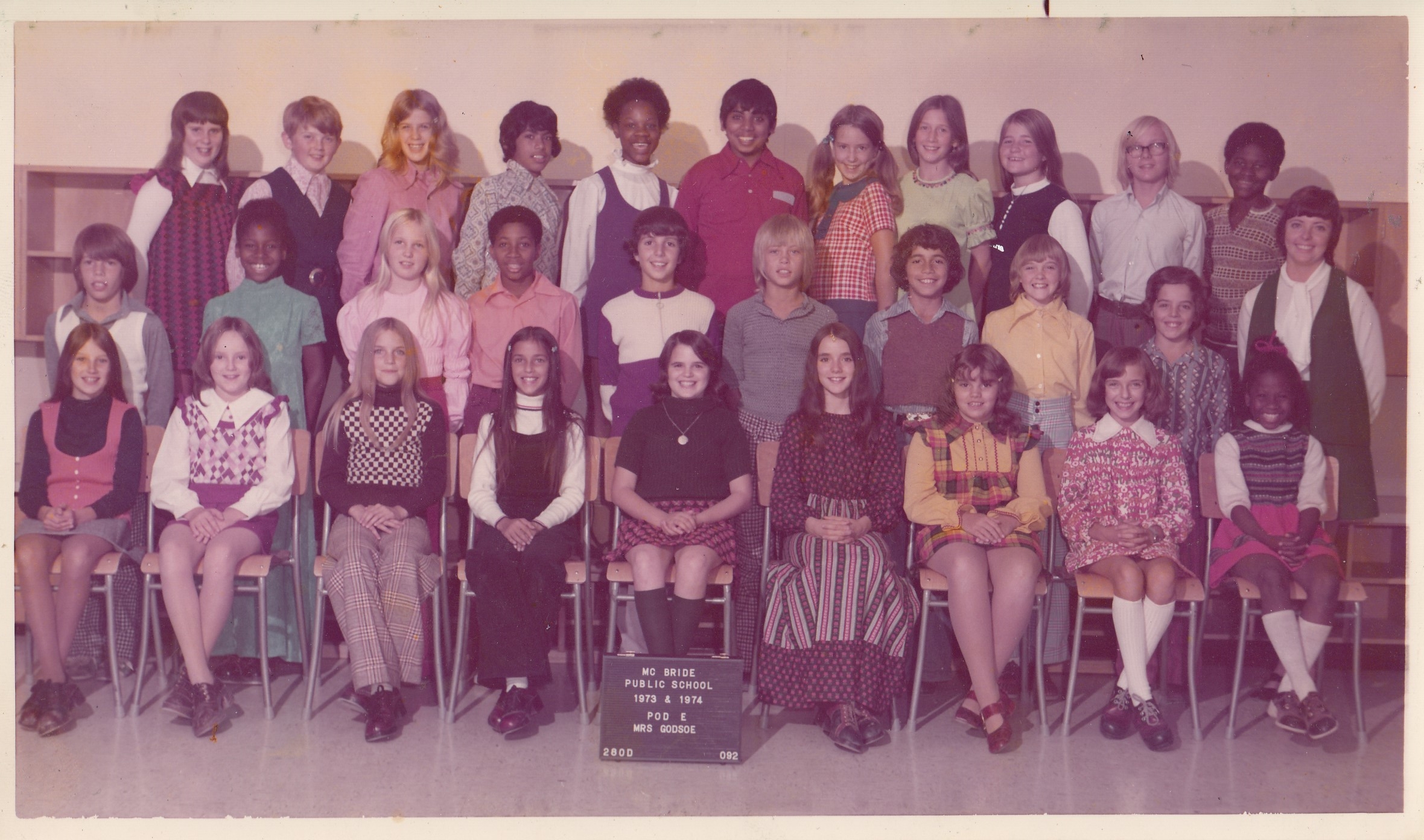
1973 1974

As a full time classroom teacher, I have the benefit of sifting through the literature and then putting it through the “real life classroom lens.”

When I was a grade 5 student in elementary school, classrooms were significantly different than they are today. We sat in rows and we did our work – there was no collaboration with other students and certainly no talking during class. Thus disruptions were minimal. I had 32 kids in my class (see the picture above – 3 kids were absent). Students who were not successful failed. Students who were deemed “special” and not at grade level were not integrated into our classroom – they were in the special classes.

As a classroom teacher, I have taught 33 students in a grade 8 classroom that could barely seat all the students – during the school year the students literally grew out of their desks. With 21st century learning, classrooms have become flexible in their seating and have pushed for a focus onto collaborative learning. Students get more say in how they are taught and assessed through co-created success criteria and self and peer assessment. This is a positive step as it makes students part of the learning and they are more engaged in the learning.

Recent research has shown that student behaviour continues to decline. There is much research documenting increases in student violence in schools. In an ETFO sponsored study it was reported that over 70% of Ontario elementary educators surveyed had seen or experienced classroom violence. A Canada-wide study conducted by the Canadian Teachers’ Federation (CTF) showed that at least four in 10 teachers experienced violence from students. I personally have been bitten, kicked, pushed, and had objects thrown at me by students. Students are experiencing significant behaviour challenges that go beyond being dealt with using standard classroom management strategies. To add to this, students’ instructional and assessment needs continue to grow, increasing the need for more special education support.

Larger class sizes not only challenge teachers, they also result in students with academic and emotional needs not being able to participate in their classroom. This results in frustration and sometimes behavioural challenges. With smaller class sizes, teachers can support students more fulsomely to help them with their learning needs and reduce behavioural challenges.

If the provincial government wants to increase class sizes, our provincial leaders need to first support teachers in dealing with student behaviour and to increase funding for special education needs. As Lazear stated in his research, when students are well behaved, larger class sizes are effective. Until this happens, class sizes should remain as is or even get smaller, as student behaviour is becoming untenable.

Collaboratively Yours,

Dr. Deborah Weston, PhD

References

Canadian Teachers Federation (Jul 09, 2018). Lack of resources and supports for students among key factors behind increased rates of violence towards teachers Downloaded from https://www.newswire.ca/news-releases/lack-of-resources-and-supports-for-students-among-key-factors-behind-increased-rates-of-violence-towards-teachers-687675241.html

Filges, T., Sonne-Schmidt, C. S., & Nielsen, B. C. V. (2018). Small Class Sizes for Improving Student Achievement in Primary and Secondary Schools: A Systematic Review. Campbell Systematic Reviews 2018: 10. Campbell

Krueger, A. B. (2003). Economic considerations and class size. The Economic Journal113(485), F34-F63. Downloaded from https://www.nber.org/papers/w8875.pdf

Lazear, E. P. (1999). ‘Educational Production.’ NBER Working Paper No. 7349, Cambridge, MA.

Mishel, L., & Rothstein, R. (2002). The class size debate (p. 3). A. B. Krueger, E. A. Hanushek, & J. K. Rice (Eds.). Washington, DC: Economic Policy Institute. http://borrellid64.com/images/The_Class_Size_Debate.pdf

U.S. Department of Education, National Center for Education Statistics. (2018). Digest of Education Statistics, 2016 (NCES 2017-094), Introduction and Chapter 2. Downloaded from https://nces.ed.gov/fastfacts/display.asp?id=28