Don’t Give Up on a Tough Class

I have one class that is very tricky. It is a very large class with a lot of emotional, physical and academic needs. It is the two periods in the week that I wish I had a clone of myself so that I could meet everyone’s needs immediately all the time (with this class I might need an army of clones).

I would rate the autumn with this class as alright. We have had our ups and downs. Some periods have gone well. Some have not. The thing that has been most consistent with this class is that I refuse to give up on them and their ability to do well in Music.

I feel at this point in the year, I have tried so many strategies to get the classes running smoothly and find ways to support my weaker students. However, it wasn’t until this past week that I feel like I have made a breakthrough!

I have finally landed on a combination of whole group instruction, peer-supported creations and individual choice.

Getting to know the students has been an important factor in this positive change. I have had several conversations with many of the students about sports, animals, music and all of their interests. I have used that knowledge to help build a relationship with them and inform my decisions around content for upcoming classes. I know for one of my students who is having the most difficult time at school right now, he really loves sports. I am planning to do a basketball dance this term to incorporate his interests.

I also have some students in the class who are significantly below grade level. Many of these students are embarrassed to ask other students for help. They are weak in reading and writing and therefore, they are very reluctant to work with many of the students in the class. Last week, I went to each of them individually and asked if they felt comfortable with anyone in the class. I let them choose who their partner was and since they all had a say in who they were going to work with, they all had a level of comfort in working in the class.

I met with the classroom teachers about good accommodations that I could provide for their students with upcoming assignments. I have also conferred with the classroom teachers about medical needs and emotional needs.

I have built in the usage of many of my student’s strengths. Everyone has so many amazing skills and I have tried to highlight them. I have a student who can’t read but is great at tech. He is my technology advisor and the kid I send everyone to when we have problems. Another student can’t read either, but is an incredible singer and rapper. He can improvise at the drop of a hat and can generate ideas at a speed I cannot match. When we need lyric or rhythm ideas, we know who we can count on.

I have continuously worked on trying to improve the climate. Last week, before we started our partner activity, I had the students do the game Two Truths and a Lie with their partner to build a relationship with their new partner. Taking time away from curriculum to build climate has been worth the investment.

Using choice as a motivator has also worked exceptionally well. Students begged me to allow them to listen to music of their choice when they are finished their compositions. “For sure!” I said. We are developing a pre-approved list of music to listen to.

Ultimately, the most important thing is not to give up. Have a good cry, a particularly big piece of chocolate cake and a long phone call complaining to your friend about your difficulties. After that, analyze what is going on that is not working, and start a plan tomorrow. And if that doesn’t work, try something else on the next time. It might take time, but it is worth it!


Precarious Absences – The impact of teacher intervention truancy systems

c648498d03ebec4dc8d0dd29a6fdfa4a

I write this blog in response to watching a highly capable and talented, long-term occasional teacher worrying about taking time off to go to a medical appointment. She actually considered cancelling her appointment as she worried about taking too much time off school because she thought it would impact her chance for a full-time teacher contract. Supply teachers and long term occasional teachers are feeling the pressure of not taking time off to meet their self care and medical needs. And this is the place where all teachers are at.

In the past few years, school boards have started using teacher intervention truancy systems. These systems track how many days teachers take off for reasons such as being sick, attending medical/dental appointments, or taking time off to care for family.

When I started teaching 18 years ago, I had 20 sick days which could be “banked” and then “cashed out” at the end of my career. As a teacher, I did not want to take time off if I did not have to … as it is a lot of work to make day plans to be off. But, as a single parent at the time, if my children were ill, I had to take time off. Also note that I got sick too. As a teacher, I am on average exposed to many children … up to 100 a day (I counted).

Then, I few years ago, teachers’ 20 sick days were reduced to 11 sick days, plus family responsibility days. This meant that teachers could no longer “bank” sick days and received a reduced salary after the 11th sick day.

Children (i.e. viral conduits) are very good at transferring their illnesses to their parents and teachers. Over my 18 years of teaching I’ve contracted a plethora of infections including many bacterial and viral infections, skin infections, eye infections, Whopping Cough (twice), Norwalk virus (twice), many weeks of bronchitis, several bouts of flu including H1N1, and lots of colds. With my doctor’s insistence, in the spring of 2017, I ended up taking 12 days off from school due to my ongoing bronchitis.

Once my health was marginal enough for me to return to work, I did coughing away, sucking on cough drops, drinking tea with honey, and carrying a tissue box around to blow my nose. Hey, it was report card time – I needed to get back!

Recently, some Ontario school boards started tracking teachers’ absences. The “teacher intervention truancy systems” notes when teachers take more than 3 sick days off in a 3 month period. At this point, the teachers are sent letters documenting that they were being put on a program to track their absences … like they were not really sick and just needed to take a day off. Let me say again that it is a lot of work to planning for being away from the classroom.

In the “teacher intervention truancy systems”, teachers have to document their absences with notes to prove they were either really sick or really attending medical/dental appointments. Note that I have had to pay $20 out of my own pocket to document my sick days, for each appointment!. In addition, to make things more interesting, teachers in some schools were told not to take half days off as schools were finding it difficult to find supply teachers who would work only half days. This tells me boards have to hire more supply teachers!

Based on my observation, I believe that this “teacher intervention truancy system” is casting a wide net to catch some people who may be abusing sick days. But based on my own experience and that of my colleagues, I believe that, since teachers are subjected to so many children’s illnesses, the relative number of sick days are too few. Teachers need more sick days!

Based on my own health experience, I believe the “teacher intervention truancy systems” have impeded by ability to meet my own self care and medical needs  – it has resulted in me having to choose between being sick or going to medical appointments. I believe that if I had taken the time I needed to rest, I would not have been off sick for so long, away from my students.

I wonder how new teachers are doing with the management of their self care, given their own family responsibilities and the care of their own health.

I find it ironic that school boards talk a lot about supporting employee health but their walk is not supporting employee health.

Collaboratively Yours,

Deb Weston

Downloadable Adaptable Emergency Lesson Plans

If you are even too sick to go to school and you have no day plans yet, I have attached a 5-day Emergency Lesson Plan that can be adapted to your classroom/grade level. Download it, change it, make it your own!

Generic Emergency Teacher Lesson Plans (1)

5 Day Plan Schedule Emerngency Lesson Plan.xls (1)

Any Read Aloud Book Graphic Organize

1 Rounding100s Game

Note: The term “teacher intervention truancy systems” is my own acronym.

The Teacher Who Couldn’t Read

It’s hard to imagine that a school board would every hire a teacher who couldn’t read. Well, if I have been given a reading test past the grade 4 level, I may not have been hired.

I am a teacher with 18 years experience. I am qualified in many areas including Reading, Technology, Math, and Special Education. I have 5 university degrees. But I cannot read well aloud past the grade 4 level, really.

I went through school with an undiagnosed reading disability called Dyslexia. When I read, words and letters move. I have a great difficulty writing and especially when I need to proofread my work. As a student, I was told I was slow … I failed grade one. I was told I made careless mistakes and I was sloppy. Spelling tests were a nightmare for me. Luckily, through lots of hard work and determination and using computers to support me in my work … I am here writing to you today as a teacher.

I’ve written a book about my challenges as a student to help students, teachers, and parents become informed of the challenges faced by struggling readers.

Here’s the link to a PDF download … share it with your students, their parents, and your colleagues.

Remember, everyday students come to school to do their best learning.

Collaboratively Yours,

Deb Weston

Review of The Girl Who Couldn’t Read

The Girl Who Couldn’t Read Friesen Press

The Girl Who Couldn't Read


Kindness and Gratitude

My hope in asking for a junior division assignment was that the students would be more independent however, I also knew that in exchange, I would be likely dealing with the issues of the tumultuous “tween” years.  My expectations for this group were particularly high because I had taught nearly half of them for two years in grades 1 and 2 and I felt as though I knew them pretty well.  Unfortunately, we have been having social issues in our classroom and the students are having difficulty treating each other with kindness.  I wasn’t prepared to have to “teach” kindness and gratitude at this age.  After 20 years in the primary grades, I suppose I assumed they would already know how to be kind.  Let me be clear.  They are not horrible kids and having raised two kids through the “tweenage” years I know the behaviour is driven by hormones etc.,  Kindness becomes more complicated in the junior grades as the social constructs change and being popular and fitting in becomes that much more important.  What I’m trying to get across to the students is that kindness is actually more powerful than being mean but they aren’t yet all buying into it…yet.  I’m not giving up.

We started by reading the book “Wonder” by R.J. Palacio together as a class.   After every few pages there was so much to unpack in discussion with the students about empathy, “precepts” for living and loyalty in friendship.  In discussions, the students were easily able to empathize the injustices suffered by Auggie and were angered by the actions of the antagonist, Julian. We also went to see the movie in order to compare the stories and they thoroughly enjoyed the experience and were thoughtful in their assessment of the themes and the major differences.  In reality, however, they were having a hard time putting all of this knowledge into practice with one another.

I needed to dig a little deeper and do some research and I happened upon a great website connected to the book; #choosekind is a campaign attached to Palacio’s book and it started us on a journey of kindness.  We’ve also been using lesson plans from the Random Acts of Kindness website and have begun daily gratitude journals.  We started restorative circles using our talking stick using Restorative Circle prompts. We have created our rules and agreement for our circle.  It has been a slow start because we are starting with topics that are allowing students to relate to one another and are not value or character based sensitive topics yet as we work to build trust in the circle.  Our first couple of prompts were, “What are 3 things that you cannot live without?” and “Who is your hero?” Not everyone is able to come up with something right away and sometimes we have to circle back, but it is a beginning.

We also wanted to do something as a class that was more global and would make an impact on people whom we didn’t even know.  In Peterborough, we have a store called Under One Sun.  They are part of a larger organization that supplies crafts from artisans in Haiti, “Restoring Dignity Through Artistry”.   We decided to participate in a Christmas ornament fundraiser which helps to create jobs and sustain families in Haiti. Some of the money goes to the artisans for healthcare, childcare, education and materials and some of the money comes back to the school.  Our class of 22 students alone sold more than $1000.00 worth of ornaments.  This fundraiser makes a difference in our community and for families living in Haiti and broadens our student’s awareness of global issues of poverty.  In addition, we are going to learn how to make paper bead jewelry ourselves as gifts for our own families.

As we move into the holiday season, December is a great month to think about giving, gratitude and kindness.  We are going to be working with the Senior Centre down the street, hanging our art work, singing songs to entertain and presenting a dramatic re-telling of “A Promise is a Promise” written by Robert Munsch.  We have created a kindness calendar which includes random acts of kindness for each day that do not cost money.  Hopefully, day by day, discussion by discussion the students will come to realize the power of kindness.

Taking care of yourself in December

Now that the hustle and bustle of progress reports is done and parent-teacher interview night is over, I am exhausted. I find this time of the year to be the longest stretch of the school year and these next four weeks to be the most demanding on me mentally and physically. Although my body and mind feel like they should be at home relaxing on my couch, I have four solid weeks of instruction to deliver, an AQ to complete and a Christmas concert to gear up for. There is no time to rest just yet! However, this is my eighth time through December at school and I have learned a few things along the way. Below are my survival tips for the next four weeks.

Survival Tip #1: Keep to your regular routine in class as much as possible. This is tough with concerts, sing along assemblies and parties in late December; however, kids get cranky and forgetful of the school rules when so many routines are disrupted. To limit the amount of negative interactions with your students, continue with normal Math lessons and guided reading circles throughout the month to mitigate all the changes happening.

Survival Tip#2: Continue your exercise routine as much as possible. Just like the kids, there are so many disruptions to our lives in December. I have multiple holiday parties that I am committed to attend, baking to do, and presents to buy. It is really easy to get overwhelmed at this time of year. However, no matter how busy I get, I drag myself to my swimming and spin classes this time of year as I always feel better when I am done. I also am a better partner and teacher when I have had one hour of a spin instructor yelling at me (I guess when you are trying your best just to keep your legs moving, you don’t have time to worry about anything else).

Survival Tip #3: Do assessments in class. This is a great time of year to have students do oral presentations, skits, or hands-on math activities in class to demonstrate their knowledge. Have your rubric/checkbric/criteria checklist etc. ready and mark them in the moment. This will encourage you to take home less marking and keep you fresher for student feedback during the day.

Survival Tip #4: Choose your battles. This tip really applies to every day of the school year but I really try to remind myself of this in December. Some students have a really hard time with the transition into the break. For students who are going home to a two-week holiday filled with fighting, substance abuse or neglect, this break can be really long and stressful. That anticipatory anxiety and stress can display itself in behaviour that is really challenging to deal with. Try your best to stay calm and choose your battles if the student’s behaviour is not impacting your ability to instruct the class. Talk to the student at a quiet moment to see if they need support.

Survival Tip #5: Attempt to eat right. I say attempt, as my mother-in-law’s sausage rolls and jam tarts always get me. However, weight gain, upset stomachs and crazy sugar crashes that are very prevalent this time of year are not great factors for running the marathon that is the last four weeks of December.

Ultimately, it is very important to take care of you in December. I know it may seem selfish, but you will have so much more to give to your students, family and friends. Good luck and have a great December!

Book group

A colleague of mine started a book club for educators in our school. We read the book “The boy who was raised as a dog” which takes you on the journey of various stories from the child psychiatrist, Bruce D. Perry. The book group involved seven to eight educators discussing the assigned chapters we had read for the week. I highly recommend this read for any teachers who have ever struggled with a “challenging” student. The book details the accounts of many children Perry encountered whose traumatic past altered their future. The book teaches all teachers to have a compassion that is so necessary for these traumatized children.

We discussed many things during our meetings each week. We started discussing the chapters but the conversations always had a way of covering anything and everything. The meetings helped me go into each day with an open mind and a compassion for a child’s situation that I did not have before. You rarely think of the reason someone behaves “badly” or defiantly. We may just assume that that is the way that child is. Many of us may have not stopped to think of the reason for that action. Realistically, we all have a lot on our plates that day and we may be thinking of a quick way to discipline the child. The book helped our book group members to think of ways to help these children in class so that they may have a successful future outside of it.

Today was our last meeting and we took the last twenty minutes to reflect on our love for teaching. How amazing of a feeling it is when you have that moment in the classroom (or outside) when you just get that feeling of “this is the most incredible job on earth!” We all discussed moments we have felt like that and how incredibly lucky we are to be teachers. The book group was a great way to celebrate and to continue our love for learning. If anyone would like more information about this book, please let me know. The book could change your entire outlook on those “tough” situations, reminding us never to give up on a child or to jump to negative conclusions especially when we do not know their entire situation.

Connecting Area and Perimeter to Art-Piet Mondrian

Whenever possible, I search for ways to integrate the curriculum to create deeper learning opportunities for students and connect to the world around them.  It has always been easy to make connections between geometry and art.  Measurement and art wasn’t something that I had integrated much before.  However, in working with my Teacher Candidate from the Trent University Faculty of Education program, we were excited to see what the students would create.  It only goes to show you that when teachers are able to work collaboratively, wonderful programming ensues for students.

We have been working on perimeter and area for a little while, but students were still having trouble figuring out the difference between the two concepts.  We started by giving the students 9 square tiles.  Students were asked to create a 3 x 3 array of square tiles and determine the perimeter and the area.  The perimeter was determined to be 12 and the area determined to be 9.  From there, students were given a number of different challenges to reduce the area but maintain the perimeter of 12.  The challenges grew increasingly difficult.

1.  Reduce the area by one square unit but maintain the perimeter of 12 units.

2.  Reduce the area to 7 square units while maintaining the perimeter of 12 units.

3.  Reduce the area to 6 square units while maintaining the perimeter of 12 units.

4.  Reduce the area to 5 square units while maintaining the perimeter of 12 units.

5.  Reduce the area to 4 square units while maintaining the perimeter of 12 units.

6.  Reduce the area to 3 square units while maintaining the perimeter of 12 units.

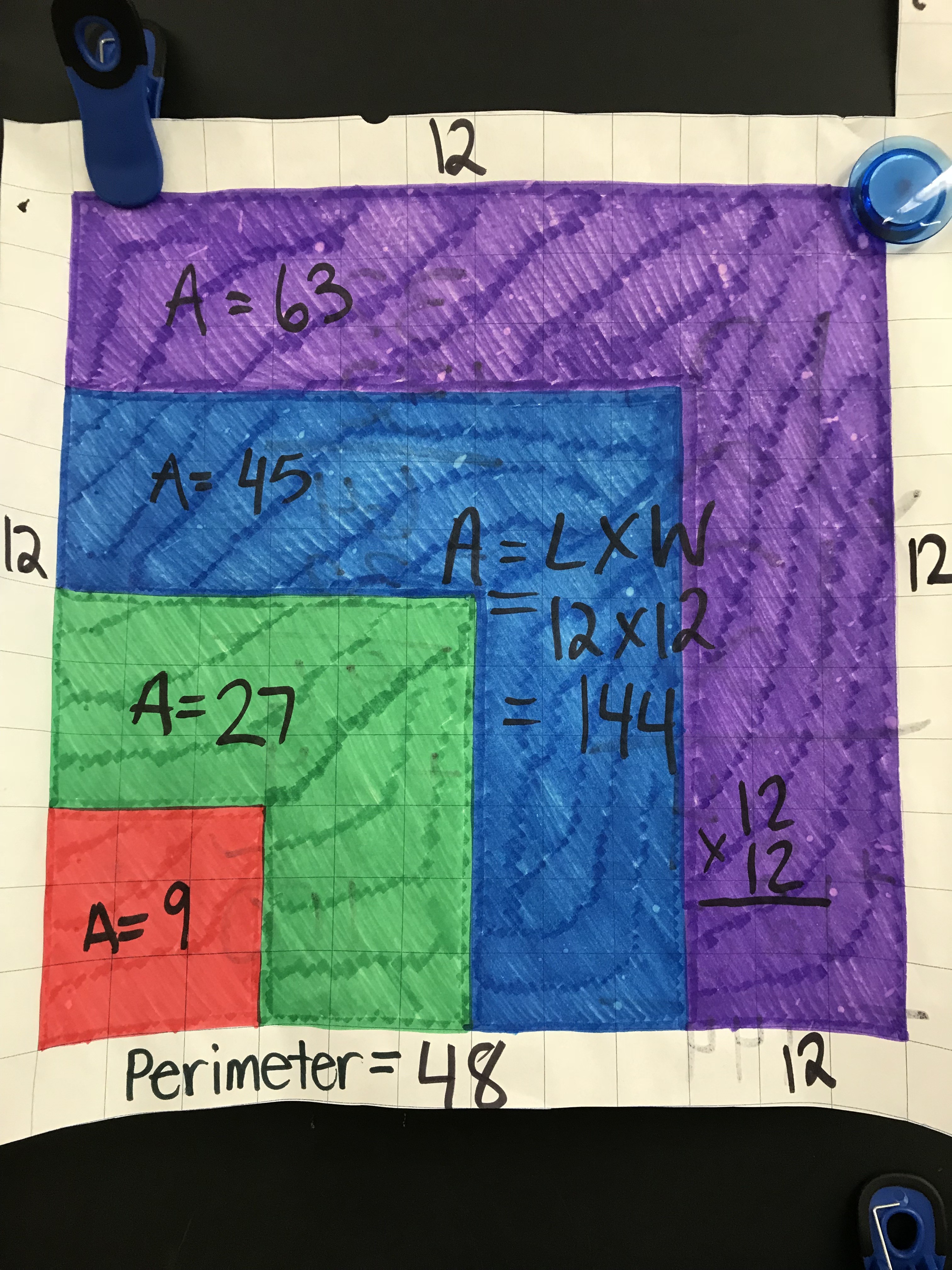
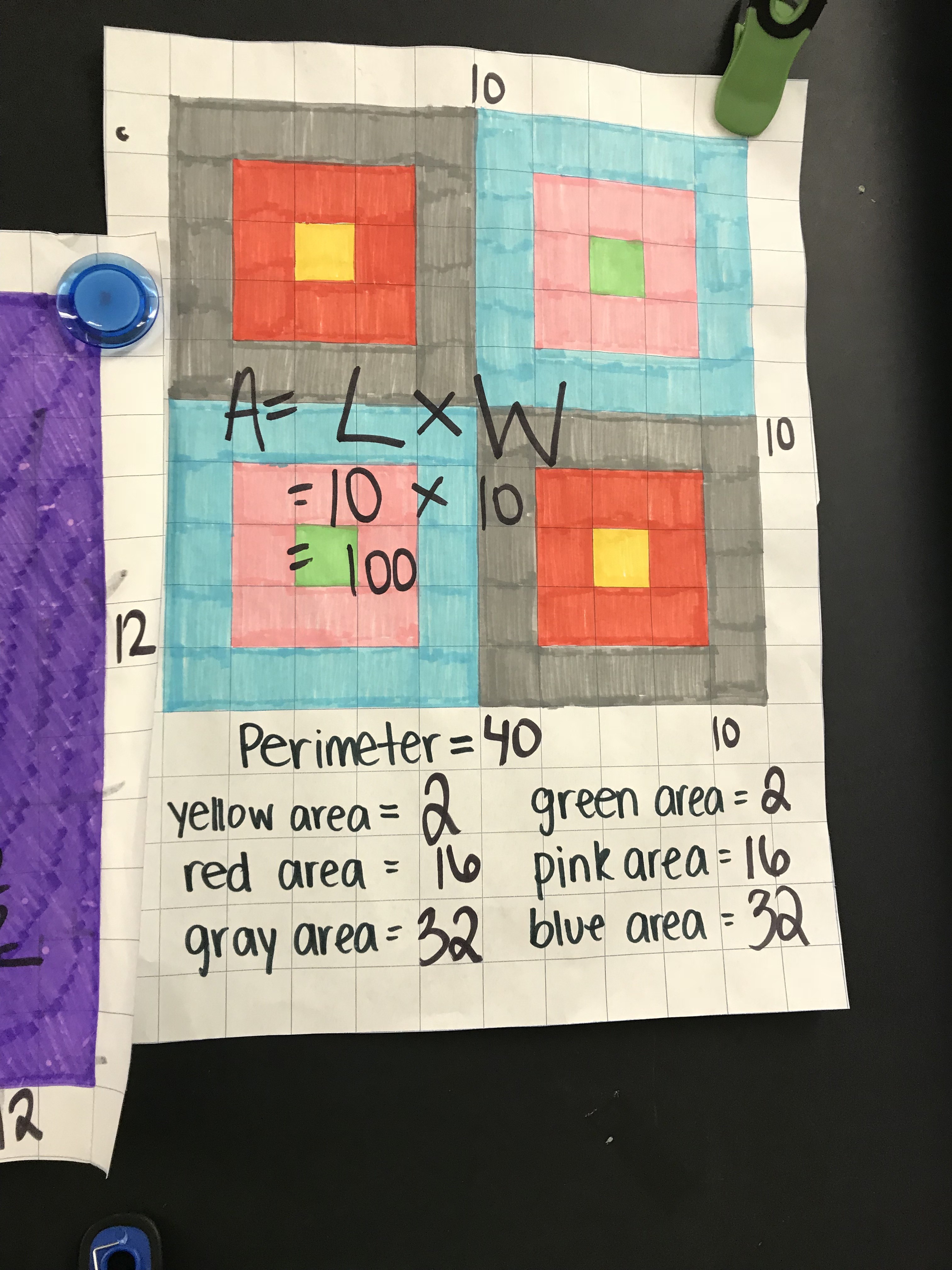
After having the students share their different solutions we thought we would show the students artwork that Ms. Marchiori created inspired by Ellsworth Kelly’s “Colors for a Large Wall”.  In a guided math lesson the students figured out the area and perimeter of different parts of the artwork.  The way in which students figured out the answers to the area demonstrated that they had a much better understanding of the difference between area and perimeter than they had previously.

artworkmath                   artworkmath2


At this point, we wanted to get into the artwork and considered the work of Piet Mondrian.  Piet Mondrian is famous for the work that he created using primary colours, horizontal and vertical lines and squares and rectangles.  Perfect for working with area and perimeter and for incorporating the different elements of art.

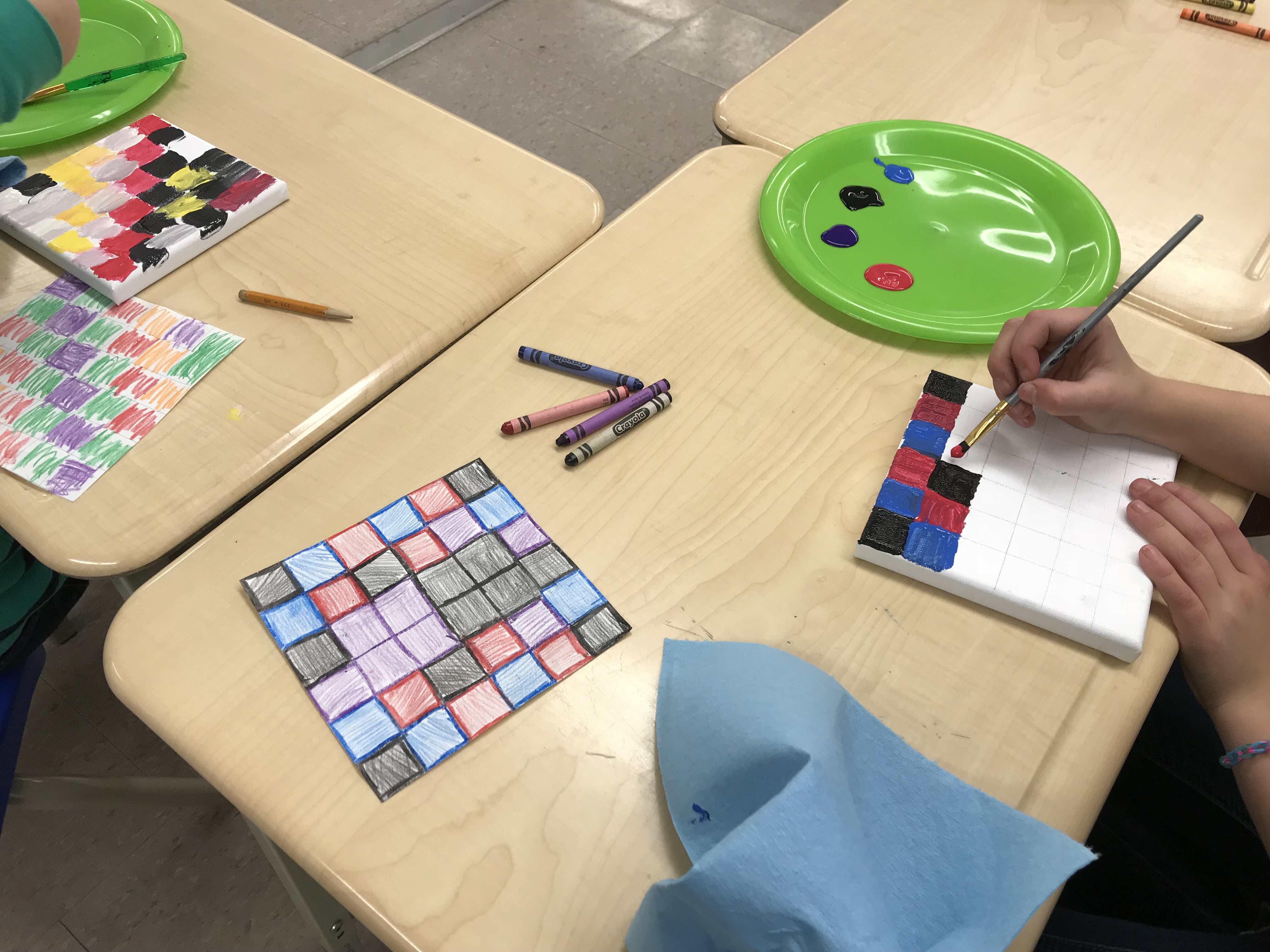
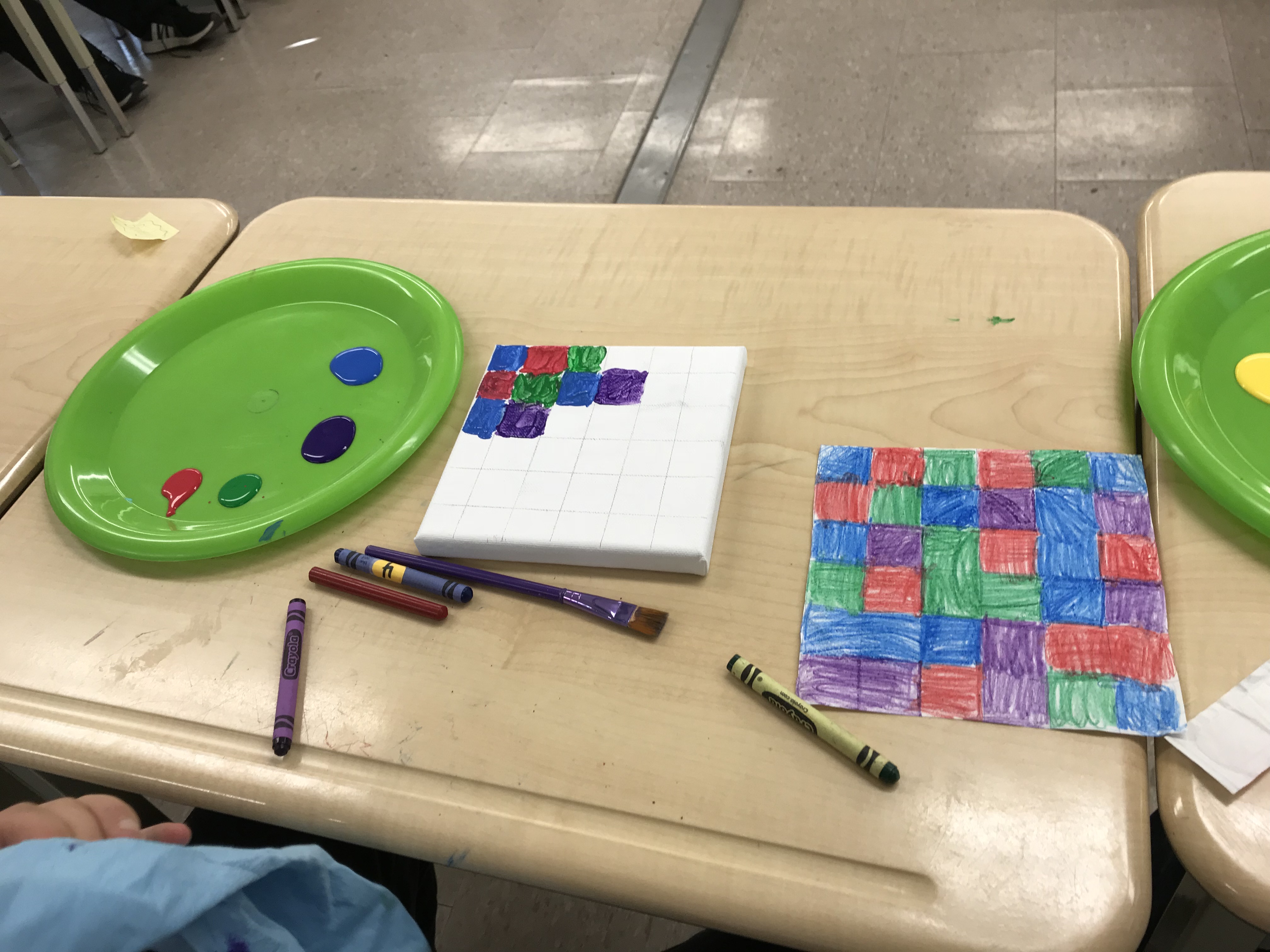
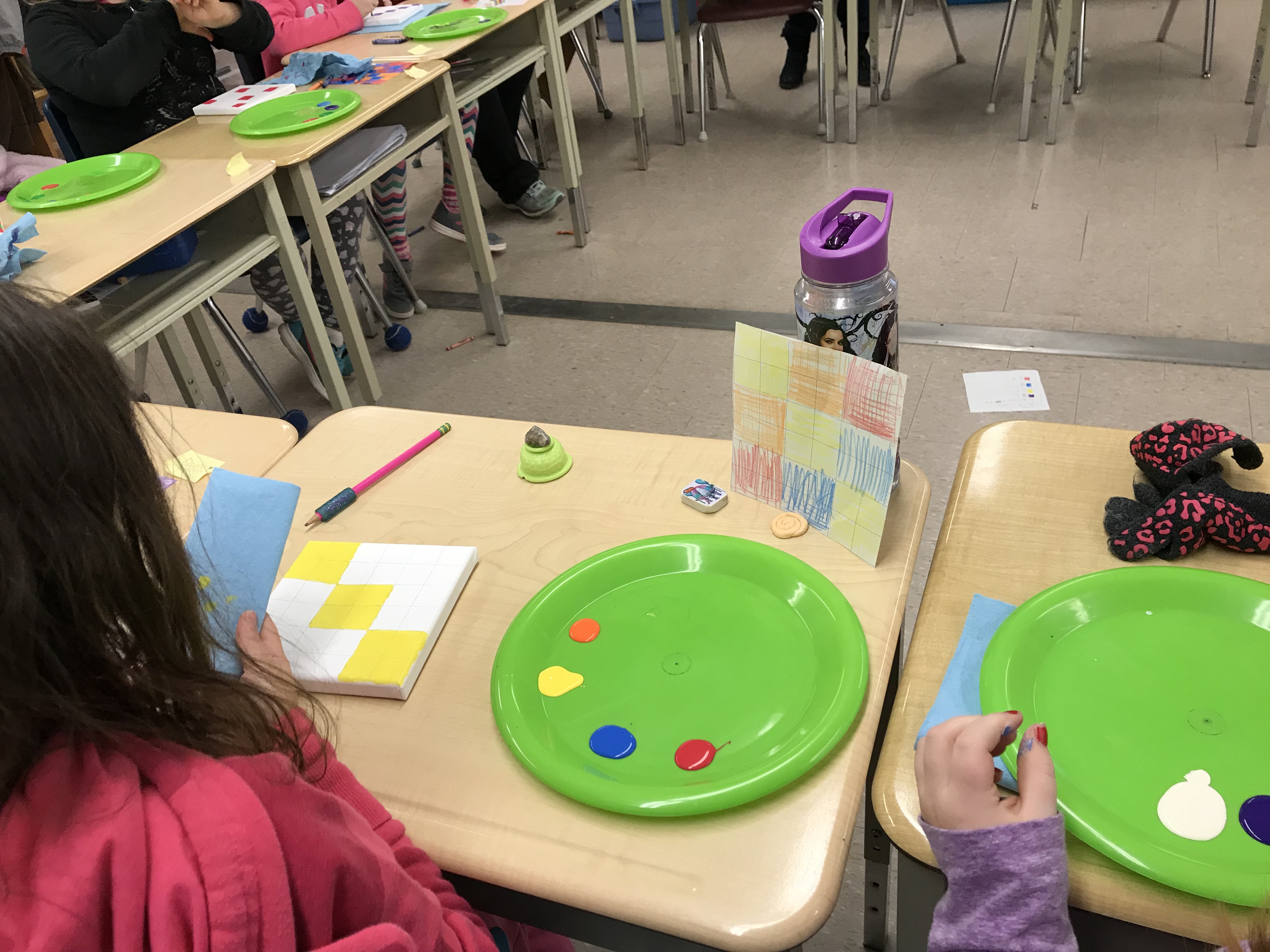
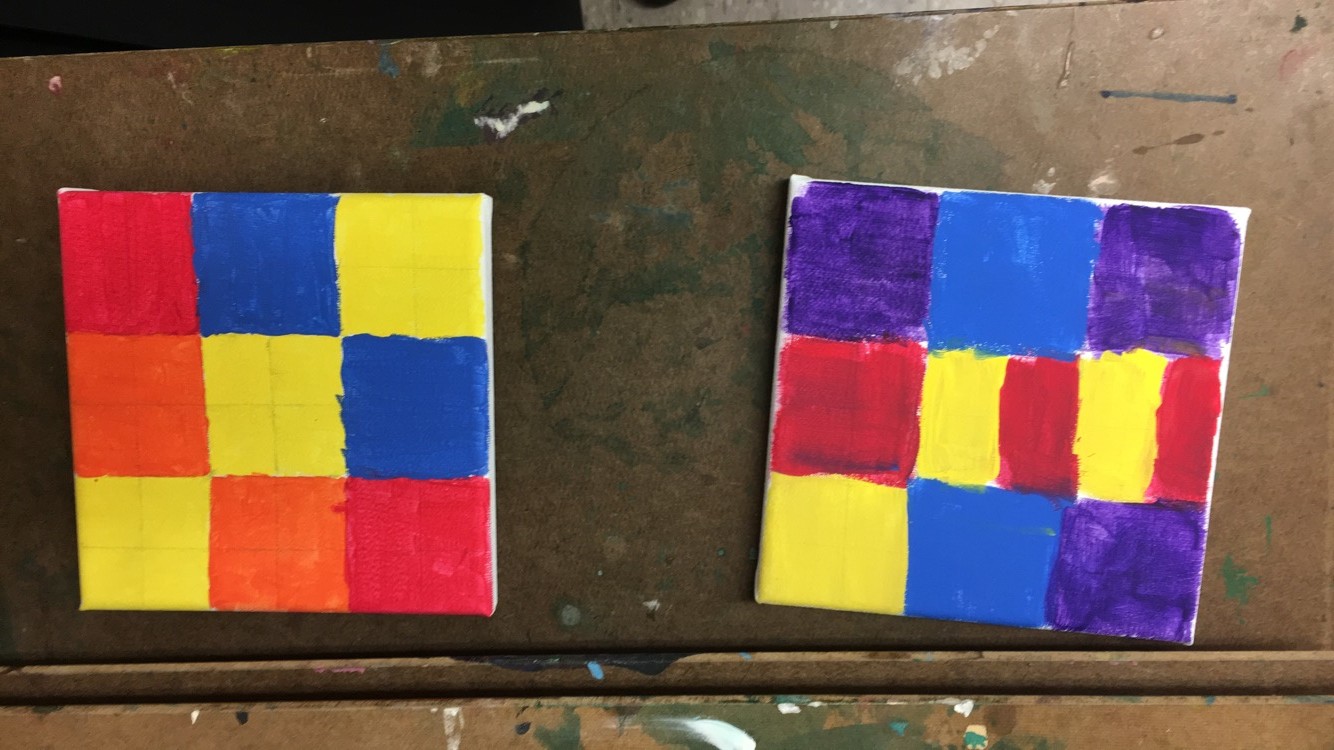
Ms. Marchiori showed the YouTube video of Piet Mondrian’s artistic life in a nutshell.  Afterwards, the students then created their own Mondrian inspired artwork using chart sized grid paper (6’X6′) and crayon.  To continue our math focus, the students then had to calculate the area of each of the colours that they used and write that on the back of their art “plan”.  From there, the students used acrylic paint on canvas with grids drawn in pencil to recreate their “plan” for their art.

artwork3 artwork 4 artwork 1

A few of the finished artwork samples;

IMG_4067  IMG_4065 IMG_4064

This artwork would also connect to fractions.  Students could express their colour content in a fraction, reducing it to it’s simplest form and then compare which colours covered the largest fraction of the area of the painting.  When the artwork is complete, the students will be adding an artist’s message about what they learned during the process about area and perimeter, about the elements of line, colour and shape and about Piet Mondrian.  This week we will be creating Mondrian inspired artwork while exploring balance and colour in art using much of the same grid technique but with the medium of crayon resist and watercolours.


Here’s your test

The good old days are a product of a bad memory

Sept 2009 – I remember entering the classroom like it was yesterday. For this new teacher, the night before my first day was understandably complete with a several concerns: Would I wake up on time? What if the staff weren’t nice? Am I prepared? Thankfully, I woke up before my alarm and my new colleagues were incredibly welcoming. I was breathing a little easier, but there were still a few doubts to overcome on the day.

Most pressingly, I wondered whether I was going to have any disciplinary issues with students? What was going to happen if it became an issue? Would I keep my cool? Would I lose the room? Would I default to my parenting brain or my parents’ parenting brains? Fortunately, the students were amazing and my first 4 days as a teacher served to cement my love of education for life.

As a Prep Coverage teacher in a French Immersion school, I taught classes from Grades 1 to 8. On Days 1 – 4, I taught English to grades 4 – 8. I never knew it could be so much fun. From the start, we created classroom culture, shared our ideas, and set goals.  Day 5 was my day to teach in the Primary Division en Français. So what could possibly go wrong after 4 amazing days? Then came Day 5 –  a Monday to boot.

Oh wait, did we forget the lesson?

You know how in Physics there is matter and anti-matter? That was how Days 1 – 4 felt compared to Day 5. By that day ‘s end I was exhausted, confused, and discouraged. The cherry on that fun sundae came when I fell asleep at a stop light on the way home after school; much to the displeasure of the rush hour commuters behind me. This experience did not diminish my love of education, but it sure made me dig in to learn and improve. I was going to need it to survive and thrive.

First things first

Things began to settle into place and I was fortunate to receive excellent guidance from my admin, NTIP mentor, and experienced colleagues. However, I still wondered about the best way behavioural expectations could be met while honouring the needs of each learner.

After all, behaviour is communication. What were students telling me by their actions? Then it happened, a yet to be identified student destroyed the classroom and I needed help. I’d always worked hard to avoid losing my temper or sending students to the office, but this time was different. My old grade 1 teacher would have tied that child to a chair (true story) and that would have been that. Yet, that never crossed my mind until I began drafting this post and reflecting on my own educational experiences.

I remember physically shaking as I dialled the office for help. I felt ashamed that I could not manage this little student, but at the same time knew help was necessary. I removed the students from the class, for their safety, and waited for backup – which was there in a heartbeat. What would my admin think? Would I be judged for not being able to handle the situation?

Supported, safe, and secure in the care of experienced CPI trained educators, the student was de-escalated and escorted out of the classroom. And then, as quickly as it started, it was over. We returned to the class, but my thoughts were still focused on what had happened 10 minutes beforehand. This singular event consumed many subsequent moments of the days that followed as I wrestled with what happened. I wanted to be able to do what they did. Was their skillset only achievable through experiencing it in person? Would I be better next time because of it? Wisely, I’ve sought the wisdom of my SERT and admin ever since(many lessons learned).

For most new teachers, the test always comes before the lesson when it comes to discipline and responding to students in various states of distress. Theories are read, strategies planned, and words of advice are offered. Yet, until an educator is in the classroom, no amount of tool box equipping will prepare them for the individuals and situations they’ll encounter in our schools. We have to lean on one another in these times. This is why it is so important for teachers at all stages of their careers to find support and wisdom in their fellow educators. It does not mean you are weak to ask for help.

It means you, like your students, are constantly learning.
That is the true heart and art of teaching and learning.

I hope you enjoyed this post. Please share and add your comments to continue the conversation.
Thank you for reading.

Mindfulness Tips for Stress Reduction

I’ve recently spent some time with fellow educators and health care practitioners in order to find solutions to an all too prevalent issue.  Burn out, stress, compassion fatigue or empathy fatigue; whatever you call it, it is a reality for those in caring professions like teaching and health care.  The room was filled with women from all over the province.  Although our stories were different, we were all exhausted, overwhelmed, and consumed by feelings of guilt and inadequacy.  We had a common purpose for coming together; to find ways to put mindfulness and stress reduction into our daily living.  
The most common excuse that people use with regards to self-care is that they don’t have enough time.  I used to say the same thing.  Then I realized that if I have had enough time to watch two episodes of something on Netflix, I had enough time to go to the gym or cook a healthy meal.  As I have learned more about mindfulness and meditation I have realized that it doesn’t have take a huge amount of time and it really doesn’t take a whole lot of effort.  You just have to start.
I’m an “all or nothing” kind of person and a perfectionist.  I used to set lofty exercise, meditation and healthy eating goals for myself and then quit when I haven’t met these unrealistic expectations.  Now, I start one thing and do it, slowly and simply.  I try to adopt Nike’s “Just Do It” advertising campaign as my mindset towards mindfulness.  I have to remind myself to be patient, kind and compassionate around my mindfulness practice.  I forget, I get distracted and I feel disappointed in myself sometimes.  The most important thing that I try to remember is I can always begin again.  I can begin again every moment.  The judgment that I have about missing days at the gym or on my meditation cushion is my own.  There is no one that works at the gym that will berate me when I come through the door.  They will welcome me and I have never left the gym or my meditation cushion wishing that I had done something else with my time.  I thought it might be helpful to share some simple and quick ideas that can easily become habits in order to become more mindful and practice self care.

1.  Begin each morning by spending three or four minutes lying in bed awake before getting out of bed.  Pay attention to your breath and set your intention for the morning rather than shutting the alarm off and immediately swinging your legs to the floor.  It seems like such a simple thing, but it can make a positive impact on how you face the day.

2.  While doing any mundane task such as washing your hands you can simply pay more attention to the task.  Don’t try to multitask and don’t be on “auto-pilot”.  Be aware of what you are doing and do it slowly.  Actually enjoy the simple task of hand washing.  It may take you a few seconds longer but it gives your brain and body time to become more grounded.  Pay attention to your breath.  Are you holding your breath?  Are your shoulders tense?  Let the warm water flow over your hands and be grateful for the water we have.  Lather the soap and feel it squish through your fingers.  Dry your hands completely, taking the time to appreciate the act.  We know in the teaching profession how important the act of hand washing for our health and we do this many times a day but how often do we wash our hands mindfully?  Take these few extra seconds, breathe, be aware and be grateful.

3.  Each morning before exiting your car at work take a few minutes to check your breathing.  Be grateful for the day, be aware of your intention for the day at work.  Try to do a quick body scan to see if you are holding any tension and let it go.  If you aren’t really looking forward to the day, force a smile.  The silly act of putting a smile on your face on purpose while alone in your car will often produce a genuine smile!

4.   Be mindful about your cup of tea or coffee.  Over the years we have become accustomed to having our tea or coffee “to go” that we are no longer mindful about drinking it.  In fact, we have adult sippy cups to ensure that we don’t spill it and companies that put warnings on the side of cups to remind us that the contents might be hot.  As a society, we have become pretty mindless about drinking hot beverages.  Our coffee and tea have become caffeine that is fuel to be consumed rather than a comforting and tasty beverage to savoured and enjoyed. So take the time when drinking your hot drink.  Take the time to smell it, feel the warmth in your hands, to really look at it and to enjoy and be grateful for it.  


For more information about “Tea” Meditation and mindfulness visit Tea Meditation – Plum Village

5.  In order to incorporate mindfulness practice into your work life, practice it with your students.  Each day I have a morning meeting with my class.  I use a singing bowl to draw attention to our practice and we sit in a comfortable position.  We only do this for a few minutes each day but we pay attention to our breathing, we close our eyes or choose a spot to land a soft gaze.  The students have said that they can feel the energy in the room become more calm and peaceful.  I do the practice along with them.  I have grade 4 and 5 so we also talk about mindfulness and what it means.  It works hand in hand with self regulation.  If students are mindful about their behaviour then it becomes easier for them to practice self regulation strategies.

I do not claim to be any kind of mindfulness or meditation guru.  I have not painstakingly researched the positive effects of mindfulness from a scientific perspective.  I’m just an elementary teacher and mom trying to bring balance to my life, one moment at a time.


Always a Mentee, Always a Mentor

MentoringImageTransparent


This year, I‘m in a new school, in a new role. This September, every school day, I’m trying to figure out where my class is suppose to be and what and how I need to teach my students with special education needs. I am gradually learning the names of my colleagues but it seems like I can only get either their first name or the last name – I cannot put the person’s whole name together. My role in this special education classroom involves using a very prescribed program to support struggling readers and I’m still figuring it out.

And our school went through re-org (reorganization). This meant redoing class lists and changing rooms. The first week of school, my room 204 was organized and I had my bulletin boards decorated. After spending two and half weeks setting it up, I had to change rooms. Really? I moved all my stuff to room 102, redoing the bulletin boards and redoing the schedule so my students and I know where and when we are suppose to be.

You’d think this would not be a challenge for me as I am in my 18th year of teaching. But every time I take on a new role, I start all over again. Why do I do this? Because every time I take on a new role, I learn, a lot.

This year, my colleague and mentor, DHS, has been wonderful in supporting me through my transition into the school and into my program. Her contemplative stance has helped me work out various decisions and challenges. She also helped me set up my newly located classroom.

Over the past 18 years, I have been a mentee and mentor. I am a big believer in “Paying it Forward”.

My first teaching mentor was AT. She was my first practicum teacher and I was very fortunate to work with her as a grade level teaching partner. AT welcomed me into teaching with an open heart and a guiding hand. She showed me how to teach and I still use what she taught me today. I’ve had other mentors who were not teachers. My Vice Principal, AMW, walked me through a new program that I started in our school. The best part of AMW was that she was straightforward with me and challenged me in areas where I needed to grow. AMW was and is a great listener and guide.

At about my 7th year of developing my teaching practice, I became a mentor to other teachers. As a mentor to another teacher, I quickly realized that this mentoring process was not about me and my success but about my mentee and their success. I’ve mentored many teachers formally and informally.

My first “official” NTIP (New Teacher Induction Program) mentee was BT. He was a grade 8 Math and Science teacher, like me. After a couple of weeks of teaching grade 8, he was going to quit teaching. He told me (his words) “I did not give up going into the tech sector to deal with this stuff” – he actually used another  word.  I still remember him pulling up a chair directly in front of my desk and putting his head in his hands. I listened to him talk about the challenges of teaching grade 8 – which can be many and very disconcerting to a grade 8 teacher. BT was ready to jump off the teaching wall in this first month of teaching. I talked him off the wall. We spent time planning and working together – he got through the year without having to take a leave of absence or worse, quitting teaching. I knew he was going to be a great teacher because he was upset and cared about his work. Today, BT is a great teacher. When I saw him recently, I was so proud for his success.

I’ve also informally mentored Long-term Occasional teachers. HK was teaching grade 8  Math and Science. My Vice Principal asked me to help her as she needed collegial support.  Unfortunately, at that time, occasional teachers did not have access to NTIP support. HK was dealing with similar challenges I had faced (and BT had faced) as a grade 8 teacher. HK was a highly skilled and dedicated new teacher that was driven to make a difference in her students’ lives. We spoke often and met every week at a well known coffee location. There were tears and many stories. It was a tough cohort year of grade 8s in our school. She made it through and has gone on to be a very strong and dedicated teacher. I am very proud of how well she has done in her career.

I’ve mentored other teachers too. One teacher came from South Africa and was looking for Canadian experience. She spent time in my grade 7 classes, learning how we teach in Ontario. I directed her towards many resources she used for courses she needed to upgrade her credentials. To my delight, she ended up getting a full time teaching position a year later.

More recently, I mentored a newly graduated teacher, who helped out in my contained special education class. SM was keen, very well qualified (i.e. she had French) and working two jobs. She was a natural when working with my academically challenged students. She ended up volunteering in a French class at our school and then landed a full time teaching position.

After many positive and fulfilling experiences, I continue my career as a mentee and as a mentor. It’s part of our teaching practice and it’s part of our career path. We are teachers for our students and our colleagues.

And even as an 18 year plus teacher, I thank my colleagues for all the mentorship, collaboration, and support they continue to give me, every day.

I believe that when working collaboratively, teachers are better together.

Collaboratively Yours,

Deb Weston

Partnering for Success Getting the most from Ontario’s New Teacher Induction Program: A Resource Handbook for Mentors

Ontario Teacher Federation: Survive & Thrive