Create Success in Intermediate Math through Play….

“What are you doing in Math today?” the VP inquires of my grade 5,6,7 and 8 students.

“We’re playing games.”

“You’re playing games?”

“Yes, we always play in math.”

The assessments gathered from these classes provide me insight of where everyone is in their learning. My experience with assessments are that individual conversations to understand the thinking process provides the most valuable information. The range of each of my classes is from a low elementary level to a low secondary level.  This is quite a span. As a school we have been, “Landscaping” these students using; Fosnots– Landscape of Learning.  http://thelearningexchange.ca/wp-content/uploads/2015/01/Creating-Conditions-for-Learning-Math-Viewers-Guide.pdf This provides an great snapshot of where your learners are on a continuum. Our board has developed some very specific assessment questions for all grade levels which include strategic numbers to help determine the strategies individuals use.

How do I managed this?

It took me a while with the continuous disruptions to the daily routine. The way, I have adopted my assessment sessions this year is similar to how a reading group would be managed.  Provide the lesson, give the class expectations, then work with a small group on a rotating basis. The entire class already understands the rules and class expectations which have been familiar routines followed to date.

Now what?

I find creating a growth mindset is most important. This is developed through creating a comfort zone for all, including the teacher. Each year I am challenged to ensure my learners grow and develop forward on the continuum. I use a variety of resources such as Sherry Parrish’s-Number Talks http://www.meaningfulmathmoments.com/number-talks.html This is a great beginning to each class.

I resource Dr. Small’s-Big Ideas https://search.library.utoronto.ca/details?7785153&uuid=5d3e7d21-dfef-4e3a-a3d3-9f33f13418b9 for different activities to compliment the concept of study.

Presently I am using, From Patterns to Algebra, by Dr. Beatty and Dr. Bruce https://school.nelson.com/from-patterns-to-algebra-book/

Play, yes these resources include play which I implement on a regular basis.  The students enjoy learning with and from each other while I guide them. During my classes, Play creates a class dynamic for success.
The Heart and Art of Teaching and Learning Resource

I’m super excited about this being my 10th year of teaching. Although this year, I’m not teaching in the traditional sense of having my own classroom, I feel really lucky to work with educators as they design exceptional learning experiences for students. Over the last month I’ve been taking some time to reflect on my 10-year journey and all of the opportunities that have lead me down my current path.

One such reflection was about my experiences with blogging and thinking about the reasons why it all began. In 2016, I was looking for an easy way to connect with parents around the work that we were doing in the classroom. I wanted to parents who weren’t always able t  o visit the school to know what was happening and to feel a part of the school experience and learning of their child. Even if only 1 parent took the time to read the blog, I found value in writing it. My weekly writings also offered me the chance to reflect and think about what we were doing in the classroom and the reasons why. I truly enjoyed blogging weekly and for the most part, kept it going for the last 3 years.

In September 2017, I started blogging for the Heart and Art of Teaching and Learning and it’s truly been an honour. Every month is an opportunity to reflect on my practice and write in the hopes of inspiring even 1 new teacher to perhaps try something new in their classroom or possibly consider an idea from a different perspective. When put that way, the task now seems a little daunting. For this post, I wanted to get back to the heart of what inspired me most about this online community and the resource that is its namesake.

Over the summer of 2017, I was sent the Heart and Art of Teaching and Learning resource. I have to say that the subtitle is a little misleading. It reads: Practical ideas and resource for beginning teachers. Perhaps it should read: Practical ideas and resources for ALL teachers. Even though this is my 10th year teaching and perhaps I’m not still a beginning teacher, there are so many amazing ideas inside. This past month, I pulled it off the shelf and dug back into it again and found a few ideas that I would love to share. I really hope that you take some time to dig in and find some amazing gems that you might be able to use in your classroom.

Mentorship

In chapter 2, there is a section on the importance of Mentorship. Throughout my career – not only as a beginning teacher – mentorship – whether formal or informal – has been an important part of my growth. In my first year, from Linda, I learned how to easily plan a Math unit that allowed for flexibility based on student learning and interest. In my second year, I learned from Toba how to truly engage students in the French language while making it relevant. In my third year, Alyson taught me the importance of connecting with students and genuinely caring for them not only academically but socially. I can honestly say that the list can continue and as the years progressed, there were often times more than one “mentor” from whom I was learning. I’ve always believed that there is something to learn from every experience and I think that I’ve been able to learn as much as I have because of the people around me. Pages 17 and 18 of the resource share models of mentorship. Take a look and see if you can find one that works for you. You never know where it might take you!

Classroom Set-up

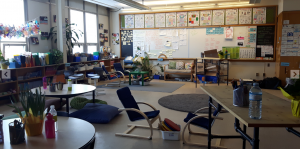
Screenshot 2016-10-23 at 08.23.27Chapter 2 ends with classroom set-up. As many of you know, I was a passionate advocate of flexible seating in the classroom. Years ago, my students worked on a Math project where they re-designed our classroom while taking into consideration their learning needs. They measured the classroom and petitioned our Principal for some money for items they thought would better meet their learning needs. Some wanted standing tables while other wanted opportunities to sit on the floor. We created a learning environment that worked best for us and the autonomy and increased levels of ownership in the classroom were an indication that students felt as thought the classroom was their space. Now I know that we were lucky in that we were given some money to redesign but since leaving that school, I learned 2 important lessons: where possible, let students design the space so they feel that sense of ownership in the space and be intentional about what you chose to include in your classroom space. This picture of our space looks quite full and I would have to say that every item spoke to who we were as a group. On pages 25 to 30, I love that each of the classroom learning spaces are different and yet the amazing educators can speak to the differences that they have included in their classrooms with intentionality. I just started feeling a little nostalgic about designing learning spaces!
 

Screenshot 2019-01-29 at 1.50.16 PMIdeas

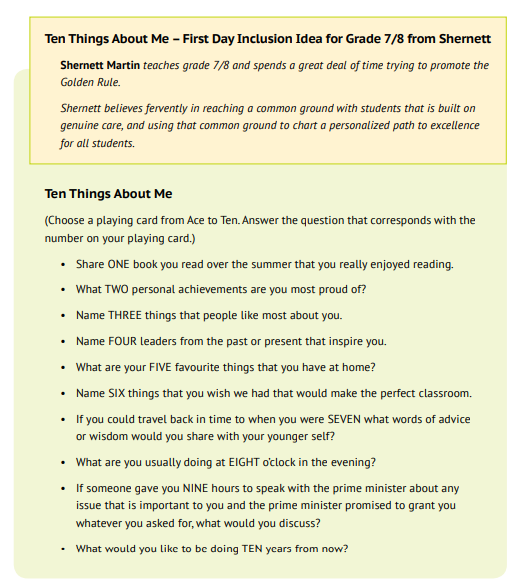
This resource has a variety of ideas meant to allow teachers and students get to know each other in the first hours/days/weeks of school. One idea that tempts me to ask around to borrow a classroom is found on page 52. I love the prompts and think they’re great for getting students – and frankly even teachers – to get to know each other on a deeper level. Beyond the first weeks of school, I think activities like these really help to promote a sense of belonging and inclusion in classroom spaces.

Tips

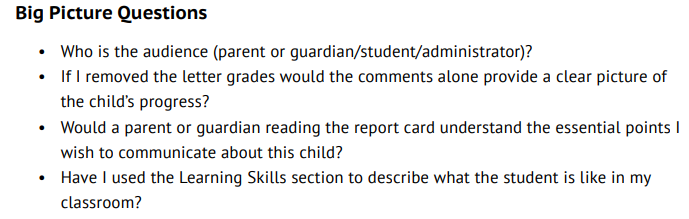
It’s report card time and I know that once again the crunch is on. Throughout my career there were many times that tips from others on best practices came in handy. This resource is FULL of great tips – and questions – that help to guide educators through some of the different aspects of our jobs. For report cards specifically, I really liked the Big Picture Questions on page 87. When reflecting on them, I think they would have been great questions for me to have asked myself during writing.

Screenshot 2019-01-29 at 2.04.13 PM

If you haven’t already, please take a look at this resource. It’s fantastic! Not only for the beginning teacher but I strongly believe that every teacher could gain something from taking a read. Once again, I’m grateful for the Heart and Art of Teaching and Learning for the chance to reflect and hopefully I’ve inspired you to take a look for yourself!

Believing in the power of a mentor to support new educators

It’s Progress Report time in many school boards this week. Once again, ETFO colleagues have typed and tweaked their thoughts about student stemming from conversations, observations, and products onto reports that capture “the learning” thus far. This annual first rite of assessment seems to come earlier and earlier each year, but is an important opportunity to map out the learning for then next 7 + months. Then there’s the meeting scheduling and organizing in addition to our already crammed days. So, how are you doing?

Have you had time to catch your breath since the start of the year?

I know the first weeks in the classroom seem to fly by for all of us. Regardless of years experience, it’s a hectic time of year.  This can be especially difficult for new teachers who find themselves working before/after school as well as during evenings and weekends at home to plan, prepare, and assess. All this, in addition to trying to have a personal life that may include time with friends and family or just to be still. To no one’s surprise, the hours that educators invest in their calling are often spent in equal proportions in and out of the classroom. So how are you doing?

What would you change about the first 11 weeks of your year?

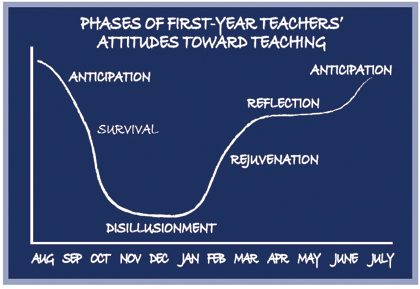
Over the years, I have enjoyed numerous conversations with new teachers at Progress Report time. For many new educators, it is the first time that they have had the time to reflect on what has gone on since the first bell in September. Many have shared that they are tired and feel a little overwhelmed by the pace and volume of work. It is not uncommon for new teachers to go through a case of the November Blahs where their energy level has waned a bit from the beginning of the year.

http://weac.org/articles/new-teacher-handbook/phases/

The first question I usually ask after “So how are you doing?” is, “Are you connecting with your colleagues to divide and conquer or are you stuck inside the walls of your classroom?” In my first year as a teacher, I made the mistake of not asking for help because I thought I could solve my own problems as they presented themselves. I did not want to appear weak to my new colleagues or admin. Needless to say, come November of the first year, things were deteriorating. So I suffered. Which means my students suffered too.

Long nights, failed planning, missed opportunities, and frustration were my regular companions at work and at home. I did not feel like I was taking advantage of the natural mentors in the building that first year. However, by my second year, my eyes and mind were open to any and all who were willing to offer their wisdom, guidance, and resources. By taking myself out of my fortress and asking for help I was able to redirect/rescue/re-invigorate my instruction and outlook.

After that point, suffering was optional. I chose to seek out the support of others when things became murky or began to go off course. It was humbling to know that the people I turned to for help had my best interests at heart. Knowing that I did not have to have it all together every moment of the day was like removing a giant gorilla from my back that was constantly whispering, “You don’t need any help. You can do this on your own. Don’t let anyone think your weak.”

Having a peer mentor to turn to has become a cornerstone of my personal development. In turn, I try to support my colleagues when they need someone in their corner. Perhaps when this time rolls around each year the first question I ask teachers is, “So how are you doing?”

Gaming…safely?

We have been trained to watch for concerns of a child’s well being. This didn’t include cyber information. As a responsible teacher I’m drawing the attention of students to current events. During this time of sharing, my students have become more relaxed and open about their after school activities which include gaming for many.

When a child discloses information about their safety we are obligated to report this to children’s services. Write down the facts, call and make a statement, fairly straight forward.

When a child shares information about interactions in Gaming, what do you do? I make a judgement based on what the information is, then I write down the facts are that were shared, then what? I’m really not sure where we go from here. I call the family and have a conversation? I chat with the principal? I provide the student with avenues of help, help lines, internet safety….

This is a new world which effects all of our students. Access to our vulnerable young students is wide open on the internet especially with group gaming and social media. Education is a form of protection. When a child is doing something their family may not agree with, they are reluctant to share concerns and can easily become victims of online abuse. How do we help? Keep open communication lines with students and their family. We all want our children to be safe.

Introducing Coding without Robots

A few years ago when I started hearing about teachers doing coding and robotics in the classroom I dismissed it as a fad.  I didn’t understand the value of coding nor could I see how it tied to the curriculum.  However, I recognize as a professional learner my initial reaction to something radically new can sometimes be resistance.  I think that this is because I can’t see myself fitting “one more thing” into my classroom practice. I always have to give myself time to process, research, find the value and then finally accept it.  After I have tried a new practice with students and see the beneficial outcomes, I endorse it and then begin to share it widely with colleagues.

When I began the journey with coding and looked at code.org I tried it on my own and admittedly, understood very little. I went to more workshops and conferences but avoided the coding and robotics thinking that it just wasn’t my bag.  Then I had a colleague that dragged me in to the world of coding and robotics.  We worked together.  I’ve since become convinced that we need to teach all students how to code.  I have also figured out that you don’t need any robots to do it.  In fact, when you start-you don’t even need a computer.

coding 4         coding 2


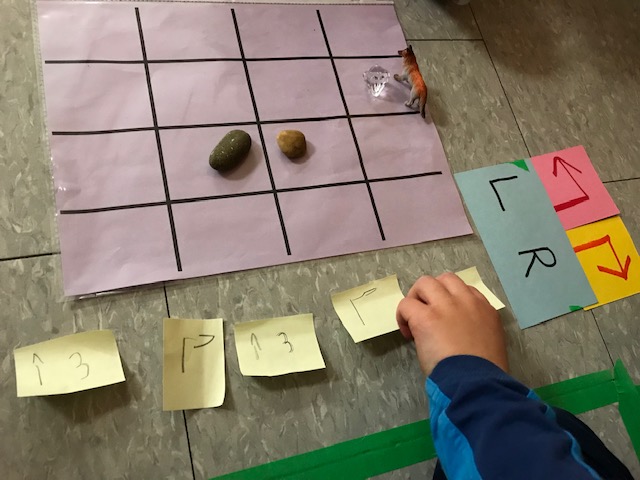
The above picture is a coding game that I used recently with a grade one and two class.  Students placed their obstacles (rocks) on a grid.  They placed their “gemstone” or finish on a spot on the board and their “robot” (animal)  on another spot.  They wrote their code on a sticky note using arrows and then had their partner take their robot through the code to test it for “bugs”.  A big part of coding is knowing your left from your right and being able to write instructions that someone else can follow.  We started out the day coding one another to walk in a square using only: “forward” “turn left” and “turn right”.  It was amazing to see how much problem solving took place.  They were using positional language, procedural writing, clear communication, visualization and proportional reasoning.  Their thinking was exploding! The students were engaged in the learning and well on their way to being able to code something online.  From there we explored the Scratch Jr. app.  After a short look together at what the different “buttons/blocks” meant they were able to code independently.  As teachers we sometimes get bogged down in the fact that we don’t have the money to purchase the technology and shy away from trying things based on the fact that we don’t have “the stuff”.  However, laying the groundwork before introducing the technology piece to students is key.  We need to always consider the pedagogy before the technology.


Barriers to Student Learning – An Overview

Priviledge

Education is one of the foundations of Canadian society. If you are wondering why your board is addressing issues of equity and inclusion recently, a policy/program memorandum has impacted the way Ontario public school boards are conducting their business of education.

Through the Policy/Program Memorandum No. 119, Developing and Implementing Equity and Inclusive Education Policies in Ontario Schools, it is stated that there is a need for our “publically funded education system to support and reflect the democratic values of fairness, equity, and respect for all” (Ministry of Education, 2013). The Government of Ontario has established three core priorities in education:

  • high levels of student achievement
  • reduced gaps in student achievement
  • increased public confidence in publically funded education (Ministry of Education, 2013)

In “providing a high-quality education for all is a key means of fostering … diversity is affirmed within a framework of common values that promote the well-being of all citizens” (Ministry of Education, 2013). The Ministry of Education recognizes factors such as race, sexual orientation, physical or mental disability, gender, and class can create barriers to learning. There is evident that some groups of students continue to encounter discriminatory barriers to learning. Research shows that when students feel connected to teachers and other students, they do better academically (Goleman, 2006).

Through Policy/Program Memorandum No. 119, all publically funded school boards are required to address equity and inclusive policies covering in three areas of focus including:

  • shared and committed leadership by the ministry, boards, and schools to eliminate discrimination through the identification and removal of biases and barriers
  • equity and inclusive education policies and practices to support positive learning environments that are respectful and welcoming to all
  • accountability and transparency with ongoing progress demonstrated and communicated to the ministry and the community (Ministry of Education, 2013)

The policy further goes on to state that “school board policies must be comprehensive and must cover the prohibited grounds of discrimination set out in the Ontario Human Rights Code. The code prohibits discrimination on any of the following grounds: race, colour, ancestry, place of origin, citizenship, ethnic origin, disability, creed (e.g., religion), sex, sexual orientation, gender identity, gender expression, age, family status, and marital status” and the intersectionality that may occur within this list (Ministry of Education, 2013).

So what does this mean to teachers?

School boards must seek out barriers to learning for all students. Teachers therefore must also address barriers to learning due to factors such as race, sexual orientation, physical or mental disability, gender, and socioeconomic status.

Through Policy/Program Memorandum No. 119, school boards, and teachers, must address barriers to learning that fall within prohibited grounds of discrimination set out in the Ontario Human Rights Code. This policy will impact all ways Ontario teachers conduct their business of education.

In the next few blogs, I will address some of the barriers to learning that students face based on their race, sexual orientation, disability, gender, and socioeconomic status.

If you would like me to address barriers to learning for a specific student group, please provide a suggestion below.

Collaboratively yours,

Deb Weston

References

Goleman, D. (2006). Social Intelligence: The New Science of Human Relationships.-New York, NY: Bantam Dell, A Division of Random House.

Ontario Ministry of Education. (2013). Policy/Program Memorandum No. 119: Developing and Implementing Equity and Inclusive Education Policies in Ontario Schools, Government of Ontario. Toronto. Downloaded from http://www.edu.gov.on.ca/extra/eng/ppm/119.pdf

Mindful Pause, with or without Technology?

Everywhere I turn I see the effects of our technologically advanced world. Gains have been made in medical research, communication abilities, and advancements toward an easier life?
Some of the effects on individuals are now coming to light. Many people are connected to the internet 24/7. This is causing sleep disturbances, eye issues, addiction behaviours, and other physical ailments.

As a previous mental health professional I look at my present vocation in Education with that type of lens. I have practiced and taught Mindful strategies for many years now. I see the benefits of technology in the curriculum. I also observe the negative effects. I have noticed some educators looking for a researched solution to help calm, focus and ground their students. Some are now turning to all the apps, and internet connections to provide a quick and easily guided mindful activity. I think this may be counter productive to being present and in the moment. We are seeing the effects of this new age world and the fast pace it is changing. As educators we are up to date with the many changes or apprised to avenues in which to guide our charges.

When I guide a group through a mindful experience I eliminate as much technology or other electrical sources as possible. I then guide students into focusing on being present in their own body and mind through the use of many verbal scripts vocalized in a relaxed, quiet voice. These moments of taking a pause are valuable. We live in a busy, stressful society where a pause can assist in a healthy balance to our daily lives.

Links-
https://www.psychguides.com/guides/computerinternet-addiction-symptoms-causes-and-effects/

https://www.psychologytoday.com/us/blog/virtual-addictions/201710/tips-mindful-technology-use

http://meditationscience.weebly.com/what-is-mindfulness-meditation.html

Mindfulness Meditation: Guided Practices

School year start up

Well we are already four weeks in and hopefully it has been a great start of the school year for everyone. I am now teaching a grade eight class, teaching math, science, history/geography, language, art and drama. I was overwhelmed at first thinking about all of the subjects I would be responsible for but I have such an amazing grade team so I am truly thankful for all of their support and activities that have been shared.

September is an important month to get to know your students for not only their likes and dislikes but just honestly, do they enjoy school? Every student has their ideas of teachers, rules, subjects, reading, the list goes on and on. Just listening to them talk to other students during class teaches you so much about their interests and about how they have been affected by various things in their past school years. By grade eight students either LOVE or HATE being in a school. I am now faced with the task of continuing to develop that love or trying hard to turn around the hate.

I have been looking at new apps, reading exciting activities for my class to try, looking at fun trips, trying to think of new clubs/teams and I am hoping that I will engage some students who have been disinterested in the past. It is definitely a year long task to try to engage and involve all students so I hope to continue on that journey each day.

On a personal note, as teachers we often feel many emotions at the end of each day. There are questions we ask ourselves and things we always wonder. The one I have been asking myself a lot lately is, “Did I get to everyone?” I feel that is the hardest thing to go home with at the end of each day. That is why I am trying this year to make a few notes on who to go to first the next day and then actually following up on those plans. I am fortunate to finish early at the end of my school day so I can finish all my school work around 3:30/4:00 pm. That gives me roughly six hours of “me” time! That time is so important for our mental health and it is something I am also hoping to focus on this year. Shopping. stair climbing, doing the laundry, making a fun dinner, watching an episode of my favourite show…just a few examples of things I can do each night to stay positive and enjoy each day to the fullest.

I am hoping to talk to my students tomorrow about how to use our after school time wisely to better ourselves and to really add to our day. Our day isn’t over after school and we should really do our best to enjoy the time we have to keep ourselves positive and to make the most of our day.

These are just a few things I have thought about as summer ended and our school year begins. These four works have not been the easiest as being permanent now full time in a very different setting has made me think differently but I am staying positive and really reflecting on the good at the end of each day and looking forward to working on new things the next day.

I am looking forward to posting every few weeks about exciting ideas that occur in my class as well as all the ways I am staying positive and making the most of each day!


Building a Community

School begins by building the student community. We invite guardians into the space and include them in building the environment.  Often this is done with a newsletter or email introducing the subjects and the adults whom have contact with each child.  Any special events or classroom supplies are mentioned to assist students with a successful transition into the new year. September is a great time to host a, “Meet the Teacher” event. This is a time when family are invited into the school.  They are able to see where their child is spending 1500 minutes a week. They are able to see what students are doing and where they do it.  Samples of the work students produce are displayed in and around the school. The learning environment set up and seating arrangements are unique to each area. Some educators will include special items to make the space inviting and safe.  These objects, such as specific lighting, and seating will be board approved to meet Health and Safety standards.

Getting to know the students begins the moment your class list is in your hands.  Every educator is responsible for reviewing and updating the IEP’s (Individual Education Plans) of their students.  This can provide valuable information about one’s learning.  A survey or the wonderful, “One Page Profile” is another way students can share more about themselves. This is complimented by a conversation with the individual.  Each board suggests specific assessment in each subject.  As an educator choose the assessment that will be most valuable to your curriculum direction and the individuals you are educating. Ensure it will provide information to direct your year plan and understand your learners.  Continuous contact with guardians is important to help develop the necessary inclusion of those in the student’s community. Some educators will call each home at the beginning of the year to introduce themselves. Some will send home a letter with information about themselves and the class.  Each day includes a variety of interactions.  If you begin slowly with non threatening activities that keep students within their comfort level, they will grow to be more receptive of inclusion and community building. The community circle for these students includes peers, educators, support staff, custodians, administrators, family members and many more. Community involvement helps grow the circle of support.

My year began in a similar way.  As I was gathering information and building the school community I reflected on many of the unique situations our students encounter.

One students’ parent has a brain tumour, another child’s father died in a motorbike accident yesterday. One individual got their first goal in hockey, and another preformed as a main character in the local theater group.  Everyone including your peers bring something different to their day.  It is important that what you see in that individual, may not be what is actually going on. Empathy, patience and a smile every morning can make wonders in a person’s life. The small steps of communication and goal setting will provide the school group with a strength based community who will support each other when they feel others care.

This is a valuable time to build the community in order to provide a safe supportive space for all. Congratulations on setting the stage and tone for the valuable learning that will happen this year.


https://www.friendshipcircle.org/blog/2012/11/20/10-items-every-special-educator-should-have-in-their-classroom/

http://www.sheffkids.co.uk/adultssite/pages/onepageprofiles-1.html

http://www.edu.gov.on.ca/eng/general/elemsec/speced/individu.html

https://uwaterloo.ca/centre-for-teaching-excellence/teaching-resources/teaching-tips/developing-assignments/group-work/group-work-classroom-types-small-groups


Happy New Year

As a parent and educator this time of year is a transition back into a regimented routine. It is the New YearNew Year, for my child entering grade 3. New Year, for myself with a traveling (on a cart) assignment, Grade 5-8 Math and Self Contained Class coverage.

Preparation for this New Year celebration spans through the summer.  Beginning in June by sorting and putting away this past year’s materials. I’m always thinking about what the New Year will hold.  When I’m shopping and something catches my eye, I think, “Is it useful to me and my charges? Can I afford it? Will I use it?” As I unpack my storage areaZ, I find all kinds of collectables there.  I started teaching at the beginning of the technological age of the education system.  I still have materials necessary before the use of technology. This year, I found a grade 3, “Word Wall”. My child’s Grade 3 teacher, inherited this and a box of books for this level. whether she uses them or not, I feel great about the possibility.  Sharing with others brings me joy.

New Year is a great celebration, ringing in the new, decorating for the season, preparing for a fantastic time, thinking of all the details, and knowing that an unpredictable event will happen and I will have to adapt and be flexible to smoothly slide through it. As Educators we have a multitude of talents. We are planners, organizers, predictors, caregivers, decorators, researchers to name a few.  With all celebrations we plan and prepare well before the event. It is exciting to watch, assist and create space for the New Year.  It is exciting to meet the new educators, children, and families whom will help with the growing and learning for all.

During the summer, usually a few weeks before the New Year, nightmares enter my dreams which include, “I’m lost in the school. I’m late getting there. I forget the most important item of my plan.” My mother has been retired from teaching for over 20 years and still has these dreams/nightmares just before the New Year. I wake up in the night thinking about plans and details. I jot notes in preparation for the celebration back, then convince my brain to slow down and return to a resting place.

The preparations as an Educator include more than the New Year celebration.  These include preparing yourself and others for a change in routine. My child has appointments through the week.  I have to plan my life around these and my own appointments too. I have to prepare for travel to and from, meals to eat, clothes for the changing season and the New Year.  I have learned to slowly slide into these practices beginning before the New Year.  This gives my body  a chance to adapt to the earlier start times, bed times and daily expectations.  I began teaching later in life and my body and mind thank me, when I care for them.  Preparing for the New Year must include self care.  I have made realistic goals to care for myself, so I can continue to celebrate the New Year with the many people I affect.

As you prepare for your New Year events, be mindful of yourself and flexible in all the change that will happen during these times. Smile, walk proud and be kind is my continuous reminder every moment of this New Year celebration.

Kimberley Cousin