Update: Inquiry project

An exciting update for my classes upcoming inquiry project, our board has funded the project for us! Students in my class will start to work with the supplied budget to help them start their treat company! This funding will make it possible for the students to make this project the best it can be.

This week they will start planning for the supplies to make the smoothies and their advertising/media project will be made possible due to the funding that will allowed them to order stickers or other items to be introduced with their treats. We are excited to begin researching paper straws and look at why it will be better to purchase the paper straws vs. the plastic ones. We will also continue to look at the best combination of ingredients in order for our smoothies to taste as good as possible!

We will have to look for suppliers for all the products now that we have the funds to buy them. This project is so exciting and I look forward to updating you all on the steps we take.

A group of ten of my students (out of 22) have indicated they would like to be in charge of delegating tasks and headlining the operation. I am so excited for my students to take this project under their wing. It will be great for them to understand that in the future they can all run their own businesses with hard work and sound thinking.

On another exciting note, two of my students applied for a grant for a mental health day at our school with fun activities for students in grade JK-8 to participate in. This will be another fun venture for my students to plan! It is awesome to see so many opportunities available to kids in our board… hopefully the funding will always be there 🙂

Inquiry Project

As part of a board focus group I am involved with, I am exploring along with a group of six other teachers, the inquiry model in the classroom. Each group that has gathered together to focus on inquiry looks at how it works in their classroom in a different way. My group has selected questioning. We are looking at how and if students select better questions, they will become more successful.

I just recently came back from Disney this Christmas break and I was overwhelmed with the many posts on instagram telling me what cool food I could find at literally every inch of the parks. There were so many options and I had to try them all and take pictures of them all. This has been an interest of mine for some time now, finding a really cool looking item of food and taking a picture with it. I came home from the trip feeling inspired and thinking, I can explore this phenomenon with my class of motivated grade eight students.

At first I posed it to them as a question, what are the most trending items right now on instagram. They came up with a huge list and then I made them create the questions. They came up with a few deep questions: Why do things trend? What makes an item trend-worthy? How can we explore a trending item in our classroom? What item could we produce as a class? It took us a while to get there but we figured out that it would be cool to market a food item as a class and then create it and sell it.

Since we were just finishing up our data management unit, we talked about how can we gather results from our student body about what item would be a hit in our school? First, we asked our office staff for advice about this exciting project. We were given the okay to market and sell an item as long as proper food handling techniques were followed. We then talked about what are the top six trending food items right now? We came up with six as a class: donuts, cookies, cupcakes, bubble tea, smoothies and the Harry Potter beverage. My students paired up, created a google survey and added all these options to the survey. They emailed every teacher in the school setting up meeting times to survey their class.

Before we analyzed our results, on our inquiry wall we came up with ways our project hits every subject we study. We talked about the literacy connections to marketing, advertisements, etc. We talked about art connections when designing logos, posters, maybe even creating a wall that would be a backdrop for a cool photo with our finished product. We talked about math connections when coming up with the cost of the item, the cost of ingredients, the profit calculations, etc. We made large lists for each subject so we can see how wide this one small question covers.

We have now gathered all our results and the top choice for our school was smoothies. We have now created a list of what to do next. It is on our inquiry wall along and our team leaders will check off our ideas as we complete them.

I would love to say we work on this six periods a day, which we very well could since it covers many expectations in each subject, however, grade eight is such a huge year that there is always so many other things that we have to be working on. Currently, we work on this project one period a day. We have 25 entries for logo ideas, 10 entries for company name and probably over 100 smoothie ideas. We will be narrowing down our choices on Monday.

I will keep you all posted on our progress! It is turning out to be a great project and the engagement level is incredibly high. We all sit around the back inquiry board and the hands that go up for ideas during this project are not up for any other time of day. My students are excited about the possibilities that this project presents. It is fun turning over everything to the kids and seeing how it all ends up!

Best to you in all you do (an alphabetic acronym for educators)

Happy New Year! Well at least the Gregorian one. What’s really neat about teaching in Ontario is the amount of cultural sharing that occurs as part of our school calender. January 1st marks the start of 2019 on most calenders and in the spirit of rebirth, new beginnings, and good will I wanted to share a prosaic attempt to encourage you all to savour the good from 2018 and prepare to embrace the awesome potential of another new year.

Always take time to reflect on the impact you are having on the lives of others.
Being present is the best present.
Channel your energy into lifting others up and creating community in your classroom.
Dedicate to change and learning even when it is uncomfortable.
Everyone matters, most importantly you.
Forget past hurts and move forward.
Give freely of your time and resources.
Homework doesn’t have to be a worksheet.
It can be a conversation or a chance to play.
Jump up and show your students why movement is important while learning.
Kinesthetic learners need to move. So do their teachers.
Leave the answers in the back of the book to explore other responses.
Make room for culturally responsive pedagogy.
Never doubt the impact you are making on the lives of others.
Open your mind to innovative practices and take risks trying something new.
Play + timely relevant instruction = learning.
Questions are bricks to build a solid foundation in learning. They are not meant to be thrown.
Respect is at the forefront of all we do. It presumes positive intentions in everyone.
Some days, some people are going to push your buttons. See R, Q, F, and C
“T
ough times don’t last. Tough people do.” Robert Shuller In case R, Q, F and C don’t work.
Understanding includes everyone. We need to seek it, model it, and share it daily.
Victories come in many forms. Somedays it will look different than others.
Wonder is the rocket fuel of enagement in education. We have the ability to send our students to the moon and beyond.
Xenophobia is an enemy that can only be defeated by dedicated educators.
You are a dedicated educator who has accomplished great things and will do so again in 2019
Zzzzzz. Sleep is your friend. Rest you deserve it.

Thank you for all you do to make education awesome. It is a privilege to share with you on this platform. Cheers to many great things in 2018, the many lessons too, and to all of the amazing potential that is to unfold in 2019. Will

Broadening Learning Space in Education

In my new role I’ve had the privilege of working with educators in different parts of North America. Through this work, I’ve been inspired by educators who are excited about transforming education so that student learning is engaging and prepares them for an ever changing future. In conversations with these educators, I’m amazed by the great work being done in pockets throughout however, I have started to ponder: how we can move forward in even greater ways? How do we “build capacity” (a term that I’ve often heard), not just within our own schools, districts or provinces but beyond that to ensure that great learning is happening for students throughout? What are ways in which we can support and inspire each other to continue the great work? How do we highlight inspirational stories in education on a large scale?

I’ve used social media – Blogs, Twitter, Facebook, Google + – and in-person meet-ups through conferences and events. Inevitably I run into the same people at conferences and online and while they inspire me and push me further in my thinking as an educator, how do we connect all of the little pockets that are out there? In this post, I’m sharing a few ways in which I have connected with others and am hoping to start a conversation on how to take things even further.

Twitter

I actually love Twitter! Three and a half years ago when a former principal suggested that hop on to join a chat that he was having at a conference, I had no idea how my world would change. Little did I know the great impact it would have on my teaching and the many connections over time. From co-creating #tdsbEd to following education hashtags, it’s become my daily dose of inspiration on-the-go. I’m fortunate to have found fantastic people to follow and have had the opportunity to meet and learn from many of them. In what ways have you used Twitter to connect with others? Are there specific hashtags or handles that you follow because they have helped you grow as an educator or sparked an interest? Please share!

Facebook

Alright…I know that it’s 2018 but I am new to Facebook. It’s taken me years to finally jump on and it’s been an interesting experience. On the FDS Facebook page, there are amazing posts that we share related to trends in education and I’m hoping to use this educator group as an online community where people can ask questions, share ideas and even get feedback on some of the innovative approaches used to engage students in classrooms.

ETFO Events

Do you find that face-to-face interactions are more appealing? ETFO always has amazing events for members. I’ve attended many in the past and find that they create a great environment for networking. I have lasting friendships resulting from a couple of events. Many of these events center around current and relevant issues in education with a lens on equity. Every event has allowed me to walk away feeling empowered and at the same time reflecting on myself and my interactions with others. I’m grateful to have had the opportunity to attend events and highly recommend them to every educator. Potentially, you’ll gain a new network of critical friends who might call you to go further in your own learning.

These are just some of the learning spaces that I’ve been a part of. I know that many, many more exist. How do we expand them even further? Have another innovative space where amazing learning is being showcased? Please share them!

Coding for all

hourofcode.com 

This has become an annual event across the nations.  In Canada, 200,000 technology jobs will not be filled in the year 2020. Hour of Code is a great way to teach about some of the opportunities available to students. December 3 – 7 is also known as Computer Science Education Week and Canada Learning Code Week. I will have students participate in a variety of activities relating to these coding activities.  This is a way to introduce and enrich the learning of students from all grades.


Hackergals Hackathon

Hackathon has also become an annual event. December 12th schools from across Canada will participate in an event which they have been learning and practicing for this past few months. Hackergals vision is to empower young girls across Canada to explore the possibilities in coding. Women are under represented in technology and this event strives to expose many girls to computer science in the classroom.


First Lego League(FLL)-

www.firstinspires.org is another activity that students eagerly participate in.  It does have an extra cost unlike the Hourofcode and Hackergals which are both free.  FLL is an event that instills many skills and abilities to all who participate.  It is a team building, code learning, exciting journey for all who participate.  Lego League has many different avenues for all grade levels.  December is the competition time where students will participate in a Qualifying Tournament to determine who will move to the next level of play. Involvement of the community provides much success for may teams.


I have enrolled teams in all three of these events.  These individuals grow in many ways and often take leadership roles in next steps.  I encourage anyone who has the support of staff and community to become actively involved in any of these activities.

Happy New Year

As a parent and educator this time of year is a transition back into a regimented routine. It is the New Year.  New Year, for my child entering grade 3. New Year, for myself with a traveling (on a cart) assignment, Grade 5-8 Math and Self Contained Class coverage.

Preparation for this New Year celebration spans through the summer.  Beginning in June by sorting and putting away this past year’s materials. I’m always thinking about what the New Year will hold.  When I’m shopping and something catches my eye, I think, “Is it useful to me and my charges? Can I afford it? Will I use it?” As I unpack my storage areaZ, I find all kinds of collectables there.  I started teaching at the beginning of the technological age of the education system.  I still have materials necessary before the use of technology. This year, I found a grade 3, “Word Wall”. My child’s Grade 3 teacher, inherited this and a box of books for this level. whether she uses them or not, I feel great about the possibility.  Sharing with others brings me joy.

New Year is a great celebration, ringing in the new, decorating for the season, preparing for a fantastic time, thinking of all the details, and knowing that an unpredictable event will happen and I will have to adapt and be flexible to smoothly slide through it. As Educators we have a multitude of talents. We are planners, organizers, predictors, caregivers, decorators, researchers to name a few.  With all celebrations we plan and prepare well before the event. It is exciting to watch, assist and create space for the New Year.  It is exciting to meet the new educators, children, and families whom will help with the growing and learning for all.

During the summer, usually a few weeks before the New Year, nightmares enter my dreams which include, “I’m lost in the school. I’m late getting there. I forget the most important item of my plan.” My mother has been retired from teaching for over 20 years and still has these dreams/nightmares just before the New Year. I wake up in the night thinking about plans and details. I jot notes in preparation for the celebration back, then convince my brain to slow down and return to a resting place.

The preparations as an Educator include more than the New Year celebration.  These include preparing yourself and others for a change in routine. My child has appointments through the week.  I have to plan my life around these and my own appointments too. I have to prepare for travel to and from, meals to eat, clothes for the changing season and the New Year.  I have learned to slowly slide into these practices beginning before the New Year.  This gives my body  a chance to adapt to the earlier start times, bed times and daily expectations.  I began teaching later in life and my body and mind thank me, when I care for them.  Preparing for the New Year must include self care.  I have made realistic goals to care for myself, so I can continue to celebrate the New Year with the many people I affect.

As you prepare for your New Year events, be mindful of yourself and flexible in all the change that will happen during these times. Smile, walk proud and be kind is my continuous reminder every moment of this New Year celebration.

Kimberley Cousin


Building Connections with Students

Be Authentic

The video of a teacher giving each of his students a “just for them” handshake each morning upon entry has gone viral.  His efforts to connect with students have been applauded.  I think that this is a wonderful way to create a bond between teacher and student; for THAT guy.  I know that this is not “my thing”.  If I were to choose to try this at the beginning of a new school year, it would not be genuine and it just wouldn’t feel right.  I’ve also often wonder what happens when a parent wants a word in the morning, or someone forgot their backpack on the bus, or there is a class trip leaving 5 minutes after the bell.  There are many ideas for connecting with students online, but you need to do what is genuine for you.  Otherwise, you won’t sustain it and the students see right through it.

Lunch

During the first few weeks of school I try to stay in my classroom while the kids eat lunch.  I will often eat my lunch at the same time as my students so that I can have the other half of lunch to relax, visit with colleagues or do some preparation.  I choose to do this for the first couple of weeks to make sure that the routines for lunch time are established and students understand my expectations around cleanliness, behaviour and technology use during lunch.  There are often different teachers on lunch duty, so it is helpful for them if the regular classroom teacher is in the room until they become acquainted with the students. When I take the time and effort to do this at the beginning of the year I find that there are less issues throughout the school year at lunch time.

Circle Chat

No matter what grade level, I have always started of my day chatting with kids.  In a circle format the students can share something, check in, ask a question or some days they pass (I will personally check in later to make sure everything is ok).  Sometimes we have topics, sometimes we have to discuss class updates but no matter what, we’ve connected in some way.  Yes, it takes instructional time.  Sometimes it takes up a LOT of time.  But, in my experience, it builds relationships with your students and saves time in the long run.

Front End Load Communication

Parents’ concern for the well being of their children seems to be at its highest point at the beginning of the school year.  It may be a new school, a new teacher, academic concerns from previous years or peer group concerns.  Taking the time to communicate during the first week of the school year by phone, note or at least a personal email in addition to class updates on websites or newsletters home will pay off during the rest of the school year.  The more you assure families that you are accessible and concerned about their child, the more supportive they will be if an issue arises.  Find the good in each student and make sure that you communicate it to families.  For the students that have academic or behaviour concerns, meet with families face to face as soon as possible.  Do not leave it until report card time.  I often start those conversations by asking them to voice their concerns, as well as asking their goals and hopes for their child for the school year.  Those positive and proactive attempts at communication at the beginning of the school year will go a long way with families and ultimately will benefit the student.

Take Your Job Seriously; Don’t Take Yourself Seriously.

About 10 years ago I picked up a pair of absolutely crazy novelty sunglasses.  No matter the weather, I wore them in the morning when I picked the students up at their bus lines and I wore them when I walked them out to their buses in the afternoon.  There were always comments from the students (and sometimes parents) and it was often a conversation starter when I could see that kids needed to be checked in on first thing in the morning or at the end of the day.  I began to get crazy sunglasses as gifts.  I now have about 60 pairs and wear different ones depending on my mood.  My staff humoured me and each wore a pair in the staff photo for the yearbook.  This might be something that you try in your classroom, I’m happy to share, but make sure it is something that suits you.

I remember being told by a colleague at the beginning of my career that you shouldn’t smile at your students during the first few weeks or even until Christmas.  I didn’t follow that advice, because it wasn’t genuine and authentic for me.  The way I see it, if you aren’t smiling at the beginning of the year, you can pretty much be guaranteed that you won’t be smiling at the end of the year!  Students feed off of the mood of the teacher.  Ultimately, the teacher makes the weather in the classroom.  There are days when I have to apply the “fake it until you make it” strategy and I smile until I really feel like smiling.  I also highly recommend a morning music mix for the way to work.  Put together 5 or 6 songs (or more depending on the length of your commute) that really motivate you, make you bouncy and make you smile.  On the days where I know I’m tense, in a mood or haven’t slept well I put this on during my drive and usually by the end I’m singing along and feeling better.  Then, I slide on those crazy sunglasses and I’m in tip-top teacher mode ready to greet every student with their name and a smile.  I may not have individual handshakes ready to go but after 23 years…I still start the year off smiling.



My Yearly Notebook

Each summer I buy a brand new spiral bound notebook.  Not the skinny ones that you get in the 3 pack from Hilroy with the flimsy cover that rips within a few uses. I am particular about my stationary.  It may be a kind of a problem.  I get the 8 1/2 by 11 solid cardboard spiral bound notebook.  It is where I keep my lists.  Lists of things to buy for the classroom.  Lists of things I want to change in the physical space of my classroom.  Lists of books I’d like to read or add to my classroom library.  Lists of things to get done before September.  Lists of the curriculum topics I’ll be teaching and in what months I plan to teach them.  Lists of special events each month that I might highlight or celebrate with my students.  Lists…of lists.  I use that big notebook all school year long to add notes from meetings, professional development sessions and of course, more lists.  I have many already filled spiral notebooks of new ideas that I’d like to try over the school year on my shelf in my office.  This summer I realized something.  After the school year is over I have NEVER opened those notebooks again.  There are lots of great ideas in there that I didn’t implement and then I feel guilty about that!  Teacher guilt never seems to stop, unless of course, I choose to stop it.

This summer I quickly read the book, “Ditch That Textbook; Free Your Teaching and Revolutionize Your Classroom” by Matt Miller. It has fantastic teaching tips for technology integration in the classroom.  Although I do not have the desire nor the access to the 1:1 technology to go completely paperless, I found a lot of wisdom and great teaching tools in Matt’s book.  I have also provided a link to Matt’s blog.  Matt helped me to break a cycle.  I haven’t bought a spiral bound notebook this summer and I’m not planning on buying one.  Among many pieces of advice in the book, Matt suggests picking two new things that you are really excited about to add to your teaching practice, being clear about your intention for using those practices and following through.  I’ve been guilty of overdoing the professional learning to the point that I overwhelm my students by doing a whole bunch of new things all at once and then don’t end up sticking to any of them.  I also get overwhelmed by the many great ideas out there and wonder if I do something else, what I’ll have to give up doing.

I’ll admit that I’m already kind of cheating.  Instead of just choosing two teaching practices I’m also choosing two new technology platforms to learn about for next year.  One of the practices that I would like to get in the habit of doing is adding more descriptive feedback to assignments that students do online and have multiple opportunities for the students to respond to that feedback and re-submit assignments with changes.  The second thing that I would like to do is educate parents on how to leave constructive feedback for their students online rather than a thumbs up or “Good job!”  I plan on exploring the video and audio creation tools, WeVideo and Voki.  I may explore more than these but these are the ones that I am committed to doing.  Since I have written my commitment here on the blog, I also commit to sharing what I thought about those tools in a review format.  If you get a chance to read Ditch That Textbook, I highly recommend it. It is a quick read with great already-made lists and hey, it made me “Ditch That Notebook”.


End Of Year Reflections

EEEK!!! Where has the time gone? I meant to post this earlier in the month to get the conversation going and to perhaps find new or different ways of reflecting both for myself and students but began writing and switched to report cards, June Reviews or OSR sign-offs.

Every June or maybe even earlier, I start to reflect on the year. I think about the positives/gains that I made both personally and with students and I take time to think about what I could have done better. Inevitably the column of what I could have done better outweighs the column of what I accomplished and while that always offers me the opportunity to improve as an educator, the problem becomes that I can leave the year feeling as though I haven’t really made as many gains – which simply isn’t the case. I wonder when we get our students reflecting, if this too is the case for them.

As I mentioned, I started reflecting earlier and I don’t think that I realized the impact that I had on my students until the day that I told them that I was leaving. While I hated seeing some break down in tears, it wasn’t until that moment that I realized that I had reached some who I perceived as my toughest critics. Students for whom I often felt as though I wasn’t reaching started to open up about the ways in which our interactions and our work together this year changed their mindsets and how they wanted to learn in the future. Some expressed a sense of being heard and/or seen while others felt as though they found their passions through some of our activities using Design Thinking. And then I started to wonder how different the last few months may have been had we taken the time to start reflecting earlier and perhaps not taken each other so for granted.

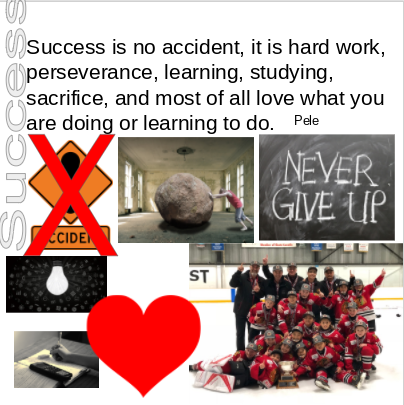
While I reflect personally, I think it’s really important to have students reflecting as well. I know that there are many ideas that are out there for ways in which students can reflect, but I wonder in what ways can we work with students so that they are constantly reflecting and not simply because they are told but because they know that reflection can facilitate greater success. This year we answered questions about moments of pride in our year as well as moments where we learned something about ourselves or others. We also created a Google Slides deck of words to live by, which included quotes we found and/ or created on our own. Students were tasked with using the words but finding images that may help viewers to feel inspired by the message of the words. Many were very deep and in retrospect, I now see that it would have been useful to have done this earlier in the year. I would have printed them out and had them on the walls of our classroom to continue to inspire us through the learning process this year.  


Screenshot 2018-06-30 at 4.25.45 PM Screenshot 2018-06-30 at 4.24.11 PM


Screenshot 2018-06-30 at 4.27.17 PMScreenshot 2018-06-30 at 4.26.48 PM


So my question is, how do we as reflective educators, truly take the time to recognize the gains made throughout the year and not just at times when journeys may be changing? Is it about smaller chunks of time on which we reflect? I know that I reflect daily but it’s sometimes a challenge to see the progress from day-to-day. How do we get our students doing the same thing? How do we get them to reflect or become eager to reflect on their own? Is it offering times of journalling or getting students to reflect like I saw a fellow Twitter Friend – Jay Dubois – do with his students – https://twitter.com/Jay__Dubois/status/1011345374009847810?

Screenshot 2018-06-30 at 4.35.54 PM

My role is changing next year but know that reflection is a huge part of my ongoing learning journey. Any ideas or suggestions would be much appreciated. How do you reflect?    

Flexible Classroom/Schedule a huge success!

The other day in my grade 4/5 class I decided to try a flexible schedule day where students would have the list of subjects available to them on the board with specific tasks under each subject. This is how the day unfolded.

Students entered the room after French and were confused by the fact that the schedule board was blank. Some of them right away started reading the black board and noticed the various subject headings. Under each heading it said grade four and grade five. The subject choices (which are the subjects that I teach on my one day LTO) were: social studies, music, math and library. In library, they are writing their own books right now so that was a writing choice.

I explained to my students that from 9:30 until 3:10, they would have the choice to pick whatever task they wanted and that they could move on when they wanted. If they completed a task, they could come hand it in to me or hand it in on google classroom. On the board I specified which tasks were to be done on google classroom. The only task on the board that required direct instruction was the grade five math task. When students were selecting that task, I asked them to come see me so I could explain it. This happened every so often throughout the day if students chose math.

I also put a “self regulation/independent work” challenge into the day where I told the class if I noticed them working hard and not getting off task, I would give them a green happy face in my app (which I have previously explained) called iDoceo. Before each break, they could come check in with me to ask how many happy faces they had.

At the end of the day, students were able to reflect on the entire experience. Here are the comments directly from the students.

Students comments about their flexible schedule/task day:

  • I liked the various choices of subjects
  • I liked how the option to switch when I wanted was there
  • This allowed us to get things done in our own timing
  • If you finished early with one task, you could move onto the other without asking what to do next
  • I liked the flow of free choice
  • There was no “have to” involved, I loved the flow of free choice
  • More time to finish things
  • “You are basically treating us like high school students”

Of my 25 students, all 25 raised their hand when I asked “How many of you prefer this type of schedule to the schedule we usually have?” The schedule we usually have is 60 minutes math, 80 minutes social studies, 40 minutes music..etc.

These were the students comments about the competition where they were asked to stay on task and work responsibly and they would be rewarded with a green smiley face in my app if they were working well:

  • The smiley faces made us work harder, they were good motivation
  • I loved the competition aspect of the day
  • Something to try for rather than just working
  • I liked finding out how many I had before each break
  • It reminded me of a race because you would still get smiley faces even if you didn’t win at the end of the day but you still had finished the race
  • Some people like competition so you can think about it like that or you could just work like usual
  • Makes you try different things

I really encourage all educators to try this flexible schedule thing! It was just a way of me looking for students that could handle the independent work challenge. The flexible schedule thing came to me while I was looking for a way to challenge students to stay on task and to work independently. I will definitely try this again next week as the kids LOVED it and as you can read, they loved the pressure free environment it allowed them to work in.