Wrong again

Privilege, position, and power are placed in the hands of all educators. Being a teacher, regardless of instructional medium is more demanding than ever before. While our world in and out of the classroom looks like nothing we have ever seen before, some things haven’t changed – such as the importance of social justice in education. What we teach must always be inclusive of who we are teaching, the community, and the world around us in our instruction.

This is why anti-racist education is so important. We need to continue this work beyond the month of February because systemic racism and bias are hard at work all year long. That means there’s always something more to learn. There’s also a chance that we could get things wrong and that can get in the way sometimes.

As learners, humans can gain much from making mistakes. There’s even an expression for it: “To err is human.” I must be really human because I have learned so much from my mistakes already. From what I am seeing in the news and on social media, our humanity has never been more human based on the loads of mistakes we’re making. Depending on how you see it, this could be good or bad? Isn’t that the essence of what we do on a daily basis? Isn’t education where we model process and progress over perfection?

Confidence does not come without failure

I am confident that there is a line about being ‘lead-learners’ in the fine print of our infinite-paged-job description. That’s because teaching naturally comes with all of the ‘lessons’ ever imagined whether you are leading or learning. The trick becomes knowing how to find them, and then accepting that none of us will ever know everything. Perhaps this peace of mind is why I have grown more comfortable with discomfort of not knowing everything, and even with being wrong at times. I have also discovered that there are many like minded educators just like me – most of us in fact.

In On becoming an anti-racist educator I wrestled with my past along the path, but it also meant confronting the existence of racism in my personal life and my part in it. A younger iteration of myself might have struggled with this, but by examining my past and my responsibility as a bystander has helped move me forward. Throughout my life I have grown accustomed to getting things wrong, but always believed that I was standing on the right side when it came to issues of equity and anti-racism. What I realized, after reflection, mentorship, and deeper learning was how my belief in those lies was solely meant to ease my burden of responsibility for my complicity and privilege.

Black History Month is 10 months away

Cue the current teaching situation where our roles have now expanded to include daily counselling on issues of mental health, experts at PPE, and classroom sanitizers extraordinaire. We have also become distance learning specialists, multi-modal lesson trailblazers, fearless conversationalists about issues of race and racism, and critical thinkers on how to overcome and dismantle systemic racism and bias. All because we have assumed a lead learners mindset fuelled by getting things wrong and working on it along the way to success.

So it doesn’t have to be different in the classroom then. For me it has meant trying to include culturally relevant and responsive content into each day. I am choosing to avoid the prescribed resources from text book companies that have grown largely culturally irrelevant and unresponsive. Now is the time to amplify new voices in our classrooms and staff meetings too. Regardless of the platform being used to deliver learning, the opportunities and responsibilities remain in every lesson and moment we engage our learners about issues of racism and how to fight against them. The work must continue long past Black History Month to undo 400 years of injustice in for the future generations.

Whether it is in my lessons or by omission, my mistakes are at the core of learning how to get things right. In all of this I find my humanity too with more mistakes to come. To misquote a Disney song and without their lawyers hurting me, “no one fails like Will G”. Embracing my messtakes, excepting korrection, and leaning form them are kee ingredients to a butter me in the classruin. Won day aisle get it write.


Nothing changes but the day

Vernal Equinox

It’s Spring and the recent trip around the sun finds me with some thoughts about fresh starts, green grass, and bunny rabbits bouncing around meadows laying chocolate eggs. Well at least the chocolate part is plausible. Thank you Cadbury. Anything to get my mind off of the fact that more and more schools are closing due to cases of COVID 19. Looking for any rays of hope, my thoughts turned to vaccinations. Now that we have those life saving jabs ready to distribute, things have to get better. Right?

For better or worse? 

My daily exposure to people in my school is around 300 people. That is 20 times greater than the promised/recommended class size for safe in person learning, and 100 times greater than at home. Who am I kidding? It’s exponentially bigger than that as each student has their own web of contacts. Like all educators, I have taken the safety precautions seriously because lives are at stake. Mine and my family members’ at home and school. All I needed to do was remain diligent, follow the protocols, and maintain my distances.

I did find some comfort knowing vaccines were coming. Having ignorantly assured myself, in January, that our provincial government would priortize educators to receive their shots (I’ll wait for you to stop laughing at my naivete). If not so much for our protection, but so that schools could remain safely opened as promised when “no expenses would be spared” was the promise. Our students needed to be back at school so their safety had to be guaranteed. Ventilation, new PPE, increased safety protocols, nurses(heard that one before), and mental health matters.

Meanwhile, at schools a different reality is playing out. Exhaustion and exhasperation while the world around us becomes smaller and smaller through restricted movement, cohorting, fatigue, anxiety, grief, fighting to speak while constantly masked, and becoming an expert at keeping 2 metres apart outside, but only 1 metre apart inside. Don’t forget the learning. What could possibly go wrong or be wrong with such a sweet set up for a learner’s success?

Gorilla in a sport coat

As an educator, nothing says, “You are NOT important to me.” like not being included in the first rounds of vaccinations. This only seemed logical as the numbers of new infections, hospitalizations, and ICU cases were climbing again through the winter and new year break. I take no joy in knowing that they are on the rise again.

The 800 pound gorilla who promised everyone would be safe, especially front-line workers, must have been distracted by something shiny on a can of buck a beer. 3 months into 2021, and despite ETFO demands for action, nothing has been done that gives me or my colleagues confidence that our health and safety are important to the sport coat set in government. As a frontline worker, I can’t help but feel saddened by the obvious message our current provincial government is sending the public about how little it values our profession by not including educators earlier on for vaccinations. Sadly, this inaction and lack of any rational thought of the long term costs will leave all Ontarians crumpling under the weight of lost lives and lost opportunities.

Is it me or are things getting heavier?

The past 3 months on-line and in person have been exhausting. There has not been a single day where I arrive home and am not wiped out mentally and physically. My students are too. This is like being asked to fix a leak on a dam with Play Doh and being told to hold it in place while the water on the other side evapourates.

January passes by, and February too, yet still little concrete news of when educators would be vaccinated. March arrives, our break is postponed in order to save the province from its collective irresponsibilty due to out of country travel and attending large super-spreader events. Now I am thinking about how each school with a case of COVID has the power to become a pint sized super-spreader event.

At my school and hundreds of others, we have had numerous students going home each week due to precautions. As of March 30th a whole class at my school is in isolation as a precaution. This is playing out across the province while restrictions are easing? If this isn’t reason enough for us to be vaccinated sooner rather than later based on data, then perhaps an appealing to compassion would be better since reason is off the table? Who am I kidding? Compassion is not part of their vocabulary because it gets in the way of patronage and profits.

As the inevitability of another lockdown looms in April, I encourage you all to stay safe and continue standing up for our students and profession as you have each and everyday. Make sure to look after yourselves too. I pray that, when this is all over, the ones who were entrusted to look after the health and safety of our public and failed will not be able to hurt our schools anymore.


Rejuvenation Through Creation

For me as a kid, there was no better feeling than opening up a new box of 64 Crayola crayons.  The big box with the flip top lid and the sharpener on the side.  I can remember agonizing over which colour to pick first and being so thrilled by the perfection of the colour palette in neat rows in that box.  I loved to draw and colour. I could do it for hours never lifting my attention from the page.  In adulthood, I abandoned doing art for pleasure.  It seemed silly for me to sit around and draw or paint for no real reason.  I felt I should be doing something productive.  A few years ago I began to create art again and realized how much I had missed it and how much joy it brought to my life. I create digital art now, which isn’t quite the same rush as opening a box of crayons but it is easier to share with others-like the picture above.  I have recently learned about the health and wellness benefits of creating. Creating is rejuvenating, it is rest and it is soul food.
Dan Tricarico, in his book “Sanctuaries: Self-Care Secrets for Stressed-Out Teachers”, he talks about how people get lost in an activity that you love so much that the rest of the world seems to fade away.  He calls it a state of “flow”.  I find myself getting into that state of flow when I draw, create music, write, cook or do jigsaw puzzles.  It isn’t that passive state of binge watching something on Netflix.  However, sometimes life’s answer is just that.  The state of flow is active and when I emerge from that state of flow, I feel rested and invigorated.  In Jessie Scholl’s article, “Go With the Flow: How States of Blissful Concentration Can Boost Your Overall Health and Well-Being” she states that, “Flow triggers the opposite of a fight-or-flight response.  Breathing becomes more relaxed, muscles loosen, and heart rate slows.  The specific biochemistry associated with flow varies depending on the activity, but the overall benefits to health and well-being are the same. ”  In fact, a 2018 Forbes article, “Here’s How Creativity Actually Improves Your Health” written by Ashley Stahl, claims that creativity increases happiness, reduces dementia, improves mental health, boosts your immune system and makes you smarter. Well, who doesn’t want all of those things?

You don’t have to be a professional musician, writer, artist or athlete to practice flow.  You can do it with any activity with some level of skill that requires you to pay attention.  It is really a type of active meditation.  Flow can be found with exercise, writing, dancing, baking, gardening, robotics or whatever activity brings you joy.

Don’t have the “time” for a creative pursuit?  It definitely requires some intentional effort to ensure that you take some time each day to pursue what you enjoy doing. It doesn’t have to be for hours but make it a specific small goal. In building anything into a routine or ritual, micro habits are key.  These are tiny steps towards implementation that grow into longer lasting habits. When I started creating art again, I just started with doing 5 minutes a day.  I just drew something.  I wasn’t worried about perfection or even completion.  I started getting lost in the flow and those minutes eventually became hours over time.  I continued to build my time until I created the habit to attempt to do something creative at least twice a week.  Beware of your inner perfectionism critic if you have one, like I do.  Give yourself some self compassion if you get out of the habit.  No one is keeping score and it is meant to be for you and your health and wellness.  When I get lost in stress and the life’s duties I often think, I should probably create something and get into that flow state-it has been a while.  Ultimately, I never regret taking that time away from the rush and hustle.

If your activity is just one more thing on your to-do list, it isn’t going to bring you joy and happiness.  In order for something to really feed your soul, it has to be something you value, something authentically you and something that you want to do because it brings you a sense of flow, peace, focus and energy.  Hopefully you will find something that gives you that “new box of crayons feeling,” whatever that means for you.

Finding Your People

As an educator in the world of school where “kindness” is taught,  I’ve often found it challenging to appear as my authentic self and still be met with kindness.  In my experience, as you enter a new space, you are often greeted in one of 3 ways: with “kindness”; with indifference; or with apprehension. Now, how your relationship proceeds can move between these 3 ways. Funny enough, there is an immediate and often permanent shift as soon as you speak up on issues that matter; the level of “kindness” that you are met with drops significantly. You see, people are often willing to be “kind” until they are made to feel uncomfortable. This makes me wonder about those of us, who on a daily basis are made to feel uncomfortable just by walking into our places of employment.  But I digress…

In this blog, I’m talking about “finding your people”. I don’t mean people who are exactly like you but rather people who have a set of characteristics that I have found to be the salve in my world of education. The people that I am thinking about as I write have a range of experiences and who differ from me in age, race, ethnicity, sexual orientation, and religious beliefs. It’s in this difference that I am able to learn, be challenged, and grow.

Critical Thinking

Many of us are familiar with the term, critical thinking. We’ve heard it in reference to competency-based education within our boards.  Simply put, critical thinking is the objective analysis of facts to form judgement, often leading to action. When I think of students who are great critical thinkers, I know that they can:

  • Question and analyze
  • Use information to solve real-world problems
  • Consider multiple solutions from a variety of perspectives
  • Apply knowledge across disciplines

This begs the question, shouldn’t the same be required of the educators within the learning spaces as they are “teaching” students? When educators question and consider a variety of perspectives, it’s refreshing and leads to greater outcomes for students. It baffles me how we expect students to question and think critically and yet as an educator, if you question, you are perceived as being a “trouble maker” or as having “a problem with everything”. Better yet, if you are a Black woman, well…you are angry. At what point will it be expected that we reflect on practices that we have always done, simply because “they have always been done”? At what point will we start to ask questions about who these practices are serving? Who is being further marginalized? To whom are these practices causing harm and trauma? Why does our “fun” or “sense of enjoyment” trump the real harm to students and their families? Those who sit down and think critically about the why behind lessons or school practices and challenge the status quo in order to make schools more equitable, are my people.

Empathy

For me, empathy has always been about a deep understanding of the experiences of another. In education, I have often seen it mixed in with the idea of saviourism. Rather than taking the time to investigate the why and subsequent actions that need to be taken to dismantle unjust systems, there is the idea of “saving” one or a few in order to feel better about oneself. This isn’t empathy. Neither is feeling sorry for someone. Deep empathy causes one to act in order to bring about tangible change. It goes beyond “putting yourself in someone else’s shoes” and causes you to reflect and do the work. As educators, what are you hearing from your colleagues? From your students and school community? How are you understanding their experiences and thus taking action to disrupt systems of injustice? You may not feel impacted by an unjust practice within your school but understanding how it causes harm to others and speaking up so that practice is changed is really what empathy is about. Over the last few months, there have been students and educators messaging and reaching out about challenging “Crazy Hair Day” in their schools. Not simply because they don’t like it but because they are understanding the harm and are choosing to act. 

Action

In 1930 Langston Hughes wrote:

I’m so tired of waiting 

Aren’t you,

For the world to become good

And beautiful and kind?

Let us take a knife

And cut the world in two—

And see what worms are eating

At the rind.

I know that many of us are tired. Tired of seeing injustices happening day in and day out in our schools. Tired of being discriminated against. Tired of always being the one to speak up. Tired of waiting for action. While many love to quote the first part of his poem, the second part – I would say – is the most critical. It’s Langston’s call to action. To take a knife, cut to the heart of the problem to see what is there and to address it. Far too often we see performative actions that do nothing but cause further harm because, well… it’s insulting. Until people are ready to actually address and deal with what is at the core of what is happening in education, it’s inaction. Those who are speaking up, naming the discrimination for what it actually is, and taking action to disrupt, are my people. This poem was written almost 100 years ago, what actions are we taking today as educators?

Navigating the complexities of relationships in Education is hard. For me, people who exhibit these traits are those among whom I want to be. They are my people. Consider your relationships within education. Who are those you value the most and why do you value them? Last week I was speaking with a couple of LTOs at our school and mentioned how refreshing it is when you find your people. Not that they agree with everything you say or do but they think critically; see you through deep empathy; and act. Have you found your people? Who are they? What makes them “your people”?

Back to the Classroom

It’s hard to believe that it’s only February and yet again, I’m sometimes amazed that it is still February! Last week, we headed back into the classroom, and with that, came mixed emotions. With a new principal in the midst of a pandemic, I was hesitant heading back because change is always hard for me. Fear of the unknown, particularly during these uncertain times, is always something that I struggle with. That being said, I was also very excited to have the chance to see my students in person again. The night before we headed back, I didn’t sleep very well but just walking into the space and envisioning my students coming in, gave me a sense of comfort and familiarity. When the bell rang and students entered the building, the familiar buzz and sense of excitement made me feel right at home. 

While we were learning virtually, I learned so much with and about my students. In this post, I’ll share a little about what I hope to continue as we learn again, in-person.

Time to Just Be

We all know the importance and benefits of social interactions in school. Opportunities to play and learn together – no matter the age – have great benefits for all students. I knew this but didn’t realize the magnitude until we went into virtual learning. While students were excited to see each other online and learn together through lessons, I noticed that they wanted more time to just be, together. Every day, I opened up our Meet at 8:45 am and school would officially start at 9 am. To my surprise, many weren’t interested in having the extra 15 minutes to ready themselves for the day but rather, many would just pop in early to talk or share something about themselves and to listen to others. It was an informal space to just be. Some mornings, students came up with games or Art activities to try with each other. We also did passion projects where we showcased something that we were passionate about in breakout rooms in Zoom. The smiles and how much they looked forward to having some “downtime” together made me realize that although learning together in the classroom has its social benefits, these moments where students were just themselves and having fun, held much value also. Since heading back to the classroom, I know that we have recess but I’m trying to figure out how we might incorporate these times – even if they are short – throughout the day. Less structured, while remaining safe and valuing more of what students choose to bring into the space.  

Voices

During virtual learning, I really tried to balance things so that all voices could be heard and not just the ones who were quickly able to hit the “raise hand” button. I was conscious of those who often spoke up and shared. I also tried to encourage those who were more quiet to understand that we so wanted to hear their voices. I was intentional in saying that while online, we need to ensure that all voices are heard and even if it took us an extra few minutes to pause to hear from a variety of students, we would. Coming back into the classroom, this is something that I want to be just as intentional about. We’re pausing and inviting more to share, being conscious of how much space we take up in discussions. 

Technology as a Tool

Since being back, it has taken us some time to get our tech back in the classroom. We’re there now and last week was a great reminder that technology is a powerful tool that is good for all and essential for some. During our time virtually, I continued to try and have students demonstrate their learning in a variety of ways. At the end of our Financial Literacy unit, we listed all that we learned during the unit, and students were tasked with creating their own resource to teach the unit to another Grade 5 class. It was amazing to see what students created. From posters and brochures to Slides presentations and videos, it was neat to see the ways in which students took an idea and ran with it, using technology. I have always been a firm believer in open tasks. Seeing what they did independently with this task was a great reminder for me. Technology is a great tool and when given the opportunity, students will use it to create and demonstrate their understanding, if we let them. 

While this learning isn’t necessarily new to me, I’ve appreciated taking the time to reflect on what was successful during virtual learning, and considering how I may bring some parts back into our in-person space. 

If you are returning to in-person learning, really hope that your return to school has been successful so far. If you are continuing to teach virtually, I give you so much credit for your work. It’s challenging to do and I’m in awe. During these challenging times, I know that we are all filled with a mix of emotions. Please remember to take some time to reflect on what is going well and also to take care of yourself!

Hindsight is…

Please don’t make me finish the title until the last second has ticked off the clock. I may have developed a defensive outlook about this trip around the sun. While I know this Gregorian Calender measurement of time will soon be in the rearview mirror of our lives, it is still a battle avoiding the queasiness and wincing that come when I think about all we have been through in 2020. Can resolutions be far behind?

Dang! I just wrote 2020

My understanding, perhaps acceptance, of this year is coming into clearer focus. It has been an extraordinary year on so many levels, and thus a great opportunity for personal growth. It has also been an educational year because, dang, I learnt a lot. 

Dang! I just wrote ‘dang’ again. 

I also taught a lot, and despite it feeling like a roller coaster ride from hell along the way, it meant that there were many lessons for me as an educator in 2020 too. Which made me happy to find this quote below after thinking I made it up myself. 

“If you are not learning, then you are not teaching.” Vernon L Smith*

A wise and gentle reminder that there was always something new to learn about ourselves, the students we teach, and the world around us during periods of unexpected loss, labour strife, professional uncertainty, and a global crisis. Smith’s words echoing loudly as I type. Here’s my version of it à la René Descartes. 

I learn, therefore I am a teacher.

So here is what I learnt from hindsight/2020:

  1. Take time to grieve and offer comfort first when students/families are hurting. The lessons can wait. It hurts to lose a student to senseless violence. Our school felt this very deeply last January
  2. Sometimes governments do not have the best interests of the population in their actions. Standing up to malfeasance and legislated tyranny is the right and a responsibility of all educators. 
  3. Mental health matters more than marks. Students/educators who struggle will not miraculously get better after a call to a helpline or a conversation with a social worker/psychologist. It is a process that takes time and patience before progress. I learned that there is much more to learn in this area to better support students, colleagues, and myself. 
    Remember that no matter how many times people tell you to take care of yourself first, there have to be reasonable boundaries and supports to make that happen. An encouraging message from admin, a Board Director’s email blast, or the Minister of Ed is not going to suffice. Set your boundaries. Do what you can do within them. Take time to be still. The work can and will wait. 
  4. Equity in schools needs to go way beyond a single day in the classroom, Orange/Pink/Purple shirt days are great starting points, but most not become performative events, but rather actionable beginnings to build on everyday in classrooms. There are so many amazing inclusion and equity resources being shared via school boards and social media for educators committed to allyship and activism in areas of Truth and Reconciliation, anti-black racism, LGBTQ2+, and culturally responsive relevant pedagogy. I learned that words in a classroom mean very little if they are not accompanied by opportunities to critically engage learners to become agents of change. 
  5. I learned not all educators are ready to confront their privilege and unearned advantage. I also learned that acknowledging my own privilege comes with the responsibility to examine my pedagogy and practice. It is a chance to unlearn, learn, and then teach. 
  6. If you are going to move into emergency distance learning within a short period of time, take it slow and make sure you have an ergonomic work space for those extended hours of screen time ahead. I learned that not all students have the same amounts of available space or bandwidth required for virtual school. I also had to accept that some students checked out the moment learning became asynchronous. 
  7. Rethink, question, iterate, bend, blend, and break everything you have done in the past to teach. Say goodbye to “we’ve always done it this way thinking”. Reimagine your reading lists, your math instruction, your use of worksheets, your classroom management, and your assessment approaches. This will not be easy, but it will be worth it. Embrace the discomfort. Learn from it, and then teach forward knowing 2020 taught us all so much. 

Thank you for a wonderful year at the speed of education. Please feel free to add what 2020 taught you in the comments below. Cheers to you all, and to a safe trip around the sun in 2021. 

*  There is comfort in the knowledge that the quote above is attributed to a Nobel Prize winning thinker because before checking, I thought the words above were mined straight out of my mind. Needless to say, I am happy to share a common thought in esteemed company. Searching out the source of the quote also allowed me to discover some of Smith’s other vast body of work in economics.


Anti-Racism and the Fight for Black Lives

I recently joined educators from across the province to participate in ETFO’s powerful four-part webinar series called, “Anti-Racism and the Fight for Black Lives”.  It was an amazing professional learning opportunity, and it should be mandatory for all ETFO staff and members.

The program involves watching a short video clip each week, and engaging in courageous and critical conversations about anti-Black racism with other educators.  ETFO released the video, “Anti-Racism and the Fight for Black Lives” during the 2020 Annual Meeting, as part of the ETFO’s Anti-Black Racism Strategy.  This video is available to all members on www.etfo.ca, along with guiding questions to explore on your own or with your colleagues. 

In the video, we hear the voices of Sandy Hudson, who is a political activist, writer and the founder of Black Lives Matter Toronto, and Phillip Dwight Morgan, who is a journalist, poet and researcher.  The interview is moderated by Alejandra Bravo, who has a history of working for progressive social change with grassroots, immigrant and labour groups. 

What does it mean to fight for Black lives?

Throughout the interview, Sandy Hudson and Phillip Dwight Morgan share knowledge and insights about how educators might use this moment of “awakening” to fight for Black lives and demand systemic change.  One of the issues that we discussed each week was the impact of police in schools and in communities, and the call to action to defund or abolish the police, and re-imagine different ways to respond and care for each other.

Each session was organized and facilitated by ETFO staff Alice Te and Matthew Sinclair, and included opportunities to break out into smaller groups to share ideas and reflect on the guiding questions.  The active and deep engagement of the participants was inspiring.  Educators from Kindergarten-Grade 8 leaned in to listen, learn, ask questions and share resources. 

What is your positionality?

In our first session, the facilitators shared a definition of anti-oppression work as the “active and consistent process of change to eliminate individual and systemic oppression”.  Alice Te and Matthew Sinclair acknowledged that we are all in different places on our learning journey towards equity and racial justice, and that being an ally sometimes means standing UP, standing BEHIND, or standing WITH others, depending on your positionality.  

Throughout the program, we were encouraged to move from individual to collective action, and think critically about how we can use our privilege as educators to work towards systemic change.  As an educator who is committed to learning and unlearning what anti-oppression looks like in schools, I am always grateful for the opportunity to learn from and with other educators about how to disrupt institutional racism.

How can we transform Canadian institutions?    

In order to change or transform systems of education, we must first recognize that schools are not safe or equitable spaces for all students, families, staff and community members.  Schools continue to reinforce White privilege, and create barriers for Black, Indigenous and other racialized students.  Please read the following ETFO VOICE articles about the impact of institutionalized racism in schools:

Anti-Black Racism in Education and Black Students Navigating the Pandemic by Stephanie Fearon

Sisters in the Struggles: Racialized Women and Microaggressions in the Workplace by Angelique Cancino-Thompson

Can you spare some change?

In Part #1, Sandy Hudson invites us to think about the difference between fighting FOR Black lives and fighting AGAINST anti-Black racism.  She says, “It is not enough to be a good person.  You have to be ready to accept a change in your living conditions, so that everyone else’s living conditions, in particular Black people’s living conditions can change.”  Alejandra Bravo agrees: “Solidarity is only real if it costs you something.”  

Educators have a lot of political and economic privilege, which can be used to fight against anti-Black racism.  As we consider how we might change or transform our institutions, we need to be ready to put our money where our mouth is, and fund direct action.  We also need to recognize how institutions are interconnected and advocate for change so that all communities have equal access to health care, housing, paid sick days, food security, accessible transit, etc.  

Two organizations that are working hard and deserve our financial support are: parentsofblackchildren.org and showingupforracialjustice.org  

Why defund police?

Part #2 focuses on defunding the police.  In the video, Sandy Hudson challenges us to shift how we think of safety and security in our society.  She explains that police have historically harmed many communities, including Black, racialized, Indigenous, 2SLGBTQ+, and the underhoused.  This harm and violence is still ongoing, and police actually make some folks feel less safe.  Hudson shares facts about how police budgets are allocated, and argues that funding must be provided to support services that are more effective, and to build alternatives.  

Why are police in schools?

As part of this program, we were very fortunate to have the opportunity to meet Phillip Dwight Morgan, and hear more about his personal experiences and his advocacy work.  Morgan encouraged us to critically reflect on the role of School Resource Officers (SRO’s) and police in schools, and to consider the impact for Black staff, students and their families.  He also questioned where police are located in Toronto schools, and the racial bias of defining “high priority” neighbourhoods as areas that have a higher percentage of racialized families.  These discussions helped me to understand where the call to defund the police comes from, and how it connects to the fight for Black lives.

What is the role of educators?

In Part #3, we discussed other forms of anti-Black racism, racial profiling and bias that need to be addressed in schools and other spaces for youth.  We also shared ideas about how we can use our position to best create and promote changes in our school and local community.  

In our break-out groups, we talked about the importance of representation, and the need to hire more Black educators.  We also talked about centering stories of Black resilience and pride, innovation, love and joy.  Educators from rural and northern communities talked about how they might teach students about anti-oppression without “othering” or reinforcing “us/them” inequities in their predominantly White communities.  Everyone agreed that addressing anti-Black racism in our schools benefits everyone.   

ETFO has developed many resources to support educators to engage in this work, including White Privilege Lesson Plans and ETFO Black 365 Canadian Curriculum.  Please share any resources that you have used in the comments below.  

What does solidarity look like?

Part #4 focuses on the need for awareness and action.  In the video, Alejandra Bravo asks if changing our individual behaviour will help make Black lives better.  Sandy Hudson and Phillip Dwight Morgan criticize the impact of individual acts of solidarity, if they do not include the call to action for systemic change.  For example, many folks are comfortable hanging a poster that says, “Black Lives Matter” or posting a black square on their social media, but they are not comfortable advocating for the abolishment of police.  

The discussion in our break-out group was interesting because we all have colleagues that are at the beginning of their learning journey, and need to do the individual work to recognize how they are impacted by and complicit in reinforcing oppression and privilege.  We talked about how we might support all members in our school community to engage in courageous conversations about racial justice and anti-oppression work.  After participating in this program, I understand that fighting for Black lives must also include advocating for systemic change and funding direct action to fight against anti-Black racism.

What are the next steps?

ETFO has a lot of privilege and political power to advocate for systemic change.  I look forward to hearing about the next steps that ETFO will take to continue to fight for Black lives.   

I am grateful to ETFO and all of the educators who created this professional learning opportunity, and I am inspired by the members who showed up every week to actively engage in this critical work.  I encourage everyone to watch the videos, and to participate in the webinar series when it is offered again.  


2020 – the roller coaster no one in education asked to ride

Please secure any loose items and keep your hands inside the car at all times.
Do not exit the ride until it comes to a full and complete stop.

Most of the time the exhilaration of a fast fun paced ride, filled with brief mind boggling G-forces, would come next. At an amusement park perhaps, but it is 2020 after all, and this ain’t your average roller coaster of a year. From the get go, it was destined to be different as it was determined to distinguish itself from the decades of other “normal” years before it. To add even more gravity to the moment, we all had take this ride, and hold on for dear life regardless of height. I want to share what it felt like for me this year.

2020 AsAroLLerCoaSTerInEdUcatIon

Instead of the fun and excitement that might normally have been anticipated, this year felt more like being in a time warped slow motion sequence while being suffocated inside of a dumpster that was on fire and rolling down a steep mountain. WEEEE! quickly gave way to AAAGHH!!!

Everytime I opened the lid of my own flaming dumpster car to look out at 2020, I saw flashes of things to grieve, endure, flee, confront, fix, stretch, and learn from.

It was as if the ride was designed to keep going non-stop and at a nauseating speed while everyone was expected to remain strapped in and trying not to lose what they brought on the ride. At times, it felt like working in a vacuum. My lungs empty of air while my mind and body rush up and over the same structure over and over again.

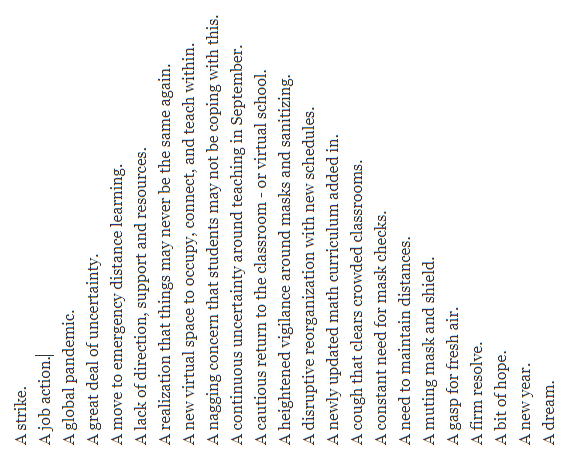
2020 AsAroLLerCoaSTerInEDucaTIon

A year.
A strike.
A job action.
A global pandemic.
A great deal of uncertainty.
A move to emergency distance learning.
A realization that not everything is equitable.
A lack of direction, support and resources at times.
A realization that things may never be the same again.
A new virtual space to occupy, connect, and teach within.
A nagging concern that students may not be coping with this.
A continuous uncertainty around teaching in September.
A cautious return to the classroom – or virtual school.
A heightened vigilance around masks and sanitizing.
A disruptive reorganization with new schedules.
A newly updated math curriculum added in.
A cough that clears crowded classrooms.
A constant need for mask checks.
A need to maintain distances.
A muting mask and shield.
A gasp for fresh air.
A firm resolve.
A bit of hope.
A new year.
A dream.

As this ride finally runs out of track, I’m thankful to be physically in one piece, but still in need of greater peace of mind over this winter break. Recovering from this ride is going to take time. While figuratively staggering off of this year’s roller coaster, I am already heading back to the line to wait and go again.

Looking back on the past 52 weeks of this ride, I am trying to see how this year shaped my personal practice as an educator. I mean, the 2020 roller coaster possessed all the thrilling twists, stomach churning turns, dizzying highs, and sinking lows which no one could have expected. It came as no surprise then that enjoying the ride, catching my breath, or being able to re-orient myself relative to the world around me would not come easy. Despite it all, I find myself resolved to bend, blend or break what has been my instructional practice in order to do better in 2021.

It is perhaps because of this discombobulation, I have questioned everything that I have ever done as an educator. Stay tuned to see where this goes.

In the meantime expressions of gratitude, encouragement, and optimism to all educators who held on through the tumultuous ride that was education in 2020. You have indeed been the models of grace, resilience, resolve, creativity, persistance, and integrity in our profession. You have been inspirations to me whenever I lifted the lid of my flaming dumpster car to look out and take a breath. I’m looking forward to teaching in 2021 because of y0u.


Occasional Teaching Online (part 1 of 3): My Realization

Full Remote Learning or FRL for short. 

A concept that I had never even imagined myself being a part of in the position of the teacher. Remote learning for post-secondary students was something I was familiar with. In fact, I was learning myself remotely as a Master of Professional Education student, but how would this be possible with children?

I applaud any and all people who have dedicated themselves to ensuring Ontario’s students are safe, engaged and happy during this extremely challenging school year. Educators have put in countless hours and ongoing efforts to reimagine their classrooms (whether they are virtual or face-to-face) all while keeping student’s needs at the forefront of their priorities. This pandemic has forced us all to stop and think and required us to view the world through a lens in which we never have before. Each person with their own perspectives, hardships, wins and realizations. Each person has their own narrative, each educator has a different experience. Personally, my emotions are running higher this year as I feel more nervous, uneasy, confused and overwhelmed than I ever have before. 


“The realization that life is absurd cannot be an end, but only a beginning” – Albert Camus


I am constantly reflecting on my teaching practice and how I can adapt to new changes, learn from them, grow with them and ‘realize’ from them.

In early October, I picked up my first supply call for FRL. I had no idea what to expect. How would I enter this classroom community and have a positive impact on these students? How do I ensure students are provided with chances for sharing? Collaboration? How do I ensure a safe space for students to take chances, ask questions and make mistakes in the era of ‘muting’ your microphones?

The resilience of children never ceases to amaze me. Here we are as educators feeling unsure, uncomfortable even, as students join in as though they have done this 100 times in the past. Teaching and learning online has reminded me to never underestimate the power of connection. Just a few days ago, I was teaching in an FRL grade 5 classroom where a new student had joined the class that same day. Before our scheduled ‘recess’ time, one of the students in the class asked me if he and the new student could remain online with me for a couple of minutes so he could introduce himself. When the rest of the class had left the Google Meet and the three of us remained, he said “Hey! Do you wanna be my friend?” and the conversation blossomed from there. 


THIS. 


It was at this moment I had a realization. It became apparent to me that we cannot stop children’s will to connect, drive for relationships and the innocence in their hearts. Nothing will stop this. Not removing them from the physical school building, not the transition to learning online, not wearing a mask, not social distancing, not a pandemic. Nothing.

Brutalist worksheets

Have you ever seen something that made you wonder whether it’s sole purpose was to make you feel small or insignificant? I don’t mean this in feelgood sort of humbling way like you might ponder a mountain’s majesty or an ocean’s depth. I mean, the way you feel uneasy when looking at a decades old worksheet from a resource 20 to 25 years past its pedogogical prime – where thought and creativity were never part of its iterations. I’m talking about copy after copy of soul sucking work pages given to students only to be regurgitated upon with rote facts and little, if any, critical thought. Let’s call them Brutalist worksheets because, like the architecture, they make the learner to feel small, and powerless, and the learning devoid of inspiration.

Over the years, I have found a number of Brutalist offerings left behind in the photo-copiers, and they make me shudder a bit to think that they were destined for students’ desks and to inevitable irrelevance shortly thereafter. I’d like to say this is a long distant memory, but it is still happening in 2020.

20 years into 21st Century learning and brutalist worksheets are still being shared. But first a bit about Brutalism.

Minds On

In the creative world of architecture there are several styles that have pervaded through history. We have remnants of the Victorian, Mid-Century Modern, Art Deco, and Modernist eras that occupy much of the past century and its edifices. There is another that cannot be overlooked because of it’s austere, raw, and imposing nature, Brutalism.

Brutalism, but this is a blog for teachers? Why are we having an architecture lesson? Why not? After all, design is design and the way that we construct, craft, curate, and create content for our students matters. It is inconceivable to think it can be done without consideration of the learners we are teaching or without differentiation.

Imagine a stark and unwelcoming piece of paper that seems as if it’s sole intention is to crush your spirit. Next, think of a page full of Math calculation questions that you have been handed, and are now expected to complete before the 2 or 3 minute timer goes off. Think of a different, but equally oppressive Math sheet with instructions, but no guiding example or room to show your thinking? Think of a double-sided sheet of French -er, ir, and -re verbs to conjugate. Brutal and absolutely intended as rote busy work to keep students from being their best.

I was visting a school a few years back and came across a teacher with a stack of photocopies at least 1500 pages or more in total. I asked if this was for a whole school letter to which they replied that it was for their classroom followed by, “You have to keep ’em busy somehow.” I walked away very sad at that moment and have tried to hang on to that interaction as a reminder of what not to do.

Brutalism in our profession has no business in any of our classroom resources. In fact, we need to seriously consider the function and purpose of everything we are printing for students. It starts by cleaning out the cabinets and binders that contain outdated worksheets. I know it means having to start fresh for some, but imagine the potential for deeper learning rather than a time filler destined for the recycle bin? Perhaps doing this over the course of the year will make it less daunting. With so many digital tools at our fingertips now, creating and updating content is easier than those Xerox days of yore.

Our shift to digital learning has allowed many of us to curate constructive content with links that are informative and interactive. There are also environmental and financial benefits from avoiding copy after copy too. With a suite of apps and productivity tools. Teachers can create these spaces from a trove of templates and fellow educators who are willing to share. No need for TPT here.*

Start with the incredible digital resources being shared from your school board and from a cohort of amazing educators via Twitter. I know that PeelDSB, TDSB, DurhamDSB, and YRDSB have provided many excellent resources to their staff, and am sure there are more boards out there doing the same for theirs. If you want to start your own, you can always check out Ditch that Textbook, MathigonShukes and Giff, TV Ontario, and TED Ed for ideas. If you have a favourite, please share in the comments below.

All that I ask is that you resist the urge to hit the copy button without considering the content you intend to share with students. Will it make them feel insignificant and under-inspired? Then you might have a brutalist worksheet in your hands and it might be time to go back to the drawing board to design something inviting and engaging to students as modern learners.

* I always think of toilet paper when I see TPT. Sorry, not sorry.