Remote Learning Hereos

Celebrating the Remote Learning Heroes

I wake up to teach each morning, excited to hear my students voices and to teach the lessons for the day. I love every moment with them and I think the world of these students. They really are little super heroes, but do I tell them that enough?

It was brought up at a staff meeting by multiple staff members this week how are our students are super heroes for engaging in a learning setting that we would have never imagined. Just waking up, signing in and listening is something that should be celebrated. But of course, we have to expect more from them and I am delighted by what they show me each day. My students are coming to school each day in a virtual setting, meeting deadlines and participating more than I have ever seen in my seven years of teaching. Just this week alone, they handed in their final copies of their MVP 0f 2020 essays, many of them writing five or more pages about their selected person. Six of my students even wanted to learn about MLA citations and how to format a works cited page. These are things that will help them so much in the future and I was so excited to teach them about that. They also worked hard on their financial literacy final project- coming up with a budget for an imaginary person, looking at how to buy a car and selecting between various interest rates as well as looking up how to save for local universities. Most of my 33 students handed in both of these projects this week and were so excited to celebrate afterwards.

Every week we do student shout-outs and yesterday, I made a “wordle” (mashup of student names) to celebrate each and every one of them. For showing up, but also, for doing so much more than that. I know for some students, the challenging situation we are in right now makes it hard for them to participate in daily lessons. One of my most engaged students told me the other day, “I don’t know how I am doing it. I have the whole world at my finger tips but I am expected to sit and listen to lessons each day. I have to avoid distractions with nobody on the other side of the screen to hold me accountable. I do not know how much longer I can do this.” What an honest statement from my student. My response was yes, what a challenging task! But imagine completing this year and having the skill to avoid distractions and to be responsible for your work without I suppose there isn’t anybody there to remind you to stay on task like there would be in the physical classroom. I encouraged my students to think about all of the things they will be able to accomplish in the future with this new found responsibility. That independence will take them all the way through their academic career.

It is also important for me to remember that they still need to engage with peers, so I have been making breakout rooms each day in a variety of subjects. This is great as well because they have another student to chat with. I love popping into the breakout rooms and hearing the conversations (all on task?!) with students they have never met in real life.

These students are so resilient and they truly are my heroes. I know it is easy to get frustrated with the lack of output from some students, but in the physical classroom, it may have been the same thing. In an online setting, it is just more noticeable. All we can do is continue to encourage our students and remember to celebrate their success, no matter how small. Always try to remember that as challenging as it is for us educators, it is even more challenging for our kids- the remote learning heroes.


Snow Day = No School Day

ETFO’s position on in-person learning remains unchanged. The union firmly believes that the daily, in-person model of instruction and support best meets the educational, developmental and social needs of students, provides the best experience for support, and is the most equitable learning model for all students. ETFO’s expectation is that elementary virtual learning in any capacity, including through hybrid models of instruction, will end once the pandemic ends.

As an elementary special education teacher, I teach in a hybrid class of some students learning synchronously online and some learning in-class. It’s a juggle of competing agendas as teaching online and in-class are very different due to different ecologies of learning. Ecology is defined as “the study of the relationships between living organisms, including humans, and their physical environment; it seeks to understand the vital connections between plants and animals and the world around them.”

In-class ecology of learning

In-class learning happens in a physical environment of personal connections. In-class students learn by watching and listening to teachers while they also complete their work. Teachers can address specific students’ needs by reading body language and answering students’ questions.

Classroom learning is personal in nature.

In-class ecology is based on interactions between participants that occur face-to-face with the opportunity to directly deal with students based on need. Needs are determined by teachers being able to assess students’ needs by their knowledge of student learning profiles and emotions identified via body language. Classrooms also provide students with opportunities to interact with other students and move while learning.

Classroom learning is fostered by relationships and the interconnections between students, parents, and teachers.

Online ecology of learning

Online learning happens in a virtual environment of auditory connections. When students learning online, they learn mostly by listening through a screen via an online platform. Teachers explain concepts through images and speaking with little or no eye contact with students. As students often have their cameras off (i.e., their choice to protect their privacy at home), teachers cannot assess students’ level of engagement nor can they assess students’ understanding of lessons. Further, since students learn via camera, they miss the opportunity to engage in learning by manipulating objects such as with math manipulatives or creating experiments in science.

Online learning is void of the personal nature found in classroom learning.

Through a camera, teachers cannot develop the fulsome relationships key to the evaluation of students’ understanding and need for support. In addition, teachers are highly limited in the understanding of students’ learning profiles or emotional needs.

The assessment of work is also a challenge as teachers cannot directly witness products or collect observations in assessing success criteria. Conducting assessments via conversations is challenging as other students are literally in the same space as the student being assessed.

Online learning falls short in the building of relationships and interconnections between students, parents, and teachers. As the act of learning is fueled by personal interactions and relationships, without them learning is constrained. Online learning, especially for students with special education needs, is not an effective venue to learn. Further, online learning disproportionally impacts students who come from lower social economic backgrounds where the additional resources of time and money may not be available to support learning from home.

Online and In-Class Learning have different ecologies

Overall, it’s taken me many months to delineate what works synchronously online and in-class via the hybrid model. As learning about how to teach is based on experience, I’ve had some lessons that were not to be repeated and through this process I know what works with my current class of students.

In-class and online teaching “Flip-o-Rama”

Tuesday, February 16th, 2021 was the day my in-class students were to return to school. My online students would remain online but follow along in class via a camera (which was finally provided to me by my board of education after a year of teaching online learning.) But Mother Nature decided not to have us return to school via a big dump of snow – a snow day was announced via Twitter.

My lesson plans for this day were based on teaching in-class at school. We were to get our classroom organized, go over new Covid protocols, discuss plans for our science projects, and learn about anti-racism. I did not plan for another day of teaching online.

I was informed via Twitter by this message “On Feb. 16, 2021, all buses are cancelled & school buildings are closed to students due to inclement weather conditions. Learning will continue at home through remote, synchronous instruction, where possible.”

I understand the need for students to continue their learning and I have been working over 6 days a week to make this happen. I have been stepping up to “learning through remote synchronous instruction, where possible” by making it possible every day since September 2020. As a teacher, during the Covid-19 pandemic, I have worked hard to meet every additional expectation presented to me by my board of education. I have made “where possible”, possible.

Just Pivot In-class to Online

The challenge I face is that I cannot “just flip a switch” (i.e. or pivot) to go from planning for in-class learning to synchronous, online learning. It is not an easy, “flip of a switch”, transition. The reality is that I need to plan more for online learning by making sure students have the materials they need to participate in lessons.

My greatest concern is that, in the future, once the pandemic passes, Snow Days (i.e., inclement weather days) will automatically become online learning days. This will result in teachers having to flip from in class learning to online learning within hours of inclement weather announcements. Parents will have to arrange their day to accommodate their child’s online school by monitoring their work and supporting learning activities where possible. It’s a big ask for teachers and parents.

Setting a precedent for online learning during inclement weather days is a slippery slope.

I can see boards and ministries of education using inclement weather online learning to move more students’ learning, online.

Collaboratively Yours,

Deborah Weston, PhD

New Year’s Resolutions

Hello all and I hope you had a lovely Christmas with whomever you were “allowed” to surround yourself with.I spent the holidays with my close family and enjoyed some quality time at home this year rather than visiting our favourite mouse in Florida. We are thankfully booked in for next Christmas as we are hoping the world will be almost back to normal by then or at least it will be safe to travel.

As we look forward to 2021, I find myself thinking about that time of year when everyone makes some resolutions for the new year. Mine have always been teaching related. Whether it be creating a fundraiser, making a basketball event for the school, planning soccer tournaments or this time last year, we were looking toward to the strike hopefully ending. Being virtual this year and knowing that we are in another lockdown, I find it hard to plan short term. Therefore, I am thinking about making  long-term personal goals this year.

  1. To see friends and family more. I think during the regular year I am always focused on what I want to do. The pandemic has allowed for lots of “me time” so I will look forward to planning gatherings with all of the new babies that were just born in my friend circle. Sadly I have not held any of the new babies as they were all born in June, July, November and two weeks ago!
  2. I will also look forward to re-booking a trip with my sister which was cancelled March Break 2020. I was so looking forward to travelling with her and hope to re-book soon.
  3. I look forward to re-doing the backyard of my new home. When I bought this house two months ago, the only thing which needed fixing was the backyard so I look forward to doing that in spring 2021, along with building a deck.

I hope everyone else is looking at the future in a hopeful way and not feeling too sad/stressed with the second lockdown in effect. I am interested in hearing from any virtual teachers if they have any exciting first week back activities. I find it hard to plan during the two week break and always leave it towards the end. I was thinking of continuing with my Monday morning activity “Brag, drag and goal” and maybe I will make that goal a New Year’s Resolution for my students as well. I also start off every new year with an essay writing activity about the MVP of the previous year. I always find a good youtube video about famous people who had a successful year in whatever field they are in. Then, students brainstorm who they nominate and write an essay about why they deserve the award. This is a fun but educational way to wrap up the previous year.

Let me know if there is anything else you have planned 🙂

Wishing everyone a happy new year and here’s to more moments with friends and family in 2021!


From zero to one hundred, real quick!

As my online teaching journey continues, I find myself always thinking about the importance of reaching all students.

Last week, I noticed I only had about 13 out of 31 students participating daily. I wouldn’t see the other students writing in the chat, posting in the discussion section or raising their hand to speak on the mic. I started to worry if they were even in front of the screen during our calls. I started to think about solutions to this problem. I contacted every family in the class to touch base about their child’s online participation. Not even one hour later, I noticed a huge change in my entire class. I know this motivation came from a parent this time, but in the future I believe it could turn into self motivation. I received 25 out of 31 responses in math, 18 readers for our online novel, nine more short story submissions and six students speaking on the microphone for the very first time. To top it all off, this was happening on a Friday afternoon!I wondered if Friday was just going to be a one off and students would go back to their bystander ways in the future, but participation during these past two days have been better than ever. Not only that, my original 13 that participate so much (since the first day) are always encouraging everyone that is just starting to participate. The environment could not get any better!

We started off this week talking about goal setting and the importance of student participation in the classroom. Every Monday, students would set a goal that they hope to achieve by Friday. On Friday, I will ask students to type in the chat or use the microphone to share if they met that goal. If they did not, their classmates will help them brainstorm ideas for them to reach it the next time.

I know teaching new concepts is something that I can do during math, language, etc. but I love when the students get to hear from each other on that microphone or in the chat. In math, I find students teaching each other concepts before I am even quick enough to reply. In language, students are congratulating each other about their reading abilities before I even think to do so. My favourite moment of last week was in drama when a student gave away his turn because he wanted someone else to have a turn who had not participated yet. I constantly feel like crying tears of joy because of the supportive environment my class has created.

I look forward to continuing this online journey as I know I have a group of hardworking, goal oriented, passionate and kind students.  I am so fortunate to be on this learning journey and I am learning that the online environment really is turning out to be an incredible place for student growth. I cannot wait to share another great success story!


Teachers Are Still Rocking It-

In March we were “Emergency Learning”.  Now we are either teaching “virtually” or “socially distanced” in classrooms.  We never thought we’d be teaching from behind a screen, learning all kinds of new technology tools, wearing masks and shields in front of students or removing all of the manipulatives from classrooms. We don’t know how long this will last.  We don’t know if COVID will worsen.  Educators aren’t used to not knowing things.  Most teachers I know like schedules, routines, knowledge and thrive on consistency.

However, in the midst of the new rules, changes and all of the things that we “can’t” do-teachers are still rocking it.  Throughout the summer I worked with a team of teachers providing virtual professional learning for KPRETFO.  Hundreds of teachers used their summer holidays to learn about technology tools before they even knew whether they were going to be teaching virtually or not. They logged in at 10 am some days in order to learn and some teachers even came to all twenty sessions that were provided. Educators were dedicated to their professional learning all summer long.

At the end of August, I had the privilege of working with another fabulous team of educators who dedicated their time to providing a three day virtual conference for over 500 Ontario Educators with ECOO.  These educators gave up their time to organize all kinds of schedules, sponsorship, presenters, keynotes and much more.  In addition, over a hundred educators created and presented webinars for their colleagues.  It truly FELT like a face-to-face educational technology conference took place in my living room!
There was a feeling of sharing, helping and collegiality.  It was exhausting but my bucket was over flowing.

As our school year is now well under way teachers are reaching out to me for assistance at all times of the day and night through email because they are dedicated to their students and want to do their best.  They are attending our evening “PD in your PJs” webinar sessions through our local union office to learn new tech tools at 7 pm on the week nights. The educators that I work with continually astound me with their dedication to professional learning.

I recently binge watched a Netflix series called “Away”.  It is a futuristic fictional narrative about the first manned mission to Mars.  The astronauts were in uncharted territory.  They encountered problems along the way for which they had not trained.  They endured mental and physical fatigue beyond anything they had ever felt before.  They were innovative and creative in order to solve problems and reach their goal.  While watching, I couldn’t help thinking about the parallels between this movie and the present state of education. We’ve heard that as we design these new learning structures and environments it is like we are building an airplane while flying. If I am going to stay true to the analogy here it is really more of a rocket ship! Educators are facing situations that they hadn’t even thought about in Faculty of Education Programs.  They are encountering issues of teaching without many of the tools they normally use such as manipulatives, group work or technology. They are suffering mentally and physically. They are being innovative  problem solvers around tools, equipment and technology.  They are building the rocket ship while they are flying it and it is full of students.

Are educators stressed?  For sure.  Are their nerves frayed?  You bet.  Are they innovative, creative, dedicated and passionate about learning and teaching? Absolutely, without a doubt.  Every educator is a front line worker,  doing their best, making a difference, being brave beyond imagination and truly an inspiration.


“Techie People”

As someone who is passionate and truly geeky about the power of technology in education, I often hear from my fellow teachers, “I’m not really a techie person.”  Now, I get where they are coming from because technology can be intimidating.  Many times I’ve said, “I’m not really a math person.”  I can “do” math and I can “learn” math but it doesn’t get me fired up quite like tech does.  However, over the last few months educators who weren’t really “techie people” didn’t have much of a choice other than to use tech in order to do their job.  I cannot imagine what that must have felt like for some educators.  For some educators, it must have been terrifying.  For me, it would have been like my Principal saying that I was now the new math consultant for the intermediate grades.  It would have caused me serious panic and anxiety. I probably would have considered resigning but I would have dug in and done the best I could with the tools available to me and I would have reached out to fellow colleagues and leaned on their expertise. THAT is what teachers all over the province of Ontario were doing after the March Break, teaching and learning by the seat of their pants.

As an innovations consultant what I witnessed during the weeks of distance learning was fellow educators doing what they do best; rolling up their sleeves, getting in there and figuring the tech stuff out.  As I (along with some fantastic  and enthusiastic educators in my board) provided webinar workshops on technological tools for teachers, I saw teachers who were self proclaimed Luddites attending and showing appreciation for what we were doing.  The resiliency of educators during this time has been absolutely amazing. The necessity of teaching through technology broke through an invisible barrier that has existed for those teachers who thought that you had to be a “techie person” in order to use tech in education.  Teachers were no longer afraid to try a new technological tool, to make mistakes and ask questions. Teachers are discovering the power educational technology and they’ve been bit by the tech bug.  Educators will always continue to seek out new and innovative ways to deliver curriculum to students and learn as they go-no matter how steep the learning curve.  Some teachers who would have quickly proclaimed, “I’m not a techie person” before March Break are now excited about the possibilities of using technology even in their face-to-face classrooms.  The Educational Technology Geek Community is over-the-moon excited about increasing it’s membership!  We are a friendly bunch, inclusive, sharing and passionate and we’re happy to help.

Classrooms After Covid-19

ETFO’s position on in-person learning remains unchanged. The union firmly believes that the daily, in-person model of instruction and support best meets the educational, developmental and social needs of students, provides the best experience for support, and is the most equitable learning model for all students. ETFO’s expectation is that elementary virtual learning in any capacity, including through hybrid models of instruction, will end once the pandemic ends.

I write this blog in response to the Province of Quebec opening their public schools as of May 11th 2020. As the education of students is challenged with many layers of complexity, I will muse about what classrooms might look like when Ontario’s students return to classroom.

Managing the Spread of the Virus

In minimizing the spread of the virus, schools may be given the responsibility of monitoring students’ level of health. This could mean morning temperature checks, hourly hand washing routines, hand sanitizer stations, and the wearing of masks. Custodians would also be tasked with cleaning areas frequented my students such as hallways and washrooms. This would mean more custodians may need to be hired to keep up with increased hygiene demands.

Further, policy might have to be put in place to send students home who are experiencing signs of Illness. As a classroom teacher, I know that parents send their children to school with diarrhea, vomiting, and fever which is likely to spread infection to others. I am concerned about the occurrence of students’ 11 o’clock fever which results in parent dosing their feverish child with Tylenol at 7 am only to have the fever return when the medication wears off 4 hours later. In 2009, when the H1N1 virus hit, one of my grade 7 classes had 18 students sick with H1N1 after a birthday party. From my students, I contracted H1N1 and was fortunately put on antiviral medication, so I recovered within a few days.

In considering teachers already being tasked with many responsibilities and challenges, I suggest that the responsibility of monitoring students’ health be placed in the capable hands of trained medical professionals. This would mean that boards of education would have to hire health professionals such as practical nurses to monitor students’ health and deal with students first aid needs.

Hallways, Entry, Exit, Busing, Recess, Assemblies

In order to limit traffic and honour social distancing, schools may have to set zones, based on students’ age, to limit contact between grade level divisions. This might mean that students in Kindergarten, primary (grades 1, 2, 3), junior (grades 4, 5, 6), and intermediate (grades 6, 7, 8) will have limited access to different hallways and staircases in order to limit numbers of students interacting.

Further, limiting numbers of students interacting may mean staggered entries and dismissals with each grade division having its own entry and dismissal time.

The number of school buses would have to increase to ensure seating to accommodate social distancing for students riding to and from school (i.e. one child per seat).

Students would have to stay in their classrooms to eat lunch and they would also have staggered recess times to limit contact between students of different ages and the number of students outside for recess at the same time.

Assemblies would be cancelled until the chance of spreading the viral infection was limited. Physical Education classes might have to be limited in size of 15 students only and often held outside to limit the spread of the virus.

Classroom Configurations

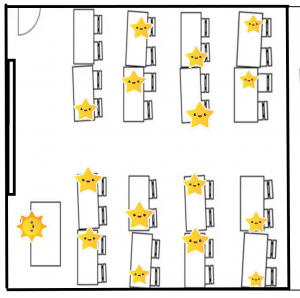
Classrooms will have to be set up very differently than they are now as flexible seating and collaborative work will not measure up to the requirements of social distancing. This means that students will be sitting in rows 2 metres apart. Students will not be permitted to get out of their seats to talk to their peers or to wander around the classroom. Classrooms will be much like my grade 5 classroom with all students sitting in rows, doing work with classroom instruction on the board.

Younger students may also have to sit separately during carpet time in their marked spot (while teaching grade 2/3, I used tape to indicate where certain students had to sit).

Connected Collaborative Classrooms

In order to engage in classroom collaboration, students, grades 4 and up, will require computers to work to complete classroom assignments and work collaboratively with other students via online classroom applications.

Class Sizes and Staffing

The Province of Quebec indicated that they would limit class sizes to 15 students. This will present a problem for many boards of education as they simply do not have enough schools and classrooms to accommodate these much smaller class sizes. Further, Kindergarten classrooms usually have up to 30 students in each classroom. In accommodating smaller class sizes, students might have to have staggered use of their classroom with half the class coming to school in the morning and the other half coming to school in the afternoon. Or instead, school boards would have to locate twice the classrooms to accommodate all Kindergarten students.

With smaller class sizes, means hiring more teachers. With class size at about 25 students average per class there will have to be 1.1 more teachers for every two classes currently (25 X 2 = 50 /15 = 1.1). If you have been involved in staffing schools, you will know teacher allocations are usually about percentages as there is usually a teacher in a school with a percentage of a whole teaching job e.g. 0.4 = 40% of time and pay of a whole teacher.

In using the numbers for an elementary school, Kindergarten to grade 8, staffing numbers could change as follows for just classroom teachers not including planning time teachers (i.e. Music, Physical Education, Health, Art, Drama, Planning Time):

Students

Current Staffing

Covid-19 Staffing

Primary Division

270

15

18

Junior/Intermediate Division

300

13.5

22

Total

600

28.5

40

In this scenario, there would be a 42% increase in teachers needed to teach smaller classes.

In cutting class sizes to accommodate physical distancing, there could be an over 40% increase in teaching staff as demonstrated above.

Limiting People with Compromise Health

Further, the Province of Quebec is suggesting that teachers over 60 years or with compromised health challenges work remotely from home. Students with compromised health challenges would also be recommended to stay home thus having them continue their online learning.

Dealing with Mental Health

This is a challenging time for all people; students and educators would require more mental health supports available on site within schools. With the stress of social distancing and more structured changes in learning, many students may not be able to cope.

Violence in schools has already been well documented as a significant concern and with more stress in schools, students will have even more challenges in regulating their emotions. Schools will need mental health professionals, more teaching assistants, and more social workers to support these students who are already at risk.

The Bottom Line for People

In the end, with all this planning and adapting of the educational landscape, parents may choose to keep their children at home. As a parent, I know that children are great spreaders of infection. I have personally missed three Christmas celebrations as my young children got sick at the time and then passed the infection on to me. I believe that viruses and bacteria strengthen in young children only to hit their parents like a tsunami – I have pictures on me lying on the floor while my kids open up their presents! Fortunately my children are adults now.

Governments should be cautious in their advocacy for reopening schools as they put staff, students, and the school community at risk of getting sick or very sick, suffering life changing consequences. Be reminded the Infection Prevention and Control is a significant health and safety concern in all workplaces.

Wishing you, your family and friends best health,

Deb Weston

Resources & Recent News Articles

Coronavirus disease (COVID-19) technical guidance: Guidance for schools, workplaces & institutions World Health Organization

COVID-19 Emergency Preparedness and Response WASH and Infection Prevention and Control Measures in Schools Unicef

COVID-19 Guidance: Occupational Health and Safety and Infection Prevention & Control

COVID-19 in Quebec: Some businesses will reopen in May, but no return to ‘normal life,’ says premier

How other countries sent their children back to school amid COVID-19

How will schools enforce physical distancing Your COVID-19 questions answered

May opening of elementary schools, daycares ‘a necessary decision,’ says Quebec education minister

No plan to reopen B.C. schools yet, says education minister

What will Canadian schools look like after COVID-19? Here’s what could change
Keep Calm and Teach ONLine

KEEP CALM

AND

TEACH ONLine

Apple

ETFO’s position on in-person learning remains unchanged. The union firmly believes that the daily, in-person model of instruction and support best meets the educational, developmental and social needs of students, provides the best experience for support, and is the most equitable learning model for all students. ETFO’s expectation is that elementary virtual learning in any capacity, including through hybrid models of instruction, will end once the pandemic ends.

I’m in my third week of working to set up my online classroom and to get my students, and their parents, up to speed with learning critical online tasks. These include knowing how to log in, remembering passwords, and completing/submitting assigned work. In addition, all of us, students, parents, and teachers, are facing a steep learning curve with using applications and technology not previously implemented.

I’ll be honest with you, reader, I’ve had some lasting moments of being completely overwhelmed with the circumstances we are going through as teachers. Isolated in our homes, we deal with steep learning curves while worrying about our students in their lives and in their learning.

Due to the Covid-19 pandemic crisis, online learning has been very quickly implemented by asking teachers, who usually teach face to face, to move to an online format. Students, who usually learn face to face, are now having to negotiate online learning without the support of their teachers. Parents, who usually rely on teachers to do the work of education, are now having to take on this role.

Doing the work of education

Through an informal survey of 145 people, via Twitter, 64% of mothers were taking on most of the education work of teaching online, while only 8% of the fathers were taking on most of this work. In addition, the survey indicated that 28% of both parents shared this education work.

This is particularly challenging as mothers and grandmothers are having to manage and maintain households while they keep children occupied and prepare meals in addition to working online and helping their children do schoolwork online. In other words, as one parent stated, parents are acting as ad hoc Teaching Assistants.

Inequity and exclusion of access to technology and reliable internet

 School boards are inadequately funded for having students work from home and only have limited resources to supply students with the technology they need to do this work. As a result, some students are doing their work on their parents’ phones. Adequate internet access is also a challenge in urban and rural areas. Students who live in low socioeconomic settings cannot afford technology to support online learning as it is an unaffordable luxury.

This discrepancy in access to technology has amplified the digital divide which boards of education and the Ontario Ministry of Education have known about for many years. Boards of Education have used stop gap measures such as students bringing devices to school which results in students using their phones to do schoolwork. Even with this measure in place, there are still students who’s families cannot afford any technology or internet access to support the technological needs of their classrooms.

In a classroom of students who “have” access to their own technology, the “have not” students stick out. This presents a significant inequity and exclusion from a society that relies on technology and internet every day. If this was not the case, the Ontario Ministry of Education could not have implemented provincial online learning from home for all Ontario students. The problem is that not all Ontario students are receiving the needed accommodations to support their learning.

When teaching is online, learning opportunities become visible. The Covid-19 pandemic crisis  has not only made learning visible but has made the inequity in learning with technology visible. This crisis has highlighted the great divide in students’ access to technology and internet. Skills developed through using this technology are key to students’ futures in doing well in education and obtaining jobs that provide a living wage. Again, students without access to technology and reliable internet face inequity and exclusion in society.

Ontario’s Education Policy Memorandum No. 119 cites that all publically funded school boards are required to address Barriers to Learning through policies of equity and inclusion. In disregarding these barriers, human rights violations occur as cited in the Ontario’s Human Rights Code. These Barriers to Learning have always been there for students; now educators are facing the consequences of inequities and exclusion while teaching online.

Challenging times for educators for teaching online

As I teach teachers online and communicate with parents and teachers from my school, I’ve collected anecdotal notes on their experiences. In addition, I’ve talked to colleagues who are also sharing their challenges with online teaching and learning.

In total, I’ve collected feedback from teachers who are experiencing many challenges from a variety of school neighbourhoods. These include schools in First Nation communities, British schools, schools in Ontario and other Canadian provinces, schools in low socio-economic communities, and schools in areas with high levels of immigration. These teachers instruct students from kindergarten to grade 12. Below are some of the major issues that the teachers addressed:

Adequate internet access:

  • In some rural and fly-in communities internet signals are not strong enough to have all students on the communities’ internet at the same time
  • Even in urban areas internet can be inconsistently unreliable
  • Many fly-in communities do not have basic services such as potable water thus making internet very much a luxury
  • Underfunding of special education means inequity and exclusion in these areas for students who need technology to learn
  • Some students have no access to internet or technology supports

Challenges teachers are facing in teaching online:

  • supporting learning via emails/phone calls with parents
  • listening to parental challenges with online learning
  • getting students to complete assigned work
  • dealing with only 20 to 70% of students signing into online courses
  • dealing with students only submitting 0 to 50% of assigned work
  • supporting parents with low levels of literacy
  • supporting parents with low levels of English and/or French as their second/third language

Supporting Students with Special Education Needs

Students with special education needs are one of the groups of students who are not receiving the support they need in this challenging time. When not at school, these students miss out on their usual learning supports that includes therapy, counselling, equipment needed for learning, assisted behaviour modification, and trained educators who deal with specific student needs.

With everyday that passes, these students miss on the supports they need to be successful as learners. For these vulnerable students, every day that is missed results in one more day of a lost opportunity to learn.

Provincial Ministries of Education need to step up and provide emergency funding for technology supports which includes paid internet access and computers to implement online learning for all.

Lost opportunities in a time of inequity and exclusion

A teacher candidate, Ms. Randhawa wrote …

“The whole world is making the best use of technology for the first time and it is very much visible that learning is not just confined to classrooms anymore.”

Indeed, not only is learning more visible but so is the discrepancies between the families who have access to technology resources and those who do not.

Due to the Covid-19 pandemic, the digital divide, between the “have” and “have nots”, is in the front line of education for all the world to see. Provincial Ministries of Education must address this deficit so boards of education can support all students. Without this, Barriers to student learning for our most vulnerable students will be impacting children’s lives, today and tomorrow.

A note just for teachers: Please remember to put the oxygen mask on yourself first. Care for yourself so you can support your students. Without a well rested and healthy teacher to support learning, students, and their parents, will be on their own.

Collaboratively Yours,

Deb Weston, PhD – At Home, Teaching and Learning Online

Content and Copyright Considerations in Distance Learning

The move to distance learning has certainly had some pitfalls. On top of all of the programming changes and logistical considerations, we’re hearing horror stories of the inappropriate use of digital tools and teachers unintentionally violating copyright laws.  It is crucial for teachers to make themselves aware of the privacy and security guidelines for their school board while also being aware of Fair Dealing and Copyright laws for online content.  Here is some food for thought, and a few tools and resources that may be helpful for teachers while creating and linking to online content.

Posting YouTube Videos

YouTube videos may be used for educational purposes in Canada so long as the creator and the source of the video is credited.  However, you might want to consider not posting a direct link to the YouTube video on your learning platform.  This link will take the students to the YouTube channel and the student may then freely search other content.  Maybe it is just me, but I’ve experienced the liquor advertisement pop up while watching a video in my classroom or the next video automatically plays and the content is not suitable for students. Teachers may want to try using online tools such as ViewPure or Safesharetv before copying the link into a learning platform.  These tools filter out advertisement and connects only the the video itself.

Reading Books Online to Students

A number of Canadian Publishers have opened up access to Educators to read published works online.  There are guidelines that an Educator must follow in order to do post an online story time.  For a list of participating publishers and more information on how to respect copyright for Canadian authors visit access copyright.  Scholastic Canada has also extended access to Educators to read published works online. The instructions on how to use Scholastic works is a little different.  Visit the Scholastic Read Aloud portion on the Scholastic Canada website in order to follow their rules and regulations.

FairDealing and Copyright

There are copyright laws specific to Education.  If you want to make sure that you can use something without violating copyright laws you can use the Fair Dealing Decision Tool.  Teachers can also refer to the Copyright Matters Document.

Privacy Policies and Statement

At the bottom of every home page for an educational digital tools you will find a link to their privacy policy or statement. I highly recommend reading what you are signing up for as a teacher when you click on a new Educational digital tool. Be aware of what data is being collected, where it is being stored and which third parties are attached to the company and make an informed decision for yourself.  Be proactive and check with someone in the Instructional Technology department at your school board to ensure that you are following recommendations before asking students and parents to sign up for a digital tool.  It is a lot for teachers to think about while at the same time just trying to get a handle on teaching in the midst of a pandemic. There is a big learning curve for everyone. Try to continue to go slowly. The move to distance learning is helping Educators truly understand the importance of digital citizenship.

May the 4th be with your students

Anyone else feeling a bit gutted after hearing the news that we will not be back in our classrooms until May the 4th? (writer raises hand) While listening to the Minister of Education deliver this news today I ran a range of emotions. Firstly, I am thankful that the government was proactive when it came to our collective health by insisting on physical distancing and staying at home.* As a result, the lives of 2 000 000 students, 200 000 educators, support staff, and their families will benefit greatly from being apart. For me this seems like light years away.

Heeding the Chief Medical Officer of Health’s suggestion to close our schools beyond March Break was a prudent move, but it all happened so suddenly that we were all left with a great deal of uncertainty heading into the time off. With such short notice, it was hard to orchestrate a full scale instructional response to the news. Like so many of the #onted family, there was some concern because information was not forthcoming. I remember saying to my students(Gr 7) that it was more important for us all to follow the advice of doctors to do our part to limit the spread of COVID 19 than it was to worry about homework.**

Our last day in the classroom before the break was supposed to be a celebration of hard work to start Term 2, but instead it was a sombre send off with more questions than there were answers at the time. I only find consolation in this now knowing that the timing of this year’s March Break probably saved countless members in our schools from illness.

Not having our students in classes eliminated millions of potential interactions that would have undoubtedly accelerated the spread of the COVID 19. I am very relieved not to be in a workplace that’s traditionally susceptible to transmission of known/unknown and unchecked viruses. We have all been in a classroom with a student/teacher who should have stayed home that day. I am not lying when I say it feels like germ warfare in school sometimes. It is a relief, to be doing my part in social isolation especially as I have a 96 year old and a severe asthmatic at home.

In fact, although really missing my students/collegues, I am thankful that we have all been given the chance to stay at home in order to slow the spread of COVID 19, to look after our own health, and to tend to the wellbeing of our families. This is hard on all of us in so many ways because it is all so new. As I shared with a number of people, “Normal” is sick and its replacement “New Normal” is here bringing with it some good and bad to each of our days. The problem is that it keeps changing faster than we’d like.

Today’s announcement lifted my spirits because it meant that if we all do our part, then we have a date for a return to Normal. It also means this time can be curated to engage our students further in this year’s learning. Not knowing what was going to happen had me struggling to remember what day of the week it was since my routines were put in limbo with each postponement. No more days when, suddenly at 7 am, I wake up thinking I was late for work only to realize my body was dealing with the “New Normal” while still on “Normal” time.

Even though we will only be meeting via Google Classroom, our class will be back in session. After contacting families and students this week, it is clear they are excited to be back, even if it will only be digitally until May 4th. Fingers crossed it won’t need to be longer. In the meantime we will get on with the connecting, communicating, and learning for now.

Whether we return to the classroom on May the 4th or not, I couldn’t help but repeat the wish I shared in the title. May the 4th be with your students, and while we stay at home may every one of us be healthy and safe.

*Although arguably, essential and non-essential jobs may be a future debate topic.
** I did promise them some work via our Google Classroom once March Break was officially over.