Class Size Matters: Then and Now

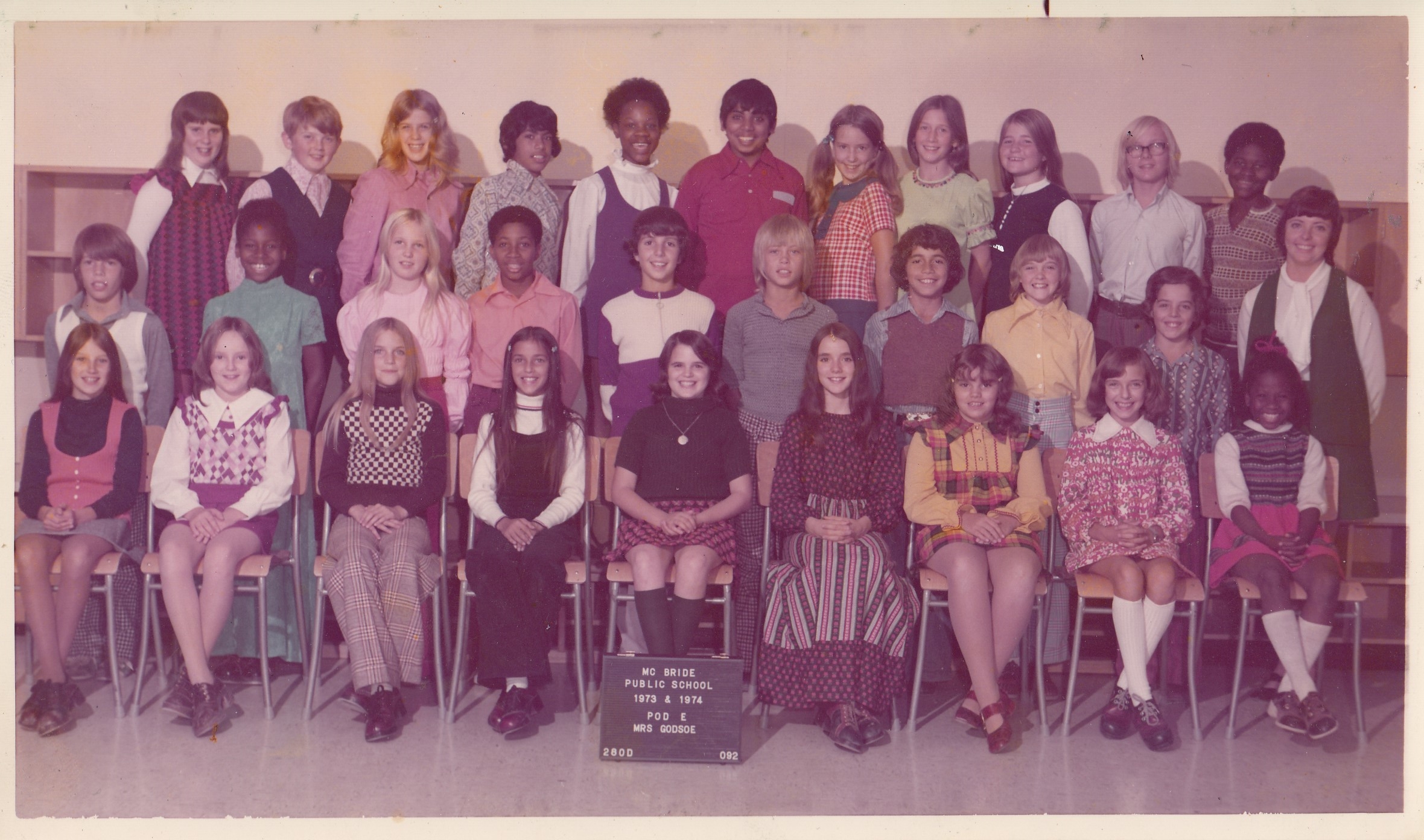
As I look back on my 1973/1974 grade 5 classroom of 29 students, there are significant differences in how we were taught.

Teacher Qualifications:

Our teacher did not have a university degree and only one year of teachers’ training. (I looked her up).

Today’s teachers must complete a 4 year university degree and two years of teachers’ training before they can become professional teachers.

Seating:

I recently returned to my former grade 5 classroom and knew exactly were I sat as we were in rows in alphabetical order. There was little or no collaboration with classmates and we were expected to sit quietly and work with little or no support from our teacher. In the 1970s, I did a lot of rote learning and paperwork – it was pretty boring. I sat and worked in the same spot for my entire grade 5 year.

Today, classrooms are dynamic with flexible seating and continual student collaboration. Now learning is more active through student inquiry and the use of technology. Collaboration within groups is a key learning skill on report cards.

Class Composition:

In 1973, we did not have any students with significant special education needs as those students were placed in contained classrooms. This was before the inclusion model was implemented. Any students who struggled were likely held back by failing a grade. (I was almost held back due to my undiagnosed learning disability). We also had students who were younger as they had “skipped” a grade.

Today, there is a wide range of student abilities in classrooms. I’ve taught classes with gifted students and students with significant learning deficits. This meant that I had to modify my teaching instruction to several grade levels higher or lower to meet these students’ needs. I once had a student functioning at a grade one level in a grade 7 classroom and was fortunate to have an educational assistant and special education teacher to support this student.

Educational Assistants:

In the 1970s, classrooms with students with significant special education needs had educational assistants/teaching assistants. I can only remember ever seeing teaching assistants in the special needs’ classrooms.  I recently spoke to a retired teacher who informed me that when the inclusion model was implemented into Ontario schools, the government promised teachers significant  support with an Educational Assistant in every classroom. That was not implemented as promised.

With today’s classroom composition, teachers need significant additional supports. A full time Educational Assistant (EA) would give teachers time to work with all students. In addition, when I’ve worked with Educational Assistants, my students have been much better behaved as there are two adults watching them work. Even when students are allocated funding for Educational Assistant support, schools often place EAs with other students who have no funding – as the EA is “assigned to the school, not the student”. This means the student with EA funding never gets their allocated support and the teacher must support this student instead. Teaching in classrooms with a few students with special education needs and little EA support is doable but currently many classrooms have up to a third or more of students with special education needs. This is unmanageable and disheartening when teachers cannot provide enough support to help all students. In this case, students who are capable but need a small amount of support never get the help they need.

Discipline:

When I went to school, students were expected to behave themselves in class. I personally was terrified to get into trouble at school as I would have received significant consequences. I remember a few students receiving “the belt” by the principal. In order the get this consequence, the principal had to document and justify the consequence.

Today, discipline varies by administrator, school, and school board. Students who misbehave can go to a behaviour teaching assistants’ room (if this is available) or to the office. The challenge is that students with behaviour needs really require intervention supports to improve their overall behaviour and academic outcome at school. I personally know of a situation where a student, who struggled academically and with behaviour needs, got the mental health and behaviour support programs they needed and is now thriving academically and with behaviour under control. (This support happened as the teacher did a work refusal due to extreme student behaviour concerns which precipitated extra support for this student).

So why can’t we implement programs like this for all students who need behaviour supports? Funding – recent government cutbacks have meant that these safeguards of mental health and behaviour supports have disappeared leaving only the most challenging students getting this critical intervention.

The Bottom Line:

Class size matters more today than it ever has as classroom compositions are highly differentiated with students with many needs. Further, with fluid and dynamic instruction, students do not sit in orderly rows not leaving their seats. As a teacher, I prefer teaching this way as it is more organic and helps students develop critical collaborative skills they will one day use in the world of work.

The bottom line is that teachers need more support in their classroom with not more, but less students. Schools need more Educational Assistants and Special Education Teachers to support students with significant academic and behaviour needs. Boards of education need more programs and qualified adults to address mental health and behaviour needs with students. Without these supports and interventions, students’ behaviour and mental health needs will only be compounded and student outcomes will flounder.

With this blog, I advocate for all students with special education and behaviour needs to get the support they require to be successful in their education … because without these student outcomes will be grim.

Collaboratively Yours,

Deb Weston, PhD

Oh wait

For all of the right reasons and in my own best interests I think it best to resolve some issues from what has been a terrible January. As such, I have taken to implementing a number of life changes in order to ensure I am my best me, living and giving my best.

Less caffeine – down to 4 cups of coffee per day from 6 – check
Drink more water – some is more than none right? – check
Sleep more – at home, not at school or while driving – check
Take time to be still – shhh I’m doing it right now – check
Exercise – I turned my Wii Fit on for the first time in 10 years and it still works – check
Read more – information is armour for the mind and soul – check
Show vulnerability – asking for help and support does not make me weak – check
Seek help – unisolating myself has been a necessary and positive experience – check
Look forward – know that good things are all around even when things look grim – check

Without all of the above, I might have really been physically and mentally weakened by an exasperating month.

Oh wait…there was something else on my mind

With nearly complete media proliferation from all ideological camps, it’s hard to have a moment of tranquility without being bombarded by [mis]information. A person in a compromised position may not have the intellectual immunity to resist the indefatigable onslaught of shady dealers wearing blue blazers and brown pants who persist in spewing surreptitious messages meant to shatter the successful education system we have worked so hard to construct and move forward to be among the best in the world. So it’s understandable that educators, students, and families would want to fight to protect it.

Come to think of it, despite months of patiently waiting for a contract, hearing about unions leaders bullying members from MPPs who seem confused on where to find beer, and from Twitter trolls who spout about how teachers are only after a pay raise to their shared 50 followers, it feels like it’s time to fully engage in this war that is being waged by the government and its partisan proxies on our profession.

Instead of a being an integral partner in education, our government has chosen to become our adversary. In addition to our exceptional daily work in the classrooms, ETFO educators are having to defend our hallowed halls from unprecedented and misleading attacks. Hearing the Minister of Education talk trash about our profession is offensive. It should never be part of an elected civil servant’s mandate.

This doesn’t even begin to address the passive aggressive and staged photo ops via social media or contrived press conferences. How can someone who appears in photo ops at a STEM daycare centre strike camp, in a school district that was not even on the line that day rather than at one of our thousands of incredible public schools, be taken seriously or trusted?

Speaking of trust

Maybe our MOE is the victim of bad advice? What if he is being setup for failure from inside his own party? MBAs (read through to the final footnote) and politicians are notoriously self serving entities. Think of the contracts to hand out to the highest bidding E-Learning providers and private sham credit mills if things go unchecked. There are lots of dollars to be made when you are unscrupulous enough to wallow in that trough, but is it worth your humanity?

What if the goal is to fleece the flock and retire to a cushy Conservative consultancy? After all, what out of touch political party doesn’t love recycling ineffective ideas? So this cut, gut, shame, and run approach will sound fresh again in 20 years since their good old days are an archaic product of a classist’s poor memory.

Perhaps in his limited time in the position and on the planet, the current Minister of Education has not been privy to grace, kindness, or truth? Wouldn’t it be swell if the lack of progress in our negotiations be weighing heavy on his conscience? With Valentine’s Day around the corner, maybe the warmth and solidarity we show as a union in standing up for education can melt his heart, and he will begin to see the impact of this current government’s flawed approach and policies. Until then we will walk and hold the line.

Walking the line

On a chilly Monday I proudly walked the picket line to fight against the legislative tyranny of our current government. 17000 steps in 3 freezing hours. 1 Day’s wages was a small price to pay in order to stand alongside my fellow ETFO members in solidarity. The honks of support, the visits from admin, superintendents, and school board systems level staff meant a lot to us all. Having families and other union members show their support was the encouragement we all needed to maintain our spirits.

Come to think of it, those 3 hours on the strike line have to rank as some of the best moments the month of January had to offer. I know there might be more days ahead, and I am dedicating my attitude and focus on everything that matters to my students, their families, my colleagues, and those who will occupy my classroom in the future. Together ETFO, and our partners in the OSSTF, will continue to make public education in Ontario a global beacon of progress and success through our work in the classrooms across the province. Together.

Thinking of you all, this week as we walk at the picket line shoulder to shoulder in solidarity and support to ensure a future for over 1.3 million students in Ontario’s public schools. Thank you.

The end is here

The end (of January) is here. Thankfully. I thought wrapping up 2019 would have signaled my surrender. I didn’t know another white flag needed to be waved so quickly, but here goes.

The month of January has been particularly trying on my mental health and well being. When I say my mental and health and wellbeing, it’s important to know that it implies the way a lot of my colleagues in education are feeling right now. It’s tough sledding right now. Let me explain what’s been going down.

The usual demons

The entire month has elapsed as a slow motion dream sequence of continually compartmentalized interactions. Meet here, teach now, listen here, discuss there, teach again, receive devastating news, listen, meet, teach, share, support, listen some more, put on a brave face, teach, weep for a student lost in a senseless act, grieve, cope, support, listen even more, meet, teach, and try to make sense of what the heck happened?

I’d like to blame Mother Nature for the storms, poor commutes, and frigid school days, but I can’t because I bought snow tires which ensured that the weather would only be bad on weekends this month. I’d like to say it’s the flu, but I can’t because I got my first flu shot in 10 years. I’d like to say that my students are being difficult, but I can’t because they are truly interesting and engaging learners.

So it’s got to be me right? I’ll own my part of things knowing that I am sharing with 7.2 billion others in January right now. Let me reiterate. It’s been an incredibly difficult month even though my usual January demons were uncharacteristically co-operative? Now that the month is over things can get better right? Either that, or something really bad is in store for the future once the demons get back from vacation. Fingers crossed, salt over my left shoulder, ladders put away, black cats all in their homes, and artificial rabbit’s foot rubbed something more positive is possible. Anything will be better than the start of 2020.

This January’s tragic events were completely out of our hands. Yet, as teachers, we were all working together in support of our students, as well as one another. At my school, the death of a student on UIA Flight 752 was devastating. Upon confirmation of the news, it was as if the air had been taken from our lungs in a flash. It was hard to breath that day. We were all in shock, and had to put on a strong face for our students and each other as the news unfolded which was not easy.

We are told to try and return things to normal as quickly as possible, but all I remember is feeling numb in the weeks that followed. I wonder how normal I looked trying to hide how it hurt to lose a student? In fact it has taken me a few weeks to even process the feelings in order to share them here.

Despite, therapy dogs, social worker support, and incredibly kind admin/school board officials it has been one of the toughest times I’ve ever experienced as a teacher.  When tragic and senseless events occur the losses are hard to overcome regardless of the supports in place. Finding “normal” again would have been very tough without help, but isn’t enough in itself. This leaves many of us having to manage some of the restoration on our own outside of school.

Setting aside a bit of quiet time to process each day helped. As simple as that sounds, it is hard to shut it all down at the end of the day or over the weekends. Taking time to remember the good things and dwell for some time on positive memories helps healing to begin. Sometimes laughter helps too. Especially, when the humour comes in the form of a joke, a meme, or a witty remark. Thank God for animal videos and Reddit.

As teachers we live and breath our callings. Our learners occupy a huge space of our thoughtlives. We have them with us as we process our days whether we are at school or not. There have been countless times where I’m reminded of a student, past and present, in a casual conversation with friends or family. The life of an educator guarantees that you will accumulate some incredible memories, and this is largely a good thing. For me there has been so much joy in reflection back on 2019, but in contrast comes a much harsher start to 2020 with the loss of a beautiful soul from our school family. As February takes over the calender, I am glad to say the end(of January)is here.

Wishing you all health, happiness, and good memories for the rest of the year and beyond.

Say Less, Ask More

Sometimes the smallest change can make a huge difference, especially in education. Things such as greeting students individually upon arrival at school can set the tone for the entire day.  Small changes in habitual behaviours can improve communication and relationships with students.

Over the last few months I’ve been reading the work of Michael Bungay Stanier.  Most recently I’ve been reading “The Coaching Habit: Say Less, Ask More and Change the Way You Lead Forever”.  I admit, that at first blush, it doesn’t sound as though this book has much relevance to elementary education.  However, as I was reading I kept making connections to communicating with students more effectively to encourage independence.  As learning becomes more inquiry based in many classrooms, teachers are having to move into more of a coaching role.  I think that the education sector as a whole has made some assumptions that teachers know how to be effective coaches and facilitators.  In my own teaching practice, there has been a huge learning curve.  Teaching through inquiry isn’t about leaving students to their own devices.  Students generally aren’t familiar with the curriculum and other than being children, they aren’t experts on child development.  Educators have to be guides for student learning.  But what exactly does that mean and how do we transition to this type of teaching?

For me the biggest change and challenge in becoming more of a guide in my classroom was talking less and letting the students do the learning. I am a problem solver, helper and rescuer and I’m sure many teachers can relate, which is why it is so hard to be quiet and back off.  I’ve also learned that asking questions might be easy, but asking effective questions is a skill for teachers and students alike.

So what did I learn from a “coaching” book that might help a classroom teacher? Keep in mind, these examples might be better suited for the older grades.  You might need to keep it a bit more simple for Kindergarten.  However, in most cases, better questions get better answers.  Here are some examples:

A student comes in from recess and is visibly upset.  Instead of asking, “What’s wrong? Did something happen at recess?  Can I help?”  Try asking just one question, “What’s on your mind?” and then be quiet and listen. The question “What’s on your mind?” is a focused question and invites someone to get into the heart of the matter. Sometimes all that is needed is a venting session and the child feels better.  You don’t always have to be a rescuer or problem solver. Most of the time, kids just want to be heard.

Normally in a situation like this I’ll ask, “Can I help?’ or “Would you like some help?”  However, the small change to “HOW can I help?” helps the student to articulate their request.  In addition, it gives them the opportunity to identify the solution and not have the adult jump in to solve things for them.

Tweaking the questions that we ask could improve communication and lead to more effective answers.  In addition, asking focused questions could empower students and lead to more independence. Michael’s work and questioning techniques are helpful for dealing with the people in your workplace.  You can sign up for Michael Bungay Stanier’s “The Coaching Habit” Podcast online and find other great coaching resources at Box of Crayons .


Celebrating us

We did it.

We brought another amazing decade of learning to a succesful close with passion, creativity, and purpose. For ETFO it has been 21 impactful years in the service of public education, students, and educators.

It’s my 11th year as an ETFO member, and I am looking back at the past decade with some mixed feelings. Perhaps it is a function of the time of year when all of the best and worst lists are being shared in the media? Regardless, I am thankful to be an educator who works with wonderful students and amazing staff at a great school.

On the other hand, I am also intrepid about what is continuing to widening gap between student needs and the resources with which to support them. What will the future look like if government cuts and policies changes go unchallenged? This got me thinking about how instrumental the work of ETFO is to supporting us and I found myself browsing through pages of resources, messages, and initiatives via etfo.ca

Whether you are newer to the profession or a veteran educator, I thought it would be a good idea to look back at the positive impacts made by our union that have helped us get us here, and as we prepare to for 2020.

Let’s take a moment to break down some of the numbers from 21 years of ETFO:

  1. Membership ~ Let’s use 75 000 as the mean number of teachers from past to present.
  2. Days of Instruction ~ 21 years x 190 days = 3990 days
  3. Minutes (days x 300 minutes of instructional time x membership) ~ 8.9775 x 10 ^10 minutes

For the sake of my own brain, I am going to say a lot of learning has occured as a direct result of tens of thousands of past and present caring ETFO educators. Millions of moments curated that have culminated and contributed to millions of positive impacts in and out of classrooms. Millions of moments where struggles turned into opportunities and hard work paid off. Millions of students who have gone on to do amazing things. Millions of lessons learned with millions more still to come.

Without becoming too nostalgic, I think it’s a great time to take stock of all the amazing things that have happened that have ensured the voices of elementary educators will be heard. 21 years on the shoulders of giants who have stood tall in the face of adversity to prepare a way for future teachers to succeed. To all of those who have taught before and alongside me, I am grateful.

Grateful for:

21 years of lessons learned in and out of the classroom.
21 years of remaining on the cutting edge of technology and ongoing teacher training
21 years of inclusivity and equity
21 years of looking out for the safety, mental health, and wellbeing of our membership
21 years of dispelling myths with facts
21 years of commitment to something bigger than themselves
21 years of standing up for students, their families, and to make public education better/stronger 
21 years of fighting against the malicious mandates of socially and fiscally tyrannical governments
21 years of solidarity

Such success is something to celebrate. Especially, with a strike mandate of 98% in favour this past Fall. Our collective voices and our profoundly positive professional impact will not be dismissed or ignored.

While certain media factions seek to villify our profession, we know that we possess the power to light the way for public education well into the coming decades. When elected officials undermine our collective good in the short term, we remain focused on the future by standing together now. Side by side, ours are the shoulders to stand on.

As I shared earlier in this post, the numbers show that the possibilities grow everyday an ETFO educators enters a classroom. Bring on 2020!

Cheering you on everyday and looking forward to celebrating an even better future in education. Thank you for reading.

Holiday Break Assumptions

December is stressful for so many reasons.  Seasonal concerts and plays, crafts and the general hustle and bustle around this time of year.  While teachers attempt to make things fun and engaging for the last few weeks before the holiday, there are a few things to consider about assumptions that as educators we might make about our students.

Not every child is looking forward to the holidays.

As working adults we look forward to the break from our daily occupations at this time of year.  For us it means a chance to regroup and reconnect.  However, for some students it may mean a lack of routine and structure which can provoke anxiety.  The reality is that some students may find school the safest place in their lives.  The two weeks off of school at the end of the December will inevitably happen for everyone however, not every kid is looking forward to it.  So it may be best not to focus on the “Countdown to Break.”

Children living in poverty.

For those children living in families who celebrate the season with any kind of gift giving, this can be a time of stress and anxiety for parents and invariably children.  According to parenting expert Alyson Schafer, “Parents of low-income families will often put themselves last in order to shield their kids from poverty and the parents’ health and well-being suffers for it.”  Some parents may even skip meals or prescription medication in order to have enough money to buy gifts.  Whether the children are aware of their family’s financial situation or not, they will witness wealthier classmates getting more at this time of year and it can be difficult for those children.   While this is the time of year that many schools engage in a food drive, teachers need to remember that some students may not be able to donate and in fact, there may be students in your class or school whose family accesses the food bank.  It doesn’t mean that would need to stop these charitable acts.  As educators we just need to be aware of the assumptions that we make about our students when we engage in the activities.

Those “fun” activities aren’t always “fun” for everyone.

This time of year gets busy in a school.  There are often more announcements, events and things for sale or collection.  Students who already struggle in school find this time of year difficult because of the multitude of interruptions to regular routines.  When possible, keep things as simple as possible for your students.  I have always found that keeping as much routine as possible in my classroom at this time of year provided much needed comfort and predictability.


Shoulders of giants.

There is a wonderful quote from Sir Isaac Newton that goes, “If I have seen further than others, it is by standing upon the shoulders of giants.” To me, this is nothing less than a gigantic nod to everyone who “tried and paved the way” before him, and a reminder of his then obligation to do the same for the generations to follow-including you and me.

I think Newton was right to pay tribute to his predecessors, but he did so implying that he was focused on the future. He knew that the past played an important part in his understanding of all things Math and Physics(Natural Law), but he was also keanly aware that there was still much work to do during his life in order to prepare for something far beyond his time, work, failures, and accomplishments. This was Newton’s way to say to his successors, “My shoulders are ready for you to stand upon and see further”. Like all teachers, Newton created the conditions where his lessons would go far into the future to a time, space, and place where he himself would never visit.

And now to the classroom

Imagine this repeating itself around the world everyday where a class is in session? We see the future everyday as we prepare students to stand on our shoulders to see further. In some ways, teachers are like conduits of time that possess the ability to bridge the past and present in service of the future. In the process, we continually build and strengthen the foundations on which we all stand and seek to see further than before.

To me, this is one of the coolest places to be as an educator because we have the ability to see through multiple states of time. This is a gift from the past, and it is important for us all to take a moment to enjoy the 360 view atop the shoulders of giants on which we now stand.*

Think about the beauty of looking back at where we’ve been a.k.a hindsight. In education it’s better known as ongoing professional reflection. In itself, reflection will always be an important tool in our collective kit. However, if we’re not careful, we can dwell too much on the past, which could then mire us in the present, and ultimately cause us to lose focus on the future – our students. That’s why we need to keep our eyes looking forward and further as we stand together to protect education from fundamentalist firestarters trying to burn its foundations with fiscal forest fires in order to fleece the future.

Despite the acrimonious arson taking place, we stand firm and united in the fight against cuts to education. Our solidarity, current WTR focus on government, and willingness to wait at the negotiating table are clear indicators to families that ETFO members are rallying around our learners even as the government burns bridges to benefit a bogus budget dilemma. Our shoulders are squared and strong.

It’s time we douse the doubt and the doubters by continuing our amazing and impactful work in education which has placed Ontario among the best in the world. Imagine what heights our students will reach when each one has equitable access to learning at all phases of their educational evolution from JK to post-secondary? Imagine underserved and under-performing students who will never fall through the cracks because there are shoulders for them to stand on too?

Stand strong. Stand together.

*This is never more meaningful when I think about the educators who stood up for teachers in the past to fight for the benefits, pay, and working conditions we have now. There is no doubt that things are better for educators in some areas, but have deteriorated in other areas. It is now our turn to clear the way and make new roads for those to come in the future. I am so thankful for those who fought for me. Even though I may never meet them in person, I am here standing on their shoulders.

In loco contractus

It has taken a lot of restraint to ignore the volumes of micro-aggressive, passive aggressive, aggressive, and macro-aggressive comments flying around the Twitterverse about education since our most recent contract with the government expired this past August.

And then there is the elected official du jour with the education portfolio.

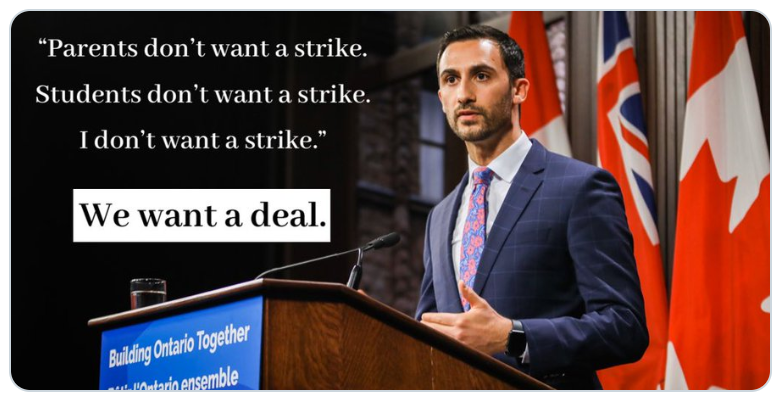
I have tried not to focus on the orchards of low hanging fruit being grown by our current Education Minister at the behest of his leader and his agenda. Elected or not, it is imperative of this incumbent and every other MPP to serve the public better. This means, any disinegenous attempts to villify our profession through weak one-liners and scripted media apperances as a scare tactic have to end. Saying you want a deal and then not bargaining will never be deemed as negotiating.

Despite not having a contract, all educators continue their tireless work on behalf of students to educate, encourage, and move forward even though our government managed to cut teachers and course offerings, and then wrote themselves a nearly 5 month absence note with a retro-active pay raise for good measure. This is not a sustainable situation. It is however, a recipe for a toxic and uncertain future.

What the province’s students need now is a government that sees, supports, and serves them and not the interests of corporate bullies or privateers bent on profiting from manufactured crises in public education. Instead they are blasted with a daily dose of misinformation without consideration of the present or the future. Our youth deserve a future and the truth.

This is what they are getting.

In between not negotiating, there have been absolutely zero authentic moments when this elected official sat at the table, conducted meaningful dialogue with teachers, or made an unscripted appearance at a public school without a camera crew. Maybe he should read my Undercover Boss post.

Instead it’s a steady stream of steamy slurry being served to the public via social media and scripted segments. #somethingsmells

Ontario education minister deletes tweet after social media backlash

“Lecce’s office told Global News on Thursday that the location of the photos was chosen due to timing and convenience, saying the decision was not made in an effort to avoid going to one of the province’s public schools but instead so as not to create a disruption.”

https://news.ontario.ca/edu/en/2019/11/minister-of-education-statement-on-first-day-of-work-to-rule.html

“My negotiating team stands ready for meaningful, good-faith bargaining 24/7, to reach the deals Ontario students and families deserve. There is a path to a deal, and it requires all parties to be reasonable and fair and put the needs of our children first.”

https://news.ontario.ca/edu/en/2019/11/statement-from-education-minister-on-osstf-strike.html

“Strikes hurt kids. Our Government has been clear, we want deals that keep students in class. For teacher unions to leave the table, to turn their back on our children, and to escalate to the point of compromising their education, is deeply troubling for parents and our Government.”

Cue Dr Carol Campbell from OISE and a litany of very committed educators who, to no surprise, have provided the corrections and descriptive feedback. Follow the thread all the way through. I especially like the part where the OntGov will never leave the table and be available 24/7. The OSSTF is also working hard at fact checking the M.O.Ed’s claims. #onceateacheralwaysateacher

There is nothing helpful about using the hashtag #strikeshurtkids that could ever be considered conscionable compared to the budget cuts being inflicted in our province. For so many people concerned about the public purse, a vision prescription update may be forthcoming to help them see the red ink that will stain the ledgers of future generations of Ontarians. When the people are denied adequate and equitable access to the world class education system that already exists in Ontario, the costs will make the current deficit look like an OLG winfall. The shortsightedness of this will end up costing us all. #antithetical #malfeasance or #unethical #incompetance

Think of overburdened social service systems, the disenfranchisement of students who have had their course options stolen, or of the marginalized/at-risk youth who deserve more interactions with opportunities and adults who are equipped to support them. Think about the danger to the economy of an underprepared/underserved workforce. This is why we need to keep up the struggle and fight against the visionless economic tyranny of the day. #cutshurtkids

Cuts Hurt Us All

Not to be overlooked, our collective rights as a union are being threatened by a pack of budget wolves that is blind to all but the bottom line. Few if any, have ever dared to step foot into the very institutions they wish to “save” and witness the magic and miracles being performed by teachers and support staff everyday without a press conference or a contract. Now that’s putting students first. #ETFOStrong

Daring Classrooms

I state the obvious when I say that teaching is a demanding job.  If you are reading this, you are most likely a teacher and this is not news to you.  I’d like to highlight a resource that feeds the soul of a teacher (and quite frankly a human being) while also providing some strategies for integrating that soul feeding into your classroom practice for your students.  Wait, what…that exists?  It is a website from Brene Brown called Daring Classrooms.  If you haven’t heard of her yet, you can find “The Call to Courage” on Netflix and/or her Ted Talk on Vulnerability.  She is inspirational in leadership, in life and in work.  Here is a snippet from her #DaringClassrooms website:

“Teachers are some of our most important leaders. We know that we can’t always ask our students to take off the armor at home, or even on their way to school, because their emotional and physical safety may require self-protection.

But what we can do, and what we are ethically called to do as teachers, is create a space in our schools and classrooms where all students can walk in and, for that day or hour, take off the crushing weight of their armor, hang it on a rack, and open their heart to truly being seen.

Teachers are the guardians of spaces that allow students to breathe and be curious and explore the world and be who they are without suffocation. Students deserve one place where they can rumble with vulnerability and their hearts can exhale.

And what I know from the research is that we should never underestimate the benefit to a child of having a place to belong—even one—where they can take off their armor. It can and often does change the trajectory of their life.

Teachers: Everyday should be Teacher Appreciation Day. I am so grateful for you and your willingness to show up and create brave, safe spaces where our children can learn, grow, and be seen.”

Some of the short (8-12 minute) video resources from Daring Classrooms include:

How do we avoid the pressure to please?

How do teachers manage oversharing?

How do we help parents understand failing as part of the learning process?

Does the word “disappointed” shame students?

In addition to the video resources there are free downloads for resources, parenting the classroom and daily life.  There are pdfs that you can print out for working with students.  My favourite one is the list of core emotions.  Sometimes when students have triggers they can’t always name or explain the emotion that caused the trigger in behaviour.  Being able to learn about the names and the definitions of core emotions is helpful for students to self-regulate.

Every year in a classroom brings new challenges.  In fact, every day in a classroom will bring on a new challenge.  I hope that as you lead your own #DaringClassroom you will find this resource helpful and that it may feed your teacher soul.

Seedlings, trees, and fallen leaves

It’s Fall. Ugh.

As the last leaves drop, it is a good opportunity to share some recent thoughts inspired by the change of seasons beyond the sub-joyous feelings from cold, wet, and grey days. It is a season that offers a lot of natural analogies about education as well.

Around my neighbourhood, as in most, the trees have shed their fashionable foliage, trading in their shade and shelter for a minimalist cover of bark. Thankfully, the ground continues to accept the last colourful leaves without a fuss. This cover provides much needed nutrients and insulation to seeds burrowed beneath the surface.

I have cut my lawn for the last time this year and made sure the leaf litter was mulched back into the soil, not removed. No raking for this homeowner. I would never have known this without teaching a unit on ecosystems. Think of all the time I could have saved?

I have accepted that wearing shorts and a golf shirt to school is no longer a viable option. Like Fall, change is all around. Time to dig out the sweaters, toques, and other winter wear. Summerlike weather is gone, I know this because more students are trying to find excuses to hide indoors as temps dip or by the behaviour challenges arising from a number of weather related indoor recess days in a row.

Speaking of weather, the other week, I was really reminded of Fall’s arrival during an end of day bus supervision where the wind was so strong it felt like it was raining under my umbrella which then collapsed into uselessness shortly thereafter. Nothing like looking like a wet rag for meet the parent night, eh?
It’s a busy time of year at home and at school. Reluctantly, my patio furniture has been forced into hibernation. My class furniture has also been arranged, unarranged, and rearranged. There’s lots going on in and outside of schools.

Everyone is in motion and even though 20% of the year is on the books it feels like the work is just getting started – not to mention progress reports. Like squirrels living in a local ecosystem, teachers are busy gathering and storing marks for progress reports and Winter. UGH!

Well enough about that. I want to spring forward to Spring because I need to have something to look forward to as the cold sets in. This means a lot of front loading with students now as we have established many solid classroom norms and daily learning opportunities. The energy and effort we are all planting into our students now will quickly grow and become so much more visible when the sun finally melts the snow and our parkas are put away.

By Spring time, seeds which have been hiding under ground have become sun seeking sprouts that quickly turn into saplings in a matter of months. Soon enough these little trees will reveal their own little canopies, provide shade, and photosynthesize like their taller neighbours. Like the classroom, with time, our students are empowered to grow and contribute to the classroom first and then the learning community.

This can get scary sometimes. Not for students, they usually take everything in stride. My fear comes from not being able to clear the weeds away or worse, inadvertantly standing on the spot where they are trying to grow. And then I remind myself to just plant the seeds, clear the rubble, and get out of the way to watch them grow. Next, prune the branches with clear expectations and feedback and above all, keep the pests away.

By Summer, you will see new seeds floating to the ground and the process has come full circle. Until September.

In the meantime, take time to enjoy every moment as you plant the seeds this Fall. Stay warm and get ready for an amazing Spring.

“Don’t judge each day by the harvest you reap but by the seeds that you plant.” Robert Louis Stevenson