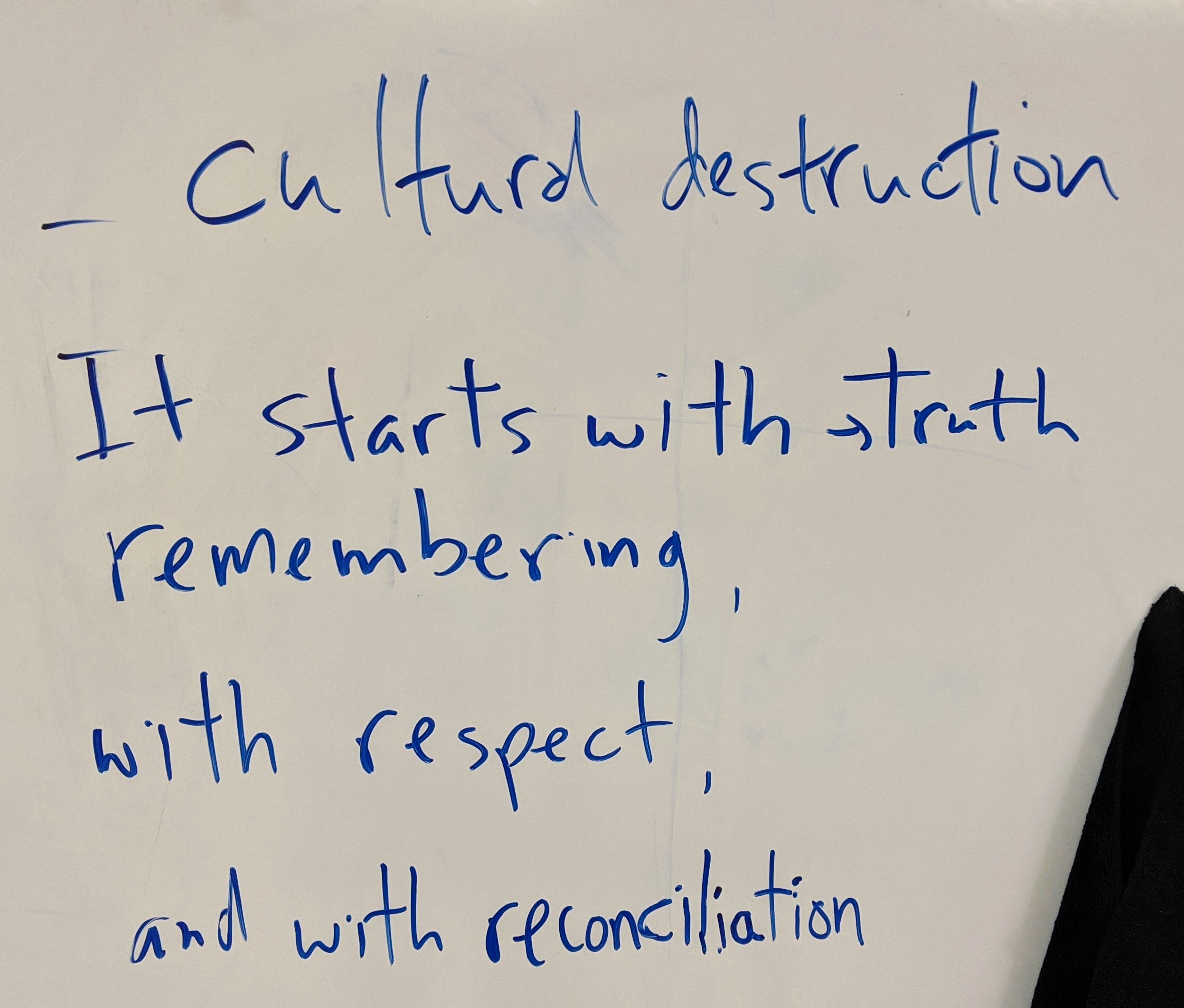
We didn’t “celebrate” Orange Shirt Day

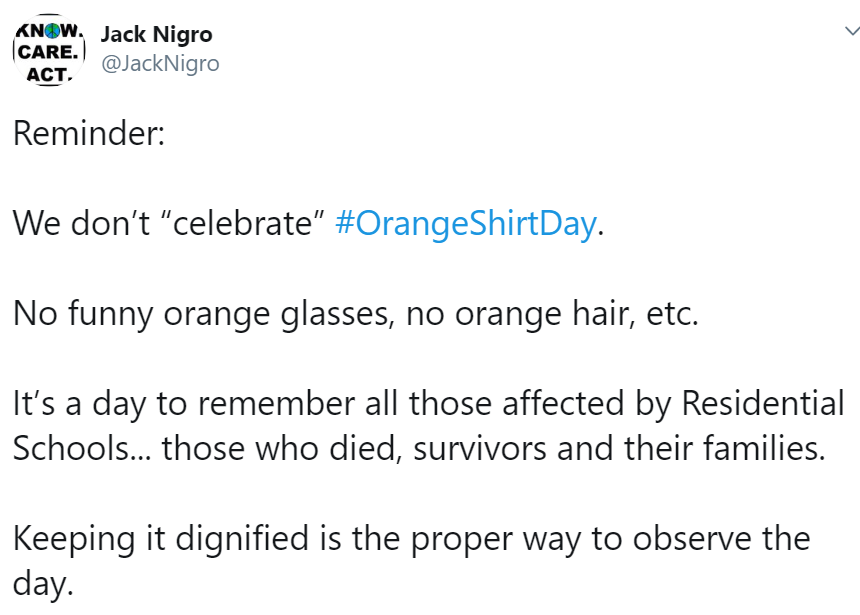
This tweet hit me square in the brain. It was neither confrontational nor rude. It was simply a sublimely and sage sentence that stuck. I said it over and over again while researching, reading, and reflecting while preparing to teach about Residential Schools on September 30th.

“We don’t “celebrate” #OrangeShirtDay.” A simple reminder to all educators and learners.

So before we started our learning today, I told my 2 grade 4/5 English classes that “this was not a celebration.” Today was meant for reflection.

I did compliment them on their numerous orange shirts, and then we were off. The first question was “Why are we wearing these shirts today?” The responses were varied and honest. One student shared how a little girl had her orange shirt taken from her. Another few recalled bits of what they had learned last year, while others seemed like this was all new to them. We went from there?

My next question was, “Have you ever heard of residential schools?” followed by, “What do you know about them?” These two questions led to some solid conversation around the institution of school as we know it compared to the residential schools where First Nations, Metis and Inuit students were forced to attend. I shared about the living conditions, the daily routines, and the terrible food. I added that they could only speak English and would be punished when they didn’t or for a litany of other things for that matter. I wanted to guide students to the understanding that something was wrong with residential schools. They got it.

I could see their eyes and minds opening after explaining how the children were scooped up and taken away for 300 days at a time, far from home, and separated from the only family they knew. Students also learned that the RCMP would arrest families who resisted. And then the question I was hoping for;
“Why were kids taken to residential schools?” Why would they do this?

This became a pivotal point because it led us to a discussion about who “they” were? Putting the brakes on for a moment, I changed they to “colonizers”. The phrase European settlers came up too since we were talking about it. This led to the point where students found out that the government was also part of the “colonizers(they)”, and that their plans included wiping out First Nations, Metis, and Inuit culture through laws and enforcement of racist colonizer policies. The word discrimination came next, followed by a call of racism.
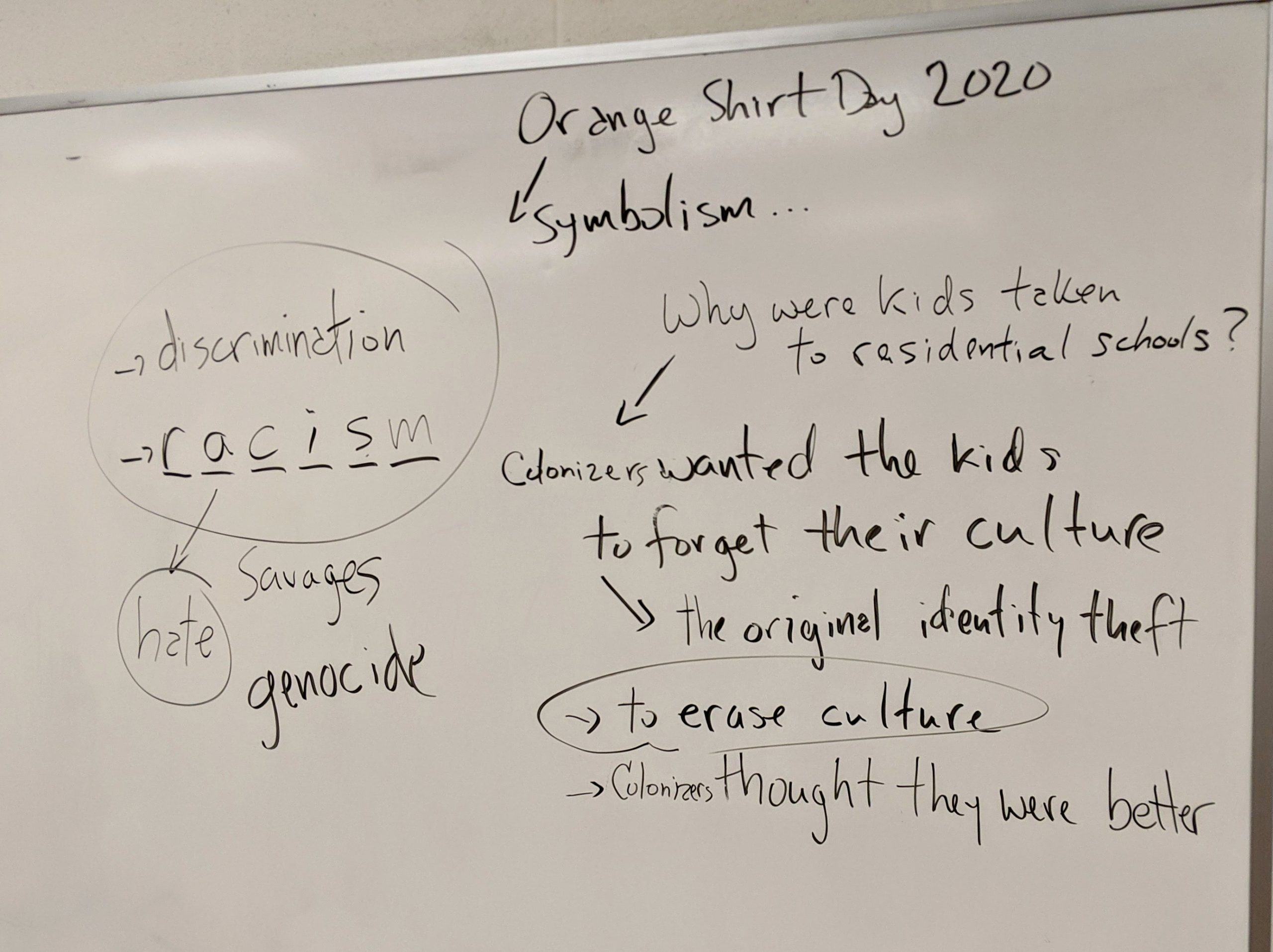
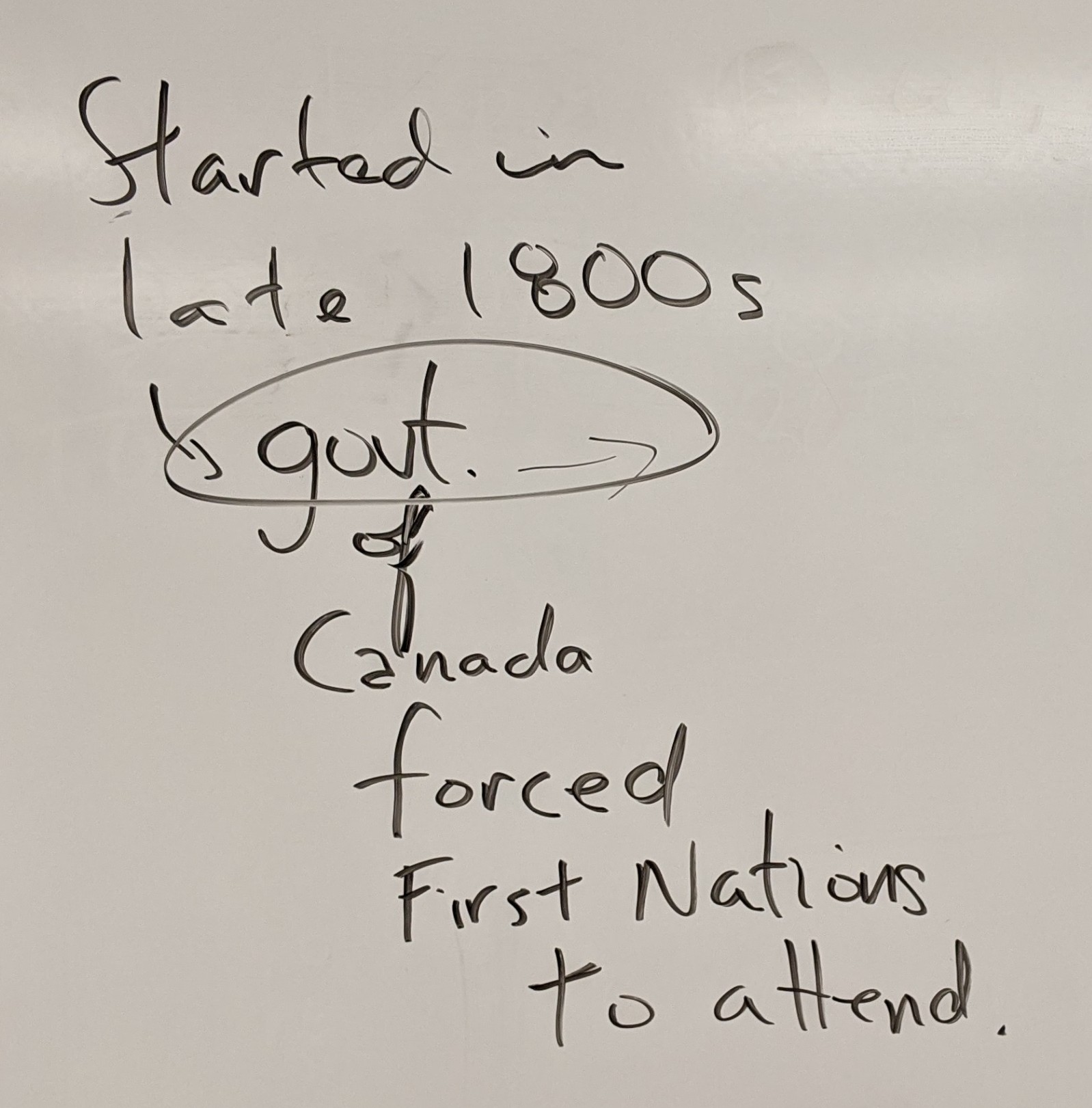
We talked and listened a lot. I shared some connections about how the government tried to label all First Nations as uncivilized savages in order to justify its desire to separate them from their land, their culture, and their dignity.

We talked about the importance of hearing the truth, and that there was more to learn. We promised to continue beyond Orange Shirt Day, and we sat quiet watching this video without sound and then with sound. https://www.nfb.ca/playlists/orange-shirt-day-edu/playback/#2 It was a powerful moment for students to see the images life in a residential school and then to reflect on why we were learning about it.

There were no tacky culturally appropriated mis-interpretations. Orange Shirt Day will not become a seasonal event like Halloween or Valentine’s Day in our schools. We will remember and continue exploring the truth about the legislated genocide attempted by the Canadian government on First Nations, Metis, and Inuit. We will also continue to examine how we continue to benefit from those inhuman actions to this day.

Today was not a day of celebration. September 30th was a day to listen, to become informed, and to reflect on the way that Canada has mistreated the First Nations, Metis and Inuit. We didn’t “celebrate” Orange Shirt Day. We inquired about it. We wrestled with it. We saw residential schools for the terrible places that they were to so many people. We sought to know more of its truth. We wore orange to respectfully remember.

Additional resources:

https://drive.google.com/file/d/1PlV8jUd2WtxcxrTHJK_HtZimP2Usng9k/view
We’re back and it feels…

  • …like a weird batch of emotions being mixed up in my head everyday. 

I use the word “weird” here as an amalgam of thoughts in order to come to grips with a whole whack of feelings. For now, let’s discuss 4 of the unique states of mind which I have been experiencing. They can be captured by the acronym C.A.G.E – confusion, anger, grief, elation. 

Confusion 

When we said our goodbyes in late June, we went home not knowing what was to come. How could we, no one did? It was a true test of the resilience of our profession as we transitioned from our physical spaces and into the virtual ones. It was emergency distance learning 101 for us all. Nobody knew how long it would go on, or how the students would respond. I recall the incredible stress of having to convert an old table and chair into a workstation at my house, the physiotherapy that came afterwards from my less than ergonomic set-up, and the (a)synchronous instructional awkwardness.

SO, after completing the balance of the academic year online and 3+ weeks of virtual summer school, I was really ready to be back in a classroom. In fact, I was elated at the possibility because things were proceeding as normally as they could as numbers declined and even though everything was up in the air when it came to education. 

At least, our tentative assignments and schedules had been shared, there was more than an air of uncertainty that things were bound to change. Daily news reports, and social media posts had us all still holding our breath. What was school going to look like after “emergency distance learning”? What was the government’s plan? What were are school boards doing to be prepared for September?

Anger

There was no shortage of sound bites and stories to fill in the gaps, and for a fleeting moment in late July, it almost looked like the numbers were dropping enough as if the winds of possibility filled the air. Things began looking positive, yet it was still relatively quiet when it came to direction from our current government when it came to education except that they had experts working on it. Come mid-August, my bubble of hope burst with news of increasing numbers of cases. Any residual confusion had given way to anger and disappointment in this educator. 

When school board emails began coming again in mid-August, the uncertainty around COVID 19 in our schools left us scratching our heads, as we did back in March. Little did we know what was about to drop on us all when school boards began surveying families about their choices for virtual or in class learning? But, that’s a topic for another post. 

It was pretty easy to get angry although it didn’t help. Yelling at the TV, like Grampa Simpson, everytime a new daily increase of cases was announced or at how someone somewhere decided that a large social gathering was a good idea without taking precautions. Seeing newsers with the Minister of Education spinning government yarns about funding increases, which they had stripped, and safety of the students raised my ire too. No wonder I spent so many hours muttering to myself while cleaning the garage in August. “Good grief!”

Grief

I’d like this to be at the Charlie Brown level when he says, “Good Grief,” but it isn’t. One of the single most powerful emotions I have been battling with since March has been grieving the way that education is now divided into B.C. (before COVID-19) and C.E. (COVID-19 Era). I am sad for my students who missed out on perennial rights of passage such as grads, sports, extra-curriculars, and trips. I feel grief for the students who had to stay at home without contact with their friends other than through blue screens. I feel for the adults who struggled to support their children’s learning while juggling their own work. Acknowledging this feeling is my way of trying to move forward in a healthy way. I know there are many teachers who are feeling something similar.

Elation

After great reflection, I chose the classroom option to start this school year. Admittedly, this is a selfish choice, as I thrive in the classroom. My wife mentioned on several occasions that I needed to be back at school too. Although, I am not sure if that was for her sake or mine? Regardless of who benefited most by my return to the classroom, the fact is I was elated to be back, but it also came with a cost. 

I now go for weekly COVID 19 Tests now that my bubble has expanded. With a 96 year old and a spouse with asthma in our home, we are proceeding with great caution. I am wearing a mask and frequently sanitizing my home, trips anywhere are only out of necessity, we are co-ordinating our schedules to reduce interactions so my father in-law does not become at greater risk, and any semblance of a social life or gatherings with extended family outside our residence bubble are now only on the camera roll of my smartphone. Yet, I think it is worth it. 

A stronger feeling of unity amongst colleagues is happening. This turmoil has given rise to a new sense of telepresent professionalism(virtual staff/team meetings). Conversations are fewer, but more meaningful. Smiles are now made more expressive as they are shared behind our masks. All of these little things have made the return to school possible despite the heavy and shifting workload.

Prepping to teach this September has matched the level of confusion and effort of my very first years. It’s tough sledding right now and more changes are ahead as we have only been through a few weeks, but even though my return to the classroom this month has me staggering, I am encouraged and challenged, in a good way, to innovate and adapt.

My head is spinning most days as I grapple to sanitize, mask up, shield up, and emotionally ramp up to teach. Yet, I cannot help, but still find some happiness in all of this each day. And although you can’t see it through my mask, seeing students and staff in real life has become the biggest reason for the smile on my face each day at school despite the CAGE. 

Stay strong. Thanks for reading. 
Will

Note: 

I had the bulk of this post ready to share our first week back, but could not do it. Something was telling me to bank my initial thoughts for a couple of weeks. Maybe I wanted to take some time for the dust to settle in order to make sense of it all. Sadly, it’s still pretty dusty around here, and based on the daily streams of educators sharing their ups and downs via social media, our collective ability to sift through the mess to make sense out of it, and let the dust settle has not occured. Yet. 

Teachers Are Still Rocking It-

In March we were “Emergency Learning”.  Now we are either teaching “virtually” or “socially distanced” in classrooms.  We never thought we’d be teaching from behind a screen, learning all kinds of new technology tools, wearing masks and shields in front of students or removing all of the manipulatives from classrooms. We don’t know how long this will last.  We don’t know if COVID will worsen.  Educators aren’t used to not knowing things.  Most teachers I know like schedules, routines, knowledge and thrive on consistency.

However, in the midst of the new rules, changes and all of the things that we “can’t” do-teachers are still rocking it.  Throughout the summer I worked with a team of teachers providing virtual professional learning for KPRETFO.  Hundreds of teachers used their summer holidays to learn about technology tools before they even knew whether they were going to be teaching virtually or not. They logged in at 10 am some days in order to learn and some teachers even came to all twenty sessions that were provided. Educators were dedicated to their professional learning all summer long.

At the end of August, I had the privilege of working with another fabulous team of educators who dedicated their time to providing a three day virtual conference for over 500 Ontario Educators with ECOO.  These educators gave up their time to organize all kinds of schedules, sponsorship, presenters, keynotes and much more.  In addition, over a hundred educators created and presented webinars for their colleagues.  It truly FELT like a face-to-face educational technology conference took place in my living room!
There was a feeling of sharing, helping and collegiality.  It was exhausting but my bucket was over flowing.

As our school year is now well under way teachers are reaching out to me for assistance at all times of the day and night through email because they are dedicated to their students and want to do their best.  They are attending our evening “PD in your PJs” webinar sessions through our local union office to learn new tech tools at 7 pm on the week nights. The educators that I work with continually astound me with their dedication to professional learning.

I recently binge watched a Netflix series called “Away”.  It is a futuristic fictional narrative about the first manned mission to Mars.  The astronauts were in uncharted territory.  They encountered problems along the way for which they had not trained.  They endured mental and physical fatigue beyond anything they had ever felt before.  They were innovative and creative in order to solve problems and reach their goal.  While watching, I couldn’t help thinking about the parallels between this movie and the present state of education. We’ve heard that as we design these new learning structures and environments it is like we are building an airplane while flying. If I am going to stay true to the analogy here it is really more of a rocket ship! Educators are facing situations that they hadn’t even thought about in Faculty of Education Programs.  They are encountering issues of teaching without many of the tools they normally use such as manipulatives, group work or technology. They are suffering mentally and physically. They are being innovative  problem solvers around tools, equipment and technology.  They are building the rocket ship while they are flying it and it is full of students.

Are educators stressed?  For sure.  Are their nerves frayed?  You bet.  Are they innovative, creative, dedicated and passionate about learning and teaching? Absolutely, without a doubt.  Every educator is a front line worker,  doing their best, making a difference, being brave beyond imagination and truly an inspiration.


The cold coffee song

 AKA – A parody on a familiar melody dedicated to teachers who finished as strong, after a tough year, if not stronger than the cold beverages in their cups.

Pt 1 (sung to the chorus of Escape, The Pina Colada Song by Rupert Holmes)

Yes I like drinking cold coffee!
And ignoring my chronic back pain.

I am out of the classroom,
At home by pandemic and fate

It’s really hard to be teaching,
sharing through cold blue screens.

It’s become easy to breakdown,
seeing students struggling each day.

Yup, it’s been rough one folx. We have come so far together and we all know that the journey is just beginning. When we look back to the start of the year in September 2019, no one would have believed that we would only be voting on a contract now. No one would have believed  that we would fund our sub-cost-of-living raises by standing up for our rights on the picket lines for 6 days. And no one would have believed that we would not see our students in real life this year past March Break. Judging by what has transpired already, I am pretty sure that the future will be equally unbelievable.

Without a doubt, we’ve shared many highs and lows in our profession over the past 10 months. We have stood together. We have found ways to make a terrible situation nearly tolerable. We have worked from home in makeshift offices at the peril of our own physical detriment. We are all grieving the loss of milestones (graduations, trips, community, playdays, track, and farewells) for the classes of 2020. Yet, we still came up with innovative ways to honour them.

We have parented through a pandemic, and cared for our parents too. We have watched vulnerable communities further separated from opportunities. We witnessed the inequity that exists in presumptions around access and “emergency distance learning.” In all of this we have maintained the dignity and duty of care everyday. On occasion, we even remembered to look after ourselves.

And even though direction from the elected only spilled out like water from a kinked hose, we knew what to do because we knew our students. So when the messages changed it didn’t matter that they came out at the end of the day on a Friday after hours or at all. In the end, teachers knew how to do right by their students. This even meant going on treasure hunts to find marks to fill report cards using a very vague map to cover a number of broad areas.

For my liking, I would love to have scrapped the focus on any marks for this term, and worked within a pass/not yet model.

Pt 2 (sung to the chorus of Escape, The Pina Colada Song by Rupert Holmes)

I am not into health spas.
I won’t ride on busses or Go Trains.

I am not into incomplete reporting
though the data sets must be gained.

I don’t like marking work til midnight
or going without sunlight for days.

I have been teaching from my basement,
and there’s no chance of escape.

The deeds are done and we can look back on them knowing that each teacher poured their heart and soul into their artistry as educators. Like any good gallery, the masterpieces ranged in complexity and beauty regardless of the eyes of the beholder. I’ll leave you with the last chorus to sing however you’d like.

At the heart of education,
We’ll stop at nothing to create,

To make the best of bad situations,
and challenges so hard to relate.

Can’t wait until we’re back in the classroom,
To learn, laugh, and say remember when?

It’s the year that no one planned for,
and hope will never happen again.

Thank you for all of your support over the past year. Wishing you a safe and relaxing summer. Celebrating you all with a cup of something cool and refreshing after I finish this cold cup of coffee.


Crazy Hair Day

Last month on Twitter, a Tweet about “Crazy Hair Day” sparked interesting conversations around words, hair, and spirit. A long-standing practice in schools has been “Spirit Days”. Centered around themes that are supposed to demonstrate school or community “spirit”, these days have been around for as long as I have been in education. As a child, I remembered these days as being about wanting to fit-in in a space where I didn’t. As an educator, I reflect on those feelings and consider these days not as “spirit” days but rather days when the disparity between who has and who has more is celebrated. Did you wear the right thing or style your hair in the right way? Great, you have “spirit”. I’ll circle back to why I have spirit in quotes here shortly. In this post, my goal is to ask you to reflect on these “Spirit Days” and to act. Now I know that might be asking a lot because there are many individuals who feel as though I’m taking the fun away from school and making something bigger of a small issue. I’ve heard it said. I would like to ask you to read further before ignoring my request. 

Words

The original post above asks readers to consider the language of the day. As we open more avenues for conversations around mental health and well-being and to remove the stigma, using the word “crazy” in education shouldn’t happen. I’ve heard the word in halls and have asked students to describe what they mean and there have always been more appropriate terms to use. If students can do that, as educators and administrators, we too can follow suit and actually lead. Words have an impact. Consider what you are saying, what you actually mean, and say that. 

Hair

Beyond the fact that the wording itself is problematic, hair has a different significance for different people. I initially wrote groups of people, but even within populations, there are differing beliefs or feelings. Now, I know that there are some looking for an education on this right now and that’s where I will ask you to do the work. This post is meant to get you to reflect and then act. Part of the work is to do the research, to come to your own understandings, and then to do better. I mentioned earlier that as a child, spirit days were about fitting in because I felt as though I didn’t. I was one of a few Black children in all of my elementary and secondary school experiences. As I recall, there were never more than a handful of students who looked like me in not just my grade, but in the entire school.  Many of my peers were fascinated by my hair. In Grade 1, I remember being teased on end because my hair was cut into a very low afro. I tear up as I write because I remember the blue jacket that I wore and when I didn’t want to remove my hood at school because I knew that everyone would laugh, and they did. Throughout elementary, I adopted the nickname, “Sonic the Hedgehog” because when I curled my hair, it didn’t move, even when I ran. Even in my attempt to fit in, I was yet again made fun of because of my difference. I could go on about stories but this isn’t about me. It’s about the students in your classrooms and schools who might be able to tell similar stories and the common theme might be that they have no one standing up for them or if they do, it’s sometimes after the trauma, to help soften the blow. 

Spirit

Earlier on, I put this in quotes because I’m interested in a serious definition of the word in this context. What does spirit actually mean? When I think of school or community spirit, I think of action for the betterment of said school or community. How does dressing up in a jersey or styling your hair in a certain way accomplish this? Oftentimes we ask students to show their spirit when in reality, their true spirit isn’t rewarded for showing up on a daily basis.  What is this spirit we are after and why is that more important than students showing up in their authentic selves on a daily basis? When we think of education, what is spirit in education? How are we honouring that? Is it merely compliance with the day? Taking this further, our role isn’t social convenor but educator, what spirit do we bring to our education spaces? What are we telling students about what we value in terms of spirit? 

Now I know that some might be upset that I’ve put it out there to consider getting rid of these days, but please consider the greater trauma being caused by what you deem to be “fun”. I’ve spoken about this in staff meetings and have been overlooked. I dread these days because often enough, I see a younger version of myself walking the yard or the halls, experiencing the same thing. Isn’t it time for us to stop?

6 Similes to describe how it felt to teach during COVID 19 Quarantine

Teaching during a quarantine was…

Like meaning with no  I, N or G. It was just mean. There were times when it felt forced, and meaningless because I was trying to make sense out of how to do this when it seemed more about keeping students busy and less about how they were feeling. 

Education during a pandemic was…

Like an infomercial. But wait, there’s more! More to do and definitely more to worry about.  Our students went AWOL – They’d gone absent without learning because they couldn’t connect. Their worlds had been turned upside down, and the one place where they could count on from Monday to Friday had been shuttered and now they were shut out. 

Learning for students during COVID 19 was…
Like making a pizza without a crust – there was nothing to hold all of the ingredients in place for students when life’s bigger problems consumed their ability to learn from home. Students needed their teachers to keep things together when things got tough and the class pizza, with all of its different toppings, got thrown into the oven.

Emergency distance learning was…
Like an ice cream cone with a hole in the bottom – the goodness melted away fast  and ended up on your shirt. Either way what was good couldn’t last long and usually there was something to clean up afterwards. I saw my students trying to make the best out of this mess yet there always seemed to be a scoop of some new flavour that no one wanted being added to the problem of learning outside of the classroom. 

Teaching from home during a shutdown felt…
Like performing a symphony where I had to write the score, conduct, play every instrument, and stack the chairs. There were so many little things that consumed the movements and moments of my day. It felt like I was simultaneously teaching a song to 25 individual performers all locked in their own rehearsal spaces.

Distance learning was…
Like running a marathon for the first time. You knew there was a finish line, but couldn’t remember how far you’d run or where you were going once you hit the wall. There came a point where fatigue set in and I began to doubt why I took this on in the first place? Some students hit the wall after the first day while others lasted until being told that the rest of their year at school was done. Even our strongest learners hit the wall at some point. Despite all of my training as a teacher, the toll that the marathon of teaching from home took on my mind and body was significant. I can only imagine how it affected our students.

I’m tired and a bit broken. The breath was stolen from my body when our students went home on March 13th. None of us imagined that we would be away for so long. I was allowed to visit my empty classroom 3 times since then and still hope that this has all been a bad dream. Walking down an empty hall in an empty school denied it’s life breath of students and their teachers was not how any of us would have wished this time in quarantine to be. 

From the onset and onslaught of learning in quarantine we had to work together, to grow together, and to continue learning together. It took time, patience, and grace. Each moment required a willingness to work meaningfully, to seek out those who had gone AWOL, bake a crust under that pizza, put a marshmallow in that cone to stop the good stuff from dripping out, play music until our fingers ached, and get up the next day ready to run the race again. 

The summer finish line has been crossed. We made it. Now where’s that pizza and ice cream?


Bitmoji Education

Love it or hate it, the app of Bitmoji has worked it’s way into education and particularly into distance learning.  From “digital” stickers for feedback to entire Google Slide Classrooms with doors to other rooms, Bitmoji is everywhere.  Bitmojis are dancing, pointing and fainting all over educational platforms.  Confession time?  I’m on the love it team and I’ll tell you why.

Bitmoji allows for a personal and creative touch to things that we share with others.  When I create short Google Slide presentations for students they are surprised to see my Bitmoji in the corners of my presentation.  Some think it is truly “geeky” but many students appreciate the effort at making the presentation a little more fun. Not having to put my real profile photo on something and being able to add a Bitmoji instead provides a small layer of privacy.  I began to make virtual, interactive classrooms on Google Slides and soon realized design and creating something so personal was a throw back to the many hours I spent playing with Barbies as a kid.  It was like planning to remodel my kitchen but without any cost what so ever.  It doesn’t feel like work.  It feels like play.  115,000 members on the “Bitmoji Craze for Educators” Facebook page all agree that it is a type of escapism and the membership grows daily.

Colleague Deanna Palmer and I created a webinar workshop for our fellow teachers about how to use Bitmoji to add some Pop to distance learning.  In the webinar we included a step-by-step slide show for educators to take away.  Find it here: Using Bitmoji to Make Virtual Learning Pop

Like with any popular craze or fad there are those who don’t or won’t buy in.  Some teachers are reluctant because they are conscious of their digital footprint-especially since in order to create the animated virtual reality Bitmojis you need to have a Snap Chat Account.  Some teachers don’t think that their students will want to see their teacher’s cartoon face all over everything in their classroom.  I can appreciate that it isn’t for everyone.  I am well aware that making learning “fun” or “cute” doesn’t make it deep or engaging.  However, if a picture can be worth a thousand words and Bitmoji can express precisely what we are feeling.  Using a Bitmoji might resonate with a colleague or student and just might make them smile. If that is what my little Bitmoji avatar does, then it was worth it.


The screens of silence

I am wondering whether the title of this post should be “The screams of silence” because that’s how it feels some days.

It’s week four of emergency distance learning and I am feeling weaker for it. Is anyone else feeling this way from staring at their screen(s) all day? If asked, I’ve been responding with thumbs up and all good, but in reality I am fighting the dissonance disrupting my days, and it relates to the way I feel about what is happening in education right now. To top it off, I am wrestling with self-doubt about whether my instructional act is all together. Add to that the pressure I’m putting on myself to wake up feeling fit and fresh because I am working from the “comfort” of my basement. Being cooped up, I mean observing physical distancing, doesn’t help. See what I mean about interchangeable titles?

Then there is the daily media segment about something or another to do with #QuarantineEducation. This week an article in The Globe and Mail shared Some overwhelmed parents are giving up on distance learning and abandoning at-home schooling. This noise is hard to tune out when we have been asked to stay in place and create something that has never been done effectively on a large scale so quickly. Maybe that’s what is holding my head hostage? Or maybe it’s that my hair is too long? Both make me want to scream sometimes

There is something to be said about the experience of facilitating learning in the vacuum of 2020. It’s cold. As I stare at several connected screens to keeping track of at least 17 other currently opened tabs on my computer, I have to admit this is all a bit daunting – even for this tech-happy educator. If teaching is my superpower, then the screens, meetings, and other digital dungeons trying to contain me have become my kryptonite.

I share this neither in angst nor anger, but out of an admission that the struggle is a real one. It sounds like I am not alone. This surreal situation we are now in was, is, and will never be a positive experience. We were starting to recover from a devasting January and dreadful February only then to be steamrolled by March when an uncontrollable virus unleashed itself on the world. Welcome April, a month that no one would have predicted to be the first of two months away from our schools…so far.

What did we do? We rallied, we pivoted to support our students and each other, and we waited patiently knowing we had to care for our own families too. We were lucky that the start of March Break landed when it did, as it may have helped us to avoid something worse had COVID 19 entered our open schools. Throughout this time we turned to our screens to watch for updates, data, and directions.

While we waited and watched for answers, our thoughts continued to race and the questions began to bubble up. How am I going to reach my learners? How are students who are marginalized by poverty and or other circumstances coping with all of this? What are the expectations from my board, admin, families, and most importantly students? What about my life at home? How will I manage when many of my teaching resources are at school? How much work do I assign? How about due dates? Do I take attendance? What happens when students don’t complete work? How do I assess anything without fear that someone else has done the work?

Everybody was working together. As our profession embraced the challenge of this reality, digital resources were curated, virtual meetings were held, contact was reinitiated with families/students, and a sense of temporary normalcy had made its way back into our weekly M to F routines. Cue some new silences.

The enthusiasm of returning to instruction, albeit asynchronously, signified that something was being done on behalf of families and our students, but the lack of connection through voice and vision has been hard to overcome for this educator. Speaking with many other educators who are feeling the same way, it is the meaningful interactions with peers/teachers and the chance of being heard that students are craving the most right now. We need to make sure they are acknowledged and heard, and the current situation is leaving them without a voice.

Teachers are the conduits for connection in their classrooms and will never be replaced by an emoji, meme, or brief feedback on a task to be viewed in silence on a student’s screen. However, it has been difficult to connect with students due security issues relating to conferencing platforms such as Google Meet and Zoom. This is extremely frustrating for a number of reasons. With those screens dark, students are left to keyboard strokes, Screencastify, and digital classroom posts for their content and updates. This is not the education any of us signed up to deliver. Despite my efforts to adapt and fill my screens with amazing shareable content to carry on, something is missing. The voices of my students. Cue the disconnects. Cue the silent screams at silent screens.

Turning to Twitter when tested in #onted

Without dipping too far into my bag of clichés this month, I wanted to focus on the incredible work coming from educators in respose to the “new normal” brought by the COVID 19 pandemic. The same educators who were standing up for the future of our students last month have been working hard to support them through the most extraordinary global event of this century.

The only way to describe what I’ve gained via the #onted Twitter hashtag, as we cope with #COVID19 and our work as educators, would be through words like perspective, wisdom, and supportive ideas. They would go alongside countless daily reminders that mental health matters, concern for students’ wellbeing, equity in education(access, tech, food insecurity, options), and concern for each other’s safety. In this post, if you’re not already tweeting, I want to encourage you all to join an amazing cohort of Ontario educators on Twitter so that you can benefit too.

Why? I am glad you asked(no I am not a sales rep for Twitter).

Imagine having a 24 hour cohort of teachers to form professional learning networks(PLNs), share resources, be encouraged by and learn from? That’s what connecting with the #onted PLN can do for all of us by connecting you with your fellow educators. While our numbers continue to grow, it is okay to start off slowly, sign up for an account, check out who is out there already, retweet some posts you like, share something new you’ve created like a blog post, lesson, piece of art or something you found interesting in the news. Make sure you include at least the #onted hashtag. Once you take flight, don’t be afraid to join in on some conversations. Following the #onted #ETFO #ETFOStrong and #OSSTF hashtags will keep you connected and up to date on all things happening in Ontario and with teacher unions.

So now that you’ve decided to sign up for a Twitter account there are a few things to consider.

  1. Do I create a personal or professional account?
    Try to have one of each if you can.  You can always have a personal account and then create a class account(check with your school board and admin for parameters). I have @willgourley and @MrGs_Class. I have also created a few school accounts for admin to share information from our board with families on the platform.
  2. Should I use my name or the number they give me?
    It never hurts to be brief or creative here. It is dangerous to be @Taylor167895 as it will be hard to find or remember a name with so many users.
  3. Do I need a picture?
    Yes. It can be of your pet. Try to personalize your page using the Settings. If you blog, include a link to your blog site too.
  4. How do I avoid all of the negativity coming from trolls and thoughtless people?
    Hit mute, block, and report. If you stick to the #onted #ETFOStrong #education family you will seldom come across most of the Tweets coming from alt-right types and fake news spreaders.
  5. Who do I follow?
    I would suggest following your preferred news outlets, then find your colleagues who are already on Twitter, and then any or all of the following people who are regularly contributing to the well being of their students and education in this province. Many on this list, are people who I have had the privilege to meet in person and can constantly count on for information and inspiration.
  6. Do I have to follow someone back?
    Not necessarily. Make sure to check over who is following you first. Sometimes it might not be an appropriate site. It is easier to block them to avoid the hassle.

In no particular order are some of the hundreds of active and engaging Tweeps you will find in Ontario;

Albert Fong – Science teacher in Peel DSB and educational action taker

Andrew Campbell – friend of Albert Fong, Gr 5/6 teacher, frequent guest on CBC, writer, TEDx speaker

Matthew Morris –  passionate blogger, introduced me to #hiphoped via Twitter, TEDx speaker

Debbie Donsky – a leaders leader, principal, artist, blogger, TEDx speaker

Jenn Giffen – tech queen, librarian, podcaster, and sketchnote guru

Noa Daniel – mentor, podcaster, TEDx speaker, and blogger

Chris Cluff – poet laureate, podcaster, long boarder, and creative genius

Rolland Chidiac – blogger, podcaster, maker spacer, good deed doer

Doug Peterson – blogger, Voice Ed Radio stalwart, glue that connects the #onted family

Kimiko Shibata – ESL specialist, active and creative ETFO member, nerd

DroptheDottCraig Zimmer‘s alter ego, TED Ed Innovative Educator, TEDx organizer, History teacher

Dr Deb Weston – member of our Heart and Art writing family, SpEd and AQ teacher

Dr Carol Campbell – no relation to Andrew Campell, OISE prof, and global education sage

Geoff Ruggero – maker space innovator in the YRDSB

Jeewan Chanicka – focused on equity and justice, TED Ed Innovative Educator,

Lisa Mastrobuono  – ETFO, Tweets about bargaining, education & labour issues

Zack Teitel – seeker and speaker of truth, always trying to make school less crappy and more meaningful

Sunil Singh – author, lover of all things Math, disruptor, TEDx speaker,

Andrew Bieronski – TEDx KitchenerEd organizer, consultant for education companies/tech startups,

Fred Galang – builder of creative literacy, teaches how to mix art & design with technology

For the sake of not overloading you as you join the #onted PLN via Twitter, I tried to include a wide variety of educators and voices for you to connect with to start. I could have included another 50, but that will have to be at another time.

Along the way you will find many others. My goal at the onset of this post was to introduce you to many of the people that I can count on for advice and support when times get tough. Congratulations in advance on joining the family. Feel free to tag me in a tweet sometime. @willgourley #onted #ETFOStrong

May the 4th be with your students

Anyone else feeling a bit gutted after hearing the news that we will not be back in our classrooms until May the 4th? (writer raises hand) While listening to the Minister of Education deliver this news today I ran a range of emotions. Firstly, I am thankful that the government was proactive when it came to our collective health by insisting on physical distancing and staying at home.* As a result, the lives of 2 000 000 students, 200 000 educators, support staff, and their families will benefit greatly from being apart. For me this seems like light years away.

Heeding the Chief Medical Officer of Health’s suggestion to close our schools beyond March Break was a prudent move, but it all happened so suddenly that we were all left with a great deal of uncertainty heading into the time off. With such short notice, it was hard to orchestrate a full scale instructional response to the news. Like so many of the #onted family, there was some concern because information was not forthcoming. I remember saying to my students(Gr 7) that it was more important for us all to follow the advice of doctors to do our part to limit the spread of COVID 19 than it was to worry about homework.**

Our last day in the classroom before the break was supposed to be a celebration of hard work to start Term 2, but instead it was a sombre send off with more questions than there were answers at the time. I only find consolation in this now knowing that the timing of this year’s March Break probably saved countless members in our schools from illness.

Not having our students in classes eliminated millions of potential interactions that would have undoubtedly accelerated the spread of the COVID 19. I am very relieved not to be in a workplace that’s traditionally susceptible to transmission of known/unknown and unchecked viruses. We have all been in a classroom with a student/teacher who should have stayed home that day. I am not lying when I say it feels like germ warfare in school sometimes. It is a relief, to be doing my part in social isolation especially as I have a 96 year old and a severe asthmatic at home.

In fact, although really missing my students/collegues, I am thankful that we have all been given the chance to stay at home in order to slow the spread of COVID 19, to look after our own health, and to tend to the wellbeing of our families. This is hard on all of us in so many ways because it is all so new. As I shared with a number of people, “Normal” is sick and its replacement “New Normal” is here bringing with it some good and bad to each of our days. The problem is that it keeps changing faster than we’d like.

Today’s announcement lifted my spirits because it meant that if we all do our part, then we have a date for a return to Normal. It also means this time can be curated to engage our students further in this year’s learning. Not knowing what was going to happen had me struggling to remember what day of the week it was since my routines were put in limbo with each postponement. No more days when, suddenly at 7 am, I wake up thinking I was late for work only to realize my body was dealing with the “New Normal” while still on “Normal” time.

Even though we will only be meeting via Google Classroom, our class will be back in session. After contacting families and students this week, it is clear they are excited to be back, even if it will only be digitally until May 4th. Fingers crossed it won’t need to be longer. In the meantime we will get on with the connecting, communicating, and learning for now.

Whether we return to the classroom on May the 4th or not, I couldn’t help but repeat the wish I shared in the title. May the 4th be with your students, and while we stay at home may every one of us be healthy and safe.

*Although arguably, essential and non-essential jobs may be a future debate topic.
** I did promise them some work via our Google Classroom once March Break was officially over.