Wrong again

Privilege, position, and power are placed in the hands of all educators. Being a teacher, regardless of instructional medium is more demanding than ever before. While our world in and out of the classroom looks like nothing we have ever seen before, some things haven’t changed – such as the importance of social justice in education. What we teach must always be inclusive of who we are teaching, the community, and the world around us in our instruction.

This is why anti-racist education is so important. We need to continue this work beyond the month of February because systemic racism and bias are hard at work all year long. That means there’s always something more to learn. There’s also a chance that we could get things wrong and that can get in the way sometimes.

As learners, humans can gain much from making mistakes. There’s even an expression for it: “To err is human.” I must be really human because I have learned so much from my mistakes already. From what I am seeing in the news and on social media, our humanity has never been more human based on the loads of mistakes we’re making. Depending on how you see it, this could be good or bad? Isn’t that the essence of what we do on a daily basis? Isn’t education where we model process and progress over perfection?

Confidence does not come without failure

I am confident that there is a line about being ‘lead-learners’ in the fine print of our infinite-paged-job description. That’s because teaching naturally comes with all of the ‘lessons’ ever imagined whether you are leading or learning. The trick becomes knowing how to find them, and then accepting that none of us will ever know everything. Perhaps this peace of mind is why I have grown more comfortable with discomfort of not knowing everything, and even with being wrong at times. I have also discovered that there are many like minded educators just like me – most of us in fact.

In On becoming an anti-racist educator I wrestled with my past along the path, but it also meant confronting the existence of racism in my personal life and my part in it. A younger iteration of myself might have struggled with this, but by examining my past and my responsibility as a bystander has helped move me forward. Throughout my life I have grown accustomed to getting things wrong, but always believed that I was standing on the right side when it came to issues of equity and anti-racism. What I realized, after reflection, mentorship, and deeper learning was how my belief in those lies was solely meant to ease my burden of responsibility for my complicity and privilege.

Black History Month is 10 months away

Cue the current teaching situation where our roles have now expanded to include daily counselling on issues of mental health, experts at PPE, and classroom sanitizers extraordinaire. We have also become distance learning specialists, multi-modal lesson trailblazers, fearless conversationalists about issues of race and racism, and critical thinkers on how to overcome and dismantle systemic racism and bias. All because we have assumed a lead learners mindset fuelled by getting things wrong and working on it along the way to success.

So it doesn’t have to be different in the classroom then. For me it has meant trying to include culturally relevant and responsive content into each day. I am choosing to avoid the prescribed resources from text book companies that have grown largely culturally irrelevant and unresponsive. Now is the time to amplify new voices in our classrooms and staff meetings too. Regardless of the platform being used to deliver learning, the opportunities and responsibilities remain in every lesson and moment we engage our learners about issues of racism and how to fight against them. The work must continue long past Black History Month to undo 400 years of injustice in for the future generations.

Whether it is in my lessons or by omission, my mistakes are at the core of learning how to get things right. In all of this I find my humanity too with more mistakes to come. To misquote a Disney song and without their lawyers hurting me, “no one fails like Will G”. Embracing my messtakes, excepting korrection, and leaning form them are kee ingredients to a butter me in the classruin. Won day aisle get it write.


About next month

Do not go gently into that next month. Do not close the book on the last one, and not open it up until the same time next year. Do not look at your checklist and think it is complete. There are still boxes to tick and more are being added each day. There is work to be done on behalf of equity, justice, identity and intersectionality. Do not go gently into that next month.

This past February has revealed so much to me as an educator. It has shown me that you cannot put a time frame around unlearning centuries of racism in the form of micro and macro aggressions against Black, Indigenous, Asian, and all People of Colour. February has shown me that the narratives of history have been whitewashed and buried in textbooks in the hopes that the bones of truth would not be exhumed.

February has taught me that even our collective best efforts to seed conversations, nurture thoughts, and harvest actions face unnatural forces of hatred and bigotry in the gardens of the communities we sow. There are weeds to pull that must be dug out from far below the surface hit by the light. We must dig down to uproot what is hidden in the dirt below.

March must be about continuing conversations around race and racism while celebrating black excellence beyond Rosa, Harriet, Nelson, and Martin. March needs to come in like a lion roaring the names who have fought against injustice and oppression who have yet to be mentioned in the history books. It is not just about athletes and performers, there are teachers, business owners, activists, and civic leaders who have all fought against systemic racism, injustice, and oppression with rarely a mention in our classrooms beyond the month of February: Afua, Dudley, Clotilda, and Denham.

The names above and so many more have been part of the fabric of our communities, but seem to get lost the other 11 months of the year. Please do not go gently in next month without digging deeper into the undershared stories of black excellence that exist around us beyond the worlds of sports and entertainment.

Do not go gently into that next month. It is our collective call to action to learn how to become anti-racist educators. It cannot be compartmentalized into a fraction of our instructional year. Anti-racism education cannot be reduced to a brief item at a staff meeting or a PD session either. 1 month out of 12 will never be enough when racism is working all year long. This work cannot be hefted onto someone else’s shoulders. We must all carry our share of the load.

Do not go gently into that next month. Now more than ever it is time to rage against what has caused so much harm from generation to generation. Embrace what discomforts you, be okay with the dissonance from not having all of the answers to students’ questions. Seek out others who are learning too. Walk alongside them as you learn and grow together and continue planting the seeds of equity and justice in your classrooms.

“Do not go gently into that…” and ‘rage against” phrasing borrowed from Dylan Thomas’ poem Do not go gentle into that good night

Suggested reading:

The skin we’re in – Desmond Cole

We want to do more than survive – Abolitionist teaching and the pursuit of educational freedom by Bettina Love

Caste – Isabel Wilkerson

Hindsight is…

Please don’t make me finish the title until the last second has ticked off the clock. I may have developed a defensive outlook about this trip around the sun. While I know this Gregorian Calender measurement of time will soon be in the rearview mirror of our lives, it is still a battle avoiding the queasiness and wincing that come when I think about all we have been through in 2020. Can resolutions be far behind?

Dang! I just wrote 2020

My understanding, perhaps acceptance, of this year is coming into clearer focus. It has been an extraordinary year on so many levels, and thus a great opportunity for personal growth. It has also been an educational year because, dang, I learnt a lot. 

Dang! I just wrote ‘dang’ again. 

I also taught a lot, and despite it feeling like a roller coaster ride from hell along the way, it meant that there were many lessons for me as an educator in 2020 too. Which made me happy to find this quote below after thinking I made it up myself. 

“If you are not learning, then you are not teaching.” Vernon L Smith*

A wise and gentle reminder that there was always something new to learn about ourselves, the students we teach, and the world around us during periods of unexpected loss, labour strife, professional uncertainty, and a global crisis. Smith’s words echoing loudly as I type. Here’s my version of it à la René Descartes. 

I learn, therefore I am a teacher.

So here is what I learnt from hindsight/2020:

  1. Take time to grieve and offer comfort first when students/families are hurting. The lessons can wait. It hurts to lose a student to senseless violence. Our school felt this very deeply last January
  2. Sometimes governments do not have the best interests of the population in their actions. Standing up to malfeasance and legislated tyranny is the right and a responsibility of all educators. 
  3. Mental health matters more than marks. Students/educators who struggle will not miraculously get better after a call to a helpline or a conversation with a social worker/psychologist. It is a process that takes time and patience before progress. I learned that there is much more to learn in this area to better support students, colleagues, and myself. 
    Remember that no matter how many times people tell you to take care of yourself first, there have to be reasonable boundaries and supports to make that happen. An encouraging message from admin, a Board Director’s email blast, or the Minister of Ed is not going to suffice. Set your boundaries. Do what you can do within them. Take time to be still. The work can and will wait. 
  4. Equity in schools needs to go way beyond a single day in the classroom, Orange/Pink/Purple shirt days are great starting points, but most not become performative events, but rather actionable beginnings to build on everyday in classrooms. There are so many amazing inclusion and equity resources being shared via school boards and social media for educators committed to allyship and activism in areas of Truth and Reconciliation, anti-black racism, LGBTQ2+, and culturally responsive relevant pedagogy. I learned that words in a classroom mean very little if they are not accompanied by opportunities to critically engage learners to become agents of change. 
  5. I learned not all educators are ready to confront their privilege and unearned advantage. I also learned that acknowledging my own privilege comes with the responsibility to examine my pedagogy and practice. It is a chance to unlearn, learn, and then teach. 
  6. If you are going to move into emergency distance learning within a short period of time, take it slow and make sure you have an ergonomic work space for those extended hours of screen time ahead. I learned that not all students have the same amounts of available space or bandwidth required for virtual school. I also had to accept that some students checked out the moment learning became asynchronous. 
  7. Rethink, question, iterate, bend, blend, and break everything you have done in the past to teach. Say goodbye to “we’ve always done it this way thinking”. Reimagine your reading lists, your math instruction, your use of worksheets, your classroom management, and your assessment approaches. This will not be easy, but it will be worth it. Embrace the discomfort. Learn from it, and then teach forward knowing 2020 taught us all so much. 

Thank you for a wonderful year at the speed of education. Please feel free to add what 2020 taught you in the comments below. Cheers to you all, and to a safe trip around the sun in 2021. 

*  There is comfort in the knowledge that the quote above is attributed to a Nobel Prize winning thinker because before checking, I thought the words above were mined straight out of my mind. Needless to say, I am happy to share a common thought in esteemed company. Searching out the source of the quote also allowed me to discover some of Smith’s other vast body of work in economics.


2020 – the roller coaster no one in education asked to ride

Please secure any loose items and keep your hands inside the car at all times.
Do not exit the ride until it comes to a full and complete stop.

Most of the time the exhilaration of a fast fun paced ride, filled with brief mind boggling G-forces, would come next. At an amusement park perhaps, but it is 2020 after all, and this ain’t your average roller coaster of a year. From the get go, it was destined to be different as it was determined to distinguish itself from the decades of other “normal” years before it. To add even more gravity to the moment, we all had take this ride, and hold on for dear life regardless of height. I want to share what it felt like for me this year.

2020 AsAroLLerCoaSTerInEdUcatIon

Instead of the fun and excitement that might normally have been anticipated, this year felt more like being in a time warped slow motion sequence while being suffocated inside of a dumpster that was on fire and rolling down a steep mountain. WEEEE! quickly gave way to AAAGHH!!!

Everytime I opened the lid of my own flaming dumpster car to look out at 2020, I saw flashes of things to grieve, endure, flee, confront, fix, stretch, and learn from.

It was as if the ride was designed to keep going non-stop and at a nauseating speed while everyone was expected to remain strapped in and trying not to lose what they brought on the ride. At times, it felt like working in a vacuum. My lungs empty of air while my mind and body rush up and over the same structure over and over again.

2020 AsAroLLerCoaSTerInEDucaTIon

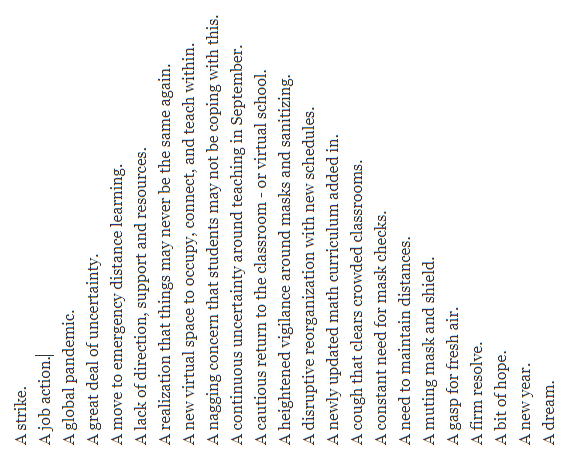
A year.
A strike.
A job action.
A global pandemic.
A great deal of uncertainty.
A move to emergency distance learning.
A realization that not everything is equitable.
A lack of direction, support and resources at times.
A realization that things may never be the same again.
A new virtual space to occupy, connect, and teach within.
A nagging concern that students may not be coping with this.
A continuous uncertainty around teaching in September.
A cautious return to the classroom – or virtual school.
A heightened vigilance around masks and sanitizing.
A disruptive reorganization with new schedules.
A newly updated math curriculum added in.
A cough that clears crowded classrooms.
A constant need for mask checks.
A need to maintain distances.
A muting mask and shield.
A gasp for fresh air.
A firm resolve.
A bit of hope.
A new year.
A dream.

As this ride finally runs out of track, I’m thankful to be physically in one piece, but still in need of greater peace of mind over this winter break. Recovering from this ride is going to take time. While figuratively staggering off of this year’s roller coaster, I am already heading back to the line to wait and go again.

Looking back on the past 52 weeks of this ride, I am trying to see how this year shaped my personal practice as an educator. I mean, the 2020 roller coaster possessed all the thrilling twists, stomach churning turns, dizzying highs, and sinking lows which no one could have expected. It came as no surprise then that enjoying the ride, catching my breath, or being able to re-orient myself relative to the world around me would not come easy. Despite it all, I find myself resolved to bend, blend or break what has been my instructional practice in order to do better in 2021.

It is perhaps because of this discombobulation, I have questioned everything that I have ever done as an educator. Stay tuned to see where this goes.

In the meantime expressions of gratitude, encouragement, and optimism to all educators who held on through the tumultuous ride that was education in 2020. You have indeed been the models of grace, resilience, resolve, creativity, persistance, and integrity in our profession. You have been inspirations to me whenever I lifted the lid of my flaming dumpster car to look out and take a breath. I’m looking forward to teaching in 2021 because of y0u.


About those indoor shoes

Winter’s coming and as I share this on the eve of December and our possible first snow day of the 20-21 school year, the timing is intentional.

Recently, I had a moment of clarity while greeting students at the door of my classroom. It started out simply enough as they returned after a snowy midday recess. Amid our usual pleasantries it happened – a simple and often overlooked aspect of privilege kicked me in the thoughts as I welcomed students back inside. Although, there was nothing out of the ordinary on this particular day, all I could think about, in that moment, was indoor shoes.

You know, that 2nd pair of shoes students are expected to bring from home, that stay at school, so they can change in and out of for recess and indoor activities. The ones that every student is told they are supposed to have. The same shoes that can be found classrooms away from their owners’ personal effects after being dribbled down the hallways soccer style by budding Christine Sinclairs and Alphonso Davies’. Those indoor shoes. 

Although an extra pair of shoes might be a small issue for many of us, I wonder whether asking students to have a dedicated pair of shoes to change into for inside school exagerates the socio-economic divisions that are obvious in many of our communities. After nearly 2000 days in the classroom, I am only seeing the ability to bring a second pair of shoes as an indicator of privilege, and that got me thinking about equity.

So, I’ll ask. Do you think that requiring/expecting students to have a 2nd pair of indoor shoes is unfair to those who are unable? Have schools become too demanding to expect this considering that many families are living pay check to paycheck? How are educators working to support their learners without isolating or alienating them by their supportive actions? Don’t even get me started about winter boots.

Clearly, there is a fine line to tread and I am wondering what’s changed, what needs to change in the way we were are doing things, and what else have I/you/we been missing? 

What’s changed? 

Nothing and it is not going to either as long as our socio-political and economic structures remain the same, we will always have students coming to school from places of unearned disadvantages being asked to act like they do not.

When we know that students are in need, how do we as a school community genuinely support them equitably? Is there a way that we can help while being discrete in our actions? One way might be by intentionally looking the other way while still making a note of things like a single pair of shoes, no boots, or a lack of weather protective garments rather than confronting their lack of them outright. How do we provide help without awkward and uncomfortable moments for a child?

What needs to change?

There will always be students with needs. Even though we might have enough, and it looks like they have enough. It is easy to be fooled into inaction by the belief that their enough is actually enough. When students are sent to school with a lunch to eat at school, it’s not obvious at first look whether it is the only meal they are having each day. It starts at relationships. 

Knowing the learner is the key here. Without it, we risk allowing students to fall through the cracks. With recent restrictions to work due to the pandemic, it is becoming clearer that families are living in more precarious circumstances. That fancy car that drops students off at the kiss and ride each morning may about to be repossessed. The top dollar running shoes and brand name everything to wear seems incongruous to the jam sandwich or mac and cheese everyday that those same students are bringing for lunch. I am always hopeful that the child really likes the same lunch everyday, but am also watchful whether it is an indicator that something else is going on outside of school.

What else have I/you/we been missing?

Even though I have used indoor shoes as the soul of this post, they are not the sole indicators of unidentified needs or inequities. At-risk students are everywhere in our hallways. I am trying to pay attention to their actions, words, and body language. I never want to look back on this time and think that our students slipped through the cracks without our support. Conversations with other colleagues also help to fill in the blanks if something doesn’t seem right. It has become second nature to ask a student how their day is going. It is also important to include all of the community resources available to schools too. 

If we pay attention to the little signs, we have an excellent chance to close some of the gaps for our students. It might be as simple as connecting families with access to community supports they may not have known about. This may be a simple as ensuring that there is English language assistance for them when it comes to access. For others, it might mean ensuring there is something extra to eat available for any who are experiencing food security issues. For others it might mean an invitation to help out in class during a particularly cold day at recess. 

Whatever the circumstances, we can walk alongside students as they learn to fill the shoes that are waiting for them in the future. 

Thanks to Tim Bradford and Nicolette Bryan @ACPS for their wisdom and candour while discussing this topic. 

Further Reading:

Equity: The Missing Piece of Most Back-to-School Conversations

Honouring those who experienced war

George Ebert

Today, Wednesday, November 11, 2020, I spoke with my students about why Remembrance Day is a special day to honour those who lived through war.

I recognized that my words had little meaning as they were just words. We watched videos about people who had been in war; but these images had little context and meaning to my students who were sitting in a classroom in 2020.

I grasped that, in order to put Remembrance Day into context, my students needed to hear real stories about real people.

Fortunately, there are many stories I can draw from, in my own family history. Here are a few …

George Wilbert Henry Ebert (1920 -1943), navigator in the British Canadian Airforce from Cache Bay, Ontario (now North Bay).

Wilbert Ebert shot down in WWII


Will was my half uncle. He survived the death of his siblings and mother from Tuberculosis (TB). My grandfather, George Wesley Ebert, met my grandmother, Permilla Ann Coulthard (nurse) in the Muskoka Tuberculosis Sanitorium. George may have contracted TB from his work as a mining electrician or as it spread through the Cache Bay community. Will and George were the only family members remaining.

Will, a school teacher, was eager to explore the world and to learn how to fly. He became a pilot/navigator after only weeks of training and was sent to fight WWII. He was 22 years, 3 months, and 2 days old when his plane was shot down over Iceland. Will would never see his family again and would never have a family of his own. I never knew Will but I have read his letters to my grandmother and grandfather. He always sent his best wishes to my mother, who would have been around 5 years old at the time.

George Wesley Ebert (1897-1957), sniper in the British Canadian Army from Cache Bay, Ontario.

George was a sniper in WWI. My mother told me he loved the wilderness. George’s mother was aboriginal. He was a skilled hunter and fisherman. He was also a perfect person to take to the Canadian National Exhibition as he always won the very large prizes in the shooting galleries. While fighting in the trenches, he was gassed several times which caused significant damage to his lungs. His health never was the same after war and upon contracting TB, it only worsened. George was a troubled person who relied on alcohol to sooth his trauma. This would lead to his end in an early death.

George Ebert with fur

Lewis Henry Weston (1910-2008), British Navy, Lieutenant Commander born in Plymouth, Devon, England, last stationed in Northern Ireland. Lewis pictured below aged 12, 45, and 96.

Lewis Henry Weston 1910052 (2)

Lewis joined the navy at the age of 12. This was not unusual as most children from working class families did not go to school past grade 6, instead working as an apprentice or in service. My grandfather had many tales to tell about his 30+ years in the navy. Lewis was a navy engineer meaning he built bridges and roads with his hands. He was also a navel diver, wearing very large metal helmets and heavy metal shoes while men pumped air into his helmet to keep him alive. Lewis stayed alive by his commitment to duty, as well as his wits and his faith in God. At the age of 45 years old, he retired from the British Navy and collected an indexed pension until the age of 98.

While Lewis was away at war, my grandmother, Iris Doreen Turpin Lawrence Weston, was in London, England during the German bombing raids. At the time, my uncle was at boarding school in the countryside. Iris and my father, David John Weston, sought safety every night in the London Underground (i.e. subway). My father shared stories of the terror he and my grandmother experienced as bombs fell every night, destroying the City of London. Even though my father never went to war, I believe that David never got over the terror he experienced. Iris never talked about the war.

In sharing these stories with my students, their understanding of the impact and loss due to war was grounded in real stories about real people, my people.

I encourage teachers to share their own family’s stories. War needs context as this will bring a deeper meaning to the courage displayed and loss experienced. This will help our students understand and remember the terrible cost and loss of war.

Collaboratively Yours,

Deb Weston

Unpacking the Invisible White Backpack in a Time of Black Lives Matter

WHITE PRIVILEGE - Showing Up for Racial Justice - SURJ

In a time focusing on the impact of racial equality, Black Lives Matter advocacy is pushing for the human rights of all those who do not identify as White. As a person who identifies as White, I do not go through life with the same experiences as people who do not identify as White.

I grew up in a family with a White mother and a stepfather from an African country. His ancestry was East Asian, African, and European. He did not have light coloured skin. His hair was lightly curled and he had a European shaped nose. My half-sisters had different skin colours and different hair. One sister had lighter skin “passing as White” with reddish hair and blue eyes. The other sister had darker skin looking very East Asian with dark brown eyes and very curly dark hair. In school, my sisters were told they could not be full sisters as they “were not the same colour.”

I did not start noticing the differences in my family’s skin colours until my grade 7 friend (who was Black) pointed it out. She came to my door one day and told me my stepfather was “Black.” I realized that she was right in the sense that he had dark skin and did not “look White.”

My awareness of skin colour did not change my experiences in my life journey as I accepted people for who they were and how they looked. I never considered that the colour of one’s skin could highly influence their life’s experience. I was colour blind.

My view of the world changed when I started my PhD studies in equity and inclusion. We spent over a week discussing issues around race, gender, background, and privilege. At this point, I was introduced to the idea of the Invisible Backpack I had carried around my entire life. As a person who looks White, I had been handed many privileges that those who don’t look White do not have.

This blew my mind. I never realized how being White gave me so much privilege. As I started unpacking this privilege, I saw many inequities in society and commerce as so many people were excluded due to their colour. My colour blindness evaporated. As an educator, inclusion is very important to me. But when I looked through all the teacher materials and books I used I only noted people that looked like me … they were all White.

Shaken by my revelation, I spoke to my friend about what I had learned. She stated that “colour blindness is a purposeful evasion as it does not honour people who do not pass as White.” She further went on to state that “as a Black Woman, I have to deal with the lack of privilege that comes with the colour of my skin.” As a well-educated Black woman, she had experienced being undermined by those who were White. Her ideas and comments were regularly questioned in her career and social settings. She told me she regularly experienced having her comments dismissed in social settings while her White husband’s were noted.

My husband is third generation Japanese Canadian. He is often asked where he is from and even though he is aware of what people really want to know, he launches into the “Where are you from” game. There’s a typical pattern to the conversation. When asked “Where are you from?”, he usually responds with “Oakville, Ontario.” The person usually follows with “Where were you born?” and his response is “Oakville, Ontario.” Then the person typically asks, “Where were your parents born?” in which he responds “Vancouver, BC.” At this point, frustration sets in and he is again asked “Where were your grandparents born?” The person finally gets the answer they were looking for, “Japan.” The person can now categorize him as of Japanese descent and not Chinese.

I spoke to my husband about my revelations from learning about the White Backpack. He told me he was always one of the only non-White people in school and at work. He knows that White people have more privilege and “it has always been that way.” He did mention that when we are out as a couple, we regularly receive glances of disapproval as an Asian man with a White woman. I’ve noted that the further away from the city we get, the more “looks” we experience.

The process of uncovering my White privilege has been ongoing. I check myself to make sure I am not precipitating my privilege over those without privilege due to the colour of their skin.

Below is a seminar developed in my studies on White privilege. I found it unpacked my own privilege and the experiences of others who may not identify as White.

On August 28th, 1963, DrMartin Luther King Jr, PhD stated “I have a dream that my four children will one day live in a nation where they will not be judged by the colour of their skin, but by the content of their character”. I was a year old when he spoke these words. Dr. King dreamed of racial equity and inclusion. It is my hope that I will live to see this dream in its true form.

Collaboratively Yours,

Deborah Weston, PhD

Activities to discuss colour-blindness and the White Backpack.

1. Colour-blindness (5 minutes)

How does colour-blindness affect schools? Read & Reflect In groups of 5, people to discuss issues around colour blindness in schools.

“Color-blindness does not deny the existence of race, but the claim that race is responsible for alleged injustices that reproduce group inequalities, privilege Whites, and negatively impact on economic mobility, the possession of social resources and the acquisition of political power. Put differently, inherent in the logic of color-blindness is the central assumption that race has no valence as a marker of identity or power when factored into the social vocabulary of everyday life and the capacity for exercising individual and social agency.” (Giroux, 2005, pp. 66-67)

2. Daily effects of white privilege as per Peggy McIntosh, 1988 (10 minutes)

“I am never asked to speak for all the people of my racial group.”

Play segment of Freedom Writers movie showing the above in a classroom.

Hand out one or two statements to each person. Have people discuss these statements in their group to uncover their privilege.

  1. I can if I wish arrange to be in the company of people of my race most of the time.
  2. I can avoid spending time with people whom I was trained to mistrust and who have learned to mistrust my kind or me.
  3. If I should need to move, I can be pretty sure of renting or purchasing housing in an area which I can afford and in which I would want to live.
  4. I can be pretty sure that my neighbours in such a location will be neutral or pleasant to me.
  5. I can go shopping alone most of the time, pretty well assured that I will not be followed or harassed.
  6. I can turn on the television or open to the front page of the paper and see people of my race widely represented.
  7. When I am told about our national heritage or about “civilization,” I am shown that people of my colour made it what it is.
  8. I can be sure that my children will be given curricular materials that testify to the existence of their race.
  9. If I want to, I can be pretty sure of finding a publisher for this piece on white privilege.
  10. I can be pretty sure of having my voice heard in a group in which I am the only member of my race.
  11. I can be casual about whether or not to listen to another person’s voice in a group in which s/he is the only member of his/her race.
  12. I can go into a music shop and count on finding the music of my race represented, into a supermarket and find the staple foods which fit with my cultural traditions, into a hairdresser’s shop and find someone who can cut my hair.
  13. Whether I use checks, credit cards or cash, I can count on my skin colour not to work against the appearance of financial reliability.
  14. I can arrange to protect my children most of the time from people who might not like them.
  15. I do not have to educate my children to be aware of systemic racism for their own daily physical protection.
  16. I can be pretty sure that my children’s teachers and employers will tolerate them if they fit school and workplace norms; my chief worries about them do not concern others’ attitudes toward their race.
  17. I can talk with my mouth full and not have people put this down to my colour.
  18. I can swear, or dress in second hand clothes, or not answer letters, without having people attribute these choices to the bad morals, the poverty or the illiteracy of my race.
  19. I can speak in public to a powerful male group without putting my race on trial.
  20. I can do well in a challenging situation without being called a credit to my race.
  21. I am never asked to speak for all the people of my racial group.
  22. I can remain oblivious of the language and customs of persons of colour who constitute the world’s majority without feeling in my culture any penalty for such oblivion.
  23. I can criticize our government and talk about how much I fear its policies and behaviour without being seen as a cultural outsider.
  24. I can be pretty sure that if I ask to talk to the “person in charge”, I will be facing a person of my race.
  25. If a traffic cop pulls me over or if the Revenue Canada [IRS] audits my tax return, I can be sure I haven’t been singled out because of my race.
  26. I can easily buy posters, post-cards, picture books, greeting cards, dolls, toys and children’s magazines featuring people of my race.
  27. I can go home from most meetings of organizations I belong to feeling somewhat tied in, rather than isolated, out-of-place, outnumbered, unheard, held at a distance or feared.
  28. I can be pretty sure that an argument with a colleague of another race is more likely to jeopardize her/his chances for advancement than to jeopardize mine.
  29. I can be pretty sure that if I argue for the promotion of a person of another race, or a program centering on race, this is not likely to cost me heavily within my present setting, even if my colleagues disagree with me.
  30. If I declare there is a racial issue at hand, or there isn’t a racial issue at hand, my race will lend me more credibility for either position than a person of colour will have.
  31. I can choose to ignore developments in minority writing and minority activist programs, or disparage them, or learn from them, but in any case, I can find ways to be more or less protected from negative consequences of any of these choices.
  32. My culture gives me little fear about ignoring the perspectives and powers of people of other races.
  33. I am not made acutely aware that my shape, bearing or body odour will be taken as a reflection on my race.
  34. I can worry about racism without being seen as self-interested or self-seeking.
  35. I can take a job with an affirmative action employer without having my co-workers on the job suspect that I got it because of my race.
  36. If my day, week or year is going badly, I need not ask of each negative episode or situation whether it had racial overtones.
  37. I can be pretty sure of finding people who would be willing to talk with me and advise me about my next steps, professionally.
  38. I can think over many options, social, political, imaginative or professional, without asking whether a person of my race would be accepted or allowed to do what I want to do.
  39. I can be late to a meeting without having the lateness reflect on my race.
  40. I can choose public accommodation without fearing that people of my race cannot get in or will be mistreated in the places I have chosen.
  41. I can be sure that if I need legal or medical help, my race will not work against me.
  42. I can arrange my activities so that I will never have to experience feelings of rejection owing to my race.
  43. If I have low credibility as a leader I can be sure that my race is not the problem.
  44. I can easily find academic courses and institutions which give attention only to people of my race.
  45. I can expect figurative language and imagery in all of the arts to testify to experiences of my race.
  46. I can chose blemish cover or bandages in “flesh” colour and have them more or less match my skin.
  47. I can travel alone or with my spouse without expecting embarrassment or hostility in those who deal with us.
  48. I have no difficulty finding neighbourhoods where people approve of our household.
  49. My children are given texts and classes which implicitly support our kind of family unit and do not turn them against my choice of domestic partnership.
  50. I will feel welcomed and “normal” in the usual walks of public life, institutional and social

The Invisible Backpack (15 minutes)

Ask people consider how they identify as people and outline their own privilege they carry in their lives.

The invisible backpack is the unacknowledged privilege that people carry due to their gender, language, religion, culture, race, social class, ethnic status, sexual orientation, physical ability, age, and geographic location. What is in your invisible backpack?

.

Tools for Educators

Unpacking the Invisible Knapsack by Peggy McIntosh

Racism 101: Definitions

What are my rights? Racism and the Law

Tools for Equity in the Classroom

Aboriginal Education Curriculum

Anti-Racism Workshop Manual for High Schools in Peterborough by Hassan Hassan

The Storytelling Project Curriculum: Learning About Race and Racism Through Storytelling and the Arts (US-based)

Speak! Radical Woman of Colour Media Collective CD

Anti-Racism Resource Kit

“Canada’s Creeping Economic Apartheid” by Grace-Edward Galabuzi (2001)

Teaching Human Rights in Ontario

References

Giroux, H. (2005). Spectacles of race and pedagogies of denial: Anti-black racist pedagogy under the reign of neoliberalism. In L. Larumanchery, (Ed.), Engaging Equity: New perspectives on anti-racist education. Calgary, AB: Detselig.

McIntosh, P. (1988). White privilege and male privilege: A personal account of coming to see correspondences through work in women’s studies. Independent School, Winter, 1990. Downloaded from http://www.case.edu/president/aaction/UnpackingTheKnapsack.pd
Engaging with Indigenous Knowledge as a Non-Indigenous Educator

Over my teaching career I have been fortunate to teach in schools with high populations of Indigenous students and to learn from the knowledge keepers and elders in the communities that our schools served.  Admittedly, I haven’t always said or done the right things but I have learned from those mistakes.  As a non-Indigenous educator, I know that I will continuously be on a professional and personal learning journey.  I acknowledge that it is my responsibility to do this learning.  There are resources that I have used along the way and I hope that by drawing attention to the following resources, I can assist others in their learning journey.

In order to avoid cultural appropriation, to honour and respect Indigenous culture and history as a non-Indigenous teacher, it is important to have the appropriate resources. We can’t avoid teaching about residential schools because we don’t feel comfortable.  It is a part of the Ontario Curriculum.  It isn’t just about “history” either.  Current events draw attention to the pervasive issues faced by Indigenous peoples.  These are teachable moments that are authentic and relevant to students.  Students will be asking questions and forming opinions. As educators we have a responsibility to assist students to find accurate and culturally respectful information.

If you are looking for a place to begin in your learning journey, visit ETFO’s First Nations, Métis and Inuit Education website.  It is filled with cultural protocols, resources and Ministry Documents.  It is a treasure trove of information on treaties, land acknowledgements and avoiding cultural appropriation.  Throughout the literature are hyperlinks for explanations of concepts and lexicon.  Through ShopETFO you can purchase the FNMI Engaging Learners Through Play  resource created for elementary educators which provides play based activities that engage all students.

A quick resource can be found on code.on.ca (The Council of Ontario Drama and Dance Educators). This resource provides a quick chart of protocols on what to do, what to avoid, why to avoid and what to try in order to bring learning about Indigenous culture and history into your classroom.  This document also provides links to videos about Indigenous Arts Protocols, and a quick reference guide for what to think about before engaging with Indigenous Knowledge.

The website helpingourmotherearth.com is filled with tools and resources for educators including videos of Indigenous Knowledge Keepers telling their stories.  There are free educational resource kits with lesson plans for primary, junior and intermediate students.  In addition, you could sign up for professional learning or a workshop on the site.

Like me, you might make mistakes.  However, my Indigenous educator friends have coached me that the worst mistake that non-Indigenous educators can make is to do nothing.  I hope that highlighting these resources will help you along your professional learning journey.

We didn’t “celebrate” Orange Shirt Day

This tweet hit me square in the brain. It was neither confrontational nor rude. It was simply a sublimely and sage sentence that stuck. I said it over and over again while researching, reading, and reflecting while preparing to teach about Residential Schools on September 30th.

“We don’t “celebrate” #OrangeShirtDay.” A simple reminder to all educators and learners.

So before we started our learning today, I told my 2 grade 4/5 English classes that “this was not a celebration.” Today was meant for reflection.

I did compliment them on their numerous orange shirts, and then we were off. The first question was “Why are we wearing these shirts today?” The responses were varied and honest. One student shared how a little girl had her orange shirt taken from her. Another few recalled bits of what they had learned last year, while others seemed like this was all new to them. We went from there?

My next question was, “Have you ever heard of residential schools?” followed by, “What do you know about them?” These two questions led to some solid conversation around the institution of school as we know it compared to the residential schools where First Nations, Metis and Inuit students were forced to attend. I shared about the living conditions, the daily routines, and the terrible food. I added that they could only speak English and would be punished when they didn’t or for a litany of other things for that matter. I wanted to guide students to the understanding that something was wrong with residential schools. They got it.

I could see their eyes and minds opening after explaining how the children were scooped up and taken away for 300 days at a time, far from home, and separated from the only family they knew. Students also learned that the RCMP would arrest families who resisted. And then the question I was hoping for;
“Why were kids taken to residential schools?” Why would they do this?

This became a pivotal point because it led us to a discussion about who “they” were? Putting the brakes on for a moment, I changed they to “colonizers”. The phrase European settlers came up too since we were talking about it. This led to the point where students found out that the government was also part of the “colonizers(they)”, and that their plans included wiping out First Nations, Metis, and Inuit culture through laws and enforcement of racist colonizer policies. The word discrimination came next, followed by a call of racism.

We talked and listened a lot. I shared some connections about how the government tried to label all First Nations as uncivilized savages in order to justify its desire to separate them from their land, their culture, and their dignity.

We talked about the importance of hearing the truth, and that there was more to learn. We promised to continue beyond Orange Shirt Day, and we sat quiet watching this video without sound and then with sound. https://www.nfb.ca/playlists/orange-shirt-day-edu/playback/#2 It was a powerful moment for students to see the images life in a residential school and then to reflect on why we were learning about it.

There were no tacky culturally appropriated mis-interpretations. Orange Shirt Day will not become a seasonal event like Halloween or Valentine’s Day in our schools. We will remember and continue exploring the truth about the legislated genocide attempted by the Canadian government on First Nations, Metis, and Inuit. We will also continue to examine how we continue to benefit from those inhuman actions to this day.

Today was not a day of celebration. September 30th was a day to listen, to become informed, and to reflect on the way that Canada has mistreated the First Nations, Metis and Inuit. We didn’t “celebrate” Orange Shirt Day. We inquired about it. We wrestled with it. We saw residential schools for the terrible places that they were to so many people. We sought to know more of its truth. We wore orange to respectfully remember.

Additional resources:

https://drive.google.com/file/d/1PlV8jUd2WtxcxrTHJK_HtZimP2Usng9k/view

We’re back and it feels…

  • …like a weird batch of emotions being mixed up in my head everyday. 

I use the word “weird” here as an amalgam of thoughts in order to come to grips with a whole whack of feelings. For now, let’s discuss 4 of the unique states of mind which I have been experiencing. They can be captured by the acronym C.A.G.E – confusion, anger, grief, elation. 

Confusion 

When we said our goodbyes in late June, we went home not knowing what was to come. How could we, no one did? It was a true test of the resilience of our profession as we transitioned from our physical spaces and into the virtual ones. It was emergency distance learning 101 for us all. Nobody knew how long it would go on, or how the students would respond. I recall the incredible stress of having to convert an old table and chair into a workstation at my house, the physiotherapy that came afterwards from my less than ergonomic set-up, and the (a)synchronous instructional awkwardness.

SO, after completing the balance of the academic year online and 3+ weeks of virtual summer school, I was really ready to be back in a classroom. In fact, I was elated at the possibility because things were proceeding as normally as they could as numbers declined and even though everything was up in the air when it came to education. 

At least, our tentative assignments and schedules had been shared, there was more than an air of uncertainty that things were bound to change. Daily news reports, and social media posts had us all still holding our breath. What was school going to look like after “emergency distance learning”? What was the government’s plan? What were are school boards doing to be prepared for September?

Anger

There was no shortage of sound bites and stories to fill in the gaps, and for a fleeting moment in late July, it almost looked like the numbers were dropping enough as if the winds of possibility filled the air. Things began looking positive, yet it was still relatively quiet when it came to direction from our current government when it came to education except that they had experts working on it. Come mid-August, my bubble of hope burst with news of increasing numbers of cases. Any residual confusion had given way to anger and disappointment in this educator. 

When school board emails began coming again in mid-August, the uncertainty around COVID 19 in our schools left us scratching our heads, as we did back in March. Little did we know what was about to drop on us all when school boards began surveying families about their choices for virtual or in class learning? But, that’s a topic for another post. 

It was pretty easy to get angry although it didn’t help. Yelling at the TV, like Grampa Simpson, everytime a new daily increase of cases was announced or at how someone somewhere decided that a large social gathering was a good idea without taking precautions. Seeing newsers with the Minister of Education spinning government yarns about funding increases, which they had stripped, and safety of the students raised my ire too. No wonder I spent so many hours muttering to myself while cleaning the garage in August. “Good grief!”

Grief

I’d like this to be at the Charlie Brown level when he says, “Good Grief,” but it isn’t. One of the single most powerful emotions I have been battling with since March has been grieving the way that education is now divided into B.C. (before COVID-19) and C.E. (COVID-19 Era). I am sad for my students who missed out on perennial rights of passage such as grads, sports, extra-curriculars, and trips. I feel grief for the students who had to stay at home without contact with their friends other than through blue screens. I feel for the adults who struggled to support their children’s learning while juggling their own work. Acknowledging this feeling is my way of trying to move forward in a healthy way. I know there are many teachers who are feeling something similar.

Elation

After great reflection, I chose the classroom option to start this school year. Admittedly, this is a selfish choice, as I thrive in the classroom. My wife mentioned on several occasions that I needed to be back at school too. Although, I am not sure if that was for her sake or mine? Regardless of who benefited most by my return to the classroom, the fact is I was elated to be back, but it also came with a cost. 

I now go for weekly COVID 19 Tests now that my bubble has expanded. With a 96 year old and a spouse with asthma in our home, we are proceeding with great caution. I am wearing a mask and frequently sanitizing my home, trips anywhere are only out of necessity, we are co-ordinating our schedules to reduce interactions so my father in-law does not become at greater risk, and any semblance of a social life or gatherings with extended family outside our residence bubble are now only on the camera roll of my smartphone. Yet, I think it is worth it. 

A stronger feeling of unity amongst colleagues is happening. This turmoil has given rise to a new sense of telepresent professionalism(virtual staff/team meetings). Conversations are fewer, but more meaningful. Smiles are now made more expressive as they are shared behind our masks. All of these little things have made the return to school possible despite the heavy and shifting workload.

Prepping to teach this September has matched the level of confusion and effort of my very first years. It’s tough sledding right now and more changes are ahead as we have only been through a few weeks, but even though my return to the classroom this month has me staggering, I am encouraged and challenged, in a good way, to innovate and adapt.

My head is spinning most days as I grapple to sanitize, mask up, shield up, and emotionally ramp up to teach. Yet, I cannot help, but still find some happiness in all of this each day. And although you can’t see it through my mask, seeing students and staff in real life has become the biggest reason for the smile on my face each day at school despite the CAGE. 

Stay strong. Thanks for reading. 
Will

Note: 

I had the bulk of this post ready to share our first week back, but could not do it. Something was telling me to bank my initial thoughts for a couple of weeks. Maybe I wanted to take some time for the dust to settle in order to make sense of it all. Sadly, it’s still pretty dusty around here, and based on the daily streams of educators sharing their ups and downs via social media, our collective ability to sift through the mess to make sense out of it, and let the dust settle has not occured. Yet.