Undercover Boss

Have you ever watched a show called Undercover Boss?

An average episode of the hour long program shows a CEO or top tier exec going incognito to better understand the work flow, flaws, and family of an organization. The show makes sure that the top dog is put alongside some pre-selected employees(often outspoken) who, fearlessly or not, walk the “newbie” through a day in the life at their job.

In most episodes, there comes a moment when a budget-line-watching-number-crunching-corner-office-seat-occupier realizes how their top down edicts are negatively impacting the organization until they see it from the perspective(s) of the workers. At this point in the show, regardless of profit and loss statements, the executive works to make things right, realizing that if things were better for the workers, the bottom line would benefit too. A win win outcome right?

I love TV. It creates narratives to suit itself. Moreover, despite a proliferation of reality TV programs, the medium remains irreal. Much like any Disney offering, TV has conditioned us to expect a happy ending that is far away from everyday experiences. If all goes accordingly, good always triumphs over evil, a hero will emerge, and on the show Undercover Boss, at least, some lucky employees will help their bosses to miraculously see the light and improve the company. This is not the current case between the government and public education in Ontario.

I would love it if our elected officials had the courage and conviction to do this for longer than the time it takes to convene a photo opp or craft a sound bite. I wonder why this is rarely, if ever, true when it comes to government and education. Other than clichés about how much the students come first and the importance of educators, hollow words do not mirror the devastating actions that senseless cuts are having on public education.

As such, we have seen neither the current Premier nor the Minister of Ed spending any meanigful amount of time with the people on the frontlines like an undercover boss. Since they are making decisions that affect everyone working in education, we all deserve to see and know that they are completely aware and informed.

I have never heard genuine words of understanding from elected officials that qualify them to make the decisions they are making which will ultimately impact our society for generations to come. In its wallet.

With so much attention placed on the bottom lines of provincial budgets, it becomes an easy target for outsiders to look across a spreadsheet and proclaim cuts can be made and no one will ever feel it without duty of care or context. This is not unique to education either.

This past year has revealed many glaring differences about how information is being (mis)used, bent, and or weaponized to suit political agendas. As such this misuse of information seems like systemic micro and macro-aggressions towards our profession, the public education system, and our students.

Which leads me to this question. How can a system of the people for the people be so myopic in its duty and dilligence? Isn’t the idea of education for all to actually provide education and therefore opportunity for all? With all of the time that governments and bureaucrats spend poring over the books, they have conveniently missed the direct cost implications of intentional systematic underfunding.

Here are some things to consider.

  1. Loss of education opportunities limits the number of skilled and quality workers contributing to the economy. That means more spending and tax dollars from higher wage earners.
  2. Economic cuts reduce opportunities for many people already living on the margins of society. That means cuts to education is a form of systemic discrimination towards many communities.
  3. Cuts to course offerings hurt the wrong people when those who can afford it can simply shift to a private school.Even my elementary students are shaking their heads about how traditional courses that lead to Post Secondary Science and Engineering courses are being limited or disappearing from local high schools. (see what is happening in my board @ YRDSB)
  4. Cuts to OSAP hurt the wrong people too. Rich kids will still go to post-secondary school, while marginalized students will have their futures moved further out of reach.
  5. Refusing to fund education to the fullest is a recipe for social disaster.  If we cannot agree on this, then we are agreeing to leave the next generation worse off than the last. When private schools are advertising that they have the courses that have been eliminated from our public schools, there is a problem.

None of the above are acceptable.

Our parents did not struggle and sacrifice for this. My mom and dad did not work full and part time for this. Neither did yours. Students and their families do not make sacrifices for this. No one would ever vote to limit the future of opportunity of its youth. Neither would a sensible and caring society allow anyone to slip through the cracks. Unless they had an agenda to undermine Canada as a civil society. The actions of our elected officials appear specious at best when it comes to education.

Our work brings value far beyond any budget lines could ever define because it brings human possibilities forward everyday. Reducing and removing opportunities also removes relationships that empower students into the future. Restricting or taking away someone’s access to education is simply an affront to all humanity. We are difference makers, miracle workers, and advocates for all of our students. We are working hard to change the narratives that have become a distraction in public education.

We are fighting to be heard and respected, let alone seen and understood, by politicians who prefer to take cover behind short sighted populist agendas that seek to serve the bosses rather than the people who work for them. It’s time for their eyes and minds to be opened.

What if every school could welcome an undercover boss(politician)? Maybe then, these decision makers would truly see the commitment, struggle, and value of our fight for students, their families, and this noble profession. My door is always open. No photographers please. It’ll disrupt the learning.

Fight on. #CutsHurtKids #ETFOStrong

Further reading

York board says bigger class sizes forced cancellation of 123 high school courses. 

What Exactly Is Happening To Ontario’s Education System? What You Need To Know

Financial facts on Canadian prisons

Optimism at 9.2 %

I was working with my students on some proportional reasoning exercises in Math. It didn’t take long before I began thinking about numbers and the relationships that exist so beautifully and naturally within them – as one does. After considering the fractions, decimals, and percentages of our tasks that day, I realized that 18 days have sped past – as of this past Friday (Sept 27th, 2019).  Here is some numerical context.

18 days 
= 2.57 earth weeks (Monday to Sunday)
= 4 school weeks (Monday to Friday)
= 1/20th of a year(non-leap)+/-
= 432 life hours
= 5400 minutes of class time
= 3480 minutes of my teaching time (preps deducted)
= 1620 minutes of recess/lunch time (school days M to F)
= 9.2% of the instructional year

Reflecting on the numbers always makes it clear for me to see that we (grade 7s+ me) have already spent a lot of time working at the speed of education. With 18 days in the books, I am feeling optimistic and here are the P.R.I.M.E reasons why.

Patience pays off, not packets of paper

So often students are hurried back to full speed once September rolls around. I have always found it better to ease learners back into the year with broad cross-curricular learning, to activate as many areas of ability from past grades. This approach may make some teachers uncomfortable because it runs counter to archaic ideas of photo-copied workbooks. However, the buy-in from students has always been positive when they are given the time, space, and appropriate tasks to challenge them.

I choose collaborative work that offers low floor and high ceilings, whether it’s Math problems that cover more than one strand at the same time, or whole class discussions/inquiries into current events. Think about tasks and activities that allow each student to show what they can do, and are differentiated enough to honour each learner’s abilities.

My students are responding well to every chance they are given to work with each other instead of another “busy worksheet” packet. I encourage teachers to possess the patience to allow students a different start to the year instead of photocopied packets, to promote engagement instead of ennui.

Relationships = good

We have worked hard to establish our relationships and expectations. In my classroom this has always meant open and ongoing dialogue. Student voice is key in this educational democracy. By always allowing a place for students to be heard, I have found that classroom management and community building become a collective responsibility and benefit.

Since the first bell in September, we have established irreducible norms about responsibility, respect, collaboration, determination, and otherliness. When students have time to grow within their community in these areas, the dynamics of our class relationships are made more positive and enduring.

Invest with interest

The past 18 days in the classroom have also been about learning what makes each student come alive or avoid at school. Having students share their highs, lows, strengths, and weaknesses has provided invaluable insight into what makes them tick in and out of the classroom.

In 11 years, I have always been surprised by the amazing and diverse interests and talents of my students. Making sure they know I am interested in getting to know them is an investment I am happy to make over and over.

Manage it all

The first 9.2% of this instructional year felt like it happened in a blender. Regardless of years of experience, this can be hard when so many daily variables (ie. schedules, personalities, tasks, etc.) are swirling around for teachers to sort out – myself included. Despite 10 years of practice, I still find that I’m overprogrammed and behind schedule. Thankfully, most of my turmoil occurs outside of the classroom from instructional planning, SERT work, and meetings.

Teachers are known for their tireless work ethics, but there has to be limits too. It’s important not to burn out at the start of the year. Setting some boundaries and giving yourself permission to leave some work for the next day is good advice to manage it all.

Encourage everyone, everytime

Take time to celebrate accomplishments on a daily basis – no matter how small. I used our recent Fire and Lockdown Drills to comment on how my students responded so well in those situations. I have also filled our corkboards with fresh work to celebrate each week. When students know they are being noticed, they will feel and have validation. This is something we can honour 100% of the year in the classroom.

Even though 9.2 % of instruction is in the books, you can see how optimism is reaching its prime already. Wishing you all an excellent next 90.8% of your school year.

Additional reading:

http://www.wismath.org/Resources/Documents/Annual%20Conference/210JMetke-Low%20Floor%20High%20Ceiling%20Handouts.pdf

Beyond

Did anyone else go to sleep on the last night of school already thinking about next year? I did.

It’s not the first time either. After 10 years in education, it is now a given that I will go to sleep on the last day of school reflective, happy, and excited about the past, present, and future of this calling.

2 sleeps into the Canada Day long weekend and the reflections continue. Along with my REM time retrospectives (not the band, although they are awesome) come some big looks forward to September. It’s okay if you think this is not normal. I’m good with it. It’s not above, but it is definitely beyond what I ever expected to happen the very moment I started teaching.

For me, it is a great time to look back and recognize the growth over a school year at the speed of learning. It is also a time to reflect on the emotional highs and lows and to unpack the instructional tool kit for some much needed organization and maintenance. However, this June seems a bit different because of the current political climate in Ontario. This has me thinking even more about the importance of some advanced preparations. And why not?

I do this now because the year is still fresh in my mind. Whether I can control it or not, I remain in teacher mode – my internal alarm clock is still waking me up on teacher time. Since it takes time to wind down, I might as well wean myself off bit by bit and I know there must be many others out there as well going through eduwithdrawal. Want proof? Check out #onted on Twitter. There is still so much happening on an hourly basis directly relating to eduction.

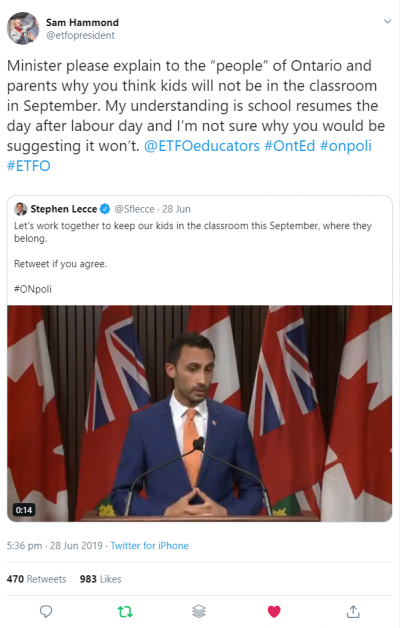
Consider this recent tweet from Sam Hammond to our newly appointed MOE Stephen Lecce. It appears that despite going on a nearly 5 month break from the legislature, the new minister was concerned that teachers did not know their schedules.screenshot-twitter.com-2019.06.30-20-35-53
You’ll come to your own correct conclusions about the collection of castigating contrarians currently in public office. I have. With so many educators still in teacher mode, more are becoming actively engaged in challenging the effrontery of messages like Lecce’s. This is in order to protect all students from the political dynamite intended to undermine the bedrock upon which our stable and progressive society was built. It may be Summer, but time out of the classroom can be well spent in dispelling false claims and  controversial assertions coming from the ruling party.

One of the biggest loads of misinformation in need of incineration has been the outright promise that no teacher jobs will be lost. This has been a massive cause of concern as class sizes have been co-opted. It has also come with the staggering and sad losses of positions for many amazing educators. Many who continued to go beyond the job in order to serve their students all the while holding the cards of an uncertain future.

Someone who is going beyond to inform us all is Andrew Campbell. He curates a comprehensive document that shows how the cuts to education are affecting our profession by the numbers and from board to board. Warning, this might provide many with night terrors if they read it before bedtime.

This is what keeps teachers awake at night. We have to deal with stunted salvos like the one above from Mr Lecce and disrupt its corrupted political narrative. We must take a stance for the students whose voices and opportunities are being stripped down to the basics in act that will only destabilize their future by limiting their access to education. This is beyond anyone’s mandate or scope of power. No decent citizen voted in the hope of shortchanging the future of our youth.

In order to get past it, we must go beyond signing petitions or retweeting.

So stay up late.
Write a letter to your MPP.
Support and encourage one another.
Read up on the issues via @ETFOeducators on Twitter or via the Building Better Schools website.

We must go beyond the government insults, the inexplicably random policy choices, the gutting budget cuts, the acrimony, the villification, the distrust, the disingenuous praise, and the indifference because the 2 million students who we are fighting for are worth it.

There is something each of us can do to make sure our collective voices are heard. Sharing yours in July and August while you rest, recharge, and prepare for September will ensure that our support of students will be heard loud and clear all Summer too.

When the bells ring again in September, our answer to the ruling party will be in the form of 83 000 + strong devoted educators each ready to teach far beyond the destructive discourse of a politician’s disputes, and instead straight to the hearts and minds of our students like we always do.

Best to you all this Summer. Thank you for a great year of interaction and inspiration. See you on Twitter.

Building bridges


The Photographer [CC BY-SA 4.0 (https://creativecommons.org/licenses/by-sa/4.0)]

Recently, I found myself staring from the platform of a steel, wood, and wire bridge at the top of Les Chutes Montmorency in Quebec. As the water spilled down the worn rock face into the St. Lawrence River, I could feel the structure moving, ever-so-slightly. Dozens of tourists were there too. I wondered if they felt it while they crossed, stopped, and admired the power and natural beauty.

To me, the vibrations were reminders that things are in constant motion and that the gentle movement of the bridge was making my senses aware of my surroundings much more than usual. What struck me in between the movements were thoughts of the incredible collaboration that went into designing and building this structure for everyone to safely enjoy the view. So much commitment, preparation, and care had to be put in long in advance of the first steps ever being taken across this spectacular wonder.

This made me think about how teachers are so very much like bridge-builders in their schools. We start laying out possible plans in late August and September. Once the first bell rings, we usually have to head back to the drawing board in order to re-coordinate, re-calculate, and reconsider it all once the classroom is filled because it is not until then that we really know the exact terrain or the distance we will need to span. Experience says that there is always a danger when we start construction too soon. Ocasionally, a demolition is required to re-start the build on a stronger and more secure footing.

Come October and November, construction of our bridges is in full swing. Shifts are organized, jobs are evolving with new work being delegated daily, and of course, focii reframed. Foundations are set and you can see signs of progress. As with any project, unknowns are constantly popping up that could not have been predicted on paper while planning. Usually these are best mitigated through preparation, experience, and flexibilty. Construction must go on.

December and January has our crews working productively in all areas. A well deserved break to rest, recharge, and regroup sees everyone returning to routines. Unlike September, the plans are not in flux. There is clear evidence of the mission, along with a sense of quasi-accomplishment, and it is encouraging to be at the half-way point. By now, some significant challenges have been overcome. Trials and tests are natural parts of overcoming impassable terrain. There is much to learn on a construction site.

It seems like we roar through February and March at school. Our bridge is really occupying the skyline now. We are able to see things from new perspectives. There are so many clubs, teams, and lessons to reckon with and distractions are not uncommon. It is important to remind everyone about the goal and the importance of the bridge they are building.

For me, these are some of the most frantic yet peaceful months of the school year. Frantic because of completing first term reports and peaceful because the rhythms of learning are clearly clicking. March Break doesn’t hurt either. Through it all brick by brick, board by board, and wire by wire it is all coming together. Through all of this time, attention is focused on safety and stability. Each day, measurements are taken to make sure everything is going as planned. In the classroom this might be a conversation, or an observation. Some times the ears and eyes of a teacher notice more and gain far more insight than is ever conveyed on a paper through a pencil.

April and May seem to happen at an accelerated pace. The end is in sight, yet somehow it can seem like the finish line is being moved further down the track. Students have become increasingly more interested in outdoor activities after being cooped up all Winter, and then kept off the grass for nearly the first 6 weeks of Spring. Movement is crucial here. Construction on our bridge is nearly complete.

Come June, our 10 month bridge building project concludes. What was once a rough and uncrossable expanse is now connected from one side to the other. As if, for the very first time, we collectively look up from our work, take a few steps back, and marvel at the work that has taken place. Our work.

By June’s end, the memories of lessons, tests, and reports are already fading, but not the positive relationships made, the acts of kindness shared, or the struggles overcome. Know that these memories will last like a well built bridge that can be crossed over years after being completed.

Thank you for being the bridge builders teachers. I look forward to building new ones with you all in September.


Long-Range Plans

Alright, now I know that some of you saw the title for this post and thought, “Seriously? Long-range planning now? It’s almost the end of the school year. I’m just trying to make it through!” Well, if you still gave me a chance and clicked to take a read, I thank you. This post comes out of a conversation that I had with a colleague through email earlier this week.

In April, I had the chance to visit her classroom to see the design project that students had been working on all year. It wasn’t a project that was taking them all year to work on but it was a magical experience where one piece of learning connected to another, and then another, and another. While students were developing a deep sense of community and empathy for the experiences of others, they too were uncovering how their communities can become greater places for acceptance and inclusion. While emailing back and forth, sharing pictures of student work in action, she said the following:

“There aren’t any ‘long-range plans’ that can foresee the type of community a class will become.”

While this was in context of the work that was happening in this class, I got a huge “ah ha” moment when I started to think about how I go about creating my long-range plans. I usually sit down and start to think about what grade(s) I’m teaching and go through curriculum resources to see which big ideas relate to events or times of year that might be better for authentic experiences and set about planning from there. While I like to think that I hold to what is in my plans, I know that they should be seen as a “living” document in the sense that it must reflect the abilities, needs and interests of the students it serves. While these are big ideas for our units of study, student inquiries may lead them in specific directions. My plan is mainly an outline which may be altered based on student needs. I often make this explicit to parents during curriculum nights.  But now as I think of it, the learning that my colleague, Barbara Robson, was referring too was so much more than specific curriculum, but I would dare say that it was perhaps that hidden curriculum, whereby students are learning skills that go beyond the content that we are supposed to be teaching. This got me further thinking about how I might be able to go about planning differently in future.

What if in addition to of outlining the curriculum, which I still think is important to know where you’re going within the guidelines set forth for us; the plans also included the specific skills (or the hidden curriculum) we wanted to develop with students? What if my long-range planning was more intentional and included specific opportunities where I was going to work on creating experiences for students that developed their critical thinking, communication, collaboration and creativity? What might that look like? How might I help students explicitly understand that this is also the “curriculum” that we are working to uncover while engaging them in the curriculum from the Ministry of Education? Would this help students be able to speak to the changes that they were noticing in themselves over time in these areas? Would that make for interesting parent-teacher interviews if we empowered students to speak to these skills along with knowledge acquisition and the synthesis of information to create?

I just threw out a lot of questions there and I’m really interested in how educators are working towards helping students explicitly and intentionally building a transferable skillset over time. We know that the workforce is evolving and as educators, part of our mandate is supporting the development of the skills in students. I’m starting to think about what September might bring and I wonder if the interweaving of the curriculum I’m given, along with the “hidden curriculum” that we know students need, into my long-range plans might make for more intentional work.

We’re winding down for the school year and this might be food for thought for the coming year. Already doing great things around skill development explicitly and intentionally with students? I would love to hear about it!

Pride

June is here! Well…almost. When I think of June, I am reminded of Pride. And while I think that every day should be filled with inclusivity in all its forms, I know that this doesn’t happen in all spaces. In this post, I would like to highlight two of the amazing resources that ETFO has to offer as we continue conversations around equity and inclusion, specifically for members of the LGBTQ Community.

While this year is slated to mark 50 years since the decriminalization for members of the LGBTQ community in Canada, we know that members continue to face issues of inequity and discrimination on an ongoing basis. In classrooms and schools, now more than ever, I believe that students need to know that these spaces must have room for everyone. In education, everyone deserves to see their whole selves represented and as educators, we have an onus to do just that, no matter of our own biases.

ETFO believes that LGBTQ education and training creates safer working and learning conditions for everyone. As such, on their site, you’ll find an abundance of resources. They have made the work of creating inclusive environments more accessible for educators. I’m highlighting two resources that I think would be incredible opportunities to guide meaningful conversations within classrooms.

The LGBTQ Education Timeline

For the 2014 World Pride, the Canadian Lesbian and Gay Archives (CLGA) and Pride Toronto collaborated to create an LGBTQ Education Timeline poster. The poster was created to show the historical changes in LGBTQ education and issues in Canada. In 2016, ETFO collaborated with the CLGA to update the timeline and add an accompanying booklet.

Like a bulletin board with memorabilia of important events you’ve gathered over time, the poster is spectacular in its display of information in a clear and concise way for students to be able to read and understand. While the poster gives a visual representation of historical events, the booklet includes more descriptions and links throughout and in the reference section that gives even more in depth information. The purpose of these resources is for educators to gain knowledge for themselves and to use within their classrooms. While digging in, I found myself both being ashamed for not taking the time before to educate myself more and amazed by all of the work that has gone on so far. I think the poster might be a great jumping off point for students in middle or high school to consider what has already been done and what new or innovative ideas they might like to create within their own school communities. The idea being to bring awareness to current issues and as a call for action for greater inclusivity.

The Every Teacher Project on LGBTQ-Inclusive Education in Canada’s K-12 Schools

The Every Teacher Project Recommendations Toolkit is the culmination of a national research effort to advance knowledge on LGBTQ-inclusive education. This Toolkit is a guide to support the implementation of the Every Teacher Project recommendations for all levels of the school system. It was developed for use by teachers, teacher organizations, and others wanting to support the development of LGBTQ-inclusive schools.

I have to start off by saying that the glossary of terms was extremely helpful. For me, understanding, especially as it relates to terminology, is an essential first step when we think about gaining a greater awareness. For that alone, I would say that this resource was phenomenal.

I also really love the appendices with a wealth of further resources. I especially appreciated page 207 which included Days of Awareness/Events and their significance. I’m learning more and more the value that celebrating these days – and not just for the sake of celebrating but for the acknowledgement of individuals for whom these days are significant – is important to students.  The more we highlight for our students the significance these days represent, the greater capacity for empathy we are able to build as students learn to understand the experiences of others. That empathy can lead to actionable change as they are either supported and accepted or work to become allies.

The above are just two of many resources available on the site. Please take a look and some time to reflect on your own biases, knowledge and classroom practice. If conversations around equity and inclusion haven’t already been happening in classrooms and schools, there is still a few more weeks to go. Take some time to dig into these resources for yourself and have brave conversations in your classrooms. I’ve said it before, as educators we are in the unique position to help our students develop empathy and to support the next generation as they are eager to create change in the world. Our classrooms and schools need to be safe places for them to be able to do this work!

Happy Pride!

Don’t Judge a Teacher By The Bulletin Board

I remember going to the Reading for the Love of It Conference in Toronto for the first time as a fairly new teacher.  I heard Mary Bigler  speak in a motivational keynote address.  She told a story that has stuck through me through the years.  It was about a brand new teacher who was full of energy, enthusiasm,  great “new” ideas and some judgement about her “older” colleague across the hall that taught the next grade.  This young teacher, (let’s call her Samantha), made sure that students were working in co-operative groups and made the learning exciting and engaging.  The teacher across the hall (let’s call her Eunice) had a structured, desks-in-rows, routine program and a quiet classroom.   Samantha often stayed after school into her evenings changing her bulletin boards and arranging desks into new formations.  Eunice would often leave shortly after the bell and sometimes her bulletin board was empty!  Throughout the year this Samantha considered her program to be superior.  She had learned all of these “new” strategies in teacher’s college and looked upon the program of her colleague as being antiquated.  She loved hearing that she was the “fun” and “best” teacher.  However, no matter what Samantha tried there were students who she could not seem to reach.  She tried all of the strategies that she had learned and she felt that she had given her all.  When it was time to send her students on to the Eunice for the next grade, Samantha was distraught.  Certainly the students would not do as well as they had in her engaging program.  They would be bored and wouldn’t thrive within the rigid structure Eunice’s classroom. Would those “unreachable” students fall further behind?

Samantha was surprised by what she witnessed in the fall with “her” students.   The students that had experienced her “exciting” program were also enjoying Eunice’s classroom.  They talked with excitement about what they were reading and writing and referred to Eunice as being the “best” teacher.  The few students who Samantha couldn’t seem to reach were thriving with the routine, quiet and structure of their new classroom.  Samantha learned a few things during that first year experience:

1.  You can’t judge a teacher by the bulletin board.  The culture of a classroom can only be truly experienced by the students.  We don’t really know what goes on behind the closed classroom door of a colleague.

2.  Every teacher has a different skill set.  Although Samantha was an engaging and exciting teacher, the students that she couldn’t reach thrived in a routine and structured environment.

3.  Children can have short memories.  In the primary grades, the “best” and “favourite” teacher often changes each year to their new classroom teacher.  It isn’t personal.  It is about the reference point of a six year old.

4.  Comparing ourselves to other teachers doesn’t serve the students.  Working longer hours doesn’t always mean that a teacher is more effective, it might mean that they are less efficient.  Teachers with experience likely have a better understanding of the curriculum and can rely on lessons that they have previously prepared. Teachers who have an understanding of work-life balance also may have more energy to offer their students.

5.  The experienced teacher across the hall has years of experience with strategies to serve the needs of students.  Instead of judging; ask for their help.  Most of them would be more than happy to share their strategies and wisdom with a colleague.

It isn’t about being “Teacher of the Year”. It is about being the teacher that your students need.


Collaborative Inquiry Celebration

The other day, many teachers from across my school board gathered together to share with other educators how their year long inquiry project went. As I have mentioned in previous posts, mine was about starting our own business as a class and inspiring my students through leadership. I shared with the other educators these successful stories from our project “8A TREATS”:

  • how many of my less successful students with traditional subjects have been excelling during this project
  • the success my students had with gathering data from classes around the school
  • collecting permission forms from the entire school
  • advertising by making imovies, posters and using a dinosaur mascot to travel around with a fake smoothie
  • tallying the smoothie results for flavours and sizes with spreadsheets
  • counting and tracking the money with spreadsheets
  • find and then order paper straws from Amazon to be environmentally friendly
  • working with a budget that was donated from the student success foundation
  • designing logos as a class, voting on the best one and then collaborating with a clothing design company to recreate this on their products
  • painting and creating a wall in our classroom that will be the location behind our brand
  • creating a video to explain the project as well as talk about our favourite parts

Image-21    (<<<our student create wall)


Our next steps with our project:

  • doing the math to find out how much of each ingredient we will now (plus extra) to make the smoothies
  • ordering the cups
  • setting up our classroom as a pop-up smoothie store
  • making 340+ smoothies on June 6th with our 22 students

It was very exciting sharing this project with my fellow educators. My students were very excited knowing that this project was shared with other teachers. They were proud when I told them how excited other teachers were to find out about this student centered initiative.

There were other educators who shared exciting inquiry projects:

  1. My colleague Lydia shared about her “Community Helpers” project where her grade one students inquired in various ways about the many community helpers in our neighbourhood. She had a guest police officer come by as well as had the students use their hands to explore various jobs. They were able to build, play with food as well as research all of the jobs available to them. The final touch was when my grade eight class came to help them put their thoughts together in an inquiry package. It was great to see her students so passionate about their future. To find out about her project, you can visit her twitter account @AppolonialydiaL. You can also view her project on this link <iframe class=”wp-block-mexp-vimeo hwdsb-tv” src=”//hwdsb.tv/media/grade-one-collaborative-inquiry-2019/?embed=true” width=”560″ height=”315″ frameborder=”0″ allowfullscreen></iframe>
  2. Teachers used a choice board to give students options when creating or completing tasks. These boards are made in collaboration with the teacher at the beginning of the year to go over all of the ways that presenting or completing every day tasks can be done that year. Apps are explored and used in new and innovative ways. I cannot wait to create a choice board in my literacy class next year. There was also a SAMR model student choice matrix that was introduced to us. It’s not the app that makes the project/task, it is how it’s used.
  3. I also heard about makerspaces from one of my other colleagues Cara. She introduces these daily in her library and students are able to create very interesting projects from her instruction cards set up at the tables. They are always able to be creative, explore and build in her library. They also explore media literacy during these creative library sessions.

There were many other projects I could not get to since we only had a half hour to explore and the other half hour was to share about our own projects. Some other apps worth checking out are: seesaw, read&write, book creator, keynote, canva, geogebra, TC studio and pear deck.


The Gender Gap in Technology

Quote for blog

According to a recent report* by ICTC (the Information and Technology Information Council) Canadian women represent about 50% of the overall workforce but represent only 25% of the technology industry workforce.  Of the 100 major tech companies in Canada only 5 have female CEOs and 1 Co-CEO.   26% of the tech companies have no women in senior leadership at all.  There is a gender wage gap in the industry of $7,000-$20,00 per year.  When I read these statistics I wondered as educators, what can we do about the gender gap in technology?  This is not an exhaustive list, but it is a place to begin:

1.  Build her confidence in her abilities.

2. Cultivate a community of supportive peers.

3.  Provide a STEM/STEAM club for girls.

4. Ensure that access to technology and computer experiences is encouraged and inclusive.

5. Foster interest in computing careers.

6. Be a role model as a LEARNER.

May 11th is National Girls Learning Code Day.  If you are looking to encourage coders in your school, why not begin on May 11th?  Below you will find links to resources for beginning coding.  Many students code on their own at home and may appreciate the opportunity to mentor fellow students.  The resources attached will get you started.  There is no special equipment or robotics required.  Teachers do not have to be expert coders to encourage their students.  Teachers can be role models of resilience, risk taking and problem solving by learning alongside their students.  Teachers only need to open the door and expose their students to the opportunities.

Girls Who Code Canada

National Girls Learn Code Day

Canada Learning Code

Scratch

Hour of Code

Code.org


*Cutean, A., Ivus, M. (2017). The Digital Talent Dividend: Shifting Gears in a Changing Economy. Information and Communications Technology Council (ICTC). Ottawa, Canada.

Elaborated and written by Alexandra Cutean (Director, Digital Innovation Research and Policy). and Maryna Ivus (Senior Analyst, Research and Policy) with generous support from the ICTC Research and Policy Team.

Remember to breathe (as you continue to inspire others)

I checked in on a few of my former student teachers today. Each of whom are shining examples of professionalism, commitment, and creativity in their classrooms. They have been on my mind alot lately, as daily news of the government sponsored attrition games occupy headlines and conversations across the province. I am sure they represent the hundreds, even thousands of new educators who have recently joined our calling.

It’s rough out there right now, and for many new hires to school boards the uncertainties of the day are leaving many wondering what the future holds? For each one of these amazing educators, things are changing and there is not much they can do to about it until the facts and figures are finalized. It must be difficult to know that the educational landscape is shaking beneath so many feet. We all need something to hold on through the experience.

Sharing what we have in the emotional toolbox may be all that can be done for now. I encourage everyone to keep checking in on one another as we remain united and ride out the storm. A call, an email, or time for a cup of coffee could provide a little needed encouragement. I have noticed that even veteran teachers are feeling the tension of these days too. I have caught myself stress eating, acting a little more impatient than usual, and struggling for motivation. I’ve taken to breathing exercises to slow down my busy mind. Perhaps it’s the unknowns of it all that are keeping me off my game?

To get a sense of it all I have been turning to Andrew Campbell. He curates Ontario Education Cuts. This is a list of announcements and projections from school boards and grade panels that challenges the message being delivered by the province to the public and school boards about job losses, shrinking course offerings, expanding class sizes, and shifts to online instruction.

screenshot-twitter.com-2019.04.30-20-35-35The information and numbers in this document seem to add up differently than political messages about job losses over time due to attrition and attrition alone. Maybe there is a Math Curriculum revision opportunity in the works here since such skewed accounting discrepancies exist?

What we all need is to have the complete set of numbers to work with before we can truly provide assurances to our new teachers that there will be jobs for them in education.

I remind myself that I am surrounded by incredibly dedicated and caring professionals whose lives are dedicated to making the world a better place. Stay informed. Stay encouraged. Be strong. We are all here to support and lift each other up when things get rough. Sometimes it might be a time for a cup of coffee and a conversation. Other times, it might be a simple reminder to breathe.