Bursting bubbles

POP!
What’s
that sound?
Fear and loss,
dreams – on hold,
watching, without a
voice as opportunity
is cut and cancelled.
For the people, or
for their bank
accounts?

Doubts – fill the staffroom.
Murmurs – echo down the halls.
Uncertainties – buzz through minds.

Bubbles – bursting before they are even formed.
Cuts like needles meant to pierce hearts and minds.

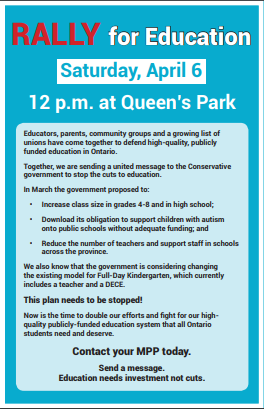
Are preparations being made for a classless class war?
Why has education been made the enemy in our province?

They say the bitter pills prescribed in government cuts must be taken or else there won’t be a future and that everyone must sacrifice because this mess is nobody’s and everybody’s fault. Yet, why aren’t elected officials in line for the same medicine that they’re prescribing? We hear tonnes of sound bites and sound bluffs. We see posturing on every stump, but where are the planters and peace makers after the forest that is public education has been razed?

We see fingers pointing in every direction because everyone is worried more about the colour of the ink on the spreadsheet than the lives that it will stain to change it.

What message is being sent to our youth by the adults, who cannot get along? The same adults making decisions about their futures? We ask our students to advocate, invest, and dedicate to their potential. We teach them to think critically, consider the facts, and make good choices. We expect students to buy into a better system, but it has already been sold out by the ones elected to take care of it.

Investing in our youth and their education should never come at a cost of denying them anything less than what their predecessors and parents had before them. Opportunity cost may be a term from an Economics textbook to understand the potential for a loss by doing something else. When we consider where things are heading in schools over the next few years, the money saved will never make up for the lost opportunity, innovation, and productivity, or the imminent financial and social costs.

Remember. Quality only hurts once. Our students are worth it. The work we provide prepares and protects them to possess a future. Our youth cannot be blamed for the mistakes of those who leveraged their futures before they were ever born. We cannot let another bubble burst and expect their children to pay for it.

The Courage to Teach
The Courage to Teach

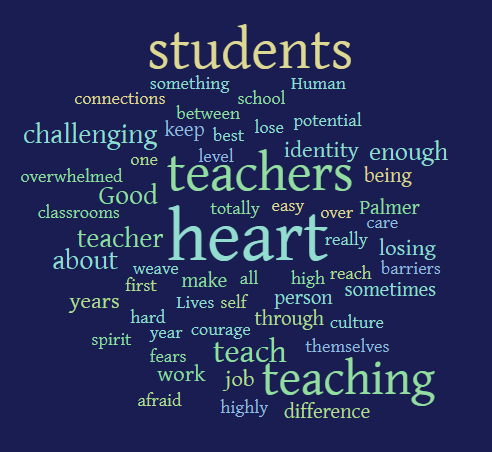
teaching from the heart

In this very challenging time of education cutbacks, teachers are on the edge. They wonder how long they will keep their jobs and what will classrooms be like in the next school year.

Losing your job as a teacher is not just about losing a job, it is about losing the work that you do to challenge your spirit to make a difference – it is about losing your heart. When teachers teach, they teach through resources no other person possesses, their identity as a teacher and as a learner and as an adult who cares about students. As a teacher of over 19 years, I know that students can tell the difference between teachers who care and teachers who do not care – and this impacts how students learn.

Parker Palmer (2007, p. 11) puts it simply “Good teaching cannot be reduced to technique; good teaching comes from the identity and integrity of the teacher.”

When teachers teach, they are connected to the students, dialed into who the students are and what interests them. Good teachers are always looking for the teachable moment to grab students’ interest and get them excited about learning.  “Good teachers possess a capacity for connectiveness. They are able to weave a complex web of connections among themselves, their subjects, and their students so that students can learn to weave a world for themselves” (Palmer, 2007, p. 11). Methods vary depending on the grade level, subject, and opportunity – lectures, Socratic dialogues of questions and answers, experiments, collaborative problem solving, or one on one discussions. It’s all good teaching when connections are made through “the place where intellect and emotion and spirit and will converge in the human self” (Palmer, 2007, p. 11), the heart of a person, a student.

As a teacher I do my best to keep my heart of teaching  strong and pliable. I have learned to roll with the challenges of teaching through dealing with challenging students, challenging parents, and sometimes challenging administrators. It is not an easy job to keep heart.

Why do teachers lose heart?

In the daily “work out” of teaching, we are highly vulnerable as we are the centre of attention in the classroom. This is a highly personal job. Students are watching us for who we are and what we represent. Our public and private lives are on the line in classrooms. We must be ourselves but we also must have a suit of self-protection against high levels of criticism that are meant to break us. Teachers will ultimately make mistakes in their teaching, in their assessment, and sometimes in their judgement but I find that students are usually very forgiving, especially if the teacher owns the mistake.

Another reason why teachers lose heart is that teaching can be very challenging. What makes teaching really hard is in seeing the potential of students and identifying the great barriers students face in fulfilling their best self. The challenge is to face with the barriers that limit students’ potential. Human potential gets sidetracked by disability, culture, identity, family, school culture, community, and economics. In having high expectations for all students, teachers make a grand difference in the students’ future. Teaching students how to get around these barriers is key to their social, emotional, and academic growth. When using intuition and identity, teachers discover ways to reach students’ hearts.

To become a really good teacher, it took me over 8 years of practice. That’s about 10,000 hours – Malcolm Gladwell’s 10,000 hour benchmark for achieving success (Gladwell, 2008).  In the VITAE (Variations in Teachers’ Work, Lives, and their Effects on Pupils) study, with 300 teachers in 100 schools, that examined influences in teachers’ identities, Day, Sammons, Stobart, Kingston, and Gu (2007) found that teachers reach their highest level of efficacy between year 7 and 8 in teaching.

In the first couple of years of teaching I went from being totally overwhelmed in the joy of teaching to totally overwhelmed with the disappointment of teaching. Some days I was afraid. I was afraid of not being competent enough, not working hard enough, not meeting students’ needs enough, not connecting with students enough, and sometimes not being quick enough when a student threw a chair in my direction (this happened the second week of my first contract).

Even after 19 years of teaching, I still have fears, but I am not these fears. Instead, I teach with courage and resilience and discovery. I teach from curiosity, honesty, hope, empathy, and conviction. I teach from who I am. I teach with heart.

I implore teachers to have the courage to teach in these challenging times. To never surrender to a person who is trying to trivialize your work as something easy and simple and something that can be done by technology … because computers don’t have heart.

Be brave. Teach from your heart.

Collaboratively Yours,

Deb Weston, PhD

References

Day, C., Sammons, P., Stobart, G., Kingston, A., & Gu, Q. (2007). Teachers matter: Connecting lives, work and effectiveness. Maidenhead, UK: Open University.

Gladwell, M. (2008). Outliers: The story of success. Hachette UK.

Palmer, P. J. (2017). The courage to teach: Exploring the inner landscape of a teacher’s life. John Wiley & Sons.
 

Be Strong in the Face of Poor Government

FDK (too soon)

EQAO (to help real estate $)

Class sizes (to build resilience)

Drill and Kill Math (We’re Open for Worksheets)

Funding formulas (creative govt accounting to underfund boards)

Antiquated HPE curriculum (since no one needs to learn about consent)

Don’t let them fool you.

Despite what the government says to the contrary: public consultation involves asking many more people than a few plum political campaign contributors. The world is not flat, and Ontario has one of the best education systems in the world.

Be strong. We serve over 2 000 000 future voters, taxpayers, and consumers who will be impacted by the short sighted and overt actions of the current government to undermine our profession. Why would anyone want to risk losing 2 000 000 votes to curry favour with businesses who prefer to pad their bottom lines rather than pay their share of taxes. It’s time we start to boycott the companies that lobby our governments for an even slimmer share of their tax obligations while holding jobs over everyone’s heads. It’s time to unite.

Be strong. The work you do has meaning. Yours may be the only kind words and smiles that a child receives each day. That snack you pay for and provide means more to that child than you could ever know. The time you invested in coaching students(teams, academics, life) long before and after the day is done continues to impact their lives long beyond the years in school. You are equipping students to do great things in their own lives and the lives of others.

Be strong. The time you spend learning, creating, and collaborating with colleagues matters. None of us is a strong or as smart as all of us when we work and stand together. Stand together, support each other when times are tough and the government tries to undermine our confidence and that of the public in us with misinformation.

Be strong. You matter. Education matters. Our students matter. We matter. And because we do, it’s time to work, even more closely together, to support one another for the collective good, not the corporate coffer.

Be strong. screenshot-www.etfo.ca-2019.03.31-21-50-18screenshot-www.etfo.ca-2019.03.31-21-50-37

Before you get hurt…again.

https://pixabay.com/photos/concrete-space-empty-3161863/

Student: (momentarily non-responsive to verbal interaction) slap, push, slap, hair grab, lunge, slap, yell, cry, run, crouch, cry, calm, apolgize

Staff: (1 CYW, 2 SERT) block, block, reassure, block, supportive stance, reassure, block, redirect, clear space, block, reassure, follow, remain calm, reassure, accept

The slaps(verbal/physical) are like slabs of concrete that a student piles up when they are in distress(feeling helpless, unheard, confused, frustrated, angry, trapped, hurt, and _________).

Our students are using these slabs to construct walls which will insulate and protect them from what they feel are are real threats to their wellbeing, happiness, and safety. All the while, staff are working tirelessly to keep them from walling off completely to the point of hurting themselves or others because the ability for flight has left, and the fight is on…again.

It has been happening a lot more frequently in our classrooms and it knows no age limit as educators are experiencing violence from JK to 12. Has it happened to you? How about to someone in your school?

A 2016/17 survey of elementary teachers showed that 70% of them had experienced or witnessed violence in their schools. That distills down to an average of 7 in 10 educators are on the frontlines of a serious problem. No one wants to work where threats and acts of violence are now daily bi-products of their job? Yet, that’s what many teachers are facing as they enter the classroom each day. Even with NVCI, CPI, SERT, CYW, EA, IBT, BHS, and Social Work support in the building or available from regional teams, incidents are increasing in number and intensity.

Students are taking out their frustration, anger, and anxiety in physical ways directed towards school staff. More than ever, it is being documented and reported more across all age panels. So what’s happening inside our schools where once seemingly uncommon incidents are now daily occurences? All of this cannot simply be dismissed as statistical anomalies.

A reminder

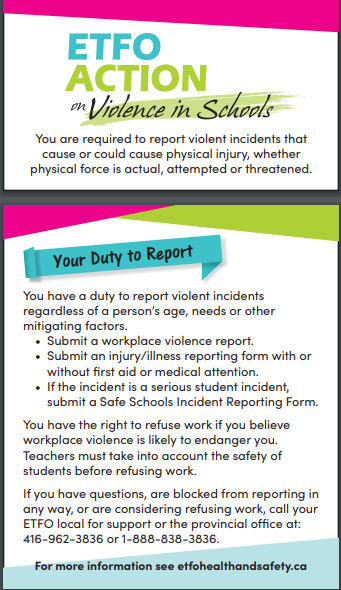
Before you get hurt, or hurt again. Each time a student slaps, bites, kicks, target throws, pushes, strikes with an object etc. a report must be made. If you are injured, seek medical help first. Make sure you tell someone (union rep, admin, a colleague). See the graphic below to make sure you are protected as you have the right to refuse work when you believe workplace violence is likely to endanger you. If you are hurt, it is not the time to play through pain or put on a hero cape. It is your health and well being that must be protected. No one should go to work expecting to be hurt on the job. If you need help, call your union rep or a colleague. Let your voice be heard.

http://etfohealthandsafety.ca/

Our schools cannot be left under-supported with an expectation to educate our students in the face of increasing violence and increasingly complex behavioural needs? Our schools need supports in place to ensure safety for all and that includes you.

I will leave you with this final question.

How have spaces of nurture, growth, hope, and community also become places of anxiety, stress, harm, and PTSD for both teachers and students? How are you managing in your school? Please keep the conversation going.


 In case you need some more food for thought

Our notifications, news outlets, and social media feeds are filled with stories, images, and video sharing what’s happening. As I draft this post. CBC News shared a disturbing news story that surfaced online involving a teacher being assaulted by several students in Toronto.

Read more about how ETFO has been lobbying our government to address the issues of violence in our schools.

https://www.thestar.com/yourtoronto/education/2017/01/17/teachers-union-raises-alarm-over-rising-violence-in-schools.html


Update: Inquiry project

An exciting update for my classes upcoming inquiry project, our board has funded the project for us! Students in my class will start to work with the supplied budget to help them start their treat company! This funding will make it possible for the students to make this project the best it can be.

This week they will start planning for the supplies to make the smoothies and their advertising/media project will be made possible due to the funding that will allowed them to order stickers or other items to be introduced with their treats. We are excited to begin researching paper straws and look at why it will be better to purchase the paper straws vs. the plastic ones. We will also continue to look at the best combination of ingredients in order for our smoothies to taste as good as possible!

We will have to look for suppliers for all the products now that we have the funds to buy them. This project is so exciting and I look forward to updating you all on the steps we take.

A group of ten of my students (out of 22) have indicated they would like to be in charge of delegating tasks and headlining the operation. I am so excited for my students to take this project under their wing. It will be great for them to understand that in the future they can all run their own businesses with hard work and sound thinking.

On another exciting note, two of my students applied for a grant for a mental health day at our school with fun activities for students in grade JK-8 to participate in. This will be another fun venture for my students to plan! It is awesome to see so many opportunities available to kids in our board… hopefully the funding will always be there 🙂

It’s About Relationships!

Over my 10-year career as an educator, there have been a number of times of uncertainty in education. These are the times that drive us to reflect on why we became educators: to have an impact. There have been some great posts within this platform with fantastic tips on how to thrive during these times. For this piece, I’m thinking about relationships.

We all know that at the forefront of education is the power that comes from building meaningful relationships, both with our students and colleagues. It’s was fuels the work that we do and empowers us to see the impact that we can have, are having and will have. It’s through relationships that we keep the lines of communication open when parents and students who don’t always know what the impacts may be a school community.

When I think about relationships I think about creating spaces that are:


  • Open to dialogue
  • Safe to try, fail and try again
  • Real


Open to Dialogue

Ever been in a quiet classroom or one where the main voice was that of the teacher? How did it feel? On the other hand, have you ever been in a classroom that was loud and slightly chaotic with meaningful dialogue happening amongst students? How did that feel? I’m sure that both spaces feel very different.

I believe that “the rules” we have in the classroom, set the tone for the way in which our students converse with each other. When students feel free to be able to bring their experiences, thoughts and ideas into the classroom, there’s a sense of freedom that comes from being who you are with people who care. Now, don’t get me wrong, I’ve been in buildings where administrators wondered about the noise happening in my classroom but when they can come in, spoke to students and saw that it was purposeful, some of the questioning dissipated. Many would also drop in for our times when we were connecting on things that were meaningful to students and had an impact both in within the classroom and the world around us.

I believe that classrooms should be spaces for students and educators to have open dialogue about what is being learned within the classroom which should also include real connections to what is happening in the world. These are sometimes courageous conversations that need to be met with students having the opportunity to share their concerns and having a non-judgemental adult being there to help guide with facts and information.  We want students to be asking rich and meaningful questions of each other and understanding that communication is a skill that they can work to develop with each other. That means that they don’t necessarily have to agree with the thoughts and ideas of another but they understand that they have to respect that diversity of thought exists.

Safe Spaces to Try, Fail and Try Again

Growing up, I always felt that at school, I had to be perfect and show what I knew. Failure wasn’t embraced and there was a culture around making sure that what was shared was the right answer for that was most important. The stress that this puts on students when they should be in a space where learning and the progression of skills and knowledge is embraced is unbelievable. As such, I tried to create spaces where students could present themselves as is and we could work towards helping them to improve where needed.

Now I can’t say that this is an easy task but imagine if students felt safe failing and viewed it as an opportunity to get back up and grow. A place where talking about what they believed to be correct and working to identify misconceptions and helping students to consider what other options might be correct. Or better yet, having their peers work towards helping to change misconceptions. What if we offered students the freedom to fail and then the opportunity to try again after providing feedback and clarification for them? This takes work, time and effort but how might the climate in our classrooms change and how might they help to deepen connections made with each other? What outcome could this provide for students in the long term?

Real

People naturally gravitate to those who are real and genuine. Colleagues are genuinely navigating uncomfortable spaces at the moment and it’s important to be able to have at least one critical friend with whom we can share our concerns but who will also empower us to continue with the goal that we know is most important, our students and their success. Have you found a critical friend? One with whom you can be real and know will help to encourage you on those tough days?  

While we are uncertain of what the outcome of the changes in education may be, we do know that through relationships, we can stay true to what we believe to be the most valuable part of our role: having an impact in education.

Back in the day was better(because now is often unbearable)

Have you ever seen or heard of students…
…compromising their identity to put on someone else’s?
…blasting their music through headphones so they don’t have to answer another question
…not quite knowing where they are going or who to ask for directions?
…taking that swig, puff, or hit to show the crowd how much they are like them?
…dressing like cookie cutter versions of each another just to feel safer in the pack?

The problems I listed above were all problems 40 years ago when I was in junior high school and they are still around today. Except now since everything is bigger and better than the good old days, the issues facing our youth have evolved in their complexity and impact on lives.

Now I ask, have you ever seen or heard of students…
…stressed out about getting into a “good” high school?
…anxious over a test, project, presentation, or recent assessment results?
…taking days off to destress over misunderstandings resulting from social media posts?
…refusing to eat because of a thoughtless and cruel comment about their appearance?
…self-harming or self-medicating in order to deal with feelings of helplessness, rejection, loss, anger, or sadness?

If so, these students belong to a growing population of students who are feeling the pressure of the 21st Century like never before. I wish this was a group that never welcomed anyone, but our world is not wired this way. What is most alarming about all of this is that it seems to have been downloaded from high school now as many of the concerns happening above used to await our JK to 8 students once they arrived at secondary school.

This year a portion of my instructional time has been dedicated to the role of Guidance Counsellor, and it has been a very eye-opening experience thus far. Imagine all of the above happening at schools across the province and around the world? It is not a pretty picture to realize that our students are hurting. The numbers must be in the millions and that I think that fingers need to be pointed in all directions because it is the adults who have made the mess in the first place and now they are trying to make the kids clean it up.

What our students need more than ever before are increased access to programs and personal supports through education and health care. How are we going to improve this when the elected bodies managing our money are making cuts to appeal to an undertaxed political support base? How can so few people dictate blantantly harmful funding cuts without gauging the socio-economic short fall they are creating by trying to pinch pennies.

A recent CBC broadcast highlighted an increasing need for more guidance counsellors in schools, but it focused more on the side of career counselling without much mention of the impending crisis lurking in the hallways of our elementary schools. In my blog Illness, I shared that schools are too often on the front lines of mental health and well being care in our society, but it is coming with consequences that will cost us billions in the long run if we fail to invest millions now to fully support our learners.

“Teachers are not trained psychologists. Schools are not clinics, and school boards are not health networks. Yet everyday, educators are on the front lines of care for those who suffer. This includes themselves. How can we address a growing need in our profession to support one another while supporting our students in areas where few are trained to inhabit?”

We need help. There is more demand for supports on already maxed out educators than ever before. Our students need help. We all need to be talking about this. Our union needs to exercise its collective voice on behalf of all learners. So even while students continue to reach out, there are an equal number at risk of being over-looked because, they’ve lost their voices or there are not enough ears to listen.

Our students need help. There are neither enough hours in the day nor teachers in our schools to deal with the depression, anxiety, and doubt plaguing our youth. If we allow government to cut education funding in the hopes that everything will get better, then we are saying to a generation of learners that they weren’t worth it, but “Hey, look at this sweet ride we just got.”

40 years ago, there were already plenty of problems facing our students, but there was always hope to be gained from the security found in education.  Now we see things have only deteriorated due to downloading the costs onto the next generation. Our students are struggling to see the present, let alone the years to come. This has to stop. We need to pay for the future now so all of our students to look forward to instead of dreading. What we don’t need are cuts to education or mental health funding that would leave any of our students vulnerable.

And we definitely don’t need a used party van for a self-serving party politician and his sycophants.


Inclusive Education for All Students Including Those With Special Education Needs

Rebecca

As Ontario teachers, we know that there is a current challenge in addressing the learning needs of special education students with significant behaviour issues including violence against school staff.

The Elementary Teachers Federation of Ontario has developed a multi-year strategy to address violence in schools. This states specific goals and includes resources such as videos on how to address needs:

  • Lobbying the Ministries of Education and Labour to address violent incidents in schools and improve school board compliance with health and safety legislation;
  • Working with Ministry and school board representatives to improve workplace violence reporting and compliance procedures and develop training materials;
  • Building community advocacy to press the government to review its education funding formula and provide more funding for special education and support for students with high risk behaviors; and
  • Providing ETFO locals and members with enhanced education, training and resources on dealing with workplace violence.

Today, I read an excellent article by Caroline Alphonso  (The Globe and Mail, January 5, 2019) discussing how students with special education needs are being excluded from school due to their behaviour and violent tendencies. Alphonso cites Annie Kidder of People for Education stating that in 2018 “58 percent of elementary school principals and 48 percent of high school principals reported asking that a student with special needs not attend school for a full day” (Alphonso, January 5, 2019) due to insufficient classroom support. In addition, in British Columbia, special needs students miss up to 35.5 school days a year (BC Confederation of Parent Advisory Councils, cited in  Alphonso, January 5, 2019).

Violence against teachers is documented in a 2018 Canada wide study, Pan-Canadian Research Review on Violence in Schools. The study showed that rates of violence against teachers ranged from 41% to 90% and that elementary teachers working in lower socioeconomic locations experience the most violence (Canadian Teachers’ Federation, July 8, 2018). Key findings included widespread funding needed to provide resources, services, and training to address inadequacies in services for student mental health, behavioural, and special education needs.

To put this bluntly, the study stated that schools do not have enough trained support staff to deal with the increases in students’ needs and the result of this discrepancy is that students are not attending school.

I was prompted to write this blog after talking to a colleague. She regularly calls me to seek advice and support for her daughter, Rebecca. When I mentioned that I would like to write about Rebecca, my colleague wanted me to use her daughter’s name. In the most recent crisis, Rebecca was banned from taking the bus to school and regularly sent home early, due to her behaviour. On the bus, Rebecca broke a school bus window, was accessing her dirty diaper and playing with its contents, and attacking the teaching assistant staff. Rebecca is a highly autistic youth who functions at about a 3 year old child’s level.

The first thing I did was question why Rebecca was in a dirty diaper on the bus. The school staff told my colleague that Rebecca said “no” to getting her diaper changed. The school staff also stated that Rebecca was having regular meltdowns in the hallways at school so they could not take her outside. The staff also said they were not allowed to touch Rebecca. Rebecca’s outbreaks and violence often resulted in her being sent home. After further discussion, I wondered how much training the educational support staff had to address Rebecca’s specific needs. In addition, Rebecca was being excluded from attending school.

Rebecca’s mother asked me to do some research specifically to help advocate for her daughter’s needs and advice on how to address these needs with the school principal. I looked into the policies and laws dealing with students with special needs. I specifically cited Policy/Program Memorandum No. 119, Developing and Implementing Equity and Inclusive Education Policies in Ontario Schools, as it states that our “publicly funded education system is to support and reflect the democratic values of fairness, equity, and respect for all” (Ontario Ministry of Education, 2013). Through Policy/Program Memorandum No. 119, school boards, and teachers, must address barriers to learning that fall within prohibited grounds of discrimination set out in the Ontario Human Rights Code.

Rebecca was facing discrimination against her right to attend school due to her disabilities. After filling my friend in on the details of Rebecca’s rights, I suggested to her that she ask questions on how Rebecca’s specific needs were being met.

Just after New Year’s day I got a call from Rebecca’s mother. The school’s principal started putting measures in place to ensure Rebecca’s needs were being met. The school brought in specialized trainers to train the teaching assistants on how to deal with Rebecca and her outbursts. The school bus windows were changed to unbreakable Plexiglas and Rebecca was fitted with a specialized body suit so she could no longer access her body while on the bus. The teaching assistants were instructed not to allow Rebecca to have meltdowns in the school hallway and told to promptly pick her up and redirect her. The teaching assistants were also told that Rebecca must have regular, daily physical activity, inside and outside of the school, as well as daily quiet time. The teaching assistants were also told to change Rebecca’s diaper immediately after a BM.

The result of this training was impressive. Rebecca stopped banging the bus window because it was too hard on her hands. Rebecca quietly stayed seated until the staff came on the bus to get her. Rebecca stopped having meltdowns because she no longer had an audience to watch her very brief outbursts. Rebecca stopped hitting staff. Rebecca’s behaviour is not perfect but it is manageable. And here is the best part, Rebecca started to ask when she was going to school. I cried when I heard that!

This story shows that with enough support and trained staff, students with behavioural issues and violent tendencies can have their needs met. With this approach, students, staff, and teachers can have good quality school experiences.

I would like to thank Rebecca’s principal for supporting Rebecca’s needs – because this girl wants to go to school.

I ask of all teachers, principals, and school staff to reach out to advocate for students who are not so easy to teach so they can attend school – because this is their human right.

Collaboratively yours,

Deb Weston, PhD

References

Alphonso, C. (January 5, 2019). Educating Grayson: Are inclusive classrooms failing students? The Globe and Mail. Toronto. Downloaded from https://www.theglobeandmail.com/canada/education/article-educating-grayson-are-inclusive-classrooms-failing-students/

People for Education. (September 4, 2018). Changes needed to make Ontario schools more inclusive: Ontario Human Rights Commission policy includes recommendations for province and school boards, People for Education. Downloaded from https://peopleforeducation.ca/research/new-policy-recommends-changes-to-make-ontario-schools-more-inclusive/

Canadian Teachers’ Federation. (July 8, 2018). News release: Lack of resources and supports for students among key factors behind increased rates of violence towards teachers, Pan-Canadian Research Review on Violence in Schools, Canadian Teachers’ Federation, Downloaded from https://www.ctf-fce.ca/en/news/Pages/default.aspx?newsid=1983998942&year=2018

Ontario Ministry of Education. (2013). Policy/Program Memorandum No. 119: Developing and Implementing Equity and Inclusive Education Policies in Ontario Schools, Government of Ontario. Toronto. Downloaded from http://www.edu.gov.on.ca/extra/eng/ppm/119.pdf

Elementary Teachers Federation of Ontario. (2019). ETFO Action on Violence in Schools, Elementary Teachers Federation of Ontario. Downloaded from http://www.etfo.ca/DefendingWorkingConditions/HealthandSafety/pages/actiononviolence.aspx

Parents: Key Partners In Education

While in the classroom, I think that I had a pretty good understanding of the value in parents being key partners in education. Over the past few weeks, while speaking with friends and family about their experiences as parents in the world of education, I’ve learned that there is much more to this complex partnership.

Parents genuinely want the best for their children and may be more open than perceived. Keeping this at the forefront when working with parents is key. While I would like to believe that I kept this at the forefront of every conversation or interaction with parents, when I reflect on interactions where we didn’t quite see eye to eye, I recognize that it is possible that I may have had a greater focus on an outcome that I hoped to achieve. While this was always centered on a positive outcome for the student, I wonder if we could have achieved more had I collaborated differently with the parent. I recently spoke with a friend who has a child on an IEP and she shared that in her experience, it wasn’t that she didn’t want the help offered for her child, she just didn’t understand the process or how having the IEP would impact her child. Because it was wholly new and not well explained – in her perspective – she felt defensive and didn’t feel heard or understood by those in the meeting. Her once positive sentiments around education were now tainted because she felt as though she wasn’t truly heard and her questions weren’t clearly answered. Through other conversations with educators, she’s understanding that the supports offered through the IEP are in addition to what she can do at home to support her child’s learning. She’s learning that it’s a living document that can be updated and reviewed. She genuinely wants for her child to be able succeed and I wonder if taking the time to ensure that she felt heard, if this process could have been a more positive experience for her.

Great learning is already happening in homes. I’ve never been a fan of homework. I’ve always seen it as “keep busy work” that can’t be assessed and is often a source of great frustration in the evenings for families. After sharing my thoughts on homework, while many parents have appreciated that I valued the learning that was happening through extra-curricular or other activities in the home, every year, I’ve had parents ask for homework. It was always challenging to balance the two extremes but understanding the value or perceived importance of homework was something that I was after. Through conversations with parents, many felt that it would help their child get ahead or make sure that they kept practicing what was being learned in the classroom. During these conversations, we often spoke about the skills needed beyond memorization of facts and content and activities that might further develop these skills. I shared with parents activities such as:

  1. Draw a map to your friends house. Include measurements and different ways to get there.
  2. “Invent” something using the various items in your recycle bin.
  3. Take something apart to see how it works – Reassemble it if possible or create something new with the parts.
  4. Look for geometric shapes in the yard, the store, or at home. Cut them out. Measure them.
  5. Listen to different genres of music and discuss the differences.

In my searches for other family-friendly activities, I found this link with more alternative homework ideas.

Great learning is already happening in homes. For a variety of reasons, parents are looking for creative ways to work with their children and help to give them an advantage. By helping to parents to understand the value in developing learning skills, they might just be ready to jump in and give these ideas a try with their children. Potentially helping to build even greater family bonds and connections.

Nothing! Without a doubt the answer to the question of, “What did you learn today in school?”. I’m amazed every time that I hear it and understand that it’s a challenge for parents to truly get a picture of what happens for the hours that their children are in our classrooms. It was one of the main reasons why I started a weekly classroom blog. It was my way of sharing with parents what we were learning and by adding a calendar to my site, it allowed for them to keep up-to-date with current events in our classroom and school. I found that the more parents knew, the more they felt informed about and engaged in their child’s learning, which is incredibly important. Several times the answer was still nothing, and this was a great opportunity to check-in with the student and to see how best to further support them in their learning.

Making parents feel heard. Understand that there is great learning already happening in homes. Support by sharing what is happening in the classroom. These are just 3 ways in which we might be better able to partner with parents to achieve even greater success in student learning.

Best to you in all you do (an alphabetic acronym for educators)

Happy New Year! Well at least the Gregorian one. What’s really neat about teaching in Ontario is the amount of cultural sharing that occurs as part of our school calender. January 1st marks the start of 2019 on most calenders and in the spirit of rebirth, new beginnings, and good will I wanted to share a prosaic attempt to encourage you all to savour the good from 2018 and prepare to embrace the awesome potential of another new year.

Always take time to reflect on the impact you are having on the lives of others.
Being present is the best present.
Channel your energy into lifting others up and creating community in your classroom.
Dedicate to change and learning even when it is uncomfortable.
Everyone matters, most importantly you.
Forget past hurts and move forward.
Give freely of your time and resources.
Homework doesn’t have to be a worksheet.
It can be a conversation or a chance to play.
Jump up and show your students why movement is important while learning.
Kinesthetic learners need to move. So do their teachers.
Leave the answers in the back of the book to explore other responses.
Make room for culturally responsive pedagogy.
Never doubt the impact you are making on the lives of others.
Open your mind to innovative practices and take risks trying something new.
Play + timely relevant instruction = learning.
Questions are bricks to build a solid foundation in learning. They are not meant to be thrown.
Respect is at the forefront of all we do. It presumes positive intentions in everyone.
Some days, some people are going to push your buttons. See R, Q, F, and C
“T
ough times don’t last. Tough people do.” Robert Shuller In case R, Q, F and C don’t work.
Understanding includes everyone. We need to seek it, model it, and share it daily.
Victories come in many forms. Somedays it will look different than others.
Wonder is the rocket fuel of enagement in education. We have the ability to send our students to the moon and beyond.
Xenophobia is an enemy that can only be defeated by dedicated educators.
You are a dedicated educator who has accomplished great things and will do so again in 2019
Zzzzzz. Sleep is your friend. Rest you deserve it.

Thank you for all you do to make education awesome. It is a privilege to share with you on this platform. Cheers to many great things in 2018, the many lessons too, and to all of the amazing potential that is to unfold in 2019. Will