The best present is one you can give year round

https://www.flickr.com/photos/72153088@N08/6510934443 CC BY 2.0

Like many gifts wrapped up during this Christmas/Winter Holiday season, this post could take a lot of forms. Whether it is with a bow, within a kindly worded card or if it is hidden in a neatly wrapped gift the feeling of giving and receiving gifts is a special one.

Classrooms can be gifts that keep on giving

Although, traditional presents are nice, it has been my experience to savour the moments when we are able to strengthen our class community through quality time together. Long after the sweetness of a treat or period off for a movie has been forgotten, students remember being part of something special that benefitted others.

When classrooms unite for a cause bigger than themselves, that is where true giving occurs. Raising funds to support schools in need of resources, supporting clean water projects, or collecting food/clothing for local charities are all ways for students to give. The holidays serve as a perfect time to make it happen, but the need does not stop in January. So why not make giving the focus year round?

Getting started is easy. Start by setting aside a little time to gather/chat about needs and goals for giving in support of others instead of getting down to the business of learning every period. There are numerous NGOs for a class to support such as Ryan’s Well, Plan Canada or Right to Play to name a few, but in 2019 I think it would be great for us to seek justice and equitable funding and access to education for our First Nations families. Most of our classrooms are embarassments of riches in my school board. I know there is room for us all to be generous.

What if we all provided time to interact and set our minds to support a common goal? Encouragement and a space to make it happen are simple gifts that teachers can offer their students. Then let them co-create and negotiate where they want to concentrate their efforts. Your class can divvy up responsibilities such as organizing awareness parties / fundraisers / whole-school events for everyone to look forward. They can plan and host inter-grade social games to include younger and older students. This way, everyone becomes connected to the event(s) in one form or another. That connection allows the community to grow closer together as they work on a common goal. Each time students work together to achieve something or are kind to one another is like a gift that keeps on giving beyond the moment. Start small, think locally, take some time, and grow from there. Remember to have fun. It will be like a breath of fresh air from the regular learning at school.

Although this post was shared in December, its message stretches well beyond any season. I’m hoping that it will serve as a reminder of the give and take that exists in our schools, as well.And, like most gifts, it is better to give than to receive. Especially in the classroom. Keep on giving your best to everyone and in all that you do.

Thank you for reading. Here’s to an amazing 2019 at the speed of learning and life.


School Choice and Challenging Charter Schools in Canada

Image result for School Choice and Challenging Charter Schools in Canada cartoon

As a citizen of Canada, I am a strong and proud advocate of access to public education. According to John Dewey, public education reinforced a democratic community that can break down barriers “of class, race, and national territory which kept men from perceiving the full import [importance] of their activity” in democracy (Dewey, 1916).

The purpose of establishing charter schools in Canada was to increase the need for flexibility to meet students’ needs as public schools were “seen as bound by excessive regulations stemming from provincial laws, school district policies and union contracts” (Brown, & Lawton, 2013). Charter school advocates often cite the need for schools to be responsive to “the demands of parents and are places where innovative educational practices are difficult to achieve” (Brown & Lawton, 2013). “Proponents say that uniformity of public schools is a detriment to the quality of students’ education and that more choices of programs and competition among schools are needed so that ineffective schools are closed” (Brown & Lawton, 2013).

Charter schools differ in the rules that govern them. Some charter schools can pick and choose students while other schools offer lotteries. Some charter schools are essentially private schools while others received some public funding charging tuition fees for attendance.

Initially, charter schools promised better levels of education, greater efficiency in spending public dollars, and high test scores. Charter schools have been functioning long enough to assess the credibility of these promises through research studies.

Bettinger (2005) compared standardized testing in both charter and neighbouring public schools and found that “test scores of charter school students did not improve, and may actually decline, relative to those of public school students.”

 Bifulo and Ladd (2006 ) found that students made “considerably smaller achievement gains in charter schools than they would have in public schools”. Further, the authors found negative impacts on student learning due to high levels of student turnover.

After the desegregation of schools in the United States, “new policies were enacted allowing school choice, charter schools, and neighbourhood attendance zoning” (Archbald, Hurwitz, & Hurwitz, 2018). The authors engaged in a 26 year longitudinal study on the impacts of school choice and charter schools showing “greater segregation by race and income among schools accelerated after the policy changes” (Archbald, Hurwitz,  & Hurwitz, 2018).

Mindzak (2015) cited that after 20 years, charter schools “have held a precarious existence” as “only a handful of charter schools remain in Canada.” Mindzak cited the importance of “some of the historical, cultural, regional, and political dimensions of education in Canada” and further stated that the “rejection of charter schools should represent a continued commitment to public education and the principles of equity and social justice” (2015).

Charter schools are sometimes seen as places for the best and brightest students to learn so they can achieve the highest level of educational success. Bouridieu and Aarseth (2015) showed that school choice reinforces elitism in order to reproduce structure of status and privilege.

In the end, charter schools did not fulfil the promises of their success. Students did not receive better education and the public did not receive a greater efficiency in the spending of public funds. Note that in some cases, funds were diverted from the funding of public schools for the partial funding of these semi-private schools.

Instead of greater academic success, students were segregated based on race and income (Archbald, Hurwitz, & Hurwitz, 2018). Charter School students did not achieve higher test scores than their public school counterparts (Bifulo &  Ladd, 2006). In Canada today, only a few charter schools remain (Mindzak, 2015) and thus many “ineffective” charter schools were closed.

By creating barriers to learning through the segregation of students without privilege, charter schools go against The Canadian Charter of Rights and Freedoms (the Charter)that guarantees equal rights and treatment based on a number of grounds, including race, national or ethnic origin, colour, religion, sex, age, or mental or physical disability”.

The Ministry of Education (2008) goes on to state that in public education “Equity and excellence go hand in hand. … In a truly equitable system, factors such as race, gender, and socioeconomic status do not prevent students from achieving ambitious outcomes. Our experience shows that barriers can be removed when all education partners create the conditions needed for success (p. 8).”

Canada is unique in its commitment to public education and the principles of equity and social justice. Canada’s public education system is effective as it allows all students, regardless of their privilege, to achieve their best. Our public education system reinforces our democracy.

As teachers, we need to keep fighting for an education system that John Dewey would embrace and be proud of.

Fight for our public education … it’s worth it!

Collaboratively Yours,

Dr. Deb Weston, PhD

References

Archbald, D., Hurwitz, A., & Hurwitz, F. (2018). Charter schools, parent choice, and segregation: A longitudinal study of the growth of charters and changing enrolment patterns in five school districts over 26 years. Education Policy Analysis Archives26, 22.

Bettinger, E. P. (2005). The effect of charter schools on charter students and public schools. Economics of Education Review24(2), 133-147.

Bifulco, R., & Ladd, H. F. (2006). The impacts of charter schools on student achievement: Evidence from North Carolina. Education Finance and Policy1(1), 50-90.

Bouridieu P & Aarseth, H. In Maudlin, J. G., & Gaztambide-Fernández, R. (2015). ‘Private schools in the public system’: school choice and the production of elite status in the USA and Canada. In Elite Education (pp. 73-86). Routledge.

Brown, D,, & Lawton, S., Charter Schools (2013). In The Canadian Encyclopedia. Retrieved from https://www.thecanadianencyclopedia.ca/en/article/charter-schools

Dewey, J. (2004). Democracy and education. Courier Corporation.

Government of Canada. (1982). The Canadian Charter of Rights and Freedoms (the Charter), Constitution Act, 1982, Part I.

Mindzak, M. (2015). What Happened to Charter Schools in Canada?. Equity & Excellence in Education48(1), 105-117.

Ministry of Education. (2018). Reach Every Student: Energizing Ontario Education, Toronto: Ministry of Education, Ontario.

Coding for all

hourofcode.com 

This has become an annual event across the nations.  In Canada, 200,000 technology jobs will not be filled in the year 2020. Hour of Code is a great way to teach about some of the opportunities available to students. December 3 – 7 is also known as Computer Science Education Week and Canada Learning Code Week. I will have students participate in a variety of activities relating to these coding activities.  This is a way to introduce and enrich the learning of students from all grades.


Hackergals Hackathon

Hackathon has also become an annual event. December 12th schools from across Canada will participate in an event which they have been learning and practicing for this past few months. Hackergals vision is to empower young girls across Canada to explore the possibilities in coding. Women are under represented in technology and this event strives to expose many girls to computer science in the classroom.


First Lego League(FLL)-

www.firstinspires.org is another activity that students eagerly participate in.  It does have an extra cost unlike the Hourofcode and Hackergals which are both free.  FLL is an event that instills many skills and abilities to all who participate.  It is a team building, code learning, exciting journey for all who participate.  Lego League has many different avenues for all grade levels.  December is the competition time where students will participate in a Qualifying Tournament to determine who will move to the next level of play. Involvement of the community provides much success for may teams.


I have enrolled teams in all three of these events.  These individuals grow in many ways and often take leadership roles in next steps.  I encourage anyone who has the support of staff and community to become actively involved in any of these activities.

Behind the behaviour – seeing our students

I see you.
I see you trying.
I see you fidgeting.
I see you working hard.
I see you fighting the floor.
I see you being a peace maker.
I see you standing up to bullies.
I see you waiting for snack time.
I see your random acts of kindness.
I see you struggling to pay attention.

I see you trying to find the space where you fit in.
I see you when you haven’t had a good night’s sleep.
I see you watching the seconds slowly tick as time crawls.
I see you throwing things because words have escaped you.
I see you searching for representation in the books you read.
I see you when you are trying to make the distractions vanish.
I see you walking off your school bus with an emotionless face.
I see you when you arrive to school without warm winter wear.
I see you taking extra long water fountain and bathroom breaks.
I see you when you come to school without having a morning meal.

I see you working to make your classroom and school a better place.
I see your desire to move about, doodle or make things with your hands.
I see you looking around the room for something else to do. Anything else.
I see you in your worst in best moments as you learn and grow as a learner.
I see you trying to understand that one student who just doesn’t fit in. Yet.
I see you avoiding difficult things because of a fear of having the wrong answers.
I see you writing notes to comfort someone who is feeling down and needs a friend.
I see you getting frustrated when things don’t go as well as you thought they would at first.
I see you when you come to school exhausted after a previous night’s music, sports or tutoring.

I see you because you matter to me.
I see you because it matters to be seen.
I see the potential in you even when you don’t.
And if I see it, so do others. Now you matter to all of us.
We see you.

Love your teacher(s).

Gaming…safely?

We have been trained to watch for concerns of a child’s well being. This didn’t include cyber information. As a responsible teacher I’m drawing the attention of students to current events. During this time of sharing, my students have become more relaxed and open about their after school activities which include gaming for many.

When a child discloses information about their safety we are obligated to report this to children’s services. Write down the facts, call and make a statement, fairly straight forward.

When a child shares information about interactions in Gaming, what do you do? I make a judgement based on what the information is, then I write down the facts are that were shared, then what? I’m really not sure where we go from here. I call the family and have a conversation? I chat with the principal? I provide the student with avenues of help, help lines, internet safety….

This is a new world which effects all of our students. Access to our vulnerable young students is wide open on the internet especially with group gaming and social media. Education is a form of protection. When a child is doing something their family may not agree with, they are reluctant to share concerns and can easily become victims of online abuse. How do we help? Keep open communication lines with students and their family. We all want our children to be safe.

David Suzuki’s message to us all

Today the grade seven and eights at our school were invited to attend the Eco Summit at Mohawk College. It was an exciting opportunity where we got to listen to motivated students from around Hamilton speak about the change they were making in their school community and beyond. Local poets, musicians and activists spoke as well about the changes we could be making and how the earth desperately needs our help.

I knew I had to prepare my students for in their mind what could have been a boring day listening to speakers. I needed to create an interest in them before they sat down in Mohawk’s auditorium. I shared with them a BBC article I had recently read about the key things we can do to keep the earth’s temperature from rising beyond what it can handle. I shared with them how we need to cut down and eliminate certain things or places such as Portugal (as I felt this summer) will be uninhabitable very soon.

I soon saw that this trip was a bit mature for some of our younger grade sevens and even for some of our eights. They did not quite have in them the interest in climate change. Only a few of our eights were brave enough to ask the student guest speakers some questions such as: how did you get your teachers or people in general to pay attention to your causes? How can we make a change? What is the most important issue facing us at the moment? Etc.

I did however find a few key takeaways in the main keynote address of the day. We were VERY fortunate to hear from David Suzuki via video conference. I wrote some notes regarding his message to our group today. Here are the main points:

  • we need to radically reduce our use of fossil fuels
  • we should research and read more about the blue dot agenda and we can do so by going onto bluedot.ca
    • once there, you can click take action
  • we can learn more by reading about the David Suzuki foundation
  • we can email the MP in our area and ask them to sign the MP pledge for environmental rights
  • anyone 18 or older needs to vote in the upcoming federal election for the most environmentally conscious leader
  • fight for the IPCC recommendation
  • it is important that we as educators offer solutions to our children without scaring them about the future
  • shift to what is called a biocentric view rather than what our world currently has, the human centric view
    • we need to see us a part of a web of living things
  • our students are the heroes of the future


That last point really stuck with me. Sure they may have been zoning off during David Suzuki’s talk or not listening to the inspirational music videos, but we cannot give up hope on our heroes of the future. Even if just a few of them take a stand, we can hope that they will be the change we need to see in this world. I encourage everyone to try to do some of the points as listed above. Also, a great read is this BBC article that challenges us to start making changes as well:

https://www.bbc.com/news/science-environment-45775309
Also, here is an amazing message to get a conversation started with your class about doing their part to make the world a more liveable place
https://youtu.be/B-nEYsyRlYo

Unless someone like you cares a whole lot, nothing is going to get better. It’s NOT. -Dr Seuss

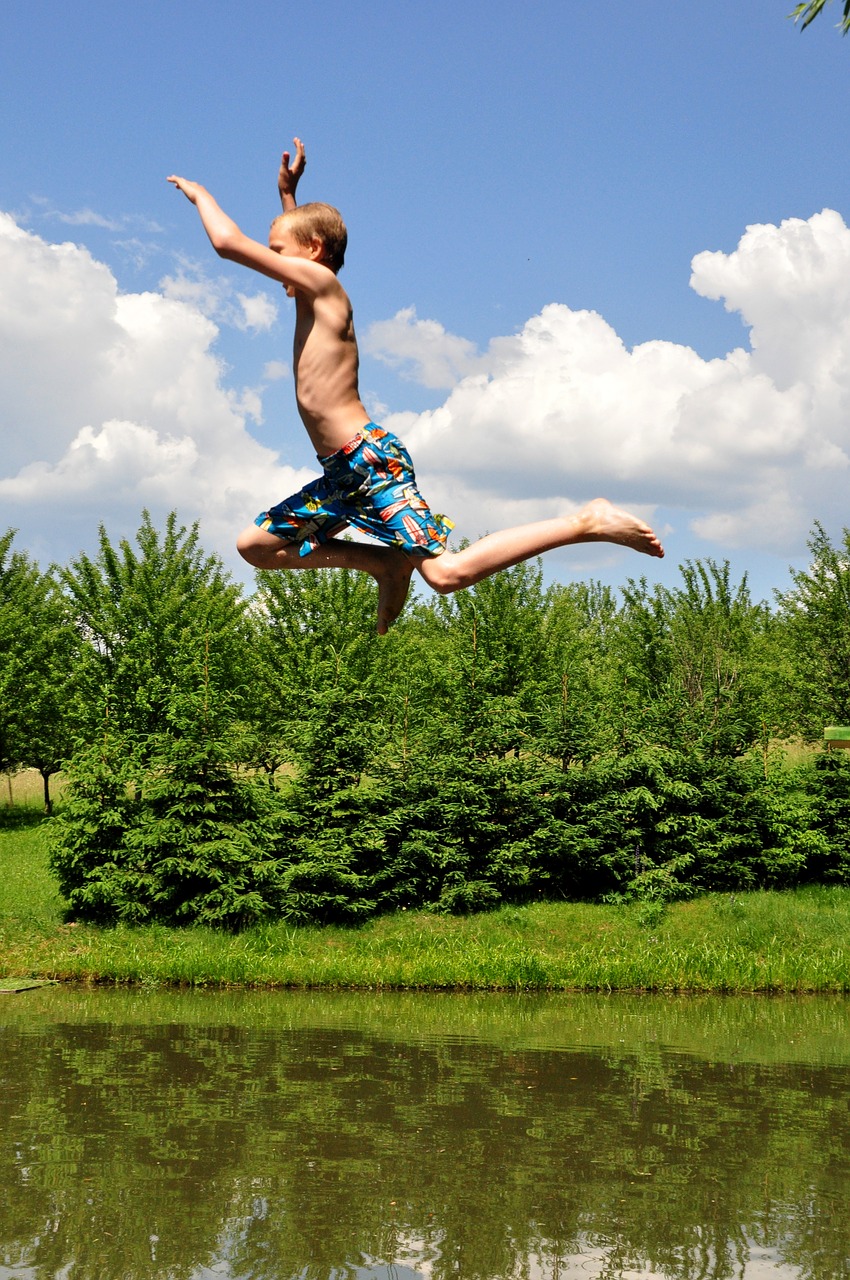
Both feet

https://pixabay.com/en/summer-swim-pond-landscape-austria-2209393/

Have you ever jumped into a body of water and been able to stop part way? If you have, can you show me how because to this point of my existence it has been impossible when I try? So far.

Defying all of the laws of Physics may not part of our human skillsets, yet. Perhaps with the aid of some bungee cords and a team of riggers, it is possible, but since most times when we take a leap(intellectual or otherwise), we do so without a team to save us.

Oddly enough, the leaps are often contrary to conventional wisdom and traditional thinking/practice. Society loves its non-conformists. As long as there are not non-comforming in their schools. Is it therefore heresy, innovation, boredom with the status quo, egotism, creativity in action, insight or indictment to break the status quo, take chances, or challenge authority/colleagues? Where does it fit in with your practice and pedagogy?

With or without a safety crew, I have always jumped into something with both feet. Knowing there is no way to stop once I’m in the air. Yes, I’ve climbed out and jumped somewhere else when the landing hurt. No, I did not land on anyone either.

Sometimes, I bounced out, unable to fit in with a particular ideology or methodology. What never changes as I try and stretch, and a leap and fall, and land/crash, is the need to keep looking for new places from which to jump with all the excitement and uncertainty that leaping, change and learning provide. A sort of educational thrill seeking if you will.

This is how I see my teaching style and I’m inviting other educators to step out onto the dock and take some leaps of their own. So often, the risk taker in all of us has been hushed by comfort, complacency, or fear. Trying new things is hard. What if no one likes it? What if I fail? How are your students supposed to take chances when you are clothed in bubble wrap yourself.

Our classrooms have to be shaped into an ultra-soft space for students to take their intellectual and emotional leaps with both feet without worrying about the landing or bouncing off the walls from time to time. It doesn’t mean they don’t feel a thud once in a while. It means that they will have a place to discover the limitless potential of their learning not the limit.

How do you see yours? When was the last time you felt free and safe enough to jump in with both feet not knowing how deep the waters?

How did  it feel?
Dangerous? Perhaps.
Exhillarating? Always.
Always successful? Not yet.
Staying put? Never!

We owe it to our students to show how much there is to gain from trying new things, taking leaps into new spaces, and from thinking about how, when, and where we are going to land.

Over the next month, I challenge you to try something new in your classroom and share it with us.
Tag me on Twitter @willgourley and try to encourage others to do the same. Thank you for reading and happy landings.

 Extra Reading for keeners

16 Reasons Why You Should get out of Your Comfort Zone

Why Taking Risks Pays off for Students and Teachers

Mindful Pause, with or without Technology?

Everywhere I turn I see the effects of our technologically advanced world. Gains have been made in medical research, communication abilities, and advancements toward an easier life?
Some of the effects on individuals are now coming to light. Many people are connected to the internet 24/7. This is causing sleep disturbances, eye issues, addiction behaviours, and other physical ailments.

As a previous mental health professional I look at my present vocation in Education with that type of lens. I have practiced and taught Mindful strategies for many years now. I see the benefits of technology in the curriculum. I also observe the negative effects. I have noticed some educators looking for a researched solution to help calm, focus and ground their students. Some are now turning to all the apps, and internet connections to provide a quick and easily guided mindful activity. I think this may be counter productive to being present and in the moment. We are seeing the effects of this new age world and the fast pace it is changing. As educators we are up to date with the many changes or apprised to avenues in which to guide our charges.

When I guide a group through a mindful experience I eliminate as much technology or other electrical sources as possible. I then guide students into focusing on being present in their own body and mind through the use of many verbal scripts vocalized in a relaxed, quiet voice. These moments of taking a pause are valuable. We live in a busy, stressful society where a pause can assist in a healthy balance to our daily lives.

Links-
https://www.psychguides.com/guides/computerinternet-addiction-symptoms-causes-and-effects/

https://www.psychologytoday.com/us/blog/virtual-addictions/201710/tips-mindful-technology-use

http://meditationscience.weebly.com/what-is-mindfulness-meditation.html

Mindfulness Meditation: Guided Practices

Drawing The Line

Each year, in Canada, approxScreenshot 2018-09-30 at 9.18.11 PMimately 460,000 women are sexually assaulted, although only a fraction of them report the assault to the police (1). In a day and age where this statistic holds true, it’s hard to imagine that our government is wanting to go back to a time where consent and gender identity aren’t being discussed in classrooms as a part of the Health Curriculum. Simply ignoring the very real issues that our students face in 2018 doesn’t make them go away, nor does it help to develop a society that is action-based and ready to implement change.

Earlier this year I was really excited to hear about ETFO’s and White Ribbon’s resource – Drawing The Line. Now I might be slightly biased as my brother is a contributing author but I was thrilled to see a resource that not only provided data-driven information for educators but also included a comprehensive guide for age-appropriate lessons for students in grades 1 to 8. I love that the guide addresses bystanders and offers students ways in which to respond to to sexual violence. Not only do the lessons connect to the Health and Physical Education Curriculum but expectations also in Language and the Arts are included in many of the lessons. This guide is truly a proactive approach to teaching students about healthy relationships and is one that every educator should read and implement in their classrooms. I know that in the past, ETFO was offering sessions on this resource and I hope that they continue.

Screenshot 2018-09-30 at 9.18.44 PM

With hotlines or tiplines being made available, it’s sad to say that we are in such a time where educators are somewhat in fear of teaching what we know to be essential for our students’ safety and healthy development. We need to be having these conversations because unless we do, nothing will change and perpetrators will feel empowered to continue. As you may already know, at the beginning of September, ETFO filed a legal injunction to pause the rollback of the 2015 Health curriculum. The union believes the government’s directive creates unsafe and unhealthy learning and working environments. In the meantime, how are you working to unpack these issues with students? They’re in the news and on the same social media platforms that students are interacting with. How will the work we do today impact the statistics in the future? In the next year, 5 or 10? If you haven’t already, please check out this resource as well as the other resources that ETFO has to offer.

1. Holly, Johnson, “Limits of a Criminal Justice Response” (University of Ottawa, 2012), https://books.openedition.org/uop/592?lang=en

New Year, New Role

Education has always had a huge place in my heart. On several occasions, my mom has recounted stories of me teaching my stuffed animals as a young child. This was even before my starting school and getting a taste of what being a part of the education system would be like. Although my path to the big question of what I want to be when I grow up – by the way, I’m still figuring that all out – veered in different directions, I find myself today in a place that I am truly enjoying within education.

A couple of years ago, I remember being asked the question of what I would do next in education and I always thought that I would never leave the classroom. I was excited to work with students on a daily basis. Discovery and laughter were two things that I could guarantee would happen daily. Over the past 9 years, my students have been the one thing that motivated me to become a better educator. Not merely for the sake of saying that I am a good educator but with a desire to take the time to grow in order to better meet the needs of the students that I had the privilege of serving. Never in a million years did I think that when presented with an opportunity to try something new, that I would start to consider it.

This past June I decided to take a leave and a leap with an amazing team at Future Design School. In August, I started my new role as an Education Lead and it’s been an amazing experience. Having the opportunity to work with educators across North America on creating exceptional learning experiences for students that empowers them to develop Future-Ready skills, is truly powerful.

So far in my new role, I’ve learned 3 things:

  • Enjoy the new learning
  • Learners are learners, whether they are children or adults
  • Take time to reflect

Enjoy The New Learning

I think this is the first time that I’ve taken such a big leap and jumped into something totally new. In the process of supporting educators in a variety of ways, I myself find it fulfilling to also be on my own journey of education on many levels. I love that there is always something new to uncover and that I have an opportunity to be apart of something fantastic that I too get to have an opportunity to help grow. I’m inspired daily to be part of a team who is passionate about transforming education and willing to share what they know with others. While I have worked with students around Design Thinking in the past, I’m understanding on a deeper level the “why” and reason for so much of the process. It’s amazing, the more I learn, the more I discover how much more growth there is to experience.

Learners Are Learners, Whether They Are Children Or Adults

I’m learning that scaffolding of any new learning is important for children AND adults. I know that this should be a simple concept for me to have realized a while ago but it has now become very clear. The definition of learning – the acquisition of knowledge or skills through experience, study, or by being taught – remains the same no matter the age of the individual. Being clear and explicit doesn’t change because of age. Nor does involving the learner in the learning change simply because of the demographic. Adults enjoy getting up in sessions and having the opportunity to talk through ideas with others. They love sharing their thoughts and experiences when designing learning experiences for their students. As educators we’re moving away from being the “sage on the stage” to the “guide on the side” and the same holds true when working with adults. I’m still learning about working with adult learners and know that best practices in the classroom are also keys to that work.

Take Time To Reflect

I think that I have always been a reflective person but I’m making the time to journal and reflect on my experiences even more. As a kinetic learner, I know that I learn best by actively doing, succeeding or failing and having opportunities to reflect, ask questions of others, and trying again. One thing that I am going to be working on this year is not being afraid of asking questions. I’m pretty confident in asking when I don’t understand something, however, I know that there are times when I am unsure and during these moments I’m a little more hesitant and sometimes like to figure things out. My goal this year is to learn as much as I can and I know that this requires that I be reflective and vulnerable in asking questions.

It’s a new year and a new role for me and I am really embracing it. Are you in a new role this year? If so, I would love to hear what you have been up to and your thoughts around starting something new. What prompted the change? What are your learning? Don’t be left out if you’re not in a brand new role, there’s always an opportunity to experience something new in education. Let’s start a conversation as we work towards growing as educators.