Recognizing and Responding to Mental Health Problems Among Students

Supporting Minds

SupportingMinds

An Educator’s Guide to Promoting Students’ Mental Health and Well-being

Government of Ontario Draft 2013

Note that dealing with mental health problems among students is highly complex and challenging. Often students are not responsive to using mindfulness and self-regulation strategies as their significant mental health needs require the support of professionals such as doctors, psychologists, and therapists. Educators cannot diagnose mental health issues.

As stated below, educators can support their students by observing and documenting possible triggers and behaviours.

How to Use Supporting Minds Document

The Supporting Minds document is presented in two parts.

Part One provides an overview of mental health and addiction problems and guidance about the role of educators in supporting students’ mental health and well-being.

Part Two contains eight sections, each dedicated to a particular mental health problem. Each section is structured to first provide educators the information they need to recognize mental health problems in their students and offer appropriate support (under such headings as “What Is Depression?”, “What Do Symptoms of Depression Look Like?”, and “What Can Educators Do?”). Background information about the particular type of mental health problem is given towards the end of each section. Hyperlinks to resources that provide more detailed information are included throughout.

Please refer to the Supporting Minds document for more in depth information.

Knowing Your Students

A first step in recognizing whether a student has a mental health problem may be simply documenting the behaviour that is causing concern. School boards may have their own forms on which to record this information. Once several observations of the particular behaviour have been gathered, educators can share these with others who can help to develop a plan to manage the behaviour.

Educators should look for three things when considering whether a student is struggling with a mental health and/or addiction problem:

  • Frequency: How often does the student exhibit the behaviour?
  • Duration: How long does the behaviour last?
  • Intensity: To what extent does the behaviour interfere with the student’s social and academic functioning?

Highlighted Mental Health Challenges

1. Anxiety in Students

 COMMON SIGNS OF ANXIETY

Although different signs of anxiety occur at different ages, in general, common signs include the following. The student:

  • has frequent absences from school;
  • asks to be excused from making presentations in class;
  • shows a decline in grades;
  • is unable to work to expectations;
  • refuses to join or participate in social activities;
  • avoids school events or parties;
  • exhibits panicky crying or freezing tantrums and/or clingy behaviour before or after an activity or social situation (e.g., recess, a class activity);
  • worries constantly before an event or activity, asking questions such as “What if …?” without feeling reassured by the answers;
  • often spends time alone, or has few friends;
  • has great difficulty making friends;
  • has physical complaints (e.g., stomach-aches) that are not clearly attributable to a physical health condition;
  • worries excessively about things like homework or grades or everyday routines;
  • has frequent bouts of tears;
  • is easily frustrated;
  • is extremely quiet or shy;
  • fears new situations;
  • avoids social situations for fear of negative evaluations by others (e.g., fear of being laughed at);
  • has dysfunctional social behaviours;
  • is rejected by peers.

(Based on information from: CYMHIN-MAD, 2011; Hincks-Dellcrest-ABCs, n.d.) Note: This list provides some examples but is not exhaustive and should not be used for diagnostic purposes.

 STRATEGIES TO REDUCE STRESS FOR ALL STUDENTS

  • Create a learning environment where mistakes are viewed as a natural part of the learning process.
  • Provide predictable schedules and routines in the classroom.
  • Provide advance warning of changes in routine.
  • Provide simple relaxation exercises that involve the whole class.
  • Encourage students to take small steps towards accomplishing a feared task.

(Based on information from: CYMHIN-MAD, 2011; Hincks-Dellcrest-ABCs, n.d.)

See Supporting Minds document Table 1.1 for Specific strategies for supporting students with anxiety-related symptoms

2. Depression in Students

 COMMON SIGNS OF DEPRESSION

Some common signs associated with depression include the following:

  • ongoing sadness
  • irritable or cranky mood
  • annoyance about or overreaction to minor difficulties or disappointments
  • loss of interest/pleasure in activities that the student normally enjoys
  • feelings of hopelessness
  • fatigue/lack of energy
  • low self-esteem or a negative self-image
  • feelings of worthlessness or guilt
  • difficulty thinking, concentrating, making decisions, or remembering
  • difficulty completing tasks (e.g., homework)
  • difficulty commencing tasks and staying on task, or refusal to attempt tasks
  • defiant or disruptive behaviour; getting into arguments
  • disproportionate worry over little things
  • feelings of being agitated or angry
  • restlessness; behaviour that is distracting to other students
  • negative talk about the future
  • excessive crying over relatively small things
  • frequent complaints of aches and pains (e.g., stomach-aches and headaches)
  • spending time alone/reduced social interaction; withdrawn behaviour and difficulty sustaining friendships
  • remaining in the back of the classroom and not participating
  • refusal to do school work, and general non-compliance with rules
  • negative responses to questions about not working (e.g., “I don’t know”; “It’s not important”; “No one cares, anyway”)
  • arriving late or skipping school; irregular attendance
  • declining marks
  • suicidal thoughts, attempts, or acts
  • change in appetite
  • loss of weight or increase in weight
  • difficulty sleeping (e.g., getting to sleep, staying asleep)

(Based on information from: Calear, 2012; CYMHIN-MAD, 2011; APA, 2000; Hincks-Dellcrest-ABCs, n.d.) Note: This list provides some examples of symptoms or signs but is not exhaustive and should not be used for diagnostic purposes.

 STRATEGIES THAT CAN HELP ALL STUDENTS DEVELOP AND MAINTAIN A POSITIVE OUTLOOK

  • Support class-wide use of coping strategies and problem-solving skills.
  • Provide all students with information about normal growth and development and ways to cope with stress (e.g., ways to address peer pressure, build friendships, address depressive feelings, maintain good sleep hygiene, build exercise into each day).
  • Write instructions on the board to provide a visual cue for students who are having trouble focusing on spoken information.
  • Model and teach optimistic and positive attitudes, language, and actions.
  • Work with students’ strengths and build on them when they complete activities in class.
  • Provide students with responsibilities and tasks that they may enjoy (e.g., allow students who enjoy computer use to incorporate a computing component into tasks; allow art-loving students to choose illustrated reading materials).
  • Provide a space in the classroom for students to go to when they are feeling overwhelmed.
  • Help students to chunk assignments and prepare for tests well in advance of deadlines.

(Based on information from: Evans et al., 2002; Hincks-Dellcrest-ABCs, n.d.)

See Supporting Minds document Table 2.1 for Specific strategies for supporting students with depression-related symptoms

 3. Bipolar Disorder in Students

 COMMON SIGNS OF BIPOLAR DISORDER

Some common signs to watch for include the following:

  • extremely abnormal mood states (generally lasting weeks or more) and involving a depressed or manic mood
  • depressive symptoms (see the section on depression)
  • manic symptoms, including:
  • feeling extraordinarily self-confident, in a manner that is out of character for the student
  • extreme irritability or changeable, “up and down” (labile) moods that are not typical for the student
  • grandiose and illogical ideas about personal abilities (e.g., the student believes he/she has supernatural powers)
  • extremely impaired judgement compared to usual ability
  • a perception that thoughts are racing
  • extreme changes in speech, particularly very fast speech or talking as if he/she can’t get the words out fast enough
  • explosive, lengthy, and often destructive rages that are out of character for the student
  • new or marked hyperactivity, agitation, and distractibility
  • “dare-devil”, risk-taking behaviour

(Based on information from: CYMHIN-MAD, 2011) Note: This list provides some examples but is not exhaustive and should not be used for diagnostic purposes.

In addition, the cognitive functioning of students with diagnosed bipolar disorder may be affected, so that they have difficulty:

  • paying attention;
  • remembering and recalling information;
  • using problem-solving skills;
  • using critical thinking skills and categorizing and organizing information;
  • quickly coordinating eye-hand movements;
  • staying focused on a topic.

See Supporting Minds document Table 2.2 for Specific strategies for supporting students diagnosed with bipolar disorder

 4. Students with Attention and Hyperactivity and/or Impulsivity Problems

SUBTYPES OF Attention Deficit Hyperactivity Disorder

The following three subtypes of ADHD have been identified:

(1) predominantly inattentive (without symptoms of hyperactivity/impulsivity)

(2) predominantly hyperactive/impulsive (without symptoms of inattention)

(3) predominantly combined (symptoms of both inattention and hyperactivity/ impulsivity)

 (Eiraldi et al., 2012). The combined type (inattention and hyperactivity/impulsivity) is the most common of the three. (Based on information from: APA, 2000)

 COMMON SIGNS OF ATTENTION DISORDERS

Some common signs of attention problems and/or hyperactivity/impulsivity include the following:

Attention problems: The student:

  • is easily distracted;
  • fails to pay attention to details and makes careless mistakes;
  • forgets things (e.g., pencils) that are needed to complete a task;
  • loses things often;
  • has difficulty organizing tasks;
  • finds it hard to concentrate;
  • follows directions incompletely or improperly;
  • frequently doesn’t finish tasks;
  • does not listen to what is being said when spoken to;
  • avoids or shows strong dislike for schoolwork or homework that requires sustained mental effort (dedicated thinking).

(Based on information from: CYMHIN-MAD, 2011; APA, 2000; CAMH, 2007)

Hyperactivity/Impulsivity: The student:

  • has difficulty sitting still or remaining in seat;
  • fidgets;
  • has difficulty staying in one place;
  • talks excessively or all the time;
  • is overly active, which may disturb peers or family members;
  • has difficulty playing quietly;
  • is always on the move;
  • has feelings of restlessness (for adolescents);
  • is unable to suppress impulses such as making inappropriate comments;
  • interrupts conversations;
  • shouts out answers before the end of the question or without being called on;
  • hits others;
  • has difficulty waiting for a turn;
  • is easily frustrated;
  • displays poor judgement.

(Based on information from: CYMHIN-MAD, 2011; APA, 2000; CAMH, 2007) Note: This list provides some examples but is not exhaustive and should not be used for diagnostic purposes.

 STRATEGIES THAT PROMOTE A CALM CLASSROOM ATMOSPHERE TO HELP ALL STUDENTS PAY ATTENTION

  • Provide a structured environment and a consistent daily routine.
  • Provide advance warning of changes in routines or activities.
  • Establish a routine and set of rules for moving from one activity to the next.
  • Establish procedures that allow all students equal opportunities to participate in activities (e.g., establish rules for turn taking; arrange for everyone to get a chance to be first).
  • Provide easy-to-follow directions and instructions (e.g., explain one step at a time; chunk multi-step directions).
  • Post rules where everyone can see them.
  • Reinforce positive behaviour such as raising a hand before speaking, engaging in quiet work.
  • Provide opportunities to learn by doing to give students an outlet for excess energy.
  • Limit visual and auditory distractions in the classroom as much as possible while considering the needs of all students.
  • When talking to students, address them directly and use eye contact. Wait until a student is paying attention before continuing a conversation.
  • Avoid a focus on competition, as students’ urge to win or be first can increase the likelihood of impulsive behaviour.

(Based on information from: House, 2002; CAMH, 2007)

See Supporting Minds document Table 3.1 for Specific strategies for supporting students with attention and hyperactivity/impulsivity problem

5. Behaviour Disorder in Students

 COMMON SIGNS OF BEHAVIOUR DISORDERS

Some common indicators of problem behaviour include the following:

  • defiance (persistent stubbornness; resistance to following directions; unwillingness to compromise, give in, or negotiate)
  • persistent testing of limits (by ignoring, arguing, not accepting blame)
  • persistent hostile mood
  • lack of empathy, guilt, or remorse, and a tendency to blame others for his/her own mistakes
  • low self-esteem that may masquerade as “toughness”
  • acting aggressively
  • disobedience
  • oppositional behaviour (e.g., challenging or arguing with authority figures)
  • bullying, threatening, or intimidating others
  • initiating fights or displaying physical violence/cruelty
  • using weapons
  • stealing
  • deliberate destruction of property
  • frequent lying
  • serious violations of rules (e.g., in early adolescents, staying out late when forbidden to do so)
  • skipping school often
  • outbursts of anger, low tolerance for frustration, irritability
  • recklessness; risk-taking acts

Signs that the problem may be serious include the following:

  • The student shows problems with behaviour for several months, is repeatedly disobedient, talks back, or is physically aggressive.
  • The behaviour is out of the ordinary and is a serious violation of the accepted rules in the family and community (e.g., vandalism, theft, violence).
  • The behaviour goes far beyond childish mischief or adolescent rebelliousness.
  • The behaviour is not simply a reaction to something stressful that is happening in the student’s life (e.g., widespread crime in the community, poverty).

(Based on information from: APA, 2000; CPRF, 2005; Hincks-Dellcrest-ABCs, n.d.) Note: These lists provide some examples but are not exhaustive and should not be used for diagnostic purposes.

 STRATEGIES THAT PROMOTE POSITIVE BEHAVIOUR AMONG ALL STUDENTS

  • Provide predictable schedules and routines in the classroom.
  • Focus the students’ attention before starting the lesson.
  • Use direct instruction to clarify what will be happening.
  • Model the quiet, respectful behaviour students are expected to demonstrate.
  • Create an inviting classroom environment that may include a quiet space, with few distractions, to which a student can retreat.
  • Be aware of the range of needs of the students in the class in order to provide an appropriate level of stimulation.
  • Communicate expectations clearly and enforce them consistently. Use clear statements when speaking to students: “I expect you to …” or “I want you to…”.
  • Focus on appropriate behaviour. Use rules that describe the behaviour you want, not the behaviour you are discouraging (e.g., Instead of saying “No fighting”, say “Settle conflicts appropriately”).
  • At the beginning of the school year, clearly and simply define expectations for honesty, responsibility, and accountability at school. Repeat these expectations often to the entire class, especially when violations occur.
  • Don’t focus too much attention on children who blame others, since that might inadvertently reinforce the behaviour.
  • Begin each day with a clean slate.
  • Facilitate the transition from the playground to the classroom by calmly telling students when there are five minutes left and then one minute left in recess, encouraging them to prepare to come in, and helping them settle in class when recess is over. Schedule a predictable classroom activity that most students will enjoy to follow recess, to help provide a smooth transition.

(Based on information from: CYMHIN-MAD, 2011; Hincks-Dellcrest-ABCs, n.d; Lee, 2012)

See document Table 4.1 for Specific strategies for supporting students with behavioural problems in classrooms

 Please see the Supporting Minds  document for further information on 

  • Eating and weight-related problems in students
  • Substance use problems in students
  • Gambling in students
  • Self-harm and suicide in students

Taking care of self as an educator

(Supporting Minds, Appendix C: Mental Health Action Signs)

Your behavioural health is an important part of your physical health. If you are experiencing any of these feelings, let your doctor know.

  1. Feeling very sad or withdrawn for more than 2 weeks
  2. Seriously trying to harm or kill yourself, or making plans to do so
  3. Sudden overwhelming fear for no reason, sometimes with a racing heart or fast breathing
  4. Involvement in many fights, using a weapon, or wanting to badly hurt others
  5. Severe out-of-control behaviour that can hurt yourself or others
  6. Not eating, throwing up, or using laxatives to make yourself lose weight
  7. Intense worries or fears that get in the way of your daily activities
  8. Extreme difficulty in concentrating or staying still that puts you in physical danger or causes school failure
  9. Repeated use of drugs or alcohol
  10. Severe mood swings that cause problems in relationships
  11. Drastic changes in your behaviour or personality

Source: The Reach Institute, The “Action Signs” Project, p. 6. Retrieved from http://www.thereachinstitute.org/files/documents/action-signs-toolkit-final.pdf

Dealing with students with mental health needs can be very challenging and draining.

Be kind to yourself and practice self care.

Reach out for help and support if you need it.

Collaboratively Yours,

Deb Weston

 

Students who don’t like to dance

Have a class that doesn’t like to dance? Me too! If my class had a choice, they would rather do anything other than dance! Instead of forcing this group of really reluctant kids to dance before they were ready, I decided to take a different approach this year. Below is how I managed to get my group of anti-dancers moving and shaking one month into term two.

  1. The very first day together all we did was talk about their feelings towards dance. I listened closely to their concerns that dance is very embarrassing. I also listening to their concerns that they would be made to move to music that they found boring or really, really awful, as my one student put it. All in all, I spent day one with my students just listening to their reasons why they didn’t like dance.
  2. On day two, I came back to them and honestly told them that learning dance was not an option at school but that I had heard all of their concerns and had some ideas on how to address their problems with dance. I made a commitment that they could always choose their own moves, own music and that they wouldn’t have to share until they were ready.   (The music comes from a pre-approved list of songs that students submitted to me.)
  3. On day three, I reassured them again that I would never put them in a position where they would be forced to dance in front of other people until they were ready.
  4. On days four and five, everyone made a dance on an app. There is a free dance app that is hilarious, called Toca Dance. Everyone’s dance was hilarious and we laughed and began to look at some of the movements that the dancers made on the app.
  5. On day six, Students watched videos of dances that they liked and shared and spoke about what they liked about the dance.
  6. On day seven, we watched a VERY simple dance together and analyzed it. We saw that there were five moves, some locomotor and some non-locomotor. Their job was to create their own dances with five moves, both locomotor and non-locomotor. Some kids chose funny moves like those from the app and some chose serious moves. All students choose their own music.
  7. On day eight, students created their own dance with a partner to a piece of music of their choosing.


The most important lesson for me was taking the time to understand my students’ feelings. This was a group of students that really wanted to make their own creations and not have their creative process dictated by the teacher. They also really needed a safe place to make their creations. Once both of these needs were met, lots of boogieing and shaking started to happen.

Dealing with Students using Behaviour Management Training

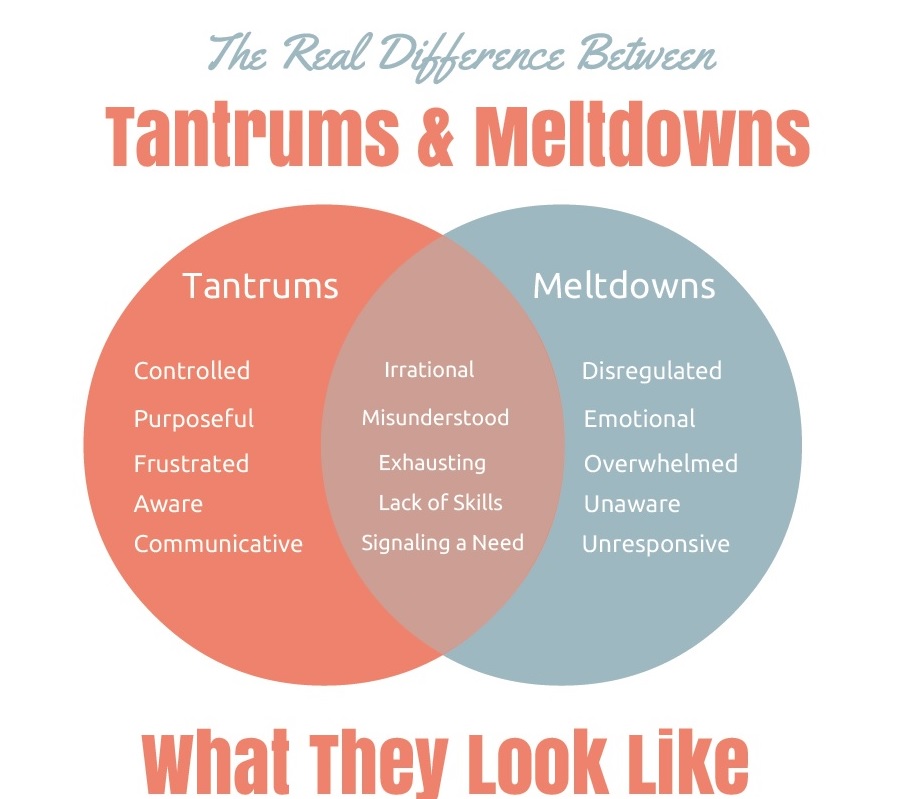
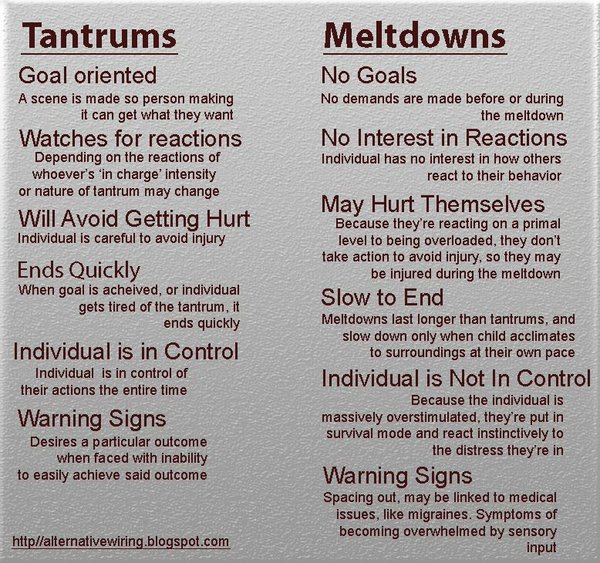
tantrums meltdowns

Source: The Real Difference Between Tantrums and Meltdowns http://lemonlimeadventures.com/the-real-difference-between-tantrums-and-meltdowns/ via @lemonlimeadv


Dealing with Students Using

Behaviour Management Training

The purpose of Behaviour Management Training for ETFO Members is to deal with the growing incidents of violence in schools and workplaces.

As I wrote about earlier in December 2017, there is research to support my own anecdotal observations of increased violence in classrooms. Based on information from ETFO (Action on Violence in Schools), ETFO members are increasing facing violent incidents in schools and workplaces. This violence increases physical and mental harm to both adults and children. With violence, teaching and learning is disrupted. Teachers and students can develop anxiety that violence will occur again.

ETFO’s Professional Relations Services published a PRS Matters Bulletin #98 addressing training offered to teachers and education workers by school boards. I have not been “officially” trained in these areas but I have used some of the strategies. The programs mentioned in the bulletin are copied directly from the bulletin and are listed below:

Crisis Prevention Intervention (CPI) – This program has a focus on prevention and strategies designed to “safely defuse anxious, hostile or violent behaviour at the earliest possible stage.” “Disengagement skills” are demonstrated and practiced to train educators to remove themselves and others from dangerous situations. Participants are trained to recognize when it is appropriate to physically intervene and implement holding skills to manage aggressive behaviour.

My experience with CPI: I have removed myself and my students from my classroom due to hostile or violent behaviour. To prepared, the students and I talked about our classroom evacuation plan (without the student with special education needs present) and the students came up with the “retreat” signal word. We practiced getting out of our classroom and either lining up or going to a neighbouring classroom to be safe. This worked well and kept all safe and no students were physically touched in the process.

Behaviour Management Systems (BMS) – This program stresses early prevention and intervention techniques. It aims to teach effective and safe physical intervention techniques. The BMS training framework is made up of four phases, one of which is the “Action Phase.” During the action phase, practitioners can “intervene physically” through a series of blocks or releases or by containing the student (i.e., by wrapping “your arms around the student”). There are four written cautions in the workbook specific to containments that mention “positional asphyxiation” and students incurring “a dislocated shoulder.”

My experience with BMS: I have not had much experience with BMS. I have blocked students from leaving a classroom or running down a hallway but I have never touched any students. Personally, with or without training, I will never be comfortable using physical contact to intervene with student behaviour, especially when injury can happen to the student or to me.

ETFO believes that behaviour management training should be voluntary and should be done within the instructional day. Members are not required to sign any waivers with respect to training or in using physical retraints.

As noted in PRS #98, using physical components of BMS and CPT could put members are risk of a possible investigation from the Children’s Aid Society (CAS), and/or Ontario College of Teachers (OCT) or the College of Early Childhood Educators (CECE).

For further information, please contact your local ETFO president or Professional Relations staff in Professional Relations Services at 416-962-3836 or 1-888-838-3836.

I did come across a chart to help distinguish between Tantrums and Meltdowns Posted on Twitter @ONTSpecialNeeds

trantrums and meltdowns

My best advice is to reach out to a supportive colleague for help as this is where I get the most help and support when dealing with challenging student behaviour!

And in the end, it’s up to you as an educator to use your professional judgement to keep your students and yourself safe.

Collaboratively Yours,

Deb Weston
Free Creation Apps to Show Student Thinking

I was asked to present a workshop about using technology in the Primary grades over a year ago and got into a debate with the Principal at the host school about apps.  The Principal was quite excited about the apps that he intended to purchase for his teachers to use with their students and he showed me his list.  I was surprised.  None of the apps were creation apps.  They were all “practice basic skills and keep kids quiet apps”. I showed him my list of preferred apps.  It was his turn to be surprised.

“These apps that you have chosen for the teachers are a lot like fancy worksheets for kids to practice basic skills.  Those skills are important, but doing a worksheet on an iPad might be a little more engaging, but it is still a worksheet, and an expensive one at that!  The apps that I am going to share with the staff today are all apps that students can choose from to show their thinking in a fun, engaging way that also provides opportunity for feedback and editing.” Unfortunately, he didn’t stay for the workshop.

The main difficulty that I have found with apps is finding something that you can use in schools that doesn’t cost a lot of money and isn’t just a free trial or have “in-app purchases”.  I don’t mind paying a few dollars for an app but when you get into the double digits for a school, it isn’t sustainable.  I thought I would share a few free creation apps that I have used with both the primary and junior grades.  I have also included some samples.  None of the samples are done by students, but I can assure you that each of these are quite intuitive and easy even for primary grades to use.  Each of the apps has a link to it in the App Store for further information.

Shadow Puppet EDU  The name is deceiving and the little white bunny on the app icon is too.  It basically provides a video of a slide show in which you can add voice and text.  Students can link to the already sourced for copyright pictures provided within the app or take pictures from their iPad or with the camera.  The students find this one easy to use but tricky to edit some of the text.  It uploads to Seesaw and other platforms easily.

Here is a sample of Puppet EDU:


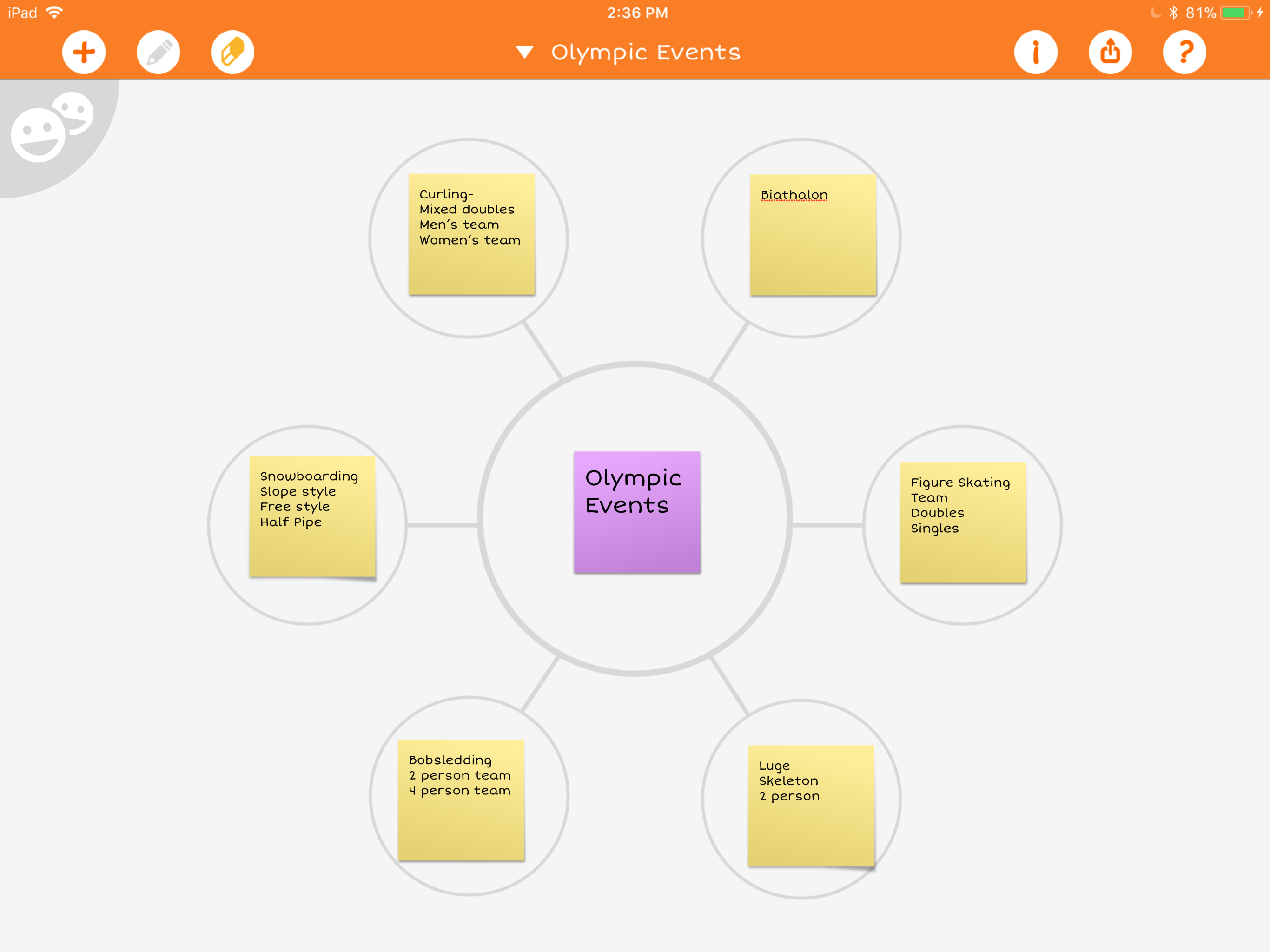
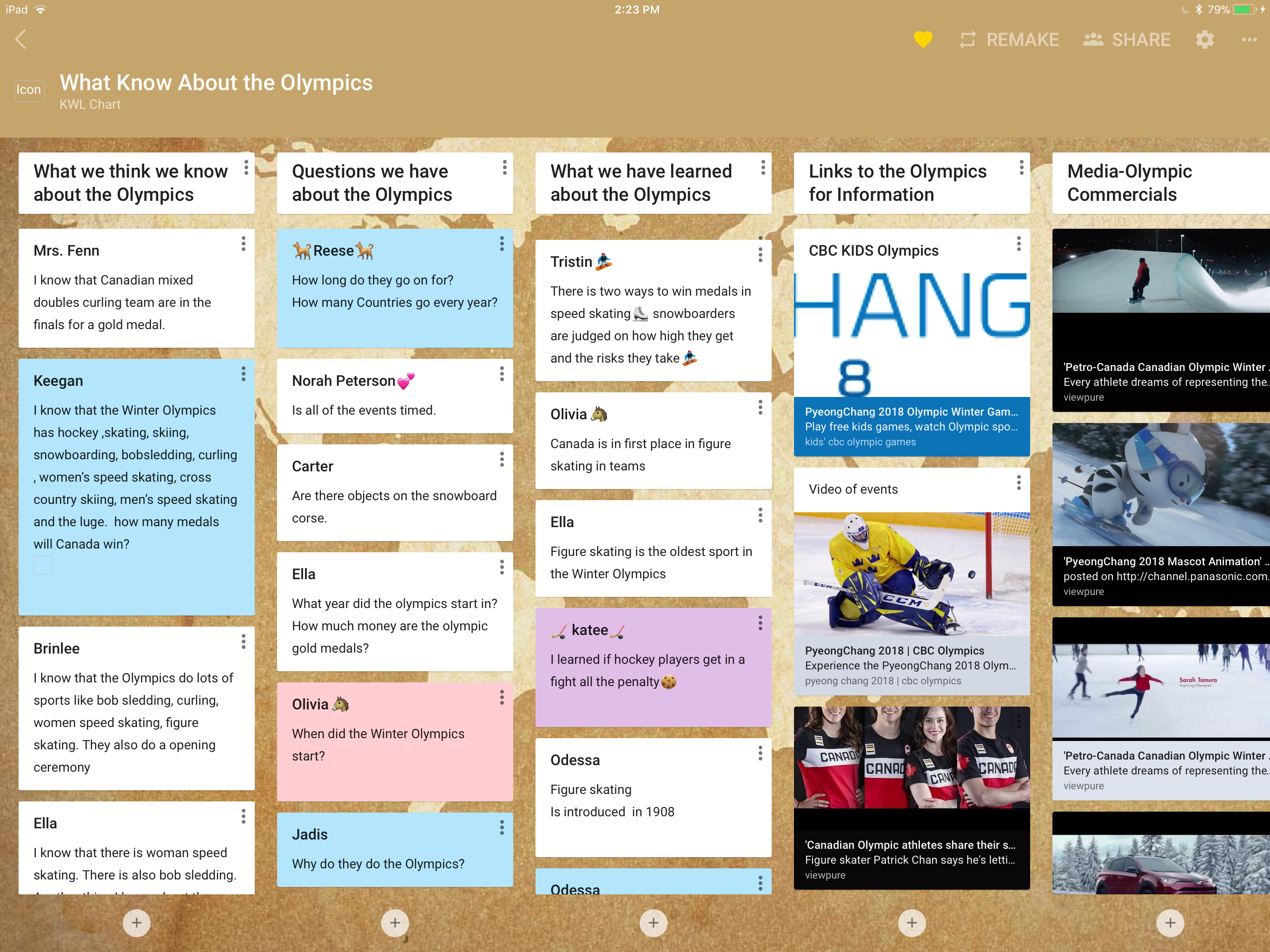
Padlet  I have used this a lot in order to begin a new unit of inquiry on something.  It provides a place to put safe links and videos that I have sourced for the students as a starting point and reference.  In addition, the students can collaborate their thinking with sticky notes. You can share it publicly with other Padlet users, but we keep ours private at this point.  We may share our Padlets with other classes at our school through the use of the QR code and password.  The sign is uses a QR code which you can print out. We are using Padlet for our unit on the Olympics.  The students will then create their own Padlet to share with classmates on an Olympic event that they will research.  Students will be invited to provide feedback to one another.  This is a screen capture of our Olympic Padlet:

2E085D6F-B02D-4F0E-828C-4DA00F168CA1

iBrainstorm  This app allows students to add sticky notes, text or hand written notes to templates like Venn Diagrams.  In addition, up to 3 other people can be invited to collaborate on the same template in real time. You can take a screen shot and save it to photos.  It also uploads to multiple platforms easily.

1DC21708-D63F-4C35-968A-3EEB52AC0F12

Don’t Give Up on a Tough Class

I have one class that is very tricky. It is a very large class with a lot of emotional, physical and academic needs. It is the two periods in the week that I wish I had a clone of myself so that I could meet everyone’s needs immediately all the time (with this class I might need an army of clones).

I would rate the autumn with this class as alright. We have had our ups and downs. Some periods have gone well. Some have not. The thing that has been most consistent with this class is that I refuse to give up on them and their ability to do well in Music.

I feel at this point in the year, I have tried so many strategies to get the classes running smoothly and find ways to support my weaker students. However, it wasn’t until this past week that I feel like I have made a breakthrough!

I have finally landed on a combination of whole group instruction, peer-supported creations and individual choice.

Getting to know the students has been an important factor in this positive change. I have had several conversations with many of the students about sports, animals, music and all of their interests. I have used that knowledge to help build a relationship with them and inform my decisions around content for upcoming classes. I know for one of my students who is having the most difficult time at school right now, he really loves sports. I am planning to do a basketball dance this term to incorporate his interests.

I also have some students in the class who are significantly below grade level. Many of these students are embarrassed to ask other students for help. They are weak in reading and writing and therefore, they are very reluctant to work with many of the students in the class. Last week, I went to each of them individually and asked if they felt comfortable with anyone in the class. I let them choose who their partner was and since they all had a say in who they were going to work with, they all had a level of comfort in working in the class.

I met with the classroom teachers about good accommodations that I could provide for their students with upcoming assignments. I have also conferred with the classroom teachers about medical needs and emotional needs.

I have built in the usage of many of my student’s strengths. Everyone has so many amazing skills and I have tried to highlight them. I have a student who can’t read but is great at tech. He is my technology advisor and the kid I send everyone to when we have problems. Another student can’t read either, but is an incredible singer and rapper. He can improvise at the drop of a hat and can generate ideas at a speed I cannot match. When we need lyric or rhythm ideas, we know who we can count on.

I have continuously worked on trying to improve the climate. Last week, before we started our partner activity, I had the students do the game Two Truths and a Lie with their partner to build a relationship with their new partner. Taking time away from curriculum to build climate has been worth the investment.

Using choice as a motivator has also worked exceptionally well. Students begged me to allow them to listen to music of their choice when they are finished their compositions. “For sure!” I said. We are developing a pre-approved list of music to listen to.

Ultimately, the most important thing is not to give up. Have a good cry, a particularly big piece of chocolate cake and a long phone call complaining to your friend about your difficulties. After that, analyze what is going on that is not working, and start a plan tomorrow. And if that doesn’t work, try something else on the next time. It might take time, but it is worth it!

Precarious Absences – The impact of teacher intervention truancy systems

c648498d03ebec4dc8d0dd29a6fdfa4a

I write this blog in response to watching a highly capable and talented, long-term occasional teacher worrying about taking time off to go to a medical appointment. She actually considered cancelling her appointment as she worried about taking too much time off school because she thought it would impact her chance for a full-time teacher contract. Supply teachers and long term occasional teachers are feeling the pressure of not taking time off to meet their self care and medical needs. And this is the place where all teachers are at.

In the past few years, school boards have started using teacher intervention truancy systems. These systems track how many days teachers take off for reasons such as being sick, attending medical/dental appointments, or taking time off to care for family.

When I started teaching 18 years ago, I had 20 sick days which could be “banked” and then “cashed out” at the end of my career. As a teacher, I did not want to take time off if I did not have to … as it is a lot of work to make day plans to be off. But, as a single parent at the time, if my children were ill, I had to take time off. Also note that I got sick too. As a teacher, I am on average exposed to many children … up to 100 a day (I counted).

Then, I few years ago, teachers’ 20 sick days were reduced to 11 sick days, plus family responsibility days. This meant that teachers could no longer “bank” sick days and received a reduced salary after the 11th sick day.

Children (i.e. viral conduits) are very good at transferring their illnesses to their parents and teachers. Over my 18 years of teaching I’ve contracted a plethora of infections including many bacterial and viral infections, skin infections, eye infections, Whopping Cough (twice), Norwalk virus (twice), many weeks of bronchitis, several bouts of flu including H1N1, and lots of colds. With my doctor’s insistence, in the spring of 2017, I ended up taking 12 days off from school due to my ongoing bronchitis.

Once my health was marginal enough for me to return to work, I did coughing away, sucking on cough drops, drinking tea with honey, and carrying a tissue box around to blow my nose. Hey, it was report card time – I needed to get back!

Recently, some Ontario school boards started tracking teachers’ absences. The “teacher intervention truancy systems” notes when teachers take more than 3 sick days off in a 3 month period. At this point, the teachers are sent letters documenting that they were being put on a program to track their absences … like they were not really sick and just needed to take a day off. Let me say again that it is a lot of work to planning for being away from the classroom.

In the “teacher intervention truancy systems”, teachers have to document their absences with notes to prove they were either really sick or really attending medical/dental appointments. Note that I have had to pay $20 out of my own pocket to document my sick days, for each appointment!. In addition, to make things more interesting, teachers in some schools were told not to take half days off as schools were finding it difficult to find supply teachers who would work only half days. This tells me boards have to hire more supply teachers!

Based on my observation, I believe that this “teacher intervention truancy system” is casting a wide net to catch some people who may be abusing sick days. But based on my own experience and that of my colleagues, I believe that, since teachers are subjected to so many children’s illnesses, the relative number of sick days are too few. Teachers need more sick days!

Based on my own health experience, I believe the “teacher intervention truancy systems” have impeded by ability to meet my own self care and medical needs  – it has resulted in me having to choose between being sick or going to medical appointments. I believe that if I had taken the time I needed to rest, I would not have been off sick for so long, away from my students.

I wonder how new teachers are doing with the management of their self care, given their own family responsibilities and the care of their own health.

I find it ironic that school boards talk a lot about supporting employee health but their walk is not supporting employee health.

Collaboratively Yours,

Deb Weston
Downloadable Adaptable Emergency Lesson Plans

If you are even too sick to go to school and you have no day plans yet, I have attached a 5-day Emergency Lesson Plan that can be adapted to your classroom/grade level. Download it, change it, make it your own!

Generic Emergency Teacher Lesson Plans (1)

5 Day Plan Schedule Emerngency Lesson Plan.xls (1)

Any Read Aloud Book Graphic Organize

1 Rounding100s Game

Note: The term “teacher intervention truancy systems” is my own acronym.

Guiding Principles

I’ve been doing some self-directed professional development on behaviour management lately. I have a personal interest in the psychology behind learning and development, and as a Kindergarten teacher this is my main area of focus on a daily basis. Before my students will learn literacy and math, I need to ensure their social and emotional well-being.

I recently took a PD session through my board where I was inspired to take a step back and think about my language in the classroom. How do my words and actions influence the behaviour and well-being of my students? After all, behaviour management in a classroom is influenced the greatest by the teacher’s words and actions, rather than those of the children.

As adults, we are tempted to flood our children with rules. These rules make us feel better. If we redirect our students constantly, we will keep them safe and ensure they are doing what we want, right? Well, this isn’t always the case. Think of how many commands, comments or redirection you dole out to your student on a daily basis. These phrases may sound familiar to you:

“Don’t run in the hall”

“Quiet voices inside”

“Don’t build that tower too high”

“Get down from that chair”

“Careful with those scissors”

“Hands to yourself”

“That wasn’t very nice”

“I don’t like to hear those words”

The list goes on, and on, and on, and on. But what if we don’t need to spew out these phrases repeatedly? What if there was a way to get that message across without overloading our kids with what, will inevitably, become white noise to them? We know that overloading kids with language can be overwhelming and as a result, can bring about even more behaviours.

This is where guiding principles come in. For your classroom, choose a phrase or a few words that define what you believe to be the most important rules. In our classroom, we use:

“At school, we are safe and kind”. 

Rather than throwing out constant redirection and comments as listed above, we simply repeat this statement to our class. Why is this effective? We’re using simple language with words that are clear and effective. Almost any situation that could come up in your classroom can be successfully redirected using this phrase. For students who are ready, it can be turned into a question to get kids thinking and reflecting about problems as they arise. For example, if a student is running in the hallway I might stop them and say, “At school we are safe. Are you being safe?”, rather than giving the command, “Stop running in the halls”. For a group of students that are not including someone in their play, I might remind them, “At school we are kind. Are you being kind?”. I think of the two words as umbrellas that all desirable and undesirable behaviours can be categorised under.

This method has worked wonders in our Kindergarten classroom. I always know my strategies are effective when I hear my students repeating my language. Since beginning using guiding principles, I hear my students guiding each other through situations by using the exact same phrase, “At school we are safe and kind!”. Undesirable behaviours are being stopped much faster and I’m noticing more mindful students.

I do believe that there is never a “perfect” or “correct” method for anything in teaching, as we know, every group of children is different. This particular method has really changed how I think and interact with my students and has been a wonderful guide to my own approach to behaviour management. I encourage you to give it a try!


The detour

MUTCD_M4-9bR.svgWanderers, tourists, sight seers, visitors, escape artists, runners…”Hey!” this teacher asks, with a smile, “See any cool artwork today?” or maybe the exchanges are in passing such as,  “How are you? How’s your day going?” However, what rarely gets asked is, “Aren’t you supposed to be in class right now?”

Have you ever observed a student or few who seem to be conspicuously far away from their usual classroom or floor? Have you ever watched them take the long way around the school to complete an errand? How about the students who take the time to ponder every single art exhibition or piece of student work in the hallways? Not surprisingly, these are the same students who are frequently found quenching their thirsts at the farthest drinking fountains or outside of their friend’s classes waving as well.

At first, I paid little attention to moments like these. Perhaps those students were delivering messages to the office or helping another teacher? Of course it’s a possibility, but I was able to discern the difference quite quickly when the students being observed were empty handed, on the opposite side of the school building relative to the office, and not in possession of a good reason for being in that particular space and time. I have to empathize with students like this. That was me too. I used to take lots of notes to the office for my teachers. I wonder if those notes said, “Please keep William busy for a few minutes and then send him back. Thank you.”?

The Thinking Lap

Maybe the students that I’m seeing are taking a lap to think? Most times I use this option as a means to support anxious, stressed, and or physically active learners. A walkabout is an excellent mental health strategy for all of us, but then I started to see some patterns that piqued my attention. The students who I was regularly seeing in the hallways, were showing up at around the same times each day? Was there something going on that they needed to get out of class at the same time each day? It was then that I began to see this through a different lens.

In my role as SERT, I provide resource support in a number of classes throughout the school. Recently, I observed a student from the intermediate panel at a water fountain on a different floor about 30 minutes into the first period of the day. Harmless enough in itself, but what struck me about all of this was the fact that the student would have had to pass at least 2 other fountains along the way. 45 minutes later they were skipping down an empty hall during class to their locker. 30 minutes after that, back at the faraway fountain. I smiled, said hello, and went about my morning.

Perhaps they are enjoying an extended walk to work out some stress? If so, what are the underlying factors that explain this student’s to need be out of class so often? Could all of their self-navigated detours be coincidence? Barring medical issues, this is less likely to be believable based on frequency and time of day. What’s worth noting as well, are the other students who might be taking their own detours around the school.

3 Questions and 3 Answers

Q1. Would these students like to have someone to walk alongside and listen?
Q2. How many others feel like doing the same, but don’t act on it?
Q3. How can wonderlust be infused into these learners’ days to go with their wanderlust?

A1. It depends on whether they will be heard or given a hard time for being in the wrong place at the wrong time without any understanding by others.
A2. If there is one, there are others. Albeit subtle, shifting, shuffling, and staring into space are good indicators to teachers that students need a break.
A3. Throw the map away sometimes. Keeping the learning space, active, challenged, and engaged is often a trip to an undiscovered land. It is an act of re-invention and creativity that takes practice, patience, and persistence. Don’t be afraid to change directions by throwing in detours of your own.

Thank you for reading this post. Please take time to comment and share to keep the conversation going. Enjoy your detours.


Occasional Teachers; Unsung Heroes

Unfortunately, I have had many health challenges this year that have necessitated having to take a significant amount of time off of work to recuperate.  These absences have provided me time to reflect on my practice as a classroom teacher and about how important occasional teachers are in our practice.  I had the pleasure of working in our local ETFO office as a released officer for 3 years alongside the incredible Marsha Jones, Occasional Teacher President extraordinaire.  She taught me a lot about Occasional Teachers, the obstacles they face and the little things that I could do to make their days go easier.  I thought I would share a few of my insights.

Occasional Teachers that come to our school like to return because of the friendly atmosphere.  In the staff room, they are included in our “tea days”, people engage them in conversation and always ask how they can be of help.  It sounds like a simple thing, but many of the Occasional Teachers that come to our school comment on our friendly staff.  So the next time you see an Occasional Teacher in your school, smile and say hello and ask them how their day is going.

Do NOT ask an Occasional Teacher “who” they are for the day.  What an insult!  You can ask who they are in for, who they are helping out, who they are rescuing or replacing, but they are themselves each and every day they come to work.  We should appreciate the fact that we have access to qualified teachers to replace us for the day so that we can take sick days when we need them or go to conferences for professional learning.

Speaking of insults, please try not to call Occasional Teachers “substitute” or “supply” teachers.  We rely on these colleagues. “Occasional Teacher” is their job title.  Be respectful of it; we rely on them.

Remember to have a few days of “emergency” plans in advance of your absence.  It takes the edge of having to type up plans in between trips to the washroom when you have the flu.  Leave them in a place that is easy for the Occasional Teacher to find.  This makes your life easier too.

If you generally have an active classroom that engages in centres, activities etc., then TRUST your Occasional Teacher and leave plans that include those lessons.  Chances are your students know how this stuff runs and will let the Teacher know.  It may mean giving up a bit of control; deal with it.  If you leave all day seat work that you’ve photocopied or a movie that isn’t connected to anything that they are doing in the classroom, it will not be enjoyable for the students and likely your Occasional Teacher will have more behaviour issues.  Consequently, you will not get the quality of work that you normally see from your students. Don’t have huge expectations.  No matter how wonderful the Occasional Teacher may be, they are not you and the students know that.  We also need to remember to trust the judgment of an Occasional Teacher.  I’ve heard it and I’ve said it; “The ‘supply’ didn’t follow my day plan. I worked for hours on that detailed plan.”  We don’t know what kind of a day that teacher had with our students.  They may have experienced a lockdown, fire drill, class evacuation, pizza money, scholastic money, a student injury or even a skating field trip.  (My sincere thanks to Occasional Teacher Rachel Johnston on that one!)  We need to remember that they are qualified teachers and they have the right to exercise their professional judgment in order to keep the class calm and engaged.  Let them do their job and thank them for it.

I write my day plans on my computer for myself each week.  This makes writing a day plan for the Occasional Teacher much easier.  I have all of my emergency information, how to deal with specific students, who to count on and the general rules and routines in a separate document to attach to daily plans.  I always attach a class list.  Try to keep your plans as close to the regular routine as possible.  If I am going to be away for a meeting I will try to find out who will be replacing me for the day and I email them the plans in advance and ask if they have any questions.  I include my cell phone number in case they can’t find a password or an item and few of them ever use it but if they do then I know that they care about my students and the plans that I have left for them.

Finally, show your gratitude.  Some Occasional Teachers drive an hour to get to our school and in bad weather.  Some are called at the very last minute, through traffic, to an unfamiliar school using GPS.  Their mornings are often stressful before they even arrive on site.  So when an Occasional Teacher has done a great job and your classroom is still standing when you go in the next day, write a quick email and say thank you. Occasional Teaching is often a thankless job but we can’t be sick without these wonderful people.


The Conundrum of Parent Communication

4 years ago I discovered the app Seesaw which is a digital portfolio for students but way more.  Recently it also added a direct parent communication piece which I absolutely love and I can also post announcements all at once to parents or just to a few by the click of a button.  The best thing about the app for me is that the students can upload their own work and comment on it and I can provide feedback.  I approve everything before it goes on the site. Parents LOVE it.  For me, it does everything that I need a communication app to do.  So what’s the issue?

3 years ago our school board got a contract with Edsby. I understand that as a school board it is accessible in many ways for all teachers.  There is system information that is on the site that can be accessed from anywhere.  There is a platform for staff room chat and places to post things on calendar etc.,  However I do not find that it is friendly for teachers nor students to use.  The mobile app is glitchy and I get frustrated at the stream of conversations that don’t seem to match up.   I have been told by our administration that we have to use it to communicate with parents.  All but two of my parents have signed up for Seesaw (internet access issues) and only a quarter have signed up for Edsby.  I don’t know why exactly, but I can only assume that they don’t find it as friendly to use.  I do paper copies for major announcements to ensure that everyone gets those in one way or another.  I use Edsby to comply to my school board’s request and I’m doubling my work in the meantime.

When I first began teaching it was a big deal to have a “monthly” newsletter and calendar of events go home to parents. Principals wanted to see copies and approve them before they went home.  Now we are in constant communication with parents and we are being told exactly what platform we are supposed to be using in order to do it.  There is a huge workload issue in parent communication and it creeps up on us daily.  With an increase in high needs students that deal with behavioural or mental health issues teachers are expected to communicate on a daily basis in a communication book with their families.  While I understand the need for documentation for myself and for the parents, the expectation is overwhelming.  I am fortunate this year that I have my preparation time at the end of the day and I can take the time to communicate with parents.  However, I don’t get to use my prep time for lesson preparation.  I don’t know what the answer is here.  I’m going to continue to use my professional judgement about how I communicate with parents however, hopefully this post will begin a discussion about communication overload.  I’m open for suggestions on how others are able to manage!