
Equity and Inclusion for All : Culturally Responsive Teaching and Assessment Pedagogy

The role of culturally responsive teaching is to understand who students are as people and who they are within their community. This pedagogical approach acknowledges, responds to, and celebrates fundamental aspects of student culture while providing equitable and inclusive education for students of all backgrounds and identities. This is especially important for students who identify as First Nations, Métis, and/or Inuit (FNMI). Essentially, in teaching through a lens of culturally responsive pedagogy, student identity is honoured.

What is student identity?

Deborah McCallum states identity is “connected to the groups we affiliate with, the language we use, and who we learned the language from. I believe that each of us has various identities according to the different groups that we belong to, and that this has implications in terms of the languages and discourses we use.” (McCallum, November 28, 2017).

Specific characteristics of culturally responsive approaches include educators taking the perspective of :

  1. positively valuing perspectives of parents and families
  2. communicating high expectations for all students
  3. adapting learning within the context of students’ culture, background, and identities
  4. student-centred instruction and assessment
  5. considering students’ culture, background, and identities within instruction
  6. reshaping and adapting curriculum to address students’ cultural and identity issues
  7. teachers stance as facilitators with students providing input to guide learning

(adapted from Ladson-Billings, 1994)

How does culturally-relevant pedagogy benefit teaching?

Teachers need to be reflective of who their students are and how best to adapt with instruction and assessment to their needs. As reflective practitioners, teachers learn to adapt their teaching to meet the needs of their students. Here, the focus of teaching goes away from the curriculum and towards the learning needs of the students.

Schön (1987) stated that in teachers’ reflection, learning influences behaviour through the teachers’ self-discovery, self- assessment, and deciding the appropriateness of instruction. It is through teacher reflection that the opportunity, the motivation, and the environment reflects on the idea that learning belongs to the learner, the student. In this process, teachers take on the role of and status of facilitator over the traditional role of an “expert” teacher (Schön, 1987).

In using a reflective stance (Schön, 1987), teachers incorporate issues of equity, inclusion, and social justice as a necessary element in their day to day teaching practices. The development of culturally relevant teaching strategies is necessary in order to challenge learners to think critically about their own learning and who they are as learners. In other words, to feel included, students need to see themselves within the curriculum and instruction (Hutton, 2019).

By including their identity in education, students become more engaged in their culture in the context of learning. This helps develop perspective and skills to adapt to present day reality in order to address skills and knowledge for the future (Hutton, 2019).

How does culturally-relevant pedagogy impact families and communities?

It is very important that teachers learn about their students’ families and backgrounds. In learning about the families and communities, students embrace their own understanding of challenges across various cultural communities and backgrounds (Hutton, 2019). This is an importance stance to take given the diversity of students in all Ontario schools.

Developing healthy family-school relationships promotes family involvement and cultural awareness which further develops the supports needed to improve overall student achievement (Epstein, 1995). In addressing the distinctions of families and communities, this results in a varied understanding how families contribute to schools which are part of their community. Depending on language and cultural expectations, different levels of involvement and engagement usually vary (Ladson-Billings, 1994).

Communication between school and home is a critical factor in developing relationships and building overall school capacity. Teachers and families work together to support schools by providing resources and in developing knowledge of diverse learners. Therefore, the community becomes an extension of the community (Ladson-Billings, 1994).

The importance of culturally-relevant pedagogy in teaching First Nations, Métis, and Inuit (FNMI) Students

With a history of abuse (i.e. residential schools),  assimilation (i.e. absorbing FNMI people into European culture), and neglect (i.e. substandard funding of education and healthcare), educators need to address ways to meet the specific needs of FNMI students in order to increase overall educational achievement (Ladson-Billings, 1994).

Culturally-relevant pedagogy addresses the connection between school and home by promoting communication, forging relationships, and building capacity for all students. At this juncture, teachers and families support diverse learners through local resources and knowledge sharing (Ladson-Billings, 1994).

The importance of culturally-relevant pedagogy in teaching students who do not identify as FNMI

Given the diversity of students across Ontario, classrooms that show diversity of culture need to represent meaningful and relevant depictions of groups of people. Pedagogy should reflect the complexities of cultures, cultural products, and students as individuals. Further, the portrayal of background needs to reflect cultural history and changes that have evolved today which includes the diversity within groups. In other words, students need to identify with curriculum and instruction. Educators must to become more culturally aware in order to meet the needs of their students and the communities where schools stand (Ladson-Billings, 1994).

Understanding student diversity in classrooms and in schools

Getting to know students is a powerful approach to help teachers understand who students are and the roots of their family history and culture. In honouring who students are in classrooms and in communities, teachers can adapt instruction and impact engagement in accessing what matters to students in their lives. By moving towards students’ cultural and learning interests, students thrive academically (Ladson-Billings, 1994).

Understanding culturally informed pedagogy in the context of assessment

Teachers undertaking culturally informed pedagogies take on the dual responsibility of external performance of assessment (i.e. large scale government assessments) and building community involvement along with student-driven learning. In balancing the demands of culturally revitalized pedagogy with the demands of present day approaches to assessment, teachers embrace pedagogy that promotes student success by not just propelling FNMI students forward academically … but to also in reclaiming and restoring their cultures (Ladson-Billings, 2014). Ladson-Billings (2014) states that “the real beauty of a culturally sustaining pedagogy is its ability to meet both demands without diminishing ether” (p. 83-84).

Best Practices for Culturally Responsive Teaching & Assessment.

The Culturally Responsive Educator Mindset (adapted from Ontario Ministry of Education, 2014, p. 4 & 5)

  1. Socio-cultural consciousness: Teachers are aware of how socio-cultural structures impact individual students’ experiences and opportunities towards
  2. High expectations: Teachers hold positive and affirming views of student success from all backgrounds.
  3. Desire to make a difference: Teachers work towards more equity and inclusion as change agents.
  4. Constructivist approach: Teachers understand that students’ learning is constructed through their own knowledge (or schema).
  5. Deep knowledge of their students: Teachers know who their students are by knowing about students and their families. Teachers then know how individual students learn best and where they are at in their learning.
  6. Culturally responsive teaching practices: Teachers design and build instruction based on students’ prior knowledge in order to stretch students in their thinking and learning.

Effective Cultural Pedagogy (adapted from Ontario Ministry of Education, 2014, p. 6 & 7)

The quality of teacher instruction and expertise outweighs challenging circumstances that students can bring to the classroom (Callins, 2006; Willis & Harris, 2000). With effective inclusive instruction, there is a promise of high academic rigour within the framework of culturally responsive pedagogy and with the supports to scaffold new learning (Gay, 2002; Ladson-Billings, 2001). Some strategies below were adapted from the work of  Kugler and West-Burns (2010):

  • Using professional judgement, teachers recognize that curriculum can be expanded upon in informal and the subtle ways in which the curriculum defines what is and what is not valued in students’ schools and society.
  • Using inquiry-based approaches to student learning, teachers engaged and self-directed learners. In this approach, students are supported in making decisions about their learning that can integrate who they are and what they already know with their home and community experiences.
  • Using a variety of resources, including community partners, teachers ensure the learning environment and pedagogical materials used are accessible to all learners and that the lives of students and the community are reflected in the daily classroom learning.
  • When using resources, materials, and books teachers insure that local and global perspectives are presented and a reflective in the students’ lives.
  • Teachers need to know and build upon students’ prior knowledge, interests, strengths and learning styles to ensure they are foundational to the learning experiences in the classroom, in the school, and in the community.
  • Teachers need to ensure that learning engages a broad range of learners so that varied perspectives, learning styles, and sources of knowledge are considered.
  • When differentiating instruction and ways to demonstrate learning, teachers ensuring both academic rigour and a variety of resources that are accessible to all learners.
  • Teachers need to advocate to ensure that the socio-cultural consciousness of students is developed through curricular approaches, emphasizing inclusive and accepting education, to inform an examination and action regarding social justice in education.

Have a restful March Break,

Collaboratively Yours,

Dr. Deb Weston, PhD

References

Callins, T. (2006, Nov./Dec.). Culturally responsive literacy instruction. Teaching Exceptional Children, 62–65.

Epstein, J. L. (1995). School/family/community partnerships. Phi delta kappan76(9), 701.

Gay, G. (2000). Culturally responsive teaching: Theory, practice, & research. New York: Teachers College Press.

Hutton, F. (2019). Notes on culturally responsive pedagogy.

Kugler, J., & West-Burns, N. (2010, Spring). The CUS Framework for Culturally Responsive and Relevant Pedagogy. Our Schools, Our Selves, 19(3).

Ladson-Billings, G. (1994). The dreamkeepers. San Francisco: Jossey-Bass Publishing Co. Downloaded from https://www.brown.edu/academics/education-alliance/teaching-diverse-learners/strategies-0/culturally-responsive-teaching-0#ladson-billings

Ladson-Billings, G. (2001). Crossing over to Canaan: The journey of new teachers in diverse classrooms. San Francisco: Jossey-Bass.

Ladson-Billings, G. (2014). Culturally relevant pedagogy 2.0: aka the remix. Harvard Educational Review84(1), 74-84.

McCallum, D. (November 28, 2017). Identity and Culturally Responsive Pedagogy , Canadian School Libraries Journal, School CultureVol. 1 No. 2, Fall 2017. Downloaded from https://journal.canadianschoollibraries.ca/identity-and-culturally-responsive-pedagogy/

Ontario Ministry of Education. (November 2013). Culturally responsive pedagogy: Towards equity and inclusivity in Ontario Schools, Secretariat Special Edition #35, Ontario Ministry of Education, Downloaded from http://www.edu.gov.on.ca/eng/literacynumeracy/inspire/research/cbs_responsivepedagogy.pdf

Schön, D. A. (1987). Educating the reflective practitioner.

Willis, A.I., & Harris, V. (2000). Political acts: Literacy learning and teaching. Reading Research Quarterly, 35(1), 72–88.
Let’s Talk About Shame

Author Brené Brown from her book “The Gifts of Imperfection” writes that there are three things that people need to understand about shame:

1.  We all have it.  Shame is universal and one of the most primitive human emotions that we experience.  The only people who don’t experience shame lack the capacity for empathy and human connection.

2.  We’re all afraid to talk about shame.

3.  The less we talk about shame, the more control it has over our lives.

While reading this it resonated with me as a teacher.  How many have you experienced Professional Learning Shame?  I’m a professional learning hoarder.  I consume professional learning whenever possible and yet, often I feel shame while experiencing professional learning.  I listen to another teacher who is courageous in sharing strategies and ideas that are meant to help me in my job and ultimately I end up thinking that I must be a poor teacher because I don’t do those things in my classroom. Often I come away feeling worse about myself.  I’ll think, “Well great, obviously everything that I’ve been doing has been ineffective and I need to add THIS onto everything else.” or “I haven’t been doing THAT in my classroom. Clearly I’m not working hard enough. What must my colleagues think of me?”

Shame makes us think that we are somehow not worthy.  I know that I’ve convinced myself of not feeling worthy when I compare my work to other teachers in my school, on Twitter or (cringe)…Pinterest.  I find it difficult to look at myself professionally through an asset lens.  The best way to stop feeling that shame is to talk about it.  Once shame is talked about it tends to lose power and it is easier to let it go.  So, I’m talking about it in a public forum so I can work on building up that resiliency.

I’ve felt shame as a teacher in social situations with people who aren’t educators.  I’ve felt judged, compared and found unworthy.  More than once I’ve heard, “Teachers are paid too much and have far too many holidays and benefits and they’re really just babysitters.”  Whenever a Provincial Government talks about making cuts to education, it sends a message that teachers aren’t worthy of maintaining the current working conditions and fuels the public perception held by some that teachers are unworthy of what we earn.

In our school, whenever EQAO results are returned and we have our fall meeting to talk about the school improvement plan for the year, we celebrate for a nano second the areas in which the student have succeeded and focus intently on the shortcomings.  As a school we know that we all share in the responsibility for the cumulative education of students and feel shame when we look at where we didn’t succeed, but some of my grade 3 and 6 colleagues have told me about how they feel solely responsible for EQAO scores and consequently, feel shame.

Well, this is a downer of a subject, get over it Fenn.  What can we do?  It’s the nature of our job right?  Nope.  There are some great pointers that Brené Brown shares about becoming shame resilient:

1.  Understand when you are feeling shame and recognize what messages and experiences trigger shame for you.

2.  Remember not to equate being imperfect with being inadequate.

3.  Share your stories with people you trust and own your stories.

4.  If you feel shame, name it.  Talk about how your feeling and ask for what you need.

Teachers are constantly in receipt of feedback about their job; from parents, students, administrators, colleagues, the public and themselves.  Staying open to criticism and feedback is what helps us improve education for our students.  We need to take risks to remain open so that we can experience improvement.  However, what we should also try to remember is that everyone is flawed and imperfect but that doesn’t mean that we are lacking.


Taking the time to collaborate and learn how to bridge the gap

Once a month, my colleagues and I go to a highschool to look at a math sample from each of our “marker students”. There are a group of about ten of us which is made up of highschool teachers, elementary teachers and math facilitators. We take time to identify what the student knows, what they are struggling with and how we know this. The main point of these meetings that occur each month is to bridge the gap between elementary and high school. We are trying to review the necessary skills that kids in grade eight will need for next year and then we will spend large amounts of time focusing on these skills in addition to the topics we currently are expected to cover. It is very helpful to know which topics to spend the most amount of time on so I will look forward to the times in the future when we will be discussing those items.


At these sessions, we talk about what the student’s work shows us, if they are struggling with something, what does that tell us about how they are learning. We call this section of debriefing the interpretations.

The next part involves looking at next steps for students and teachers. It is a great use of time and helps us as teachers look at students we need to help further and then, we directly review how to help them reach these next steps.

All teachers get to share their marker students and then we spend time talking about how these students can get some help to further understand the questions and the overall math concepts.

The challenges we face when planning and attending these sessions include selecting a rich task that we can really dive into once we gather as a group. We tried using past EQAO assessments but couldn’t find any open ended questions. We then turned to some other test questions. I also find it hard to find the time to pull these students aside to help them once we find out ways to do so after the fact. The skill is so specific once we find out what they need help with that it seems hard to just discuss it as an isolated math skill.

The benefits to meeting like this is the amount of minds on tackling the questions and looking at helpful next steps. I really look forward to all of these educators coming into a classroom with me to help the students who are struggling in a real life setting. That will be great for all of the students, especially since they would then have at least ten educators in the room to help them grasp the challenging topics.


Believing in the power of a mentor to support new educators

It’s Progress Report time in many school boards this week. Once again, ETFO colleagues have typed and tweaked their thoughts about student stemming from conversations, observations, and products onto reports that capture “the learning” thus far. This annual first rite of assessment seems to come earlier and earlier each year, but is an important opportunity to map out the learning for then next 7 + months. Then there’s the meeting scheduling and organizing in addition to our already crammed days. So, how are you doing?

Have you had time to catch your breath since the start of the year?

I know the first weeks in the classroom seem to fly by for all of us. Regardless of years experience, it’s a hectic time of year.  This can be especially difficult for new teachers who find themselves working before/after school as well as during evenings and weekends at home to plan, prepare, and assess. All this, in addition to trying to have a personal life that may include time with friends and family or just to be still. To no one’s surprise, the hours that educators invest in their calling are often spent in equal proportions in and out of the classroom. So how are you doing?

What would you change about the first 11 weeks of your year?

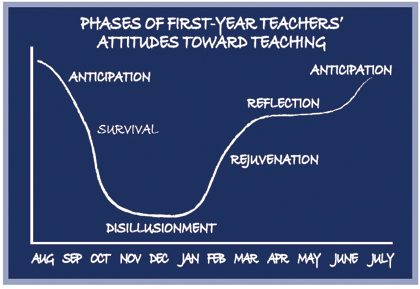
Over the years, I have enjoyed numerous conversations with new teachers at Progress Report time. For many new educators, it is the first time that they have had the time to reflect on what has gone on since the first bell in September. Many have shared that they are tired and feel a little overwhelmed by the pace and volume of work. It is not uncommon for new teachers to go through a case of the November Blahs where their energy level has waned a bit from the beginning of the year.

http://weac.org/articles/new-teacher-handbook/phases/

The first question I usually ask after “So how are you doing?” is, “Are you connecting with your colleagues to divide and conquer or are you stuck inside the walls of your classroom?” In my first year as a teacher, I made the mistake of not asking for help because I thought I could solve my own problems as they presented themselves. I did not want to appear weak to my new colleagues or admin. Needless to say, come November of the first year, things were deteriorating. So I suffered. Which means my students suffered too.

Long nights, failed planning, missed opportunities, and frustration were my regular companions at work and at home. I did not feel like I was taking advantage of the natural mentors in the building that first year. However, by my second year, my eyes and mind were open to any and all who were willing to offer their wisdom, guidance, and resources. By taking myself out of my fortress and asking for help I was able to redirect/rescue/re-invigorate my instruction and outlook.

After that point, suffering was optional. I chose to seek out the support of others when things became murky or began to go off course. It was humbling to know that the people I turned to for help had my best interests at heart. Knowing that I did not have to have it all together every moment of the day was like removing a giant gorilla from my back that was constantly whispering, “You don’t need any help. You can do this on your own. Don’t let anyone think your weak.”

Having a peer mentor to turn to has become a cornerstone of my personal development. In turn, I try to support my colleagues when they need someone in their corner. Perhaps when this time rolls around each year the first question I ask teachers is, “So how are you doing?”

David Suzuki’s message to us all

Today the grade seven and eights at our school were invited to attend the Eco Summit at Mohawk College. It was an exciting opportunity where we got to listen to motivated students from around Hamilton speak about the change they were making in their school community and beyond. Local poets, musicians and activists spoke as well about the changes we could be making and how the earth desperately needs our help.

I knew I had to prepare my students for in their mind what could have been a boring day listening to speakers. I needed to create an interest in them before they sat down in Mohawk’s auditorium. I shared with them a BBC article I had recently read about the key things we can do to keep the earth’s temperature from rising beyond what it can handle. I shared with them how we need to cut down and eliminate certain things or places such as Portugal (as I felt this summer) will be uninhabitable very soon.

I soon saw that this trip was a bit mature for some of our younger grade sevens and even for some of our eights. They did not quite have in them the interest in climate change. Only a few of our eights were brave enough to ask the student guest speakers some questions such as: how did you get your teachers or people in general to pay attention to your causes? How can we make a change? What is the most important issue facing us at the moment? Etc.

I did however find a few key takeaways in the main keynote address of the day. We were VERY fortunate to hear from David Suzuki via video conference. I wrote some notes regarding his message to our group today. Here are the main points:

  • we need to radically reduce our use of fossil fuels
  • we should research and read more about the blue dot agenda and we can do so by going onto bluedot.ca
    • once there, you can click take action
  • we can learn more by reading about the David Suzuki foundation
  • we can email the MP in our area and ask them to sign the MP pledge for environmental rights
  • anyone 18 or older needs to vote in the upcoming federal election for the most environmentally conscious leader
  • fight for the IPCC recommendation
  • it is important that we as educators offer solutions to our children without scaring them about the future
  • shift to what is called a biocentric view rather than what our world currently has, the human centric view
    • we need to see us a part of a web of living things
  • our students are the heroes of the future


That last point really stuck with me. Sure they may have been zoning off during David Suzuki’s talk or not listening to the inspirational music videos, but we cannot give up hope on our heroes of the future. Even if just a few of them take a stand, we can hope that they will be the change we need to see in this world. I encourage everyone to try to do some of the points as listed above. Also, a great read is this BBC article that challenges us to start making changes as well:

https://www.bbc.com/news/science-environment-45775309
Also, here is an amazing message to get a conversation started with your class about doing their part to make the world a more liveable place
https://youtu.be/B-nEYsyRlYo

Unless someone like you cares a whole lot, nothing is going to get better. It’s NOT. -Dr Seuss

Innovation Collaborative Inquiry

I am currently starting a really exciting journey which involves myself and a group of 10 teachers. We are choosing a topic that interests us and going on a year long journey to discover the answers to this question. We are currently thinking about our question having to do with student led learning and how can we get students to take the lead with their learning and how to make meaningful tasks that will inspire action.

We are meeting 3.5 days this year and we are able to work alongside these other teachers to discuss our findings and see how we can put this plan into action in the classroom.

The first meeting involved getting to know all the teachers. We did this by mingling with the crowd based on which card in the deck we had (all sixes went together, the tens went together..) and then we met up with the same suit cards and then we had a few different challenges after that. When we met with our random groups, we answered the question how have we seen or used innovation in our classroom. It was amazing the chats that we had when this question was posed to us. I felt happy explaining my students current inquiry projects where they research a question of their choice which they will then present to the group it relates to. I also shared about selecting meaningful projects that will somehow create change or an action in our school. We discussed all of our innovation ideas and then we were asked to go back to our seats.

A teacher across the room shared about something that someone had said to her that will change and solve all problems involving math: going gradeless. She mentioned there would be various levels in math like when children go to swimming lessons and they wouldn’t be able to move onto math level two until they finish level one. In a way it sounds like an IEP but it would be in place for all students.

The rest of the morning we had to find a group of people that had a common area of focus as us and that is how I ended up in the student led learning group where students guide themselves to tasks that they find to be meaningful and essentially are 21st century learning tasks. This group will meet next week to discuss our plans.

After going to this exciting learning opportunity, I went back to my class and made a self reflection for our drama haunted house that the students had just finished planning, creating, presenting and then cleaning up. I had them assess themselves using four words: not engaged, somewhat engaged, engaged and very engaged. I told them to circle which word best described their involvement before, during and after the haunted house. It was incredible to see that the word they had circled lined up with the way I would assess them. If they had done this same self assessment and I had put marks or levels on the page, I am not so sure they would have been as successful with their assessment.

I am excited to continue learning with my inquiry group and keep trying out things that we learn as a group. The gradeless self assessment was just one small thing that I know will come of this exciting learning opportunity. It is very fun being apart of a group of like minded people that are really hoping to see a positive change in our classrooms.

More to come!

It’s Progress Report Time!

This is my first November out of the classroom in 10 years and yet with the majority of my friends as teachers, I still find myself somehow feeling the anxiety that comes with this time of year. Not only have they been feverishly working to complete progress reports, they know that with reports come Parent-Teacher interviews. This can be an incredibly stressful time for teachers, students and parents.

The first thing that used to bring a great deal of anxiety at this time of year was often wondering whether or not I had gotten to know the strengths and needs of my students well enough to write a report. I found myself thinking that parents would surely expect me to know everything about their child by this point of the year and yet I found that in every day, there was something new to learn. While I found that there was sometimes stress placed upon me by parents to know everything about their child, a lot of the stress and anxiety I felt at this time of year was my own doing. In retrospect, there were a few things that I could have done differently to ease some of the pressure although I am fully aware that it wouldn’t be eliminated completely.

Plan ahead when writing reports. I know that anyone who knows me well is laughing right at this precise moment. Throughout my career, I have been that teacher who has left reports until the very end. All-nighters have been pulled trying to make sure that I could cram every last letter into the reports. I’ve always been one who needs some of the stress of a close deadline in order to get things done. Many times this strategy worked but I notice that as I get older, planning my time seems to be a more effective. I find that when I give myself deadlines to achieve different parts of a task, they become more manageable and I end up achieving greater results. I know that the deadline is fast approaching – if it hasn’t already – perhaps consider breaking up the task of writing reports into smaller components and working through them at your own pace. Is writing a few reports a day manageable or could writing a specific comment each day for all students be easier? Either way, take some time to consider and plan what would make the task more simple for yourself and ultimately more meaningful as you document the progress of your students.

Take time to do something fun with friends. I’m all for working hard and playing hard. My struggle is finding the balance between both. Lucky enough I have great friends and family who notice and try to help. When the crunch is one, I often don’t think that I have time to spare. However, it’s amazing how much more focused and in the moment I become when I actually take some time to stop and connect with someone and have a good laugh. I’m learning more and more that during times of stress, I need to make the time to stop, laugh and enjoy the company of others. Mental health is an important part of our general health and well-being. We know that reports won’t go away and neither will the stress of them but consider what is in your wellness tool-kit that might help as you go through the stressful time. For me it’s laughter with people and I need to make sure that I take the time – even if it’s only for an hour – to do just that.

Consider student-led interviews. The question that is heard the most by teachers in the month of November is, “How is my child doing?”. Every parent wants to know and every teacher feels as though they are just scratching the surface in understanding who the child really is. Over the years, I’ve had colleagues share about student-led interviews. I’ve done them at the end of the first term but wonder about their effectiveness for the progress report. What if we continued in our role as facilitator in these interviews and prepared our students ahead of time to share what they have been learning over the course of the year? Imagine how powerful it could be to get students sharing about the first 2 months and how they have worked to build the classroom community as well as how they are growing as learners. It would certainly allow for students to take the time to reflect on the past couple of months and it could be a great way for them to start setting goals and to discuss how parents might be able to support them in their goals at home. What if we asked students to use the following sentence starters to garner how they are feeling about school as an authentic opportunity for student voice?

  1. So far I’ve learned…
  2. I’m really excited about…
  3. I feel successful…
  4. I need some help with…
  5. I’m most proud of…
  6. I would like to improve…

I wonder if starting off the first set of interviews in this way would reduce the stress teachers felt and would empower students to start thinking about their strengths and advocating for their own needs. It certainly wouldn’t be easy as teachers work to prepare students but I think this could be a really effective start to the relationship between home and school. I can’t help but think that using the 10 to 15 minutes to actually hear from students about their own progress might be a fantastic insight into their true progress.

As I mentioned before, it’s my first November outside of the classroom in a long time and yet I can’t help reflecting on my own practice and thinking about what I might do differently if I was in the classroom at this time. Here’s hoping that my thoughts in hindsight might help another teacher who is currently experiencing some of the stresses of Progress Report time.

Progress Reports

It is that time of year again! Progress reports are due in most boards this month. It is a hard task to think about what your students have done in just a month and a half of school.

I like to give students time to reflect on their learning skills as well as what they have done in each subject. Each year I create a survey for students to self evaluate themselves. Then, I include comments from this evaluation on their progress report. I like to use google forms to create the survey so all of their answers stay in my google drive.

For learning skills, my current grade eight class has made it quite challenging to comment on. They have good and bad days but it is important to set these students up for their next grade. Getting an “E” has to be true at all times since next year I am nervous about how their learning skills would measure up. I gave my students time to come check their current learning skills today and only one student came to my desk to see their mark. At my old school, the entire class used to line up to check their current learning skills. I feel that they may know they aren’t doing the best since they did not come to see their marks.

For math and literacy, progressing very well is very hard to receive as a level four is hard to achieve at all times. I have explained this to my class so that they will not be disappointed by the “progressing well” comment on their reports.

Other subjects we are just getting started on so the “progressing well” comment is hard to justify. “With difficulty” and “very well” also wouldn’t make sense since we have just begun. It is for that reason I find the progress reports timeline a bit challenging and I wish students had a bit more time to dive into each subject. It is hard to get students interested in their marks as well for the first time in my career so this thought makes me nervous for them in high school as well as for the rest of the year.

Is getting students interested in their marks something I can teach or is it just something students come to school with? I am hoping my students will gain that desire soon.

Returning to Work as a New Parent

Four weeks ago, I returned to work after being on parental leave for ten months. It was my second parental leave, so this time around, I felt much more prepared: I knew I wouldn’t be as rested, energetic, or rational as usual, so I did what I could to make my return easier on me. I took the time over the summer to plan out the first few weeks, wrote my long range plans in July, had my annual learning plan ready to go…

I was ready. Returning to work was still brutally hard.

It didn’t help that I had a challenging assignment, with many students in need of additional support that just does not exist in the French Immersion stream. It didn’t help that my second child doesn’t sleep as well as my first, so I was operating on an average of 3-4 hours of sleep. Mostly, though, coming back to work with a young child at home is just really, really hard.

The second week of school, I found myself reassuring a fellow teacher that feeling overwhelmed was a normal part of adjusting to life as a parent and teacher. She had just come back to work after having her first child, and she’d had a particularly rough night at home, followed by a rough morning in class. Everything she was feeling, I had felt myself – not just this past month, but two and a half years ago, too, when I went back to work after having my first child. I remembered how it felt to have someone else validate how I was feeling, reassure me that I wasn’t alone, and tell me that everything I was going through was normal.

Here is what I would like you to know, new parents who are now navigating life as both parent and teacher:

You are not a bad parent or a bad teacher, but you will feel like both. It took me a year of being back at work before I felt like I was almost back to being “myself” as a parent and a teacher. It was incredibly difficult to know that I wasn’t able to give the same level of attention to parenting or teaching that I was used to, and I hated feeling dissatisfied in the job I was doing on both fronts. I didn’t like rushing out of the house in the morning without being able to play with my baby. I didn’t like rushing out of school at the end of the day with calls left to make, assignments left to mark, and my plan for the next day being little more than a skeleton. I was sure that I was damaging my relationship with my baby and letting my students down.

Neither of those things were true. My baby still loved me just as much as she did before I went back to work. My students were still learning and enjoying school. Some assignments never did end up being returned with grades, and some days I didn’t get to see my baby at all because I would leave before she got up and get home after she was in bed, but it was fine. I was still a good parent. I was still a good teacher. My baby and my students were still thriving – just as yours will.

Your priorities will change. I’ve always been heavily involved in clubs, eager to take professional development courses, willing to stay late at work to ensure that things were organized and prepared for the next day. Now, I’ve scaled back my extracurricular involvement dramatically, I haven’t done much PD outside of a few AQs, and I only stay late at work when I have absolutely no choice. It’s hard to make myself leave at 3:30 every day, because I know I’m leaving behind a pile of work that will never really get any smaller, but I have to or I won’t see my children before bedtime. Having time together to eat, talk, and enjoy each other’s company as a family is really important to me. Work, which used to be my top priority, now comes in second. I’ve watched my colleagues make the same decisions – leaving earlier, passing the torch for clubs and sports teams, making less time for work and more time for their family.

It gets better. It may take a long time, but you will get to a place where you feel like you have things under control. You will start to feel like you can balance your teaching life and your life as a parent. Then something will come along to change that (like having a second child, or your kids starting school, or your home life changing) and you’ll feel out of sync again, but it will come back. It’s hard every time, but it isn’t forever.

Ultimately, your children and your students will be fine. You may do more worksheets than you used to because some days you just don’t have it in you to teach that hands-on, super engaging, but very exhausting lesson you had planned. You may serve a dinner you said you’d NEVER serve because some days you will get home and not be able to fathom anything more complicated. That’s okay. Your students will still learn. Your children will still bond with you. You’ll have to make some hard decisions to do what’s best for you – and even when some days are absolute disasters and you’re an emotional wreck, it’ll still be okay.

Be kind to yourselves, parents. You can’t be everything to everyone, and some days, you’re going to feel like you failed at everything. We’ve all been there. Reach out to your colleagues for help, even if only to talk through what you’re feeling. Lean on them. We’re all in this together, and I promise you that we’ve got your back.

School year start up

Well we are already four weeks in and hopefully it has been a great start of the school year for everyone. I am now teaching a grade eight class, teaching math, science, history/geography, language, art and drama. I was overwhelmed at first thinking about all of the subjects I would be responsible for but I have such an amazing grade team so I am truly thankful for all of their support and activities that have been shared.

September is an important month to get to know your students for not only their likes and dislikes but just honestly, do they enjoy school? Every student has their ideas of teachers, rules, subjects, reading, the list goes on and on. Just listening to them talk to other students during class teaches you so much about their interests and about how they have been affected by various things in their past school years. By grade eight students either LOVE or HATE being in a school. I am now faced with the task of continuing to develop that love or trying hard to turn around the hate.

I have been looking at new apps, reading exciting activities for my class to try, looking at fun trips, trying to think of new clubs/teams and I am hoping that I will engage some students who have been disinterested in the past. It is definitely a year long task to try to engage and involve all students so I hope to continue on that journey each day.

On a personal note, as teachers we often feel many emotions at the end of each day. There are questions we ask ourselves and things we always wonder. The one I have been asking myself a lot lately is, “Did I get to everyone?” I feel that is the hardest thing to go home with at the end of each day. That is why I am trying this year to make a few notes on who to go to first the next day and then actually following up on those plans. I am fortunate to finish early at the end of my school day so I can finish all my school work around 3:30/4:00 pm. That gives me roughly six hours of “me” time! That time is so important for our mental health and it is something I am also hoping to focus on this year. Shopping. stair climbing, doing the laundry, making a fun dinner, watching an episode of my favourite show…just a few examples of things I can do each night to stay positive and enjoy each day to the fullest.

I am hoping to talk to my students tomorrow about how to use our after school time wisely to better ourselves and to really add to our day. Our day isn’t over after school and we should really do our best to enjoy the time we have to keep ourselves positive and to make the most of our day.

These are just a few things I have thought about as summer ended and our school year begins. These four works have not been the easiest as being permanent now full time in a very different setting has made me think differently but I am staying positive and really reflecting on the good at the end of each day and looking forward to working on new things the next day.

I am looking forward to posting every few weeks about exciting ideas that occur in my class as well as all the ways I am staying positive and making the most of each day!