Top Ten Tips for Attending Virtual Professional Learning for Educators

So much learning is happening virtually now and it is amazing.  I recently attended a virtual EdTech Conference in Nebraska!  This is an opportunity I never would have been able to take advantage of before the pandemic.  I have attended a number of virtual conferences during COVID and I’ve also organized and facilitated virtual learning over the last year and it is a different way to get your learn on!

In order to really get the most out of Virtual Professional Learning here are my go-to suggestions:

  1.  Organize your time and your conference selections in advance.  If there are many choices, take the time to do the research on the session and on the presenter. If there are digital links for presentations on the conference site to add into a digital tote-do it before your sessions so that you aren’t tempted to leave the session in order to do so.  Thank you ISTE LIVE 21  for the digital tote feature!
  2. Be PRESENT.  Be mindful and intentional about your learning.  If it isn’t the kind of learning that you were expecting, hop over to another session otherwise you’ll be resentful of wasted time and learning.
  3. Put your “out of office” email message on and don’t check your email.  If you were in an in-person setting, checking your email would be rude. This is time for your learning so treasure and protect that time.
  4. When possible attend LIVE sessions not asynchronous or previously recorded sessions.  LIVE sessions have opportunities to engage and ask questions which makes the learning is deeper.
  5. Have a PLP (Professional Learning Partner) or two! No one really wants to go to a conference by themselves. Some of the best learning takes place when you share what you learned in a session that your PLP wasn’t able to attend! You double the learning!
  6. Participate in the learning.  If there is a chat feature then put who you are and where you are from in the chat.  Ask questions, engage and connect.  This is where you grow your Professional Learning Network.  In a face to face conference you would sit down and meet new people.  Think of how you would engage with others in a real conference setting.
  7. TWEET! TWEET!  Get the conference hashtag, follow it, retweet and tweet about your learning and the presenters.  Follow those presenters and give them a shoutout. Take a picture of the slide that they are sharing and post it (without people’s faces and names in it.)  It is awesome as a facilitator to see the tweets afterwards.  It is timely feedback and motivational for the presenter.
  8. Take notes.  My PLPs and I recently collaborated on note taking using a Google Slide deck while attending a conference.  We pasted links, took screenshots and put notes of important information into the slide deck so we have the learning for later.
  9. Participate.  As a presenter, it isn’t nice to present to the empty boxes on Zoom or Webex. Just as in person, it is nice to see the reaction of the audience to pace yourself and to know that they are still with you! That being said, if you are eating or dealing with your dog or family or have decided to multi-task, leaving your camera on can be distracting for the participants and the presenter.  If there is a question asked in the chat, respond! There is nothing like being a presenter left hanging.  If there is a poll, a word cloud, a Jamboard,or a Kahoot, play along! The presenter created these things in order to make the presentation interactive for the adult learner.
  10.  Take Breaks.  Make sure you look carefully at the schedule (and the time zone) in order to plan your screen, water, coffee, bathroom, movement or snack breaks.

The most important thing to remember is that the presenters put time and effort to share their learning and expertise with you.  It is nerve-wracking to present to a group of educators.  Tech savvy people have tech issues too.  Give presenters grace and remember to thank them and provide feedback for their work and expertise.  They will appreciate it!
 

Trouble with Hybrid Learning

ETFO Provincial – Algoma OT

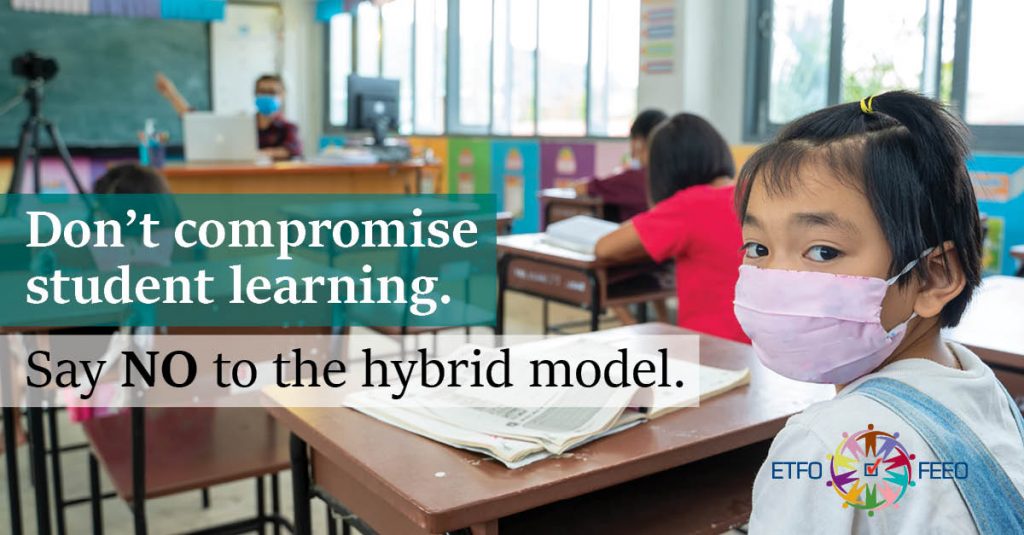
ETFO’s position on in-person learning remains unchanged. The union firmly believes that the daily, in-person model of instruction and support best meets the educational, developmental and social needs of students, provides the best experience for support, and is the most equitable learning model for all students. ETFO’s expectation is that elementary virtual learning in any capacity, including through hybrid models of instruction, will end once the pandemic ends.

As a teacher of the hybrid synchronous in class and online instructional model, I’ve been vexed by the real possibility that this model will be sustained in Ontario’s public education system. As a person who studied education policy implementation, I have considered how this model would be implemented. I solely believe that implementing this model, would be detrimental to students and their families.

As a teacher with experience teaching in the Hybrid model, I’ve written a few blogs about the educational challenges faced by students, parents, and teachers. In this blog, I’ll consider the dark side of implementing this model beyond the months of the pandemic as it could become a set mode of instruction in Ontario.

Highlights of the Elementary School Hybrid Teaching Model:

Cost Savings

  • Less infrastructure is needed for online teaching so there will be less need for schools
  • Less schools means less costs for heating/cooling, internet, cleaning, repairs etc
  • Transportation costs would be reduced due to students learning from home, instead of requiring bussing
  • Class sizes could grow as more physical space for students becomes available, while students move to online learning; this would mean more students online and more students in class
  • Less staffing would be required as less onsite students would mean less onsite supports for students with behavioural and special education needs (i.e. as these needs and supports would be provided at home by families)
  • Online learning via laptops would be less expensive than funding classrooms but cost savings may be neutralized by the technological and pedagogical needs of classroom teachers
  • Instructional materials and consumables would have to be virtual so physical textbooks and other printed materials would not be required, consumables such as pencils and markers would be provided by home
  • Physical education, art, and music equipment would not be required as all these topics would be taught online
  • Closing down or consolidating community schools with fewer in class students could occur to safe infrastructure costs

Less Community Supports

  • School clubs, trips, and other extra curricular activities would not be provided to online students as they participate in school from an online platform
  • Social support programs such as Breakfast Clubs and social work would not be provided by schools as students would only do school from home, these supports would likely be downloaded to regional governments
  • Newcomers to Canada would not receive the supports put in place by schools and these supports would be handled by regional governments instead
  • Students with little knowledge of English/French would not be immersed in an English/French language setting and would not become fluent as quickly
  • Special Education, students with special education needs could be taught from home instead of being integrated with their peers
  • Schools, as community hubs, would be diluted as there would be fewer relationships developed with parents and students
  • Downloading the monitoring of class work would be done by family members instead of the teachers and educational assistants who are trained for this purpose
  • Administrators could recommend that students with high physical and behavioural needs move to online learning so schools do not have to deal with these challenges

Hybrid Hurts Relationships

  • Online students would not have the opportunity to develop relationships with their teachers as they would not be in the same physical space as their teachers
  • Teachers would have a harder time getting to know online students as they could not observe them working and interacting with other students
  • Teachers would naturally focus on in class students who are directly in front of them and not online students who are only seen through a camera
  • Assessment and feedback of student work would be challenging as teachers could not guarantee that work was done by the students
  • Teachers would face challenges showing students how to do work, such as math, that is best taught and assessed in person
  • Learning is built on developing relationships between teachers and students – online students would not get to know their teachers as well

Competing Agendas (Online vs In Class)

  • Schools are run by schedules where periods are set for all subjects including physical education, art, and music
  • With the hybrid model two sets of students would have to be accommodated for all subjects like online/in school gym, online/in school art, and online/in school music
  • Result would mean having to provide subjects such as physical education to online students while in class students would be with their gym teacher making coordinating timetables difficult

Long-term consequences

  • Two-tiered system – hybrid teaching would offer two levels of education in one class
    • online learning would provide a watered-down version of school, with no social opportunities to interact with peers and teachers, with no physical education, no opportunities for being part of school clubs and all the other in person opportunities face to face school learning provides
    • online students could become “invisible” participants in classrooms as they are not present and not there physically to get attention
  • Flexible flipping back and forth opportunities could be offered to parents allowing students to go to and from in class/online learning , putting great stress on teachers to accommodate these students’ needs, which would be exacerbated by larger class sizes
  • Not all students do well in an online setting as some students need to be face to face with teachers in order to attend to lessons and stay on task

As a teacher who has experienced teaching online and in the hybrid model, I know that I could not sustain another year of this work. My experience was especially trying as I teach students with special education needs. After teaching all day, trying to meet the needs of my online students, I was left with little energy to do anything else … and if you know me, I’m usually a high energy person.

In a real-life case, a teacher, providing hybrid instruction, was having behavioural challenges with a student. Administration suggested that the student be switched to online to prevent behaviour happening at school.

Imagine …

Due to decreased funding, schools do not have the resources to support all students, especially with behaviour and significant special education needs. Imagine, how this hybrid model could be used to download “problem” students to online learning from home. This would mean that students would not get the appropriate supports provided by professionals in order for them to be successful learners. Administrators could also suggest that students learn online to avoid expensive bussing transportation or physical care needs.

If education costs are put ahead of students’ needs, this can only end poorly for students with significant learning needs.

Speak out to stop the hybrid model from being implemented.

Collaboratively Yours,

Deb Weston, PhD

What’s Your Superpower?


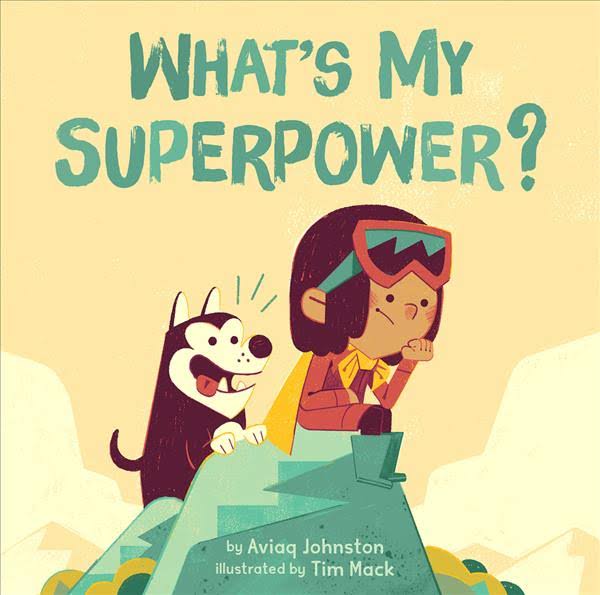
“What’s My Superpower” is a sweet and powerful book written by Aviaq Johnston and illustrated by Tim Mack. This is the story of Nalvana, an Inuit child who lives in a northern community, and her journey to find her own “superpower”. This book was gifted to me by my educator friend, Ellie Clin. She thought I might be able to relate to Nalvana, and she was right!

As we prepare for the end of year, some of us might be hoping to include student voice in our Report Cards and/or facilitate Student-Led Conferences. This story could inspire Writing, Drama, and Visual Arts, as well as meaningful opportunities for self-reflection and celebration of all of our “superpowers.”

Here is how I am planning to use this book:

1. Listen to the story, “What’s My Superpower?” by Aviaq Johnston, read aloud on-line.

2. Reflect: What is your superpower?
For example: What makes you a good friend? What activities feel easy for you? What are your gifts or talents?

3. Write about your superpower. Give examples.

4. Draw a picture of yourself using your superpower.

5. Optional: Dress up as a superhero and share your superpower with the class.


I shared this idea with other teachers in the school, and invited them to co-create the template and “success criteria”. We have been talking about creating a shared writing task that can be implemented across the grades to help us build a skills continuum or exemplars of student work from Kindergarten-Grade 6. This writing sample could be considered both a self-reflection for Learning Skills and an introduction to next year’s teacher. It could be included in every students’ portfolio, and/or used for moderated marking.

Transforming Power:
I recently participated in professional learning as part of ETFO’s MentorCoaching program. One of the workshops was called “Transforming Power,” and it was facilitated by Indy Bathh and Louise Pitre. The first activity we did together was to share our superpowers in the Chat. This was a wonderful way to introduce ourselves to each other, and to practice naming our strengths.

It is always interesting to reflect on qualities of leadership with a group of educators who identify as women. As you might expect, the impact of patriarchy and misogyny, capitalism and racism reinforce the oppressive belief that women have less value. In a group of union leaders, it was still difficult for some of the women to identify their own superpowers. This reminded me of how important it is for all of our students to know their power, and to feel powerful, and to use their power to make change.


I want to encourage everyone who is reading this blog to pause and reflect. What are your superpowers? Make a list or draw them. Can you think of a time when you used your superpower to support and empower others? HINT: You do it every day with your students!

CommUNITY:
As I reflect on my own superpowers, I think about how I have been successful at creating community this year: in the classroom, in the school, and in professional learning communities.  During this time of isolation, building relationships and making connections has been the most meaningful work I have done.

In the classroom, I support everyone to feel like a VIP every day. We play together, and celebrate our strengths by giving and receiving Heartprints. In GLOW Club, I actively teach about love, pride and resistance. I organize whole-school events, like the WTF embodied Land Acknowledgment, Gender Splendour Week, sing and dance like a Mummer, and strut my stuff on the runway during our Kiki Ball. I listen and share picture books with staff, and acknowledge the powerful work they are doing with their students.

In the school, I facilitate brave conversations with families through Book Club and Community Core Values discussions, and I share resources with families about Settler Allyship and how to talk to children about anti-Black racism. As the Union Steward, I use our BBSAT (Building Better Schools Action Team) distribution list to share information about ETFO campaigns and actions by Ontario Education Workers United and Ontario Parent Action Network. 

As part of my own professional learning, I will continue to share ETFO’s Women’s Equality Project with locals, and collaborate with members in Ottawa to build relationships of equity and justice. I will continue to attend ETFO webinars and access resources.  I hope to finish my Masters of Education next year.  It has been an honour and a privilege to learn with educators in community.

Gratitude:
After 12 years, I will be leaving The Grove Community School. As one of the founding teachers, I am extremely proud of the learning we have done together to create the first public alternative elementary school with an explicit focus on environmental justice, equity and community activism. I am deeply grateful for all of the students, families, educators, and community members I have worked with at The Grove, ETT and ETFO.  Thank you!

Thank you to “The Heart and Art of Teaching and Learning” for the opportunity to document this unusual year with my Grade 2 students. This summer, my partner and I are moving to Peterborough.  I will be teaching in Kawartha Pine Ridge as an Occasional Teacher next year, which will be a humbling experience.  I will be looking for new allies and educator friends, and re-reading posts from this blog for support and inspiration.

The Show Must Go On…..

I was very disappointed to learn that we would not be returning to school in June. I am missing the students and their families. I feel isolated from my co-workers, and I am longing for the times when we would connect in the hallway and out in the yard. I do not love teaching on-line, but I am finding new ways to engage with my students, collaborate and play.

Reader’s Theatre:
Reader’s Theatre and/or writing and performing original plays works really well on-line. With younger students, you can share the screen and read a poem or a play together as a shared reading activity. Older students can work in Break-Out rooms (ZOOM) or in their own meetings to write and/or read together.  To support the creative process, there are several Drama games and conventions that work on-line, such as speaking in-role, Mirror, exploring different feelings through movement and facial expressions, charades, and more!

It’s Show Time!
As we have all discovered, there is something extra performative about staring at yourself while you are teaching. There are times when I feel like a Children’s Television Host, trying to be as animated and entertaining as possible, which can be exhausting. My students need a body break every 30 minutes, so I always join them to jump and dance to various fitness videos. I have seen educators on social media upload photos of themselves in costumes, sharing ideas about themes such as Beach Day and Star Wars Day. We are all working so hard to be creative and keep our students happy. We deserve a standing ovation every day!!

In preparation for Earth Day, we listened to the story “The Great Kapok Tree” by Lynne Cherry. When a Kapok tree in the Amazon rainforest is threatened, different animals who depend on the tree speak out.  All year, we have been learning about relationships, and the ways in which humans and more-than-humans are all related and connected. This book also supports the Science learning in Grade 2 for Growth and Changes in Animals, as well as environmental justice. I found a Reader’s Theatre script on-line shared by another educator, which I was able to revise for my own students.

Puppets!
Puppets can be used very effectively to tell stories on-line. After choosing their parts, everyone was encouraged to think about how they might develop their character using voice and movement. One of the students’ in the class has two parents who are actors. Krystal Meadows and Eli Ham joined us on-line as special guests. They shared ideas about how we could use the “box” that we are in to move in different ways. We imagined how our character might be feeling, and how that might impact the way the character moves and speaks. We learned about pitch (how high and how low), tempo (how fast and how slow), and timbre (the quality of sound).  During this rehearsal time, everyone was working at home to make a puppet. Some students used a paper bag, or glued a drawing to a stick. Others used toilet paper rolls or socks. They were all very creative!

“Keep Calm and Break a Leg”
After two weeks, we were ready to share our play. In preparation for our performance, some students created their own art to use as backgrounds, which was lovely. We discovered that virtual backgrounds don’t work because the puppet (and the actor) sometimes disappear. During the performance, students were amazing at muting and unmuting themselves. I encouraged everyone to have their own copy of the script so that we did not have to share the screen. We also used “Speaker View” to focus on who was speaking.

The first time we performed, I recorded the meeting and shared it with families to enjoy. We also watched the recording together as a class. We practiced giving and receiving feedback, and thinking about how we might improve our performance. At the next Staff Meeting, I invited other classes to join us for a second performance. I shared our ZOOM link and we had another chance to share our hard work with a new audience.

One of the advantages of performing on-line is that the audience was able to hear the actors clearly. Without a microphone, it can be challenging in-person, (especially when wearing masks) to be heard on stage. If you have an on-line opportunity to write a play with your students or use Reader’s Theatre to perform poetry or a script, I highly recommend it. Drama is so playful and filled with possibilities. Play on!!

Student-led end of the year conferences

As we wind down towards the final report cards, I find myself wondering how I will be organizing my yearly student-led conferences. Each year on June 1st (or the first school day in June), I met with students one on one to discuss their upcoming final report. This gives students time to ask questions that relate to their final report. This year, I was wondering how I could run these conferences as a remote teacher (and having never met these students). I decided to use a sign up sheet with five minute intervals and then use breakout rooms for my interview spaces.

To introduce this activity, I told students that they would have the opportunity to ask questions about their upcoming report and to work towards improving some of their learning skills or doing some extra assignments to add to their lower marks. This is how the interviews with my grade sevens went:

  • Students created multiple questions to guide the interview such as:
    • What is my best learning skill?
    • What is a subject I should look for an extension in?
    • How can I bump up my math mark?
    • What subject should I look to participate the most in?
    • Am I lower than the class average in any subject?
    • Can I add to my grades in certain subjects or is it too late?
    • Are there any next steps you have for me?
    • How am I doing in health?
  • Students were given a personalized action plan which we worked together on, to come up with additional tasks that they could complete to improve their marks/ learning skills
  • Students were beyond thrilled to have the opportunity to bump up their lower marks
  • Students that had been idle for a while came to life!

All 30 student interviews took place yesterday. I emailed families to make them aware that their child had an interview on MS Teams and that they would have an opportunity to bump up their marks in time for their final reports. Parents were thankful for the opportunity and mentioned that they would encourage their child to work on these activities.

Today (the day after the interviews) I noticed a few students that had been silent for the past few months were starting to participate again. One student even led the discussions today in history, science and math. This is something that occurred as a result of a little encouragement and a private five minute discussion. Having students actively interested in their learning and the outcome is so important, especially in remote learning.

Student led interviews and feedback sessions are something that I was taught in my first placement as a teacher candidate. My associate teacher called over a student one at a time and let them see their “lower” mark and encouraged them to bump them up. It didn’t work for everyone but for some students, I noticed it gave them the extra drive and determination to finish the year on a positive note.

I know that it is already June but I wanted to make sure that students are not surprised when their reports come. I tried doing this in May in the past but I find June works best as reports are around the corner and students are looking to showcase their learning a few final times. I am so excited to get to some fun activities this month but I know these interviews can get students to really care about their final reports. This turns it into a working document rather than a piece of paper that students never care to read. They are proud to show their parents their areas of improvement and their marks rather than throwing it in the nearest garbage.

It is still early in June so you could try it out in your class and see how it works! Not everyone cares about their “marks” but for those that do, this is a powerful tool to motivate them even a little bit further.

Happy June everyone and enjoy your weekends 🙂