What’s Your Superpower?


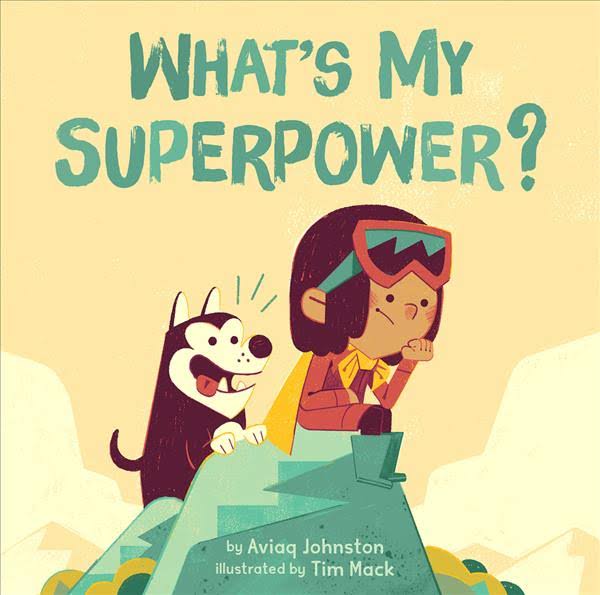
“What’s My Superpower” is a sweet and powerful book written by Aviaq Johnston and illustrated by Tim Mack. This is the story of Nalvana, an Inuit child who lives in a northern community, and her journey to find her own “superpower”. This book was gifted to me by my educator friend, Ellie Clin. She thought I might be able to relate to Nalvana, and she was right!

As we prepare for the end of year, some of us might be hoping to include student voice in our Report Cards and/or facilitate Student-Led Conferences. This story could inspire Writing, Drama, and Visual Arts, as well as meaningful opportunities for self-reflection and celebration of all of our “superpowers.”

Here is how I am planning to use this book:

1. Listen to the story, “What’s My Superpower?” by Aviaq Johnston, read aloud on-line.

2. Reflect: What is your superpower?
For example: What makes you a good friend? What activities feel easy for you? What are your gifts or talents?

3. Write about your superpower. Give examples.

4. Draw a picture of yourself using your superpower.

5. Optional: Dress up as a superhero and share your superpower with the class.


I shared this idea with other teachers in the school, and invited them to co-create the template and “success criteria”. We have been talking about creating a shared writing task that can be implemented across the grades to help us build a skills continuum or exemplars of student work from Kindergarten-Grade 6. This writing sample could be considered both a self-reflection for Learning Skills and an introduction to next year’s teacher. It could be included in every students’ portfolio, and/or used for moderated marking.

Transforming Power:
I recently participated in professional learning as part of ETFO’s MentorCoaching program. One of the workshops was called “Transforming Power,” and it was facilitated by Indy Bathh and Louise Pitre. The first activity we did together was to share our superpowers in the Chat. This was a wonderful way to introduce ourselves to each other, and to practice naming our strengths.

It is always interesting to reflect on qualities of leadership with a group of educators who identify as women. As you might expect, the impact of patriarchy and misogyny, capitalism and racism reinforce the oppressive belief that women have less value. In a group of union leaders, it was still difficult for some of the women to identify their own superpowers. This reminded me of how important it is for all of our students to know their power, and to feel powerful, and to use their power to make change.


I want to encourage everyone who is reading this blog to pause and reflect. What are your superpowers? Make a list or draw them. Can you think of a time when you used your superpower to support and empower others? HINT: You do it every day with your students!

CommUNITY:
As I reflect on my own superpowers, I think about how I have been successful at creating community this year: in the classroom, in the school, and in professional learning communities.  During this time of isolation, building relationships and making connections has been the most meaningful work I have done.

In the classroom, I support everyone to feel like a VIP every day. We play together, and celebrate our strengths by giving and receiving Heartprints. In GLOW Club, I actively teach about love, pride and resistance. I organize whole-school events, like the WTF embodied Land Acknowledgment, Gender Splendour Week, sing and dance like a Mummer, and strut my stuff on the runway during our Kiki Ball. I listen and share picture books with staff, and acknowledge the powerful work they are doing with their students.

In the school, I facilitate brave conversations with families through Book Club and Community Core Values discussions, and I share resources with families about Settler Allyship and how to talk to children about anti-Black racism. As the Union Steward, I use our BBSAT (Building Better Schools Action Team) distribution list to share information about ETFO campaigns and actions by Ontario Education Workers United and Ontario Parent Action Network. 

As part of my own professional learning, I will continue to share ETFO’s Women’s Equality Project with locals, and collaborate with members in Ottawa to build relationships of equity and justice. I will continue to attend ETFO webinars and access resources.  I hope to finish my Masters of Education next year.  It has been an honour and a privilege to learn with educators in community.

Gratitude:
After 12 years, I will be leaving The Grove Community School. As one of the founding teachers, I am extremely proud of the learning we have done together to create the first public alternative elementary school with an explicit focus on environmental justice, equity and community activism. I am deeply grateful for all of the students, families, educators, and community members I have worked with at The Grove, ETT and ETFO.  Thank you!

Thank you to “The Heart and Art of Teaching and Learning” for the opportunity to document this unusual year with my Grade 2 students. This summer, my partner and I are moving to Peterborough.  I will be teaching in Kawartha Pine Ridge as an Occasional Teacher next year, which will be a humbling experience.  I will be looking for new allies and educator friends, and re-reading posts from this blog for support and inspiration.

Some days I don’t like teaching

The above title is not a lie, but it hasn’t always been like this. I have no intentions on adding on more unlikeable days either, even while there are forces beyond my control always at work. I am seeking to understand how and why it feels this way?

Prior to January 2020, it would have been easy to count the number of bad days I have had  over 11 years of teaching on one hand – that includes the Laurel Broten years as MOE. Okay, 2 hands #FireLecce. Sadly, a year and a third later, I am using the segments of my fingers too.* I am sure that this admission probably mirrors what many in our profession are feeling whether in class or in virtual school settings. For the sake of this post, I will stay in my lane and write for myself with the knowledge that this is common ground. 

Not that my students would ever notice, but there are numerous days when I find it hard to like what it takes to facilitate instruction of any sort. I am struggling to find any of the profound and prevalent joy that naturally occurs in the in-person classrooms in which I am privileged to teach. While emergency online education has occasional moments of brilliance, they seem more like faded flashes of light than beacons of lasting inspiration lighting the way forward. I perish the thought that this becomes acceptable in education beyond these “extreme and exceptional” circumstances. 

These moments pass through our cold screens as quickly as posts on a social media feed. Lately, it seems as if students have become conditioned to seeking out fleeting moments of happiness/joy while on-line – something akin to the addictive need for instant gratification. They need to know the answers now, and don’t want to wait for them. Are you noticing this happening in your lockdown learning spaces?

At a time when most answers are available to learners by simply opening another tab or pointing an app at a screen, it is hard for students to get excited about “the learning” when it comes without a healthy struggle or a need to problem solve. By being able to get what they need without any demand on their intellect other than Google skills, students are missing out on some deeply foundational learning right now. The issue comes when they are asked to apply some of this instant knowledge to something different that can’t be searched. 

At first, I wondered whether it was the type of questions I was asking. Were the answers googleable? Teachers can fall into that trap really easily, but it can also be avoided by asking students to evaluate and infer as part of their responses rather than to regurgitate the who, what, when, and where answers. I am a why and how guy when it comes to asking questions so most of the literal variables in questioning are out. I suggest reframing questions to help students respond to content in ways that ask for their opinions while using the lesson or text to reference and support their own ideas.

Then I wondered whether the pace of instruction was too rapid? Was I assigning too much? I teach a combined class and try to provide enough time built in for much shorter lessons with considerably more digital supports for students to reference when they are working independently. Providing time in-class, re-negotiating due dates, reminders, and check-ins are all part of the process.

Despite multiple hours of availability on and off line, students have still been struggling to complete work in a timely manner. With so much pressure to keep everyone engaged more content/lessons/assignments get shared over the course of a the instructional week, more check-ins for understanding happen, and the cycle of lockdown learnig online repeats itself. Adding more work was not the answer. Maybe variety is the answer?

So I mixed it up with TED talks, TED Ed lessons, discussions, visual Math, digital manipulatives, assessments with links to prompt and remind students, and some extra time be silly and do Just Dance. That moved the excitement and engagement needle in the right direction and then in the last little while, the cameras began staying off. 

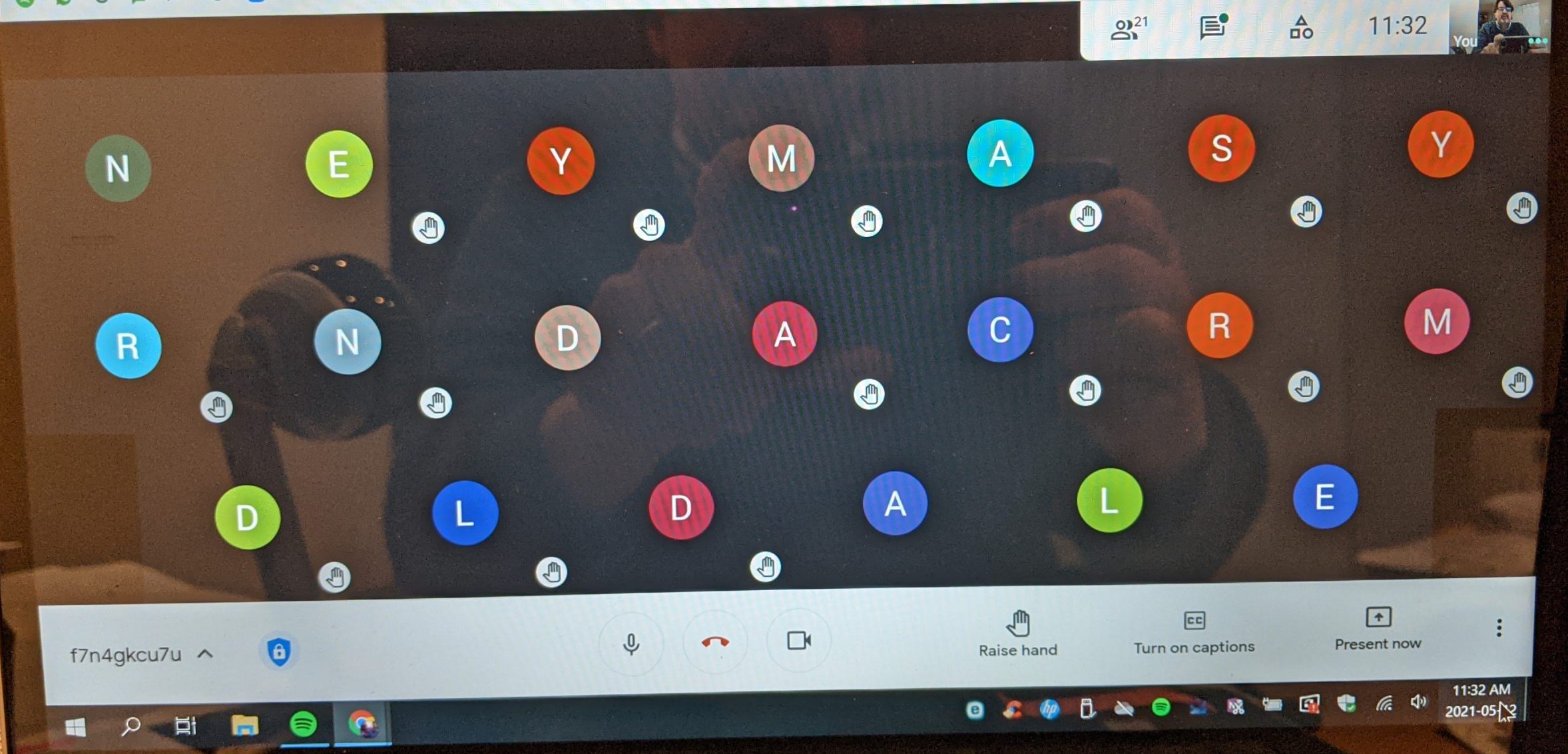
Cue the dots

This is what teaching looks like during a pandemic yet this is the reality of virtual instruction right now. Despite the differentiation it is still hard to find joy or connection in these spaces. At least the sounds of voices and the occasional witty remark in the chat lighten things in the moment. I can only imagine how hard it must be on the students who have been thrust into this virtual maelstrom and expected to perform as if nothing has changed in their lives or the world around them. I am still working on making it better for all of us in the spaces we are forced to occupy right now. In the meantime I am want to make sure that our time is meaningful, fun, and mentally healthy in advance of a return to in-person instruction in the future. Maybe then I can stop counting the unlikeable days and resume counting the amazing ones again. 

Further reading
The Twitter Generation: https://tomprof.stanford.edu/posting/1182

https://medium.com/launch-school/the-dangers-of-instant-gratification-learning-d8c230eed203

Educational Perfection

As we end another school year and look forward to summer vacation, I think back to my first years in education and what summer “vacation” looked like for me. July was spent taking additional qualification courses and most of August was spent prepping and planning. It wasn’t really much of a vacation.  So why did I do it? Two reasons. I am passionate about learning and I am a (now recovering) perfectionist-especially as an educator.

I must have thought there was some kind of a prize for having the tidiest, prettiest and well organized classroom. I wanted my classroom to look like something out of the Scholar’s Choice catalogue. The custodians would be annoyed at having me in the school and I would wait anxiously for them to be finished waxing our hallway so that I could get in and set up my classroom. I needed everything to match. If I had baskets for items in the classroom they had to all be the same colour. It isn’t always easy to find 24 of the same basket at the Dollar Store.  Before the students started in September I felt the need to have labels on all of their notebooks, duo tangs and I even labelled their pencils. I spent an inordinate amount of time trying to control the environment for my students. My classroom looked like a showroom on the first day of school and I would spend the next 194 days trying to maintain that standard. Our first printing practice lesson (because we still did that back then) was to practice writing “A place for everything and everything in it’s place.” When I think back now to all of the time and energy that I wasted not allowing learning to get messy I shake my head. It was exhausting.

After twenty plus years in education I’ve learned a few things about educational perfectionism and letting go of control in order to empower the learners in the classroom. When I was given a portable for a classroom that I wasn’t able to get into much before school started I panicked at first.  I didn’t have space or time to create a showroom. I decided to give the design over to the grade 4-5 students.  I still had labelled duo tangs and a place for each of them to put their things that was their space ready on the first day but the rest, we did together. It built community, it gave the students ownership and it gave me some of my summer back. If you’ve ever taught in a portable that has the coat racks inside, winter is a bit of a nightmare for an organizational freak but eventually I let it go. We still had a tidy classroom because their wasn’t enough space to be too messy but the organization of things didn’t stifle the learning. We learned how to paint in a portable without water using buckets and trips into the school. We brought lawn chairs to school at sat outside at reading time. I loved our little cabin in the woods.

As educators we have a lot of people that we are accountable to in our jobs. Students, families, administrators, our board and our communities are all stakeholders in what we do. The pressure to be perfect in our roles can be overwhelming and paralyzing. What educators do each day is literally driven by “overall and specific EXPECTATIONS”. It took time for me to realize that the expectations that I was putting on myself were much higher than those of anyone else. It took reflection to realize that perfectionism isn’t the badge of honour that I thought it once was and that it was making my life more difficult. I came to understand that it isn’t the room or the resources that make me a good educator.  It is about the connections and relationships with my students and their families that matter. It is about embracing the Ms. Frizzle moments and rolling with it.  If I’ve learned anything from COVID-19 it is that being flexible and letting go of what I cannot control are the keys to staying out of perfectionism. I plan on guarding my summer vacation as I would a medical specialist’s appointment but I’ll likely take a few professional resource books along to read in the waiting room.


Break open…and rise up!

Spring is a good time to reflect and pay attention to growth, change and transformation. After a long year of isolation and stillness, everyone is hopeful about the promise of movement and possibility. Planting seeds is a wonderful metaphor of the learning that we are doing together in our school communities.

Planting Seeds:
Jenny Davis is one of the parents at The Grove Community School who has supported the growth of the Rainbow Garden, by working in consultation with First Nations and Indigenous families and community members. In the fall, Jenny harvested seeds from some of the edible plants, including sunflowers, cornflowers, and marigolds. This Spring, families worked together to deliver a paper bag of soil, seeds and a pot to every student.

Jenny facilitated on-line planting with our classes, and shared what she is learning about important Indigenous protocols, such as the practice of gratitude and reciprocity. We were encouraged to sort and describe our seeds and learn their names before planting, to draw pictures on our popsicle sticks to welcome them, to “pay attention” and give them what they need to grow. During our Land Acknowledgment, I have been honouring our plant relatives, and inviting students to share what they notice about their seeds as they break open and rise up.

Me and White Supremacy:
This winter, as part of my ongoing commitment to the practice of anti-racism, I participated in a community Book Club with a small group of parents and staff. Together, we read “Me and White Supremacy: Combat Racism, Change the World, and Become a Good Ancestor” by Layla F. Saad. I highly recommend this resource to White educators. This is a powerful book that includes journal prompts at the end of every chapter to support deep reflection and action. Layla Saad first wrote the book as a 30 day Instagram challenge, with daily prompts to support readers who have White privilege to recognize and disrupt White supremacy in their lives. Our Book Club met on-line every month, and we discussed one week at a time.

Layla Saad offers a process for engaging in the work called “The Circle Way”, which was developed by Christina Baldwin and Ann Linnea. The Circle Way includes guidelines and a structure for readers to follow, including rotating facilitators and a shared intention and responsibility to stay focused on the work. It was very helpful, and can easily be used to facilitate critical and courageous conversations in other contexts. I recently facilitated a discussion about the final chapters, and I invited everyone to think about their own growth, change and transformation, and how we might invite others into this work.

Root into darkness:
This work is not supposed to be easy. Layla Saad explains that feelings of devastation, anger, and confusion are important parts of the work. She writes, “Without those feelings, nothing changes, because there is no reason to heal what does not feel broken.” (page 199) As White educators who are committed to racial justice, we must recognize how we are complicit in a system that is causing harm to Indigenous, Black and racialized people, and allow the pain “to break your heart open” and work towards creating change.

Maya Angelou wrote: “Do the best you can until you know better. Then when you know better, do better.” After discussing what holds us back from “doing better”, such as fear, loss of privilege, confusion, or insecurity, the Book Club members made commitments to take action and disrupt White supremacy in our different communities. Each member shared “I will….” statements, and we agreed to continue the Book Club next year, and support new families to join the discussion.

Me and My Commitments:
I want to share my own commitments to anti-racism and publish them in this blog, so I can be held accountable. I will also include concrete actions that I will take towards these goals.

*I will….continue with my own on-going learning and professional development.

(I recently started the ETFO MentorCoaching program, and I am learning about intersectional feminism, anti-oppression frameworks, and transforming power. I will continue to use the reflective journaling prompts in the book to challenge my own White silence and fragility.)

*I will….share my learning with others.

(As an ETFO workshop facilitator, I meet with members from all over the province and always position myself as a co-learner. I will always join committees at school and/or in my local, that are doing racial justice and equity work.)

*I will….use my privilege to disrupt White supremacy in my classroom and school community.

(I will meet with my principal to discuss Equity goals for next year, and share recommendations at our last Parent Council meeting, including an on-going process of discussion and reflection to determine how well we are meeting our collective goals.)

*I will….center and celebrate voices of Indigenous, Black and racialized voices in the classroom.

(I have more learning to do about anti-Asian racism, and integrating curriculum to support East/South Asian students. I will dig deeper into the new ETFO resources, and implement Culturally Relevant and Responsive Pedagogy. I will teach love and pride always.)

*I will…listen and learn when I am called out and called in. I will allow myself to make mistakes, especially as I break open and rise up!!

Thank you for reading this blog. Writing and learning in community continues to be a transformative practice for me. I am deeply grateful for all of the support and nourishment I have received to keep growing.

OAME Math Conference 2021: Equity Counts

I am very excited to write today’s post as I had the pleasure of once again attending the OAME math conference this year. The conference ran from Monday, May 17th and ends today Friday, May 2st. There were over 160 sessions to select from so it was hard to narrow it down to three per evening. I was offered a volunteer position with OAME to assist with moderating 3-4 sessions. This gave me access to the entire conference and as usual, this year’s conference did not disappoint. I would love to tell you about the exciting sessions I went to and some details about them. I also attached resources that were made publicly available and some ways I have already used my learning inside my grade seven math classroom.

Session Name: Supporting the new Elementary Math Curriculum: Educator Learning Modules
Presenters: Moses Velasco and Chantal Fournier
Summary of my learning: Moses and Chantal shared their presentation about ELMs. They shared a great resource as well! This presentation was geared towards more of a math coach audience which as I am not was not able to connect with much of their content. The ELMs were from 2017 and I know there were some questions about making new ones with the new math curriculum. Moses let the audience know that they will be coming out soon. The examples that we saw on the website were great! Feel free to explore their resource.
Resources: https://sites.google.com/view/operation-sense/home
———————————————-

Session Name: Assessment that Moves
Presenter: Jordan Rappaport
Summary of my learning: Jordan was a gifted speaker and he had so many important things to share. Many of them I implemented in my class the very next day. Jordan spoke a lot about virtues in math:

  • Being creative
  • Being a thinker
  • Curiosity
  • Perseverance
  • Willingness to take risks
  • Ability to collaborate

Jordan shared that these virtues are important to people who hire mathematicians and essential in every math classroom. We also looked at a forward thinking rubric which had three boxes and a large arrow on top. He talked about using this so students can see where they are and where they should move towards. For the topic of collaboration, on the left column on the rubric, you would put terms like excluding, not being supportive, etc. and on the far right you would put the expected behaviours (opposite of the left side). You would then circle the place where the student was at. Jordan mentioned that building a rubric should be a collaborative process and he starts jamboards and shares them with his students. They generate ideas together when talking about a specific math virtue, what you should see and not see.
How I used this in the classroom this week: The day after hearing from Jordan, I posted the virtues on my slide and asked students to share what their best math virtue is. This allowed us to engage in conversations about why they take risks, why others may not, etc. This conversation was so meaningful and I loved hearing from my students.
Resources:

https://www.francissu.com/ 

https://buildingthinkingclassrooms.com/ 

https://www.peterliljedahl.com/ 

http://fractiontalks.com/
———————————————-

Session Name: Designing Classroom Explorations that Engage All Students
Presenter: Gail Burrill
Summary of my learning: During this session, Gail spoke about many exciting topics. Gail shared that in her math classroom, she has her students complete various math tasks such as: book reports, research reports (math in art, etc.), write stories from graphs and many more. This connects math to many other subjects and is meaningful for students. Some other key takeaways included:

  • Data driven tasks are important in the classroom
  • Connecting math to student’s lives
    • Gail gave an excellent example where students had to find the problem with Fred VanVleet from the Raptors as his shooting percentage was in a rut. They had to solve if there was a rut or not and look at percentages with his shooting statistics.
  • Following instructions doesn’t mean your students have learned anything
  • Turning procedures into problems because then students will want to solve them and remember them
  • Vertical non-permanent surfaces
  • Visibly random groups
  • Comments before grades; feedback should be for thinking

Gail also mentioned a great resource where you can visit https://censusatschool.ca/ and have students answer: What do you notice? What do you wonder? These real life statistics engage her students for the first fifteen students of her class and she looks at real life scenarios. Gail also left us with some things to think about:

  • How much time do your students spend..
    • in silence?
    • talking to peers?
    • listening?
    • presenting?

Resources: https://censusatschool.ca/
———————————————-

Session Name: Building Math Residue with Lessons That Stick
Presenter: Graham Fletcher
Summary of my learning: Graham shared many ideas that help students engage in explorations and lessons that really make students wonder, what is the answer to that question? I loved this idea from Graham:

  • Estimation Waterfall: asking students to wait until they hit enter so that they are not just copying the student who always gets it “right”

Of course, the focus of the session was what makes a good task? Here were Graham’s steps:

  1. Simple: Is it accessible? Avoid language due to any language barriers
  2. Unexpected: Does it fire up the guessing machine? Do students actually want to know the answer?
  3. Concrete: Do your students have any prior knowledge to connect to?
  4. Credible: What validates the math?
  5.  Emotional: Does it create an ah-ha moment?
  6. Stories: How will the math story be told?

Graham also mentioned the following ideas which are important to know and to understand:

  • Anyone can be good at math
  • Listening to a student’s thinking is more important than the answer
    • Graham showed a video of him working with a student and he was so patient, waiting to hear the student get the answer and listening to their process
  • Right answers should only matter at the end of a unit (assessment/test). The journey along the way is for making mistakes and for building understanding
  • A good math question makes you excited for the answer
  • Teachers shouldn’t jump on their students when they see a wrong answer, they should question them and wait for them to have that ah-ha moment

How I used this in the classroom this week: The day after hearing from Graham, I asked my students join a jamboard and I posed the above statements to them. I had them disagree or agree and if they wanted, they could share their reasoning on the mic. Students had such incredible things to say about all of the statements and we even got one anxious student to admit that making mistakes along the way is okay!  A huge breakthrough for this student.
Resources: https://gfletchy.com/Be sure to check out the tab “3-Act tasks” for some engaging lessons that stick!
————————————————–
Session Name: Math, Social Justice and Actions
Presenter: Robert Berry
Summary of my learning: Robert Berry brought up incredible conversations that need to be had in our math classrooms. Robert shared a provocation for us: Who are our essential workers? What do you notice, wonder and how does it impact your community? Robert shared a lot of insight on how to create your own social justice math lesson:

  • Learn about relevant social injustices
  • Identify the math
  • Establish your goals
  • Determine how you will assess your goals
  • Create a social justice question for the lesson
  • Make student resources
  • Plan for reflection/action

There should be conversations about connecting math with students cultural and community histories. This was a great session and I was so engaged in his presentation, I did not take many notes!
Resources: https://padlet.com/rqb3e/sjmathresources Attached are incredible social justice mathematics resources
————————————————–

Session Name: Some of my Favourite Problems
Presenter: Mike Eden
Summary of my learning: Mike is from the University of Waterloo and he shared many engaging math problems from various contests and from challenging math lessons. He asked people in the chat to share their answers and we looked at many ways to solve these challenging problems. I am sure you are all familiar with “Problem of the Week” from the University of Waterloo, well Mike took us further with these incredible problems!
Resourceshttp://: https://www.cemc.uwaterloo.ca/ https://www.cemc.uwaterloo.ca/contests/past_contests.html
—————————————————
Session Name: Slow Reveal Graphs as Social Justice Provocations
Presenters: Kyle Pindar and Jennifer Fannin
Summary of my learning: This was such an engaging session that used the website https://trends.google.com/trends/ to design slow reveal graphs. The focus of the lessons are asking the questions these key questions: What? So what? Now what? Also, what do you notice? What do you wonder? Slow reveal graphs are innocently framed as hard hitting social justice questions. Kyle explained how to make these slow reveal provocations using these steps:

  1. https://trends.google.com/trends/?geo=CA Make sure you are using the Canadian trends (setting on top right should say “Canada”
  2. Download the image (graph) you want to use
  3. Open up a blank google sheet
  4. Upload the download and re-size the columns
  5. Delete the top two lines
  6. Create slide show

Then, show your students these graphs, slowly revealing new features on the graph such as: the actual data, x axis information, y axis information and then eventually, the title (trend). Kyle and Jennifer discussed generating expected students responses so that you can be prepared to have these discussions as a class. They had great examples, specifically a graph showing the googling of “BLM” and you could see the spike on the day that George Floyd was murdered. Both presenters discussed how you would have that conversation with the class of what made these search results spike up in May of 2020? These are such great ways to have social justice discussions in class!
Resources: https://trends.google.com/trends/?geo=CA https://www.statcan.gc.ca/eng/start

Overall, I am so grateful for the opportunity that was this year’s OAME Math Conference. I wish I had been able to attend/moderate more sessions but as an OAME volunteer, I have the ability to listen to recorded sessions I could not attend. I will listen to some over the next few weeks and post anything else I gather. I hope this post provides a snapshot of such incredible math presentations and all of their wisdom that they wished to pass on to math educators! I know it is late in the year to take in this much incredible math information, but this post will be here to refresh your memory after a well-rested and well-deserved summer vacation!

If you wish to learn more about OAME or how to attend the conference next year, visit their website: https://oame.on.ca/main/index.php

The Importance of Trust

The COVID-19 pandemic has led to uncertainty and change in education.  Just when I think I have a handle on the way things are going to go for the week there is a Government announcement that changes the plan.  I am “pivoting” so much I have motion sickness. When decisions that affect a work environment seem to be constantly changing, trust becomes more important than ever.  In a recent video “How Leaders Build Trust,” author and leadership thought leader Simon Sinek, describes trust:  “Trust is a feeling. It is earned and evolves based on a series of actions that prove that you are worthy of trust.  It creates a sense of belonging.  When you don’t feel trust or without a circle of safety, we inherently concern ourselves with our own survival and become cynical, selfish and paranoid.  You become convinced that everything is trying to hurt you.  We do things to protect ourselves.”  In her book “Braving the Wilderness”, author Berne Brown says that “in the absence of communication we make up stories and the majority of what we tell ourselves isn’t true.  In fact, our brain goes into self-protection mode and those stories that we make up are often exaggerate our worst fears and insecurities.” It is hard to learn or work when you are in self protection mode.

In learning more about culturally relevant and responsive pedagogy, I have noticed that a common keystone element in what I’ve been reading is that trust is crucial to creating a truly inclusive classroom.  In the famous YouTube video “Every Kid Needs a Champion” educator and speaker Rita Pierson stated, “Kids don’t learn from people they don’t like.”  I would go one step further to say that even more so, kids aren’t likely to learn from people they don’t trust.

So how do we create an environment of trust in which students can be their absolute best? More specifically how do we do this at a time when we are teaching students over Google Meet, through a PPE shield and mask or even through video that students watch asynchronously? I think that we do it the same way we would in a pre-COVID classroom.  One small interaction at a time.  I recently experienced an a-ha moment while engaging in a webinar called “The Neuroscience of Trust” presented by Dr. Rumeet Billan.  According to Dr. Billan; “Trust is something that has to be given to you and needs to be earned.”  Trust is something that comes from repeated behaviours that demonstrate that we are worthy of trust.  When we repeatedly demonstrate that we listen actively, show authentic care and empathy, we generate trust.  When we provide opportunities that deliberately and intentionally extend trust, such as giving students voice and choice in their learning, we generate trust.  When we provide actionable and meaningful feedback to students and celebrate their learning goals with them, we generate trust.  When we provide learning opportunities for students to make mistakes, when we celebrate the learning from mistakes and provide an opportunity to try again, we generate trust.  When we genuinely demonstrate transparency with students such as admitting to not knowing all of the answers about a concept or sharing times where we have failed and persevered, we generate trust.

Creating an environment of trust with our students and with our colleagues is something that we have to work on daily. It is currency that we build up with one another to draw on in a time of need.  I think of creating an environment of trust like learning how to play a musical instrument.  You cannot learn to play an instrument by practicing for seven hours straight.  You need to practice daily in order to become truly proficient.  When you don’t practice, you get rusty.  When things in my classroom feel as if they are particularly stressful or students are exhibiting behaviours that are uncharacteristic, I usually come to the realization that it is because  trust has eroded between us.  It might be that I haven’t been recognizing their accomplishments as readily.  It might be that I haven’t been giving them challenging opportunities to learn that extends trust to them to persevere and practice resilience. It may be that I haven’t followed through on something that I said was going to happen.  When I come to those realizations I have to go back to the student and repair that trust. Ignoring the event will only widen the gap. If we want kids to be innovative, creative and take risks a psychologically safe space with mutual trust is essential.  It doesn’t happen overnight but by making it a priority, amazing learning will happen.

“How can I help?”

The adage of “If you want something done right, do it yourself,” was ingrained in me at an early age.  Until recently, I have always thought that being confident, capable and successful meant never asking for help.  I used to think that asking for help meant that you were weak.  I now think that asking for help is incredibly brave.  My 17 year old son recently told me about a group chat with his workmates.  Someone at work had sent an urgent message to the group asking how to do something while closing up the restaurant.  Many of the coworkers poked fun at the lack of knowledge of the person seeking help.  My son (brace yourself for this proud Mama Bear moment) texted that it was really brave of his co-worker to ask for help and provided the information that the coworker needed to close up for the night. I think that his act demonstrated wisdom an empathy far beyond his years.

Have you ever felt a little territorial or protective about your ideas or lessons in your classroom?  I imagine everyone likes to be valued for their unique talents and abilities.  In general, I don’t think anyone likes to be seen to be struggling and consequently, some teachers might choose to work in isolation. Perhaps it is fear. I’ve spoken to many colleagues who have identified as suffering from imposter syndrome. Perhaps those of us who have experienced imposter syndrome think that if anyone else got eyes on what we do every day that we would be judged and found to be lacking in some way.  Often teachers will tell me that they don’t have time to share with their colleagues-there just isn’t enough time in the day to collaborate. With the busy pace of education, I know that I have absolutely felt that way. My experience has been that when I take the time to collaborate with others I in fact, have more time and consequently better programming.  It is a concerted effort and takes a trusting relationship to co-plan and co-teach but when it works, it is amazing.

In my role as an instructional leadership consultant I am responsible for two portfolios; Innovation and Technology and the New Teacher Induction Program.  At the beginning of the COVID pandemic as teachers were teaching virtually for the first time, some had never used things like Google apps, FlipGrid and Kahoot. I was doing my best to support teachers with tools for teaching online.  Thankfully, I knew some other teachers that I could reach out to and ask for help.  These teachers, close to the beginning of their careers, were using these tools in the classroom and were able to help design and present webinars to other more seasoned colleagues.  As teachers, we often think that we need to have all of the answers for our students and with one another.  I’ve heard it referred to as the “Sage on the Stage Syndrome.” We seem to feel that we need to stay ahead of everything, which is impossible.  Education is changing more rapidly than ever.  I learned so much from my colleagues over the months that we worked together as a team and even though it was stressful at times, it was also incredibly fun.  I look back now on the powerful outreach our work had and the gratitude that was expressed by our colleagues and I am so glad that I got over myself and asked for help.

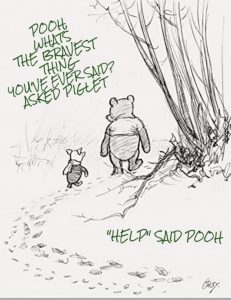
In the t.v. drama “New Amsterdam” whenever the new director of the hospital is introduced to someone, the first question that he asks is, “How can I help?”  It happens in the first episode about twenty times. This was a BIG a-ha moment for me.  What a powerful question!  How often have we wanted our students to ask for help?  How often have they refused when we have asked “Can I help you?”or “Do you need help?”  Unfortunately, asking for help is still seen as a weakness by many people.  However the question “How can I help?” turns it around so that the responsibility and focus is on the person offering assistance.  It is more difficult for someone to just say “No.” to this question.  It can help to create psychological safety in order to focus on what can be done to help rather than someone sitting in discomfort or shame because they won’t ask for help.  Sometimes just asking can make all the difference to someone when they are feeling overwhelmed, even if they decline the offer.  The four small words, “How can I help?” can make a powerful impact.  Sometimes, asking for help is the bravest thing you can do.

Attitude of Gratitude

I don't have to chase extraordinary moments to find happiness -- it's right in front of me if I'm paying attention and practicing gratitude.

Many years ago I remember watching a gratitude themed Oprah episode.  There was a gratitude journal that the guest had developed and was relaying all of the benefits of writing down things that you were grateful for each day.  The power of suggestion (I’m a sucker for an impulse buy for self-improvement) lead me to the nearest Chapters to purchase one of those journals that weekend.  I certainly didn’t fill that journal. I think I lost interest in a couple of months because it felt as though I was writing the same thing over and over again.  I realize now that gratitude, like mindfulness and meditation, is a “practice.”

Gratitude practice is most effective when life is rough.  It sounds counterintuitive.  It is much easier to be grateful when things are going well right?  Easy to “count your blessings” when you are sitting on a beach in a resort in the Dominican Republic.  I personally feel the power of the gratitude practice when life isn’t going according to plan.  Though, I want to be clear here, there is a fine line between true gratitude practice and “looking on the bright side” or “finding the silver lining.”  That bright-side-silver-lining thinking can border on toxic positivity which isn’t helpful.

Gratitude practice means different things to different people.  For me, it is connected to daily journaling.  Each night since the fall I have been writing about my day in terms of gratitude before going to bed. Some nights I might write for 5 minutes.  Some nights I write for a half hour.  It might read something like, “I’m grateful that we got outside for a walk, that my son felt good about his essay after all of the struggles and tears, that we were able to eat a healthy meal, for Hello Fresh being delivered to my door and for the opportunity to reach out and connect to some new teachers through professional learning today.”  I try to reflect on the events of my day in terms of gratitude.  I could write in my journal that the technology in my professional learning session that day was glitchy, we got off to a rocky start trying to get everyone into the WebEx room, and there were links that didn’t work even though I had tested them twice. Instead, I choose to be grateful for the connection and discussion that I had with the teachers that day.  It isn’t that I ignore that bad things happen or think about how things can be improved, but ruminating on the bad things that happened during the day right before going to bed isn’t going to ensure much of a restful sleep.

In some of the professional learning opportunities that I have recently hosted with new teachers we have discussed the struggles of the current climate in the classroom.  It is important to have a safe place for teachers to voice those concerns and have someone listen with compassion and empathy and ask curious questions.  I will often say that there are many things that I can’t help them with, but that I am there to “embrace the suck” with them.   At the conclusion of those discussions my final question is always, “What is a recent personal or professional success that you’ve experienced that you would like to share with the group?”  This ends the discussion on a note of gratitude. It is SO easy to get caught up in venting and complaining about the situation in education right now. Teaching it is NOT an easy job on any given day but the difficulties have grown exponentially with the pressures that COVID has added.  So when we can take a moment to remember why we continue to go to work each day, why we got into the job in the first place and what our recent wins have been, I think it brings a feeling of hope.

Sometimes I practice gratitude in a less formal way that is more like mindfulness.  Recently while walking on a treed trail on a bright, sunny, winter day with my best friend, I stopped mid sentence and just looked around at the beauty.  I said to my friend, “I just had to take a minute to take this in.  We are so fortunate to be able to walk here.”  It only took a moment.  I don’t do that all of the time, we’d never get anywhere on our walks! However, remembering to do it every so often helps me to deal with stress and the bad things when they do happen.  If in the moment of a stressful situation I can take a moment to breathe and practice gratitude it sometimes keeps the emotions from escalating.  When conversing with someone who is frustrated and perhaps complaining or lashing out I try to remember that this person is doing the best they can at that moment and that each opportunity to interact with someone who is suffering is a chance to learn and I try to be grateful for that.  Author Andrea Owen in her book, “How to Stop Feeling Like Sh*t” would call it an AFOG-another flipping opportunity for growth.  When I remember to think about gratitude in a not so great moment, I might do it raised shoulders and through gritted teeth, but I keep trying.  It is, after all a practice.

“If the opposite of scarcity is enough, then practicing gratitude is how we acknowledge that there’s enough and that we’re enough.” -Brene Brown

Wrong again

Privilege, position, and power are placed in the hands of all educators. Being a teacher, regardless of instructional medium is more demanding than ever before. While our world in and out of the classroom looks like nothing we have ever seen before, some things haven’t changed – such as the importance of social justice in education. What we teach must always be inclusive of who we are teaching, the community, and the world around us in our instruction.

This is why anti-racist education is so important. We need to continue this work beyond the month of February because systemic racism and bias are hard at work all year long. That means there’s always something more to learn. There’s also a chance that we could get things wrong and that can get in the way sometimes.

As learners, humans can gain much from making mistakes. There’s even an expression for it: “To err is human.” I must be really human because I have learned so much from my mistakes already. From what I am seeing in the news and on social media, our humanity has never been more human based on the loads of mistakes we’re making. Depending on how you see it, this could be good or bad? Isn’t that the essence of what we do on a daily basis? Isn’t education where we model process and progress over perfection?

Confidence does not come without failure

I am confident that there is a line about being ‘lead-learners’ in the fine print of our infinite-paged-job description. That’s because teaching naturally comes with all of the ‘lessons’ ever imagined whether you are leading or learning. The trick becomes knowing how to find them, and then accepting that none of us will ever know everything. Perhaps this peace of mind is why I have grown more comfortable with discomfort of not knowing everything, and even with being wrong at times. I have also discovered that there are many like minded educators just like me – most of us in fact.

In On becoming an anti-racist educator I wrestled with my past along the path, but it also meant confronting the existence of racism in my personal life and my part in it. A younger iteration of myself might have struggled with this, but by examining my past and my responsibility as a bystander has helped move me forward. Throughout my life I have grown accustomed to getting things wrong, but always believed that I was standing on the right side when it came to issues of equity and anti-racism. What I realized, after reflection, mentorship, and deeper learning was how my belief in those lies was solely meant to ease my burden of responsibility for my complicity and privilege.

Black History Month is 10 months away

Cue the current teaching situation where our roles have now expanded to include daily counselling on issues of mental health, experts at PPE, and classroom sanitizers extraordinaire. We have also become distance learning specialists, multi-modal lesson trailblazers, fearless conversationalists about issues of race and racism, and critical thinkers on how to overcome and dismantle systemic racism and bias. All because we have assumed a lead learners mindset fuelled by getting things wrong and working on it along the way to success.

So it doesn’t have to be different in the classroom then. For me it has meant trying to include culturally relevant and responsive content into each day. I am choosing to avoid the prescribed resources from text book companies that have grown largely culturally irrelevant and unresponsive. Now is the time to amplify new voices in our classrooms and staff meetings too. Regardless of the platform being used to deliver learning, the opportunities and responsibilities remain in every lesson and moment we engage our learners about issues of racism and how to fight against them. The work must continue long past Black History Month to undo 400 years of injustice in for the future generations.

Whether it is in my lessons or by omission, my mistakes are at the core of learning how to get things right. In all of this I find my humanity too with more mistakes to come. To misquote a Disney song and without their lawyers hurting me, “no one fails like Will G”. Embracing my messtakes, excepting korrection, and leaning form them are kee ingredients to a butter me in the classruin. Won day aisle get it write.


Nothing changes but the day

Vernal Equinox

It’s Spring and the recent trip around the sun finds me with some thoughts about fresh starts, green grass, and bunny rabbits bouncing around meadows laying chocolate eggs. Well at least the chocolate part is plausible. Thank you Cadbury. Anything to get my mind off of the fact that more and more schools are closing due to cases of COVID 19. Looking for any rays of hope, my thoughts turned to vaccinations. Now that we have those life saving jabs ready to distribute, things have to get better. Right?

For better or worse? 

My daily exposure to people in my school is around 300 people. That is 20 times greater than the promised/recommended class size for safe in person learning, and 100 times greater than at home. Who am I kidding? It’s exponentially bigger than that as each student has their own web of contacts. Like all educators, I have taken the safety precautions seriously because lives are at stake. Mine and my family members’ at home and school. All I needed to do was remain diligent, follow the protocols, and maintain my distances.

I did find some comfort knowing vaccines were coming. Having ignorantly assured myself, in January, that our provincial government would priortize educators to receive their shots (I’ll wait for you to stop laughing at my naivete). If not so much for our protection, but so that schools could remain safely opened as promised when “no expenses would be spared” was the promise. Our students needed to be back at school so their safety had to be guaranteed. Ventilation, new PPE, increased safety protocols, nurses(heard that one before), and mental health matters.

Meanwhile, at schools a different reality is playing out. Exhaustion and exhasperation while the world around us becomes smaller and smaller through restricted movement, cohorting, fatigue, anxiety, grief, fighting to speak while constantly masked, and becoming an expert at keeping 2 metres apart outside, but only 1 metre apart inside. Don’t forget the learning. What could possibly go wrong or be wrong with such a sweet set up for a learner’s success?

Gorilla in a sport coat

As an educator, nothing says, “You are NOT important to me.” like not being included in the first rounds of vaccinations. This only seemed logical as the numbers of new infections, hospitalizations, and ICU cases were climbing again through the winter and new year break. I take no joy in knowing that they are on the rise again.

The 800 pound gorilla who promised everyone would be safe, especially front-line workers, must have been distracted by something shiny on a can of buck a beer. 3 months into 2021, and despite ETFO demands for action, nothing has been done that gives me or my colleagues confidence that our health and safety are important to the sport coat set in government. As a frontline worker, I can’t help but feel saddened by the obvious message our current provincial government is sending the public about how little it values our profession by not including educators earlier on for vaccinations. Sadly, this inaction and lack of any rational thought of the long term costs will leave all Ontarians crumpling under the weight of lost lives and lost opportunities.

Is it me or are things getting heavier?

The past 3 months on-line and in person have been exhausting. There has not been a single day where I arrive home and am not wiped out mentally and physically. My students are too. This is like being asked to fix a leak on a dam with Play Doh and being told to hold it in place while the water on the other side evapourates.

January passes by, and February too, yet still little concrete news of when educators would be vaccinated. March arrives, our break is postponed in order to save the province from its collective irresponsibilty due to out of country travel and attending large super-spreader events. Now I am thinking about how each school with a case of COVID has the power to become a pint sized super-spreader event.

At my school and hundreds of others, we have had numerous students going home each week due to precautions. As of March 30th a whole class at my school is in isolation as a precaution. This is playing out across the province while restrictions are easing? If this isn’t reason enough for us to be vaccinated sooner rather than later based on data, then perhaps an appealing to compassion would be better since reason is off the table? Who am I kidding? Compassion is not part of their vocabulary because it gets in the way of patronage and profits.

As the inevitability of another lockdown looms in April, I encourage you all to stay safe and continue standing up for our students and profession as you have each and everyday. Make sure to look after yourselves too. I pray that, when this is all over, the ones who were entrusted to look after the health and safety of our public and failed will not be able to hurt our schools anymore.