Keeping it fresh.

As of the end of February, it is apparent to no one in Ontario that Spring is just around the corner. Judging by the blankets of snow and recent school bus cancellations, winter continues to disrupt and annoy us with the same creative sadism as a government hell-bent on destroying public education. Despite the stark reality of a manufactured education crisis and a real climate crisis, I know that Spring is coming soon. I saw a spider. Photograph by Will Gourley

Isn’t it wonderful? Putting ONGov’s systemic affronteries aside, my heart lept at the sight of a spider. On a normal day seeing one is something exciting to behold, but this opportunity came after nearly 3 days of snow, several white-knuckled commutes, and bone chilling winds. It was a sign of hope that most of winter’s worst weather would be over, well at least statistically.

It signified that Spring was on almost here because, in my own amateur scientific way, I have observed, over several years, that spiders usually emerge around my house again when winter is almost over. Usually. My returning guest got me energized and thinking about how to channel that into the classroom?

2020 has blessed me with a number of ups and downs in my professional life as an educator. It has brought me immense joy on a daily basis in the classroom, but also sadness and grief in light of tragic events that have happened to our learning community. You see, not all lessons and outcomes are going to be good. The opportunity to share the struggles and successes with students helps create a deeper appreciation of the learning process. By admitting when things got tough meant more to them and my colleagues than any veneer of perfection I could ever hope to put on.

My January post was meant to share my personal struggles in hopes of encouraging dialog among educators and to show the benefits of releasing some of the emotional weight that many of us carry inside. I wondered whether I could use my catharsis as a catalyst for our learning spaces? How could I make it fresh and keep it fresh for my students and self?

Never one to shy away from doing something differently, I quickly began working through new ways for students to interact with their learning, for demonstrating their understandings, to collaborate with each other, and to dig deeper into opportunities rarely afforded by traditional transmission and texts teaching.

Here’s what we worked on;

In Math, I remain committed to “no text book math lessons” as much as possible. Using YouCubedPeterLiljedahlMath RecessWaterloo POTWCEMC, and Khan Academy. My students love working on problems together, they argue, iterate, communicate, and solve problems. We make Math a social activity instead of a game of one upping each another.

Another change this year is having Wipebooks for students to use. They have added another dimension to our learning by enabling vertical approaches to Math problems. This has students out of their seats, standing, thinking, and  solving. They can also wander from group to group to see the different approaches being used to answer questions. This has led to some excellent discussions and growth.

Recently, I also started adding Quizizz tasks to our Google Classroom. These fun quizzes allow you to make memes for correct and incorrect responses. I find this format a great way to have students continue to work on concepts taught in prior months.

Becoming a strong group facilitator using Character Lab Playbooks and a co-constructed success criteria. Genius Hour – personal inquiry projects where every student becomes the class expert in their subject. I have shared this one before, but it was for a different class at the time. Besides, it’s a perrenial favourite and my students have asked to do it again already.

In Language, we remain very fond of TED Talks. I now find myself creating reading response tasks with posts from the TED Blog. Another tool that it is being brought back discussion and digital citizenship is Padlet. Our recent work focused around an assignment inspirted by my friend and colleague Tim Bradford  that read;

“In the past and present, people have always treated each other fairly.” Agree or disagree

Students had to create a 30 + word response to the statement and then respond to each other. The depth of understanding from them was very encouraging. It was also nice to see how they kept each other in check when it came to appropriate responses and use of technology. Here are 2 of their responses of the entire class who thoughtfully disagreed;

To add a lot of fun to my instructional week, is my grade 3 FI Music class where my students recently wrapped up creating their own identity raps in French, complete with backbeats from Groove Pizza. Once their shyness subsided, they were excited to present their hard work. It was also fun to see how they incorporated the lessons we had about how to beatbox from Nicole Paris and about the notes and rhythms we covered in Term 1.

In all of this, the focus was on hands on and collaborative experiences intended to engage and deliver the learning. Although much can go wrong, there is so much that can go right when you commit to keeping it fresh. I know that the next 4 months will bring more of the same and I am excited to try new things with my students. Looking forward to introducing Flipgrid, podcasting, and sketchnoting already to keep it fresh. Bring on Spring!

Have you tried something new that you would like to share? Mention it in the comment section and include a link if you can. Thanks for reading.

Say Less, Ask More

Sometimes the smallest change can make a huge difference, especially in education. Things such as greeting students individually upon arrival at school can set the tone for the entire day.  Small changes in habitual behaviours can improve communication and relationships with students.

Over the last few months I’ve been reading the work of Michael Bungay Stanier.  Most recently I’ve been reading “The Coaching Habit: Say Less, Ask More and Change the Way You Lead Forever”.  I admit, that at first blush, it doesn’t sound as though this book has much relevance to elementary education.  However, as I was reading I kept making connections to communicating with students more effectively to encourage independence.  As learning becomes more inquiry based in many classrooms, teachers are having to move into more of a coaching role.  I think that the education sector as a whole has made some assumptions that teachers know how to be effective coaches and facilitators.  In my own teaching practice, there has been a huge learning curve.  Teaching through inquiry isn’t about leaving students to their own devices.  Students generally aren’t familiar with the curriculum and other than being children, they aren’t experts on child development.  Educators have to be guides for student learning.  But what exactly does that mean and how do we transition to this type of teaching?

For me the biggest change and challenge in becoming more of a guide in my classroom was talking less and letting the students do the learning. I am a problem solver, helper and rescuer and I’m sure many teachers can relate, which is why it is so hard to be quiet and back off.  I’ve also learned that asking questions might be easy, but asking effective questions is a skill for teachers and students alike.

So what did I learn from a “coaching” book that might help a classroom teacher? Keep in mind, these examples might be better suited for the older grades.  You might need to keep it a bit more simple for Kindergarten.  However, in most cases, better questions get better answers.  Here are some examples:

A student comes in from recess and is visibly upset.  Instead of asking, “What’s wrong? Did something happen at recess?  Can I help?”  Try asking just one question, “What’s on your mind?” and then be quiet and listen. The question “What’s on your mind?” is a focused question and invites someone to get into the heart of the matter. Sometimes all that is needed is a venting session and the child feels better.  You don’t always have to be a rescuer or problem solver. Most of the time, kids just want to be heard.

Normally in a situation like this I’ll ask, “Can I help?’ or “Would you like some help?”  However, the small change to “HOW can I help?” helps the student to articulate their request.  In addition, it gives them the opportunity to identify the solution and not have the adult jump in to solve things for them.

Tweaking the questions that we ask could improve communication and lead to more effective answers.  In addition, asking focused questions could empower students and lead to more independence. Michael’s work and questioning techniques are helpful for dealing with the people in your workplace.  You can sign up for Michael Bungay Stanier’s “The Coaching Habit” Podcast online and find other great coaching resources at Box of Crayons .


Shoulders of giants.

There is a wonderful quote from Sir Isaac Newton that goes, “If I have seen further than others, it is by standing upon the shoulders of giants.” To me, this is nothing less than a gigantic nod to everyone who “tried and paved the way” before him, and a reminder of his then obligation to do the same for the generations to follow-including you and me.

I think Newton was right to pay tribute to his predecessors, but he did so implying that he was focused on the future. He knew that the past played an important part in his understanding of all things Math and Physics(Natural Law), but he was also keanly aware that there was still much work to do during his life in order to prepare for something far beyond his time, work, failures, and accomplishments. This was Newton’s way to say to his successors, “My shoulders are ready for you to stand upon and see further”. Like all teachers, Newton created the conditions where his lessons would go far into the future to a time, space, and place where he himself would never visit.

And now to the classroom

Imagine this repeating itself around the world everyday where a class is in session? We see the future everyday as we prepare students to stand on our shoulders to see further. In some ways, teachers are like conduits of time that possess the ability to bridge the past and present in service of the future. In the process, we continually build and strengthen the foundations on which we all stand and seek to see further than before.

To me, this is one of the coolest places to be as an educator because we have the ability to see through multiple states of time. This is a gift from the past, and it is important for us all to take a moment to enjoy the 360 view atop the shoulders of giants on which we now stand.*

Think about the beauty of looking back at where we’ve been a.k.a hindsight. In education it’s better known as ongoing professional reflection. In itself, reflection will always be an important tool in our collective kit. However, if we’re not careful, we can dwell too much on the past, which could then mire us in the present, and ultimately cause us to lose focus on the future – our students. That’s why we need to keep our eyes looking forward and further as we stand together to protect education from fundamentalist firestarters trying to burn its foundations with fiscal forest fires in order to fleece the future.

Despite the acrimonious arson taking place, we stand firm and united in the fight against cuts to education. Our solidarity, current WTR focus on government, and willingness to wait at the negotiating table are clear indicators to families that ETFO members are rallying around our learners even as the government burns bridges to benefit a bogus budget dilemma. Our shoulders are squared and strong.

It’s time we douse the doubt and the doubters by continuing our amazing and impactful work in education which has placed Ontario among the best in the world. Imagine what heights our students will reach when each one has equitable access to learning at all phases of their educational evolution from JK to post-secondary? Imagine underserved and under-performing students who will never fall through the cracks because there are shoulders for them to stand on too?

Stand strong. Stand together.

*This is never more meaningful when I think about the educators who stood up for teachers in the past to fight for the benefits, pay, and working conditions we have now. There is no doubt that things are better for educators in some areas, but have deteriorated in other areas. It is now our turn to clear the way and make new roads for those to come in the future. I am so thankful for those who fought for me. Even though I may never meet them in person, I am here standing on their shoulders.

Triggers and Habits in Teaching Part One

Dreaded Seating Arrangements

Almost every teacher I talk to says, “I have a really difficult class this year.”  The difficulties identified are most often tied to “behaviour” issues.  In my experience effective classroom “management” can be connected to dynamic programming and developing solid relationships with students. Many of us go to things like Class Dojo or incentive programs to “manage” behaviour and some have their merits.  However, they might “manage” behaviour, but does it help student to learn to self-regulate?  I understand that there are students who have behaviour safety plans that can provide challenges and I do not mean to downplay the effect that even one student’s behaviour can have on an entire class.  However, there are ways in which we can have small tweaks in our triggers and habits in teaching that will have a positive outcome on developing a community of learners.

So what is a trigger?  A trigger in psychological terms can  used to describe sensations, images or experiences that re-visit a traumatic memory.  It can also mean to make something happen very quickly; a reaction.  It is also referred to as an event that kicks off the automatic urge to complete a habit.*  Habits are seen as something that people do often or regularly.  Habits can even be unconscious behaviours and sometimes difficult to stop.  What do triggers and habits have to do with teaching?

Over the years I think I have become more self aware in the classroom about my own triggers and habits.  It is easy to continue to do a routine in a classroom simply because it is something that we have always done. Even when we have sound pedagological reasoning, it can be difficult to change or cease a habit. For example, for many years I put names on the desks of students before they entered the classroom on the first day of school.  I don’t really know why I began this habit.  Besides a wedding, some kind of gala or a reservation at a restaurant, I get to choose where I sit every day.  It is a fairly important life skill.  I’m not going to find my name on a seat on the city bus.  Once I recognized that this routine was purely out of habit and was “triggered” by the first day of school, I decided to change it up.  On the first day of school with a grade 4-5 class, the students came into the room and sat wherever they wanted. I admit that this made the perfectionist in me who loves order, routine and habit rather uncomfortable.  I had some students sit in groups, some in pairs and some on their own.  Then we had a class meeting about how they had felt when they entered the room and had to make their seating choice.  There was talk of anxiousness, sweaty palms, heart rate increase, fear of missing out and for some it was no big deal.  I decided to create a google form to survey the students about where to sit in the classroom, how often we would change it up and who would decide.  The results of the survey were fascinating.  Some students wanted me to choose where they sat and wanted to have that same spot every day for 194 days.  Some never wanted to “sit” in a group but wanted to be a part of it during group work time.  We came up with a plan that each Monday the students would choose where to sit for the week and the students who wanted a regular spot would be able to keep it and the other students would respect their choices without question.  We also had some extra choices for seating that students could go to if their choices for that week weren’t working out.  The students gained incredible insight into self-regulation.  I heard things like, “I sat with Gracie all week and we’re such good friends, I didn’t get my work done so I’m not going to sit with her next week.”  or  “I don’t hang out with Olivia but I know she is a serious student so I’d like to sit with her in a group.”

It isn’t easy to be self aware while we are trying to keep our head above water, collect permission forms, listen to announcements, adjust our day plan for the assembly that was announced, deal with a parent that wants to chat in the hallway AND teach curriculum.  I GET that…however, being aware of triggers and habits and making small tweaks to our teaching behaviour can make a big difference in our classroom community.

*106:Triggers-The Key to Building and Breaking Habits, Chris Sparks, 2018


Daring Classrooms

I state the obvious when I say that teaching is a demanding job.  If you are reading this, you are most likely a teacher and this is not news to you.  I’d like to highlight a resource that feeds the soul of a teacher (and quite frankly a human being) while also providing some strategies for integrating that soul feeding into your classroom practice for your students.  Wait, what…that exists?  It is a website from Brene Brown called Daring Classrooms.  If you haven’t heard of her yet, you can find “The Call to Courage” on Netflix and/or her Ted Talk on Vulnerability.  She is inspirational in leadership, in life and in work.  Here is a snippet from her #DaringClassrooms website:

“Teachers are some of our most important leaders. We know that we can’t always ask our students to take off the armor at home, or even on their way to school, because their emotional and physical safety may require self-protection.

But what we can do, and what we are ethically called to do as teachers, is create a space in our schools and classrooms where all students can walk in and, for that day or hour, take off the crushing weight of their armor, hang it on a rack, and open their heart to truly being seen.

Teachers are the guardians of spaces that allow students to breathe and be curious and explore the world and be who they are without suffocation. Students deserve one place where they can rumble with vulnerability and their hearts can exhale.

And what I know from the research is that we should never underestimate the benefit to a child of having a place to belong—even one—where they can take off their armor. It can and often does change the trajectory of their life.

Teachers: Everyday should be Teacher Appreciation Day. I am so grateful for you and your willingness to show up and create brave, safe spaces where our children can learn, grow, and be seen.”

Some of the short (8-12 minute) video resources from Daring Classrooms include:

How do we avoid the pressure to please?

How do teachers manage oversharing?

How do we help parents understand failing as part of the learning process?

Does the word “disappointed” shame students?

In addition to the video resources there are free downloads for resources, parenting the classroom and daily life.  There are pdfs that you can print out for working with students.  My favourite one is the list of core emotions.  Sometimes when students have triggers they can’t always name or explain the emotion that caused the trigger in behaviour.  Being able to learn about the names and the definitions of core emotions is helpful for students to self-regulate.

Every year in a classroom brings new challenges.  In fact, every day in a classroom will bring on a new challenge.  I hope that as you lead your own #DaringClassroom you will find this resource helpful and that it may feed your teacher soul.

Don’t Judge a Teacher By The Bulletin Board

I remember going to the Reading for the Love of It Conference in Toronto for the first time as a fairly new teacher.  I heard Mary Bigler  speak in a motivational keynote address.  She told a story that has stuck through me through the years.  It was about a brand new teacher who was full of energy, enthusiasm,  great “new” ideas and some judgement about her “older” colleague across the hall that taught the next grade.  This young teacher, (let’s call her Samantha), made sure that students were working in co-operative groups and made the learning exciting and engaging.  The teacher across the hall (let’s call her Eunice) had a structured, desks-in-rows, routine program and a quiet classroom.   Samantha often stayed after school into her evenings changing her bulletin boards and arranging desks into new formations.  Eunice would often leave shortly after the bell and sometimes her bulletin board was empty!  Throughout the year this Samantha considered her program to be superior.  She had learned all of these “new” strategies in teacher’s college and looked upon the program of her colleague as being antiquated.  She loved hearing that she was the “fun” and “best” teacher.  However, no matter what Samantha tried there were students who she could not seem to reach.  She tried all of the strategies that she had learned and she felt that she had given her all.  When it was time to send her students on to the Eunice for the next grade, Samantha was distraught.  Certainly the students would not do as well as they had in her engaging program.  They would be bored and wouldn’t thrive within the rigid structure Eunice’s classroom. Would those “unreachable” students fall further behind?

Samantha was surprised by what she witnessed in the fall with “her” students.   The students that had experienced her “exciting” program were also enjoying Eunice’s classroom.  They talked with excitement about what they were reading and writing and referred to Eunice as being the “best” teacher.  The few students who Samantha couldn’t seem to reach were thriving with the routine, quiet and structure of their new classroom.  Samantha learned a few things during that first year experience:

1.  You can’t judge a teacher by the bulletin board.  The culture of a classroom can only be truly experienced by the students.  We don’t really know what goes on behind the closed classroom door of a colleague.

2.  Every teacher has a different skill set.  Although Samantha was an engaging and exciting teacher, the students that she couldn’t reach thrived in a routine and structured environment.

3.  Children can have short memories.  In the primary grades, the “best” and “favourite” teacher often changes each year to their new classroom teacher.  It isn’t personal.  It is about the reference point of a six year old.

4.  Comparing ourselves to other teachers doesn’t serve the students.  Working longer hours doesn’t always mean that a teacher is more effective, it might mean that they are less efficient.  Teachers with experience likely have a better understanding of the curriculum and can rely on lessons that they have previously prepared. Teachers who have an understanding of work-life balance also may have more energy to offer their students.

5.  The experienced teacher across the hall has years of experience with strategies to serve the needs of students.  Instead of judging; ask for their help.  Most of them would be more than happy to share their strategies and wisdom with a colleague.

It isn’t about being “Teacher of the Year”. It is about being the teacher that your students need.


Collaborative Inquiry Celebration

The other day, many teachers from across my school board gathered together to share with other educators how their year long inquiry project went. As I have mentioned in previous posts, mine was about starting our own business as a class and inspiring my students through leadership. I shared with the other educators these successful stories from our project “8A TREATS”:

  • how many of my less successful students with traditional subjects have been excelling during this project
  • the success my students had with gathering data from classes around the school
  • collecting permission forms from the entire school
  • advertising by making imovies, posters and using a dinosaur mascot to travel around with a fake smoothie
  • tallying the smoothie results for flavours and sizes with spreadsheets
  • counting and tracking the money with spreadsheets
  • find and then order paper straws from Amazon to be environmentally friendly
  • working with a budget that was donated from the student success foundation
  • designing logos as a class, voting on the best one and then collaborating with a clothing design company to recreate this on their products
  • painting and creating a wall in our classroom that will be the location behind our brand
  • creating a video to explain the project as well as talk about our favourite parts

Image-21    (<<<our student create wall)


Our next steps with our project:

  • doing the math to find out how much of each ingredient we will now (plus extra) to make the smoothies
  • ordering the cups
  • setting up our classroom as a pop-up smoothie store
  • making 340+ smoothies on June 6th with our 22 students

It was very exciting sharing this project with my fellow educators. My students were very excited knowing that this project was shared with other teachers. They were proud when I told them how excited other teachers were to find out about this student centered initiative.

There were other educators who shared exciting inquiry projects:

  1. My colleague Lydia shared about her “Community Helpers” project where her grade one students inquired in various ways about the many community helpers in our neighbourhood. She had a guest police officer come by as well as had the students use their hands to explore various jobs. They were able to build, play with food as well as research all of the jobs available to them. The final touch was when my grade eight class came to help them put their thoughts together in an inquiry package. It was great to see her students so passionate about their future. To find out about her project, you can visit her twitter account @AppolonialydiaL. You can also view her project on this link <iframe class=”wp-block-mexp-vimeo hwdsb-tv” src=”//hwdsb.tv/media/grade-one-collaborative-inquiry-2019/?embed=true” width=”560″ height=”315″ frameborder=”0″ allowfullscreen></iframe>
  2. Teachers used a choice board to give students options when creating or completing tasks. These boards are made in collaboration with the teacher at the beginning of the year to go over all of the ways that presenting or completing every day tasks can be done that year. Apps are explored and used in new and innovative ways. I cannot wait to create a choice board in my literacy class next year. There was also a SAMR model student choice matrix that was introduced to us. It’s not the app that makes the project/task, it is how it’s used.
  3. I also heard about makerspaces from one of my other colleagues Cara. She introduces these daily in her library and students are able to create very interesting projects from her instruction cards set up at the tables. They are always able to be creative, explore and build in her library. They also explore media literacy during these creative library sessions.

There were many other projects I could not get to since we only had a half hour to explore and the other half hour was to share about our own projects. Some other apps worth checking out are: seesaw, read&write, book creator, keynote, canva, geogebra, TC studio and pear deck.


The Gender Gap in Technology

Quote for blog

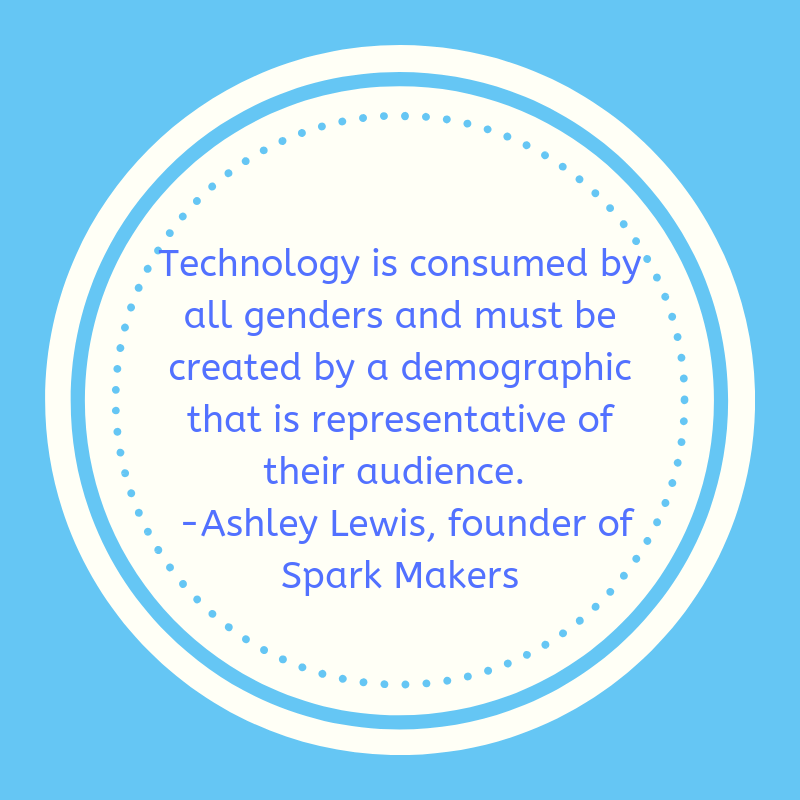
According to a recent report* by ICTC (the Information and Technology Information Council) Canadian women represent about 50% of the overall workforce but represent only 25% of the technology industry workforce.  Of the 100 major tech companies in Canada only 5 have female CEOs and 1 Co-CEO.   26% of the tech companies have no women in senior leadership at all.  There is a gender wage gap in the industry of $7,000-$20,00 per year.  When I read these statistics I wondered as educators, what can we do about the gender gap in technology?  This is not an exhaustive list, but it is a place to begin:

1.  Build her confidence in her abilities.

2. Cultivate a community of supportive peers.

3.  Provide a STEM/STEAM club for girls.

4. Ensure that access to technology and computer experiences is encouraged and inclusive.

5. Foster interest in computing careers.

6. Be a role model as a LEARNER.

May 11th is National Girls Learning Code Day.  If you are looking to encourage coders in your school, why not begin on May 11th?  Below you will find links to resources for beginning coding.  Many students code on their own at home and may appreciate the opportunity to mentor fellow students.  The resources attached will get you started.  There is no special equipment or robotics required.  Teachers do not have to be expert coders to encourage their students.  Teachers can be role models of resilience, risk taking and problem solving by learning alongside their students.  Teachers only need to open the door and expose their students to the opportunities.

Girls Who Code Canada

National Girls Learn Code Day

Canada Learning Code

Scratch

Hour of Code

Code.org


*Cutean, A., Ivus, M. (2017). The Digital Talent Dividend: Shifting Gears in a Changing Economy. Information and Communications Technology Council (ICTC). Ottawa, Canada.

Elaborated and written by Alexandra Cutean (Director, Digital Innovation Research and Policy). and Maryna Ivus (Senior Analyst, Research and Policy) with generous support from the ICTC Research and Policy Team.

The Courage to Teach

The Courage to Teach

teaching from the heart

In this very challenging time of education cutbacks, teachers are on the edge. They wonder how long they will keep their jobs and what will classrooms be like in the next school year.

Losing your job as a teacher is not just about losing a job, it is about losing the work that you do to challenge your spirit to make a difference – it is about losing your heart. When teachers teach, they teach through resources no other person possesses, their identity as a teacher and as a learner and as an adult who cares about students. As a teacher of over 19 years, I know that students can tell the difference between teachers who care and teachers who do not care – and this impacts how students learn.

Parker Palmer (2007, p. 11) puts it simply “Good teaching cannot be reduced to technique; good teaching comes from the identity and integrity of the teacher.”

When teachers teach, they are connected to the students, dialed into who the students are and what interests them. Good teachers are always looking for the teachable moment to grab students’ interest and get them excited about learning.  “Good teachers possess a capacity for connectiveness. They are able to weave a complex web of connections among themselves, their subjects, and their students so that students can learn to weave a world for themselves” (Palmer, 2007, p. 11). Methods vary depending on the grade level, subject, and opportunity – lectures, Socratic dialogues of questions and answers, experiments, collaborative problem solving, or one on one discussions. It’s all good teaching when connections are made through “the place where intellect and emotion and spirit and will converge in the human self” (Palmer, 2007, p. 11), the heart of a person, a student.

As a teacher I do my best to keep my heart of teaching  strong and pliable. I have learned to roll with the challenges of teaching through dealing with challenging students, challenging parents, and sometimes challenging administrators. It is not an easy job to keep heart.

Why do teachers lose heart?

In the daily “work out” of teaching, we are highly vulnerable as we are the centre of attention in the classroom. This is a highly personal job. Students are watching us for who we are and what we represent. Our public and private lives are on the line in classrooms. We must be ourselves but we also must have a suit of self-protection against high levels of criticism that are meant to break us. Teachers will ultimately make mistakes in their teaching, in their assessment, and sometimes in their judgement but I find that students are usually very forgiving, especially if the teacher owns the mistake.

Another reason why teachers lose heart is that teaching can be very challenging. What makes teaching really hard is in seeing the potential of students and identifying the great barriers students face in fulfilling their best self. The challenge is to face with the barriers that limit students’ potential. Human potential gets sidetracked by disability, culture, identity, family, school culture, community, and economics. In having high expectations for all students, teachers make a grand difference in the students’ future. Teaching students how to get around these barriers is key to their social, emotional, and academic growth. When using intuition and identity, teachers discover ways to reach students’ hearts.

To become a really good teacher, it took me over 8 years of practice. That’s about 10,000 hours – Malcolm Gladwell’s 10,000 hour benchmark for achieving success (Gladwell, 2008).  In the VITAE (Variations in Teachers’ Work, Lives, and their Effects on Pupils) study, with 300 teachers in 100 schools, that examined influences in teachers’ identities, Day, Sammons, Stobart, Kingston, and Gu (2007) found that teachers reach their highest level of efficacy between year 7 and 8 in teaching.

In the first couple of years of teaching I went from being totally overwhelmed in the joy of teaching to totally overwhelmed with the disappointment of teaching. Some days I was afraid. I was afraid of not being competent enough, not working hard enough, not meeting students’ needs enough, not connecting with students enough, and sometimes not being quick enough when a student threw a chair in my direction (this happened the second week of my first contract).

Even after 19 years of teaching, I still have fears, but I am not these fears. Instead, I teach with courage and resilience and discovery. I teach from curiosity, honesty, hope, empathy, and conviction. I teach from who I am. I teach with heart.

I implore teachers to have the courage to teach in these challenging times. To never surrender to a person who is trying to trivialize your work as something easy and simple and something that can be done by technology … because computers don’t have heart.

Be brave. Teach from your heart.

Collaboratively Yours,

Deb Weston, PhD

References

Day, C., Sammons, P., Stobart, G., Kingston, A., & Gu, Q. (2007). Teachers matter: Connecting lives, work and effectiveness. Maidenhead, UK: Open University.

Gladwell, M. (2008). Outliers: The story of success. Hachette UK.

Palmer, P. J. (2017). The courage to teach: Exploring the inner landscape of a teacher’s life. John Wiley & Sons.


A meme of a teacher wishing for a single point rubric.

Effective Assessment and Feedback: The Single Point Rubric

RUBRIC MEME

I’ve never really been focused on grades in my classroom. Some educators and parents might find it shocking to read a teacher put that in print.  However, what I mean is that I seldom talk to my students about levels and letter grades.  I focus discussion around feedback, improvement, exemplars and success criteria.  When rubrics were all the rage I used them rather unsuccessfully. I found that traditional 4 level rubrics were about evaluating after the fact rather than providing feedback that can be acted upon during the learning. Rubrics are sometimes handed to the students as a “big reveal” when the project has been evaluated without any chance for acting on feedback.  I don’t believe that success criteria should be a secret to be kept from students.  It isn’t fair that students are thinking, “Well, if you’d only told me that was an expectation I’d have been happy to include it.  I can’t read the teacher’s mind!”  Clear is kind.  Be clear about the learning goals and success criteria for an assignment and give the students a rich task that they will have to dig into and get feedback to act upon during the learning.

Apart from the evaluative vs. the assessment function of a traditional rubric there are two other things that I dislike about the traditional 4 level rubric.  The first thing is that traditional rubrics inform students about what the bare minimum is that they have to do to complete something.  Some students will look at level 2 and do only just what it takes to fulfill that level.  Secondly, level 4 is meant to go above and beyond the expectations.  In a traditional rubric, students seeking level 4 don’t need to think outside the box at all.  All of the criteria for a level 4 is clearly stated-no thinking necessary.

The answer to this assessment question?  For me it was the Single Point Rubric.  Using the single point rubric changed the learning for my students and shifted my assessment practices. It focuses on what the student is doing well, what the student can do to improve in the work and exactly what the learning goal and the success criteria is for the learning.  However, it also allows for the above and beyond to be driven by the student.  It lets the student pleasantly surprise the teacher with creative thinking.  It is a clear and kind way to deliver feedback to students to encourage them to be successful in their learning.

I have included an example for a grade four  Single Point Rubric Literary Response.  Feel free to copy and change it to suit your needs.

If you would like to learn more about Single Point Rubrics:

Cult of Pedagogy

Edutopia-6 Reasons to Try the Single Point Rubric