Blog

Wrong again

Privilege, position, and power are placed in the hands of all educators. Being a teacher, regardless of instructional medium is more demanding than ever before. While our world in and out of the classroom looks like nothing we have ever seen before, some things haven’t changed – such as the importance of social justice in education. What we teach must always be inclusive of who we are teaching, the community, and the world around us in our instruction.

This is why anti-racist education is so important. We need to continue this work beyond the month of February because systemic racism and bias are hard at work all year long. That means there’s always something more to learn. There’s also a chance that we could get things wrong and that can get in the way sometimes.

As learners, humans can gain much from making mistakes. There’s even an expression for it: “To err is human.” I must be really human because I have learned so much from my mistakes already. From what I am seeing in the news and on social media, our humanity has never been more human based on the loads of mistakes we’re making. Depending on how you see it, this could be good or bad? Isn’t that the essence of what we do on a daily basis? Isn’t education where we model process and progress over perfection?

Confidence does not come without failure

I am confident that there is a line about being ‘lead-learners’ in the fine print of our infinite-paged-job description. That’s because teaching naturally comes with all of the ‘lessons’ ever imagined whether you are leading or learning. The trick becomes knowing how to find them, and then accepting that none of us will ever know everything. Perhaps this peace of mind is why I have grown more comfortable with discomfort of not knowing everything, and even with being wrong at times. I have also discovered that there are many like minded educators just like me – most of us in fact.

In On becoming an anti-racist educator I wrestled with my past along the path, but it also meant confronting the existence of racism in my personal life and my part in it. A younger iteration of myself might have struggled with this, but by examining my past and my responsibility as a bystander has helped move me forward. Throughout my life I have grown accustomed to getting things wrong, but always believed that I was standing on the right side when it came to issues of equity and anti-racism. What I realized, after reflection, mentorship, and deeper learning was how my belief in those lies was solely meant to ease my burden of responsibility for my complicity and privilege.

Black History Month is 10 months away

Cue the current teaching situation where our roles have now expanded to include daily counselling on issues of mental health, experts at PPE, and classroom sanitizers extraordinaire. We have also become distance learning specialists, multi-modal lesson trailblazers, fearless conversationalists about issues of race and racism, and critical thinkers on how to overcome and dismantle systemic racism and bias. All because we have assumed a lead learners mindset fuelled by getting things wrong and working on it along the way to success.

So it doesn’t have to be different in the classroom then. For me it has meant trying to include culturally relevant and responsive content into each day. I am choosing to avoid the prescribed resources from text book companies that have grown largely culturally irrelevant and unresponsive. Now is the time to amplify new voices in our classrooms and staff meetings too. Regardless of the platform being used to deliver learning, the opportunities and responsibilities remain in every lesson and moment we engage our learners about issues of racism and how to fight against them. The work must continue long past Black History Month to undo 400 years of injustice in for the future generations.

Whether it is in my lessons or by omission, my mistakes are at the core of learning how to get things right. In all of this I find my humanity too with more mistakes to come. To misquote a Disney song and without their lawyers hurting me, “no one fails like Will G”. Embracing my messtakes, excepting korrection, and leaning form them are kee ingredients to a butter me in the classruin. Won day aisle get it write.


Social Studies in Action

From my blog posts this year, you’ve probably gathered that I believe that in order for change, there needs to be action. By action, I mean steps that are different than what is currently happening. I also believe that these steps should be taken with the community. By listening and understanding how issues are affecting people, we gain deep empathy and can create effective solutions together. 

Having taught Grade 5 before, I sometimes find teaching about Government not particularly exciting. This year, however, I was eager to dig into one of the big ideas from the Social Studies curriculum: Citizens and governments need to work together in order to be able to address issues effectively and fairly. With this in mind, the students in our classroom have been hard at work learning about and creating action plans for a range of issues. In this post, I’ll share our journey thus far.

I’ll start by saying that I have been lucky to have many of the students in our classroom for the second year. The work that we did last year around exploring problems within our community certainly gave us a foundation from which to do this work. Last year, we did a couple of design thinking projects and my students are well aware that empathy is at the core of bringing about any sort of tangible change.

In January we read part of an article that shared the top 20 phrases of 2020. From there, we began an exploration of issues impacting people in our community, in Ontario, in Canada, and the world. During our reading, students identified a number of social issues: homelessness, climate change, global warming, racism, Covid-19 (deaths and vaccines), bankruptcies, and access to clean water. Students then picked an issue of interest to them and our research began. Using links online – for example, the Global Goals – students began to understand the problem in a deeper way and also started to learn about what was currently being done in terms of solutions. As they learned, they were asked to make notes, answering the questions below:

  • What is this issue all about? Use facts from the sites and articles shared with you to give a brief description of this issue.
  • Why has this become an issue? What are the potential causes for this issue?
  • Who is affected by this issue?
  • How are they affected by this issue?
  • Where is this issue most prevalent?
  • When does this issue happen? Is it ongoing or seasonal?

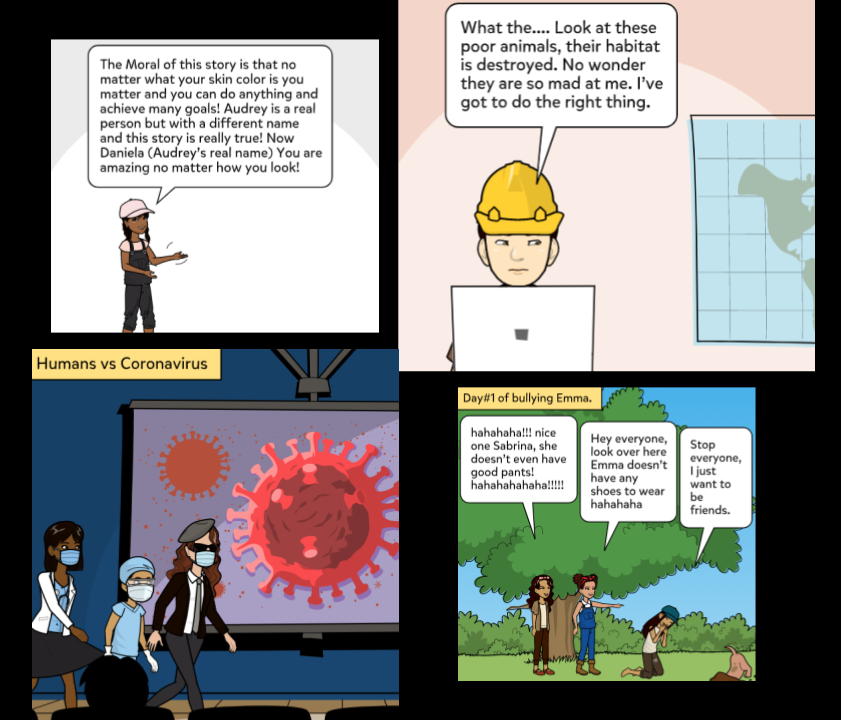
For many of the issues, some students identified that lack of awareness was an inhibiting factor when it came to creating change. If people – young people in particular – didn’t know about or weren’t directly affected by the issue, then perhaps that’s why they weren’t taking action to bring about change. We also spoke about change makers and the fact that so many are quite young. With this in mind, the students began discussing ways to raise awareness. In our class, we’ve used Kayak Magazine in the past. I shared that many of the issues include a graphic novel or comic that highlights a particular issue for students in a clear and understandable format. In the past, we read about the Black Railway Porters and about Tom Longboat and it was through these comics that we learned more about the ways in which racism has impacted the lives of Black and Indigenous People. Next, the responsibility was turned over to them to be the authors of a story about their social issue.  After using a simple graphic organizer, they planned their story and used Pixton to bring it to life. 

After sharing their comics with one another and getting feedback, our job was to continue to think about change. We read the book, Sometimes People March, and discussed activism and the fact that there are many forms. Thinking back to our big idea, we considered petitioning our government to act. One way of doing this is by writing letters so we started off with a lesson on letter writing, meant to persuade. Students decided if they wanted to write to their local Councillors, MPPs, or MPs about their issue and got to work. In their letters, they were tasked with sharing their recommendations for change. 

We recently came together in small groups to create action plans with peers who were working on similar issues. There are so many amazing ideas being thrown around. Through this work, I continue to be amazed by young people and their ability to come up with new and innovative ideas to bring about change. Not only for themselves but for others who may be impacted. This journey has taken us a few months and we’re not quite at our end goal. We’ll keep pushing forward in hopes of making the world a better place.

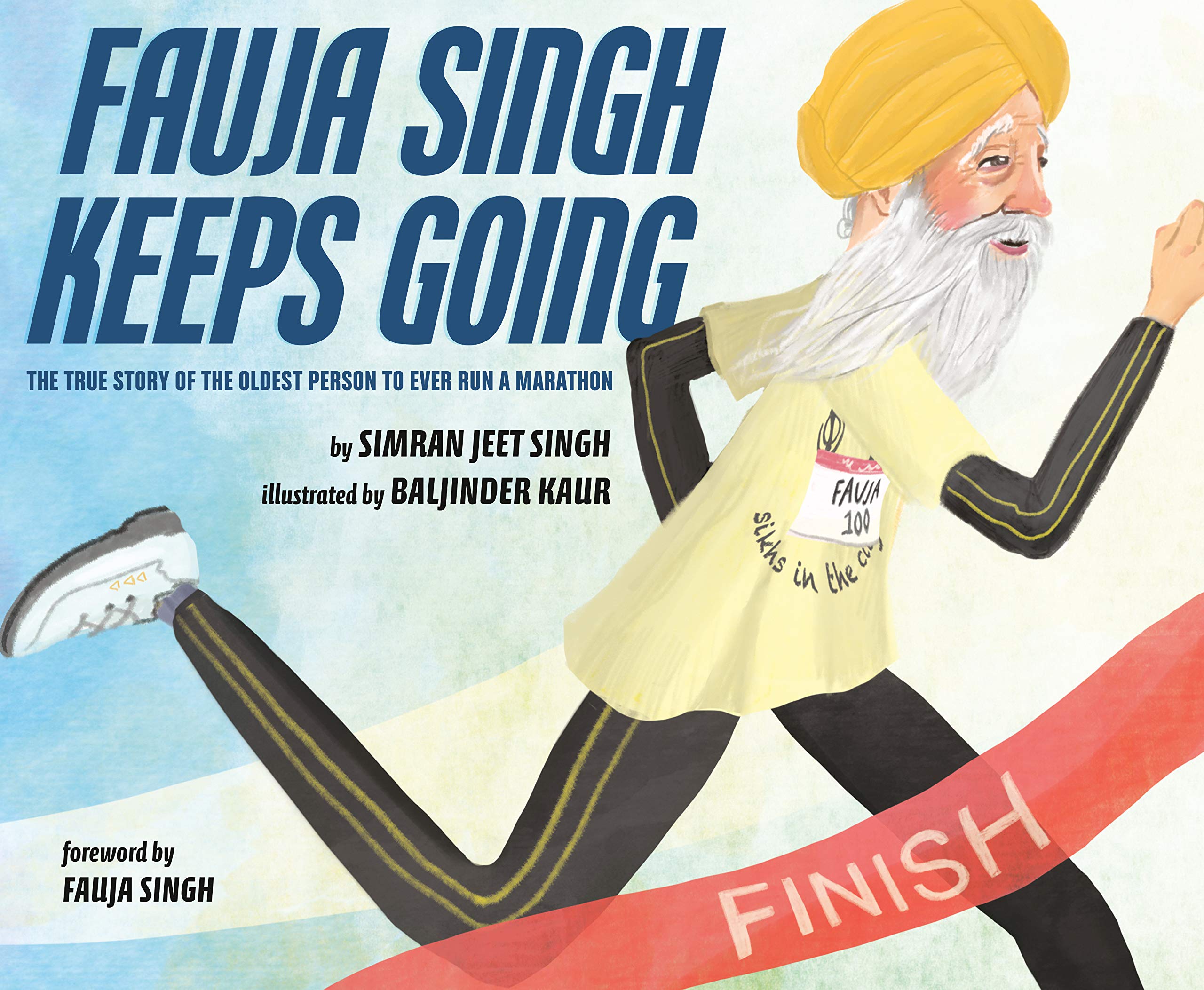
Book cover: Favja Singh Keeps Going

Fauja Singh Keeps Going

Once in a while, a book comes out that gets you so excited that you practically knock over your students with your animated read aloud to your class.

This is how I feel about the book released in 2020 called “Fauja Singh Keeps Going” by Simran Jeet Singh.

I LOVE THIS BOOK!!

I understand that my initial enthusiasm for this book is clearly connected to my love of running and obsession with one day being able to complete a full marathon, however this book is so much more. It has so many excellent themes and lessons to examine that this book will be a staple in my future programming for many years to come.

For those of you that are unfamiliar with the story, Fauja Singh is the oldest person to complete a marathon. At the age of 100 (yes, you read that correctly) he competed in and completed the Toronto Waterfront Marathon in a time of 8 hours, 11 minutes and 5.9 seconds. Unbelievable! But that is only one part of a truly phenomenal story that is captured so well in this book.

This book shares his entire life’s journey and begins with an incredible forward written by Mr. Singh himself about overcoming obstacles. There are so many themes that could be explored while reading this book. Below are just a few:

Perservance/benefits of hard work: Fauja Singh was unable to walk as a young child. He did not take his first step until after his fifth birthday. He was home-schooled for much of his elementary years because he could not walk to school. But he never gave up and committed himself to learning to walk. Hard work allowed him to set numerous records and take pride in becoming a world class runner. Every day he just put one foot in front of the other.

Be open to trying new things at any age: At 81, Mr. Singh got on a plane for the very first time and moved to England so he could be closer to family. While there, trying to find something to do to pass the time, he saw some people running on TV and decided to give it a try. It is a good reminder to all of us that we should be open to trying new things and not to be afraid of new opportunities in life.

The impact of racist words: One of the first times Fauja Singh doubted his ability to run was when he was verbally attacked by spectators at the New York City Marathon. The racist words and phrases that were shouted at him at the start line really impacted Mr. Singh and he ran his slowest race that day. He began to ask himself “Maybe this is too hard. Maybe you are too weak.”

Overcoming limitations set by others: Throughout Fauja Singh’s life people told him he couldn’t do things. However, his strong sense of self helped him overcome the limits that other people thought he should have.

Self care of ones mind, body and soul: Mr. Singh focuses on care of his body, mind and soul. This is what ultimately helps him to do what many people believed would be impossible.

On the very last page of the book is a list of Fauja Singh’s records. The records are extensive and amazing! However, there is a very important statement that is shared on this page that would be the perfect impetus for an inquiry assignment. The book states “While many running organizations have recognized his records, the Guinness Book of World Records has yet to officially honor Fauja Singh as the world’s oldest marathoner. Guinness does not accept Fauja Singh’s government documents and requires a birth certificate-even though India did not begin registering births until 1969, 58 years after Fauja Singh’s birth.” This statement could really be at the center of a class study on structures that exist in organizations that are exclusionary and limiting.  It could also be an excellent tool to explore what can you do about a structure that you don’t agree with. The possibilities are endless.

Overall, a really fantastic book that could be used to inspire students of all ages.


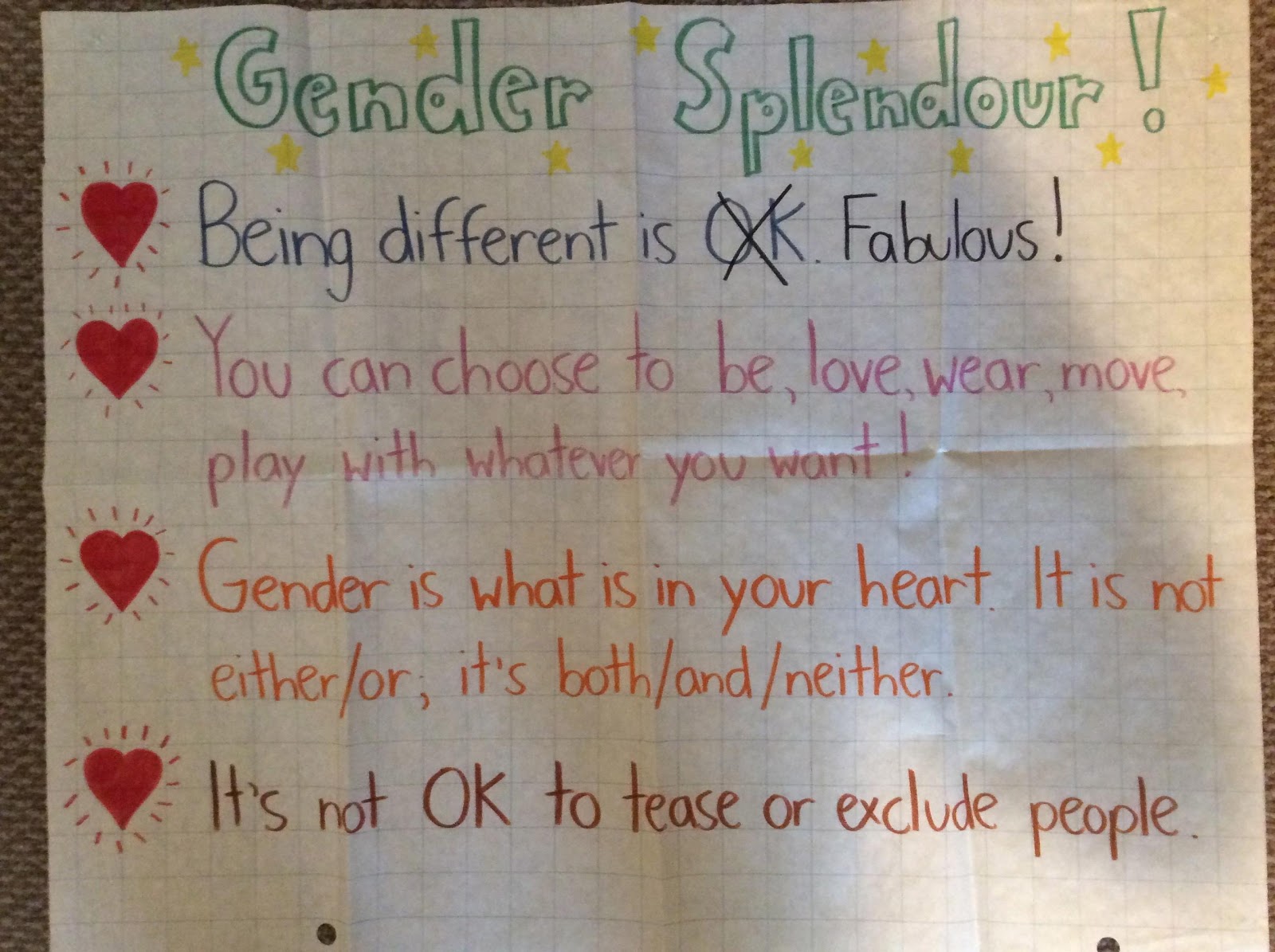
Gender Splendour!

This year, our school community will celebrate Gender Splendour from April 6-9, 2021.  It will be our 11th year implementing arts-based curriculum that explores gender identity and equity, 2SLGBTQ+ communities, inclusive families, and disrupts homophobia and transphobia. 

Over the years, the Kindergarten-Grade 6 students have participated in several inclusive and intersectional workshops, including: Love Makes a Family, “The F-Word” (feminism), Kiki Ballroom and the History of Voguing, Toys Will Be Toys, LGBTQ+ Rights Around the World, Pronouns and Possibilities, and more! 

When I was in elementary school, my mother came out as a lesbian.  This was in the 1980’s and she told us not to tell anyone because she was afraid of losing her job.  I learned about the painful impact of fear, silence, and homophobia outside of the home.  I also learned about the power and strength of community and love, as we marched in the streets at parades and protests.  My young life as an activist and an ally has developed into a strong, on-going commitment to social justice.  When I became an educator, I was determined to break the silence and celebrate the pride and resistance of 2SLGBTQ+ communities.

All You Need is LOVE….and an ALLY:

When Shannon Greene joined the staff, I found an ally and an accomplice.  We were both creative and committed to transforming our pedagogy.  Together, we brainstormed ideas about how we might support students, families, and staff to explore and express their intersectional identities.  We gathered resources, including picture books and media texts to support these critical conversations.  We reached out to families and community members, and generated guiding questions to investigate.  We wanted to empower students to stand up to injustice and take action.  And we wanted to have fun!!   

Boas and Bowties:

We celebrate Gender Splendour during the second week of April, which includes the International Day of Pink.  This year, COVID-19 has pushed our celebration a week earlier.  In addition to wearing pink, we encourage everyone to dress-up in different ways.  These Dress-Up Days are always optional.  They are meant to be playful and fun, and create brave spaces for community members to express themselves without fear.  In the past, we have worn: Rainbow Colours, Wings and Capes, Boas and Bowties, Clothing Inside-Out, Spots and Stripes, Glitter and Glam, and Pink! 

Free to Be:

Every social movement needs a soundtrack.  Throughout the years, we have discovered several songs that make us think, and make us dance.  “True Colours” by Cyndi Lauper, is an anthem that honours how it feels to be seen.  “Same Love” by Macklemore, explores issues of homophobia and same-sex marriage.  “Stereotype” by Samsaya, invites us to stand up to injustice.  Recently, we collaborated with Freedom School Toronto, and learned about how dance can be a form of resistance.  Everyone enjoyed learning about Kiki Ballroom, and the five elements of voguing, before strutting our stuff on the runway. 

As we prepare to smash gender stereotypes and critically examine gender binary roles in our society, I am feeling reflective, grateful, and proud.  I am also looking forward to practicing my “death drop!”

Nothing changes but the day

Vernal Equinox

It’s Spring and the recent trip around the sun finds me with some thoughts about fresh starts, green grass, and bunny rabbits bouncing around meadows laying chocolate eggs. Well at least the chocolate part is plausible. Thank you Cadbury. Anything to get my mind off of the fact that more and more schools are closing due to cases of COVID 19. Looking for any rays of hope, my thoughts turned to vaccinations. Now that we have those life saving jabs ready to distribute, things have to get better. Right?

For better or worse? 

My daily exposure to people in my school is around 300 people. That is 20 times greater than the promised/recommended class size for safe in person learning, and 100 times greater than at home. Who am I kidding? It’s exponentially bigger than that as each student has their own web of contacts. Like all educators, I have taken the safety precautions seriously because lives are at stake. Mine and my family members’ at home and school. All I needed to do was remain diligent, follow the protocols, and maintain my distances.

I did find some comfort knowing vaccines were coming. Having ignorantly assured myself, in January, that our provincial government would priortize educators to receive their shots (I’ll wait for you to stop laughing at my naivete). If not so much for our protection, but so that schools could remain safely opened as promised when “no expenses would be spared” was the promise. Our students needed to be back at school so their safety had to be guaranteed. Ventilation, new PPE, increased safety protocols, nurses(heard that one before), and mental health matters.

Meanwhile, at schools a different reality is playing out. Exhaustion and exhasperation while the world around us becomes smaller and smaller through restricted movement, cohorting, fatigue, anxiety, grief, fighting to speak while constantly masked, and becoming an expert at keeping 2 metres apart outside, but only 1 metre apart inside. Don’t forget the learning. What could possibly go wrong or be wrong with such a sweet set up for a learner’s success?

Gorilla in a sport coat

As an educator, nothing says, “You are NOT important to me.” like not being included in the first rounds of vaccinations. This only seemed logical as the numbers of new infections, hospitalizations, and ICU cases were climbing again through the winter and new year break. I take no joy in knowing that they are on the rise again.

The 800 pound gorilla who promised everyone would be safe, especially front-line workers, must have been distracted by something shiny on a can of buck a beer. 3 months into 2021, and despite ETFO demands for action, nothing has been done that gives me or my colleagues confidence that our health and safety are important to the sport coat set in government. As a frontline worker, I can’t help but feel saddened by the obvious message our current provincial government is sending the public about how little it values our profession by not including educators earlier on for vaccinations. Sadly, this inaction and lack of any rational thought of the long term costs will leave all Ontarians crumpling under the weight of lost lives and lost opportunities.

Is it me or are things getting heavier?

The past 3 months on-line and in person have been exhausting. There has not been a single day where I arrive home and am not wiped out mentally and physically. My students are too. This is like being asked to fix a leak on a dam with Play Doh and being told to hold it in place while the water on the other side evapourates.

January passes by, and February too, yet still little concrete news of when educators would be vaccinated. March arrives, our break is postponed in order to save the province from its collective irresponsibilty due to out of country travel and attending large super-spreader events. Now I am thinking about how each school with a case of COVID has the power to become a pint sized super-spreader event.

At my school and hundreds of others, we have had numerous students going home each week due to precautions. As of March 30th a whole class at my school is in isolation as a precaution. This is playing out across the province while restrictions are easing? If this isn’t reason enough for us to be vaccinated sooner rather than later based on data, then perhaps an appealing to compassion would be better since reason is off the table? Who am I kidding? Compassion is not part of their vocabulary because it gets in the way of patronage and profits.

As the inevitability of another lockdown looms in April, I encourage you all to stay safe and continue standing up for our students and profession as you have each and everyday. Make sure to look after yourselves too. I pray that, when this is all over, the ones who were entrusted to look after the health and safety of our public and failed will not be able to hurt our schools anymore.


Lessons From a Teacher Candidate

Over the years I’ve had the opportunity to mentor Teacher Candidates (TC). When asked this year if I would mentor a TC, I had mixed feelings. On the one hand, I thought it would be great to support a TC who is probably experiencing a variety of emotions starting off their career in the middle of a pandemic. At the same time, I thought of how I have been feeling – tired, impatient, uncertain – and wondered if I would be able to provide the level of support needed. Needless to say, I agreed to mentor a TC and I’m learning a lot.

Remembering My “Why”

We all got into teaching for a reason. For me, it was the opportunity to work with some of the greatest and most creative people on the planet. Kids have an incredible ability to make sense of the world and make me realize that the work that we do, matters. My journey to education is one that has taken many turns, in part because of some of the teachers I had. 

Early on in our mentorship relationship, I asked the TC in our classroom why she wanted to become a teacher and she emotionally shared her experiences as a child and wanting to be a teacher she wished she had. Now I’ve been at this for the last 11 years and you would think that I am pretty firm in my “why” but I have to say that this was a conversation that I needed at that moment. I happened organically and it has served as a reminder of my “why” through this incredible time of uncertainty, tiredness, and honestly, fear. After having this conversation, I took some time to really sit with and write about my “why”. On days when I don’t feel like I’m having an impact or I feel like this pandemic is beating me down, I look back at and reflect on my “why”.  While it doesn’t make things easier, it’s my anchor through all of this, in hopes that we’ll get to a better place in education, where these incredible people will be centered.

Open Communication

I’m a fan of clear and explicit communication and I’m often quite frank. What you see, is what you get. For some it’s overwhelming. For others, I think it’s appreciated. When meeting new people, I sometimes try to juggle this but honestly, in the midst of a pandemic, I find I just don’t have it in me. I’m working on speaking the truth from a place of love. In our mentorship relationship, we’ve gone the route of clear and open communication and it’s working. The TC knows what to expect from me and vice versa. That’s not to say that we’re not patient with one another but I think that there is mutual growth because we’ve chosen a position of being open with one another and talking things through, without judgment. At a time when people are experiencing so much, we’re growing in our empathy and I think that’s helping us as a class.

Going With the Good

When students are engaged, there’s a buzz in the air and things are good. The TC has chosen to teach one of the most challenging subjects (in my opinion) – French as a second language – and I have to admit that things are good. The students are eager to learn from and with her and I’m seeing her engage more and more with them as they learn. At a time where everyone is really exhausted and in need of a break, it’s refreshing to see that the students are giving it their all. We were reminded of the importance of centering students and teaching from there. As we await the April Break, we continue to find what interests our students and collaborating so as to keep the learning engaging. 

As I stated at the beginning, I had mixed feelings about mentoring a TC during a pandemic. 3 weeks in, I have to say that I’m so grateful for the time to reflect on my “why”, my practice, and myself.  It’s been yet another learning opportunity and I’m glad that I said yes. 

As we approach April Break, I hope that you continue to stay safe and take care of yourself. I know that this has been a challenging time for us all. Please take care.

Rejuvenation Through Creation

For me as a kid, there was no better feeling than opening up a new box of 64 Crayola crayons.  The big box with the flip top lid and the sharpener on the side.  I can remember agonizing over which colour to pick first and being so thrilled by the perfection of the colour palette in neat rows in that box.  I loved to draw and colour. I could do it for hours never lifting my attention from the page.  In adulthood, I abandoned doing art for pleasure.  It seemed silly for me to sit around and draw or paint for no real reason.  I felt I should be doing something productive.  A few years ago I began to create art again and realized how much I had missed it and how much joy it brought to my life. I create digital art now, which isn’t quite the same rush as opening a box of crayons but it is easier to share with others-like the picture above.  I have recently learned about the health and wellness benefits of creating. Creating is rejuvenating, it is rest and it is soul food.
Dan Tricarico, in his book “Sanctuaries: Self-Care Secrets for Stressed-Out Teachers”, he talks about how people get lost in an activity that you love so much that the rest of the world seems to fade away.  He calls it a state of “flow”.  I find myself getting into that state of flow when I draw, create music, write, cook or do jigsaw puzzles.  It isn’t that passive state of binge watching something on Netflix.  However, sometimes life’s answer is just that.  The state of flow is active and when I emerge from that state of flow, I feel rested and invigorated.  In Jessie Scholl’s article, “Go With the Flow: How States of Blissful Concentration Can Boost Your Overall Health and Well-Being” she states that, “Flow triggers the opposite of a fight-or-flight response.  Breathing becomes more relaxed, muscles loosen, and heart rate slows.  The specific biochemistry associated with flow varies depending on the activity, but the overall benefits to health and well-being are the same. ”  In fact, a 2018 Forbes article, “Here’s How Creativity Actually Improves Your Health” written by Ashley Stahl, claims that creativity increases happiness, reduces dementia, improves mental health, boosts your immune system and makes you smarter. Well, who doesn’t want all of those things?

You don’t have to be a professional musician, writer, artist or athlete to practice flow.  You can do it with any activity with some level of skill that requires you to pay attention.  It is really a type of active meditation.  Flow can be found with exercise, writing, dancing, baking, gardening, robotics or whatever activity brings you joy.

Don’t have the “time” for a creative pursuit?  It definitely requires some intentional effort to ensure that you take some time each day to pursue what you enjoy doing. It doesn’t have to be for hours but make it a specific small goal. In building anything into a routine or ritual, micro habits are key.  These are tiny steps towards implementation that grow into longer lasting habits. When I started creating art again, I just started with doing 5 minutes a day.  I just drew something.  I wasn’t worried about perfection or even completion.  I started getting lost in the flow and those minutes eventually became hours over time.  I continued to build my time until I created the habit to attempt to do something creative at least twice a week.  Beware of your inner perfectionism critic if you have one, like I do.  Give yourself some self compassion if you get out of the habit.  No one is keeping score and it is meant to be for you and your health and wellness.  When I get lost in stress and the life’s duties I often think, I should probably create something and get into that flow state-it has been a while.  Ultimately, I never regret taking that time away from the rush and hustle.

If your activity is just one more thing on your to-do list, it isn’t going to bring you joy and happiness.  In order for something to really feed your soul, it has to be something you value, something authentically you and something that you want to do because it brings you a sense of flow, peace, focus and energy.  Hopefully you will find something that gives you that “new box of crayons feeling,” whatever that means for you.

My Inner Critic and the Teacher Across the Hall

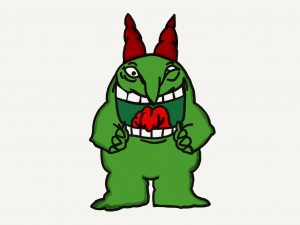
Sadly, I’ve spent a lot of time over my career as an educator listening to my inner critic.  Recently, I’ve actually put a “face” to my inner critic.  My inner critic looks remarkably like the mascot from Montreal’s “Just for Laughs” festival.  Ironically, the name given to the mascot by the festival is Victor.  In more cases than I care to admit, Victor has been victorious in getting the better of me.  Sometimes I can visualize squashing Victor underneath my shoe.  Those are good days.  Other times I might be able to stuff him into a cupboard.  Sometimes he is sitting right on my shoulder and whispering in my ear and won’t go away no matter what I do.  All Victor really wants to do is protect me from getting hurt-inner critics do serve a purpose, but he will lie to me in order to get his way.  What I am constantly practicing is separating the truth from the lies and stories that I tell myself about a situation before it gets out of hand.

Victor gets particularly loud whenever it has anything to do with my being an educator.  My inner critic often compares me to others and makes me feel bad about myself.  It might go something like this, “How can you be so weak?  Everyone else is handling their job during the pandemic just fine! You cannot ask for help or let others see you sweat.  They will think that you are crap at your job and you’ll be fired from teaching altogether.  Why can’t you be more like those Super Teacher-of-the-Year Educators on Twitter?”  Sometimes I can get lost in the middle of Victor’s storytelling.  He can be quite convincing.  However, when I am self aware I can pick apart his rationale.  “How do you know that everyone else is handling things just fine?  I don’t know the story of everyone else.  They might be suffering just as much as I am but don’t want to talk about it either.  People don’t get fired for having bad days.  Asking for help is not weak.  Asking for help is brave.  Those teachers on Twitter might post their best days and best lessons but still have bad days.  What are they even teaching and assessing with this Pinterest project?  I am a strong educator and I am doing my best every day, in the middle of a pandemic and sometimes good enough has got to be good enough.  There is more to life than my job.  Go to your cupboard Victor, you aren’t winning this one.”  Sometimes it works like a charm and Victor scurries away.  Other times I have to stuff him in the cupboard forcefully. (Disclaimer: No mascots were injured in the writing of this blog). The idea is that I have to be self aware and separate fact from fiction.  I have to be very careful with the stories that I tell myself-especially ones that compare me to others.  I never have all of the facts about the lives of other people.

I taught grade one for a number of years and my classroom was across the hall from the Kindergarten teacher.  I was always in awe of her programming, dedication and energy.  In my head, she had it together every single day.  I remember thinking, I wish my program was as amazing as hers.  I don’t feel like what I do with my students measures up.  After many years thinking in this way we chatted about it one afternoon and she admitted that she felt exactly the same way about ME!  That discussion was incredibly enlightening to me. I realized that the stories we tell ourselves about others shape how we feel about ourselves.  Just like on social media, we put our best selves out there and often don’t let others see our cracks.  However, we ALL have cracks.  In the words of Leonard Cohen: “Forget your perfect offering.  There is a crack, a crack in everything.  That’s how the light gets in.”  Perfection is a myth, highly overrated and impossible to sustain.  We need to treat ourselves gently, with care and compassion.  Victor isn’t going to go away anytime soon but I am learning to know when he is lying and I’m calling him on it.  “Go to your cupboard, Victor.”

June Tired

Is anyone else June tired in March?


The loss of March break has clearly impacted everyone involved in education – students included. The rumours of shut downs coming our way and whisperings of the government cancelling the April break are lurking everywhere I go. The thought of either of these things happening is devastating to me personally for many reasons. 


Though we continue to battle a pandemic everyday while committing ourselves to our students, their families and the community – we are tired. We are here. We are doing our best. We are rocking it. But.. we are tired. 

In response to this, I want to get a conversation going. 

What things are you doing for yourself right now? 

Of course, there are many things we are doing for our students to keep learning exciting as we all feel in desperate need of a break. But what are you doing for you? How are you practicing self-care?

Please feel free to comment on this post as a space to share what you are doing for YOU. If you have not done anything for yourself, this is your reminder! 

Take care everyone, secure your own oxygen mask before helping others. 


“Talk to yourself like you would to someone you love” – Brenè Brown

Birds of a Feather….

….FLOCK Together!!

In preparation for the Spring Equinox, which is usually held in the Rainbow Garden, I started to think creatively about how we could gather as a whole school community and respect COVID health and safety protocols. I wanted to incorporate dance, and then I remembered about flocking.

WTF?
Flocking is a type of movement improvisation, where the whole group mirrors each other’s movement. Students can be organized in a straight line or in the shape of a diamond. In flocking, there is one student who leads a movement, which is followed by the other students.

Different students can become the leader, just like birds do when they are flying together, by changing their position. In a diamond formation, the student at the top of the diamond is the leader. When everyone rotates a quarter turn, there is a new leader at the top of the diamond. Flocking can be inspired by music that is played, but I wanted to integrate text and embody the Land Acknowledgment.

Thanksgiving Address:
We are learning that many Indigenous and First Nations communities offer greetings and gratitude at the beginning of every gathering. The Haudenosaunee Confederacy, which includes the nations of Cayuga, Onondaga, Tuscarora, Seneca, Mohawk and Oneida, share The Thanksgiving Address. Here is a video that describes the importance of this text.

In the Thanksgiving Address, all parts of creation are recognized with honour and respect. Here is a link to the text we used. We have been deepening our understanding of this important protocol by speaking and listening to the words, drawing, writing and reflecting. This was our first time exploring the text through choral movement and mindfulness. It was very powerful.

Bear Song:
As educators, it is important to build relationships with First Nations and Indigenous families, which includes consultation and collaboration, and invitations to share knowledge with the community. At our school, we are fortunate to have several parents who have shared songs, drumming and dancing at different events. After gathering in the field, Archer and Ansley sang the Anishinaabe Bear Song to welcome Spring. Here is the song performed by Turning Point Women’s drum group from Skownan, Manitoba.

Medicine Wheel Teachings:
In the article, “Teaching by the Medicine Wheel: An Anishinaabe framework for Indigenous education,” Dr. Nicole Bell (2014) describes how schools might integrate Indigenous knowledge, and create a process of education that is respectful and culturally relevant for Indigenous families. Bell explains that while there are some variations of teachings and representations of the Medicine Wheel, there are common threads of understanding, including the importance of appreciating and respecting the interconnectedness and interrelationships of all things.

I wanted to incorporate Medicine Wheel teachings into our Spring Equinox gathering. The Medicine Wheel is a circle that is divided into four parts, which represent the four directions (East, South, West, North) using four different colours. Each of the directions include teachings that are interdependent, including the four seasons, stages of life, times of day, medicines, life givers, and learning process.

We organized the students into four sections, from youngest to oldest, starting in the East. Everyone was standing in the field, facing the same direction. As the Junior students read the Thanksgiving Address, everyone followed the movements of the Junior leader at the top of the diamond. The refrain, “And Now Our Minds Are One”, was repeated in chorus, and was the signal for everyone to rotate a quarter turn to the right together. Then, we started to follow the movements of a new leader. The rotations and the movements continued until the Thanksgiving Address was finished.

It was flocking amazing to welcome the new season with movement, gratitude and respect. Happy Spring!!