Innovation Collaborative Inquiry

I am currently starting a really exciting journey which involves myself and a group of 10 teachers. We are choosing a topic that interests us and going on a year long journey to discover the answers to this question. We are currently thinking about our question having to do with student led learning and how can we get students to take the lead with their learning and how to make meaningful tasks that will inspire action.

We are meeting 3.5 days this year and we are able to work alongside these other teachers to discuss our findings and see how we can put this plan into action in the classroom.

The first meeting involved getting to know all the teachers. We did this by mingling with the crowd based on which card in the deck we had (all sixes went together, the tens went together..) and then we met up with the same suit cards and then we had a few different challenges after that. When we met with our random groups, we answered the question how have we seen or used innovation in our classroom. It was amazing the chats that we had when this question was posed to us. I felt happy explaining my students current inquiry projects where they research a question of their choice which they will then present to the group it relates to. I also shared about selecting meaningful projects that will somehow create change or an action in our school. We discussed all of our innovation ideas and then we were asked to go back to our seats.

A teacher across the room shared about something that someone had said to her that will change and solve all problems involving math: going gradeless. She mentioned there would be various levels in math like when children go to swimming lessons and they wouldn’t be able to move onto math level two until they finish level one. In a way it sounds like an IEP but it would be in place for all students.

The rest of the morning we had to find a group of people that had a common area of focus as us and that is how I ended up in the student led learning group where students guide themselves to tasks that they find to be meaningful and essentially are 21st century learning tasks. This group will meet next week to discuss our plans.

After going to this exciting learning opportunity, I went back to my class and made a self reflection for our drama haunted house that the students had just finished planning, creating, presenting and then cleaning up. I had them assess themselves using four words: not engaged, somewhat engaged, engaged and very engaged. I told them to circle which word best described their involvement before, during and after the haunted house. It was incredible to see that the word they had circled lined up with the way I would assess them. If they had done this same self assessment and I had put marks or levels on the page, I am not so sure they would have been as successful with their assessment.

I am excited to continue learning with my inquiry group and keep trying out things that we learn as a group. The gradeless self assessment was just one small thing that I know will come of this exciting learning opportunity. It is very fun being apart of a group of like minded people that are really hoping to see a positive change in our classrooms.

More to come!

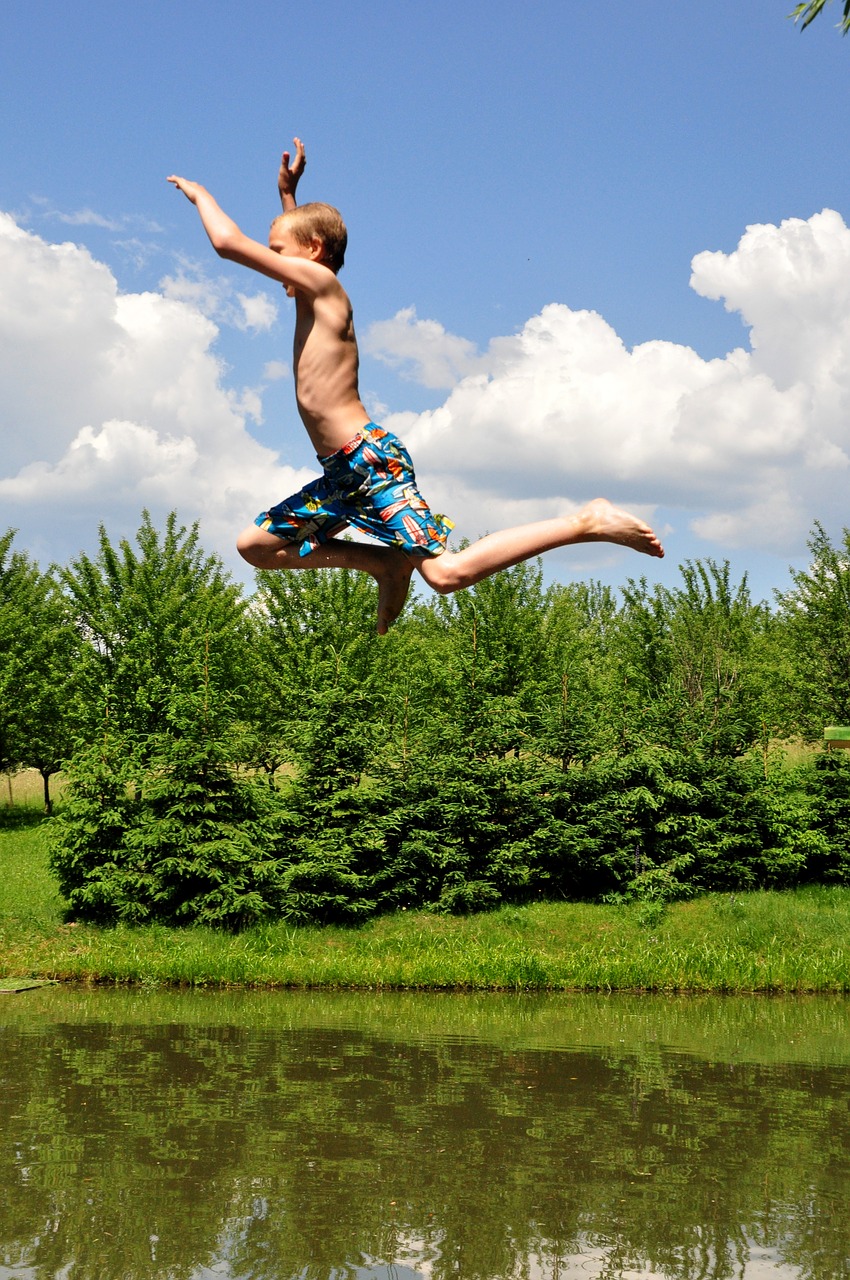
Both feet

https://pixabay.com/en/summer-swim-pond-landscape-austria-2209393/

Have you ever jumped into a body of water and been able to stop part way? If you have, can you show me how because to this point of my existence it has been impossible when I try? So far.

Defying all of the laws of Physics may not part of our human skillsets, yet. Perhaps with the aid of some bungee cords and a team of riggers, it is possible, but since most times when we take a leap(intellectual or otherwise), we do so without a team to save us.

Oddly enough, the leaps are often contrary to conventional wisdom and traditional thinking/practice. Society loves its non-conformists. As long as there are not non-comforming in their schools. Is it therefore heresy, innovation, boredom with the status quo, egotism, creativity in action, insight or indictment to break the status quo, take chances, or challenge authority/colleagues? Where does it fit in with your practice and pedagogy?

With or without a safety crew, I have always jumped into something with both feet. Knowing there is no way to stop once I’m in the air. Yes, I’ve climbed out and jumped somewhere else when the landing hurt. No, I did not land on anyone either.

Sometimes, I bounced out, unable to fit in with a particular ideology or methodology. What never changes as I try and stretch, and a leap and fall, and land/crash, is the need to keep looking for new places from which to jump with all the excitement and uncertainty that leaping, change and learning provide. A sort of educational thrill seeking if you will.

This is how I see my teaching style and I’m inviting other educators to step out onto the dock and take some leaps of their own. So often, the risk taker in all of us has been hushed by comfort, complacency, or fear. Trying new things is hard. What if no one likes it? What if I fail? How are your students supposed to take chances when you are clothed in bubble wrap yourself.

Our classrooms have to be shaped into an ultra-soft space for students to take their intellectual and emotional leaps with both feet without worrying about the landing or bouncing off the walls from time to time. It doesn’t mean they don’t feel a thud once in a while. It means that they will have a place to discover the limitless potential of their learning not the limit.

How do you see yours? When was the last time you felt free and safe enough to jump in with both feet not knowing how deep the waters?

How did  it feel?
Dangerous? Perhaps.
Exhillarating? Always.
Always successful? Not yet.
Staying put? Never!

We owe it to our students to show how much there is to gain from trying new things, taking leaps into new spaces, and from thinking about how, when, and where we are going to land.

Over the next month, I challenge you to try something new in your classroom and share it with us.
Tag me on Twitter @willgourley and try to encourage others to do the same. Thank you for reading and happy landings.

 Extra Reading for keeners

16 Reasons Why You Should get out of Your Comfort Zone

Why Taking Risks Pays off for Students and Teachers

Happy New Year

As a parent and educator this time of year is a transition back into a regimented routine. It is the New YearNew Year, for my child entering grade 3. New Year, for myself with a traveling (on a cart) assignment, Grade 5-8 Math and Self Contained Class coverage.

Preparation for this New Year celebration spans through the summer.  Beginning in June by sorting and putting away this past year’s materials. I’m always thinking about what the New Year will hold.  When I’m shopping and something catches my eye, I think, “Is it useful to me and my charges? Can I afford it? Will I use it?” As I unpack my storage areaZ, I find all kinds of collectables there.  I started teaching at the beginning of the technological age of the education system.  I still have materials necessary before the use of technology. This year, I found a grade 3, “Word Wall”. My child’s Grade 3 teacher, inherited this and a box of books for this level. whether she uses them or not, I feel great about the possibility.  Sharing with others brings me joy.

New Year is a great celebration, ringing in the new, decorating for the season, preparing for a fantastic time, thinking of all the details, and knowing that an unpredictable event will happen and I will have to adapt and be flexible to smoothly slide through it. As Educators we have a multitude of talents. We are planners, organizers, predictors, caregivers, decorators, researchers to name a few.  With all celebrations we plan and prepare well before the event. It is exciting to watch, assist and create space for the New Year.  It is exciting to meet the new educators, children, and families whom will help with the growing and learning for all.

During the summer, usually a few weeks before the New Year, nightmares enter my dreams which include, “I’m lost in the school. I’m late getting there. I forget the most important item of my plan.” My mother has been retired from teaching for over 20 years and still has these dreams/nightmares just before the New Year. I wake up in the night thinking about plans and details. I jot notes in preparation for the celebration back, then convince my brain to slow down and return to a resting place.

The preparations as an Educator include more than the New Year celebration.  These include preparing yourself and others for a change in routine. My child has appointments through the week.  I have to plan my life around these and my own appointments too. I have to prepare for travel to and from, meals to eat, clothes for the changing season and the New Year.  I have learned to slowly slide into these practices beginning before the New Year.  This gives my body  a chance to adapt to the earlier start times, bed times and daily expectations.  I began teaching later in life and my body and mind thank me, when I care for them.  Preparing for the New Year must include self care.  I have made realistic goals to care for myself, so I can continue to celebrate the New Year with the many people I affect.

As you prepare for your New Year events, be mindful of yourself and flexible in all the change that will happen during these times. Smile, walk proud and be kind is my continuous reminder every moment of this New Year celebration.

Kimberley Cousin


Building Connections with Students

Be Authentic

The video of a teacher giving each of his students a “just for them” handshake each morning upon entry has gone viral.  His efforts to connect with students have been applauded.  I think that this is a wonderful way to create a bond between teacher and student; for THAT guy.  I know that this is not “my thing”.  If I were to choose to try this at the beginning of a new school year, it would not be genuine and it just wouldn’t feel right.  I’ve also often wonder what happens when a parent wants a word in the morning, or someone forgot their backpack on the bus, or there is a class trip leaving 5 minutes after the bell.  There are many ideas for connecting with students online, but you need to do what is genuine for you.  Otherwise, you won’t sustain it and the students see right through it.

Lunch

During the first few weeks of school I try to stay in my classroom while the kids eat lunch.  I will often eat my lunch at the same time as my students so that I can have the other half of lunch to relax, visit with colleagues or do some preparation.  I choose to do this for the first couple of weeks to make sure that the routines for lunch time are established and students understand my expectations around cleanliness, behaviour and technology use during lunch.  There are often different teachers on lunch duty, so it is helpful for them if the regular classroom teacher is in the room until they become acquainted with the students. When I take the time and effort to do this at the beginning of the year I find that there are less issues throughout the school year at lunch time.

Circle Chat

No matter what grade level, I have always started of my day chatting with kids.  In a circle format the students can share something, check in, ask a question or some days they pass (I will personally check in later to make sure everything is ok).  Sometimes we have topics, sometimes we have to discuss class updates but no matter what, we’ve connected in some way.  Yes, it takes instructional time.  Sometimes it takes up a LOT of time.  But, in my experience, it builds relationships with your students and saves time in the long run.

Front End Load Communication

Parents’ concern for the well being of their children seems to be at its highest point at the beginning of the school year.  It may be a new school, a new teacher, academic concerns from previous years or peer group concerns.  Taking the time to communicate during the first week of the school year by phone, note or at least a personal email in addition to class updates on websites or newsletters home will pay off during the rest of the school year.  The more you assure families that you are accessible and concerned about their child, the more supportive they will be if an issue arises.  Find the good in each student and make sure that you communicate it to families.  For the students that have academic or behaviour concerns, meet with families face to face as soon as possible.  Do not leave it until report card time.  I often start those conversations by asking them to voice their concerns, as well as asking their goals and hopes for their child for the school year.  Those positive and proactive attempts at communication at the beginning of the school year will go a long way with families and ultimately will benefit the student.

Take Your Job Seriously; Don’t Take Yourself Seriously.

About 10 years ago I picked up a pair of absolutely crazy novelty sunglasses.  No matter the weather, I wore them in the morning when I picked the students up at their bus lines and I wore them when I walked them out to their buses in the afternoon.  There were always comments from the students (and sometimes parents) and it was often a conversation starter when I could see that kids needed to be checked in on first thing in the morning or at the end of the day.  I began to get crazy sunglasses as gifts.  I now have about 60 pairs and wear different ones depending on my mood.  My staff humoured me and each wore a pair in the staff photo for the yearbook.  This might be something that you try in your classroom, I’m happy to share, but make sure it is something that suits you.

I remember being told by a colleague at the beginning of my career that you shouldn’t smile at your students during the first few weeks or even until Christmas.  I didn’t follow that advice, because it wasn’t genuine and authentic for me.  The way I see it, if you aren’t smiling at the beginning of the year, you can pretty much be guaranteed that you won’t be smiling at the end of the year!  Students feed off of the mood of the teacher.  Ultimately, the teacher makes the weather in the classroom.  There are days when I have to apply the “fake it until you make it” strategy and I smile until I really feel like smiling.  I also highly recommend a morning music mix for the way to work.  Put together 5 or 6 songs (or more depending on the length of your commute) that really motivate you, make you bouncy and make you smile.  On the days where I know I’m tense, in a mood or haven’t slept well I put this on during my drive and usually by the end I’m singing along and feeling better.  Then, I slide on those crazy sunglasses and I’m in tip-top teacher mode ready to greet every student with their name and a smile.  I may not have individual handshakes ready to go but after 23 years…I still start the year off smiling.


Welcoming Refugees … by any other name

St Louis Jewish in Germany Refugee Ship 1939

Turned Away: Tale of St. Louis and the fate of its 907 German Jews.

Welcoming Refugees by any other name

While reading the Toronto Star, I came across an article by Martin Regg Cohn writing about his experience meeting refugees making their way through the Vermont forest into Canada. This made me think about black slaves coming to Canada through the Underground Railroad beginning in the late 1700s. This further got me thinking about all the people who have come to Canada seeking refuge after being forced to leave their country in order to escape war, persecution, natural disaster or just to find a secure place to live and raise their family.

Canada (and its previous names of British North America, Upper and Lower Canada, and New France), has always been a destination for refuge. Today and before confederation in 1967, our nation would not have grown in population or diversity without the seekers of refuge. There’s been significant waves of refugee seekers over Canada’s last 250 years. I was surprised at the extend of the list!

This is a partial list from the Government of Canada’s Canada: A History of Refuge

1776: 3,000 Black Loyalists, among them freemen and slaves, fled the oppression of the American Revolution.

1783: Sir Guy Carleton, Governor of the British Province of Quebec, and later to become Lord Dorchester, safely transported 35,000 Loyalist refugees.

1789: Lord Dorchester, Governor-in-Chief of British North America, gave official recognition to the “First Loyalists” – those loyal to the Crown who fled the oppression of the American Revolution to settle in Nova Scotia and Quebec.

1793: Upper Canada became the first province in the British Empire to abolish slavery. In turn, over the course of the 19th century, thousands of black slaves escaped from the United States and came to Canada with the aid of the Underground Railroad, a Christian anti-slavery network.

Late 1700s: Scots Highlanders, refugees of the Highland Clearances during the modernization of Scotland, settled in Canada.

1830: Polish refugees fled to Canada to escape Russian oppression.

1845-1851: Irish refugees escaping the Great Potato Famine.

1880-1914: Italians escaped the ravages of Italy’s unification as farmers were driven off their land as a result of the new Italian state reforms.

1880-1914: Thousands of persecuted Jews, fleeing pogroms in the Pale of Settlement, sought refuge in Canada.

1891: The migration of 170,000 Ukrainians began, mainly to flee oppression from areas under Austro-Hungarian rule, marking the first wave of Ukrainians seeking refuge in Canada. 1920-1939: The second wave of Ukrainians fled from Communism, civil war and Soviet occupation. 1945-1952: The third wave of Ukrainians fled Communist rule.

1947-1952: 250,000 displaced persons (DPs) from Central and Eastern Europe came to Canada, victims of both National Socialism (Nazism) and Communism, and Soviet occupation.

1950s: Canada admitted Palestinian Arabs, driven from their homeland by the Israeli-Arab war of 1948.

1950s-1970s: A significant influx of Middle Eastern and North African Jews fled to Canada.

1956: 37,000 Hungarians escaped Soviet tyranny and found refuge in Canada.

1960s: Chinese refugees fled the Communist violence of the Cultural Revolution.

1968-1969: 11,000 Czech refugees fled the Soviet and Warsaw Pact Communist invasion.

1970s: 7,000 Chilean and other Latin American refugees were allowed to stay in Canada after the violent overthrow of Salvador Allende’s government in 1973.

1970-1990: Deprived of political and religious freedom, 20,000 Soviet Jews settled in Canada.

1971: After decades of being denied adequate political representation in the central Pakistani government, thousands of Bengali Muslims came to Canada at the outbreak of the Bangladesh Liberation War.

1971-1972: Canada admitted some 228 Tibetans. These refugees, along with their fellow countrymen, were fleeing their homeland after China occupied it in 1959.

1972-1973: Following Idi Amin’s expulsion of Ugandan Asians, 7,000 Ismaili Muslims fled and were brought to Canada.

1979 -1980: More than 60,000 Boat People found refuge in Canada after the Communist victory in the Vietnam War.

1980s: Khmer Cambodians, victims of the Communist regime and the aftershocks of Communist victory in the Vietnam War, fled to Canada.

1990s: By the 1990s, asylum seekers came to Canada from all over the world, particularly Latin America, Eastern Europe and Africa.

1992: 5,000 Bosnian Muslims were admitted to Canada to escape the ethnic cleansing in the Yugoslav Civil War.

1999: Canada airlifted more than 5,000 Kosovars, most of whom were Muslim, to safety.

2006: Canada resettled over 3,900 Karen refugees from refugee camps in Thailand.

2008: Canada began the process of resettling more than 5,000 Bhutanese refugees over five years.

2015: Close to 6,600 Bhutanese refugees arrived in Canada. Canada completes a seven-year commitment and welcomes more than 23,000 Iraqi refugees. Canada commits to and begins resettling 25,000 Syrian refugees.

2017: Canada announces historical increases in multiyear resettled refugee admissions targets, as well as new commitments for resettling refugees from Africa and the Middle-East.

2018: Canada resettled more than 1,300 survivors of Daesh in 2017 and 2018.

If it were not for Canada’s generosity to refugees and immigrants, my mother’s family would not have made it to Canada. Her family consists of Scots Highlanders escaping the Highland Clearance in 1830, British Loyalists and Quakers refusing to participate in the War of 1812, and Irish refugee escaping the starvation of the Potato Famine between 1845-1851. My Northern Irish immigrant father, on the other hand, was escaping bad business deals.

Canada, as a place, has not always been generous to refugees. In 1939, the William Lyon Mackenzie King government turned away 900 Jews escaping Nazis rule in order “to keep this part of the continent free from unrest and from too great an intermixture of foreign strains of blood” (Prime Minister King, 1939). Note that a third of these Jewish refugees died in concentration camps. During World War 2, Canada allowed less than 5,000 Jews into the country – a small quantity considering the numbers for the United States (200,000), Great Britain (195,000), Argentina (50,000), and Brazil (27,000) welcoming Jews into their countries.

In what we now call Canada, British governments created their own refugees through the expulsion of the thriving community of Acadians in 1755 and the ongoing expulsion of indigenous peoples from their traditional lands.

Be aware, that once settled in Canada, people were not safe from human rights violations. In 1941, 22,000 Japanese Canadians were interned in camps along with 660 Germans and 480 Italians. My very intelligent mother-in-law lost her opportunity to complete her high school education after being interned in Lemon Creek, B.C. Many of the internees were born in Canada but were treated as foreigners. The Chinese, who’s hands build Canada’s first national railroad, paid a Chinese only Head Tax for every person entering Canada between 1885 and 1923.

Given its history of welcoming refugees, why is there such a great debate about the current refugee crisis in Canada? If I look at the past refugees and immigrants, a great deal of immigrants could be classified as WASP – White Anglo Saxon Protestants who spoke English. Canada has opened its doors for non British, non English or French speaking refugees and immigrants. In the early 1950s, Canada welcomed my children’s grandparents from Yugoslavia. All the families and relatives lived in one house until each family could afford to buy their own house (this is not unlike what some families do today). The Yugoslavians did not speak English, but they were White.

As classroom teachers, we know who is coming into our country as it is evident from our classroom compositions. I often share that if it were not for refugees and immigrants, I would not have a job as a teacher. I have taught many refugees from all over the world including Africa, Bosnia, Kosovo, Thailand, Syria, Iraq and the Middle East. I have been honoured to teach them and to hear their stories.

I believe that the current refugees are receiving pushback from some Canadians (i.e. who’s families were also immigrants and refugees) because many of the refugees coming to Canada are not White. I believe that this pushback is solely due to racism.

Refugees and immigrants, regardless of place, time, or label, sacrifice everything for a chance at a better life when they set foot in Canada. When talking about human rights in my classroom, I always remind my students that if we do not stand up for the human rights of others, ours could be at risk.

If Canadians allow for the discrimination against our current refugees, we are setting ourselves up for a future of more discrimination, regardless of status in Canada. Do Canadians really want to repeat the tale of the St. Louis and the fate of its 907 German Jews? More recently, do Canadians want to see more children like 3 year old Syrian-Kurdish Alan Kurdi lose their lives while their families seek more secure places to live?

Alan_kurdi_smiling_playground

This blog is dedicated to the refugees I had the honour to support as a Red Cross volunteer this summer. I wish you all success in your new country, Canada.

Collaboratively Yours,

Deb Weston

References

https://www.thestar.com/opinion/star-columnists/2018/08/20/my-border-encounter-with-a-migrant-family.html

https://www.canada.ca/en/immigration-refugees-citizenship/services/refugees/canada-role/timeline.html

http://thechronicleherald.ca/novascotia/1174272-canada-turned-away-jewish-refugees

https://en.wikipedia.org/wiki/Chinese_head_tax_in_Canada

https://www.dummies.com/education/history/world-history/canadian-history-for-dummies-cheat-sheet/

https://en.wikipedia.org/wiki/Death_of_Alan_Kurdi
My Yearly Notebook

Each summer I buy a brand new spiral bound notebook.  Not the skinny ones that you get in the 3 pack from Hilroy with the flimsy cover that rips within a few uses. I am particular about my stationary.  It may be a kind of a problem.  I get the 8 1/2 by 11 solid cardboard spiral bound notebook.  It is where I keep my lists.  Lists of things to buy for the classroom.  Lists of things I want to change in the physical space of my classroom.  Lists of books I’d like to read or add to my classroom library.  Lists of things to get done before September.  Lists of the curriculum topics I’ll be teaching and in what months I plan to teach them.  Lists of special events each month that I might highlight or celebrate with my students.  Lists…of lists.  I use that big notebook all school year long to add notes from meetings, professional development sessions and of course, more lists.  I have many already filled spiral notebooks of new ideas that I’d like to try over the school year on my shelf in my office.  This summer I realized something.  After the school year is over I have NEVER opened those notebooks again.  There are lots of great ideas in there that I didn’t implement and then I feel guilty about that!  Teacher guilt never seems to stop, unless of course, I choose to stop it.

This summer I quickly read the book, “Ditch That Textbook; Free Your Teaching and Revolutionize Your Classroom” by Matt Miller. It has fantastic teaching tips for technology integration in the classroom.  Although I do not have the desire nor the access to the 1:1 technology to go completely paperless, I found a lot of wisdom and great teaching tools in Matt’s book.  I have also provided a link to Matt’s blog.  Matt helped me to break a cycle.  I haven’t bought a spiral bound notebook this summer and I’m not planning on buying one.  Among many pieces of advice in the book, Matt suggests picking two new things that you are really excited about to add to your teaching practice, being clear about your intention for using those practices and following through.  I’ve been guilty of overdoing the professional learning to the point that I overwhelm my students by doing a whole bunch of new things all at once and then don’t end up sticking to any of them.  I also get overwhelmed by the many great ideas out there and wonder if I do something else, what I’ll have to give up doing.

I’ll admit that I’m already kind of cheating.  Instead of just choosing two teaching practices I’m also choosing two new technology platforms to learn about for next year.  One of the practices that I would like to get in the habit of doing is adding more descriptive feedback to assignments that students do online and have multiple opportunities for the students to respond to that feedback and re-submit assignments with changes.  The second thing that I would like to do is educate parents on how to leave constructive feedback for their students online rather than a thumbs up or “Good job!”  I plan on exploring the video and audio creation tools, WeVideo and Voki.  I may explore more than these but these are the ones that I am committed to doing.  Since I have written my commitment here on the blog, I also commit to sharing what I thought about those tools in a review format.  If you get a chance to read Ditch That Textbook, I highly recommend it. It is a quick read with great already-made lists and hey, it made me “Ditch That Notebook”.


Why Coding is Important Part One

I consider myself a fairly techie teacher.  However, until recently I hadn’t really tried my hand at coding or robotics.  Well, I had, but I had lost interest as I quickly felt as though I was out of my depth.  So, I did what I always do when I really want to learn something about teaching, I go to a colleague that has the knowledge and I try it WITH the students.  Collaborative inquiry.

Until recently, I didn’t see what the big deal was or why it was important to teach coding to students.  Yeah, playing with robots is fun but what does that have to do with curriculum?  When I started working with and learning coding along side students I had a change in mindset.  There is a lot of math, strategic planning and visualization in coding. Coding may not always directly relate to curriculum content-that is true.  However, in terms of teaching students about the deep learning competencies, coding is key.  If you aren’t sure what I mean by the deep learning competencies; they are referred to as the 6 C’s.  Here is a link to the New Pedagogies for Deeper Learning paper but I have extracted a summary of the 6 C’s for a quick reference:

Character: Character refers to qualities of the individual essential for being personally effective in a complex world including: grit, tenacity, perseverance, resilience, reliability, and honesty.

Citizenship: Thinking like global citizens, considering global issues based on a deep understanding of diverse values with genuine interest in engaging with others to solve complex problems that impact human and environmental sustainability.

Collaboration: Collaboration refers to the capacity to work interdependently and synergistically in teams with strong interpersonal and team-related skills including effective management of team dynamics, making substantive decision together, and learning from and contributing to the learning of others.

Communication: Communication entails mastery of three fluencies:digital, writing and speaking tailored for a range of audiences.

Creativity: Having an ‘entrepreneurial eye’ for economic and social opportunities, asking the right questions to generate novel ideas, and demonstrating leadership to pursue those ideas into practice.

Critical Thinking: Critically evaluating information and arguments, seeing patterns and connections, constructing meaningful knowledge and applying it in the real world.

I reflected on these 6 C’s as I wrote the learning skills for my grade 4/5 students this year.  I spend the most time on my reports creating the Learning Skills for each student.  They are personal and they reflect each individual student.  As a parent, it is what I am most interested in reading about my own child.  The 6 C’s are competencies not only for school, but for life.  While students were exploring coding I had them working in pairs or small groups to give them the opportunity to communicate, collaborate and show leadership.  When the code didn’t work, they were able to go back and find the error and correct it and try it again with results right away. Sometimes they found it painstaking and I had to let them work through that and they were glad in the end when I didn’t give them the easy way out and they solved things on their own.  When they learned something in coding, they quickly wanted to share their learning with other students.  I gave basic instruction about the program to start using a youtube tutorial and then let the students go.  Students who often don’t do well in groups with “typical” academic tasks often excelled as leaders in coding because it is a divergent way of thinking and they had a self-check strategy built into the task.  It was incredible to witness the amount of learning that was taking place.

You don’t have to have robots to code.  There are online coding websites that teach kids to code such as code.org and Scratch.  The students even as young as grade 3 are easily able to use these sites to code.  Scratch Jr. is available for younger students.  The sites have great tutorial videos and somehow the students seem to just start discovering and creating things intuitively.  They begin helping each other when they see that someone has created something cool and ask the creator to show them how to do it too.

I am proud to say that I can now code a square, star and a small obstacle course using blocks and a Sphero robot.  My students discover new things every day and share them with me.  It is definitely a new age in teaching.


Summer Professional Learning

The summer is here and if you are anything like me, it’s the perfect time for some professional learning. Ok…well maybe after the long weekend so at least you’ve had a bit of time to unwind from a hectic month at school. You may be wondering, “what’s out there this summer for me to learn?”. Well, here are 2 great opportunities that I am excited to be a part of this summer.

Screenshot 2018-06-30 at 4.51.25 PMMakerEdTO – Every year, during the first week of July, educators who are excited about Making get together for the MakerEdTo Conference which is held at the York School.  From inspiring keynotes to hands-on sessions, this is a conference that I’ve been inspired by for the last couple of years. What I appreciate most is having the time and space to play and talk with colleagues about applications in the classroom in order to get new ideas for the following year. Maker Festival Toronto is also happening July 7th & 8th at the Toronto Public Library.


Screenshot 2018-06-30 at 4.51.07 PMETFO’S Summer Academy  – With over 55 courses this year, ETFO’s Summer Academy has something for every teacher who is looking for more than just a day workshop but rather an opportunity to network and connect with like-minded educators for 3-day courses on topics from Kindergarten to Design Thinking and Technology to Mathematics. I’ve been fortunate enough to learn from some of these amazing educators and I’m certain that you’ll leave feeling excited about trying something new or more confident about a specific area in your teaching practice.  I’m facilitating courses on Getting Started with G Suite Edu in Stratford on July 17th, 18th & 19th and Empowering Students Through Design Thinking on July 31st, August 1, & 2nd. Consider joining me!

Prefer to do some professional learning on your own? ETFO has amazing Resources that are available. From resources for Occasional Teachers to resources and Book Lists on Social Justice topics, there is such a wide variety of information available for reading on your own time.

This summer, I hope that you take some time for yourself to rest, relax and enjoy the beautiful weather and if – like me – you get the professional learning bug, seize the opportunity and enjoy it!

Flexible Classroom/Schedule a huge success!

The other day in my grade 4/5 class I decided to try a flexible schedule day where students would have the list of subjects available to them on the board with specific tasks under each subject. This is how the day unfolded.

Students entered the room after French and were confused by the fact that the schedule board was blank. Some of them right away started reading the black board and noticed the various subject headings. Under each heading it said grade four and grade five. The subject choices (which are the subjects that I teach on my one day LTO) were: social studies, music, math and library. In library, they are writing their own books right now so that was a writing choice.

I explained to my students that from 9:30 until 3:10, they would have the choice to pick whatever task they wanted and that they could move on when they wanted. If they completed a task, they could come hand it in to me or hand it in on google classroom. On the board I specified which tasks were to be done on google classroom. The only task on the board that required direct instruction was the grade five math task. When students were selecting that task, I asked them to come see me so I could explain it. This happened every so often throughout the day if students chose math.

I also put a “self regulation/independent work” challenge into the day where I told the class if I noticed them working hard and not getting off task, I would give them a green happy face in my app (which I have previously explained) called iDoceo. Before each break, they could come check in with me to ask how many happy faces they had.

At the end of the day, students were able to reflect on the entire experience. Here are the comments directly from the students.

Students comments about their flexible schedule/task day:

  • I liked the various choices of subjects
  • I liked how the option to switch when I wanted was there
  • This allowed us to get things done in our own timing
  • If you finished early with one task, you could move onto the other without asking what to do next
  • I liked the flow of free choice
  • There was no “have to” involved, I loved the flow of free choice
  • More time to finish things
  • “You are basically treating us like high school students”

Of my 25 students, all 25 raised their hand when I asked “How many of you prefer this type of schedule to the schedule we usually have?” The schedule we usually have is 60 minutes math, 80 minutes social studies, 40 minutes music..etc.

These were the students comments about the competition where they were asked to stay on task and work responsibly and they would be rewarded with a green smiley face in my app if they were working well:

  • The smiley faces made us work harder, they were good motivation
  • I loved the competition aspect of the day
  • Something to try for rather than just working
  • I liked finding out how many I had before each break
  • It reminded me of a race because you would still get smiley faces even if you didn’t win at the end of the day but you still had finished the race
  • Some people like competition so you can think about it like that or you could just work like usual
  • Makes you try different things

I really encourage all educators to try this flexible schedule thing! It was just a way of me looking for students that could handle the independent work challenge. The flexible schedule thing came to me while I was looking for a way to challenge students to stay on task and to work independently. I will definitely try this again next week as the kids LOVED it and as you can read, they loved the pressure free environment it allowed them to work in.

Teacher Guilt

I have felt guilty about my job since the first year that I started teaching.  I have always felt that I did not do enough, didn’t contact parents enough, didn’t make it fun enough, didn’t write down observations or assessments enough, didn’t do enough intervention with those struggling readers, writers, mathematicians, didn’t do all of the wonderful Pinterest extras, didn’t go above and beyond enough, didn’t volunteer for enough extra curricular activities, didn’t give enough timely critical feedback, didn’t document behaviour enough, didn’t post enough on Seesaw and the big one is not feeling like I get enough work done on the weekend.  When I told a colleague about this recently he said, “If you were only doing half of the things that you do, you would still be working harder than me and a whole bunch of your colleagues!” I thought to myself, “Really?  I thought everyone else was working harder and doing more than I was and seemed to have it all together.”  The truth of it is though, most of us feel like I do and we feel the same way about our colleagues.   Rationally, I know that we can’t “do” it all.  However, I somehow feel that I might if I just keep trying!  Crazy, right?

I lamented to a friend recently that I don’t get enough done on a weekend and always feel guilty on Sunday night.  “I have 48 hours every weekend.  You’d think I’d be able to get something done! I manage to watch Netflix and read my book.  Why do I feel like such a lazy teacher every Sunday night?”   Her wise answer was this, “You think you have 48 hours to do work?  I suggest you write down what you do in a weekend, write everything down from sleeping to eating to doing the laundry and driving your son around.  You’ll see you don’t have 48 hours to do work.  You also need to balance with family time and self care.  Reading your book or watching Netflix is not being a lazy teacher.  It is practicing self care.”  So, I did it.  I wrote down everything I did in a weekend.  Guess what?  I had precisely 3-4 hours to do some teacher type work which is on average the amount of work I do practically every weekend.

Social media keeps me connected with friends and family all over the world.  Sometimes, however, it also becomes a land mine for guilt.  I find myself thinking, “I should be doing that or what a great idea!”  I used to send home a hand painted pumpkin at Halloween and hand painted Christmas decorations for every student every year. When I stopped doing it, no one said a word. That is not what the students remember me for years later.  They remember the connection and the relationship.  They remember my quirky sense of humour and the hand puppet named Butch who is a little irreverent and likes to use the word underwear in whatever song it will fit.  I have discovered that I’m not the Pinterest teacher and I have to be okay with that.

After20+ years of teaching I still struggle in thinking that I haven’t done enough but I’m trying to look at all of the things that we have accomplished this year rather than all of the “great ideas” on the many lists that I didn’t accomplish.  I will cut myself some slack.  I will look at self care as a positive and necessary thing and not a lazy one.  On the lists I make now I will put family time first, accompanied by good sleeping habits and good eating habits.  Keeping me healthy makes me a better teacher and a better person.  So if you struggle like I do, here is a video that a friend suggested to me to help me get through those negative self-talk times when I feel that I am not enough.

Stop It.

You won’t regret watching it.  I promise it will make you smile.