Anti-oppressive student placement cards

Anti-oppressive student placement cards

With the focus on anti-oppressive pedagogy, my board of education is advocating for schools and teachers to consider their past practices in supporting students. This, of course, includes writing report card comments and student placement cards that are inclusive and equitable in nature. I will cover report card comments in a later blog.

In this blog, I’d like to address the past practices of the placement of students into classes

Past Student Placement Cards:

  • Gender: Blue cards for boys, Pink cards for girls
  • Academic success: High, Medium, Low (circle one)
  • Language: High, Medium, Low (circle one)
  • Math: High, Medium, Low (circle one)
  • Special Education Support: formal/informal IEP (circle one)
  • English Language Learners: Steps of ELL for Listening, Speaking, Reading, Writing
  • Students to place in same class with:
  • Students to not place in class with:
  • Attendance issues: Yes/No Reasons for absence:
  • Student Behaviour: Big “B” and little “b”
  • Parental issues: Big “P” (big parent problem)

In looking closely at these descriptors, it seems obvious that they are obviously oppressive in their approach.

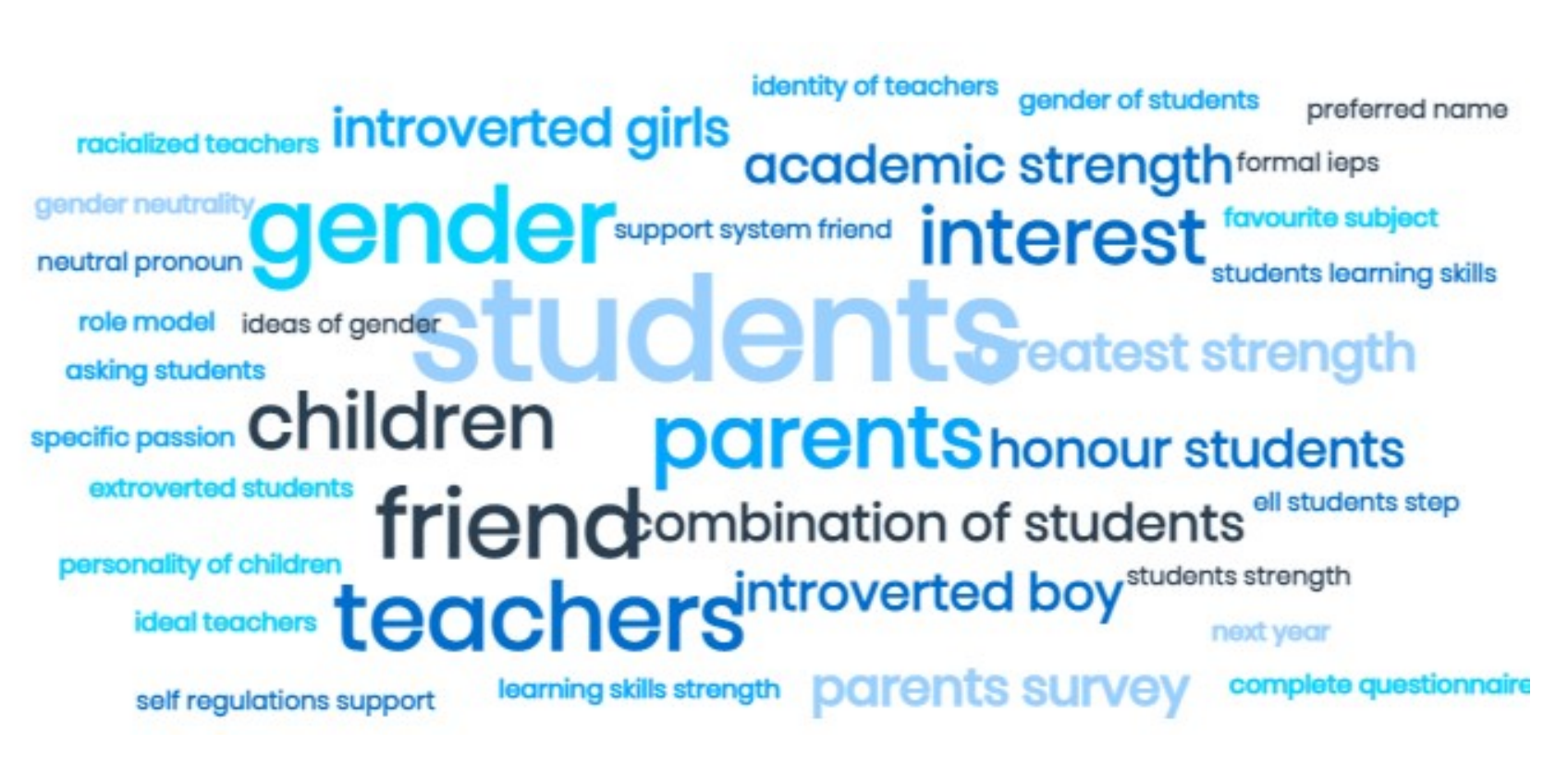
With feedback from teachers about student placement cards, themes came from their comments and conversations. These included (some points will naturally overlap):

Focus on student

Gender Neutral

  • No colour coded cards
  • Preferred gender identification (e.g. she/her, they/them, he/him)
  • Gender identity (e.g. male, female, transgendered, gender nonspecific)
  • No balancing the number of “boys” and “girls” in classes

Learning Styles/Personalities

  • Extrovert, introvert, a little of both
  • Academic and Non-academic strengths
  • Academic and Non-academic needs
  • Consider placing students with “supportive” friends
  • Consider students seeing self identity in teacher’s identity (i.e. BIPOC, Racialized)
  • Ask students who they would like to have and not have in their class
  • Ask students what type of teaching style they prefer
  • Consider who they like to collaborate with
  • Resources required to support needs (i.e. Behaviour Teaching Assistant, Office Support, Educational Assistant, public health nurse for medical issues)

Student conference/feedback/questionnaire

  • Extrovert, introvert, both
  • Academic and Non-academic strengths
  • Academic and Non-academic needs
  • Consider placing students with “supportive” friends
  • Consider students seeing self identity in teacher’s identity
  • Ask students who they would like to have and not have in their class
  • Ask students what type of teaching style they prefer
  • Consider who they like to collaborate with
  • Greatest strength, greatest need academic and non-academic
  • What I want my teacher to know about me …

What sparks student’s interests?

  • Favourite subjects, topics, interests, passions
  • Hobbies
  • Art, Music, Drama
  • Sports
  • Things they do out of school

Focus on Classroom

Class Composition

  • No stacking classrooms with students with IEPs
  • Consider number of introverts with extroverts
  • Consider placing students with “supportive” friends
  • Consider students seeing self identity in teacher’s identity
  • Ask students who they would like to have in their classroom
  • Ask students what type of teaching style they prefer
  • Level of emotional and behaviour support needed (Behaviour Teaching Assistant, Office support)

Learning Environment

  • more structured, less structures
  • style of teachers
  • types of learning tools in class
  • more tech savvy with more techy teacher
  • Hard of Hearing in quieter class with lower noise level

Focus on Community

  • consider 1st language of student
  • put students who speak the same language with same language, supportive friends
  • build community of same language speakers in school

Parental conference/feedback/questionnaire about child

  • ask parents how to support their child next year
  • Student is an extrovert, introvert, both
  • Academic and Non-academic strengths
  • Academic and Non-academic needs
  • Consider placing students with “supportive” friends
  • Consider students seeing self identity in teacher’s identity
  • Ask parent who they would like their child to have and not have in their class
  • Ask parents about preferred teaching style for their child
  • Greatest strength, greatest need academic and non-academic
  • What I want my child’s teacher to know about my child
  • Students to help create a parent survey to learn about what is important to the school community, school families, and students

This is not a complete list, nor have I actually developed student placement cards that reflects these themes – there is a draft below. I also have not developed a survey to collect this data – but I will ask my students to do this as part of a math assignment.

The purpose of this collection of themes is to spark discussions and thoughts about developing anti-oppressive student placement processes that will support students and teachers in the business of learning.

This is a start. I’d love to get feedback on developing student placement cards further – please leave a comment below.

Collaboratively Yours,

Deb Weston, PhD

Draft of Student Placement Card/Information

  • Identity: Female – Male – Gender Neutral – Trans – Other
  • Pronouns: She/Her, He/Him, They/Them, Other
  • Personality: Introvert-Extrovert-Both-Other
  • Racial Identity: BIPOC, FMNI, Mixed, Other
  • Special Education Support: formal/informal IEP (circle one)
  • English Language Learners: Steps of ELL for Listening, Speaking, Reading, Writing
  • Language(s) spoken at home:
  • Favourite Subjects: Language, Media, Math, Science, Social Studies (History/Geography), Phys Ed/Gym, Music, Art, Drama, Recess, French
  • Least Favourite Subjects: Language, Media, Math, Science, Social Studies (History/Geography), Phys Ed/Gym, Music, Art, Drama, Recess, French
  • Supportive Student Friends:
  • Students who need a break (from each other):
  • Medical Needs/Fears:
  • Favourite Things To Do (away from school):

Any suggestions? Please make a comment below!

“How can I help?”

The adage of “If you want something done right, do it yourself,” was ingrained in me at an early age.  Until recently, I have always thought that being confident, capable and successful meant never asking for help.  I used to think that asking for help meant that you were weak.  I now think that asking for help is incredibly brave.  My 17 year old son recently told me about a group chat with his workmates.  Someone at work had sent an urgent message to the group asking how to do something while closing up the restaurant.  Many of the coworkers poked fun at the lack of knowledge of the person seeking help.  My son (brace yourself for this proud Mama Bear moment) texted that it was really brave of his co-worker to ask for help and provided the information that the coworker needed to close up for the night. I think that his act demonstrated wisdom an empathy far beyond his years.

Have you ever felt a little territorial or protective about your ideas or lessons in your classroom?  I imagine everyone likes to be valued for their unique talents and abilities.  In general, I don’t think anyone likes to be seen to be struggling and consequently, some teachers might choose to work in isolation. Perhaps it is fear. I’ve spoken to many colleagues who have identified as suffering from imposter syndrome. Perhaps those of us who have experienced imposter syndrome think that if anyone else got eyes on what we do every day that we would be judged and found to be lacking in some way.  Often teachers will tell me that they don’t have time to share with their colleagues-there just isn’t enough time in the day to collaborate. With the busy pace of education, I know that I have absolutely felt that way. My experience has been that when I take the time to collaborate with others I in fact, have more time and consequently better programming.  It is a concerted effort and takes a trusting relationship to co-plan and co-teach but when it works, it is amazing.

In my role as an instructional leadership consultant I am responsible for two portfolios; Innovation and Technology and the New Teacher Induction Program.  At the beginning of the COVID pandemic as teachers were teaching virtually for the first time, some had never used things like Google apps, FlipGrid and Kahoot. I was doing my best to support teachers with tools for teaching online.  Thankfully, I knew some other teachers that I could reach out to and ask for help.  These teachers, close to the beginning of their careers, were using these tools in the classroom and were able to help design and present webinars to other more seasoned colleagues.  As teachers, we often think that we need to have all of the answers for our students and with one another.  I’ve heard it referred to as the “Sage on the Stage Syndrome.” We seem to feel that we need to stay ahead of everything, which is impossible.  Education is changing more rapidly than ever.  I learned so much from my colleagues over the months that we worked together as a team and even though it was stressful at times, it was also incredibly fun.  I look back now on the powerful outreach our work had and the gratitude that was expressed by our colleagues and I am so glad that I got over myself and asked for help.

In the t.v. drama “New Amsterdam” whenever the new director of the hospital is introduced to someone, the first question that he asks is, “How can I help?”  It happens in the first episode about twenty times. This was a BIG a-ha moment for me.  What a powerful question!  How often have we wanted our students to ask for help?  How often have they refused when we have asked “Can I help you?”or “Do you need help?”  Unfortunately, asking for help is still seen as a weakness by many people.  However the question “How can I help?” turns it around so that the responsibility and focus is on the person offering assistance.  It is more difficult for someone to just say “No.” to this question.  It can help to create psychological safety in order to focus on what can be done to help rather than someone sitting in discomfort or shame because they won’t ask for help.  Sometimes just asking can make all the difference to someone when they are feeling overwhelmed, even if they decline the offer.  The four small words, “How can I help?” can make a powerful impact.  Sometimes, asking for help is the bravest thing you can do.

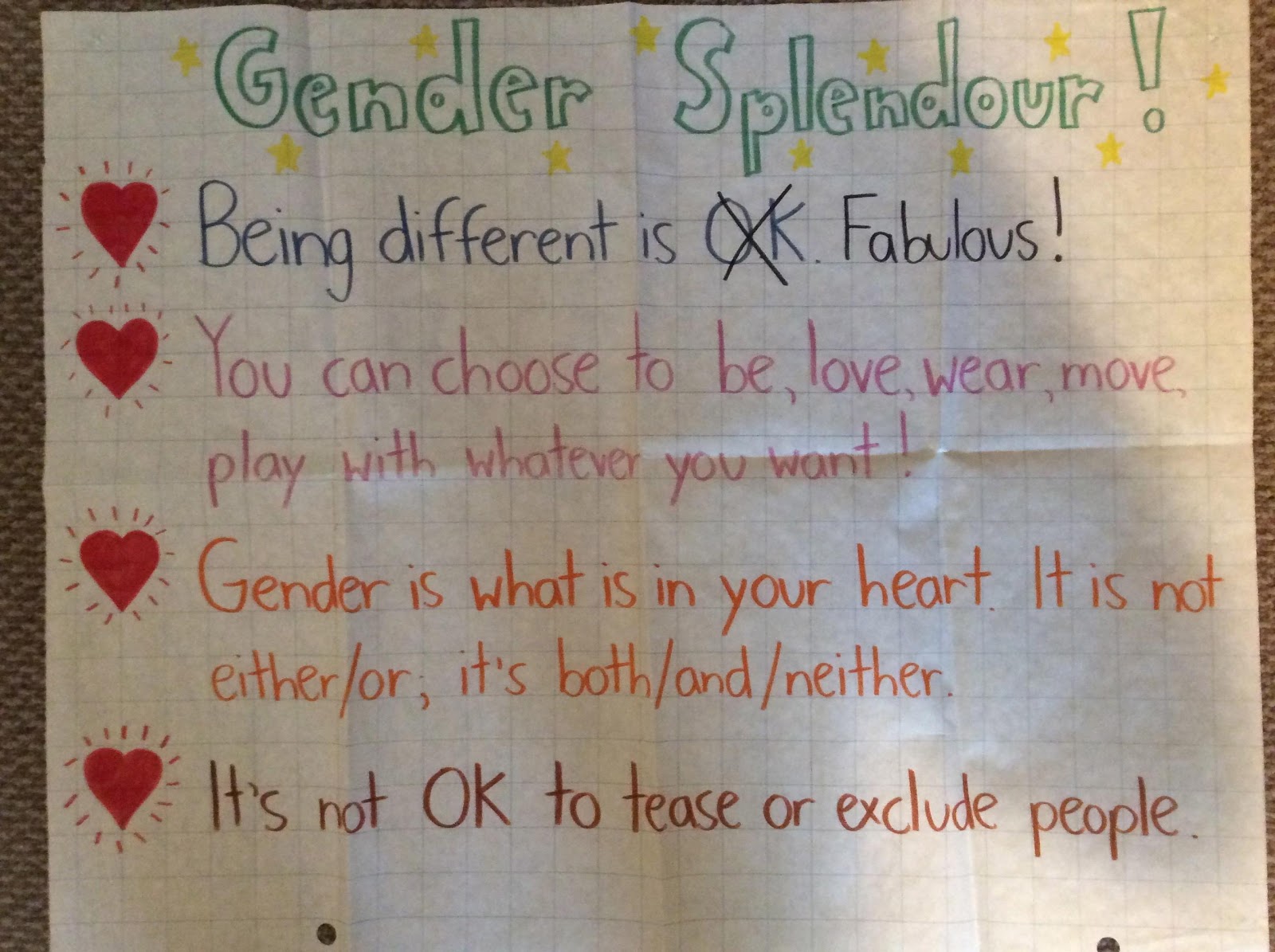
Gender Splendour!

This year, our school community will celebrate Gender Splendour from April 6-9, 2021.  It will be our 11th year implementing arts-based curriculum that explores gender identity and equity, 2SLGBTQ+ communities, inclusive families, and disrupts homophobia and transphobia. 

Over the years, the Kindergarten-Grade 6 students have participated in several inclusive and intersectional workshops, including: Love Makes a Family, “The F-Word” (feminism), Kiki Ballroom and the History of Voguing, Toys Will Be Toys, LGBTQ+ Rights Around the World, Pronouns and Possibilities, and more! 

When I was in elementary school, my mother came out as a lesbian.  This was in the 1980’s and she told us not to tell anyone because she was afraid of losing her job.  I learned about the painful impact of fear, silence, and homophobia outside of the home.  I also learned about the power and strength of community and love, as we marched in the streets at parades and protests.  My young life as an activist and an ally has developed into a strong, on-going commitment to social justice.  When I became an educator, I was determined to break the silence and celebrate the pride and resistance of 2SLGBTQ+ communities.

All You Need is LOVE….and an ALLY:

When Shannon Greene joined the staff, I found an ally and an accomplice.  We were both creative and committed to transforming our pedagogy.  Together, we brainstormed ideas about how we might support students, families, and staff to explore and express their intersectional identities.  We gathered resources, including picture books and media texts to support these critical conversations.  We reached out to families and community members, and generated guiding questions to investigate.  We wanted to empower students to stand up to injustice and take action.  And we wanted to have fun!!   

Boas and Bowties:

We celebrate Gender Splendour during the second week of April, which includes the International Day of Pink.  This year, COVID-19 has pushed our celebration a week earlier.  In addition to wearing pink, we encourage everyone to dress-up in different ways.  These Dress-Up Days are always optional.  They are meant to be playful and fun, and create brave spaces for community members to express themselves without fear.  In the past, we have worn: Rainbow Colours, Wings and Capes, Boas and Bowties, Clothing Inside-Out, Spots and Stripes, Glitter and Glam, and Pink! 

Free to Be:

Every social movement needs a soundtrack.  Throughout the years, we have discovered several songs that make us think, and make us dance.  “True Colours” by Cyndi Lauper, is an anthem that honours how it feels to be seen.  “Same Love” by Macklemore, explores issues of homophobia and same-sex marriage.  “Stereotype” by Samsaya, invites us to stand up to injustice.  Recently, we collaborated with Freedom School Toronto, and learned about how dance can be a form of resistance.  Everyone enjoyed learning about Kiki Ballroom, and the five elements of voguing, before strutting our stuff on the runway. 

As we prepare to smash gender stereotypes and critically examine gender binary roles in our society, I am feeling reflective, grateful, and proud.  I am also looking forward to practicing my “death drop!”

International Women’s Day

Happy International Women’s Day!


What does this mean to you?
What does this mean to your teaching practice?


Feminism is for everyone

“Eighty-one percent of the members of the Elementary Teachers’ Federation of Ontario (ETFO) are women and, in many ways, the history of women teachers reflects the struggles of all Canadian women” (ETFO voice, 2016 https://etfovoice.ca/feature/looking-back-womens-history-ontario-teacher-federations). 

The world needs women. Feminism can be practiced daily by elementary educators in Ontario. Not because we are a group largely composed of women, but because a society that values women is one that promotes equity, opportunity, and growth. Feminism is not exclusively for women. Feminism in the classroom generates a culture founded on inclusivity. This environment creates a safe space for critical thinkers, status-quo challengers and allows students to grow into adults who advocate for positive change. 

You cannot have feminism without intersectionality 

You cannot support women without supporting Black women. Women who belong to racialized groups. Women with disabilities and special needs. Women who are part of the 2SLGBTQ+ community. FNMI women. Women who are marginalized by society. Elderly women. Young women. 

We must support all women, teach about all women, listen to all women and respect all women. To not value the experiences of all women is to misrepresent the harsh reality women have lived and continue to face. Inaccurate or nonexistent representation of women places student learning and well-being at a disadvantage.

Women deserve equitable opportunities and to see themselves reflected in curriculum 

Women merit the encouragement to become involved in science, math, engineering, technology and sports. Our students have the right to equitable opportunities in all aspects of curriculum and school activities. In order to promote these experiences in the classroom, students must see themselves reflected in past and current literature, stories, videos, guest speakers and so on. Let us get rid of those history books that exclude or depreciate women’s accomplishments and rather promote the positive impacts women have made, and continue to make in the world. 

Let’s continue to celebrate women today and every day

Cheers!

On Being a Queer Student in Ontario Schools

Recently, there was a PD day in my board where the morning was dedicated to equity training. We started with a discussion about a book that has been provided for every school in the OCDSB titled George

If you’re unfamiliar with the book, here is a brief synopsis from Scholastic Canada

A bright, bold debut about a girl who was born a boy, but refuses to let that stand in the way of her dream.

More than anything else, George wants to play Charlotte in her fourth-grade class’s production of Charlotte’s Web. The problem is, her teacher won’t let her, because George is a boy. But George isn’t about to let that squash her dream. With the help of her best friend, George must learn to stand up for her wish — and brave a few bullies along the way.

Transcending all categories and genres, George is a pertinent and poignant middle-grade read for kids of all backgrounds.

As soon as this discussion was presented to us, I felt my heart rate increase. I debated turning my camera off (we were doing this PD remotely) so that my colleagues couldn’t see my reactions. We were given a few minutes to explore some questions about how we would approach this text in the classroom and share our thoughts on a collaborative whiteboard.

Reader, I didn’t make it past the first question: “What biases do we have that we may bring to the text?”

I didn’t make it past this question because I kept seeing the word FEAR come up on the screen in front of me. I started to sweat. My leg started shaking restlessly. I found it hard to sit still. I grit my teeth and started adding my thoughts next to theirs: 

Why do we have to “warn” families that we are going to use this resource?

This implies that there is something controversial about being queer.

As educators, we have to make students feel seen and validated.

I’m not going to go through a detailed account of how that “training” went for me. I still haven’t fully recovered. It was an incredibly difficult day to get through and I left feeling overwhelmed by how much work there is to do in education to do better for our students. I’m going to talk about that “FEAR” idea later, after I put some of this in the context of Who I Am.

What I am going to do here is challenge the idea that discussions about 2SLGBTQ+ people, perspectives, and experiences are a challenging or uncomfortable topic in the classroom. This is going to be a two-parter, so bear with me. Maybe even a three-parter. Who knows when I’ll get to the exact point I’m trying to make.


In this first part, I’m going to talk about my experience as a student in this province.

In my Twitter bio, I describe myself as “Queer AF.” My profile picture has the pan flag as a background. I grew up in the ‘80s and ‘90s in a small town close to Ottawa and went to Catholic school from JK to OAC (grade 13, that magical year that no longer exists).

I know many people can point to the exact moment when they realized they’re queer, but I can’t. In many ways, it feels like I’ve just… always known. Because I’ve always been queer. What I needed, as a child, was the opportunity to see myself reflected in lessons, stories, media, discussions in the classroom.

That is not what I got.


There is something wrong with me. 

I can’t tell you how many times that thought ran through my head as a child. As a teenager. As a student. I remember watching movies and shows, reading books, seeing families in the news, and trying to imagine myself as an adult. Sometimes, I could see myself in these families. Sometimes, I could see myself fulfilling the role that society was very clearly expecting me to take on.

Sometimes, though, I couldn’t. There would be moments where I’d imagine myself as a Wife to a Husband and it just felt… wrong. Like it didn’t fit.

I got older. People started developing crushes. We’d talk, as friends, about who we “liked.”

I never liked anyone. I never had crushes. That’s what I told myself, anyway, because everything we were taught was that girls would have crushes on boys, boys would have crushes on girls, and that was that. That’s how “biology” worked. 

It wasn’t until later that I realized that oh, I had crushes, they just… were all on girls.

I sat in class thinking about this often. Why was I broken? What was wrong with me? I would try to pick out boys that maybe, one day, I could convince myself I liked. Sometimes it worked, fleetingly, but most of the time, I felt indifferent.

I moved on to high school. I wrote a love letter (yes, it was immediately shared around the school, and yes, it was mortifying) to a boy. I was deeply set in my feeling that everyone can tell that I am very broken inside and I needed someone to think that no, I’m normal, see? I have crushes on boys! I’m just a regular girl! Just like everyone else!

I think I had everyone else mostly convinced that I was straight, but I had trouble making and keeping friends all the same because the depth of that feeling of otherness was overwhelming. I struggled with mental health, self-harm, depression. 

I even tried to be a Good Catholic Girl in grade 11. I became very interested in liturgies. I tried very hard to make prayer work for me. When it came time for Reconciliation, I thought, This is it. This is where I can fix everything. 

I confessed to having feelings for other girls. But also, sometimes boys! I’m– I’m redeemable, right? This is my big chance! I’ll tell the truth, I’ll pray, I’ll do my penance, and then I’ll be “better.”

And at school, in a school-sanctioned (and required) event, with school staff, I was told that I would go to hell. It confirmed my fears that I was broken. Fundamentally wrong. A sinner. Don’t you want to have children? Don’t you want to go to Heaven? Don’t you want God’s love?

These questions, thrown at me like accusations by the school chaplain, are burned in my mind. The memories are like scars. I actually wrote them down. I kept the journal where I wrote that down for years, for some… awful, self-loathing reason. I don’t know why.

I was shaken by that. My mental health declined even further. I became convinced that my mental health was just another example of how irrevocably screwed up I was as a person. I mean, everyone else around me was “normal.” People were dating. In movies and shows, everyone was straight. If a character came out in the media, it was shocking. Because it wasn’t “normal.”

I withdrew into the online world even more than I had before. I threw myself into the online roleplaying community, playing make-believe as all manner of characters from different genres. I wrote stories – so, so many stories. I read fanfiction. I learned what “slash” and “shipping” meant.

Most importantly, online, I found the queer community. It was sneaky, at first – just little glimpses of other people who were like me, hidden in their writing and the characters they played. I started to wonder if I wasn’t so alone. In time, this world of beautiful, bright, loving, ABSOLUTELY NORMAL PEOPLE helped me see that it wasn’t me that was wrong, it was the world I was expected to live in that was.

And reader, that made me so angry. I had wasted so much time hating myself, trying to fix myself, trying to be someone I wasn’t. I had hurt myself, and in the process, I had hurt my family, too. I had pulled away from them because I didn’t want to cause them pain by being their broken kid.

Furious at my own ignorance to my identity, emboldened by my online friends, determined that none of this should be this way, I came out as bisexual at school in grade 12.

The reaction was swift, decimating, and brutal. People teased. People joked. In that same journal from before, I kept track of the things people said to me: I was doing this for attention. I was saying this because I was too ugly or weird to get a boyfriend. Besides, I couldn’t be bi if I’d never even kissed a girl to know if I really wanted to. What a weirdo. What a freak. Obviously I’m screwed up, since I also have all those scars on my arms. Hey, is that why I was trying to die? Because I knew how screwed up I was?

I hid. I got quiet. I did not talk about being bi after a few weeks of that misery. By OAC, I think most people had forgotten about my moment of “attention-seeking” and moved on to some other target. It wasn’t until I had moved away and started university that I let myself explore my identity and figure out some small piece of who I am.


So. You’ve read all of that, and you’re wondering what any of this has to do with education, maybe? Maybe you think that none of the responsibility for this fell on the school, because after all, it wasn’t my teachers saying that I was a freak. It wasn’t my teachers saying that I was broken or looking for attention.

The thing is, they also didn’t normalize 2SLGBTQ+ identities. They didn’t talk about them at all. And because they never brought them into the class, not only did I sit there feeling like I was fundamentally broken because I couldn’t relate to what I was seeing – my peers internalized the idea that cis-het is the norm and everything else outside of that is deviant.

In short, school created, presented, and perpetuated a perception that being cis-het is the default. If any other perspectives ever came up, they were immediately juxtaposed with the Straight Experience. If students tries to explore queer topics in their work, they were summarily shut down, implying that there was something about it that was wrong or inappropriate for school.

School let me down.

There was a chance for school to be the place where my peers were shown a wide range of experiences, perspectives, and identities to broaden their worldview.

Instead, they perpetuated one experience and held it up as the one you’re supposed to have.

And we’re still doing it, but that’s what Part 2 of this is going to be about.


If you read all of that, thanks. There’s a lot in here that I’ve never said out loud – not to my partner, not to my family, not to my friends.

But it was time.

See you in Part 2.

G.L.O.W.

GLOW (Gay, Lesbian or Whatever) is an extracurricular club for Grades 6-8 students to explore issues related to the 2SLGBTQ+ community and their allies. We have been meeting on-line every week since April 2020. Before COVID-19, we would meet during lunch at school. GLOW is a proud and positive space for students and educators to share their own stories, ask questions, make art, and take action. It is always the highlight of my week.

There is extensive data to hold schools accountable and support students who may identify as 2SLGTBQ+. Many of these students continue to be bullied or harassed by their peers, and pushed out of school. It is critical that educators respond to homophobic or transphobic comments and actions that are harmful, and to teach diverse stories of 2SLGBTQ+ communities with pride.  There are several resources provided at the end of this blog.

WHERE DO I BEGIN?
You don’t need permission to start a GSA (Gay-Straight Alliance). In fact, if a student requests a GSA, many schools are required to provide one. The first thing I did was reach out to my Grade 7/8 teacher friend, Tia Chambers. I asked her to share the role with me because everyone needs an ally. It didn’t take long before other staff wanted to join GLOW. This year, we are sharing the role of co-host with Kindergarten teacher, Nikki Kovac.

We start every meeting with an introduction, which includes our pronouns, and we answer a question. This helps us to build relationships and honour who we are. If there is a new member, we will review our GLOW Agreements. These agreements were generated together in our first meeting and describe what we hope for and what we need in order to feel comfortable.

After making our agreements, we invited students to share music that they like and we created a playlist. Some of these songs are performed by 2SLGBTQ+ performers, and other songs just make us feel good. We asked everyone for ideas about what they wanted to discuss, and the type of activities they might want to do. It is important for educators to amplify student voice, listen and respond with respect. Inspired and informed by the students’ ideas and questions, we prepare activities and questions to guide our discussion every week.

WHAT HAPPENS AT GLOW?
Here is an example of what we discussed at our GLOW meetings in February. As Valentine’s Day was approaching, I wanted to challenge the heteronormative narrative about love and romantic relationships that are reinforced by the media, and create space for more possibilities. I thought that we might discuss these issues and create our own Valentine’s Day cards with inclusive messages.

Our check-in question was about love. I asked: “What or Who do you love?” Then, I used these guiding questions: “What are the messages about love and relationships that you notice on television or in movies?” “Who do they include or exclude?” “How do these messages reinforce a “norm” about relationships that is heterosexual?” “How might we make Valentine’s Day more inclusive?” We also talked about self-love and different ways we might care for ourselves.

I shared a few examples of Valentine’s Day cards that provide a counternarrative, and I invited everyone to design their own inclusive Valentines. We talked about word play, and how Valentines often include puns and rhyme. As we drew, we listened to songs on our playlist. The following week, one of the students shared a poem that they had written about love that was inspired by our discussion. It filled my heart with pride.

RESOURCES
ETFO has created many resources to support educators who want to create brave and inclusive spaces in our schools.

My teacher friend, Melissa Major, has written two excellent articles in VOICE magazine, which can spark meaningful discussions with your students:

How to Become a Super Rad Gender Warrior reminds us that all members of a school community have the right:

To be free from discrimination and harassment.
To have a safe and inclusive learning environment.
To use the bathroom or change room they feel is the most appropriate.
To dress in a way that feels right and safe for them.
To be spoken to with their chosen name and gender pronoun.
To be treated with dignity and respect and the recognition that all gender expressions and identities are a normal and healthy part of a spectrum.
To present their gender in different ways at different times

Gender Neutral Language: An Activity for Day of Pink or Any Day explains how educators can use inclusive language to disrupt the gender binary.

Last Spring, I attended an ETFO webinar called “How to start a GSA and support 2SLGBTQ+ during Remote Learning” presented by Toronto teacher, Jordan Applebaum. It was intersectional and inspiring. You can watch the webinar in four parts here:

Be Proactive to Support Trans and LGBTQIA2S POC – Part 1
Be Proactive to Support Trans and LGBTQIA2S POC – ​Part 2​
Be Proactive: How to Start a GSA During Remote Learning – Part 3​​
Be Proactive: How to Start A GSA During Remote Learning – ​Part 4

I have also joined a few Facebook groups to support this work. Recently, I discovered that the Durham District School Board has created Pink Shirt Day and Beyond, a slide deck which is filled with lesson plans to use in the classroom or at your next GLOW meeting.

Shine on!!


Student-Led Conferences

Writing report cards and IEPs during COVID-19 was frustrating and stressful. COVID-19 has exposed deep inequities that affect families disproportionately, and it has impacted teaching, learning and assessment in significant ways. There are so many challenges to assessing and evaluating students on-line, and there are many strengths/skills that cannot be measured on a report card.

Needs Improvement
The current assessment, evaluation and reporting practices and procedures needs improvement. Ontario schools reflect a colonial, Eurocentric approach to curriculum and assessment that privileges some students over others. Report cards and IEPs measure students against standardized levels of achievement, which fail to recognize multiple and different ways of knowing. There is extensive research about the impacts of systemic racism and educator bias, which construct certain students as “failures”.

Most of our professional development is focussed on how we can meet the diverse needs of students and make the curriculum more inclusive; however, we also need to think critically about how assessment and evaluation practices reinforce racial inequity, and privilege student “success” and belonging. How might we transform our assessment and evaluation so that all students feel empowered to achieve excellence, and feel successful?

Collaborative Assessment
Student-Led Conferences are one example of how educators might disrupt traditional forms of evaluation, and facilitate a more collaborative approach to assessment. In a previous blog, I wrote about how collaborative assessment actively engages families, educators and students as co-learners, and helps to build trusting relationships that are reciprocal.

Student-Led Conferences, goal-setting and self-evaluation are powerful examples of how collaborative assessment can center student voice, support meta-cognition, and develop critical thinking and self-reflective skills. Collaborative assessment can increase student engagement and motivation, and has been shown to impact student achievement and behaviour.

What is a Student-Led Conference?
Every year, I prepare my students to facilitate a Student-Led Conference with their family in February and June. This is an alternative to the Parent-Teacher Conference, and often tells a counter narrative to the report card. Usually, there are 4-5 conferences happening in the classroom at one time, and I will rotate between families to listen and add to the discussion. These conferences can last anywhere between 15-45 minutes.

It is my hope that Student-Led Conferences support all students to feel successful, because they create meaningful opportunities for students to identify their strengths, and share evidence of how well they are meeting their learning goals. They also invite families and educators to share responsibility in the teaching and learning process.

What happens BEFORE a Student-Led Conference?
At the beginning of the year, most schools invite families to visit the classroom and meet their child’s teacher to learn about the curriculum expectations and classroom routines. During this discussion when I introduce our learning goals, I also share information about collaborative assessment and Student-Led Conferences. I explain the benefits, provide resources, and invite families to ask questions.

As we begin to build relationships and honour all of our “multiple intelligences” and different ways of knowing, I encourage students to set individual short-term goals that are “just right” for them. We talk about our strengths and struggles as we learn about different folks who have worked hard to overcome barriers and achieve excellence. Older students might engage in diagnostic surveys to find out how they feel about different subjects.

Portfolios
Every student will develop a portfolio, which will hold samples of work that demonstrate growth and learning in concrete ways. Some of these work samples will be chosen by the student and others will be chosen by educators. For example, I always include goal-setting and self-evaluation, as well as our monthly unedited, unassisted writing samples in their portfolio.

In January and June, in preparation for a Student-Led Conference, students will look through completed work, and choose samples of work that they are proud of. In my class, students staple a piece of paper to this work and write about why they are proud of it. Students also have the opportunity to look back at work samples, and identify how they know they are growing. This process can take several days, and it is a great opportunity to reflect and set new goals for Term #2 in January and/or for the summer in June.


Student Voice:
Before writing the report card, I always ask students to reflect on their Learning Skills and Work Habits and complete a self-evaluation. As a class, we might discuss each skill and generate “success criteria” and specific examples that relate to our learning together. I often try to include student voices in the report card, and quote their writing and self-reflection. It is critical that students understand the criteria by which they are being evaluated, and that they have opportunities to share their thinking about themselves as learners. It is invaluable formative feedback for educators and families.

During COVID-19, our Student-Led Conferences have continued on-line. I created a Google Form, and asked families to help their child answer questions about their learning. The form included opportunities for students to identify their strengths and areas for improvement in different subject areas, as well as the Learning Skills and Work Habits. These “stars” and “wishes”, or “GLOW” and “GROW” comments helped to guide our discussion during our virtual Student-Led Conference. I shared the screen and asked the students to read their ideas aloud, and invited families to share feedback. I was only able to support one conference at a time, but I believe it was worth the extra time.

What happens DURING a Student-Led Conference?
Student-Led Conferences will look different depending on the age of the student. In the early primary years, I provide families with a checklist and sentence prompts to help support the discussion. Older students can follow a script to lead the discussion. During a Student-Led Conference, students will share their portfolio with their family. Families are encouraged to listen, ask questions and share what they notice about their child’s growth and progress. My role is to circulate around the room, listen, and contribute observations and reflections to the discussion.

What happens AFTER a Student-Led Conference?
After a Student-Led Conference, I provide a template and ask families to write a letter to their child. This letter describes what they are proud of, and how they will help their child to achieve their learning goals. In my experience, families have found the Student-Led Conference to be meaningful and informative.

One Kindergarten parent wrote:

It really opened up space for dialogue about what types of learning matter to our child, some of which were a pleasant surprise to us that we can carry forward at home now as well. Also, being able to experience his learning environment at school from his perspective was deeply gratifying for us and self-esteem building for him. He was so proud to show us around the space and really demonstrate the independence he’s building there. Grateful for the entire process and so heartened to know that he is in a classroom and school environment that really values the agency and intelligence of children!
(Parent comment, 2018)

Student-Led Conferences are a powerful tool that educators can use to honour the multiple and diverse ways that students learn and share knowledge. They provide a counter-narrative to the report card, and engage families, educators and students in a collaborative learning relationship that celebrates student achievement with pride and possibilities.

Video Resources:
Grade 3, Grade 6, Grade 7/8 Student-Led Conferences
The Literacy and Numeracy Secretariat Webcast Professional Learning Series, Ontario Ministry of Education

Preparing for a Student-Led Conference, New Zealand

Student-Led Conferences: Empowerment and Ownership, Chicago

On becoming an anti-racist educator

Not everything that is faced can be changed, but nothing can be changed until it is faced. James Baldwin

2020 was like a personal worldview culminating activity that happened in slow motion. It was a merger of events and interactions that finally allowed me the ability to see race and racism more clearly than ever before. 2020 also showed me that there were many more threads woven into this tapestry and that I needed to look at them one by one in 2021. 

Although this post is not intended to be a look back, it definitely includes some reflection and understanding that are decades overdue.

Before ever becoming an ally, activist, and anti-racist there is something I have to do first. Confront my past and present racism. Whether it was implicit or explicit, recognizing the fact that racism is part of my past and present is the first step. In my past it came in the form of exclusion, cruel words, omission, inaction, fear, ignorance, and/or silence. In the present, my acknowledgement of racism in my life comes from waiting for so long to change what I do in the classroom before developing a culturally relevant and responsive pedagogy that was truly inclusive of the students I was entrusted to teach. It comes from sticking to a Eurocentric approach to history and by failing to include the voices of others who have been silenced by a whitewashed curriculum. 

I am sorry for all of it. Even though I was never called out or made to account for my actions I need to own them even though they cost me anything other that regret. This has taken decades to sink in because, ultimately, there was a cost, although so much of it went unnoticed.

Neither the bill, nor the collection agency arrived at my door demanding payback. Only after the realization that my racism accountability statement was seriously overdrawn was I moved to action. The clearest recollections come from middle school, where I remember not standing up for someone who was at the end of racist epithets and exclusion, and laughing while someone shared a racist joke. I see now a complete lack of caring, courage, and conviction to confront what I was willing to let continue by my complacency. I have to own this as part of my past because someone else always paid the price. What worries me more are the times that went by when I was oblivious yet still complicit to how racism was affecting those around me. There was a cost.

Even though it came to me without cost I was still given insight and the tools to effect necessary change each time I dived deeper into how to be an anti-racist beyond the hashtag. It started with some powerful reads such as the work of Ibraham X Kendi, Colson Whitehead, and Eddie S Glaude Jr.. Sharing Kendi’s Stamped from the Beginning with a men’s book club and subsequent conversations last summer have helped me more clearly understand the history of slavery, anti-black racism, and the problems they continue to cause in a time where all men and women are created equal. It wasn’t the readings alone that have brought me to this place though.

There were the #QuarantineEd Zoom calls with Matthew Morris, Jay Williams and educators from across the continent. These weekly discussions of race, identity and Black Lives Matter happened before, during and after the murder of George Floyd and the global outrage that followed. Through all of this, it seemed more beneficial to listen than speak. This extended to one on one conversations with friends and colleagues too. I am thankful for the grace with which wisdom, truth, and insights of anti-racist activists, teachers, and seekers of justice were shared. Learning more about the words white privilege, systemic racism, and black lives matter are now anchored in deeper understanding of the hurt and pain that has been caused by racism. 

I can never go back in time to repay what I owe for my past actions, but I can pay up, and pay it forward – a necessary change for which I hope we will each make a contribution. For me, atonement for past mistakes will be to acknowledge the racism in my life, and to continue listening and learning what needs to be undone and done differently to overcome it. Only then can I move forward to making sure it is eliminated from the spaces I occupy as an anti-racist educator. I want to be part of the generation that ends centuries of racial injustice in our communities and schools.

The words of the next generation sum it up quite nicely, “Racism sucks! Why would anyone want to be racist?” – grade 4 student.

Big thanks to Nicolette Bryan at Adrienne Clarkson PS, @callmemrmorris, @mstrjaywill, @MrTBradford, #QuarantineEd, @chrisjcluff, and #bc4men for the discussion, wisdom, and constant inspiration. Thanks for reading.


Water is Life

I have been learning with, from, and about water for several years. In another blog, I shared examples of what decolonial water pedagogy might look like in a Grade 2 classroom.  Whenever possible, it is critically important to invite Indigenous artists, activists, and Earth workers to share their knowledge with students in their own voices.

Water is Life:

This fall, the Grade 2-6 students participated in a workshop with Joce Two-Crows Tremblay and Faye Mullen called “Water is Life”.  They describe the workshop as: “Wondering on water as an ancestral highway, as home, as Medicine and more, through story, song and ceremony.”  

It was a beautiful morning. We gathered in a circle and welcomed our special guests with the song, “Funga Alafia”. Archer Pechawis, a Grove parent, joined us and shared songs and drumming. We offered tobacco and gratitude for their teachings. 


Water as Home:

Joce taught us about the strong connections between language and land. We learned about the Indigenous roots of many words spoken in English. After the workshop, I asked the Grade 2 students to document their new learning on inquiry cards with the prompt, “Now I know….”.

NOW I KNOW….
…that Toronto is pronounced many different ways. SOL
…that Lake Ontario in the Indigenous language is “Lake Handsome Lake.” DEMA


Water as Relative:

After a discussion about the importance of water and who we consider to be our relatives, we learned about the relationship between salmon, people, and water. When young children see themselves in relationships with land that are rooted in reciprocity and respect, they might care for all humans and more-than-humans as family.

Water as Ancestral Highway:

In preparation for the workshop, everyone had made salmon puppets, and we re-created water using tarps and blue material. As Joce and Faye paddled up the river, singing an Anishinaabe Water song, our salmon puppets swam upstream to spawn.

NOW I KNOW….

…a song about water. GWEN
…that people sing river songs to catch up to salmon. CLEM

At the end of our journey, we learned more about how Anishinaabeg used land as tools and technology in innovative ways.

NOW I KNOW…

...how to catch salmon, and when to.  DESMOND

…people put Willows down to trap big salmon.  SVEA

Water as Medicine:

We ended our workshop with a Water Ceremony. We sat in a circle and water was poured into our cup. As we held water in our hands, Joce and Faye invited us to think about how living things can feel and absorb our energy, and that is why we must be aware and intentional about our relationship to land. We were encouraged to send greetings of love and hope and gratitude to the water. After sitting quietly and reflecting, we drank from our cup and wondered if the taste of the water was affected by our ceremony.

NOW I KNOW….
…water can hold lots of energy. LOTE
…water gives life to everything. ELLIOT

It was a powerful morning.  We learned many important lessons about land and language, connection and community, technology and teachings.  Everyone enjoyed learning outside with and from the land, through storytelling, movement and music.  Thank you to Joce, Faye and Archer for sharing your knowledge with us.

Eco-Justice: Learning with Water

I was invited to co-host a webinar about Ecojustice Education, hosted by the Toronto District School Board’s EcoSchools team, in collaboration with OISE’s Environmental and Sustainability Education Initiative. 

My inspiring co-host was Farah Wadia. Farah is a Grade 7/8 teacher in Toronto, and she has written about her work raising issues of environmental justice through the study of water with local and global connections in VOICE magazine. You can watch our webinar here.

As an anti-colonial educator, I am actively learning how to centre Indigenous perspectives, knowledge, worldviews, and stories of resistance throughout my curriculum. This integrated water inquiry is one example of what eco-justice pedagogy might look like in Grade 2.

Land as Pedagogy: Welcoming Circle
As I deepen my understanding about how to support Indigenous sovereignty, and actively disrupt settler colonialism, I am coming to know that some of the most powerful work I can do is to build relationships, make connections, and acknowledge land with respect.

Every morning, we begin our day outside. We take a few deep breaths together and pay attention to the land (which includes plants, wind, animals, water, soil, etc.) around us. We notice the clouds, the mist, the frozen puddles, and share our observations with each other. We honour the original caretakers of land, practice gratitude, and promise to care for the land as part of our responsibility as treaty people.


My approach to land education is to honour, celebrate and strengthen the relationships that children have with their natural environment, which includes the urban setting. Inquiry-based learning that is grounded in love and wonder can support children to be curious and critical thinkers. If children feel a strong connection to the land, they might also feel responsible for taking care of the land, and each other.

Building Relationships: Sharing our Water Stories
Our water justice inquiry began with an idea that I learned about in the first edition of Natural Curiosity. In September, students shared samples of water that they had collected from different water sources they encountered during the summer. Every day, one student shared what they love about water, and told stories about the water they had collected. We wrote about every experience. This act of storytelling helped to connect us as a community, and created a shared intention for learning with and from water.


A Community of Co-Learners:
Students shared their knowledge and what they love about water in different ways. During MSI (Math-Science Investigations), I asked everyone to build and create structures that connect to water. We used inquiry cards to document what students already knew and the questions they wanted to explore together. These questions provided diagnostic assessment, and will guide our inquiry throughout the year.


Taking Action:
It is critical that young children learn stories of resistance, and see themselves as agents of change. We are reading many picture books to support and guide our inquiry. “The Water Walker” by Joanne Robertson and “Nibi’s Water Song” by Sunshine Tenasco, are two excellent stories written by Indigenous authors. Reading these stories inspired more questions:

Why does Water need to be protected?
Do all people have access to clean water? Why or why not?
How can I take action to protect water?

Students used a Venn Diagram to make text-to-self connections and compare themselves to Anishinaabe Water Protector, Josephine Mandamin. 


Write for Rights:
As students learn to recognize inequity and confront injustice in their lives, they need multiple strategies and tools that they can use to take action and feel empowered as activists and allies.

Every year, Amnesty International organizes a letter writing campaign on December 10, called “Write for Rights”. In 2020, I learned that Amnesty International was highlighting the First Nations community of Grassy Narrows. I decided that the students would learn about the issues and write letters of solidarity. Everyone was very surprised when Premier Doug Ford wrote us back! 


Learning Through the Arts: Water Poems
We are learning that Water Protectors will often sing to the water. This call to action has inspired us to write our own songs of gratitude for water in our local community. In preparation, the Grade 2 students wrote a variety of poems, and we explored the sounds and shapes that water makes through soundscapes and movement. Students expressed their appreciation and love for water in creative ways.


Water Songs:
As we compose our water songs, we will continue to listen to the songs of Water Protectors for inspiration and guidance. Some of the songs that we have been learning are: “The Water Song” by Irene Wawatie Jerome, “Home To Me” N’we Jinan Artist from Grassy Narrows First Nation and “We Stand” by One Tribe (Kelli Love, Jordan Walker, and MC Preach). It is my hope that we will sing our songs to the water, with gratitude and joy.