First Days of School Through a Wellness Lens

The long awaited return to the classroom has finally come! After being outside of the classroom since March 2020, I was able to go back to the physical classroom this September 8th. I was so happy to be able to set up my room and await the arrival of students. Teaching online was challenging and did not allow me to have the face-to-face connections that are much needed in a classroom. I am so happy that schools are open and that my position is no longer online. This year, I am teaching grades 7 & 8. I hope to still be teaching the same class come October, but with re-organization, things could change. 

Preparing for the first day was challenging as it had been 14 months since I had taught in person. Luckily, our school board prepared activities for us entitled “Reimagining Wellness”, where teachers are asked to teach 90 minutes a day from the wellness activity choice boards. The choice boards have a variety of activities within one of these three categories: Community and Team Building, Physical Activation and Social Emotional Skill Development. Teachers select one activity from each of these categories to introduce each day (thirty minutes per activity). My students seem to enjoy the activities and have enjoyed getting to know each other without feeling pressured to jump into all the curriculum activities. I am thankful for these resources as it has always been important to start a class off with these types of activities, especially after many students have been away for 14 months as well.

Additionally, it has been great to get to know students such as finding out their preferred pronouns and to try to get back into the swing of things. Our school board is looking to start voluntary extracurriculars soon and my class has already begun planning for the Terry Fox Assembly. Myself and my students are looking forward to these leadership opportunities as we have been without them for much longer than the COVID shutdown. As long as we can stay safe and get back to doing the things at school that we love, the extra things make the day that much better. 

As October draws closer, teachers in our board find out if any students are leaving to go online/returning from online. Our school could undergo a massive re-organization and we are all hoping things will stay the same as many students have now had the chance to bond due to these wellness activities. However, after teaching online last year, I have gotten better at dealing with change and learning how to overcome challenges. So if my assignment changes, I will be able to accept that with a positive attitude. 

I hope all teachers and students had a great first two weeks and that everyone is happy to be back. I know that all students are definitely glad to be back in the physical classroom where they can continue to make connections and learn in the way we were always meant to learn. 

Educational Perfection

As we end another school year and look forward to summer vacation, I think back to my first years in education and what summer “vacation” looked like for me. July was spent taking additional qualification courses and most of August was spent prepping and planning. It wasn’t really much of a vacation.  So why did I do it? Two reasons. I am passionate about learning and I am a (now recovering) perfectionist-especially as an educator.

I must have thought there was some kind of a prize for having the tidiest, prettiest and well organized classroom. I wanted my classroom to look like something out of the Scholar’s Choice catalogue. The custodians would be annoyed at having me in the school and I would wait anxiously for them to be finished waxing our hallway so that I could get in and set up my classroom. I needed everything to match. If I had baskets for items in the classroom they had to all be the same colour. It isn’t always easy to find 24 of the same basket at the Dollar Store.  Before the students started in September I felt the need to have labels on all of their notebooks, duo tangs and I even labelled their pencils. I spent an inordinate amount of time trying to control the environment for my students. My classroom looked like a showroom on the first day of school and I would spend the next 194 days trying to maintain that standard. Our first printing practice lesson (because we still did that back then) was to practice writing “A place for everything and everything in it’s place.” When I think back now to all of the time and energy that I wasted not allowing learning to get messy I shake my head. It was exhausting.

After twenty plus years in education I’ve learned a few things about educational perfectionism and letting go of control in order to empower the learners in the classroom. When I was given a portable for a classroom that I wasn’t able to get into much before school started I panicked at first.  I didn’t have space or time to create a showroom. I decided to give the design over to the grade 4-5 students.  I still had labelled duo tangs and a place for each of them to put their things that was their space ready on the first day but the rest, we did together. It built community, it gave the students ownership and it gave me some of my summer back. If you’ve ever taught in a portable that has the coat racks inside, winter is a bit of a nightmare for an organizational freak but eventually I let it go. We still had a tidy classroom because their wasn’t enough space to be too messy but the organization of things didn’t stifle the learning. We learned how to paint in a portable without water using buckets and trips into the school. We brought lawn chairs to school at sat outside at reading time. I loved our little cabin in the woods.

As educators we have a lot of people that we are accountable to in our jobs. Students, families, administrators, our board and our communities are all stakeholders in what we do. The pressure to be perfect in our roles can be overwhelming and paralyzing. What educators do each day is literally driven by “overall and specific EXPECTATIONS”. It took time for me to realize that the expectations that I was putting on myself were much higher than those of anyone else. It took reflection to realize that perfectionism isn’t the badge of honour that I thought it once was and that it was making my life more difficult. I came to understand that it isn’t the room or the resources that make me a good educator.  It is about the connections and relationships with my students and their families that matter. It is about embracing the Ms. Frizzle moments and rolling with it.  If I’ve learned anything from COVID-19 it is that being flexible and letting go of what I cannot control are the keys to staying out of perfectionism. I plan on guarding my summer vacation as I would a medical specialist’s appointment but I’ll likely take a few professional resource books along to read in the waiting room.


The Importance of Trust

The COVID-19 pandemic has led to uncertainty and change in education.  Just when I think I have a handle on the way things are going to go for the week there is a Government announcement that changes the plan.  I am “pivoting” so much I have motion sickness. When decisions that affect a work environment seem to be constantly changing, trust becomes more important than ever.  In a recent video “How Leaders Build Trust,” author and leadership thought leader Simon Sinek, describes trust:  “Trust is a feeling. It is earned and evolves based on a series of actions that prove that you are worthy of trust.  It creates a sense of belonging.  When you don’t feel trust or without a circle of safety, we inherently concern ourselves with our own survival and become cynical, selfish and paranoid.  You become convinced that everything is trying to hurt you.  We do things to protect ourselves.”  In her book “Braving the Wilderness”, author Berne Brown says that “in the absence of communication we make up stories and the majority of what we tell ourselves isn’t true.  In fact, our brain goes into self-protection mode and those stories that we make up are often exaggerate our worst fears and insecurities.” It is hard to learn or work when you are in self protection mode.

In learning more about culturally relevant and responsive pedagogy, I have noticed that a common keystone element in what I’ve been reading is that trust is crucial to creating a truly inclusive classroom.  In the famous YouTube video “Every Kid Needs a Champion” educator and speaker Rita Pierson stated, “Kids don’t learn from people they don’t like.”  I would go one step further to say that even more so, kids aren’t likely to learn from people they don’t trust.

So how do we create an environment of trust in which students can be their absolute best? More specifically how do we do this at a time when we are teaching students over Google Meet, through a PPE shield and mask or even through video that students watch asynchronously? I think that we do it the same way we would in a pre-COVID classroom.  One small interaction at a time.  I recently experienced an a-ha moment while engaging in a webinar called “The Neuroscience of Trust” presented by Dr. Rumeet Billan.  According to Dr. Billan; “Trust is something that has to be given to you and needs to be earned.”  Trust is something that comes from repeated behaviours that demonstrate that we are worthy of trust.  When we repeatedly demonstrate that we listen actively, show authentic care and empathy, we generate trust.  When we provide opportunities that deliberately and intentionally extend trust, such as giving students voice and choice in their learning, we generate trust.  When we provide actionable and meaningful feedback to students and celebrate their learning goals with them, we generate trust.  When we provide learning opportunities for students to make mistakes, when we celebrate the learning from mistakes and provide an opportunity to try again, we generate trust.  When we genuinely demonstrate transparency with students such as admitting to not knowing all of the answers about a concept or sharing times where we have failed and persevered, we generate trust.

Creating an environment of trust with our students and with our colleagues is something that we have to work on daily. It is currency that we build up with one another to draw on in a time of need.  I think of creating an environment of trust like learning how to play a musical instrument.  You cannot learn to play an instrument by practicing for seven hours straight.  You need to practice daily in order to become truly proficient.  When you don’t practice, you get rusty.  When things in my classroom feel as if they are particularly stressful or students are exhibiting behaviours that are uncharacteristic, I usually come to the realization that it is because  trust has eroded between us.  It might be that I haven’t been recognizing their accomplishments as readily.  It might be that I haven’t been giving them challenging opportunities to learn that extends trust to them to persevere and practice resilience. It may be that I haven’t followed through on something that I said was going to happen.  When I come to those realizations I have to go back to the student and repair that trust. Ignoring the event will only widen the gap. If we want kids to be innovative, creative and take risks a psychologically safe space with mutual trust is essential.  It doesn’t happen overnight but by making it a priority, amazing learning will happen.

I am happy you are here

As I was supply teaching one day in a full remote learning classroom, my wifi decided to take a short vacation. Now if you’re anything like me, technical difficulties feel like they come up at the worst possible times. Now that is a dramatic statement of course, but it really does feel like a “WHY NOW” situation. It can’t just be me?! 

Anyways, in the middle of our math lesson I was logged out of the google meet, leaving the students and their questions behind. I think my immediate reaction was “AHHH”. 

Upon taking a big breath, I was able to log myself back in after about 3 whole minutes. 3 minutes doesn’t sound like a long time, but in this short time frame I had convinced myself the students would have left the meet, had become overwhelmed with the math questions or upset with me for leaving mid conversation. I was cautious upon logging in again and unsure the atmosphere to which I was returning. 


I could hear one student say “she’s back”, as I started turning on my camera and microphone. I then started rambling on and began to apologize and explain why I had left mid conversation.


“We are just happy you’re here, Miss”, one student replied. 


We are happy you are here. 


What a simple, yet powerful way to welcome someone into a room or conversation. 


To this day, I am still applauding whoever taught this child to say that, whoever fostered empathy within that child, and ultimately applauding the child themself for being so brave and confident to voice such powerful words. 


I have adopted this saying and now use it daily in my practice. 

“I am happy you are here”.

This statement shows compassion, empathy, understanding and is welcoming, inviting and warm. 


It would never be my reaction to ridicule students for showing up late. As I really believe there is always a reason for this. Especially with my job as an occasional teacher, I typically do not know much about students’ lives outside of school other than what they have chosen to share. Prior to this profound moment for me, if a student had shown up late or at the wrong time I likely would have said “that’s okay!” or “no problem!”. Presently, those statements seem much less inviting and warm and lack appreciation for the presence of another person.

Now, when students arrive late to class I smile and tell them I am happy they have made it. Happy to see they are here. 

To all who read this post…

I am happy you are here.


“How can I help?”

The adage of “If you want something done right, do it yourself,” was ingrained in me at an early age.  Until recently, I have always thought that being confident, capable and successful meant never asking for help.  I used to think that asking for help meant that you were weak.  I now think that asking for help is incredibly brave.  My 17 year old son recently told me about a group chat with his workmates.  Someone at work had sent an urgent message to the group asking how to do something while closing up the restaurant.  Many of the coworkers poked fun at the lack of knowledge of the person seeking help.  My son (brace yourself for this proud Mama Bear moment) texted that it was really brave of his co-worker to ask for help and provided the information that the coworker needed to close up for the night. I think that his act demonstrated wisdom an empathy far beyond his years.

Have you ever felt a little territorial or protective about your ideas or lessons in your classroom?  I imagine everyone likes to be valued for their unique talents and abilities.  In general, I don’t think anyone likes to be seen to be struggling and consequently, some teachers might choose to work in isolation. Perhaps it is fear. I’ve spoken to many colleagues who have identified as suffering from imposter syndrome. Perhaps those of us who have experienced imposter syndrome think that if anyone else got eyes on what we do every day that we would be judged and found to be lacking in some way.  Often teachers will tell me that they don’t have time to share with their colleagues-there just isn’t enough time in the day to collaborate. With the busy pace of education, I know that I have absolutely felt that way. My experience has been that when I take the time to collaborate with others I in fact, have more time and consequently better programming.  It is a concerted effort and takes a trusting relationship to co-plan and co-teach but when it works, it is amazing.

In my role as an instructional leadership consultant I am responsible for two portfolios; Innovation and Technology and the New Teacher Induction Program.  At the beginning of the COVID pandemic as teachers were teaching virtually for the first time, some had never used things like Google apps, FlipGrid and Kahoot. I was doing my best to support teachers with tools for teaching online.  Thankfully, I knew some other teachers that I could reach out to and ask for help.  These teachers, close to the beginning of their careers, were using these tools in the classroom and were able to help design and present webinars to other more seasoned colleagues.  As teachers, we often think that we need to have all of the answers for our students and with one another.  I’ve heard it referred to as the “Sage on the Stage Syndrome.” We seem to feel that we need to stay ahead of everything, which is impossible.  Education is changing more rapidly than ever.  I learned so much from my colleagues over the months that we worked together as a team and even though it was stressful at times, it was also incredibly fun.  I look back now on the powerful outreach our work had and the gratitude that was expressed by our colleagues and I am so glad that I got over myself and asked for help.

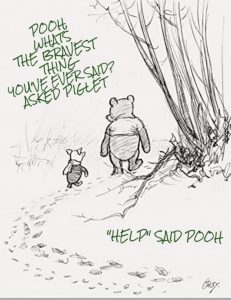
In the t.v. drama “New Amsterdam” whenever the new director of the hospital is introduced to someone, the first question that he asks is, “How can I help?”  It happens in the first episode about twenty times. This was a BIG a-ha moment for me.  What a powerful question!  How often have we wanted our students to ask for help?  How often have they refused when we have asked “Can I help you?”or “Do you need help?”  Unfortunately, asking for help is still seen as a weakness by many people.  However the question “How can I help?” turns it around so that the responsibility and focus is on the person offering assistance.  It is more difficult for someone to just say “No.” to this question.  It can help to create psychological safety in order to focus on what can be done to help rather than someone sitting in discomfort or shame because they won’t ask for help.  Sometimes just asking can make all the difference to someone when they are feeling overwhelmed, even if they decline the offer.  The four small words, “How can I help?” can make a powerful impact.  Sometimes, asking for help is the bravest thing you can do.

Attitude of Gratitude

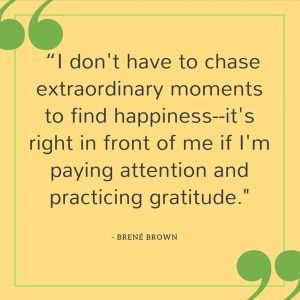
I don't have to chase extraordinary moments to find happiness -- it's right in front of me if I'm paying attention and practicing gratitude.

Many years ago I remember watching a gratitude themed Oprah episode.  There was a gratitude journal that the guest had developed and was relaying all of the benefits of writing down things that you were grateful for each day.  The power of suggestion (I’m a sucker for an impulse buy for self-improvement) lead me to the nearest Chapters to purchase one of those journals that weekend.  I certainly didn’t fill that journal. I think I lost interest in a couple of months because it felt as though I was writing the same thing over and over again.  I realize now that gratitude, like mindfulness and meditation, is a “practice.”

Gratitude practice is most effective when life is rough.  It sounds counterintuitive.  It is much easier to be grateful when things are going well right?  Easy to “count your blessings” when you are sitting on a beach in a resort in the Dominican Republic.  I personally feel the power of the gratitude practice when life isn’t going according to plan.  Though, I want to be clear here, there is a fine line between true gratitude practice and “looking on the bright side” or “finding the silver lining.”  That bright-side-silver-lining thinking can border on toxic positivity which isn’t helpful.

Gratitude practice means different things to different people.  For me, it is connected to daily journaling.  Each night since the fall I have been writing about my day in terms of gratitude before going to bed. Some nights I might write for 5 minutes.  Some nights I write for a half hour.  It might read something like, “I’m grateful that we got outside for a walk, that my son felt good about his essay after all of the struggles and tears, that we were able to eat a healthy meal, for Hello Fresh being delivered to my door and for the opportunity to reach out and connect to some new teachers through professional learning today.”  I try to reflect on the events of my day in terms of gratitude.  I could write in my journal that the technology in my professional learning session that day was glitchy, we got off to a rocky start trying to get everyone into the WebEx room, and there were links that didn’t work even though I had tested them twice. Instead, I choose to be grateful for the connection and discussion that I had with the teachers that day.  It isn’t that I ignore that bad things happen or think about how things can be improved, but ruminating on the bad things that happened during the day right before going to bed isn’t going to ensure much of a restful sleep.

In some of the professional learning opportunities that I have recently hosted with new teachers we have discussed the struggles of the current climate in the classroom.  It is important to have a safe place for teachers to voice those concerns and have someone listen with compassion and empathy and ask curious questions.  I will often say that there are many things that I can’t help them with, but that I am there to “embrace the suck” with them.   At the conclusion of those discussions my final question is always, “What is a recent personal or professional success that you’ve experienced that you would like to share with the group?”  This ends the discussion on a note of gratitude. It is SO easy to get caught up in venting and complaining about the situation in education right now. Teaching it is NOT an easy job on any given day but the difficulties have grown exponentially with the pressures that COVID has added.  So when we can take a moment to remember why we continue to go to work each day, why we got into the job in the first place and what our recent wins have been, I think it brings a feeling of hope.

Sometimes I practice gratitude in a less formal way that is more like mindfulness.  Recently while walking on a treed trail on a bright, sunny, winter day with my best friend, I stopped mid sentence and just looked around at the beauty.  I said to my friend, “I just had to take a minute to take this in.  We are so fortunate to be able to walk here.”  It only took a moment.  I don’t do that all of the time, we’d never get anywhere on our walks! However, remembering to do it every so often helps me to deal with stress and the bad things when they do happen.  If in the moment of a stressful situation I can take a moment to breathe and practice gratitude it sometimes keeps the emotions from escalating.  When conversing with someone who is frustrated and perhaps complaining or lashing out I try to remember that this person is doing the best they can at that moment and that each opportunity to interact with someone who is suffering is a chance to learn and I try to be grateful for that.  Author Andrea Owen in her book, “How to Stop Feeling Like Sh*t” would call it an AFOG-another flipping opportunity for growth.  When I remember to think about gratitude in a not so great moment, I might do it raised shoulders and through gritted teeth, but I keep trying.  It is, after all a practice.

“If the opposite of scarcity is enough, then practicing gratitude is how we acknowledge that there’s enough and that we’re enough.” -Brene Brown

Rejuvenation Through Creation

For me as a kid, there was no better feeling than opening up a new box of 64 Crayola crayons.  The big box with the flip top lid and the sharpener on the side.  I can remember agonizing over which colour to pick first and being so thrilled by the perfection of the colour palette in neat rows in that box.  I loved to draw and colour. I could do it for hours never lifting my attention from the page.  In adulthood, I abandoned doing art for pleasure.  It seemed silly for me to sit around and draw or paint for no real reason.  I felt I should be doing something productive.  A few years ago I began to create art again and realized how much I had missed it and how much joy it brought to my life. I create digital art now, which isn’t quite the same rush as opening a box of crayons but it is easier to share with others-like the picture above.  I have recently learned about the health and wellness benefits of creating. Creating is rejuvenating, it is rest and it is soul food.

Dan Tricarico, in his book “Sanctuaries: Self-Care Secrets for Stressed-Out Teachers”, he talks about how people get lost in an activity that you love so much that the rest of the world seems to fade away.  He calls it a state of “flow”.  I find myself getting into that state of flow when I draw, create music, write, cook or do jigsaw puzzles.  It isn’t that passive state of binge watching something on Netflix.  However, sometimes life’s answer is just that.  The state of flow is active and when I emerge from that state of flow, I feel rested and invigorated.  In Jessie Scholl’s article, “Go With the Flow: How States of Blissful Concentration Can Boost Your Overall Health and Well-Being” she states that, “Flow triggers the opposite of a fight-or-flight response.  Breathing becomes more relaxed, muscles loosen, and heart rate slows.  The specific biochemistry associated with flow varies depending on the activity, but the overall benefits to health and well-being are the same. ”  In fact, a 2018 Forbes article, “Here’s How Creativity Actually Improves Your Health” written by Ashley Stahl, claims that creativity increases happiness, reduces dementia, improves mental health, boosts your immune system and makes you smarter. Well, who doesn’t want all of those things?

You don’t have to be a professional musician, writer, artist or athlete to practice flow.  You can do it with any activity with some level of skill that requires you to pay attention.  It is really a type of active meditation.  Flow can be found with exercise, writing, dancing, baking, gardening, robotics or whatever activity brings you joy.

Don’t have the “time” for a creative pursuit?  It definitely requires some intentional effort to ensure that you take some time each day to pursue what you enjoy doing. It doesn’t have to be for hours but make it a specific small goal. In building anything into a routine or ritual, micro habits are key.  These are tiny steps towards implementation that grow into longer lasting habits. When I started creating art again, I just started with doing 5 minutes a day.  I just drew something.  I wasn’t worried about perfection or even completion.  I started getting lost in the flow and those minutes eventually became hours over time.  I continued to build my time until I created the habit to attempt to do something creative at least twice a week.  Beware of your inner perfectionism critic if you have one, like I do.  Give yourself some self compassion if you get out of the habit.  No one is keeping score and it is meant to be for you and your health and wellness.  When I get lost in stress and the life’s duties I often think, I should probably create something and get into that flow state-it has been a while.  Ultimately, I never regret taking that time away from the rush and hustle.

If your activity is just one more thing on your to-do list, it isn’t going to bring you joy and happiness.  In order for something to really feed your soul, it has to be something you value, something authentically you and something that you want to do because it brings you a sense of flow, peace, focus and energy.  Hopefully you will find something that gives you that “new box of crayons feeling,” whatever that means for you.

Tough emotional and right somehow

Tears.

I am pretty sure there were tears in the classroom. 
It wasn’t the first time and won’t be the last.
They were real. They were mine.

You know when you are in the middle of your classroom, midway into a lesson, and a thought hits? It was surreal to say the least as it happened on our first day back after another 6+ weeks of lockdown learning due to COVID 19. I was so proud of my students. Suddenly, thoughts of how hard they have worked through all of the ups and downs, changes, models, and separations that have been pieced into this school year.

Is it raining in here?

My students knew something was up because they all became really quiet. They are usually quite vociferous. Not that day. Perhaps the collective breath we had all been holding onto since Dec 18th was simlutaneously exhaled; we were in each other’s presence again. As often is the case, we were in the middle of a conversation about life. This one was about acts of kindness, and I shared a video from Thai Life called Unsung Hero.

The video tells the story of a person who does little acts of kindness for others, and how those simple gestures impact their lives. The narrator reads through the spot saying how the giver will not get anything in return, be richer or become famous. The only reward will come from witnessing the happiness in sharing simple acts of kindness.

It was at some point in the video when I thought about all of the grace and kindness of the students in my class, at my school, and around the world who have had their educational lives disrupted beyond anything in recent memory that could not be attributable to war or natural disasters. Where was their recognition for coping through all of this? I thought about the trust with which so many of the students whom I teach were able to transition to temporary education on-line, show up everyday, engage, continue to learn, and then at the flip of a switch show up for in person classes only having missed a few beats. In that moment I felt such appreciation for all that they have gone through this year all without complaint or disengagement. What kept them coming back with such positivity when there was so much uncertainty? 

I thought about all of the students who couldn’t return to in person learning as well. I thought of everyone who struggled and continues struggling to turn their cameras and microphones on everyday for virtual school. Whether it has been the result of inequitable access to technology and reliable WiFi, or that they could not stand to stare into a glass plate for 6 to 8 hours a day any longer. I thought of the students and teachers who are slipping through the cracks because they cannot hold on to emailed messages of “Your mental health matters”, “Stay strong”, “We are here to help”, and “We appreciate you” as their only safety harnesses while dangling over the edge of depression, frustration, and anxiety in the virtual classroom. 

I saw how brave my students have been to return with such positive attitudes, knowing that they would be cohorting, masking, sanitizing, listening to lessons muffled by masks and shields, eating lunch with 15 to 20 others at the same time, and trusting that the adults in their lives have made all of the right decisions on their behalf. I knew that these moments were happening in thousands of classrooms at the same time. It was in that moment, I could not help but be proud, humbled, inspired, and worried for them all at the same time. There were tears in my classroom that day.

Epilogue

What caused my brief waterworks could be chocked up to a mix of joy and exhaustion. Joy that we were back in the classroom together. Exhaustion because despite misinformation to the contrary, not only is syncronous learning online physically exhausting, but it comes with the added unjoyment of being mentally exhausting too. Teaching to 20+/- essentially (e)motionless emojis exacts everything of the educators who had to pivot to online learning during this round of lockdowns. Long term syncronous instruction online, in its current iteration, is unsustainable when it comes to the mental health of students and educators.

There has already been an incredible cost to all of this and that bill will need to be paid in full at the expense of the future. I am frightened that it will come at the expense of the social and emotional wellbeing of our communities. I fear what the default model of pandemic learning will do to us all if left in place. I fear it will not only serve as another social divide by widening disparities of equity, opportunity, and privilege, but as a wedge into the longterm wellbeing of families, our youth, and those who teach them. 


No Tired, Like Online Covid Teaching Tired – Rest, Sleep, Restore

ETFO’s position on in-person learning remains unchanged. The union firmly believes that the daily, in-person model of instruction and support best meets the educational, developmental and social needs of students, provides the best experience for support, and is the most equitable learning model for all students. ETFO’s expectation is that elementary virtual learning in any capacity, including through hybrid models of instruction, will end once the pandemic ends.

It’s been 6 weeks since I started teaching synchronously online and it’s draining me. Before the winter break, I was teaching synchronously online and in class. As a few of my students are solely online, I tried to make them feel included in all our lessons. Being physically in school gave me the opportunity to interact with people, from a distance. I enjoyed my days teaching physically present in school.

But teaching online all day is different. Interacting all day in a virtual class forum drains me.

Teaching online is also lonely. Yes, I get to spend my day talking to students through my online meeting platform. But in this lockdown, I am isolated as my partner is often away working for the Red Cross. It’s just me and my 19-year-old cat, Whitney.

When I was teaching in class, I had a chance to go for a walk, stretch my legs, visit with colleagues (via social distancing) and get outside during my recess duty. While teaching solely online, I am stuck in my home office at my desk.

For me, teaching is more than just explaining and guiding via lessons. Teaching is all about reading how students are feeling about their work and figuring out how to help them understand content and the ideas within the content. When I teach exclusively online, I feel blind as I cannot use my senses to read students’ moods and body language. This means I need to focus solely on students voices and asking questions to promote clarifications within students’ work.

One day, it was particularly challenging as I was dealing with a student who was having challenges attending online. I dealt with constant interruptions while teaching. I told the student that I would help them separately on a one-on-one basis. Their mother was also calling me on my cell phone about this student’s behaviour/mood. I heard the student state that “My mom wants to talk to you right now!” I informed the student that I would help them later and that I would call their mother after school was over. When I did go to help the student, they had left the online meeting. Mom did not pick up when I called.

I usually have a solid attention span, but this situation threw me off. While teaching about the surface area of 3D solids, I made a mistake forgetting that the formula for the area of a triangle is base times height divided by two. It was embarrassing but I turned it into a learning opportunity by explaining that I learned about math by making many mistakes.

I find being online all the time, exhausting. It’s pushed me towards burn out were I sit wanting to do nothing. I am also dealing with ongoing insomnia. My mood is leaning towards more being cranky than experiencing anxiety.

Being online sucks my “social” energy until it is gone.

As I try to write about issues that are informative and helpful to teachers, I’ve included some things that I’ve found helpful being isolated during this lockdown.

Acknowledge Yourself

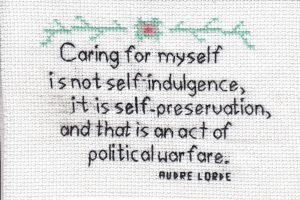
Taking steps to care for yourself is not a selfish act as it is critical to your happiness and wellbeing. Without self care and setting limits with work, your physical and mental health will be impacted. Your effectiveness in your work will deteriorate. Work less to be more effective.

Restore Yourself

Image

Take time to do something you love.

This could be taking up a hobby you’ve  done in the past or reading books you’ve wanted to read. I’ve learned if I work too much, I become less effective. Taking time to restore myself with non work activities makes me more effective as a teacher in my practice. My hobby? I’ve returned to my cross-stitch, focusing on making “Really Cross Stitch” by @haleykscissors which has been fun and cathartic!

Calling Friends and Colleagues

Talking to friends and colleagues connects me to others and gives me joy to hear their voices. I have not seen some of my friends and colleagues, face-to-face, in over a year now. I miss the regular collegial conversations we once had at work. Reaching out to others also supports them in this time of isolation. It keeps us connected, even though we are apart.

Sleep Hygiene

Getting to sleep is an ongoing issue for me. Waking up is worse as I feel like “molasses flowing in February.”

When I am overworked, I find it hard to relax enough to fall asleep. Being relaxed before sleep means sleep comes quicker. I takes steps to make sure that I do not take any stimulants past 1 pm, drinking only decaffeinated teas at night. I even refrain from chocolate.

My need to fall asleep challenges me as my partner virtually falls asleep as soon as his head hits the pillow. I end up listening to him and my cat softly snore while I toss and turn, flipping like a fish in bed. The worse thing I can do is look at the clock, noting how long it has taken me to get to sleep. Some nights one, two, and three hours pass before sleep finds me.

When reading up on how to get a better sleep, I’ve found some tips that might promote sleep and establish an improved sleep hygiene :

  • Go to sleep and wake up at the same time every day (even on weekends!)
  • Set an alarm to go to bed, as well as to wake up
  • Take a bath with bath salts
  • Hydrate with warm caffeine-free drinks
  • Skip alcohol before bed
  • Try to let go of your daily “drama” related to work and/or family
  • Big one for me – stay off social media (I’m known for my late-night Twitter posts)

Readers, if you have any other tips to pass on, please note them in the comment section.

Wishing you more rest, sleep, & restoration,

Collaboratively Yours,

Deborah Weston, PhD

Occasional Teaching Online (part 2 of 3): My Challenges

I will never forget my first supply day for virtual learning. Even though I am early into my teaching career, I believe this experience has changed the way I will reflect on my teaching practice for years to come – dare I say forever?

As I logged onto my first Google Meet with no idea who was greeting me on the other side, so many things raced through my mind and my heart felt like it was going to beat out of my chest. Nerves. Excitement. Fear. 

In my last post I reflected on my realization of the power of connection and children’s drive for relationships. As I continue to venture on with positivity and optimism, I cannot ignore the raw emotions I have felt, the challenges I have faced and the questions I have unanswered. 


“I don’t know”. 


In my personal and professional life this year, “I don’t know” has been part of my daily conversations with colleagues, friends and family. Last year, saying this out loud would have felt like admitting defeat, accepting failure even. As the uncertainty and the unknown continues, we are being forced to live in a world of “I don’t know”. The challenge is constantly turning the “don’t know” into “let’s try” with a smile on our faces. Of course we want to support our students, their families, and our communities. Of course we want to embrace change, challenge, and even failure. But, the reality is, we are navigating this new path in which there are no correct answers, there is no manual, and there are no instructions.  

Openly admitting what I don’t know feels uncomfortable and scary. But discomfort is required for growth and change. I share my challenges with you as a means of connection. Maybe you don’t know either – and that is okay. Additionally, admitting the unknown provides opportunities to gain insight from those who may know, those who have ideas and those who can say “I have been there, and I know how hard it can be”. 

As an OT I have felt it challenging at times to engage with students who are not turning on their microphone or camera, for whatever reason. I want to get to know them but am also mindful how vulnerable they may feel turning on their video to chat with a complete stranger. How are you supporting student engagement and providing a safe space for all? 

How are you supporting students with special needs, learning challenges and students who are working with limited resources? I once taught in a class where one of the students did not have paper or pencils. 

How are you supporting students through technical difficulties or navigating new online platforms? I have been doing a lot of screen sharing. I often share my own screen and/or ask students to share their screen if they are comfortable. I am finding this method to be extremely time consuming. Although sometimes necessary, it can also be very distracting. When students share their screen, it puts the issue they are having on display for the whole group to see. This can be helpful if someone knows how to solve the problem, or harmful under certain circumstances and can intensify feelings of helplessness for some students. 


*Holds breath* 

No correct answers.

No manual. 

No instructions. 

*Exhales*


There is beauty in this.

It may be hidden or the view may be obstructed right now. But it is there. Together with our students and our colleagues, we are the creators, we are the inventors, we are the pioneers.