Introducing Coding without Robots

A few years ago when I started hearing about teachers doing coding and robotics in the classroom I dismissed it as a fad.  I didn’t understand the value of coding nor could I see how it tied to the curriculum.  However, I recognize as a professional learner my initial reaction to something radically new can sometimes be resistance.  I think that this is because I can’t see myself fitting “one more thing” into my classroom practice. I always have to give myself time to process, research, find the value and then finally accept it.  After I have tried a new practice with students and see the beneficial outcomes, I endorse it and then begin to share it widely with colleagues.

When I began the journey with coding and looked at code.org I tried it on my own and admittedly, understood very little. I went to more workshops and conferences but avoided the coding and robotics thinking that it just wasn’t my bag.  Then I had a colleague that dragged me in to the world of coding and robotics.  We worked together.  I’ve since become convinced that we need to teach all students how to code.  I have also figured out that you don’t need any robots to do it.  In fact, when you start-you don’t even need a computer.

coding 4         coding 2


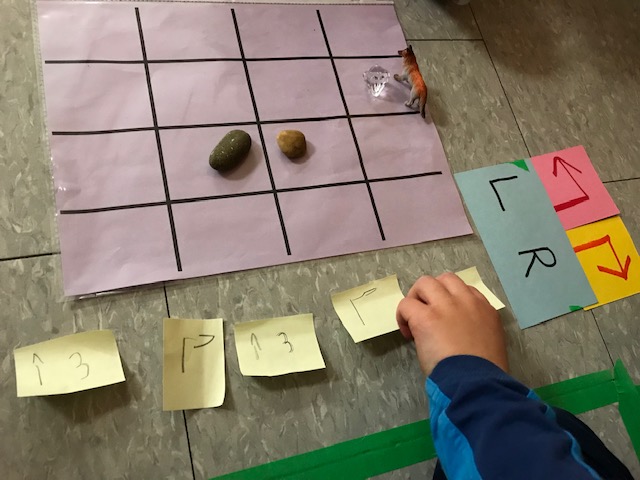
The above picture is a coding game that I used recently with a grade one and two class.  Students placed their obstacles (rocks) on a grid.  They placed their “gemstone” or finish on a spot on the board and their “robot” (animal)  on another spot.  They wrote their code on a sticky note using arrows and then had their partner take their robot through the code to test it for “bugs”.  A big part of coding is knowing your left from your right and being able to write instructions that someone else can follow.  We started out the day coding one another to walk in a square using only: “forward” “turn left” and “turn right”.  It was amazing to see how much problem solving took place.  They were using positional language, procedural writing, clear communication, visualization and proportional reasoning.  Their thinking was exploding! The students were engaged in the learning and well on their way to being able to code something online.  From there we explored the Scratch Jr. app.  After a short look together at what the different “buttons/blocks” meant they were able to code independently.  As teachers we sometimes get bogged down in the fact that we don’t have the money to purchase the technology and shy away from trying things based on the fact that we don’t have “the stuff”.  However, laying the groundwork before introducing the technology piece to students is key.  We need to always consider the pedagogy before the technology.


Creative Confidence

Lately, I’ve been thinking a lot about the concept of creative confidence. At its core it’s about believing in your ideas and that you hold the ability to have a positive impact on the world.

I share with people all the time that I’m always amazed by kindergarten students. Whenever faced with a challenge, they somehow jump right in and offer solutions that they truly believe will work. They eagerly share solutions to everyday challenges without censoring themselves or second-guessing their ability to actually be a part of a change for the better. But what happens with these eager students as they move into higher grades? At what point do they start to censor themselves and display that creative confidence in a muted way? I’ve had students as young as those in grades 4 and 5 who no longer believed in their ideas and genuinely didn’t know what steps to take in order to solve a problem “in the right way”. How did they get there? How do we get them back? I wonder if the following elements that exist in Kindergarten classrooms might be key in answering these questions.

Play

If I haven’t mentioned it before, I have the two most amazing nephews in the entire world! I genuinely love watching them play. Sometimes in role as others or even just as themselves, they interact and problem solve on the fly. Issues come up when the other character doesn’t quite respond in the way one expects and they have to come up with a solution so that the game or activity continues. There’s the freedom to play anything and to try anything. The idea that you have to be good at playing just doesn’t exist. They just do it at home and at school. I wonder if we adopted the same idea for older students as they entered the classroom, what might the learning be like? What if tools were given and they were asked to interact with them in a way similar to play? What if there was no association with being good at something but the idea of just jumping in and trying it was valued. Would students engage more and worry less about the outcome? Would they embrace failure and try again, ultimately learning as they try again? How would our classrooms be different if this concept or idea was valued well after kindergarten?

Design

Kindergarten students are forever designing something for someone or something. They build homes for their figurines with blocks and use craft materials to build homes for animals. They also draw pictures to bring a smile to a loved-one’s face and some use tech to create. How might we keep this going as they age? It’s no secret that I’m going to say…dig deep into Design Thinking! It’s a creative framework that can be used in any discipline to allow students to hone their creativity as they work towards creating unique and innovative solutions for real-world problems. Consider the learning goals that you are working towards, connect them to a real-world problem and let students engage in the process. The more that they see themselves as creators of meaningful change in the world, the greater their creative confidence will be!  

Interdisciplinary Learning

I can’t help but be inspired by the interdisciplinary learning that happens in kindergarten. This reminds me of the learning that happens as adults. I joke that I don’t just do Math between 10:30 and 11:30 and often wonder why this is the case for our students. What if we were able to integrate subjects? What if students saw connections between the work that they were doing in Language and in Math? Or Social Studies and Science? Would they learn more easily learn the transferability of skills? I know that it’s a challenge when we have a specific number of minutes or hours of a specific course that have to be completed and even more so in Secondary Schools where subjects are taught by specialists. In what ways might we make a shift so that learning isn’t so siloed? I don’t have an answer but I wonder if when students see the connections between subjects, if they might just become more excited about approaching something new because they realize that they have a tool-kit from a variety of subject areas that can be meshed together to them as they go.

I’m working on my own creative confidence by playing more, designing new things at Future Design School and thinking about how I might be able to help others with interdisciplinary planning and learning for students. I’ll keep you posted on how things go!

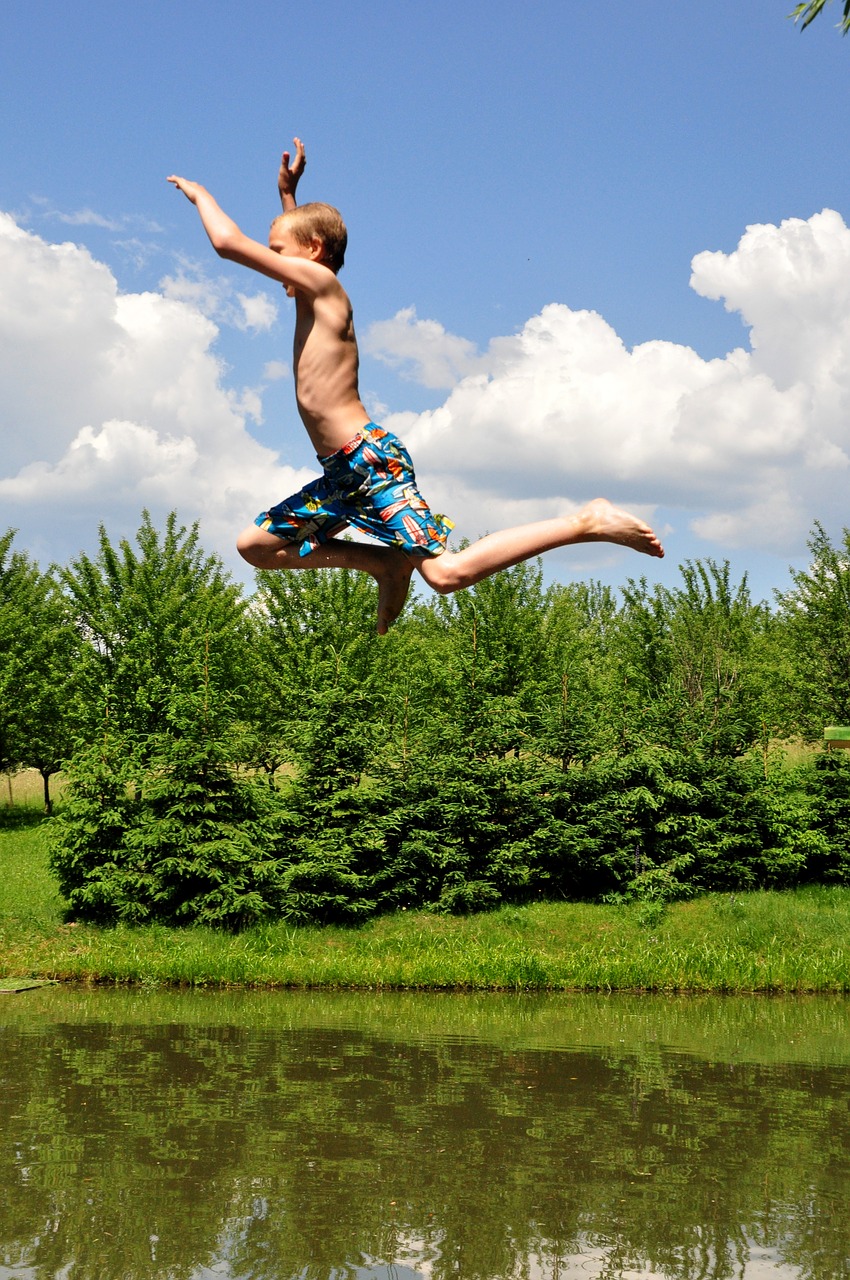
Both feet

https://pixabay.com/en/summer-swim-pond-landscape-austria-2209393/

Have you ever jumped into a body of water and been able to stop part way? If you have, can you show me how because to this point of my existence it has been impossible when I try? So far.

Defying all of the laws of Physics may not part of our human skillsets, yet. Perhaps with the aid of some bungee cords and a team of riggers, it is possible, but since most times when we take a leap(intellectual or otherwise), we do so without a team to save us.

Oddly enough, the leaps are often contrary to conventional wisdom and traditional thinking/practice. Society loves its non-conformists. As long as there are not non-comforming in their schools. Is it therefore heresy, innovation, boredom with the status quo, egotism, creativity in action, insight or indictment to break the status quo, take chances, or challenge authority/colleagues? Where does it fit in with your practice and pedagogy?

With or without a safety crew, I have always jumped into something with both feet. Knowing there is no way to stop once I’m in the air. Yes, I’ve climbed out and jumped somewhere else when the landing hurt. No, I did not land on anyone either.

Sometimes, I bounced out, unable to fit in with a particular ideology or methodology. What never changes as I try and stretch, and a leap and fall, and land/crash, is the need to keep looking for new places from which to jump with all the excitement and uncertainty that leaping, change and learning provide. A sort of educational thrill seeking if you will.

This is how I see my teaching style and I’m inviting other educators to step out onto the dock and take some leaps of their own. So often, the risk taker in all of us has been hushed by comfort, complacency, or fear. Trying new things is hard. What if no one likes it? What if I fail? How are your students supposed to take chances when you are clothed in bubble wrap yourself.

Our classrooms have to be shaped into an ultra-soft space for students to take their intellectual and emotional leaps with both feet without worrying about the landing or bouncing off the walls from time to time. It doesn’t mean they don’t feel a thud once in a while. It means that they will have a place to discover the limitless potential of their learning not the limit.

How do you see yours? When was the last time you felt free and safe enough to jump in with both feet not knowing how deep the waters?

How did  it feel?
Dangerous? Perhaps.
Exhillarating? Always.
Always successful? Not yet.
Staying put? Never!

We owe it to our students to show how much there is to gain from trying new things, taking leaps into new spaces, and from thinking about how, when, and where we are going to land.

Over the next month, I challenge you to try something new in your classroom and share it with us.
Tag me on Twitter @willgourley and try to encourage others to do the same. Thank you for reading and happy landings.

 Extra Reading for keeners

16 Reasons Why You Should get out of Your Comfort Zone

Why Taking Risks Pays off for Students and Teachers

Mindful Pause, with or without Technology?

Everywhere I turn I see the effects of our technologically advanced world. Gains have been made in medical research, communication abilities, and advancements toward an easier life?
Some of the effects on individuals are now coming to light. Many people are connected to the internet 24/7. This is causing sleep disturbances, eye issues, addiction behaviours, and other physical ailments.

As a previous mental health professional I look at my present vocation in Education with that type of lens. I have practiced and taught Mindful strategies for many years now. I see the benefits of technology in the curriculum. I also observe the negative effects. I have noticed some educators looking for a researched solution to help calm, focus and ground their students. Some are now turning to all the apps, and internet connections to provide a quick and easily guided mindful activity. I think this may be counter productive to being present and in the moment. We are seeing the effects of this new age world and the fast pace it is changing. As educators we are up to date with the many changes or apprised to avenues in which to guide our charges.

When I guide a group through a mindful experience I eliminate as much technology or other electrical sources as possible. I then guide students into focusing on being present in their own body and mind through the use of many verbal scripts vocalized in a relaxed, quiet voice. These moments of taking a pause are valuable. We live in a busy, stressful society where a pause can assist in a healthy balance to our daily lives.

Links-
https://www.psychguides.com/guides/computerinternet-addiction-symptoms-causes-and-effects/

https://www.psychologytoday.com/us/blog/virtual-addictions/201710/tips-mindful-technology-use

http://meditationscience.weebly.com/what-is-mindfulness-meditation.html

Mindfulness Meditation: Guided Practices

Education Acronyms

PLC, IEP, TPA,…. Just a few acronyms in the world of Ontario education. I managed to complete the expectations of those three letter words, this month.

WOW! Some may say, “What are you talking about?”, others may say,” HOW?!”

As a person who is a futuristic thinker, I am continuously planning, creating lists and maximizing my energy.  I plan each weekend to complete a portion of the upcoming expectations for the month. This past month, I spent time creating unit plans to ensure a smooth sail through the four Junior and intermediate Math classes I teach.  While knowing that IEP’s (Individual Education Plans), are due in early October and help me understand my students. I reviewed and updated these a few at a time.

Yes of course this is my TPA (Teacher Performance Appraisal) year. Things have changed since I graduated from Teachers College.  I was just as nervous as my first evaluation.  This one was much different because I have learned many new teaching strategies, and ways to interact with all the people we come in contact within our profession.  I look at each year with a lens of the time. October, pumpkins are in season.  Pumpkins are a great way to create a hands on unit in Math for all grades. If you are still learning about making the many connections to the Big Ideas, there are many units on the web.  This is a perfect topic to bring excitement into the class, being aware of all the variables from cleanliness, to the use of sharp objects, and social skill development for group work.  This TPA in my umpteenth year of teaching was successful. After I reviewed my assessment, I realized some things still need work.  I need to clearly connect to daily learning goals to guide the directions of my students and their exploration. I also want to find a way to create easily displayed information charts/word walls that can travel from class to class? Keeping abreast of recent research and data helps.  A specific focus is important  so ideas don’t become lost in the many theories of our closely connected world (www).

This year I’ve noticed my board is using Monthly meetings and PD (Professional Development) days to facilitate PLC’s (Professional Learning Communities).  To my advantage, our focus is on math.  The discussion and connections for all help create a purposeful direction in our teaching and learning.  The superintendents and lead teachers carefully create PD to learn from and directly effect board and school goals. As a team, we have each other to support our teaching and direction.  If communication is continuously supported in meetings, this assists in sharing and supporting each other and the growth of our students and programs. Some of my observations from these meetings are: Don’t get rid of the old…some strategies are still good. Things are changing quickly. It’s admirable to see colleagues rise to new and connected positions while keeping valuable connections.

At the beginning of the month, I was apprehensive about completing these monthly tasks.  Tah Dah…another successful month as an educator.

Links:

Learning for All: http://www.edu.gov.on.ca/eng/general/elemsec/speced/LearningforAll2013.pdf

Planning for Learning: 

http://www.etfo.ca/SupportingMembers/Resources/ForTeachersDocuments/Planning%20for%20Student%20Learning.pdf

TPA: http://www.edu.gov.on.ca/eng/teacher/pdfs/TPA_Manual_English_september2010l.pdffbclid=IwAR3rtRjDQ50iFr81Lb45e9SXuzhXJebIzEdjFhzqIFTNqtvnw_IMaGV-V3kspecific links

http://www.etfo.ca/SupportingMembers/Professionals/Pages/ALP.aspx

Pumpkin Unit Ideas:

Ultimate Collection of Pumpkin Math Ideas for K-12

New Year, New Role

Education has always had a huge place in my heart. On several occasions, my mom has recounted stories of me teaching my stuffed animals as a young child. This was even before my starting school and getting a taste of what being a part of the education system would be like. Although my path to the big question of what I want to be when I grow up – by the way, I’m still figuring that all out – veered in different directions, I find myself today in a place that I am truly enjoying within education.

A couple of years ago, I remember being asked the question of what I would do next in education and I always thought that I would never leave the classroom. I was excited to work with students on a daily basis. Discovery and laughter were two things that I could guarantee would happen daily. Over the past 9 years, my students have been the one thing that motivated me to become a better educator. Not merely for the sake of saying that I am a good educator but with a desire to take the time to grow in order to better meet the needs of the students that I had the privilege of serving. Never in a million years did I think that when presented with an opportunity to try something new, that I would start to consider it.

This past June I decided to take a leave and a leap with an amazing team at Future Design School. In August, I started my new role as an Education Lead and it’s been an amazing experience. Having the opportunity to work with educators across North America on creating exceptional learning experiences for students that empowers them to develop Future-Ready skills, is truly powerful.

So far in my new role, I’ve learned 3 things:

  • Enjoy the new learning
  • Learners are learners, whether they are children or adults
  • Take time to reflect

Enjoy The New Learning

I think this is the first time that I’ve taken such a big leap and jumped into something totally new. In the process of supporting educators in a variety of ways, I myself find it fulfilling to also be on my own journey of education on many levels. I love that there is always something new to uncover and that I have an opportunity to be apart of something fantastic that I too get to have an opportunity to help grow. I’m inspired daily to be part of a team who is passionate about transforming education and willing to share what they know with others. While I have worked with students around Design Thinking in the past, I’m understanding on a deeper level the “why” and reason for so much of the process. It’s amazing, the more I learn, the more I discover how much more growth there is to experience.

Learners Are Learners, Whether They Are Children Or Adults

I’m learning that scaffolding of any new learning is important for children AND adults. I know that this should be a simple concept for me to have realized a while ago but it has now become very clear. The definition of learning – the acquisition of knowledge or skills through experience, study, or by being taught – remains the same no matter the age of the individual. Being clear and explicit doesn’t change because of age. Nor does involving the learner in the learning change simply because of the demographic. Adults enjoy getting up in sessions and having the opportunity to talk through ideas with others. They love sharing their thoughts and experiences when designing learning experiences for their students. As educators we’re moving away from being the “sage on the stage” to the “guide on the side” and the same holds true when working with adults. I’m still learning about working with adult learners and know that best practices in the classroom are also keys to that work.

Take Time To Reflect

I think that I have always been a reflective person but I’m making the time to journal and reflect on my experiences even more. As a kinetic learner, I know that I learn best by actively doing, succeeding or failing and having opportunities to reflect, ask questions of others, and trying again. One thing that I am going to be working on this year is not being afraid of asking questions. I’m pretty confident in asking when I don’t understand something, however, I know that there are times when I am unsure and during these moments I’m a little more hesitant and sometimes like to figure things out. My goal this year is to learn as much as I can and I know that this requires that I be reflective and vulnerable in asking questions.

It’s a new year and a new role for me and I am really embracing it. Are you in a new role this year? If so, I would love to hear what you have been up to and your thoughts around starting something new. What prompted the change? What are your learning? Don’t be left out if you’re not in a brand new role, there’s always an opportunity to experience something new in education. Let’s start a conversation as we work towards growing as educators.

Building blocks

This post is a follow up to Building upon balance. It also has a companion post titled Wyoming 1971 if you want a trip back in time that adds more context to my thinking.

In the 1980’s, if you wanted to attend a university program you needed to complete a 5 year high school school diploma. Grade 13. The big one. It was a make or break year for any and all of us with aspirations of a white collar middle-class jobs whether they be Engineering, Medicine, Law or Finance. That was it. There were no other jobs(sigh).

Grade 13 meant you could choose some of your courses. Some. You still had to take English and at least one Math course. I chose the easiest one, Functions and Relations, or so I thought. By mid-term I was on my way to a failing grade(60%) with poor results at every turn. I wondered why it wasn’t clicking? I had an 85% in Grade 12 Math so a decent mark should not have been out of the question. My teacher was good enough most days, my effort was only questionable some days, but scraping by was not going to get me into university. I ended up with a 51%.

I wondered why things had not come together? Then I realized that my grade 12 Math class had been nearly a year before. My school was on the semester system, and that meant if you took Math in Term 1, you might not be taking it again until a year later. At the bare minimum if I do the Math right, it meant 8 months of not keeping previously acquired skills sharpened if your course ended in January. I limped through the course, somehow graduated, went to university, and got kicked out 3 years later for academic underperformance. Could not practicing Math on a more frequent basis have contributed to my lacklustre results?

Like so many people I was mad at Math. I wasn’t good at it(cop out). I didn’t have a Math brain to solve for x or any other letters of the alphabet for that matter(fixed mindset). I used my Math skills for bargains, business, and family budgets(with a calculator). I did not take another Math class until 20 years later in teachers college. I rediscovered my love for Math after many hours of review and practice problems because I saw it not as problems and symbols on a page, but as a challenge and chance to be a problem solver. It was like working out for the first time and instead of my body waving the surrender flag, it was my brain most of the time. After a number of months, some, but not all of the concepts were returning. However, I had lost a lot of form and vocabulary. To put it another way, the blocks of my foundation were in bad shape and in need of a rebuild(still working on it).

A few years into the future I stood in front of my first Math class as a teacher. To no one’s surprise, the first few weeks were like peddling a bike with square wheels. It took a while to wear down the edges in order to build momentum. The students needed time to build up their brain muscles too. It had been nearly 3 months since their last Math lesson and although the blocks were formed, they were no longer as firmly fixed to their foundations for the time being. It was like a knowlege hemorrhage had happened over the summer. This made me wonder whether I could change the way Math and other subjects could be taught to reduce this from happening each year?

The following September, it became clear that there was some evidence supporting my observation that students were losing their academic edges over the summer break. I wanted to find out whether any academic studies were considerate of this and if there were ways to slow it down or stop it. In a study from 2016 titled Summer Math Loss, this occured much more frequently as a result of socio-economic factors, but that was not the issue at my school which by and large did not mirror the demographics mentioned in the article. However, the Harvard Study provided a practical solution that would help regardless of socio-economic status. Simply, share a little bedtime Math along with that last story of the night. From experience, I can say that a little Math conversation can go a long way. It could be a matter of planning a family fun day or saving for a new toy. It could also happen earlier in the day while driving somewhere by playing license plate Math. Whatever time of day it happened would add some rock solid reinforcement about remainders, ratios, and everyday numeracy. The article goes on to share 4 ways to overcome a “summer slump” that could be easily applied in all seasons.

If it can be done at home, then it can definitely be done in the classroom over the 10 months of learning each year. Teachers can now work at threading or interleaving concepts throughout the entire school year. When we shift from the teach, test, and move on model of instruction to the teach, apply, connect, assess, and revisit model our students’ abilities to acquire, apply and retain concepts will improve. I see the value in doing whatever it takes to help my learners succeed. On one hand a longer school day or year may be the answer. For others, it may still come in the form of more worksheets(please no). There is also the spiralled or interleaved approach that constructs the foundations of understanding block by block the whole school year long.

We have 9 months of incredible opportunities ahead of us. I hope you are already seeing the hard work you are pouring into your classrooms paying off and that the foundations are being strengthened for a growth filled year to come.

Note:

I started this post with the intention of arguing about why we need a more balanced school year because our students are not retaining what they have learned. I softened my stance after reading a few papers in the research(some are linked above). I wanted to share my experiences of losing my own skills when they went unused over time. It ended up as a reflection and a call to action, not to tear down the walls, but to strengthen them around our students as often as possible.

I hope you enjoyed reading this post. Please consider sharing it with others and commenting to keep the conversations going strong. Thank you.



Tools and Resources for Math Talks

One of the reasons that I spent so many years teaching the primary grades is that teaching math to older students terrified me.  Growing up I struggled with math.  I changed schools in the middle of my grade three year and missed a great deal of multiplication and division instruction which haunted me for the rest of my math learning.  I remember crying at the kitchen table over my homework and my father being distraught over not being able to help me.  I totally understand how a student feels when they shutdown and “can’t” get it.  That understanding along with having excellent tools and resources helped me immensely when I taught grade 4 and 5 mathematics.

Math Growth Mindset

Jo Boaler is a professor of mathematics education at Stanford University and the co-founder and faculty director of youcubed.  This fabulous website provides unique, research based instructional approaches to teaching math.  There are videos for students of different age ranges and the “Week of Inspirational Math” was what helped me to create a positive math learning environment with a growth mindset in my Junior grade classroom.  It doesn’t have to be the first week either-you can do it at any point.  Jo Boaler has also co-written a series of mathematics instructional resources called “Mindset Mathematics” for each of the junior grades.

Math Talks

Number Talks: Whole Number Computation, Gr K-5: A Multimedia Professional Learning Resource became my go-to resource when I began daily number talks with primary students and it made the transition to teaching math in the junior grades much easier.  The format of math discussion remains essentially the same no matter what grade level.  It is an expensive resource but well worth it.  If you want to give math talks a try there are some more affordable online resources that you can use as well.

Math for Love is a website that provides a number of online math talks for K-5.  EduGains gives a brief synopsis of how to develop your math learning community in your classroom.  Another great online resource for daily math talks is Which One Doesn’t Belong?  This website provides all sorts of pictures for math discussion. Eventually my students began creating pictures for other classes to use for their math talks after using the examples on the website. Math Talk Resources is a comprehensive spot for math talk information and connects you to many different math talk resource websites.

When students have the opportunity to discuss math and hear fellow student’s different perspectives, they begin to see their own entry point into every math problem.  They also begin to see the value of challenging each other’s ideas respectfully and adding to one another’s ideas. “What do you see and what do you wonder?” is a much friendlier way to open up math discussion than, “Who can give me the answer?” I am convinced that because my students engaged in respectful math talks they were able to transfer these skills into other discussion topics in our classroom.  For me, the anxious math teacher, math talks became the highlight of our daily math lessons and sometimes, the highlight of my day.


School year start up

Well we are already four weeks in and hopefully it has been a great start of the school year for everyone. I am now teaching a grade eight class, teaching math, science, history/geography, language, art and drama. I was overwhelmed at first thinking about all of the subjects I would be responsible for but I have such an amazing grade team so I am truly thankful for all of their support and activities that have been shared.

September is an important month to get to know your students for not only their likes and dislikes but just honestly, do they enjoy school? Every student has their ideas of teachers, rules, subjects, reading, the list goes on and on. Just listening to them talk to other students during class teaches you so much about their interests and about how they have been affected by various things in their past school years. By grade eight students either LOVE or HATE being in a school. I am now faced with the task of continuing to develop that love or trying hard to turn around the hate.

I have been looking at new apps, reading exciting activities for my class to try, looking at fun trips, trying to think of new clubs/teams and I am hoping that I will engage some students who have been disinterested in the past. It is definitely a year long task to try to engage and involve all students so I hope to continue on that journey each day.

On a personal note, as teachers we often feel many emotions at the end of each day. There are questions we ask ourselves and things we always wonder. The one I have been asking myself a lot lately is, “Did I get to everyone?” I feel that is the hardest thing to go home with at the end of each day. That is why I am trying this year to make a few notes on who to go to first the next day and then actually following up on those plans. I am fortunate to finish early at the end of my school day so I can finish all my school work around 3:30/4:00 pm. That gives me roughly six hours of “me” time! That time is so important for our mental health and it is something I am also hoping to focus on this year. Shopping. stair climbing, doing the laundry, making a fun dinner, watching an episode of my favourite show…just a few examples of things I can do each night to stay positive and enjoy each day to the fullest.

I am hoping to talk to my students tomorrow about how to use our after school time wisely to better ourselves and to really add to our day. Our day isn’t over after school and we should really do our best to enjoy the time we have to keep ourselves positive and to make the most of our day.

These are just a few things I have thought about as summer ended and our school year begins. These four works have not been the easiest as being permanent now full time in a very different setting has made me think differently but I am staying positive and really reflecting on the good at the end of each day and looking forward to working on new things the next day.

I am looking forward to posting every few weeks about exciting ideas that occur in my class as well as all the ways I am staying positive and making the most of each day!


My Yearly Notebook

Each summer I buy a brand new spiral bound notebook.  Not the skinny ones that you get in the 3 pack from Hilroy with the flimsy cover that rips within a few uses. I am particular about my stationary.  It may be a kind of a problem.  I get the 8 1/2 by 11 solid cardboard spiral bound notebook.  It is where I keep my lists.  Lists of things to buy for the classroom.  Lists of things I want to change in the physical space of my classroom.  Lists of books I’d like to read or add to my classroom library.  Lists of things to get done before September.  Lists of the curriculum topics I’ll be teaching and in what months I plan to teach them.  Lists of special events each month that I might highlight or celebrate with my students.  Lists…of lists.  I use that big notebook all school year long to add notes from meetings, professional development sessions and of course, more lists.  I have many already filled spiral notebooks of new ideas that I’d like to try over the school year on my shelf in my office.  This summer I realized something.  After the school year is over I have NEVER opened those notebooks again.  There are lots of great ideas in there that I didn’t implement and then I feel guilty about that!  Teacher guilt never seems to stop, unless of course, I choose to stop it.

This summer I quickly read the book, “Ditch That Textbook; Free Your Teaching and Revolutionize Your Classroom” by Matt Miller. It has fantastic teaching tips for technology integration in the classroom.  Although I do not have the desire nor the access to the 1:1 technology to go completely paperless, I found a lot of wisdom and great teaching tools in Matt’s book.  I have also provided a link to Matt’s blog.  Matt helped me to break a cycle.  I haven’t bought a spiral bound notebook this summer and I’m not planning on buying one.  Among many pieces of advice in the book, Matt suggests picking two new things that you are really excited about to add to your teaching practice, being clear about your intention for using those practices and following through.  I’ve been guilty of overdoing the professional learning to the point that I overwhelm my students by doing a whole bunch of new things all at once and then don’t end up sticking to any of them.  I also get overwhelmed by the many great ideas out there and wonder if I do something else, what I’ll have to give up doing.

I’ll admit that I’m already kind of cheating.  Instead of just choosing two teaching practices I’m also choosing two new technology platforms to learn about for next year.  One of the practices that I would like to get in the habit of doing is adding more descriptive feedback to assignments that students do online and have multiple opportunities for the students to respond to that feedback and re-submit assignments with changes.  The second thing that I would like to do is educate parents on how to leave constructive feedback for their students online rather than a thumbs up or “Good job!”  I plan on exploring the video and audio creation tools, WeVideo and Voki.  I may explore more than these but these are the ones that I am committed to doing.  Since I have written my commitment here on the blog, I also commit to sharing what I thought about those tools in a review format.  If you get a chance to read Ditch That Textbook, I highly recommend it. It is a quick read with great already-made lists and hey, it made me “Ditch That Notebook”.