Daring Classrooms

I state the obvious when I say that teaching is a demanding job.  If you are reading this, you are most likely a teacher and this is not news to you.  I’d like to highlight a resource that feeds the soul of a teacher (and quite frankly a human being) while also providing some strategies for integrating that soul feeding into your classroom practice for your students.  Wait, what…that exists?  It is a website from Brene Brown called Daring Classrooms.  If you haven’t heard of her yet, you can find “The Call to Courage” on Netflix and/or her Ted Talk on Vulnerability.  She is inspirational in leadership, in life and in work.  Here is a snippet from her #DaringClassrooms website:

“Teachers are some of our most important leaders. We know that we can’t always ask our students to take off the armor at home, or even on their way to school, because their emotional and physical safety may require self-protection.

But what we can do, and what we are ethically called to do as teachers, is create a space in our schools and classrooms where all students can walk in and, for that day or hour, take off the crushing weight of their armor, hang it on a rack, and open their heart to truly being seen.

Teachers are the guardians of spaces that allow students to breathe and be curious and explore the world and be who they are without suffocation. Students deserve one place where they can rumble with vulnerability and their hearts can exhale.

And what I know from the research is that we should never underestimate the benefit to a child of having a place to belong—even one—where they can take off their armor. It can and often does change the trajectory of their life.

Teachers: Everyday should be Teacher Appreciation Day. I am so grateful for you and your willingness to show up and create brave, safe spaces where our children can learn, grow, and be seen.”

Some of the short (8-12 minute) video resources from Daring Classrooms include:

How do we avoid the pressure to please?

How do teachers manage oversharing?

How do we help parents understand failing as part of the learning process?

Does the word “disappointed” shame students?

In addition to the video resources there are free downloads for resources, parenting the classroom and daily life.  There are pdfs that you can print out for working with students.  My favourite one is the list of core emotions.  Sometimes when students have triggers they can’t always name or explain the emotion that caused the trigger in behaviour.  Being able to learn about the names and the definitions of core emotions is helpful for students to self-regulate.

Every year in a classroom brings new challenges.  In fact, every day in a classroom will bring on a new challenge.  I hope that as you lead your own #DaringClassroom you will find this resource helpful and that it may feed your teacher soul.

Breakout EDU

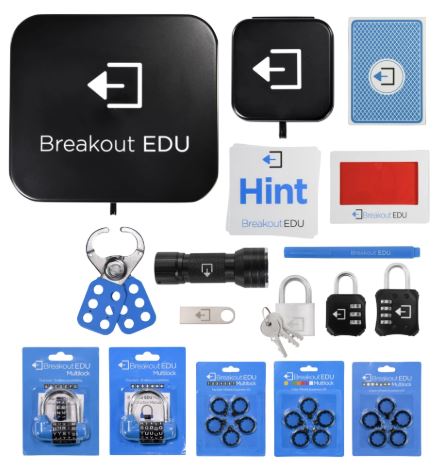
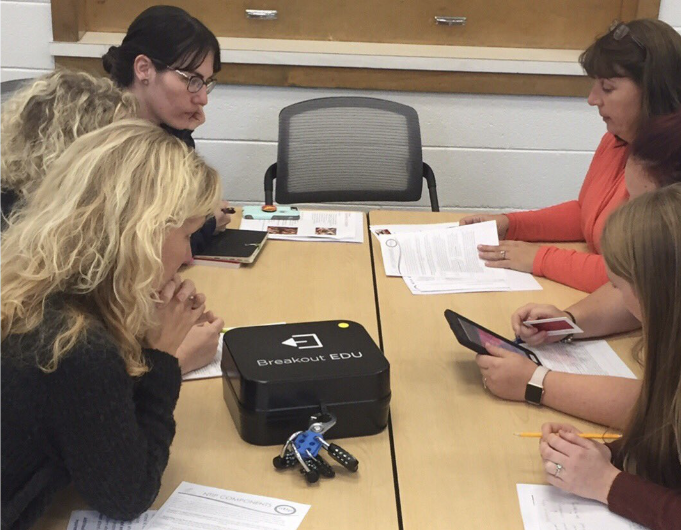
Breakout EDU is like an Escape Room in a box. The players use teamwork and critical thinking to solve a series of challenging puzzles in order to open a locked box. The first time I experienced Breakout EDU with my students I was not the designer of the game.  Another teacher had designed the Breakouts and we were using it as a provocation for an inquiry on the Olympics.  I was amazed at how much I wanted to help my students.  It was difficult to watch them struggle and yet, that is where the learning happens.  We want our students to BE “gritty” and we need to provide opportunities for students to develop that grit.  Breakout EDU is a great way in which to have the students experience “the struggle”.  The kit looks like this:
https://www.breakoutedu.com/

The kit itself is quite pricey and unless your school already has one, it is quite an investment.  However, you can make your own with a tool box and locks purchased from a variety of stores.  You can also create online digital Breakouts that create the same kind of collaborative, problem solving activity just without the cool locks.  Here is the link to some curated online “digital” breakouts.   I haven’t looked at all of these for curriculum alignment, but it will give you some ideas to use to create your own digital breakouts.

“Breakout” is sort of a misnomer.  You are actually “breaking in” to the box using a number of clues students solve puzzles in order to open the various word, number and key locks.  This can connect to the curriculum in a number of different ways and can be used effectively as an introduction, provocation or summary for learning.  You aren’t going to get too terribly deep into content when students are busy trying to solve for clues.  For me, Breakout EDU is far more about developing the 6 C’s; collaboration, creativity, critical thinking, communication, citizenship and character building.   It is fascinating to have students work in groups to solve problems with a common goal.  Breakout EDUs provide opportunities for students to practice developing their learning skills and gives the teacher the opportunity to collect data as the learning is self-directed.  The activities lead easily into self-reflection of learning skills. Below are some of the questions that I find valuable for the consolidation portion of a lesson after a Breakout EDU activity:

Questions for Reflection

1.  How did you determine roles in your group?

2.  What did you find most difficult?

3.  What did your group do really well together?

4.  What would you do differently next time?

5.  How did you contribute to the group?

6.  How did you work to include everyone in your group?

Once students are familiar with the Breakout EDU format (depending on the age/grade level) they can then create their own Breakouts for their classmates.  The students interact with the learning from a different perspective and have to find the most important information to highlight for the clues in the development of the Breakout.

So what are the drawbacks?  Breakout EDU is competitive.  The students are working against each other and/or against the clock.  You have to know which students can handle that type of pressure. Working in groups on a common task may be difficult for some students with self-regulation issues so you have to know your students well and plan accordingly, as you would for any group activity.

Finally, Breakout EDU is also a great tool to use with your staff.  If you have a lot of information to get through and you want the participants to get to some salient points and the Google Slide presentation just isn’t cutting it, using a Breakout EDU will make for an interactive, team building staff meeting!  It is also great to have the adults experience the struggle that we all want students to go through to develop grit and resilience.

Like with any tool, it takes time and research to ensure that it is right for your classroom.  The more I use Breakout EDU in my teaching,  the more I think of ways to use it!

Risk Taking

As educators, we’ve all done it. We’ve probably said it and even perhaps written it on report cards. “So-and-so needs to take more risks.”  Over the last few weeks, I’ve been contemplating what it means to take risks and how past experiences may form our propensity for future risk taking. In this post, I invite you to join me on a little journey. 

I’ll admit it. I’ve often been the one who makes very calculated decisions when it comes to risks. More and more as an adult, I’ve learned to be a little more adventurous in “safer spaces” but I ultimately need to first find that space to hold some safety. 

In the work that I have had the opportunity to do with educators, many have put up their hands to attend a session and are possibly ready to take some time to reflect on their own practices. The process is guided and while participants are often thrown into a place where they have to quickly create, many feel safe enough to consider and try new ideas because the scaffolding has been put in place to get to them to that point. They move from a place of being unsure of what the day may hold to quickly being excited about the potential of an idea. With this in mind, I’ve been thinking about my own learning and the learning that I have the opportunity to facilitate in my classroom with students. 

As I mentioned before, I’ve always been calculated in taking risks. In school, I remember equating success with receiving high marks. High marks on the last couple of pages of the report card, not necessarily the learning skills, which I was usually able to quietly meet expectations. I think that because I knew the game of school, the learning skills were seen as perhaps the icing on the cake, while the real substance was to be found in the marks received in subject areas. These were the things that were going to help me get to my ultimate goal. I always equated the better your marks, the better your options. This thinking kept me in a space where I focused on making sure that I continued to do what I knew worked. I learned really well to safely play the game of school but at what cost?

I say all this to come back to our students. We want them to be creative risk takers but how do we do this when perhaps what is perceived to be valued is a letter grade at the end of a few months of learning about a specific subject? How do we help students to value process over product and to realize that failure is a part of the learning process? How do we help them to see that perhaps the detriment might be not in the failure itself but in perhaps failing and not learning from it or being so afraid to try that there is no room to fail? We want students to be risk takers and of course there is probably some calculation to that risk but how do we create a system that supports students in truly understand what matters most? How do we create a shift?

Clearly I don’t have all of the answers to this and I know that this isn’t the work solely of a group of educators and perhaps speaks to a larger shift in education. I wonder what changes could be made if we were to create learning environments where there are scaffolds and supports to ensure that students can safely take risks, fail, learn, try again, take even greater risks, fail or succeed and take risks again?  I know this is already being done especially in elementary but imagine if there could also be a shift in secondary also. Where an exam or test mark isn’t the only thing that speaks to the success of a student. Would we have more risk takers who are excited about new challenges they will face in an uncertain future? I’m back in the classroom in September and I have learned so much about the value of a scaffolded process and the fact that it might look different for each student. I’m looking forward to using this process to helping them develop a greater ability to take some big risks to try something new.

Don’t Judge a Teacher By The Bulletin Board

I remember going to the Reading for the Love of It Conference in Toronto for the first time as a fairly new teacher.  I heard Mary Bigler  speak in a motivational keynote address.  She told a story that has stuck through me through the years.  It was about a brand new teacher who was full of energy, enthusiasm,  great “new” ideas and some judgement about her “older” colleague across the hall that taught the next grade.  This young teacher, (let’s call her Samantha), made sure that students were working in co-operative groups and made the learning exciting and engaging.  The teacher across the hall (let’s call her Eunice) had a structured, desks-in-rows, routine program and a quiet classroom.   Samantha often stayed after school into her evenings changing her bulletin boards and arranging desks into new formations.  Eunice would often leave shortly after the bell and sometimes her bulletin board was empty!  Throughout the year this Samantha considered her program to be superior.  She had learned all of these “new” strategies in teacher’s college and looked upon the program of her colleague as being antiquated.  She loved hearing that she was the “fun” and “best” teacher.  However, no matter what Samantha tried there were students who she could not seem to reach.  She tried all of the strategies that she had learned and she felt that she had given her all.  When it was time to send her students on to the Eunice for the next grade, Samantha was distraught.  Certainly the students would not do as well as they had in her engaging program.  They would be bored and wouldn’t thrive within the rigid structure Eunice’s classroom. Would those “unreachable” students fall further behind?

Samantha was surprised by what she witnessed in the fall with “her” students.   The students that had experienced her “exciting” program were also enjoying Eunice’s classroom.  They talked with excitement about what they were reading and writing and referred to Eunice as being the “best” teacher.  The few students who Samantha couldn’t seem to reach were thriving with the routine, quiet and structure of their new classroom.  Samantha learned a few things during that first year experience:

1.  You can’t judge a teacher by the bulletin board.  The culture of a classroom can only be truly experienced by the students.  We don’t really know what goes on behind the closed classroom door of a colleague.

2.  Every teacher has a different skill set.  Although Samantha was an engaging and exciting teacher, the students that she couldn’t reach thrived in a routine and structured environment.

3.  Children can have short memories.  In the primary grades, the “best” and “favourite” teacher often changes each year to their new classroom teacher.  It isn’t personal.  It is about the reference point of a six year old.

4.  Comparing ourselves to other teachers doesn’t serve the students.  Working longer hours doesn’t always mean that a teacher is more effective, it might mean that they are less efficient.  Teachers with experience likely have a better understanding of the curriculum and can rely on lessons that they have previously prepared. Teachers who have an understanding of work-life balance also may have more energy to offer their students.

5.  The experienced teacher across the hall has years of experience with strategies to serve the needs of students.  Instead of judging; ask for their help.  Most of them would be more than happy to share their strategies and wisdom with a colleague.

It isn’t about being “Teacher of the Year”. It is about being the teacher that your students need.


Collaborative Inquiry Celebration

The other day, many teachers from across my school board gathered together to share with other educators how their year long inquiry project went. As I have mentioned in previous posts, mine was about starting our own business as a class and inspiring my students through leadership. I shared with the other educators these successful stories from our project “8A TREATS”:

  • how many of my less successful students with traditional subjects have been excelling during this project
  • the success my students had with gathering data from classes around the school
  • collecting permission forms from the entire school
  • advertising by making imovies, posters and using a dinosaur mascot to travel around with a fake smoothie
  • tallying the smoothie results for flavours and sizes with spreadsheets
  • counting and tracking the money with spreadsheets
  • find and then order paper straws from Amazon to be environmentally friendly
  • working with a budget that was donated from the student success foundation
  • designing logos as a class, voting on the best one and then collaborating with a clothing design company to recreate this on their products
  • painting and creating a wall in our classroom that will be the location behind our brand
  • creating a video to explain the project as well as talk about our favourite parts

Image-21    (<<<our student create wall)


Our next steps with our project:

  • doing the math to find out how much of each ingredient we will now (plus extra) to make the smoothies
  • ordering the cups
  • setting up our classroom as a pop-up smoothie store
  • making 340+ smoothies on June 6th with our 22 students

It was very exciting sharing this project with my fellow educators. My students were very excited knowing that this project was shared with other teachers. They were proud when I told them how excited other teachers were to find out about this student centered initiative.

There were other educators who shared exciting inquiry projects:

  1. My colleague Lydia shared about her “Community Helpers” project where her grade one students inquired in various ways about the many community helpers in our neighbourhood. She had a guest police officer come by as well as had the students use their hands to explore various jobs. They were able to build, play with food as well as research all of the jobs available to them. The final touch was when my grade eight class came to help them put their thoughts together in an inquiry package. It was great to see her students so passionate about their future. To find out about her project, you can visit her twitter account @AppolonialydiaL. You can also view her project on this link <iframe class=”wp-block-mexp-vimeo hwdsb-tv” src=”//hwdsb.tv/media/grade-one-collaborative-inquiry-2019/?embed=true” width=”560″ height=”315″ frameborder=”0″ allowfullscreen></iframe>
  2. Teachers used a choice board to give students options when creating or completing tasks. These boards are made in collaboration with the teacher at the beginning of the year to go over all of the ways that presenting or completing every day tasks can be done that year. Apps are explored and used in new and innovative ways. I cannot wait to create a choice board in my literacy class next year. There was also a SAMR model student choice matrix that was introduced to us. It’s not the app that makes the project/task, it is how it’s used.
  3. I also heard about makerspaces from one of my other colleagues Cara. She introduces these daily in her library and students are able to create very interesting projects from her instruction cards set up at the tables. They are always able to be creative, explore and build in her library. They also explore media literacy during these creative library sessions.

There were many other projects I could not get to since we only had a half hour to explore and the other half hour was to share about our own projects. Some other apps worth checking out are: seesaw, read&write, book creator, keynote, canva, geogebra, TC studio and pear deck.


The Gender Gap in Technology

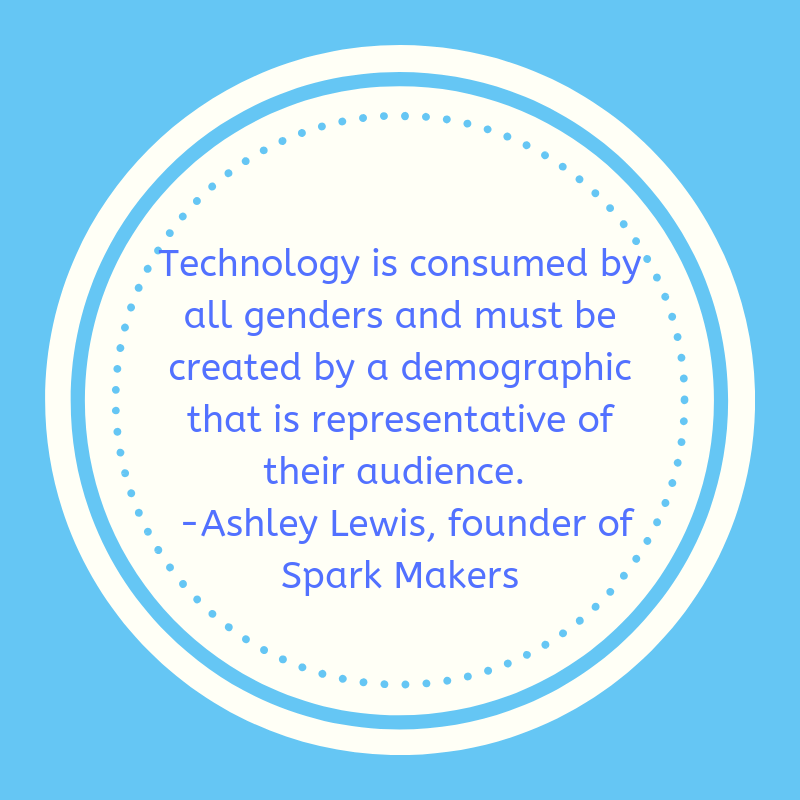
Quote for blog

According to a recent report* by ICTC (the Information and Technology Information Council) Canadian women represent about 50% of the overall workforce but represent only 25% of the technology industry workforce.  Of the 100 major tech companies in Canada only 5 have female CEOs and 1 Co-CEO.   26% of the tech companies have no women in senior leadership at all.  There is a gender wage gap in the industry of $7,000-$20,00 per year.  When I read these statistics I wondered as educators, what can we do about the gender gap in technology?  This is not an exhaustive list, but it is a place to begin:

1.  Build her confidence in her abilities.

2. Cultivate a community of supportive peers.

3.  Provide a STEM/STEAM club for girls.

4. Ensure that access to technology and computer experiences is encouraged and inclusive.

5. Foster interest in computing careers.

6. Be a role model as a LEARNER.

May 11th is National Girls Learning Code Day.  If you are looking to encourage coders in your school, why not begin on May 11th?  Below you will find links to resources for beginning coding.  Many students code on their own at home and may appreciate the opportunity to mentor fellow students.  The resources attached will get you started.  There is no special equipment or robotics required.  Teachers do not have to be expert coders to encourage their students.  Teachers can be role models of resilience, risk taking and problem solving by learning alongside their students.  Teachers only need to open the door and expose their students to the opportunities.

Girls Who Code Canada

National Girls Learn Code Day

Canada Learning Code

Scratch

Hour of Code

Code.org


*Cutean, A., Ivus, M. (2017). The Digital Talent Dividend: Shifting Gears in a Changing Economy. Information and Communications Technology Council (ICTC). Ottawa, Canada.

Elaborated and written by Alexandra Cutean (Director, Digital Innovation Research and Policy). and Maryna Ivus (Senior Analyst, Research and Policy) with generous support from the ICTC Research and Policy Team.

Bursting bubbles

POP!
What’s
that sound?
Fear and loss,
dreams – on hold,
watching, without a
voice as opportunity
is cut and cancelled.
For the people, or
for their bank
accounts?

Doubts – fill the staffroom.
Murmurs – echo down the halls.
Uncertainties – buzz through minds.

Bubbles – bursting before they are even formed.
Cuts like needles meant to pierce hearts and minds.

Are preparations being made for a classless class war?
Why has education been made the enemy in our province?

They say the bitter pills prescribed in government cuts must be taken or else there won’t be a future and that everyone must sacrifice because this mess is nobody’s and everybody’s fault. Yet, why aren’t elected officials in line for the same medicine that they’re prescribing? We hear tonnes of sound bites and sound bluffs. We see posturing on every stump, but where are the planters and peace makers after the forest that is public education has been razed?

We see fingers pointing in every direction because everyone is worried more about the colour of the ink on the spreadsheet than the lives that it will stain to change it.

What message is being sent to our youth by the adults, who cannot get along? The same adults making decisions about their futures? We ask our students to advocate, invest, and dedicate to their potential. We teach them to think critically, consider the facts, and make good choices. We expect students to buy into a better system, but it has already been sold out by the ones elected to take care of it.

Investing in our youth and their education should never come at a cost of denying them anything less than what their predecessors and parents had before them. Opportunity cost may be a term from an Economics textbook to understand the potential for a loss by doing something else. When we consider where things are heading in schools over the next few years, the money saved will never make up for the lost opportunity, innovation, and productivity, or the imminent financial and social costs.

Remember. Quality only hurts once. Our students are worth it. The work we provide prepares and protects them to possess a future. Our youth cannot be blamed for the mistakes of those who leveraged their futures before they were ever born. We cannot let another bubble burst and expect their children to pay for it.

Prom Project Hamilton

On Saturday, April 13th at Delta High school in Hamilton, the Prom Project held an amazing event. This event is supported by the same foundation who gave my students our grant for our inquiry project, the Hamilton Foundation for Student Success.

The Prom Project allows students to pick out outfits free of charge to wear to their upcoming school events such as grad or prom. There were thousands of dresses, suits, shoes, accessories, hair stylists, make up artists and even on site seamstresses to help kids who needed their pants hemmed or their dresses taken in. I was able to volunteer at this amazing event along with many other teachers, principals and other adults from around Hamilton. The event was record breaking with almost 500 students walking away with new outfits. These outfits help increase their confidence knowing that they will have an outfit to wear to these events.

Among those 500 students who received outfits were 12 students from my own school. With the help of the prom project volunteers, the boys and girls found outfits that were their size, got these outfits altered and even left with their hair and makeup done. They received a swag bag full of helpful treats for their lives such as soap and other beauty products. It was awesome to see all the community partners there who donated their time, products and style capabilities to make the event the success it was.

You can still volunteer for the May 4th event by visiting http://www.promprojecthamilton.ca/. Follow the hashtags #PPH2019 and #promprojecthamilton for more info about the event. Pictured below is myself along with six students from my school who went home with Copley suits, Michael Kors suits and much more! An amazing event that really benefited so many children in our city!

Image-12

Social Advocate through Children’s Story

While many are marching to show the Ford Government our thoughts about the budget cuts, I am reflecting on how we can safely ride out this storm. As a Social Advocate for equal rights and positive outcomes for our children and this world, I am with my sisters and brothers at Queens Park today in spirit and via social media. I find myself planning ways to help the education team and students get through this next tumultuous time while supporting each other and focusing on self care. #ETFOstrong

This week I was privileged to be part of an audience engaged by the “beautiful” and talented writer, Helaine Becker. http://www.helainebecker.com/abouttheauthor.html

She presented to our school community to Grades 4-8 and then to Grades K-4.  I always enjoy an inspiring hero and artist who can inform and bring all those social justice issues that I am passionate about to the forefront with the power of words and books.

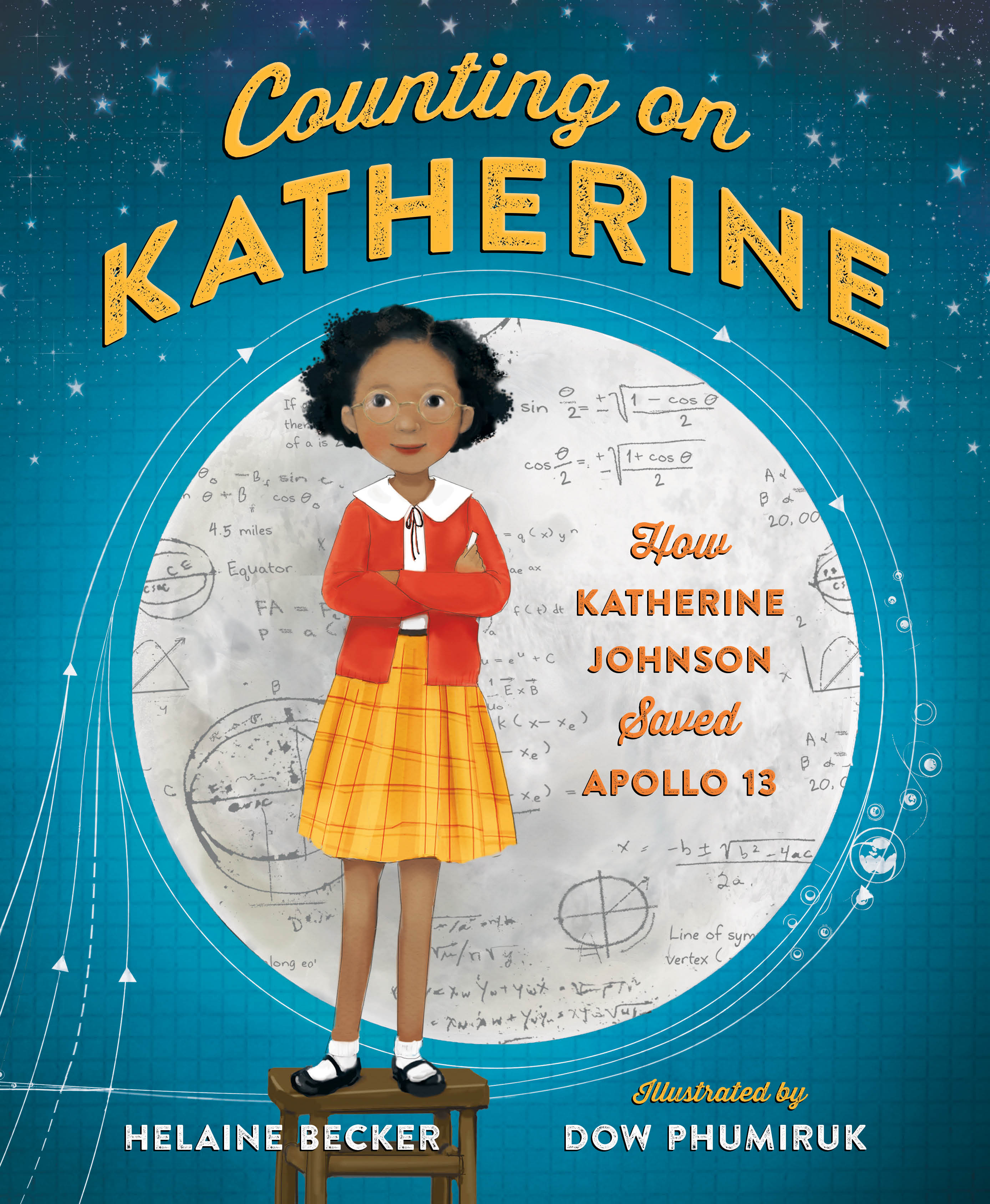
I am a woman science and mathematics teacher. This book excites me. It encompasses so many issues that I am passionate about.  “Counting on Katherine” tells the story of Katherine Johnson and the societal blocks she faced through her life.  She faced racism and sexism at every turn yet never stopped believing in herself. This story brings the truth to us about how she improved the world. She is one of the many previously unknown hero’s of my time.

countingonkatherinerevised_cover

During the very “beautiful” and talented Helaine’s presentation, I found myself and the school population, captivated with her presentation. She spoke of so many subjects which excite me. These topics open opportunities and possibilities for the many I educate. Helaine spoke of how she wrote about feminism, racism and suppression. She included topics of mathematics, science, space, and the “power of the pen”. She introduced the dream of writing to many during her amazing and dynamic presentation of her children’s books.

Thank you, Helaine for introducing me to another hero. I will now share Katherine Johnson’s story with many for years to come.

It’s About Relationships!

Over my 10-year career as an educator, there have been a number of times of uncertainty in education. These are the times that drive us to reflect on why we became educators: to have an impact. There have been some great posts within this platform with fantastic tips on how to thrive during these times. For this piece, I’m thinking about relationships.

We all know that at the forefront of education is the power that comes from building meaningful relationships, both with our students and colleagues. It’s was fuels the work that we do and empowers us to see the impact that we can have, are having and will have. It’s through relationships that we keep the lines of communication open when parents and students who don’t always know what the impacts may be a school community.

When I think about relationships I think about creating spaces that are:


  • Open to dialogue
  • Safe to try, fail and try again
  • Real


Open to Dialogue

Ever been in a quiet classroom or one where the main voice was that of the teacher? How did it feel? On the other hand, have you ever been in a classroom that was loud and slightly chaotic with meaningful dialogue happening amongst students? How did that feel? I’m sure that both spaces feel very different.

I believe that “the rules” we have in the classroom, set the tone for the way in which our students converse with each other. When students feel free to be able to bring their experiences, thoughts and ideas into the classroom, there’s a sense of freedom that comes from being who you are with people who care. Now, don’t get me wrong, I’ve been in buildings where administrators wondered about the noise happening in my classroom but when they can come in, spoke to students and saw that it was purposeful, some of the questioning dissipated. Many would also drop in for our times when we were connecting on things that were meaningful to students and had an impact both in within the classroom and the world around us.

I believe that classrooms should be spaces for students and educators to have open dialogue about what is being learned within the classroom which should also include real connections to what is happening in the world. These are sometimes courageous conversations that need to be met with students having the opportunity to share their concerns and having a non-judgemental adult being there to help guide with facts and information.  We want students to be asking rich and meaningful questions of each other and understanding that communication is a skill that they can work to develop with each other. That means that they don’t necessarily have to agree with the thoughts and ideas of another but they understand that they have to respect that diversity of thought exists.

Safe Spaces to Try, Fail and Try Again

Growing up, I always felt that at school, I had to be perfect and show what I knew. Failure wasn’t embraced and there was a culture around making sure that what was shared was the right answer for that was most important. The stress that this puts on students when they should be in a space where learning and the progression of skills and knowledge is embraced is unbelievable. As such, I tried to create spaces where students could present themselves as is and we could work towards helping them to improve where needed.

Now I can’t say that this is an easy task but imagine if students felt safe failing and viewed it as an opportunity to get back up and grow. A place where talking about what they believed to be correct and working to identify misconceptions and helping students to consider what other options might be correct. Or better yet, having their peers work towards helping to change misconceptions. What if we offered students the freedom to fail and then the opportunity to try again after providing feedback and clarification for them? This takes work, time and effort but how might the climate in our classrooms change and how might they help to deepen connections made with each other? What outcome could this provide for students in the long term?

Real

People naturally gravitate to those who are real and genuine. Colleagues are genuinely navigating uncomfortable spaces at the moment and it’s important to be able to have at least one critical friend with whom we can share our concerns but who will also empower us to continue with the goal that we know is most important, our students and their success. Have you found a critical friend? One with whom you can be real and know will help to encourage you on those tough days?  

While we are uncertain of what the outcome of the changes in education may be, we do know that through relationships, we can stay true to what we believe to be the most valuable part of our role: having an impact in education.