Compassion Fatigue and Teacher Burnout

It is no secret to educators that teaching is an occupation of high stress.  A Johns Hopkins University study ranked teaching as the 4th most stressful job of all occupations.  Educators know that the job is stressful, but sometimes it helps to put a name to something in order to help us cope.  Sometimes, it is enough to know that others are going through what we are going through in order to come to terms with our own feelings. Recently during a webinar workshop from “Right to Play,” the facilitators referred to what some educators are experiencing right now as “compassion fatigue.”  I had heard of this phenomenon relating to emergency response occupations, but I had never really thought about it in terms of education.  What we may consider “stress” in the teaching profession may be explained in better detail by examining compassion fatigue.

According to Joanna Krop, author of  “Caring without Tiring: Dealing with Compassion Fatigue Burnout in Teaching,” compassion fatigue “is a form of burnout characterized by extreme mental, emotional and spiritual exhaustion, and it’s an occupational hazard in the caring professions.”

Teacher burnout is not something new.  Recently, however, there have been a number of articles written on the topic of teacher burnout.  A few days ago, the CBC released and article with the results of a survey completed by 2,000 teachers about the pressures in education. One third of the respondents are thinking about retiring or seeking a new career.  One third.  Some educators cite that the pressure and stress is coming from trying to maintain the best educational experiences possible for students while also trying to adhere to pandemic rules and guidelines.  Teachers hold themselves to a high level of integrity and service in their work, in addition to wanting to help their students and their families.  Then add a global pandemic on top of the regular burnout reasons.  As if that wasn’t enough, there are so few teachers available for daily occasional work that teachers feel more guilty than ever when they need to take time for their health.  For many educators, teaching isn’t the only thing that is leading to that compassion fatigue as many teachers have the added pressures of taking care of children and/or aging parents. The most challenging aspect of burnout is that what seems to be the biggest factor in burnout is dedication to the job.  The more dedicated the teacher, the more apt they are to experience burnout. Teachers are burning out because they care.  Hardly seems fair.

The question becomes then, how do we counteract compassion fatigue and burnout? From what I’ve researched, it is all of the things that we know are good for our mental health:

  • figure out what you can control and what you can’t and focus on what you can control
  • temper your expectations of yourself and your work (remember that we are in the middle of a global pandemic and the circumstances are different)
  • small steps towards getting outside, eating betting, exercising and doing creative things
  • surround yourself with supportive people and trusted colleagues
  • be aware of toxic positivity or the rabbit hole of complaining about things
  • show your true self to your students, be authentic so that your students have permission to be authentic too
  • quiet time for yourself and for being mindful

All of that sounds wonderful.  All of it sounds like common sense.  However, it isn’t as easy to put into practice as all of the research makes it sound.  This can appear of just another long list of things to do added to an already long list of things to do. Sometimes burnout can get to a point where you feel immobilized or you may even be at the point that just getting through the next breath is all that you can plan.  As someone who generally plans the menu of meals for our family a week in advance so that we can do our groceries, I know the chaos I feel with uncertainty.  Right now my plan is to try to be patient and gentle with myself.  Everything is going a hundred miles an hour and I keep thinking that I have to keep up or somehow I’ll miss the bus.  However, I also know that if I get to the point of exhaustion, I become less self aware and I’ll end up getting run over by the bus and won’t be good to anyone.

It feels like an impossible task to willingly accept less of myself than I normally expect.  I feel like I will let others down.  However, if I don’t temper the expectations that I have of myself and my work I’m going to have tire tracks on my back and that won’t be good for anyone.

About those special days at school Pt 2.

This post is a continuation of About those special days at school Pt 1. Both seek to make sense of a number of events in and out of the classroom over the month of October. I believe it serves as an excellent snapshot of the incredible amounts of effort, organization, and attention that educators put into this calling on behalf of students even when faced with the extraordinary circumstances of 2020. In that context alone there is nothing to refute. However, my goal is to continue working through this month’s mind purge along the contiuum towards anti-racist education and equity – something that cannot be contained by a day, a month or a year. Hence…

I get it. I feel the fatigue of being an educator during a pandemic.
I see it in your eyes and via your posts on social media.

I get that not everyone is at the same place on the anti-racist continuum.
This is not a virtue signalling contest. We are not playing.

I’ve heard that we have to tread lightly for fear of offending someone’s feelings(privilege). This is not about codling your fragility or mine at the expense of someone else’s existence. There will be no emotional power plays allowed here, but that doesn’t mean we don’t hold power. In fact that has been one of the biggest barriers to authentic change in the past and now because we are part of a system that has held all of the power. I’ll let that sink in.

You, me, us have benefitted for a long time from the systems that have been created to oppress others. Don’t run away. I promise something good can come from all of this if we listen, unlearn, and work together.

I know that acknowledging and reconciling issues of systemic racism take a lot of emotional energy. I hear it directly from friends, in group chats, and through the silences about how draining and frightening it can be. There has never been a better time to recharge your batteries than by taking the next steps along the continuum with others on the same journey. You’ll find you have more stamina to overcome your fears than you thought.

Tired or not, this does not mean we cannot take on the necessary work that needs to be done to undo 400+ years of colonialism and systemic racism in our country and education system. I fear that failing to face our discomfort(fear) or to foster learning around systemic issues will be far more detrimental to the future than any ignorantly bliss days we have without it. This is not the time to sit on the sidelines of history. There is too much at stake, but with so much happening all at the same time, it is easy to see how it can be put on the back burner in our schools. It doesn’t have to mean that the heat is off though.

My October

October started at a brisk pace. If by brisk you mean tornadic and unpredicatable for students and staff in class and online, you nailed it. So, it should surprise no one that there was not a lot of time to tackle tough topics during that first week with a reorganized larger class and new schedule. Did I mention it was Islamic Heritage Month? Reminder to self. Share with students and ask them what it means to them and how should be approach learning more about it?  Oh, and Happy Thanksgiving if you celebrate that! Remember that the history of Thanksgiving has ties to settlers who broke treaties with First Nations across North America. No school on Monday.

Week 2 – routines falling into place. Did someone switch the hand sanitizer for some cheap booze? Students nearly retching as the virus killing juice splashes their hands. Wipe down markers, pencils, technology, and anything with a surface repeatedly. The realization that some concepts taught during Emergency Distance Education may not be easily recallable or cemented. Looking your way Math. Hey, don’t forget to wear purple to show support and solidarity for  2SLGBTQ+ youth who have been bullied for their identities. Reminder to self. Revist conversation about Islamic Heritage month.

Week 3 – Math, Language, AP level Sanitizing and distancing, classroom closure due to possible COVID 19 Case. Staff and students on edge. Conversations around the Mi’kmaq First Nation and  about Black Lives Matter that leave my bucket filled by students asking more questions and forming some critical connections. Don’t forget to talk to your parents about virtual meet the teacher night next week. Reminder to self. Visit board web site for resources and events for Islamic Heritage month and share with staff. Done and done. Make sure to mention the significant contributions to Math from Islamic and Indian mathematicians. Wonder how to extend learning about Islamic heritage further into future months.

Week 4 – See prior week and add in 2 sessions of virtual meet the teacher night, a morning of PD planning for our staff leadership team, an assessment or two, a realization that Friday is the day before Hallowe’en and that the place is already going a bit bonkers with the excitement. Debate over decorations or not? Not. Debate over distribution of candy in class to students and how to do it safely in times of COVID 19 while tying it into a wonderful Data Management and Number Sense activity. Done and done with a few sweet treats to spare. Send students home happy, safe, and full of treats.

Throughout the entire month we tried to tackle issues that are relevant beyond a single day. No pumpkin spiced worksheets, word searches, or TPT drivel was necessary to make the month meaningful. My only regret was not taking more time to check in one on one with my newer students a bit more. We had a few rough days that still need refining, and their resilience has been admirable despite the long shadows of COVID 19. Next month will be better.

With November smashing down the door, my class will be embracing the learning from a whole new set of special days. Many of them specific to November such as Holocaust education week and Remembrance Day. It is my goal to make each one meaningful and relevant for my students while continuing to instruct through culturally responsive relevant pedagogy and anti-BIPOC racism focus. Sorry, there will be no themed worksheets this month either.

Note to self: Complete progress reports and confirm virtual parent interviews. Stay safe. Stay strong.

 

Engaging with Indigenous Knowledge as a Non-Indigenous Educator

Over my teaching career I have been fortunate to teach in schools with high populations of Indigenous students and to learn from the knowledge keepers and elders in the communities that our schools served.  Admittedly, I haven’t always said or done the right things but I have learned from those mistakes.  As a non-Indigenous educator, I know that I will continuously be on a professional and personal learning journey.  I acknowledge that it is my responsibility to do this learning.  There are resources that I have used along the way and I hope that by drawing attention to the following resources, I can assist others in their learning journey.

In order to avoid cultural appropriation, to honour and respect Indigenous culture and history as a non-Indigenous teacher, it is important to have the appropriate resources. We can’t avoid teaching about residential schools because we don’t feel comfortable.  It is a part of the Ontario Curriculum.  It isn’t just about “history” either.  Current events draw attention to the pervasive issues faced by Indigenous peoples.  These are teachable moments that are authentic and relevant to students.  Students will be asking questions and forming opinions. As educators we have a responsibility to assist students to find accurate and culturally respectful information.

If you are looking for a place to begin in your learning journey, visit ETFO’s First Nations, Métis and Inuit Education website.  It is filled with cultural protocols, resources and Ministry Documents.  It is a treasure trove of information on treaties, land acknowledgements and avoiding cultural appropriation.  Throughout the literature are hyperlinks for explanations of concepts and lexicon.  Through ShopETFO you can purchase the FNMI Engaging Learners Through Play  resource created for elementary educators which provides play based activities that engage all students.

A quick resource can be found on code.on.ca (The Council of Ontario Drama and Dance Educators). This resource provides a quick chart of protocols on what to do, what to avoid, why to avoid and what to try in order to bring learning about Indigenous culture and history into your classroom.  This document also provides links to videos about Indigenous Arts Protocols, and a quick reference guide for what to think about before engaging with Indigenous Knowledge.

The website helpingourmotherearth.com is filled with tools and resources for educators including videos of Indigenous Knowledge Keepers telling their stories.  There are free educational resource kits with lesson plans for primary, junior and intermediate students.  In addition, you could sign up for professional learning or a workshop on the site.

Like me, you might make mistakes.  However, my Indigenous educator friends have coached me that the worst mistake that non-Indigenous educators can make is to do nothing.  I hope that highlighting these resources will help you along your professional learning journey.

Teachers Are Still Rocking It-

In March we were “Emergency Learning”.  Now we are either teaching “virtually” or “socially distanced” in classrooms.  We never thought we’d be teaching from behind a screen, learning all kinds of new technology tools, wearing masks and shields in front of students or removing all of the manipulatives from classrooms. We don’t know how long this will last.  We don’t know if COVID will worsen.  Educators aren’t used to not knowing things.  Most teachers I know like schedules, routines, knowledge and thrive on consistency.

However, in the midst of the new rules, changes and all of the things that we “can’t” do-teachers are still rocking it.  Throughout the summer I worked with a team of teachers providing virtual professional learning for KPRETFO.  Hundreds of teachers used their summer holidays to learn about technology tools before they even knew whether they were going to be teaching virtually or not. They logged in at 10 am some days in order to learn and some teachers even came to all twenty sessions that were provided. Educators were dedicated to their professional learning all summer long.

At the end of August, I had the privilege of working with another fabulous team of educators who dedicated their time to providing a three day virtual conference for over 500 Ontario Educators with ECOO.  These educators gave up their time to organize all kinds of schedules, sponsorship, presenters, keynotes and much more.  In addition, over a hundred educators created and presented webinars for their colleagues.  It truly FELT like a face-to-face educational technology conference took place in my living room!
There was a feeling of sharing, helping and collegiality.  It was exhausting but my bucket was over flowing.

As our school year is now well under way teachers are reaching out to me for assistance at all times of the day and night through email because they are dedicated to their students and want to do their best.  They are attending our evening “PD in your PJs” webinar sessions through our local union office to learn new tech tools at 7 pm on the week nights. The educators that I work with continually astound me with their dedication to professional learning.

I recently binge watched a Netflix series called “Away”.  It is a futuristic fictional narrative about the first manned mission to Mars.  The astronauts were in uncharted territory.  They encountered problems along the way for which they had not trained.  They endured mental and physical fatigue beyond anything they had ever felt before.  They were innovative and creative in order to solve problems and reach their goal.  While watching, I couldn’t help thinking about the parallels between this movie and the present state of education. We’ve heard that as we design these new learning structures and environments it is like we are building an airplane while flying. If I am going to stay true to the analogy here it is really more of a rocket ship! Educators are facing situations that they hadn’t even thought about in Faculty of Education Programs.  They are encountering issues of teaching without many of the tools they normally use such as manipulatives, group work or technology. They are suffering mentally and physically. They are being innovative  problem solvers around tools, equipment and technology.  They are building the rocket ship while they are flying it and it is full of students.

Are educators stressed?  For sure.  Are their nerves frayed?  You bet.  Are they innovative, creative, dedicated and passionate about learning and teaching? Absolutely, without a doubt.  Every educator is a front line worker,  doing their best, making a difference, being brave beyond imagination and truly an inspiration.


“Techie People”

As someone who is passionate and truly geeky about the power of technology in education, I often hear from my fellow teachers, “I’m not really a techie person.”  Now, I get where they are coming from because technology can be intimidating.  Many times I’ve said, “I’m not really a math person.”  I can “do” math and I can “learn” math but it doesn’t get me fired up quite like tech does.  However, over the last few months educators who weren’t really “techie people” didn’t have much of a choice other than to use tech in order to do their job.  I cannot imagine what that must have felt like for some educators.  For some educators, it must have been terrifying.  For me, it would have been like my Principal saying that I was now the new math consultant for the intermediate grades.  It would have caused me serious panic and anxiety. I probably would have considered resigning but I would have dug in and done the best I could with the tools available to me and I would have reached out to fellow colleagues and leaned on their expertise. THAT is what teachers all over the province of Ontario were doing after the March Break, teaching and learning by the seat of their pants.

As an innovations consultant what I witnessed during the weeks of distance learning was fellow educators doing what they do best; rolling up their sleeves, getting in there and figuring the tech stuff out.  As I (along with some fantastic  and enthusiastic educators in my board) provided webinar workshops on technological tools for teachers, I saw teachers who were self proclaimed Luddites attending and showing appreciation for what we were doing.  The resiliency of educators during this time has been absolutely amazing. The necessity of teaching through technology broke through an invisible barrier that has existed for those teachers who thought that you had to be a “techie person” in order to use tech in education.  Teachers were no longer afraid to try a new technological tool, to make mistakes and ask questions. Teachers are discovering the power educational technology and they’ve been bit by the tech bug.  Educators will always continue to seek out new and innovative ways to deliver curriculum to students and learn as they go-no matter how steep the learning curve.  Some teachers who would have quickly proclaimed, “I’m not a techie person” before March Break are now excited about the possibilities of using technology even in their face-to-face classrooms.  The Educational Technology Geek Community is over-the-moon excited about increasing it’s membership!  We are a friendly bunch, inclusive, sharing and passionate and we’re happy to help.

Bitmoji Education

Love it or hate it, the app of Bitmoji has worked it’s way into education and particularly into distance learning.  From “digital” stickers for feedback to entire Google Slide Classrooms with doors to other rooms, Bitmoji is everywhere.  Bitmojis are dancing, pointing and fainting all over educational platforms.  Confession time?  I’m on the love it team and I’ll tell you why.

Bitmoji allows for a personal and creative touch to things that we share with others.  When I create short Google Slide presentations for students they are surprised to see my Bitmoji in the corners of my presentation.  Some think it is truly “geeky” but many students appreciate the effort at making the presentation a little more fun. Not having to put my real profile photo on something and being able to add a Bitmoji instead provides a small layer of privacy.  I began to make virtual, interactive classrooms on Google Slides and soon realized design and creating something so personal was a throw back to the many hours I spent playing with Barbies as a kid.  It was like planning to remodel my kitchen but without any cost what so ever.  It doesn’t feel like work.  It feels like play.  115,000 members on the “Bitmoji Craze for Educators” Facebook page all agree that it is a type of escapism and the membership grows daily.

Colleague Deanna Palmer and I created a webinar workshop for our fellow teachers about how to use Bitmoji to add some Pop to distance learning.  In the webinar we included a step-by-step slide show for educators to take away.  Find it here: Using Bitmoji to Make Virtual Learning Pop

Like with any popular craze or fad there are those who don’t or won’t buy in.  Some teachers are reluctant because they are conscious of their digital footprint-especially since in order to create the animated virtual reality Bitmojis you need to have a Snap Chat Account.  Some teachers don’t think that their students will want to see their teacher’s cartoon face all over everything in their classroom.  I can appreciate that it isn’t for everyone.  I am well aware that making learning “fun” or “cute” doesn’t make it deep or engaging.  However, if a picture can be worth a thousand words and Bitmoji can express precisely what we are feeling.  Using a Bitmoji might resonate with a colleague or student and just might make them smile. If that is what my little Bitmoji avatar does, then it was worth it.


Looking on the bright-side during this dark time.

During this time at home, we are all probably having positive and negative learning moments. From seeing students thrive for the first time to having zero assignments turned in, the highs and lows have been a rollercoaster over the past few months. However, during this time for my sanity, I need to focus on the positive ones. I would love to share a few from my experience teaching grade eight online.

  1. Removing student anxiety: Many of my students have had a hard time in the classroom this year due to certain factors that make them extremely anxious. Attendance issues have made it hard for some of them to learn this year and that has always been something I have struggled with, how to reach the students who do not attend. Even the students who do attend have anxiety issues related to noise in the room, other students bothering them or starting the day in a terrible mood. My class is super respectful so I always had a hard time understanding what the exact factors were, but I came to realize it was just a feeling they carried with them and could not be easily fixed. With online learning, these students have submitted work daily and have been involved on our online teams meetings. They have been thriving in this environment and for the first time, I am learning so much about how intelligent they are and how much they have to share. The online platform has given them a voice and a chance to accomplish things.
  2. Reaching all learners: Now that the school day exists at all times, I can answer all questions at once without there being a physical line up or a limit on the amount of students I can help. When someone online needs help, I can help them right away as the odds that another student needs help at that exact moment is slim. Although my students are working at all hours of the day, I had informed them that I would be available (virtually) from 9-3 everyday. They keep their questions for the most part within these hours and I love that I can respond to them right away. Also, I am able to help students via platforms that work for them and I am so thankful that my students have downloaded all of the new apps that have been made available to us.
  3. Continued differentiation in a new and unique way: With the help of google classroom, I can assign specific work to every student at the click of a button. I can modify every assignment and make special ones for my students that go directly to their google drive. When creating an assignment or learning material, I can tailor the assignment to how they want to learn, what they want to learn and give it directly to them. I was already doing this in the classroom but I am happy I can continue to do it online. I was nervous about assigning work online and how I could make it specific to students so with google classroom I was happy to see it was an easy process. Then, once my students finish an assignment, I can assign them more work at their own pace. Right now I have students completing work at 25 different rates and I need to be able to keep track of what they have/have not done. Google classroom allows me to look at what they have handed in and then direct them to the next assignment.
  4. Small groups style learning: My favourite thing about teaching online is creating small groups live meetings. We have been using the apps “Teams” by Microsoft and it was has been an amazing way to teach in small and medium sized groups. Every Tuesday, I have a live math/literacy class with my students. I invite all of them but usually I only get half the class. From there, I create smaller groups to teach them the topics that they still need help with or to move them ahead in the unit. I also have a meeting on Wednesdays with my ESL students where we read a book and answer questions together. We also work on math topics and play simple word games. On Thursdays, all of the other grade eights meet together to play games and reminisce about the year. This Thursday, they will be sharing their favourite writing piece from the year and will be sharing to their classmates their strengths as a writer. Small groups is something I had done in the classroom but online now more than ever I have implemented small groups in a way that really reaches all learners. I really hope to bring that into the classroom at a new level more successful than ever before. That is my favourite success from the online learning environment.

Although there are days when I feel like I may be posting to no one, I know that there must be students who are benefiting from it. The online meetings have been such a blessing during this time as hearing their voices always remind me of how special this profession is and how lucky we are to have technology to help us through this time. I am desperately looking forward to the day where we can teach in the classroom again but for now, I am happy to have these successes to think on and to reflect about how they will make me a better educator. I hope everyone else has some moments that they can look at and reflect positively on.

Overwhelming Resources

As we engage in distance/remote/online/emergency learning Educators are being inundated with resources and tools to use in their virtual classrooms.  It isn’t easy to decide which would be most effective and which ones are safe for teachers and students to use.  There is no one size fits all answer to this but there are a few things that I do in order to narrow down my choices of whether or not to use a particular digital tool or resource:

  1.  I search for tools that are designed by Canadian or better yet, Ontario Educators and where possible, data is housed in Canada.
  2. I look at whether or not the tool will still be free after the COVID crisis is over or whether it has always been a free tool.  I honestly don’t mind paying for a tool from the outset but I don’t really like the whole free trial thing.  I also don’t want to pay some kind of a monthly fee.  One time price, please!  I don’t want to love a tool so much while it is free and then have to pay for it when I go back into the classroom.
  3. I look at whether or not it is a one time fee or negative billing.  I won’t give anyone my credit card to start a free trial for a tool.
  4. I search for tools that I know will be supported by my ICT department.  Anything that wants access to email contacts in my school board is a non-starter.
  5. I search for tools that inspire collaboration and creativity.  I’m not one to sign up students for a gaming platform that is really just an engaging math drill.
  6. I look at bang for my buck (even if it is free).  Is it a versatile tool?  Does it allow for different forms of communication?  Can I embed audio and video?  Is there an opportunity for a variety of feedback methods?
  7. I look at the Privacy statement.  Although I am no expert in this, I can generally tell when something has red flags.  Anything that is attached to third party social media platforms like Facebook is a non starter for me.
  8. Right now while there are so many sign ups and passwords for students, I stay away from platforms that want to create student accounts and want information apart from an email.
  9. I look to see if it is a Microsoft or Apple Education certified product?  I know that for the most part, those tools are trustworthy.
  10. I look at user reviews and YouTube tutorials.  I want to know what the pitfalls are of something before I invest time and/or money.

At the end of the day no tool is perfect and few tools are unlikely to meet the specific needs of each and every student in your classroom.  However, I hope that what I do when choosing a tool might guide you to the most effective tools in the over abundance of resources that are floating around out there.

STEAM to Foster Innovation and Collaboration

In my heart of hearts I am a teacher of the arts.  I began integrating technology into my classroom practice a number of years ago but always from a creation perspective.  There is still a misconception that innovation is synonymous with technology.  However, some of the deepest innovative learning comes from low technology.  Keep it simple.  On the whole students enjoyed being challenged and getting the opportunity to practice problem solving in a safe and creative way.

In order to practice the true design process I have been testing a number of STEAM challenges with students in a variety of grades.  When I do this, I ask them feedback on the process that we experience and how I might change it for other grade levels.  Students always amaze me with the amount of innovation that they demonstrate when given the opportunity and their feedback has been helpful to streamline the challenges.

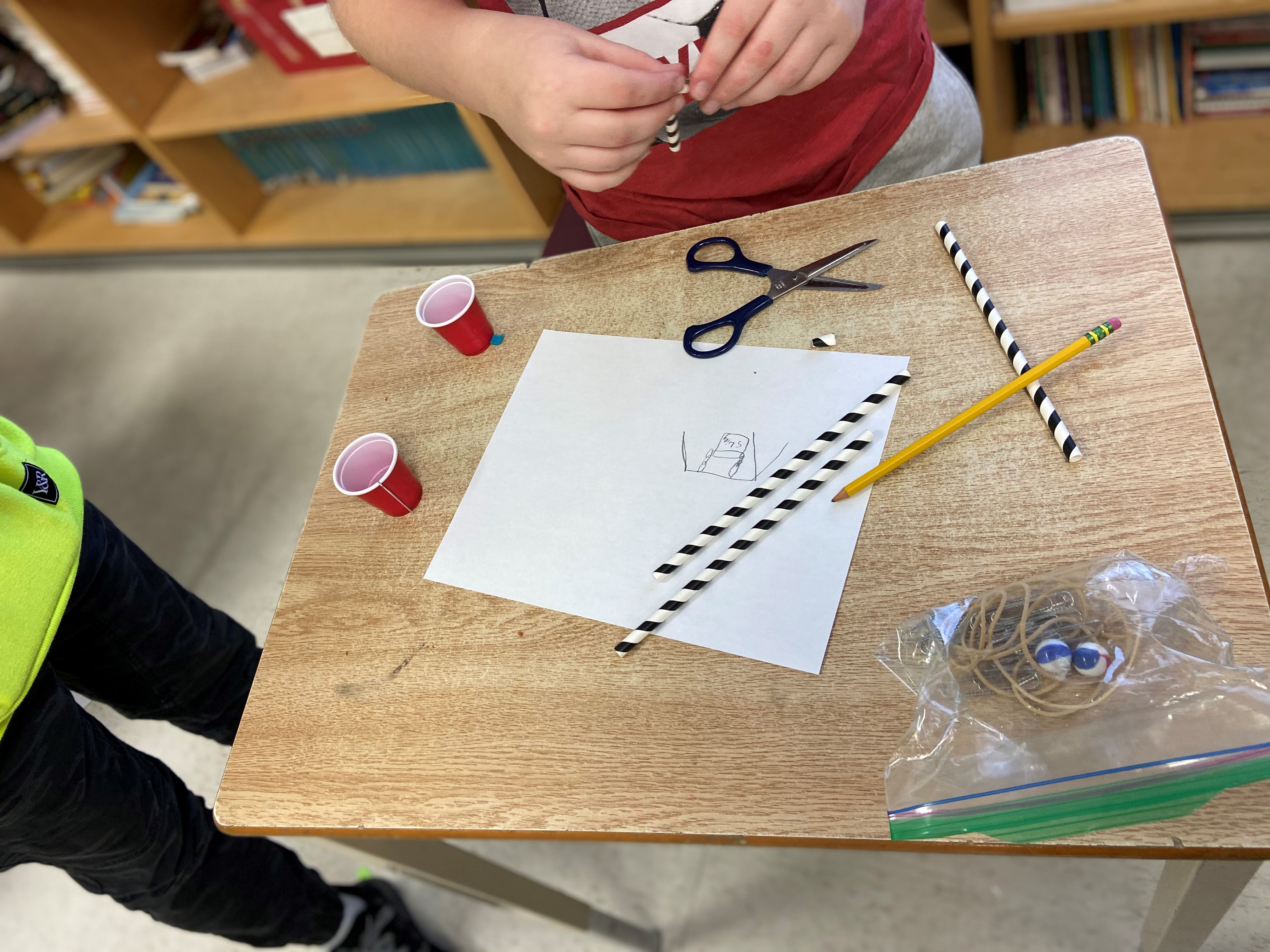
I recently worked with a grade 6 class for a STEAM challenge and brought bags of materials for each pair of students.  In the bags were: two tiny plastic cups, 10 jumbo paper clips, 10 small paper clips, 4 large elastics, 4 paper straws, 2 marbles and access to string and masking tape.  I showed the students the materials and gave them about 10 minutes to create a design.  The caveat was that whatever they created had to have some kind of function or movement.  They could cut or change the materials as needed and did not have to use all of the materials.   We discussed the different part of the The-Design-Process and made success criteria for the challenge.  The success criteria focused on communication, collaboration, critical thinking and problem solving.  It wasn’t about who build the “coolest” thing.  There was room to be creative, there was room to fail and there was room to improve upon the design and try again.

Their creations were amazing! Here are a couple of innovative designs that two of the groups created.  To my ultimate delight-the engagement was the same for all genders in our classroom.

STEAM movie

STEAM movie 2


Say Less, Ask More

Sometimes the smallest change can make a huge difference, especially in education. Things such as greeting students individually upon arrival at school can set the tone for the entire day.  Small changes in habitual behaviours can improve communication and relationships with students.

Over the last few months I’ve been reading the work of Michael Bungay Stanier.  Most recently I’ve been reading “The Coaching Habit: Say Less, Ask More and Change the Way You Lead Forever”.  I admit, that at first blush, it doesn’t sound as though this book has much relevance to elementary education.  However, as I was reading I kept making connections to communicating with students more effectively to encourage independence.  As learning becomes more inquiry based in many classrooms, teachers are having to move into more of a coaching role.  I think that the education sector as a whole has made some assumptions that teachers know how to be effective coaches and facilitators.  In my own teaching practice, there has been a huge learning curve.  Teaching through inquiry isn’t about leaving students to their own devices.  Students generally aren’t familiar with the curriculum and other than being children, they aren’t experts on child development.  Educators have to be guides for student learning.  But what exactly does that mean and how do we transition to this type of teaching?

For me the biggest change and challenge in becoming more of a guide in my classroom was talking less and letting the students do the learning. I am a problem solver, helper and rescuer and I’m sure many teachers can relate, which is why it is so hard to be quiet and back off.  I’ve also learned that asking questions might be easy, but asking effective questions is a skill for teachers and students alike.

So what did I learn from a “coaching” book that might help a classroom teacher? Keep in mind, these examples might be better suited for the older grades.  You might need to keep it a bit more simple for Kindergarten.  However, in most cases, better questions get better answers.  Here are some examples:

A student comes in from recess and is visibly upset.  Instead of asking, “What’s wrong? Did something happen at recess?  Can I help?”  Try asking just one question, “What’s on your mind?” and then be quiet and listen. The question “What’s on your mind?” is a focused question and invites someone to get into the heart of the matter. Sometimes all that is needed is a venting session and the child feels better.  You don’t always have to be a rescuer or problem solver. Most of the time, kids just want to be heard.

Normally in a situation like this I’ll ask, “Can I help?’ or “Would you like some help?”  However, the small change to “HOW can I help?” helps the student to articulate their request.  In addition, it gives them the opportunity to identify the solution and not have the adult jump in to solve things for them.

Tweaking the questions that we ask could improve communication and lead to more effective answers.  In addition, asking focused questions could empower students and lead to more independence. Michael’s work and questioning techniques are helpful for dealing with the people in your workplace.  You can sign up for Michael Bungay Stanier’s “The Coaching Habit” Podcast online and find other great coaching resources at Box of Crayons .